 |
|
[Page 8]
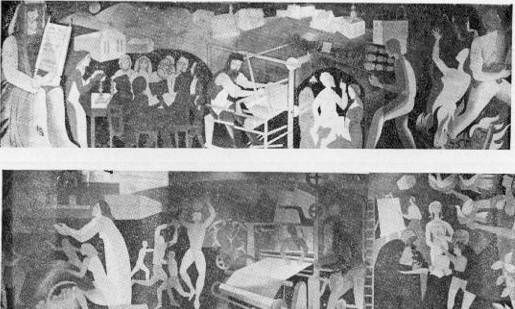
[ABSTRACT (from the Spanish Section):] This is a composition of six panels by the famous artist Manuel Kantor. They adorn our headquarters and represent the six stages of Jewish life and struggle. The author states that it is difficult to write about this kind of art, one must look and admire it.
|
|
(The author is Martin Bornstein's great uncle. Martin's grandfather Mendel Szczukocki is also mentioned in the article.)
In (the year) 1914 when I was a Bar-Mitzvah boy I began to work as a journeyman weaver for Moshe Eliezer Lefkowitz [Lewkowicz] (Vootl) and with that I was able to help out my parents [financially] a little.
As if it were today, I still remember that sad terrible fall. As a 13 year old boy, or youth, I did not precisely understand what as such is (the meaning of) war. I heard how older Jews spoke and commented about different things, which they alone did not properly understand. The air was full of fashionable words, such as: mobilization, offensive, strategic points, and a lot of similar words and meanings. Jews in the Bes Midrash [study house] continuously used to repeat that “Fanya Ganev must lose” * [“The Russian Thief must lose”], one carried around a hatred against Russia due to the pogroms and persecution – there was not a lack of motives for that hatred.
Immediately when the first Russian soldiers appeared in the town, mainly Cossacks, there began to occur in Belchatow robberies and stealing, and Jews were beaten without motive and without pity.
I remember still the episode when Cossacks came in to Helwik's, in to the beer brewery, they got drunk and broke everything that came in front of their hands. The biggest sacrifice was Itshe Meir Naparstek, who worked there. The Cossacks beat him with murderous blows and broke his hand and foot.
My father, who rented the field by Helwik**, had to run away and hide by a neighbor, Avramtshe Beirich's, and in this manner avoided getting beaten.
In haste the Russians left and Belchatow was occupied by the Germans, who fortunately were not the same Germans as those of the last world war [meaning World War II], and the Jews were able to breathe easier. In a short time around, the Russians once again came in to Belchatow. Bitter battles took place next to Bahrever [Barewer] mountain, not far from Belchatow. The Russian army was strongly entrenched there and the Germans were victims of a great certainty. The Synagogue, the Bet Midrash [study house], and the Gerer Shtibl [Gur Hasidim study house] were requisitioned and infirmaries were set up there for wounded soldiers. The fighting lasted a long time, till the Germans finally pushed out the Russians and put in their own military administration.
The first sacrifice of the new administration, was the Pollack Ribak who had disarmed two German soldiers during the times when the Germans had withdrawn, and for that said crime, the Germans hung him.
The Polaks for revenge informed on a Jew to the Germans, Hersh Laib Machabansky's son-in-law, that he had so to say telephone conversations with the Russians. The Germans carried out a search by the Jew, who dealt in old things, and they found some pieces of telephone wire. This was already sufficient that he was condemned to death, while this was considered maintaining contact with the enemy. After a strong intervention and effort from the Belchatower Rabbi, Reb Tzemach and the Evangelical Pastor (who was a straight out friend of the Jews), it worked itself out to having the sentence “revoked”, and that Jew was sent as a captive to Germany. After the war he returned home.
A short time passed and Belchatow was given over to the Austrian military commander, to administer in place of the Germans. One could live with them a little bit more in peace, without terror / fear, but there was not any way to make a living. The worst [situation] was with the weavers – and the mass [majority] of Belchatow Jews were still weavers. Other professions [trades] such as bakers, shoe makers, tailors, and so on had it easier to find a piece of bread [make a living], but for the majority of Belchatower it was difficult and bitter times.
In the year 1915 the military front estranged itself [moved away] from our home region and Belchatow was practically isolated from the surrounding world. Lodz for example, belonged to the German military administration and [in order] to travel there, one had to obtain special permission from the Belchatow town commandant, which was not always easy to obtain. Our Belchatow with her textile production, was completely dependant upon the great [large] Lodz, and not just economically, but all in all we were torn apart from the surrounding world. It was seldom when information [news] reached us about the goings on that were occurring in the larger world.
Not having looked [directly] upon it, still news from the [outside] world, also tore itself through to Belchatow. By us, in person, the social [communal] life in town revived itself. The Cultural Organization was founded under the auspices of the Bund, that as a forerunner of many years played an important role in raising and orienting Jewish youth.
The Social Organization was a warm corner and drawing place for the youth. I too, as a 15 year old boy [student] used to go in there to “warm up” and listen to a lecture from a local [home town] lecturer, or to a guest who was invited from time to time. The main leaders whom I remember in the Cultural Organization were: Abraham and Henoch Lieberman, Simcha Stadtlander, Yecheil Laibish Goldberg, Chatzkl Bierenzweig [Birenczwajg], and others who I don't remember any more. A nice and cultural dedication was carried out, around which was assembled the more intelligent and cultured portion of the Belchatow youth.
The economic situation however became more difficult and unbearable from day to day, and one was forced (drawn) to look for special ways out – and the said ways were to consent to allow yourself to go to other countries within the area that belonged to Germany. A group of young people signed up to go to work in Hungary. I was however too young and they did not want to take me.
At that time Mendel and Wolw Szczukocki, Abraham and Shalom Pukac, David Zylberglat, Yishaya Abramowicz, as well as a lot of others went away. Some of them were killed in the year 1918, in Bela Kun's army, taking part in the battle against the counter – revolutionary armies. In that fighting perished the Belchatow youth: Shalom Pukac and Przybilski.
In 1917 the resonance of the February Revolution in Russia arrived in Belchatow, and the news that the Czar had been dethroned. Later the news arrived, that the Bolsheviks took over the government, concluded a separate peace pact with the Germans, and declared the “Proletariat Dictatorship”, with the outlook of spreading it to the whole world.
The war ended – and it awoke the hopes for a nicer and better world, which regrettably did not come to be [pass].
Footnotes
* Fanya is a derogatory nickname for Russia. Return
** The author's father was Ire Laibish Zylberszac and he rented fields with orchards from which he harvested the fruit and sold it. Return
In Israel, they are building, or better yet, they have already built, a new place to record everything that is or was Judaism in the world, mainly in the last centuries.
Together with the institutions “Yad Vashem,” “Kibbutz Lohamei Hagetaot – The Ghetto Fighters Kibbutz,” the “Martef Hashoah” (the Cellar of the Holocaust), they made the “Bet Hatefutsoth” [Museum of the Jewish Diaspora], which describes all that the Jewish towns created in the diaspora (or galuth) during the last two thousand years.
In this sacred place, we cannot and must not forget the name of the village Belchatow! That is how our compatriots of Israel understood it, and how our companions of the United States, and how our friends of Brazil contributed, and this is how we must also.
Because the last sparks of those who knew Belchatow are being quenched, if we do not do it ourselves no one will replace us.
|
|
Edited by Jerry Liebowitz and Gloria Berkenstadt Freund [with comments in brackets]
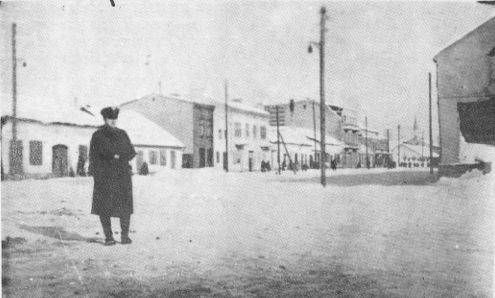
It is not an easy task to write about the memories of the former city where we were born, which was called Belchatow. All of us loved and cherished the small town. And even now – when this very shtetl no longer exists – we Jews speak its name with much love and great respect.
First of all, the shtetl itself. Until today, nobody has estimated or calculated the size and the amount of the population of Belchatow. It is assumed that Belchatow was like hundreds of other average small towns in Poland. Jews believe that the population in the shtetl itself had reached 6,000 souls, of which about 5,000 were Jews and about 1,000 were non-Jews. According to this same accounting, Jews in this shtetl should have a majority of councilors on the City Council and in City Hall – and perhaps the “President” of the town should be a Jew. But, because Polish “patriotism” could by no means permit this, a series of surrounding areas and even villages were “annexed” to the town. In this way, “Greater Belchatow,” which numbered 12,000 souls, was created – (incidentally, the Poles did this same thing with many an actual Jewish city and shtetl) – and the result was a Polish “majority”…
And the same could also be said of Belchatow's designation by many as a city, others as a town [shtetl], and still others as a small town [shtetele]. This came in large measure from the size of the city – but much more from the love felt for and carried by a person for this city (or shtetl).
And we possessed all of the qualities possessed by either a city, a town, or a small town. And it is not so easy to cite every type possessed by Belchatow and every episode. However, it can be said without hesitation that there was a rich Jewish life in Belchatow – certainly from a spiritual standpoint, which we could share (and did share) with all Jewish settlements in the former Poland.
The Jews did not have a very good financial and economic life in Belchatow. There were very few rich Jews, so few that they could be counted on the fingers of one hand... There was also a certain [portion] – a larger portion – that belonged to the so-called middle class, that one could say, in great measure, was a class without means. These were the merchants and craftsmen, who had the special problem of writing and erasing; that is, receiving a loan in one place in order to pay the debt in another place. They borrowed and planned, and their lives did not become easier.
The poor comprised the third – and largest – class. There was no lack of them in our shtetl, and they were the actual majority of us.
But that which we did not demonstrate in the economical realm, we did attain and demonstrate in the spiritual, social, and cultural realms. Thus, our shtetl stood on a very high level and could compete with the larger, and even the very large, cities of Jewish Poland. All the Jewish [political] parties and groupings, from the right to the extreme left, existed and were active in Belchatow, and [they] occupied an important place even outside Belchatow. In this regard, it is enough to say that the Jewish parties of Poland always had one or two members on the Central Committee [in Warsaw] from Belchatow, which means that we Belchatowers had an influence on the national policies of all parties.
Every political party possessed a large and rich library, which was used by many readers. Each party had free evening courses and also almost free public schools [folkshuln]. Belchatow had a staff of its own good speakers, yet, speakers from Warsaw and Lodz would also visit us.
All of the great Jewish artists and ensembles performed in the same Firemen's Hall, and their success was assured. In this way, we were visited by Morris Schwartz and his [theater] troupe, the “Vilner Trupe” [“Troupe of Vilna”], Ida Kaminsky [Editor's note: she was known as Ida Kaminska], Pesakh'ke Burstyn, and many others. And even though, as we stated earlier, the Belchatower Jews were not wealthy, they would find the means, and the Jewish artists and theater troupes had much success here.
Each one lived out his life spiritually and felt comfortable in his party, as in his home (and often even better than in his home); they would play chess or checkers there. “Kestel-oventn” [evenings with a variety of speakers and writers presenting their ideas, designed for people with little education] used to take place, in which they would pose questions and carry on discussions. They would hold readings and lectures on all kinds of themes, concerning both Jewish matters and also world-problems.
– All of this occurred before the German devils, with the help of the Poles, may their names be erased, destroyed everything.
Everyone made his living in Belchatow, not only for himself but also for another; one would go to another to ask for something for a third one – and when one could, one gave, and someone else would say something good about him. It was the same with spiritual food: someone who could [read] gave a reading, and the other listened to him. One taught another to read or to write; in turn he worked to earn money for bread, for himself, for his family, or for the poor.
I remember very well how my mother, of blessed memory, every Friday took a neighbor, Mrs. Shatan (Issachar Shatan's mother), or Chana the kasha maker, of blessed memory, and used to “go from door to door,” collecting products and distributing them to the needy homes. And therefore, the saying is correct, that “kol yisroel yesh lahem chelek l'olam habah” [“All Israel has a place in the world to come (Paradise)”].
And the Mishnah says about this, that the explanation of [the expression], “all Israel has a place in the world to come,” is that a poor man who is unable to give any charity will receive the same portion of Paradise as the rich men who can give – all Israel without distinction!
[15] And when Belchatow is remembered, one must exclaim: “Chaval el davdin v'lo mishtavchin” [“Woe to those who are lost and not remembered”] – woe to all of us that we are unable to bring back the thousands of Jews from Belchatow and the millions of Jews from Eastern Europe that perished [at the hands of the Nazis] before their time and did not live out their lives!
[Page 70]
[This translation is only of part of the article, pages 72-73]
|
|
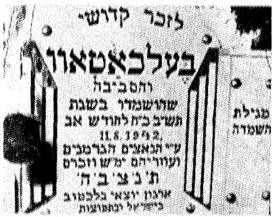
…. It was the 11th of August 1942, early in the morning. Belchatow was surrounded by the German police and S.S. people. They chased out the Jewish people from all the houses. At the Synagogue and at other places they made selections. About 80% of the Jews were pushed into the Shul and about 20% - who had a younger and physically stronger outlook were loaded into big freight automobiles and sent to the Lodzer Ghetto. All of the others who were together, the young and the old Belchatower, were taken away, as we later found out, to perish in Chelmno.
The village of Chelmno is located 12 kilometers from Kolo, on the way to Dobia, on the river Narev. In this village the Germans made their first gas chamber.
How did the Belchatower Jews perish in Chelmno? How did these mass murders of the Jewish people in general, take place in Chelmno? We found out about this from three Jewish gravediggers, who somehow, with great risk to themselves, did run away from this terrible place. Their report is published in a book under the name “In the Years of the Jewish Tragedy,” from which we bring here a lengthy excerpt:
“The arriving Jews were first taken into the church of Chelmno where they left their belongings. From there the Jews were taken to an old castle. This was a one story dilapidated place which used to be one time a palace that was destroyed in the First World War. On their arrival in Chelmno the Jews were handled delicately and mildly. They were helped coming out of the wagons and so on, with courtesy. Especially chanting was one older German of about 60 years of age.
“The Jews were taken into a barn which was surrounded by ladders, just like in a steam bath. From there steps led to an underground corridor where there was a ramp at the end. At the side of the corridor were basements. In one of these basements this old German gave a speech to the Jews.
“He told them they were being taken to the Lodzer Ghetto where the men would be employed in factories and in businesses and other kinds of work. The women would do housework and the children would be sent to school, but that they must first take showers in the local baths and would have to be disinfected, also their clothes would be disinfected as well. The Jews were then told to undress, the women except for their shirts, and the men except for their underwear. Valuable things were to be left so that they would not get spoiled. Finally they were all taken down the corridor to the ramp.
“Here there was a sudden change in the way the Germans handled them. With whips and rifle butts they chased and put the Jews into trucks. At this time there were scenes impossible to describe of the fear and the bewilderment of the Jews. They prayed in a very loud voice.
“The trucks were fitted out with metal on the inside and underneath pipes were installed through which they pumped in the gas. This gas machine was controlled by the driver. After they had pushed the victims into the trucks and closed the doors, the truck then drove about 7 kilometers in the direction of Kolo. This trip took about 15 minutes. Over there, left of the main road was the place they took them to.
“The whole place was surrounded by Police equipped with machine guns. Here was a grave from about 5 meters (or 16 feet) deep, and 1-1½ meters wide at the bottom of the grave and 5 meters wide at the top of the grave. Here were around 30 Germans and from 20-50 Jewish gravediggers dressed only in shirts. From the approaching trucks you could hear muffled shrieks and banging on the walls of the trucks, but in about 15 minutes everything fell silent.
“One of the drivers, dressed in a Hitler detachment uniform, put on a flashlight and looked through the small glass on the truck. When he saw that everyone was dead he drove the truck to the mass grave.
“The Commander of the S.S. then gave a signal to open the truck. Eight Jewish gravediggers started their work. Four threw down the dead bodies from the truck, two others threw them into the grave and two more, standing in the grave, put them around. Two civilian Germans again checked every dead body, ripping off rings from fingers, chains from necks, and pulling out golden teeth with pliers. The abused and murdered bodies were then laid out in the grave in a row, under the direction of the S.S. men who would point to these with a tree branch in his hand showing that the head of one body is to be placed at the feet of another body. Children were put in the empty spaces between. In such a layer about 200 bodies were placed, then earth was shoveled on top of this layer and then another layer of bodies was put in.…”
With such a gruesome and martyred death, together with thousands and thousands of Brothers and Sisters of our nation, also perished our Belchatower Jews….
|
JewishGen, Inc. makes no representations regarding the accuracy of
the translation. The reader may wish to refer to the original material
for verification.
JewishGen is not responsible for inaccuracies or omissions in the original work and cannot rewrite or edit the text to correct inaccuracies and/or omissions.
Our mission is to produce a translation of the original work and we cannot verify the accuracy of statements or alter facts cited.
 Belchatow, Poland
 Yizkor Book Project
 JewishGen Home Page
Copyright © 1999-2026 by JewishGen, Inc.
Updated 22 Nov 2008 by LA