 |
 |
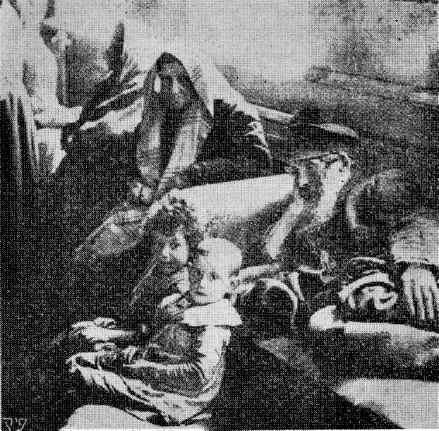
Accused of espionage, they are being taken to Dvinsk
Taking a rest break …
 |
 |
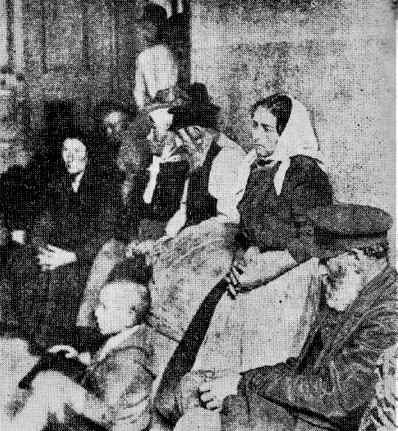
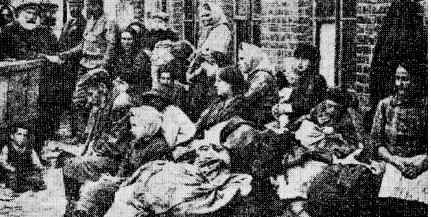
At a railway station
Waiting for a meal
|
|
[Pages 89-118]
Translated by Judie Goldstein
Revised by Sonia Kovitz
The eastern front cut through the Jewish Pale of Settlement. Evacuation of local industry to the Russian interior created severe unemployment and a desperate economic situation for Jews in the war zone. Thousands of Jewish families were ruined when towns and villages were destroyed by the fires and bombs of battle. A large segment of the Jewish population had no means of support and was forced to seek community relief. Jewish families of mobilized reservists lacked a breadwinner. Thousands of families that had survived on money sent by relatives in America, South Africa, Australia, and other places were left without resources.
Nevertheless, the Jews of Russia demonstrated great loyalty to their fatherland. They linked their fate to the strength of the country and together with all Russians, hoped that Russia's victory would bring freedom for all its peoples, including Jews. The Vilna [Jewish] community held a patriotic banquet where the following speech was made:
Our beloved country of birth, Russia, has been thrust into a difficult, savage war. Our fellow Jews throughout Russia are prepared to do their duty as citizens and many have volunteered to fight on the battlefields. We already have casualties among those who took part in battles. Our goal is to offer help however we can to the families left behind by the men who have been mobilized, and to care for sick and wounded soldiers. The history of wars of the past, and in this century from 1812 until now, demonstrates that our Jewish brothers have always fulfilled their duty as devoted citizens ready to sacrifice their lives on the altar of the fatherland. At this critical moment for our beloved fatherland we, the elected heads of the Vilna community—one of the oldest Jewish communities in Russia and the largest community that is closest to the front—take this opportunity to ask our Jewish brothers to help the wounded and the families of the mobilized reservists whenever possible. Without regard to religion or nationality we will extend care to all soldiers of the mighty Russian Army.”1At the beginning of the war Lithuania became a military camp for the Russian Army. Many among the Christian population agitated against Jews, although at the start, local authorities opposed these outbreaks of hostility. Local staff commanders warned the population that spreading false rumors and accusations and inciting hatred of minorities would be punished with the full force of wartime law. In Yanove [Janova] the local commander announced to the population: “Here there are no Jews and no Lithuanians, only Russian citizens.” In Ponevezh [Panevezys], local authorities warned pogrom instigators that if they provoked a Jewish pogrom, they would be punished according to military wartime law. Similar warnings were issued by civilian and military officials in Kovno Province and elsewhere.
In fact the incitement of the Christian population against Jews came from above. -The Commander-in-Chief of the Imperial Russian Army, Grand Duke Nikolai Nikolaevich [Romanov], was a stubborn reactionary like [his cousin] Tsar Nikolai II. The Grand Duke's Chief of Staff at General Headquarters, Nikolai Nikolaevich Yanushkevich, was a major instigator of aggression against Jews. Yanushkevich had long been using every possible means to expel Jews from the army in order to prevent them from “offending the Russian people.” Thus the war played into the hands of the Jew-haters. Soon after the war began, Jew-haters provoked the backward elements by saying that the Jews wanted Russia to be defeated. They convinced the rabble that Jews spied for the enemy, and called for revenge against the traitor zhids [derogatory Russian term for Jews] by spreading insane rumors such as: “Jews wear telephone apparatus in their beards in order to send war secrets to the Germans.” “Jews stuff geese with money and send them to the enemy”.
When the Germans captured the town of Raseyn [Raseiniai], the anti-Semitic newspaper New Time rejoiced that the former capital of Zamet [Zemaitija] with its large population of zhids had fallen to the enemy. The Storm, another Jew-hating newspaper, wrote:
Now is the right time, once and for all, to put an end to the accursed “Jewish question.” All Jews should be gathered together in a single place that is expected to fall quickly to the enemy so that they will be forever expelled from Russian soil. Later, when our military takes the place back, the zhids can easily be expelled across the border as “foreigners.”Military commanders under General Yanushkvitch [who had no field experience] thirsted for Jewish blood as a way to hide their own ineffectiveness and the many defeats at the front. Ignorance, laziness and thievery ruled the high command. Industry and transport were continually behind in fulfilling the needs of a nation at war. In the Mazur marshes of Eastern Prussia, the defeat of the Tsarist army under the command of Adjutant General Rennencampf was a great embarrassment to the honor of the Imperial Army. Staff officers had to find a guilty party, a scapegoat, and their malicious plan was to blame the Jews for the Russian defeats and withdrawals. They said that Jewish betrayal had brought the Germans into Russian territory. Their strategy accomplished its goal when the reactionary anti-Semitic Russian press informed the Russian populace that zhids were to blame for the untimely death of thousands of Russian soldiers. The press claimed that the fathers, sons and brothers of simple Russian people had fallen on the battlefields in vain, all because of signals and secret information sent to the enemy by zhids at the front lines. It was said that Jewish houses and synagogues had secret undercover telephone wires installed, and that the Yiddish spoken by Jews was in fact German, the language of the enemy. Even in the residential city of Petrograd, the main synagogue was searched by counterespionage agents ordered to find the telephone wires that communicated with the enemy.
The fumbling ineptitude of the Russian war leadership, incapable of assuring victory, was the fault of the Jews. Russian military preparations were ruined by Jewish traitors. It was also said that Jewish contractors supplied the Russian army with spoiled meat and expired canned goods that poisoned thousands of Russian soldiers. Another false accusation was that Jewish soldiers deserted their posts and sold to the Germans their knowledge of the locations of Russian strongholds. The reactionary Russian press invented many more false accusations against Jewish soldiers. Yet some progressive Russian newspapers wanted to disclose the falsity of the accusations made against Jewish soldiers. Boris Smoliar said he was sent to the front by a Russian newspaper to gather material showing that the Jews fought in the army as heroically as the Russians and that the stories of Jewish traitors and Jewish espionage were anti-Semitic old wives' tales.2
Grand Duke Nikolai Nikolaevich [Romanov] and General Yanushkevich ordered army commanders to use Jewish soldiers as the spearhead of every attack. During retreats, Jewish soldiers were to be in the last rows so that they would be first to take fire from the enemy in pursuit.
The false accusations against Jewish soldiers came at a time when the largest Jewish centers in the former Jewish Pale of Settlement, such as Vilna, Minsk and other cities, were learning of the casualties of the first Jewish cavalry, many of whom had their hands and feet shot off. The cavalrymen wore their Order of St. George crosses [Imperial Russian medal for bravery] on their ruined chests not as freeloaders or beggars looking for pity but as heroes and Maccabees who had fought on the bloody battlefields not only for “Tsar and Fatherland” but also “for the respect and honor of the Jewish people”! Therefore the enemies of Israel would realize that Jews are not cowards, Jews are not spies, and the Jewish soldiers at the front are no less heroic than the non-Jewish soldiers and often more heroic.3The Commander-in-Chief ordered the expulsion of 2,500 Jewish soldiers from the Kovno Fortress because he was certain that these Jews wanted to surrender the fortress to the Germans. As it turned out, the Germans took the Kovno Fortress a few days later with the help of traitors under the Russian Commander Grigoriev.
Jewish doctors, it was often written, could not be trusted to heal wounded Russian soldiers because they might simply kill the soldiers instead4.
The Jewish press was forbidden by military authorities to write anything about the “wise heads” in the “high windows” since the Tsarist army's repeated defeats were blamed on the Jewish press as well. The anti-Semitic campaign affected not just the commanders but the entire army. On all fronts, the ignorant Russian soldiers were continually told of horrible betrayals carried out by Jews.
The first Jewish expulsion in Lithuania took place in March 1915 from the shtetl Botki [Batakiai] near Tavrig [Taurage]. The Jewish population of 50 families was expelled within a half-hour's time because of a false accusation that the Jews had thrown a cat in the town's community well in order to poison the Christian population.
The conscience of nearly the entire liberal press in Russia and other countries was aroused over the false accusations and oppression of the Jews. The press also voiced fears that the Jewish expulsions might impede the future victory of Russia, but this possibility did not stop the high command of the Russian army from continuing to turn the local population against the Jews. The “tall staffpole with skinny feet,” as the Jews referred to Grand Duke Nikolai Nikolaievitch, was not concerned about the thousands of destroyed homes in Jewish towns and the banished, tortured, hanged Jews seen along the roads as the defeated Russian troops marched past.
In accordance with the decree of the Commander-in-Chief of the Army, all Jews living west of the Kovno/Yanove [Kaunas/Janova] railway line must be expelled, namely in Vilkomir [Ukmerge], Rogove [Raguva], Ponovezh [Panavezys], Posvol [Pasvalys], Salant [Salantai] and Boisk [Bauska]. These locations are to be included in the total count of areas from which Jews must be expelled. With regard to Jews living in areas currently occupied by the Germans, this order must be carried out as soon as the enemy has been driven out and our troops have taken over.With the stroke of a pen, this terrible decree uprooted a Jewish population of about 200,000 from settled areas and left them homeless and without possessions. With the expulsion decree, a sea of troubles poured down on the Lithuanian Jews, and at the same time newspapers published the fabricated Kuzhi story. The Kuzhi false accusation was intended to create a mood in the country that would make the mass expulsion of the Lithuanian Jews appear to be a necessity.Exiled Jews must settle in the following districts: Bakhmut, Mariupol, Slavyanoserbsk in Ekaterinoslav Province; and Poltava, Godiach [Hadiach], Zenkov [Zinkiv], Kobeliaki, Konstantinograd, Lohvytsya, Lyubny, Mirgorod, Romny, and Khorol in Poltava Province.
The deadline for the expulsion is the 5th of this month, May 1915. After the deadline, any Jews remaining west of the aforementioned railway line will be punished in accordance with wartime law. Police officers who do not take all necessary steps to carry out the aforementioned order will be dismissed from their posts and brought before a tribunal. Upon completion of this order that has been entrusted to you, entailing the general expulsion of Jews beyond the district borders, you are to communicate with me by telegraph by midnight May 5. Concerning the expulsion of Jews from areas now in enemy hands, I will communicate after the enemy has been driven out. Signature. 5
The “evil story” of Kuzhi [a village near Siauliai] was first published on April 30 in the form of a report by Corps Commander Fedotov to his superiors, who were “obliged to know” all the details of this large-scale Jewish betrayal. A description of the “terrible incident” next appeared in the May 5 edition of the northern army's Bulletin. The official report of the Kuzhi story read as follows:
During the night of 28 April 1915, Germans attacked the village of Kuzhi, located on the northwest side of Shavl [Siauliai], not far from Kurshan [Kursenai]. Several detachments of the 131st Piatogorski Infantry were in the village at the time. An event occurred that revealed the terrible betrayal of our army by the zhids. As our soldiers retook the village from the Germans, some German soldiers who had been left behind were hidden by the zhids in their cellars. Then the zhids set fire to the village by shooting, to serve as a signal to the enemy. The Germans quickly came out of their hiding places in the cellars and began shooting at the house where Colonel Dovilev was quartered. This unfortunate case shows the necessity of being careful in places previously occupied by the enemy where the majority of the population is Jewish.This absurd accusation soon appeared in the Government News, from which it was picked up by the Petrograd Telegraph Agency, and from there the story went to newspapers across the length and breadth of the Russian Empire. In large population centers the story was posted on walls in the same manner as a bulletin from the front. The editors of one newspaper who did not want to print the provocative false accusation were forced to publish it after receiving threats from the governors of preeminent regions.
The Kuzhi false accusation was aimed at inciting the ignorant masses against the Jews throughout Russia. In Tashkent a large, agitated mob gathered in front of the governor's palace to pray to their God to release the Russian army from the hands of the Jewish betrayers. The Kuzhi false accusation was so widespread by this time that the more honorable Christians did not speak up.
A commission from the Fourth Duma [semi-representative body], headed by the radical Duma Deputy Aleksander Kerenski, was sent to Kuzhi to investigate the entire affair properly. After a careful inquiry, Kerensky determined that the entire story from start to finish was a fabrication by the General Staff. It was simply a frame-up. The investigation revealed that only six Jewish families lived in Kuzhi and that a reconnaisance detachment of only eight Germans had been stationed there. The Germans requisitioned all the food in the village along with other items and then departed. Very soon after their departure a detachment of Pyatigorski [Russian] infantry arrived and its officers were quartered in the house of the Jew Kibart. The Jew warned the Russian officers that the Germans had left only moments before and were certainly still very close to Kuzhi, but the officers ignored the warning. At nightfall the Germans started shooting at the village and Kibart's house was set afire. The Russian officers and soldiers helped Kibart save some of his belongings from the flames. In the middle of the night, Kibart and the other Jewish families, carrying their rescued bundles, were accompanied from Kuzhi under military guard. Soon after that, the Russian army lost Kuzhi because when the Germans arrived in the burned-out village for the second time, they found it deserted.
The Kuzhi accusation served to justify the Russian authorities for expelling the Lithuanian Jews. The authorities found it intolerable that Jews and Lithuanians should live amicably side by side. Even the Russian government officials assigned to the Lithuanian area had been very friendly with the Jewish population. This was especially obvious in the smaller villages where the officials came into frequent contact with Jews and knew every Jew by name. The army headquarters' plan to create a rift between the officials and the Jews soon succeeded. The officials carried out the government order for expulsion with precision, unmoved by appeals, pleas and tears in the name of justice and fairness.
In Kovno Province alone, 160,000 Jews were brutally uprooted . All Jews, including women, children and the elderly, were now considered by the previously friendly Christian population to be spies and traitors. The fate of the Lithuanian Jews was even harder than that of the Russian Polish Jews, since the latter were allowed to travel freely wherever they wanted. Lithuanian Jews were classified as deportees by the state, to distinguish them from refugees who departed voluntarily to escape from the war. The majority of Lithuanian Jews were not allowed to travel freely. Rather they were given a certificate limiting them to certain specific provinces.
All Russia learned from these certificates that the Jews carrying them were suspected traitors and the cause of the defeats suffered by the Russian army. Authorities in the areas of the expulsions— as well as the local Christians, mostly Russians—were suspicious of every Jew. They believed that Jews wanted to sell Russia to the enemy and must therefore be immediately removed to a distant destination.
Many married men who had emigrated from Lithuania before the war, to the United States or South Africa, had left their wives and children behind. These women and children were now among the large numbers of Jews forced to leave Lithuania. All deportees from a given area had to travel as a group, the elderly from the old people's homes, the sick from the hospitals, the bedridden from their homes. In the old people's home in Ponovezh were 43 people, of whom the youngest was an octogenarian and the oldest was 99 years old. In Vilki [Vilkija] a dying Jewish woman named Vilenshchik was placed in a wagon and a few days later she died on the road. The husband of another dying woman, Pesye Fishelevich, went to beg the police to allow him to stay with his wife until her last breath, but the police commissioner expelled him, with his terminally ill wife left in the shtetl to die alone.
In Shavl [Sauliai], eight hours notice was given to the Jews to prepare for departure; in Vilkomir [Ukmerge], Ponevezh [Panevezys], Rogove [Raguva], Posvol [Pasvalys] and other towns, 24 hours notice was given. In Shavl, several days before the expulsion began, all young, healthy Jewish men were enlisted in forced labor gangs digging trenches outside the city. The officials deliberately did not inform the laborers of the expulsion decree while it going on in their absence. When the laborers returned to town, their loved ones were gone. As a result, members of many Jewish families of Shavl were separated for years.
The writer of these lines [Louis Stein] remembers what happened in his birth shtetl of Rogove [Raguva] on the day of the expulsion. It was erev Shavuos [Festival of Weeks marking the giving of the Torah] and we were preparing for the holiday. Official notices appeared in the marketplace announcing the evil decree. All of us were to be forcibly dispatched to Poltava, Ekaterinoslav, or Tavrichesky Provinces, without recourse. The turmoil and dismay were indescribable. The entire eve of the holiday was spent packing. Peasant wagons were rented so that people could leave the shtetl quickly before nightfall of the following day. My grandfather, sexton of the old Rogove synagogue, ran there first to rescue the Torah scrolls, which he wrapped and packed in boxes; then ran to the beys-medresh [study house] to rescue its Torah scrolls; and then he went in search of a wagon in which to transport them. Terrible panic reigned in our house. My two small sisters were sick in bed with high fevers and we had to rouse them. My mother wrung her hands and there was much lamenting, but laments could be heard coming from every house. Our family went to Trashkun to stay with relatives for the holiday and from there to Aniksht [Anyksciai], where we stayed until the end of summer, when the army carried out a pogrom there. My two little sisters, two and three years old, who endured our journey in shocking, unsanitary conditions without medical treatment, died soon after we arrived in Penza [about 900 miles east].
In some areas of Lithuania the local government carried out the order to expel the Jews on May 4 by allowing them to stay until the morning of May 5 before departing. In other places the Jews were driven out with great cruelty. In Velyun' [Poland], for example, the local police were in a fury. “Zhids, hurry up and leave! If there's any sign of you in two hours, all of you will hang.” In Vilki [Vilkija] police accepted bribes to allow the Jews until the evening of May 5, so they could pack more belongings to take with them. In still other places police treated the exiles with mockery and contempt, as if they were all spies and traitors. In Keydan [Keidaniai] the local government instructed the Christian wagon drivers to charge outrageous prices for driving the banished zhids anywhere. In Rumshishek [Rumsiskis], police forbade the peasants from renting their wagons to Jews. When some Jews managed to obtain wagons with drivers anyway, and the women, children, elderly and sick were already sitting in them, a callous policeman would approach and curse the peasants for agreeing to drive the zhid betrayers. The Jews had to get out of the wagons and leave the shtetl on foot.
By midnight of May 5, 1915, the eve of Shavuos 5675, no Jews remained within the borders of the areas required to be empty of Jews on order of the Tsarist High Command. Many banished Lithuanian Jews who did not manage to travel by wagon had to walk until, hungry and exhausted, they reached a train station, or larger Jewish center such as Vilna, in the Pale of Settlement. No announcements of displaced Jews searching for lost children and relatives were published in the Russian newspapers because the censor did not want the sad, true situation of the exiled Jews to be made public, because it would compromise the government and the military staff in the eyes of the world.
Anti-Semitic officials, entrenched enemies of the Jews, knew no shame and found various ways to show their hatred. Christian Sisters of Mercy stood at railway stations with arms akimbo, cold bloodedly watching sick and dying Jews being clumsily lifted onto trains by other Jews. In some places the exiled Jews had to come to a halt when hooligans jeered at them and scoundrels threw stones. Jewish homes and belongings were left abandoned in towns and villages, and families' shabby possessions were plundered by thieves. In some areas the police assured the departing Jews that their property would be protected from robbery in their absence, but such an occurence was rare. I know of such a case in Vilkomir [Ukmerge].
Prominent Russian merchants and manufacturers in Belorussia were distressed by the devastation of the Jewish communities in Kovno Province because it brought economic hardship to the entire country. They approached the Finance Minister [of the Russian empire] with their concern. The Finance Minister turned to the Minister of War—the highest military command, with supreme power over the country in time of war—and suggested allowing the Jews to return home. The Minister would not agree to the release of this worthless rabble because Jews were traitors and spies who had brought about many defeats. Intervention by the Finance Minister did not succeed.
On May 10, 1915, five days after the expulsions began, Commander-in-Chief Nikolai Nikolaevich [Romanov] informed the army authorities that the welfare of the general population would be endangered if the Jews were not expelled. He ordered that the expulsions should take place from one location at a time “as necessary.” This despicable so-called “Benefactor”also ordered that in the areas to which some Jews were permitted to return, the Jews must offer hostages to the local authorities. The hostages were to be chosen from upright fellow townsmen or religious or community leaders and would answer with their lives for the loyalty of the entire community. If any Jews of the community committed betrayals, the hostages would be hanged.
The taking of Jewish hostages to take responsibility for the behavior of the local Jewish population cost the Jews as much blood as at the battlefront. If any Jewish citizens departed [without permission] from a town, several hostages would be shot to death or hanged. Hostages were rarely released alive from the murderous hands of their captors. This supposed favor extended by the Commander-in-Chief provoked strong objections from the Jewish populace. The Ponevezh lawyer Naftali Friedman, Jewish Deputy from the 4th Duma of Kovno Province, wrote the following letter addressed to the Prime Minister of Russia:
As Deputy for the Town of Kovno, from which I was expelled, together with my Jewish brothers and sisters, I consider it my duty to report the following to his Excellency. According to the latest military decree, some banished Jews will be allowed to return to their homes (later it became known that the “permission” was no more than a false rumor) on condition that Jews in that residential area will offer hostages to the local authorities. You may be sure that the Lithuanian Jews will never agree to such disgraceful conditions demanded of them by the government. They would rather continue their wandering on the highways and in the freight cars and die from hunger rather than fulfill a demand that demeans their national and civil honor. The Jews have fulfilled their duty to the fatherland and will continue to do so. They will not be the victims of intimidation and no persecution will lead them astray. No persecution in the world would be powerful enough to force us to say “a lie is the truth” in order to confirm through our surrender the disgusting false accusations made against us. We Jews are considered more suspect of treason than anyone else. The condition to turn over live hostages to the authorities is against our national honor and we will not accept such a "favor.” So it is understood by all Jewish subjects and so also by myself.Rumors about permits to return home stirred the exiles wherever they were, but it soon became clear that not only would the exiles not be allowed to return, but that more and more expulsions of Lithuanian Jews were taking place.
On May 10 all the Jews of Tirksle [Tirksliai] were expelled in the course of three hours, and at the end of May – from New-Aran [Varena, Orany]. At the end of July 1915 all the Jews in Maliat [Moletai] in Vilna Province were given four hours to leave and were sent to Penza in sealed freight cars like convicts.
The majority of Jewish exiles were loaded into crowded freight cars that carried them [eastward] to the far side of the Dnieper River to the areas where they were required to settle. The railway officials were informed that these travelers were not refugees but exiled spies.. Therefore the special trains carrying the Jews passed most stations without stopping as the travelled into the interior of Russia. The railway administration treated the Jews with contempt. They locked the Jews from the shtetl Pasval [Pasvalys] into their freight cars for 10 days. By the time the cars were opened when the train reached Chernigov Province, everyone had lost consciousness, sixteen of the passengers had scarlet fever, and one had spotted typhus. This prison on wheels arrived in Zolotonosha in Poltava Province on May 12 and the passengers were ordered to get off the train with their baggage and wait on the station platform. The city fathers refused to allow them to stay on the platform, so the Jews had to crawl into the same dark freight cars again with their baggage. When the train started go in the direction of Kovno, the rumor spread among the Jews inside the cars that they were being taken back to their homes, but the train stopped in Novovileysk [near Vilna], made a turn, and set off on its previous route, but this time they were taken to Tavrichesky Province.
Many locations to which the Jews were sent protested that their towns were already overcrowded and there was no room for the exiles. The train cars filled with these unfortunate Jewish families from Lithuania were sent here and there, from one place to another. In mid-June 1915, two additional provinces became available for the Jews: Tambov and Penza.
The train on which the author of these lines [Louis Stein] traveled with his family went first to Romny in Poltava Province, but the city administration did not allow us to stay so we were sent to [the town of] Poltava. We were not allowed to stay there either. Representatives of YeKoPo, headed by the Poltava rabbi, the famous Rabbi Akiva Rabinovich zts'l [of blessed and saintly memory], met our train and arranged for us to get off the train onto the station platform for the first time. The committee distributed something for us to eat and drink, after which we were sent to Kharkov. Finally we arrived in Penza. When YeKoPo was unable to provide food or drink at the stations, many of the suffering Lithuanian Jews died as the trains traveled onward through Russia. Railway officials often did not allow YeKoPo representatives even to approach the trains that had stopped at a station until detectives had searched them and felt the food parcels to make sure no secret military orders were hidden in the food.
Black Hundreds6 sent by the government visited villages near the train stations and incited the ignorant peasants against the exiled Jews. Hooligans were positioned to throw stones into the open doors of the freight cars as the trains carrying the “Jewish traitors” passed by. Sometimes a rowdy village rabble would attack the train and rob the Jews.
In Potchep and Starodov in Chernigov Province, where a number of Lithuanian Jews had been sent, the Christian population refused to rent lodgings to the Jews and attacked and robbed them upon their arrival.
The wild Don and Kuban Cossacks [Russian army irregulars] practiced their special forms of cruelty and barbaric anti-Semitism. The Cossack batke-atamans [father-atamans] became enraged if any Cossacks paid for a product in Jewish stores. The Cossacks were ordered to take whatever they wanted. Military [Cossack] pogroms spread like wildfire in a forest. Numerous Jewish communities in Kovno Province suffered pogroms through the month of July.
On July 10, 1915, when the Cossack pogromniks arrived in Suboch [Subacius], the Jews ran from the shtetl but met up with a band of vicious dragoons [light cavalry] who kicked and beat them with murderous blows. A few Jews with large sums of money were able to pay bribes so as not to be beaten. The only Jewish family that remained in Suboch was locked in the local jail and the father was beaten badly and tortured. The Cossacks robbed and destroyed the shtetl Vobolnik [Vabalnikas] and violated the women. A large number of Jewish families, even the rich, had to depend on charity to survive.
On July 13 the Cossacks carried out a dreadful pogrom in Trashkun ]Troskunai]. Not one unbroken window pane remained in Jewish homes, not one Jewish store escaped being robbed. The women were violated. The Jews fell at the feet of the Cossack Ataman and pleaded for him to stop the pogrom but he coldly replied that his Cossacks will not pay attention to him. After the wild Cossacks had taken everything they wanted, they forced the Jews to leave Trashkun. The unfortunate Jews wandered around on the roads and through the villages and slept in the open. The peasants had been sharply warned not to allow zhids into their houses or to show them any pity.
The shtetl Vishinte [Viesintos], not far from Trashkun, did not escape destruction. There the Cossacks, after robbing the Jews of their belongings, set fire to the houses and left amidst the smoke. Soldiers in the company of their officers went from house to house dousing them with kerosene and gasoline and then lighting the fire. Legend has it that soldiers lit the fire at the beys-medresh twice, but the fire went out both times and it did not burn. Only on the third try did the fire catch, and the only beys-medresh in Vishinte went up in flames.
On July 14 a pogrom was initiated in Aniksht [Anyksciai] by an infantry regiment detachment. Not only did their commander not attempt to restrain and calm the soldiers, but he himself captured two Jews in the street, beat one of them horribly and then ordered him to beat the other Jew, an old man of 65. When the beaten Jew refused to carry out the order and would not lift his hand against the older Jew, the commander ordered his soldiers to take them both away and execute them. Jewish women who had hidden in cellars and attics were violated when they were discovered. Outside Aniksht the Jewish miller was murdered for trying to protect his wife and daughter.
Also on July 14 July the army pogromniks destroyed the Jewish shtetl of Dobeyk [Debeikiai]. They forced their way into the beys-medresh, broke the bima [raised reading desk] and tore open the Holy Ark. They dragged out the Torah scrolls, ran them through with swords, then spread the cut pieces over the floor and relieved themselves on them.
On July 23 the storm of pogroms moved to Vabolnik [Vabalninkas] where the wild dragoons violated a fourteen-year-old Jewish girl.
In Rakishok [Rokiskis] the pogrom began on July 27. The majority of Jews had already left the shtetl on the advice of the local police commissioner, who had learned that a pogrom was in the offing. The wealthy Jews of the shtetl hid their most valuable articles (gold, silver, and better utensils) in a courtyard cellar of the local priest, along with all the Torah scrolls. The Cossacks found the hiding place, which the priest's servants had revealed, stole the valuables, violated the Torah scrolls, and then destroyed them.
In Shimants [Simonys] the army warned the peasants not to hide any zhids in their houses. The peasants were told that any who ignored this order would be punished by having their houses set on fire. In Vidz [Vidzy] about 65 families remained in a desperate state. Out of fear of the Cossacks, the Jews locked themselves into the school building. Around three o'clock in the morning the Cossacks broke into the school, took all the men out naked and murderously beat them. The women, young and old, were violated in front of their husbands.
The famous Jewish lawyer in Russia, the late Oskar Gruzenberg, wrote in his World War I memoirs:
Jews were considered outside the law. They were robbed and murdered and made the target of false accusations, for which they suffered punishment. Here is a characteristic case: in the Baltic region, Jewish parents brought a complaint to a Russian high commander, providing the names of persons who had violated Jewish girls. He gave them this insulting answer: “So, now all the old Jewish prostitutes throw the blame for their sins on the army!”7
After the fall of Kovno in 1915, the entire northwestern region of Russia presented a savage picture of “blood, fire, pillars of smoke” [Joel 3:3]. The Germans pressed the retreating Russian troops, who were last to withdraw. The Russians, trying to conduct the retreat in an orderly manner, stopped only for short periods . In some areas they ordered the local population to dig trenches; in others, they ordered everyone to leave the area. The Russians burned down entire villages and towns to ensure that no food or winter shelter would remain for the Germans.Both Jews and non-Jews were among the wandering masses. Abramovicz wrote that “the very air around the Jews was filled with hatred.”At night the red skies were terrifying. The Jews, their wagons packed with household goods and bundles, travelled the roads mixed in among the Russian army. The cattle they had with them bellowed with hunger. The thunder of cannon fire and rifle shots combined with the laments of women and children made a demonic music.
Nobody had the slightest idea where to go or what to do. At first people thought they could hide off the beaten tracks for a while, in marshes, forests and valleys. They figured that after both armies had passed by, they could just turn around and go home. This was a mistake because often around the very next bend, where even in the best of times people could neither walk nor drive, a stubborn battle might be raging.
The local population was “off the bridge and in deep water.” There were three groups: the Germans; the Russians; and the homeless, who were waiting everywhere, not knowing what to do or where to go. At night sometimes people would stop in fields, meadows and forests to dig potatoes. They were almost never under a roof. Unfortunately rain was often pouring down. Infants were soaked to the skin. Diseases began to spread, although it is worth noting the psychological-physical phenomenon that in such conditions as these, some sick people forgot their illnesses and, with a few infrequent stops, did not feel the great distances and would simply walk on and eat whatever there was—there should only be something!
Accused of espionage and friendship with Germans, Jews were persecuted again and again. According to the rumours, the Cossacks caused the Jews even greater torments. Reality gave enough evidence of it. The Christians shunned the Jews on the road, even their good acquaintances. They did so, they claimed, because if a Jew were to be found with a Christian, they all would be shot immediately. Jews were unable to find a night's rest in a peasant's home in a village so they halted by themselves and slept in the fields and meadows. It must be stated that there were exceptions and some Christians were very friendly to the homeless Jews.Abramovicz describes this interesting situation that he heard about:
Early in the war, the Jews of the shtetl Visoki-Dvor had sent a humble telegram to the Tsar wishing him victory over the enemy. The rabbi received a thank you by way of the Governor in the form of an official lettert. The rabbi framed it and hung it on the wall. When officers later came and took over the rabbi's home, the rabbi pleaded with them not to use one of the rooms. For having such chutzpa, the officers decided the rabbi deserved a stiff punishment, but when it turned out that the rabbi was referring to the room where the Governor's letter hung, the rabbi's request was granted. These Jews were not forced to leave Visoki-Dvor as they had originally been commanded, but nevertheless they departed from the shtetl quickly. The official letter was again of help to them on the road.The Germans arrived in Vilna on September 18, 1915, Yom Kippur. Abramovicz relates that on the second day after their arrival, a multitude of displaced Jews ran to Lukishki [Lukiskes] Square, where travel certificates were being distributed that allowed people to return home.It was a sad situation for Jews who had already been exiled once and were now expelled a second time from the villages where they had settled. Some took wagons filled with merchandise and household goods to neighboring villages. Running for the second time, they were unable to take everything with them so they concealed merchandise and good quality articles in cellars or buried them. When discovered, these items aroused indignation: “It is being hidden for the Germans”.
In the last hours before departure, the army became entirely lawless. No power in the world, even with the best of intentions, could have ended the pillaging, especially when it had to do with Jews. Even though the “Jewish enemies of the fatherland” were being expelled, it was still considered a good deed to take revenge on them.
In one shtetl there was a brick cellar where Jews tossed all the belongings that they could not take with them. Also some Jews who were going to stay in the shtetl hid there. It was shabbos. Germans were on the outskirts of the shtetl and shooting broke out. The Jews needed a minyan [prayer quorum] so one of them left the cellar to search for a tenth man. A Cossack saw him and discovered the cellar with live Jews! “Aha, a gang of Jews who prepared all these goods to welcome the Germans!” The belongings were quickly loaded onto military wagons and the Jews were pulled from the cellar and taken outside the shtetl to be shot. Their hands were bound and they were already reciting the vidui [confession of sins before death]. Suddenly a heavy assault by the enemy began. The Cossacks decided not to carry out the sentence—they fled, throwing aside bag and baggage. The Jews recited the traditional gomel prayer of thanks [for surviving danger] as they ran away under the hail of bullets”.
The considerable number of Jews who reached Vilna spent many months spending the night in community buildings or with friends and relatives, where they could at least find a place to rest their head.
The tens of thousands of people could not be accommodated in just a day or two. Everyone was pushing and shoving, and the newly formed militia was unable to restore order. Many people gave up hope of getting a permit and began to set out for their ruined homes without one. The certificates included the statement that neither the horses nor the possessions of people who were homeless could be requisitioned.What did the Jews find in their shtetls? How did they feel under the difficult German occupation? It was not hard to find housing, some kind of shelter to settle in, because the shtetls were deserted. Everyone sought a hearth of his own, but there was no end to the poverty. People were dragged by the Germans to forced labor. German commanders put their dirty mitts on everything and permissions were required for everything..Officers wanted pretty Jewish daughters to come to them to get the permissions. Jews struggled tooth and nail against insults. The Germans' intention was to remain and rule. They wanted the friendship of the Lithuanians and of Jews and proclaimed that they offered salvation for both. They came to Lithuania with the slogan “Liberate Lithuania” but in fact they requisitioned everything they could from the peasants. In the desolate towns and shtetls the Germans also took everything they could from the Jews, right down to the doorknobs from the doors. The few Jewish returnees lived in want and fear in the hands of the enemy.The roads were flooded with German troops who were setting out after the Russians. The German horses who had endured endless rapid marches were exhausted to the extreme. For the local population it was a shock to see these poor horses in comparison with the well-fed horses of the Russian military. On the road the Germans exchanged horses with people returning home and in exchange gave them carcasses, or simply took the horses outright.
Dead soldiers lay along the roads and in the fields, unburied. The sight of them threw the people returning home into a state of terror. Towns had been looted and set afire, fields trampled, but a few potatoes remained in the fields. That year there was an abundant potato harvest so people survived on potatoes on the way home and after their return.
The Jews wandered past estates large and small that had been abandoned along with cattle and fowl by their owners. Returnees found only piles of bones. The Germans had eaten everything on their way to fight the Russians. The courtyards and inns that had not been set afire lacked windows and doors, and the furniture had been burned.”8
Tens of thousands of people who had been expelled from their homes in Kovno, Vilna, Grodno, and other the [western] provinces were scattered over the length and breadth of Russia from Moscow to Irkutsk. After long wanderings these unfortunates arrived hungry and sick in Okhtyrka [Sumy Region, Ukraine], Rybinsk [Yaroslavl Region, Russia], Penza [Russia], Tambov [Russia], Yaroslavl [Russia], Ekaterinoslav [Dnipropetrovsk Region, Ukraine], Samara [1935-1991 known as Kuybyshev, Russia], and other Russian cities. The local Russians were friendly and took in the homeless Jews, ignoring the poisonous rumors being spread about the “Jewish traitors and spies.”The well-known Jewish educator Moshe Krol wrote:Soon after the arrival of exiled Jews, representatives of the Hevra Mefitsei Haskalah [Society for the Promotion of Culture Among the Jews of Russia] would organize a public school kindergarten. By the end of 1915, virtually no town or shtetl [in central Russia] lacked a Jewish public school. Prior to 1915, in a city such as Penza in the Volga region, newly arrived Jews would have been taken to jail directly from the station, since Penza was outside the Jewish Pale of Settlement. After 1915, Penza had a homeless Jewish population of 12,000 and three public schools, a kindergarten, a dormitory for orphans, courses for grown-ups, and teaching workshops.”9
Early in the war, waves of displaced Jews, expelled from their former homes on the western front, financially ruined and spiritually broken, reached Irkutsk Province in Siberia. Thousands of innocent people, including many elderly and women with children, were under suspicion of espionage. Something had to be done for these unfortunate, sick, half-crazed exiles. They had to be clothed and kept from starving to death.At that time even Moscow with its many church steeples was a whirlpool of Jewish exiles. They did not meet with hostility from the Muscovites, but unfortunately the very opposite took place in the case of Moscow's privileged Jews, merchants of the first guild. Author Daniel Czarny wrote that the Jewish upper crust of Moscow had “no money to spare” for the refugees and wanted them to be sent as quickly as possible to the central provinces of the Volga region.Their needs were so great that one could not even think of sending them elsewhere. The Jews of Irkutsk accomplished more for them than was even thought possible. They organized kitchens within Irkutsk and on the nearby roads along which the refugees travelled. Medical help was organized. Warm clothing was supplied because it was already winter in Irkutsk and there was a deep frost. The Jewish youth of Irkutsk devoted heart and soul to this work and the YeKoPo [Jewish Aid Committee] worked without rest to meet the needs and relieve the sufferings of this enormous number of people.10
Nevertheless, many Jewish refugees managed to settle in Moscow. They banded together on their own in the poorest and already the more or less Jewish quarter. The privileged Jewish residents feared an expulsion of all Muscovite Jews, but the refugee element was so strong by then that the Tsarist government could not regulate the Jews or keep them in check. Moreover the refugees included some people of means who were not a burden to any relief committee.11The writer of this account [Louis Stein] ended up with his family in the city of Penza. I can tell you that thousands of Lithuanian Jews settled in a former Jewish public school building and in several unfinished barracks beyond the city limits. There was almost no heat and for meals we had to trek as a group a long distance across the city to a public kitchen opened by the Penza YeKoPo. Because of the dirty, crowded barracks, hundreds of Jewish families wanted to leave Penza, so they let themselves be banished to the Ural region, and some were sent even farther – to Siberian cities. The Siberians, by the way, were kind to the Jewish refugees, and the established local Jews there had already made arrangements to receive them.
In Penza, epidemics broke out among the unfortunate refugees. During the difficult winter of 1915-16, the new Jewish cemetery filled up as the Angel of Death reaped right and left. There was hardly a family from which death had not stolen one or more members. Later, when most of the refugees had learned better Russian and found employment, their situation improved. Barracks emptied as little by little people settled down and began to earn, some in government and some in business. Their lives stabilized and became more normal. People began to gather in private homes. Craftsmen opened workshops and took Jewish boys and girls as apprentices, just as they once did in the little Lithuanian shtetls in the good old days. In addition to the material improvement, there was also great improvement in the cultural and social domain. Like mushrooms after a rain, groups were founded, mainly among the Zionists, both left and right. Libraries, reading rooms, dramatic circles were organized; charities were formed; people got married. The uprooted Jews began to put behind themselves their wanderings and troubles, and waited only for a time when real peace would come.
Jewish cultural and community activists, as well as most former party leaders, looked to the prospect of a future Jewish national autonomy, which was the new ideal of the public intellectuals. People were simply drunk with the possibility of being able to move freely throughout all Russia and of carrying culture to the Jewish masses from one end of Russia to the other.All of this happened during the so-called honeymoon of the February Revolution, but as fate would have it, this joyous atmosphere did not last long. New grievances filled the air. Exhausted, hungry masses demanded their due—Bread and Peace. This slogan appealed to millions of soldiers and civilians weary of war. The Kerenski government was replaced by the Bolsheviks after a fierce and bloody struggle during the “ten days that shook the world” [the October Revolution]. With the new Bolshevik government came the promised peace, with the signing of the Brest-Litovsk Treaty.Prospects for better times opened for Lithuanian Jews in the towns along the Volga. People baked and sold Jewish bread, prepared stuffed fish and delicacies such as teyglakh, blessed the candles, celebrated bris ceremonies, planned new Jewish cemeteries, assembled minyans, opened Jewish libraries, blessed the new moon, and celebrated tashlikh12 on the banks of “Mother Volga”.13
Most of the displaced Jews in Russia suffered the full horror of the Civil War in 1918, 1919 and 1920. Many died in the epidemics that broke out in the hard, bitterly cold winter of 1919. Hunger ruled the country. In heavily Jewish-populated areas of southern Russia, where a significant number of Lithuanian Jews had settled, many Jews were murdered by White Guard bands set on destroying “Jewish Bolshevism”.
Peace between the Lithuanian republic and the Soviet government was concluded on July 12, 1920.. A clause in the peace accord, added upon the intervention of the Jewish National Council in Lithuania, stipulated that the Soviet government was obligated to transport to the Lithuanian border at Soviet expense.all those who stated that they were citizens of the Lithuanian republic and were ready to return to their former homes.
In August 1920, long trains carried Lithuanian Jews back to their homeland of Lithuania. Yet even long before this, some Lithuanian Jews had already returned by various means. They set out under G-d's care, on their own and often illegally. Some were caught at the border and sent back into exile.
Part of the generation that had grown up in the years of war and revolution remained in the USSR. They hesitated to take up wandering again to return to destroyed and ravaged towns, by now overgrown. Others longed for their own house and garden again and their former heymish lifestyle. The thought of traveling in a democratic Lithuania brought joy and courage to these refugees. They wanted to help build a Jewish national autonomy.
A hundred thousand Lithuanian Jews returned from the Soviet Union. Together with the Jews who were already living in independent Lithuania, they formed a community of a 160,000 Jews.
|
|
|||
Accused of espionage, they are being taken to Dvinsk |
Taking a rest break … |
|||
|
|
|||
At a railway station |
Waiting for a meal |
|||
|
|
JewishGen, Inc. makes no representations regarding the accuracy of
the translation. The reader may wish to refer to the original material
for verification.
JewishGen is not responsible for inaccuracies or omissions in the original work and cannot rewrite or edit the text to correct inaccuracies and/or omissions.
Our mission is to produce a translation of the original work and we cannot verify the accuracy of statements or alter facts cited.
 Lita (Lithuania)
 Yizkor Book Project
 JewishGen Home Page
Copyright © 1999-2026 by JewishGen, Inc.
Updated 2 Nov 2020 by MGH