 |
|
|
[Pages 85-87]
Donated by Esther R. Buchsbaum
Edited by Hannah Kadmon The free winds of change that had blown in Russia in the beginning of the 20th century had also reached the small town of Horodetz, but, in a small way. The reason was plain. There weren't any factories in Horodetz, and consequently the working class didn't exist. There were a few hired workers in town: at the men's and women's tailors, the shoemakers, carpenters, and smiths, where there were one or two workers. The owners worked together with them from morning to night.
According to the system of that time, they used to hire a worker for 1 year or 3 years, with meals and a pair of work boots (at the shoemaker) or a suit (at the tailor). That way, the worker became a son of the house like their own child. The worker used to also do housework like taking out the slop buckets or taking care of the owner's children. So the owner was not an exploiter according to the modern way of thinking. Many times the owner had to use his wits to get the few rubles he needed to pay his workers.
The only true worker who understood the revolutionary movement in Horodetz, and did everything he could to advance the revolution, was Feishe, Yankel Rosenbaum's son.
|
|
Feishe had been a shoemaker hired by a landlord who was a shoemaker in town. He was a true proletariat;.a son of generations of “horopashnikes”, that is, people who lived by the labor of their own hands. He was ready for anything. He wasn't afraid of anyone, not even a police officer (a uriadnik) or the priest.[1]
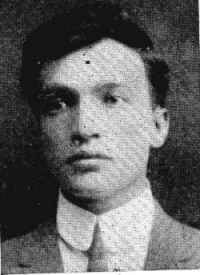
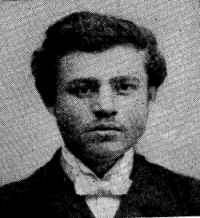
Potentially the Horodetz workers were ready for revolutionary work. They, however, lacked organizers. But this element was soon to come to Horodetz in the form of two young men, Avraham, Chaim Hersh Nadritchni's son and Itche, Shiah Farber's son, who had studied in Pinsk. During Passover vacation in 1905, when they came home for the holiday, they took it upon themselves to revolutionize the Horodetz workers.[2]
|
|
|
|
Avraham and Itche were very close to members of the S. S. party. [in Yiddish: ס.ס] This party was a mixture of Labor Zionists and of Territorialists. In 1905, Pinsk was an important place in the S. S. movement.
Soon Avraham and Itche came to understand that the world is not only for Jews. There were also gentiles who had to be pulled into the cause. That was a hard piece of work and also dangerous. You don't play around with gentiles. Finally, they did organize a large group of non-Jewish youth. For this, they received high praise from Vanya Sverdiuk, the younger son of Maxim Sverdiuk, a Horodetz gentile, who was very wealthy and a secretary of the village council.
When they invited Vanya to address a gathering, he quickly accepted. But, because he was not a speaker, he suggested that he would read out something appropriate. The gathering met behind the sluice gates of the river. The meeting was a great success.
Avraham and Itche were dissatisfied with this reading-out. They approached people directly, personally. They brought proclamations. One of the gentiles hooked up his horse and wagon and both organizers put on gentile clothes. Feishe had made glue (pap). In the middle of the night they rode around the village neighborhoods and glued the proclamations on the crosses which stood at each end of the village and on the offices of the A. D. Gordon Zionist organization. The neighborhood talked about this action for a long time.
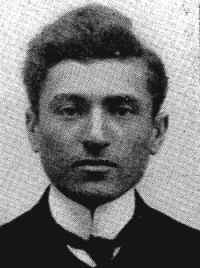
A little later, Aaron Karlinski joined the two organizers. He was the son of Mottie Hillel Karlinski, one of the real big shots from Horodetz.
Aaron was a Zionist who was pulled toward practical and cultural work. Through his initiative were founded free evening courses in which one could learn to read and write Yiddish and Russian. Naturally, those who were learning were mostly girls since the boys had already learned in Hebrew school (cheder). All the poor seamstresses studied there. The teachers were Ruhama, daughter of Isaac Israel, and Maita, daughter of Shimon Isaac Glantzer.
Aaron Karlinski had also dreamed of founding a cooperative in Horodetz. His argument was as follows. In Horodetz, many young women loiter without a stitch of work. Therefore cooperatives have to be organized, so that the Horodetz folks can become productive.
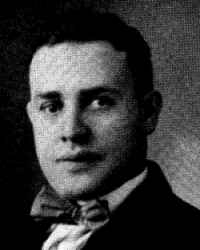
Very often the Pinsk Central Committee of the S.S. sent agitators to Horodetz. One of these young men was the 18 year old Aaron Asher Weinberg who, in 1906, was a traveling agitator. He is now the current New York advocate and Labor Zionist worker.
The first lecture which Aaron Weinberg read in Horodetz was in a grove behind the brick making factory. He lectured about historical materialism, that in essence must lead to territorialism. That was on a summer Sabbath. On that Sabbath all the youngsters - the worker's children and the employer's children - disappeared from the village. Fathers and mothers ran around the village wondering what had become of their sons and daughters. No one realized the reason for this disappearance. In the evening, when the young people finally came home, not one of them was punished.
The second lecture which Weinberg gave in Horodetz was about the concentration of capital and its leading directly to materialism. I think that the second lecture took place in Chana Pelte's house. This lecture made a big impression on the listeners, whether because of the rich topic or because of Weinberg's outward appearance. He had grown a patriarchal beard (for various political reasons).
Besides the S.S. being in Horodetz, there were also the Bundists, but they were a small group. The Bund, whose program was to nurture a Jewish working class, had, as was pointed out before, no working class in Horodetz to work with. That's why the Bund did not have a future in Horodetz. It wasn't entirely unrecognized though. It called out strikes and campaigned for fewer working hours, better conditions and higher wages, similar to the program of the A.D. Gordon Zionist group.
The speaker for the Bund was Jeremaiah Aaron, son of Asher Rudetski, who was a land owner and a rich Jew. In addition to the practical revolutionary work, daily educational-work was required. This enlightening work could not be done adequately by either a visiting or local lecturer. For this task, a library was organized which was filled with Yiddish books with a socialist orientation by authors such as Karl Marx, Kutski, and A.D. Gordon. The library was kept in the home of Shlomo, son of Moshe Burstein. Shlomo was also the librarian. Sadly, the library did not exist long because, little by little, the readers kept the books for themselves in their homes.[3]
|
|
By the end of 1906, the important members and leaders of the revolutionary group had gone away, some to America and some to Warsaw or other towns. With their departure, the revolutionary spirit also drifted away and new winds started to blow in the village.
Footnotes
Comment by Hannah Kadmon:
The (ס.ס) S.S. party mentioned in this article deserves some clarification.
In the conference of Poalei Zion in Minsk, 1901, the following issues were disputed: the linkage to Eretz Israel, the connection to the International Socialism of non-Jewish workers, and the connection to the Russian revolutionists. In 1905, following the Uganda Plan presented in the 6th Zionist Congress, the Territorialists (those who wished for a territory for the Jews not necessarily in Eretz Israel) withdrew and founded the ס.ס (S.S) The Zionist-Socialist Workers Party. The initials should therefore be Z.S. rather than S.S…
|
|
JewishGen, Inc. makes no representations regarding the accuracy of
the translation. The reader may wish to refer to the original material
for verification.
JewishGen is not responsible for inaccuracies or omissions in the original work and cannot rewrite or edit the text to correct inaccuracies and/or omissions.
Our mission is to produce a translation of the original work and we cannot verify the accuracy of statements or alter facts cited.
 Gorodets, Belarus
 Yizkor Book Project
 JewishGen Home Page
Copyright © 1999-2024 by JewishGen, Inc.
Updated 3 Mar 2011 by MGH