[Page 351]
Communal Directions (Aims)
and Institutions
[Page 353]
About Shmuel Goldberg
by Rafal Mahler
Translated by Hinda Jacobs
Edited by Renee Miller
The title and the first page of the booklet about the Jewish school of education. Speech by Shmuel Goldberg given before the commercial union in Sandz in 1896 (one year before the First Zionist Congress)
Shmuel Goldberg, one of the wonderful pioneers of Zionism in Galicia, a son-in-law of the Rabbi Rzepniki, a resident of Grybow, distinguished himself as well with his thorough Jewish and secular education and with his spirited jokes and humor. His witticisms and anecdotes were popular in all of Sandz and surrounding areas. He was faithful to Zionism with all his heart up to his last years. With the pleasure of a child, even in his very old age, he would go along on the Hashomer Hatzair outings [(Hebrew - “The Young Guard”) Marxist Zionist youth movement, founded in Europe in 1916, to prepare Jewish youth for kibbutz life in Israel. In addition to Zionism, its ideology meshes Jewish culture with scouting and youth values- {The Encyclopedia and Dictionary of Zionism and Israel}]. His nephew Eliezer Riger was one of its founders.
We received this rare booklet thanks to the extraordinary kindness of Eliezer's brother, the splendid pedagogue, Saul Riger (of blessed memory)
R. M.
[Page 354]
How Kheyder-Yingl
[Boys from Religious Grade School] Became Zionists
by Kalman Mahler
Translated by Hinda Jacobs
Edited by Renee Miller
This happened in 1900. A group of kheyder-yinglekh, in their Bar Mitzve years had an association called
“MShivas Nefesh” [Restoring the Soul]. The purpose of the association was to help the boys who were “eating days”. These were young poor boys from the area who were studying in Sandz. They were supported by the benevolent businessmen and housewives who would each feed them one day a week. There were also some who used to invite the boys for Shabes or holidays. My grandfather, Reb Yoske Mahler was one of these young men who ate once a day. Quite often a young man would miss a day “in the week and had to be helped”. Among them were good learners, some proud, some bashful. They used to be given food secretly.
Our meetings used to take place in the Khevre-Shomrim Shul. Gershon Weinberger was the recording secretary. There also was a treasurer, one of the young men. He would charge some interest for the alms given and would give a receipt to each recipient. The trustees were selected by election and on the day of the election, our teacher Reb Khanina Falex gave us a free half day.
Reb Khanina, who also had a nickname “Zhona” was a good Gemore teacher. In his class we had to get up very early and study aloud early, but – “I recall my sins” – I was a lazy at studying and getting up.
Our rebbe had a beautiful handwriting and when my uncle Reb Eliezer Mahler wrote something, he would give it to Khanina to rewrite it for him. Khanina warned Ben-Tsion Krisher and me not to tell anyone about it. He could lose his position as teacher if anyone found out that he was writing for Eliezer Mahler, the heretic…
In 1901 I was already a student of Reb Sholem Reb Baruch's [Sholem is the son of Baruch]. This kheyder [school] was in the house of Reb Yitzhok Tevia, the “Divrei Chaim's” son-in-law. The saint's besmedresh [house of prayer and study], the Orthodox synagogue was also in that house. Also the kheyder of Reb Sholem's father, Reb Baruch was not far from the besmedresh. There he taught a small group of students, among them Yankl Nusbaum and Heshe Sheinfeld. They would also repeat their lessons in the Talmud [the Mishne and Gemore] in the besmedresh, sitting alone, not far from the Holy Ark
[Page 355]
Once, leaving the kheyder, Yankl Nusbaum called us into the besmedresh. Heshe Sheinfeld was also there. He introduced us to a young man of our age who had run away from Russia. He was a good student and knew Hebrew and other languages well. The young man made a very big impression with his appearance and his way of speaking. He told us that he was also a Zionist who aspired to go to Isroyl. Yankl took us aside and told us that the young man had no money and asks if we could help him through our society's treasury. After so many years, I remember that Gershon Weinberger and Ben-Tsion Krisher were also there. We refused to give our help because he was a Zionist and we only helped people from the Yeshiva. Yankl pleaded that he knew about our help in other situations, but we stuck to our position: we would not help a Zionist.
The next day, Yankl again called us into the synagogue. The young man was there. Yankl insisted that we ask the young man to sing and to let us hear his fine voice. We asked and he sang for us the shire [a Jewish religious song of praise- Weinreich], “MSat Nefesh” [Gift of the Soul] from the Hebrew poet Mordechai Zvi Mane, who left this world very young. He sang with so much emotion. We were moved to tears by his compassion for the young poet and his longing for Eretz Isroyl. We were thinking that he was the poet himself who sang to us:
We should be ruled by the surrounding quiet calm
That ascends without waking
The solitary, silent mountain peak
Upon which the poet resides.
Alas, who will give me the wings of an eagle!
I also have a struggle to overcome
Like any other human being.
I would like the freedom to come and go.
By turning his song toward the longed-for distant land, it became much more sensitive.
Wherefore, wherefore are you, Holy Land.
My spirit clamors toward you!
The atmosphere of your land is the life of the soul
That even heals a corpse.
Wherefore, wherefore are you, Holy Land.
My spirit clamors toward you!
Both you and I are together.
Let us yet return to the rebirth.
[Page 356]
We heartily thanked the young man, the singer, and left embarrassed, with a feeling of guilt. Later we had a meeting and decided to help the young man from the treasury as much as we could. Some of us also gave from their saved-up pocket money.
We gave the money to Yankl and Heshe, and that is how it started. Yankl enlightened us about Zionism, and with much enthusiasm we decided to become Zionists and bought Keren Keyemeth stamps. [Jewish National Fund (Abbreviation - JNF, Hebrew: Keren Kayemeth Leyisrael, KKL) established by the Fifth Zionist Congress in 1901 to purchase land in Israel and move settlement forward. JNF stamps were a fund raiser – {Zionism and Israel - Encyclopedic Dictionary}]. Later, Yankl Nusbaum gave us Zionist literature to read from the “Ezra” library [“Ezra” was a Zionist youth movement named after the prophet]. I borrowed the “Divrei Imoy Olam” [Treasure of Israel] from my uncle Eliezer and the “Divrei Yemei Israel” [History of Israel] from Kalman Shulman, also “Ahavas Zion” [Love of Zion] by Mapu from Gretz and Feierberg's “Lon” [Whither?]. My other friends did the same thing, with even more zeal.
The majority of us became members of “Ezra”. How this upset our young lives!! The sturm-un-drang of our young lives met the sturm-un-drang of this period of Zionism.
I will never forget that Hanukkah evening, Ezra's first Maccabi [Jewish sports organization] festival. It took place in the hall at the corner of the marketplace across the intersection that lead to the Jesuits. We put up a big menorah in the window of the hall that lit up part of the marketplace. The festivities were very impressive and a large audience attended. We were entertained and presented with pictures such as “The Yeshiva” by Hirszenberg and others. [Samuel Hirszenberg, artist, born in Lodz in 1866]. Our comrade Wolf also participated in this. We sang Zionist songs; our happiness was without end.
Zionism awoke in us the desire for knowledge, learning Hebrew, Jewish literature, Jewish history and also general knowledge. In Zionism we heard a call to the people to take their goal in their own hands.
In 1905, the Zionist movement also began to have an effect on the field of Jewish national politics and in 1907 (the year I went to America) four Jewish national representatives were elected to the Austrian Parliament. Zionism gave content to our lives. We felt equal to other nations.
[Page 357]
The Zionist Movement in Sandz
By M. D. Berl (Dubi)
Translated by Miriam Kreiter
Edited by Renee Miller
With great anxiety and stormy soul I am starting this important work of remembering days that were 56 years ago. Those were different times, wonderful, filling our hearts. Then people had different and strange ideas that would be difficult to understand now. Our young generation is brought up in freedom, and in their innocence, they cannot imagine what young people were thinking at that time. A generation enslaved by religious fanaticism, burst out to free itself with all its might from the fanatic enslavers.
At that time, any drop of light, education, Haskalah [Enlightenment] cost the young people blood and soul. We lived our secret life but fought for our independence and for our desires and the wishes we had for our life. We fought and we won. However, our victory was without hate and without insults. We honored our parents and were careful doing it.
It is very difficult to bring up and talk about memories from days past. It is even more difficult since that generation that we battled with is gone from this world, not because of age. They lost their lives and hopes because of a powerful and cruel enemy.
When I remember our town Sandz, where I lived for 35 years, was educated and taught Hebrew for two generations, my heart still pains me for this beautiful city and the wonderful people I was so close to for so many years. I remember the young people; they were like family. They were all dreaming of freedom and a homeland but unfortunately too late. They are all gone forever.
In 1900, when I came to live in Sandz, I found the town full of ignorance. There were rays of light but without cultural organizations. Khsides [religious movement founded in the 18th century in Eastern Europe stressing pious devotion and ecstasy more than learning] was the prevalent organization around.
There were some educated people in town that did not wear shrayml [fur-edged hat worn by rabbis and Hasidic Jews on the Shabos and holidays] on Shabos. And, there were hidden Zionists. Some knew who the Zionists and apikorsim [heretics] were.
[Page 358]
It was difficult to find Hebrew books in town. However, some young people who got tired of the besmedresh [prayer and study house, small Orthodox synagogue] started to look for new ways to satisfy their desire for knowledge by learning Polish and German. This was not enough; but it was a guide toward the right direction.
The Zionist idea was as abstract as the air. In cities around them there were many Zionist organizations, Hebrew libraries, Zionist meeting houses, etc. Only here in Sandz was it forbidden. Having come from Tarnow, a town of writers, Zionists and social organizations and Ahavat Zion [Lovers of Zion] whose goal was the founding of settlements in Palestine, I found myself in a new place unhappy and lonely. However, I found a special task was needed: to find people who could arouse the youngsters who were thirsty for help.
The brothers Zilberman and other people were the right ones for this task. Zilberman and other friends were influential in the city. They called for a meeting. At this meeting different opinions were voiced among the 60 people who came. Some wanted to be able to have time and opportunity to play cards and billiards. The Zionists suggested the time should be used for reading and discussion. The Zionist suggestion was accepted.
After this meeting the religious people complained that the Zionists wanted to hurt the youth by bringing reading and Reading Rooms where the youth would be reading non-religious books and would convert. This religious opposition brought the Zionists to life. In a short time the brothers Zilberman, on their own, rented halls for club Ezra [Ben-Gurion was among the founders of the Zionist youth club Ezra]. They furnished it and ordered newspapers, magazines in Hebrew, Polish, German and Yiddish, also books on Jewish topics in Polish and German.
Soon a Hebrew group that met every evening was started. Practically every week lecturers from Tarnow, Krakow and Lvov [Lviv] were invited to talk about the problems of Zionism. The number of members increased quickly, the excitement was high and there was a change in values.
[Page 359]
During the first Chanuka after the founding of the Ezra Club, there was a big party with a big Mogen Dovid [the six-pointed star that is often used as a symbol of Judaism]. It was the first time the youngsters heard an historical lecture about Chanuka and the Maccabees. Thus it was the first time we celebrated our national holiday. School students sang Zionist songs and a big party followed where friends celebrated together.
While the Zionist youngsters were celebrating, however, the Orthodox people, who were members of the synagogue were nervous and felt the Zionists had desecrated Chanuka and the Maccabees. There were passionate arguments between the Zionists and the religious parties. In spite of the difficulties between the Zionists and the religious parties, the Zionists became stronger and a group of girls B'not Zion [Daughters of Zion] began to learn Hebrew, history and geography.
Two years after Club Ezra had been started, a private Hebrew school opened. The youngsters put on plays and parties. It made a big impression and helped the Zionists to become stronger in our town.
Workers became Zionist and started to organize. Some chose the Labor Zionists [mixture of socialism and Zionism] that we supported. The Ezra organization offered them the Clubhouse for meetings and lectures. We helped them until they gained strength and were able to function without help. In 1904 when Dr. Theodor Herzl passed away, z”l [may his memory be blessed], Mr. Leybl Toybs was invited by the head of the congregation to eulogize our great leader in the big synagogue. It was a victory for us.
[Page 360]
So what did the Chasidim plan? They influenced the gabe [trustee of a synagogue] to leave the city and take the keys of the synagogue along. He did it. Nobody knew. People came to hear the eulogy for Dr. Herzl and found the synagogue door locked. The gabe and the keys were not there. Suddenly there was a miracle. The entrance door of the synagogue opened from the inside. Later we found out that someone had climbed up to the roof, came down on the inside of the building and opened the door. The entire audience came in. those who wanted to hear the eulogy came in; those who wanted to disturb it were kept outside.
The synagogue was filled with listeners. However, during the eulogy, those outside threw stones and broke windows. But the meeting was still a success!
Those were our enemies from the inside. When the people from the audience left the synagogue the Chasidim met them with sticks and stones. We did not take them to court. We called a dintoyre [lawsuit before a rabbinical court]. This incident and similar ones did not hurt the Zionist enterprise. On the contrary, the Zionist groups grew and the Ezra clubs were very active. People were drawn to newspapers, books in different languages and to the lectures held several times a week.
Already, by 1913 we were part of a big and important organization in town. In the same year the “war of languages”[1] broke out in Palestine. The Ezra clubs and the Hilfsverein [benevolent society] in Berlin decided to adopt German as a teaching language to be used in the Haifa Technion. Strikes were mounted in all the schools in Palestine.
Nahum Sokolow[2] visited many towns in Poland. He went from city to city to get support for the removal of the edict. He got the Technion the help it needed so that it could function without aid from Ezra. We felt it was important to invite Nahum Sokolow, the wonderful speaker, to our town. The Poles reacted to all this by spreading the notion that Sokolow had written that “Poland was a dead body that never would revive”. Polish students demonstrated against Sokolw in every city where he came to talk. The high school students came with their teachers. Threw stone toward windows wherever Sokolow was speaking. The audiences were brave. Everybody remained in their seats. When the Demonstrators called Sokolow “provocateur” some of the young people threw chairs and ran after the demonstrators.
The Police came to keep peace among the groups. Eventually quiet prevailed. The party in honor of Sokolw was also peaceful. In spite of our enemies, we rejoiced until morning.
In 1917 when the war was in full swing, we learned the wonderful news about the Balfour Declaration[3]. In town, the news caused much excitement and hope was renewed. Of course, most of the young people had been mobilized, but some had run away to Austria.
In 1918,the war ended. The Austro-Hungarian Empire fell and upon its destruction Poland came to life again.
The first thing they turned to was pogroms. Jewish soldiers who had returned from the war organized under the Zionist flag to defend against the attacks.
In a short time the Hechalutz[4] was founded and all the organizations that had been active before the war became active again.
The hope of returning to Zion was reborn on the realization that there would not be and chance for Jews in Poland. The movement grew and the people who originally had been virulently opposed, now remained silent.
Footnotes:
- Yellin, David (1864-1941), Born in Jerusalem; educator and one of the leaders of the pre-independence yishuv [settlement] In 1903, he was one of the organizers and first president of the Teachers Association, and in 1912 became deputy director of the Jerusalem teachers seminary. Yellin led the fight to use Hebrew as the exclusive language of learning, instead of German. When the administration insisted that the language of instruction be German, he founded the Hebrew Teachers Seminary and was its principal until his death. The Jewish Agency for Israel, Dept. for Jewish Zionist Education Return
- Sokolow, Nahum (1859-1936) Zionist leader, pioneer in Hebrew journalism and prolific Hebrew author. After being invited to serve as general secretary of the World Zionist Organization in 1906, Sokolow began working ardently for the Zionist cause. He traveled throughout Europe and America, winning the support of many Jews and non-Jews. Entry taken from “Junior Judaica, Encyclopedia Judaica for Youth” CD-ROM Return
-
Foreign Office, November 2nd, 1917
Dear Lord Rothschild,
I have much pleasure in conveying to you, on behalf of His Majesty's Government, the following declaration of sympathy with Jewish Zionist aspirations which has been submitted to, and approved by, the Cabinet.
“His Majesty's Government view with favour the establishment in Palestine of a national home for the Jewish people, and will use their best endeavours to facilitate the achievement of this object, it being clearly understood that nothing shall be done which may prejudice the civil and religious rights of existing non-Jewish communities in Palestine, or the rights and political status enjoyed by Jews in any other country.”
I should be grateful if you would bring this declaration to the knowledge of the Zionist Federation.
Yours sincerely,
Arthur James Balfour
World War I Document Archive Return
- “Hechalutz” is a Hebrew word meaning “the pioneer.” It is the name of a worldwide movement to teach youth to farm, founded in Odessa in the first decade of the twentieth century, to prepare young people who were planning for pioneering immigration to Palestine and were planning to settle the land.) Return
[Page 362]
The Development of the Hebrew Movement
in Sandz from 1900 to 1935
by Alter Neiman
Translated by Miriam Kreitzer
Edited by Renee Miller
The Hebrew movement in Galicia developed side by side with the movement. In the big cities many Hebrew schools had been established, but the Hebrew movement at not yet reached us in Sandz.
Children's education was at the lowest level. The teachers were totally ignorant; they did not even know how to read Hebrew correctly. The young people who had spent at least a decade in the Hebrew kheyder [school for young children] studying did not understand one line of the Five Books of Moses [the Torah] and even their Hebrew prayers were distorted. When they left the kheyder and began their professional lives in trade or commerce, they remained ignorant for the rest of their lives.
A few among them, those who were more intelligent, continued their studies in a Hebrew seminary, but they had no idea how to begin or where to begin. However, there also were in the Seminary young men who were dedicated to Hebrew study and they were able to help the newcomers and guide them in their studies.
The studies at the kheyder were dedicated to the Torah, Mishnah [collection of post-Biblical laws and rabbinical discussions of the 2 cent. BC] and Gemara [The Talmud, especially that part that comments on the Mishnah]. Study of Prophets and Writings [divisions of the Jewish Bible] was forbidden. If there was a student who was interested in the study of Prophets, he was considered an agnostic.
That is how it went on, without any change or spark of life. A generation came and a generation went and everything remained the same.
In 1900, I was 15 years old. I was a student in the local school of Rabbi Shalom Halbershtam, the grandson of the famous tsadek [saintly man], Rabbi Chaim Halbershtam.
I spoke occasionally with older students who had “gone off the tracks” and become Zionists. Hebrew books and newspapers were falling out of their arms.
One bright day the conversation became very lively. We had heard that a young man from Tarnow was about to arrive in our city, married to the daughter of R' Israel Mark, and he was a teacher of Hebrew, a Zionist, and a non-believer.
In appearance he was like all the other young men: short curls and a round beard; his clothing included a long overcoat and a suede hat on his head – one of us. However, people were saying that he was dangerous and that he incited the young people with Zionism and Hebrew culture. They said that he was teaching the Bible, not in the traditional way, but according to the Enlightenment [Haskole {Jewish Enlightenment movement of the 19th century}].
Several days went by and then we heard that a Jew, one of the property owners, the most enlightened in our city, had hired the teacher for his sons, so they could study the Hebrew language and grammar of the Bible.
His first students were: Mordechai, the son of Shmuel Mahler, Mordechai, the son of Rabbi Berish Abramowicz, Yitzhak, the son of Abraham Friedman, Yakov the son of Simkha Gutfreund, Eliezer, the son of Abraham Meir Infeld, Mikhal and Rivka, the children of Mordechai Mahler.
[Page 363]
|
|
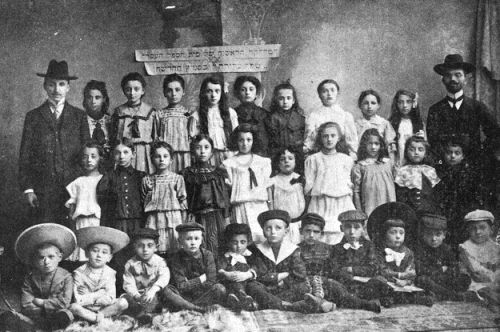
Bes Sefer Evri “xxxxxxx” 1907
From right to left, the first row on top: The teacher M. D. Berl, Fride Einhorn, Mina Mahler, Sobel, Esther Krischer, Rukhl Krischer, Chave Berger, Sheindl Amsterdamm Rukhl Infeld, Hochheiser, the teacher Naphtali Zigl
The second row: Eliezer Berl, Sarah Berl, Gusta Mahler, Stein, Ruzhke Nusboym, Sala Nussbaum, Mina Zigler, Mina Kleinmann
The Third row, seated: L. Margalles, [Margules?] Dudek Berger (the older), Moyshe Berger, Dudek Berger (the younger), Wolf Holzer, M. Kleinmann, Effner, Goldklang, Sprei, Herbst, Shimek Wadler |
[Page 364]
Adults also studied with his in evening classes. The young adults began to tiptoe around him in order to hear something about Zionism and the new Hebrew literature from his own mouth.
Among the youths were those who yearned to read a Hebrew book or newspaper. Unfortunately, there was no Hebrew book or newspaper to be found in the entire city.
The above-mentioned Hebrew teacher, Mordechai Dovid Berl, on his own ordered many Hebrew and Yiddish books, as well as newspapers and magazines – for a large sum of money – he spent one-third of his dowry in order to quench the thirst for knowledge of the Jewish youth.
When the Hebrew materials arrived, it was though a ray of sunshine had pierced the darkness. In the evenings, the young people would stealthily run to the teacher's home in order to receive a book or newspaper to read, and at the same time, to have a conversation about the Zionist world and Hebrew literature.
This private library awakened in the young people a yearning for reading, although he had a strong desire to expand the Hebrew and Yiddish culture and the Zionist idea. But Mr. Berl would not enlarge or expand it because his readers did not pay any dues.
When the club “Ezra” [“Ezra” was a Zionist youth movement named after the prophet] was established in our city, Mr. Berl tried to establish a large library in order to quench the thirst of the young for the Hebrew book
He collected the necessary funds from contributors and the first public library was established. Besides Hebrew and Yiddish books, the library also contained books in Polish and German on Jewish subjects.
The Zionist idea was slowly disseminated and the yearning to learn Hebrew expanded into lessons by Mr. Berl. He could not satisfy everyone's needs. Therefore, he suggested that a Hebrew school be established so that anyone who wanted his sons to study Hebrew would be able to send them to that school.
The school was established in 1906, and 80 students enrolled. Mr. Berl, who could not do all the teaching by himself, invited another teacher, Naftali Ziegler to join him, and with great enthusiasm, they both dedicated themselves to their work.
It goes without saying that this did not please the Hasidim in our city. They began to agitate and demanded that parents of the students enrolled in the school should be expelled from religious study and synagogues.
The school opened immediately after the Succos holiday. On the Shabes “at the beginning” (Bereshis), it was announced in all the religious schools “whoever sends his son or daughter to the Hebrew school will be compelled to leave the religious school”.
As it was witnessed later on, the parents were not frightened by this warning. They found a place for themselves in the big synagogue in our city and they could pray there. Since there were no Hasidim there, they were not persecuted nor expelled.
The Hebrew school under the name “A Clear Language” (the Hasidim called it a “cursed language”) had survived. The students received a modern education; they studied Hebrew, grammer, Bible and Jewish history. Everything was taught in Hebrew without any translation. At that time, it was a great innovation.
The entire organized youth: “Bnei-Zion”, “Bnot-Zion” Hashomer Hatzair as well as labor “Hechalutz”, they all studied with the above-mentioned teacher in the evening hours. Hebrew speech was heard in the streets and in the city parks.
[Page 365]
In order to open such a school, it was necessary to obtain a permit from the minister of the region and to submit a certificate from the Rabbi that the teacher was qualified in the required subjects.
Mr. B. was brave enough to demand the necessary document from the Rabbi, his main opponent. At the beginning the rabbi refused claiming that he had heard that Mr. B. was teaching the Bible with Mendelsohn's commentary. [Moses Mendelsohn, early proponent of modernity].
As it happened, the Rabbi's main advisor, Israel Borfind, was there. He knew the teacher and sometimes listened to his instruction in Shmuel Mahler's home, and he said: “If the Rabbi would hear how the son of Mahler, a student in the Hebrew school, speaks Hebrew and studies Torah, the Rabbi would give Mr. B. the necessary document.”
The Rabbi responded: “I will give him the document provided that he does not teach Toray with Mendelsohn's commentary.”
Slowly, they got used to the fact that the school was in existence, and they no longer protested that fact. On the contrary, there were those among them who frequented the religious school, who sent their daughters to study Hebrew in the school because the latter claimed: “We don't have any desire to pray or make a blessing over the meal, to read the “Shma” [Shma-Yisroel {the Prayer: Hear O Israel the Lord is our help! God the Lord is one! are the first two words of a section of the Torah that is used as a centerpiece of all morning and evening Jewish prayer services and closely echoes the monotheistic message of Judaism. It is considered the most important prayer in Judaism, and its twice-daily recitation is a mitzvah (religious commandment).}] or “The Ethics of the Fathers” [known in Hebrew, Pirchei Avot, is perhaps the most popular and widely read tractate of the Mishna. It was collected some two thousand years ago by Rabbi Yehuda HaNasi, the author of the Mishna.] because we do not know what they mean; if we study Hebrew and we understand what we say, we will pray with more fervor.” That way, they convinced their parents and later boasted that their daughters were reading Hebrew books and understand the Bible.
That was how the school developed from year to year. The number of students increased, and in 1943 there were about 200 students in the school.
Mr. Berl realized that he did not have the resources to administer the school under the existing circumebrew and stuHebrew school, speastances. The school required great expenditures such as breaking up the walls of the great halls and adding new teachers. He turned to thelocal Zion ist Council, or rather, to the brothers Silberman, asking the Council to debate this issue.
A plenary meeting was called and it was decided to approach the matter with complete seriousness. An apartment was rented from Mrs. Sarah Englander at Sobieski Street 14. It was elegant and a large apartment with three large halls. Another teacher and two kindergarten teachers were hired and a kindergarten was established. About 250 students were enrolled in the school and the kindergarten and about 50 adults also studied in evening classes.
Under the supervision and direction of the Executive Committee and with the help of Mr. Yizmiahu Frenkel and Moshe Nussbaum, the work continued in full power. There was hope that in the course of the second year, a government school would be founded.
The Hebrew movement had achieved a great victory. Hebrew speech was heard everywhere. Hebrew songs were heard joyfully. The teachers, members of the Council, together with adult students attempted to beautify and improve the school and they watched over it.
This success did not last too long because in 1914 World War I broke out. The Hebrew school closed down. The teachers left town together with the majority of the Jewish residents to escape the invasion.
In 1915, after Russia's first defeat, thousands of Jews began returning to their homes. The teacher Berl also returned. Parents and students clamored for the re-opening of the school.
The organizations worked underground because of the prohibition ordered during the time of crisis. The library had opened, Hebrew lessons were renewed. Even the children's school was opened. Kindergarten also opened and that is how things evolved until the end of the war.
[Page 366]
After the war, the Hebrew movement expanded. The renowned educator and writer, Yizmiahu Frenkel returned from the war. He was actually a lawyer by profession, but he considered it his mission to teach. He organized evening classes for adults. There was no dearth of students for Dr. Frenkel and Mr. Berl, because the hope for aliyah [immigration to Palestine/Israel] –after the Balfour Declaration [The Balfour Declaration of 1917 was the first significant declaration by a world power in favor of a Jewish “national home” in what was known as Palestine] - was fervent.
After nine years, Dr. Frenkel left town and moved to Lodz where he was appointed the director of the Hebrew gymnasia “Yavneh”. Other Hebrew teachers came to Sandz and the instruction of Hebrew expanded. In 1935when Berl, the teacher made aliyah to the land of Israel, with his family, there were already three Hebrew schools:
- The "Tarbuth" school with government rights
- The school of “Mizrahi”
- The school of Agudath Israel (Bnot Yaakov)
Of all three schools, the latter had the largest number of female students.
Besides the Zionist organizations such as “Hechalutz”, Hashomer Hatzair”, “Hanoar Hatzioni”, Hitachdut” and “Gordonia”, there was also an organization for girls. “Beth Yaacov” of the “Agudah”
In all of them, instruction in the Hebrew language had the most prominent place educational and cultural fields.
I Became a Teacher in Sandz
by Naftali Zigl
Translated by Miriam Kreiter
Edited by Renee Miller
A
In those days I was still living in my home town, Ustechko, a town neighboring Przemyœl, and dreaming about preparations for entry in a rabbinical seminary in Vienna. I had been studying Talmud with a few friends: Rabbi Abraham Boymel and later with Rabbi Damte, Rabbi Chaim Nahum Halbershtam of Sandz origin. In my home I studied the “German language and the literature of the Middle Ages with my friend Shmuel Frenkel; the Klaters, the principles and also modern literature, each generation and its researches, the meanderer through the path of life, religion and life, etc. I was a correspondent for the weekly “Hamitzpeh” that was published in Krakow by Sh. M. Lazar.
Then, I was approached by Menachem Lazer, the former head of the Yeshiva in Pogroszyn and later editor of a Yiddish weekly, “Der Yidishe Freynd” [The Jewish Friend] in Stanislawow, who invited me to participate in his magazine. He used to send me the weekly free of charge, even though I never published anything in it since it was not a publication in my spirit.
Efraim Dopler of Chernevtsi, a famous writer in those days, wrote a series of articles for the weekly criticizing the method of “Hebrew in Hebrew”. Those articles stimulated me to respond. I sent the article to Moshe Kleinman, editor of “Der Tagblatt” [The Daily Paper] in Lviv. He answered that he would publish it in one of the future issues.
[Pages 367]
My article that was published in “Tagblatt” even made an impression on the famous teacher Rafael Sumsman, the head of the teachers' association in Austria. He sent me a membership card in the teachers' association…
Many ladies started to frequent our home and talk in low voices to my mother; later I understood: they offered matchmaking for me; my parents did not reveal the secret to me.
One day I was home writing “The Scroll of Esther” (Megillat Esther –[chapter in the Bible]) on a folio page in tiny letters. A merchant from Peremyshlyany by the name of Hersh Schnegl, had been living in our home. He had come to market and seen me and my work.
He stood and looked at me for a while and when I got up, he shoved the scroll into his pocket. I protested and said I was writing it for my uncle and he replied: “I will not return it to you; you will receive a nice gift from me in return”. For the entire day, the merchant did not stop whispering with my parents; my grandfather of blessed memory revealed the secret to me: “He would give you his daughter in marriage and a very large dowry”. The news astounded me. For my parents, it was a business as was customary in every Jewish home, but for me, it was a disaster. How will I be able to resist my parents? I was ashamed to look in their faces. I spent nights of horror, in strangled weeping. When I calmed down, I spent a very tense time thinking about what to do to escape the verdict. There was no one among my friends or relatives I could approach, and moreover, I was ashamed to confront them with my tale of woe. Therefore, I was on my own in finding a solution to my dilemma.
I approached the editor of “Hamitzpe” [published in Krakow] (in writing, I was not ashamed to reveal my desperation) and asked him to give me the name of one of the subscribers in the town of Premyslany who might be able to rescue me from this distressful situation. In the next issue of “Hamitzpe” I found, among the letter to the Editor, a response: “Please write to Michael L. and he will surely fulfill your request.”
I wrote a letter to Michael L. and I swore him to complete secrecy and I told him: “I am fifteen years old and my parents want to marry me off to the daughter of H. Sh. Who resides in our town. I hope you can help me. How? If you approach Mr. H. Sh. and tell him that the young man to whom he hopes to marry his daughter to, was expelled from the Rabbi's study because of his heresy; the whole town is aware of it, etc., etc.”
His reply was: “I have fulfilled your request and I will keep your secret.”
As long as my parents lived, I have never revealed to them what I had done.
The match was off but the danger did not pass because neighbors were still coming and going bringing various suggestions. What was I to do?
I returned, therefore, to Mendl Krap whom I had known through his participation in “Hamitzpe” and he suggested that I accept a position as Hebrew teacher in a school in his town. He even spoke with members of the Board as well as with the renowned writer Abba Appelbaum z”l [of loving memory], who knew me from the correspondence in “Hamitzpe”. They invited me to come in order to get to know me.
Mr. Appelbaum spoke to me about studies of Judaism and he encouraged me.
After a week's time, I received a letter from the Board saying they would accept me as a teacher.
[Pages 368]
However, rescue appeared from another quarter, again, by Mr. Sh. M. Lazar. He submitted my name to the director of the Hebrew school in Nowy Sacz, Mr. M. D. Berl and the latter invited me to come for an interview. I came, I saw, and I was victorious – I was accepted as a teacher.
B
For the first time in my life, I left the guardianship of the Orthodox leaders of M¹chocice, from the curiosity of the women, and from the strict oversight of my teacher and rabbi, Rabbi Damta Chaim Nahum Halbershtam (who sometime before had forbidden me to participate in his lessons on the Talmud, after he realized that I was writing for “Hamitzpe”.) I found myself among the agitated youth of Nowy Sacz, among the lawless students of the Talmud Torah [a tuition-free elementary school maintained by the community for the poorest children] and the students of the high school, as well as the university students. All were determined “to make a man” out of me.
Miknbrun (Minubiturg) a student of the seventh grade in the gymnasie, served as my teacher. I learned a great deal from the brothers Yaacov and Yosef Nusbaum, and mostly from Mashmai Fridman. The latter took long walks with me. He involved me in cultural and literary issues, and took upon himself to liberate me from the shackles of my traditional education.
In the home of my friend, M. D. Berl, where I resided, they still tell the tale of how I refused to eat a cake baked with butter on the Sabbath evening around 10 pm, after we came back from a walk or a visit, since the Sabbath dinner, consisting of soup and meat, had been eaten at 5 pm, and there was only a five hour interval, and we needed 6 hours before we could eat dairy.
One day, at Berl's home, I met a young slim man with long curled side locks who was called “the heretic from Zimigrod”. He read to me the article by Ahad Ha'am[1] “Torah in the Heart” [called for the Torah in the Heart to replace the Torah of Moses and of the rabbis], and he demonstrated great knowledge of the new and old Hebrew literature as well as Talmud and other sources.
Years later, he became famous as a philosopher because of his articles and books. He served as teacher at the Hebrew high school in Krakow. His name was Ben Zion Rapaport hy”d. [Hashem Yikom Damo {for martyred Jews}]
The “Ezra” club, where both old and young of all levels of society frequented, served as my Zionist as well as my general school.
I personally met the Zionist leaders, the brothers Drs. Silberman and Sysup (a relative on my mother's side).
Briefly: I had entered a different world – entirely new. Many years went by and new impressions made me forget the old ones. But from time to time, when I would encounter the subject of “Sandz”, my heart would fill up with recognition and thanks to all those with whom I had been in touch. Here are some particulars that I have not forgotten even until today:
On one of the summer Saturdays, at approximately three o'clock, I met the young man, Borgnicht, of an Orthodox family. He was dressed in a black silk suit and velvet hat, and he said to me: “Gutvokh! (good Shabes {good week}] and to my query: “Are you mad?” He responded: “I have just 'separated' and I'm smoking a cigarette”…
[Pages 369]
One day, I came to the club; I got frightened by the noise of loud voices, among them, the voice of Berl: “This is a khutzpah! Ignoramus!”, “Do you hear?” - He turned to me – Mordchai Mahler (a law student) is teaching his friends that “Ahad Ha'am was superficial” “What nerve! He is an ignoramus. How does he dare say something like that?”
When everyone calmed down, it appeared that Mahler had read to his friends the article by Max
Nordau[2] against Ahad Ha'am concerning “Altneuland”[3], by Herzl in which Nordau expressed his sentiments as quoted above.
Among the younger students, I remember Herbst, six years old, when he was learning to read from a picture book (in which there were pictures of a donkey) and he read slowly: “d..do..donkey. Then turned to me with a question: “Donkey?” (after all, a donkey is the teacher?)
My visit at three o'clock in the afternoon at the prayer house of the Rabbi of Sandz, made a great impression on me. The rabbi broke down in tears and his voice could not be heard since it was hoarse. The beadle, who stood near the rabbi, made a sign that the rabbi was completing the chapter. Many congregants hit their heads on the wall in great ecstasy. I sensed what the meaning of “suspension of materialism” was: they floated between heaven and earth and did not even see the guests who were gazing at them.
That was a city with everything in it. On the one hand, people prayed devoutly and on the other, the young people prepared food in order to revive them, the others who were praying wrapped up in their prayer shawls.
I had not had an opportunity to visit Sandz since then, and now I am no longer interested in seeing it.
Back during the First World War, I met Gershon Weinberger and N. M. Rakur who published the newspaper, “Morgenpost” in Vienna, and I had published articles and essays in it.
Footnotes:
- Ahad Ha'am (Hebrew: “One of the People”), born Aug. 18, 1856, Skvira, near Kiev, Russian Empire [now in Ukraine] died Jan. 2, 1927, Tel Aviv, Palestine [now in Israel] original name Asher Ginzberg - Zionist leader whose concepts of Hebrew culture had a definitive influence on the objectives of the early Jewish settlement in Palestine. Courtesy of the Central Zionist Archives, Jerusalem Return
- Max Nordau - born July 29, 1849, Pest [now Budapest], Hung. died Jan. 23, 1923, Paris, France. His original name, Max Simon Südfeld, physician, writer, and early Jewish nationalist who was instrumental in establishing recognition of Palestine as a potential Jewish homeland to be gained by colonization Return
- “Altneuland” in the original German {The Old New Land} is a utopian novel published by Theodor Herzl, the founder of political Zionism, in 1902. Outlining Herzl's vision for a Jewish state in the Land of Israel, it became one of Zionism's establishing texts -Wikipedia) Return
[Pages 371]
The First Jewish Worker-party Z.P.S.
(Jewish Socialist Party)
by Yitzhok Frenkel (Bnei Brak)
Translated by Hinda Jacobs
Edited by Renee Miller
The first Jewish worker party (Z.P.S.) in Niesandz was located in the house of H. Tenzer, near the Piekel Bridge; a big hall of three rooms.
At the age of 13, as a tailor apprentice, I joined the youth Z.P.S.. This was in 1910.
The youth movement was led by Itche Zilberbach, Morgnbeseer, Hershl Meyerfeld, Hochhauser and Yitzhok Frenkel. The party was led by Chaim-Leyb Shindl, Yakow Zilberbach, Moyshe Westreich, Yokl Arbeitsman and Yisroel Birnbaum.
Z.P.S. had three professional sections: tailors, carpenters and bakers, managed by Shindl, H. Arbeitsman and Pinchas Lux.
The First Split of P.P. S.
During the rise of P.P.S.[Polska Partia Socalistyczna (The Polish Socialist Party known by their initials, (PPS) founded in 1892].in the Austrian territories, meaning Galicia and Bukowina, the Jewish Workers' Bund had not existed there. The split took place after the Congress of the Second Socialist International in Stuttgart in 1907.
Until the split, all professional unions belonged to the P.P.S. A very small number of Jewish workers were organized in their ranks. During the elections the P.P.S. had a certain influence over the Jewish vote.
In Sandz there were very few Jewish members of the P.P.S.; only one until the end: for everlasting remembrance, Kh. Zemia Schus.
The rise of labor in the city began with the rise of the Jewish Labor Party, Z.P.S. in Sandz.
Saturday morning, seven o'clock, at the first minyan in the Talmetoyre [community school], Itche Zilberbach stands with a pack of newspapers, Freie Yugnt [Free Youth]; all the apprentices buy the paper. You could see a tailor worker with a newspaper in his pocket, “The Social Democrat” and a Yiddish book under his arm as he goes home to his boss for the Shabes meal. The worker is greeted by the master craftsman: Hey! Shlome, what happened? You became a Tsitsilist? What does he think? That I will go to the baker to pick up the cholent and he will come home with a Youth newspaper in his hands? Not by me. Today he will eat kadokhes [nothing]. I won't let him into my house any more.
[Pages 372]
During the meal, the master starts: Listen well, children, every Shabes, as soon as we light the lamp after havdole [the ceremony ending that ends Shabes], you all have to be at the machines, not procrastinating in the streets for a long time. The work for the market in Limanova is needed. You could sit a little longer, until 12 midnight. You rested an entire Shabes.
-- Herr Master, today? What are you saying? You know that we put on plays in our union. Chaim Leyb plays the crazy one in the hospital. Everyone will be there. No one will come to work Shabes night. A group will go around; lamps and heads will fly. All shops will be checked today. Even our apprentice does not have to work. You yourself can work, even the entire night.
-- Who gave such orders? The Tschower bakers' son and Berl Koter's son? They will not lead me by the nose. I took you in for the term and you have to work from Shabes night until Friday, candle lighting. I will not pay a heller [Heller was the term for 1/100 of the Austro-Hungarian krone, the currency of Austria-Hungary from 1892 until after the demise of the Empire.-Wikipedia]. Listen! Listen! A new business in the middle of a holiday week, when the work is mit fuln bren [full blast]. Well, well, we will see who will succeed.
The First Strike in the Jewish Neighborhood in Neisandz, 1911, Under the Leadership of Z.P.S.
The second-hand tailor workers decided to strike. A strike committee was elected. The strike steps in with force with four demands: 1) Ten-hour work day, 2) 25 percent increase in pay, 3) The apprentices cannot be used for housework, only to learn the trade, 4) Recognition for the professional union of the tailor workers.
The first ones to toss away the work were the foreign workers. Later, the master's own children joined in. After two weeks of strike, it turned out that the apprentices were very important and they were taken away from the masters. The boss provided lodging and sleeping quarters. Furthermore, since a large number of them were from the provinces, of poor station, it was necessary to take on the biggest tailor shop, that of Ch. Wolf Ettinger, to get a kitchen and benches from the union for sleeping at night. Ettinger voluntarily gave his shop. This way, they took care of the ones who needed food and sleeping quarters.
During the strike of 1911, Neisandz was a center of trade. Sandz was the key point on the Hungarian and Austrian border
The ready-to-wear trade had a few big firms and employed two or three agents. They traveled for almost the entire year in Galicia, Bukowina, Serbia, Albania and Hungary. Therefore, they had a large market.
[Pages 373]
You could hear the beat of machines in almost every house. Hundreds of Jewish families made a living. At the same time in Sandz, plumbing, running water and electricity were installed where a few hundred people were working.
The demand for ready-to-wear workers was so great that the merchants fought bitterly. They sold all the poor merchandise that had been moldy for a long time until they remained with empty warehouses. In all the synagogues, in all the streets night and day discussions were held – merchants with storekeepers and tailors – over the pace of the strike.
After the sixth week of the strike, a secretary of the Central Committee of the professional unions came from Vienna with a bag of money. – that is what they were saying in the streets. He stayed in the “Grand” Hotel until the strike ended
The strike was over after eight weeks and instead of the demanded 25 percent raise, the strikers' earnings were raised 40 percent. All their demands were agreed upon and signed.
This was the first material and moral victory of the Jewish workers of Sandz
The Cultural Work of the Z.P.S. in Neisandz from 1912 Until the First World War: The Assistance of Dr. Shia Fensterbloy
Dr. Shia Fensterbloy came to Sandz to practice with Dr. David. He gave his first speech in Polish. He was miraculous. After the first four weeks he already managed to speak Yiddish, throwing in a few Polish words. In time he improved and spoke pure Yiddish as opposed to the comrades he had enlisted for the cultural work. They spoke Polish until the end, like Dr.Ameyzns's daughter, Dr. Goldberg and others. They made it a rule three times a week to teach reading and writing Yidish. Our teacher was Itche Zilberbach. Twice a week Dr. Shia Fensterbloy gave lectures on modern socialism, on Engels and Marx. Every Friday night he talked about current events from the war in the Balkans and about the Beilis case and so forth. Dr. Fensterbloy also taught us political economy. Sixteen comrades participated.
A drama club was also active. The participants were Shindl, both brothers Arbeitsman, Hersh and Itche Zilberbach with his bride, Mendl Flaster and Hershl Mayerfeld, the two sisters Shweid, Mrs. Birnboym and the sisters Gitl and Chana Troymfeter.
[Pages 374]
It is also worth mentioning that Dr. Sh. Fensterbloy took every opportunity in his lectures to talk about the resolutions of the First Socialist International, about the conferences in Vienna and in Stuttgart and about the resolutions asking all Socialist parties to fight against the war.
When the war broke out in 1914, Dr. Sh. Fensterbloy and the lecturers from P.P.S. took farewell from all their comrades in the middle of the market. It was Friday at 5:00 in the evening. They were to leave for the front Saturday night. He spoke near the City Hall building with these words: “We go as one man to fight the Tsarist regime. Let freedom come”.
The cars with the military that were going to the front were veiled in red banners.
All the unions were closed. The idealists left for the front.
That is how the Second International ended in Sandz; that is how the Z.P.S. ended.
This material is made available by JewishGen, Inc.
and the Yizkor Book Project for the purpose of
fulfilling our
mission of disseminating information about the Holocaust and
destroyed Jewish communities.
This material may not be copied,
sold or bartered without JewishGen, Inc.'s permission. Rights may be
reserved by the copyright holder.
JewishGen, Inc. makes no representations regarding the accuracy of
the translation. The reader may wish to refer to the original material
for verification.
JewishGen is not responsible for inaccuracies or omissions in the original work and cannot rewrite or edit the text to correct inaccuracies and/or omissions.
Our mission is to produce a translation of the original work and we cannot verify the accuracy of statements or alter facts cited.
 Nowy Sacz (Poland)
 Yizkor Book Project
 JewishGen Home Page
Yizkor Book Director, Lance Ackerfeld
This web page created by Lance Ackerfeld
Copyright © 1999-2024 by JewishGen, Inc.
Updated 17 Jun 2009 by LA