 |
|
|
[Page 104]
About an Orange
by Tzvi Khasid [Nachalat Yiztchak]
Translated by Yosi and Svetlana Shneider and Hadassa Goldsmith
Edited by Jerrold Landau
My father was from the Lubavitcher Chasidim. My grandfather was one of the organizers of Chasidim in Jonava. As he was very busy in the organization, he spent most of the time in the shtibel of the Chasidim. Therefore, the Chasidim began to call him Khasid. This name took root and was inherited from generation to generation. Even until today, all of the family members have the surname Khasid.
The Russians drove out the Jews from this region of Lithuania at the beginning of the First World War. It was in 1914. The Jews were sent out to different areas of White Russia and the Ukraine. Some of them came to Vilna, including us. We were in Vilna until the Germans captured Vilna. The Jews from Jonava who lived in Vilna returned to their houses in Jonava. But it was not so simple, because the railway did not work and everything was in the hands of the German Army.
Our family and two other families from Jonava bought boats. Since my parents were once occupied with the transporting of logs on rivers, they were able to organize this ferry along the Viliya river to Jonava. There were temporary low bridges along way that were built by Germans. We had to unload everything from the boat, carry the empty boats along the land, and put them back in the water on the other side of the bridges. This journey would take 3-4 days until we arrived in Jonava.
We found destroyed houses, and pillaged, empty dwellings. Our house was occupied by gentiles, but after a short time, we got it back. There were horses kept by the Germans in our synagogue, which they turned into a stable. When the German army advanced into Russia, they emptied the synagogue. The worshippers repaired it, and began to gather for services.
My parents began to work in their bakery again and reopened their grocery store. We also had machines to make felt slippers from sheep wool. The gentiles would bring the wool, and we would make the shoes for their private use.
We immigrated to Israel in 1925[1]. What caused us to immigrate?
The Rabbi from Jonava obtained 200 dunams of land in Israel to sell to the Jews of our town. We were among the buyers. We purchased 10 dunams on the condition that we would settle in Eretz Israel. The story goes like this:
My father was ill. My mother was supposed to buy oranges for him on the advice of the doctor, so that he should eat them and become healthy. One day, the rabbi saw my mother through the window and called to her saying that she would have her own oranges if she would buy from him a plot of land in Eretz Israel. Indeed, after we bought the land, we decided to move to Eretz Israel.
There were other families that also bought land and prepared to move, but they had no one to whom to sell their house and property. The priest told the gentiles not to buy from the Jews, because if they did not buy from them the Jews would be forced to leave everything anyway. We also did not have a buyer. We gave our property to a member of a family from Kedainiai, on the condition that if we could not succeed in Eretz Israel we would return to Lithuania and receive our property back.
I and my parents made aliya to the Land at a propitious moment in 1925. The land that we bought was near Afula. Agudat Israel called this place Mahane Israel. We lived with four other families. In addition, there were thirty people whose wives and children were still in the Diaspora. Agudat Israel hired these people to build cottages, pave roads, and other such work. They earned thirty grush a day, which was enough to live on because everything was cheap.
In 1927, Agudat Israel did not have the funds to employ people, so the work stopped. Many people went to other places or returned to their original towns in the Diaspora. My parents and I remained. My mother got a job in a children's village near Afula. I worked in agriculture, primarily in the cultivation of crops.
The disturbances began in 1929. We had to leave the place. In our neighborhood there was an Arab who owned a great deal of land. The place was called Ein-Dor. Today, Kibbutz Davrat is located there, opposite Mount Tabor. This Arab was a friend of the Jews. We remained in constant contact with him. One day he came and warned us that there were Arabs who were preparing to kill us and burn down our houses. We dismantled our house, bought a plot in Afula, and moved our house to the new location. We began to set up a cattle stall and an auxiliary farm. In five years our farm grew to the point that we had 12 milk cows. We moved to Nachalat Yitzchak near Tel-Aviv, because we could no longer maintain ourselves in Afula. We had nobody to whom to sell milk, and prices were very low because the situation in the areas was difficult, and there was no employment in other areas of work.
We enlarged our farm in Nachalat Yitzchak. Finally, we had to liquidate our farm along with everyone else according to the demand of the Minister of Agriculture, Moshe Dayan.
To this day I live with my family in the environs of Tel-Aviv.
|
|
|
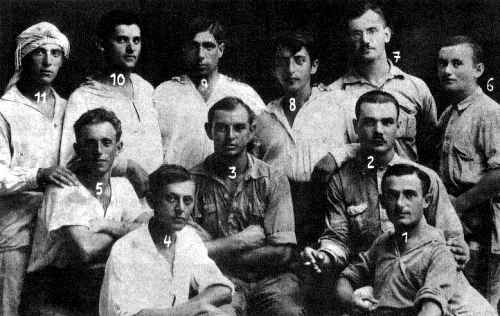
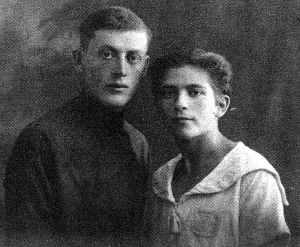
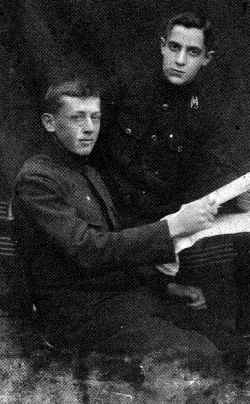
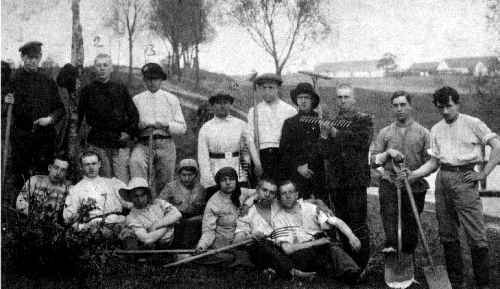
Jonavers in the Achva group. Aharon Zisla (4), Dov Blumberg (3), Eliahu Opnitsky (2), Baruch Namiot (1) – 1919, B. Namiot (6), Opnitsky (4), D. Blumberg (10), A. Zisla (11) – Achva, 1920 |
|
|
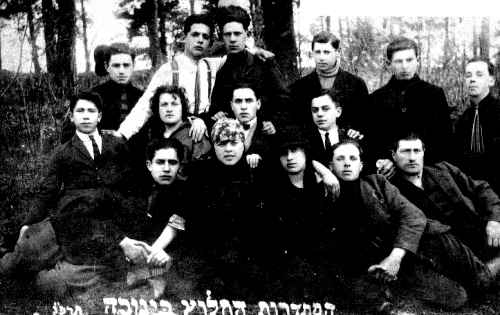
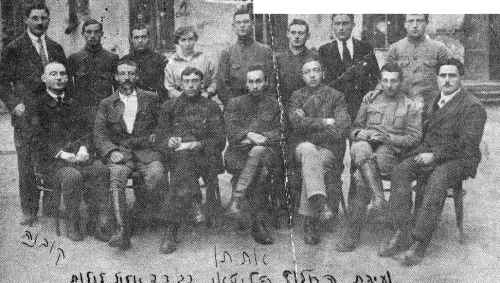
Photo reads: Hechalutz Organization of Jonava 5683 / 1923 |
|
|
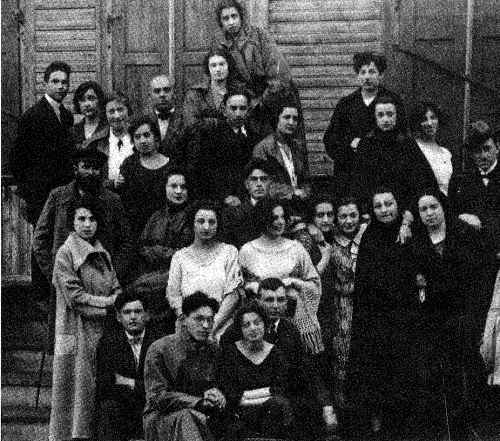
Zacks, Sara Slomin, Intriligator, Reizel Morr, Chasia Intriligator, Yentel Slomin, Menachem Mines, Zacks, Eliezer Levin, Rivka Grossman, Sara B., Moshe Solski; Chasia Friedland, Sheina Levin, Elka Wolk, Bluma Pogirsky, Chana Sandler, Miriam Lomianski, Shoshana Morr, Henia Segalovski, Batya O.[pnitsky], Ivensky, Liba Chana Stern; Zeev Epstein, Rachel Levin, Yitzchak B., Berl Antes |
|
|
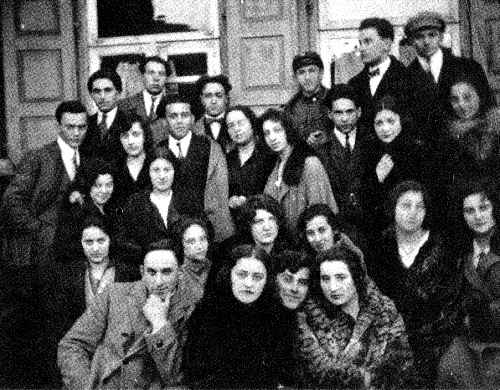
Velvel Sesitzki, Shimon Zack, Bleiman, Shmuel Kaplan, X, Aryeh Zisla, Lyuba Katz, Bluma Pogirsky, Moshe Solski, Sara Slomin, Sheina Levin, Tzvi Opnitsky, Sara Burstein, Eliezer Goldshmidt, Rivka Sesitzky, Rachel Levin, Masha Segalovski, Tivka Katz, Beila Opnitsky, Shimkovitz, Faya Donat, Malka Kaplan; Chaya Morr, Alter Sandler, Chana Segalovski, Menachem Mines |
|
|
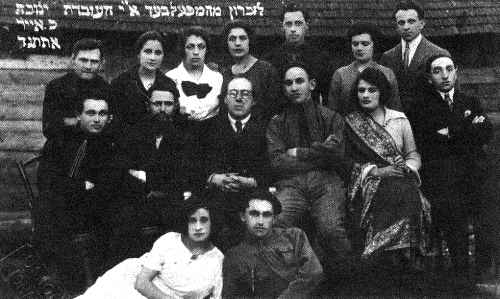
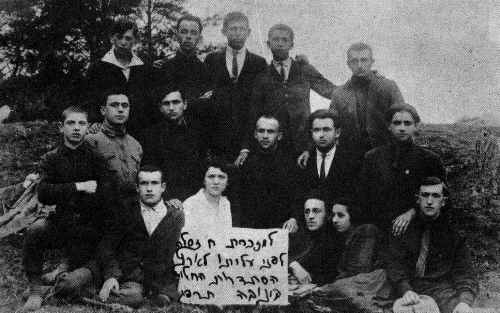
| Batten, Shoshana Troyush, Chaim Blumberg, X., Prakt, Tzipora Klotz, Velvel Kirzner; Tzvi Resnick, Reina Lea Kulbiansky, Menachem Mines, Nathan Grinblatt, Ivensky, X; Dov Zisla, X Caption on photo says: In memory of the activity on behalf of the Working Land of Israel, Jonava, 20 Iyar, <year is hard to make out> |
|
|
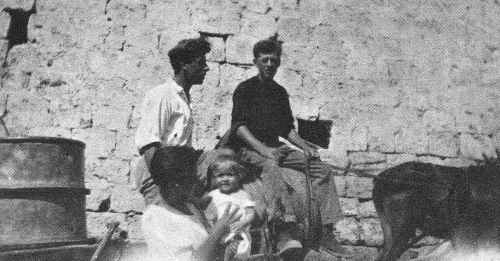
| Eliahu and Abba Opnitsky carrying water in the first year of the aliya of the Achva group, on the Geniger land (1924). Next to the wagon is Rachel, Eliahu's wife, with their daughter. |
|
|
|
|
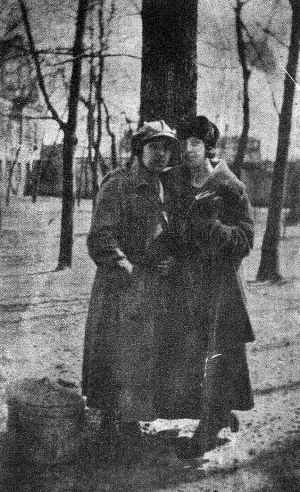
| Batya Opnitsky-Taub in the civic garden in Kovno, on her way to the Land. Accompanying her is Rachel Levin. The suitcase contains all of her possessions. |
|
|
Mendel Dobiansky, Reizel Khasid, Zelig Stein, Mina Grodsky; Batten, Tzipora Shoham, Epstein, Tzipora Klibansky; Barron, Grodsk |
|
|
Henia Blumberg, Alter Monitz, Chana Pesia Glazer, Shlomo Friedman; Sara Lea Rikliansky, Ivensky, Z. Stein, Tzipora Grossman |
|
|
X, A. Batten, Rivka Atkatz, Sara Rikliansky, Alter Monitz, Lea Kronick, Tzipora Shoham, Tzila Unterschatz, X, X; Stein, Tz. L. Weiner, Guttman, Baron, Epstein, Ida Zochovsky, Sonia Kaplan; Moshe Unterschatz, Tzipora Klibansky, Batten, Tzipora Grossman, X |
|
|
Tzvi Opnitsky, X., Reping, Shlomo Friedman, Avraka Unterschatz, Feivka Shapira, X, X, Zelig Stein |
|
|
|||
| My hands are stiff with calluses And the sun beats down over my head
I take hammers in my hand From a poem from those days |
|
|
|
|||||
|
|
The delegates from Jonava: at the top Baruch Namiot (1), Rachel Zisla |
|
|
|
|
Translator's Footnotes
[Page 106]
by Rachel Ben-Yehuda (Mintz)
|
|
My father Reb Yoel of blessed memory was an ordained rabbi. It is said that he was one of the geniuses of the Yeshiva. My father did not wish to make his Torah into “a spade with which to dig”[1]. After he married Sara Rivka of blessed memory, the daughter of Menachem Cohen, he joined the business of his father-in-law, who was a wood merchant, and was well-known for his honesty.
We lived in our private house in Jonava next to the new synagogue, located on Lipniak. There was a large Yeshiva in the synagogue under the leadership of Yudel Gorfinkel and Rabbi Hershel Peretz. The latter was a scholar, an upright man, and a Tzadik. Rabbi Yehuda Gorfinkel was very knowledgeable in Torah, as well as being a modern man in general. He thoroughly knew Torah, Gemara and halachic decisors. He would not look into books during his studies with Yeshiva students due to his poor vision. During a discussion of didactics or the explanation of a difficult section of Talmud, he would tell the students the page number in the Talmud, and point to the place with his finger. He would see the Jordan River in his imagination as he walked by the banks of the Vylia. At times, when he was pining for Zion he would stop a gentile on his way and ask, “Mr. Squire, where is the route that leads to Palestine?” He moved away from Jonava, then went to Kovno, from where he made aliya to the Land. He died there. Both of these Rosh Yeshivas frequented our house in Jonava. They always debated about a page of Gemara, issues of the day and politics with my father. Our mother, Sara Rivka, was also present in their company, as she was a wise woman. She knew Hebrew and foreign languages. My mother excelled in hosting guests, and offering assistance and support to those in need. She was the “writer” of addresses and letters for women whose husbands had emigrated oversees in search of livelihood.
Our family moved to Kovno in 1921, for the daughters had grown up in the interim and there was no high school in Jonava. In 1924, a group of middle class Jews was organized in Kovno, who purchased agricultural land in the Land. My father was the head of this effort. Our family left Lithuania, made aliya to the Land and settled on the land that we had purchased. The Moshava Magdiel was established on these lands. My brothers Dov and Yekutiel were among the first to go to that land. They dedicated themselves to agricultural work with all their might. They struggled with the pitted land with all their energy. They had great erudition. They worked during the day and studied and researched their new profession of agriculture during the night. They took interest in plants that would be fitting for the local terrain. To our bad fortune and great agony, they both died prematurely. May their memories be a blessing. Yekutiel left behind a wife Chana, and two sons, Avraham and Yoel, who continue on in our path. My younger sister Dvora Dror also worked on the farm with our brothers for many years. My lot unfolded in a different manner. I spent the first 15 years of my life in Jonava. The best years of my youth are connected with that town. When I grew older, a group of friends would gather in our house to study the history of the Jewish people. Our teacher was Natan Janusovich of blessed memory, one of the young maskilim of Jonava. A policeman standing at the corner of the street noticed that we were gathering without a permit, and therefore we were forced to stop the lessons. I loved to see the Yeshiva students dispersing and strolling on Lipniak during their recess. They would even continue with their didactic discussions on their section of Talmud during these moments.
[Page 107]
I also enjoyed going out to Lipniak, sitting under the trees, being alone with a book, listening to the songs of the birds and the sounds of the Vylia. When I finished the Real Hebrew Gymnasium in Kovno, I traveled to continue my studies at the University of Vienna. I decided to change the path of my life after the first year of studies. This was after the Balfour Declaration. A wave of nationalism swept over the nation in the Diaspora. I came to the realization that this was not the time to sit on the school bench. It was our duty to make aliya to the land and to participate in the building of the homeland for the nation. I joined Hechalutz, and made aliya to the Land after a brief period of hachshara, even before the aliya of the entire family. In the Land, I was accepted by Kibbutz Ein Harod. Incidentally, I arrived there on the heels of Rachel Zisla of blessed memory, a native of Jonava, one of the first and best known chalutzim of Lithuania and in the Land in her time. When the family arrived in the Land, I advised Father to join me in the Kibbutz. His soul and inclination did not tend toward Socialism. Therefore, as I stated above, he chose Moshava Magdiel. Only our oldest sister, Reizel Cohen, remained in Lithuania to our sorrow. She endured all the tribulations of the war along with her family as refugees in Russia. Her desire is to be united with the remainder of the family in the Land.
[Page 107]
Fortunate – With a Dual Meaning
by Zelig Even (Stein), Kibbutz Gvat
When we returned from Russia after the First World War, I decided to study in the Tarbut evening classes. Thus did I learn Hebrew. I joined the Maccabee group.
I discovered that youths from Jonava were becoming chalutzim and were going out for agricultural hachshara on the Kibbush[2] farms of Hechalutz, and some of them had already succeeded in making aliya to the Land. I began to take interest in how to reach actualization and aliya. However my young age – I was 16 at the time – prevented me from realizing that dream.
Hechalutz Hatzair (Young Chalutz) was founded in Lithuania at that time. We set up a chapter in Jonava as well, and after a half a year, I succeeded in going out to hachshara with the first group of Hechalutz Hatzair, to a Jewish farmer near Radvilishki who agreed to take on eight chalutzim. There I learned to sow, harvest, grow vegetables and spread chemical fertilizer – all by hand of course.
I had to travel home after the summer of work. But I stood my ground that they should send me to a hachshara group that continues throughout the entire year. There were about twelve such places in the farms in the area of the city of Memel. Thus did I get to the Dompen group, about ten kilometers from Memel. There were fifteen of us there. Every Sabbath, we would go to meetings of all the hachshara groups under the auspices of the Memel Beit-Hechalutz.
Then the fortunate time came: I was authorized for aliya[3]. I arrived in the Land in 1926, even before I was 18 years old. There was a serious depression in the Land, which we already sensed on the journey. When we passed through the port of Marseilles, we were greeted by people returning from the Land, who had worked there. They uttered to us: “New victims!” When we arrived at the red Histadrut building in Jaffa, we saw a long line of unemployed people. Each person received a 25 grush stipend per week.
Our group of new immigrants numbered twenty people. We were sent to Rechovot to join the Lithuanian group that had made aliya before us. There was little work. We received an allotment of eight or nine work days for our group of thirty-five members. We worked in the orchards and vineyards. The Lithuanian group earned a good name as workers. The farmers asked for workers from the Lithuanian group. The salary was low – 15 grush per day! We worked as contractors in “Bechar” – digging with our hands.
At that time, the plan of “Hityashvut Haelef” (Settlement of the Thousand) appeared: settling about 1,000 families near the Moshavot, who would be able to tend to a small independent farm, 10-15 dunam per family. The Lithuanian group joined with the Ein Harod group, and together with the Wolhyn group and the Italian immigrants headed by Enzo Sereni[4], we were given an area of settlement near Rechovot, which we called Givat Brenner. Members of the Lithuanian group laid the foundation. Later, we were joined by chalutzim from Germany from Kibbutz Chirot. In this manner, the group of Lithuanian natives, I among them, was given the merit of founding and creating, along with others, a kibbutz that today is the largest in the country.
With the passage of time, I moved to the Jezreel Valley, and I continued my life in Kibbutz Givat.
[Page 108]
by Eliezer Kochavi (Stern) of Kibbutz Netzer Sereni
From the distance of time, I see the life of the Jewish community, the life of generations of Jews in the town, which for a long period lived independently in most areas of life.
The town was surrounded by villages of the ruling nation, but the majority of the population of the town itself was Jewish. The Jews imprinted their stamp on life on week days and holy days, in economy, work, education and culture.
With respect to the civic situation, the internal government was independent, and everyone was subordinate to its institutions. The connection to religion and the surrounding organization drew the Jews of the town together into one community, with an air of simplicity, and a flowing of life.
The influence of the rabbi of the city spread into secular matters as well. Every court case between one Jew and his fellow was brought before the rabbi rather than being brought to the gentile court system. The authority of the rabbi was accepted, and nobody refused to accept the decision of the rabbi in accordance with the laws of the Torah.
The educational institutions that were under the independent authority of the community included the cheder, the Yeshiva buildings, and later, the schools.
Before the First World War, I began my studies in cheder at the age of five. At that time, a Talmud Torah Hebrew school already existed. It was a modern school at a high level. I entered the cheder on my own accord, as I went with a friend, and I remained there to learn. The rebbe was Pitkovsky. I studied with him for one year. The class took place in one room. We sat next to tables around the walls, and the classes were conducted in a good spirit. For the second year, I transferred to the Talmud Torah, a modern school of four grades.
The school was founded during the first years of the century by a group of communal activists with the aim of raising the level of study and providing education in the Hebrew/national spirit. Its aim was to select students from all strata of the community. The school was full, and it could not accept everyone who wanted to enter. The wooden building was surrounded by a spacious yard. Even the classrooms were spacious, with light, air, and good equipment.
My teacher was Keidanski, a man with a pleasant disposition, and pedagogic and organizational talents. He did not impose strict punishments. One winter day, a Christian parade passed by. Curiosity aroused several students of the class to watch the “mystery” of the dipping of the symbols into the frozen waters of the river, beneath the ice. I was one of the curious ones. When we returned, the teacher called me and told me to come to his house that evening. There he ordered me to write several pages of “handwriting.” I did thus feel the justice of the “punishment.” The exercise indeed improved my handwriting.
I have positive recollections of my period of study. I continued there until the outbreak of the First World War and the expulsion. The Germans were approaching on the front. As if to obfuscate the disgrace of their retreat, the Russian command accused the Jews of the region of spying for the Germans. We moved to Zusli, where we remained for several months. From there we moved to Bobruisk near Minsk in White Russia. There, I entered the Hebrew school that had been opened for the children of the refugees. This was a modern school, and good, dedicated teachers taught there.
We endured the year of the Russian Revolution in that city. For me, this was also a school of a different type – for awareness of the political and national movements, as I saw the events as they unfolded before my eyes.
We hastened to return to the town at the end of the war. At that time of government and general unrest, the Jews of the town took independent action to conduct their matters. A city council with a Jewish mayor was established. My father, Shmarya Stern, served in that role at that time. Alongside the city leadership, a militia was set up to preserve order, in which Jews also took part.
I continued my studies with Rabbi Hershel Peretz. We studied Gemara in his home. Then we moved to study in the Beis Midrash. Rabbi Hersh Peretz had a good disposition. We studied with him for two terms.
Then I went to study in a Hebrew secondary school – the Real Gymnasium of Kovno, under the direction of Dr. Tzemach Feldstein.
On the same day as the matriculation exams ended, I enrolled in Hechalutz. I made aliya to the Land of Israel in 1926 after two years of agricultural hachshara.
[Page 109]
by Daniel Rikless of Tel Aviv
As if from the mist, my father's spacious, brick home flutters and appears before my eyes. It had four windows, all facing toward the street, the Rabbi's Alleyway.
What We Saw Through the Windows
The five young children, four brothers and one sister, would stare out the window during the long winter days. They each had enough panes to comfortably see all that was taking place on the street. Thanks to peering out at the alleyway and beyond, during our childhood we absorbed the entire Jonava reality, starting with the hustling of the men and women for existence. We witnessed many experiences, noticed the differences in dress, and realized that among those, there were rich and poor. I slowly digested all this, and my horizons continued to expand. These childhood impressions remain etched in my mind to this day.
We Absorbed the Atmosphere of the Home
My father Reb Meir was a member of the family of Yisrael, the owner of the brick kiln. That family consisted of five sons and four daughters. He possessed Torah education that he had received from one of the cheders in Jonava. Father was not able to continue his education, since from his early youth, he was forced by conditions to help Grandfather in the brick kiln. Through mutual powers, they were able to overcome the issues of livelihood for a family of 11. According to Father, the livelihood was very meager.
Father managed to persevere, and fell in love with the young lady Sara Reizel of the Landsman family of Jonava. He[5] was nicknamed “Bina der taker” (Bina the engraver). Thanks to this well-matched couple, both in their characters, their spirit and their youth, with time a family of four sons: Yaakov, Chaim, Nachum-Berke, and Daniel, and a sister Yudit arose. My father was a tall man. He was not a zealot, but rather a progressive man. My dear mother was the same height as Father, pretty, blond, and good hearted. She was a faithful housewife for her husband, and dedicated
[Page 110]
to the education and care of her dear children. Family life went well, and was ideal in the full sense of the term. All of this left its mark on the education of the children, who followed in the footsteps of the parents.
Livelihood was meager. Father continued to work in the brick kiln with Grandfather. He attempted to expand it. He worked at all types of physical labor for the brick kilns were primitive and “automated” only by horsepower. There were other partners in the brick kiln, Chaim and Mordechai Rikless. In order to make things easier for Father, after the children got older, mother decided to open up a bakery in the house. Thereby, she too participated in the yoke of livelihood.
In the Cheder with Shimon the Teacher
Like many of the children of the city, we also studied in cheder with Shimon the teacher. His cheder was located on a narrow lane on Breizer Street. Approximately twenty students studied in the cheder. The teacher was observant, a zealot, and prone to anger and wrath. We received only a Torah education there. We were required to worship together with him three times a day. The rebbe especially elongated his Shmone Esrei prayer. During this break we let ourselves go free – we caused trouble and pulled at his kapote. When he finished Shmone Esrei, it was as if he had taken hold of “amok.” He ran after us in anger inside the cheder and gave us what was coming to us – to some a slap with the hand, to others a blow with the stick – and he thereby assuaged his anger.
During the Expulsion – Korolenko Saves us From a Pogrom
In 1915, in the midst of the expulsion by the Czar that decreed that the Jews must leave the District of Kovno, we too were forced to pack up some of our belongings and wander afar. We traveled in the same train wagon as other Jonava families and arrived in Poltava, Ukraine. These families were the Silberman, Kursk (Kosiksik), Judelevich families and others. We lived in Poltava until 1921, for there was no possibility of returning to Lithuania, which had received its independence in the interim, due to the civil war and chaos that pervaded at that time. My brother and I studied in a Yeshiva in Smolensk with a cultured rabbi, who had incidentally also come from Jonava, and settled there before the war. My brother Yaakov did not wish to study in the Yeshiva, so he transferred to a Byelorussian gymnasium. Our studies at that time were not especially fruitful, for the revolution and the civil war had their influence. There were many days when we had no classes.
We lived in the neighborhood in which the house of the well-known Russian writer Korolenko[6] was located. He was a good man, in fact exceptional, and he related to us refugees with great understanding and a good heart. He would often invite us to his house and treat us with all types of delicacies. To us, he appeared as a redeeming angel. A pogrom took place on our street in 1918. Korolenko hurried out to the street to influence the Cossacks to refrain from perpetrating a slaughter on us. Thereby we were saved.
Returning to our Brick Kiln
We were finally able to return to Jonava and our home in 1921. Father began to reconstruct the ruins of the kiln, and we, the sons, helped him. In a short period, Father was able to take pride in his first shipment to the market. We children continued our studies in the modern Tarbut School, under the leadership of the well-known, eminent principal Shaul Keidanski. My brother Chaim continued his studies in the renowned Slobodka Yeshiva. Every summer Friday after our studies, we all ran to our brick kiln on the banks of the Vylia. We waited an entire week for these hours. There, in the bosom of nature, we were able to give freedom to our desires – either by riding on the horses that were associated with our brick kiln, by floating on boats, by gleefully bathing together, or climbing the nearby mountain to collect and eat handfuls of wild berries. We did not assist Father with physical labor in the summer. However, in the winter, during the time of the baking of the bricks, father would assign us a task. We would transfer the bricks that had been prepared in molds beneath the screens during the summer to the large, underground oven. When it was full, Father would ignite the oven through the crater in the middle that was full of dry wood.
[Page 111]
The baking lasted for two weeks. At night, the crater of the oven was like hell. We stood afar, warming up and enjoyed this splendid experience.
|
|
|||
before their aliya with Alter Monitz |
Activities at Young Socialists and in the Community
A group formed in 1928, headed by Aryeh Stern, Yerachmiel Teitelbaum, Shlomo Meirovich, Alter Monitz, Dr. Shimon Zak, Naftali Gurvich and I, and founded a chapter of Young Socialists. The governments did not permit the Socialist party to organize and engage in politics, therefore it was organized under the name “Sirkin Society,” for cultural work only. Of course, it engaged in undercover political activities. Our meeting place was located in Petarosovich's house. The chapter was active in the social and cultural life in Jonava until the day that it united with Young Zion-Hitachdut. Our representative in the Jonava city council was Yerachmiel Teitelbaum, and in the Keren Kayemet and Keren Hayesod it was Alter Monitz and I. All of the meetings of these committees took place in the home of David Burstein, who was the chairman of the two funds. Our two representatives to the general Sick Fund of the Kovno District were Yitzchak Burstein and I. I will mention a few of the young activitsts: Tzvi Josefs, Tzvi Perevoznik, Dov Rikless, David Friedman, the Perchik brothers, Zelig Judelevich, Zelig Abramovich, Chaim Teitelbaum, Yitzchak Nachumovich, Dina Perlstein, Tzipora Grossman, Batya Sandman, Eliahu Kagan, Eliahu Braun, and Mordechai Yaffa.
The Plans for Aliya Drag On
In 1925, I decided to actualize my philosophy and make aliya to the Land of Israel. I registered for the Hechalutz organization, which directed me to hachshara on the “Avoda” cooperative in Kovno. The director of the cooperative was Chaya Shragovich. I continued to study the carpentry trade for two years and I then received my permit for aliya. The gates of the land closed in 1927, and I did not receive a certificate. I was forced to return to Jonava. I worked in the carpentry shop of Moshel Klibanski and Chaim Solomin. Our family had another house, inherited from my maternal grandfather, on Breizer Street
[Page 112]
near the Josefs. Incidentally, he was known by the name: Chaim-Moshe, Reiza-Leah's, and his son was known as Hirshka, Chaim-Moshe, Reiza Leah's Josefs. Since the crowding of the carpentry shop was great, the owners of the carpentry shop allowed me to set myself up in that house and work for them. I joined my brothers Yaakov and Dov, and the three of us worked together. Thus did we become professional carpenters. Our father died in 1929, and we were orphaned. We did not want to work in the brick kiln, so we sold it and took the yoke of the family livelihood onto ourselves. I would work during the day, and be active in communal work as stated above.
We Merited to Actualize our Aspirations
I married Dina Perlstein, a member of my party, in 1934. I received a certificate, bid farewell to Mother, the family, and all of our friends, and we made aliya to the Land as chalutzim. I continued to work in the carpentry trade in the Land. We set up a cooperative group. We were four chalutzim from Jonava: Menachem Levin, Baruch Kursk, Yaakov Katzav and I. Later, the group expanded to fourteen. The name of the group was registered as “Hamekashet.” The group disbanded with the passage of time due to the recessions that afflicted the Land and that area of trade. I took possession of a carpentry shop to work independently with a partner. In the meantime, our family grew. We had a son Yosef and a daughter Meira. I continued with my family life and the traditions of my parents' home.
Thirty-six years have passed since I left Jonava, and I have never regretted that I bound my lot to the Land, despite the difficult times that overtook us. My wife Dina and I have seen in this a full realization of our aspirations. I owe gratitude to my parents and the party that educated me in this direction and brought me to this point. However, my heart is pained over my family and my wife's family who struggled but were not daring enough to make aliya to the Land. All of them perished in the Holocaust, including my dear mother, my sister Yudit and her family, my three brothers and their families, my two uncles Chaim and Mordechai and their families, as well as Dina's parents, her two sisters and their families. May their memories be a blessing.
[Page 112]
by Baruch Lin (Ilinevich)
Jonava was infused with the spirit of Zionism. However, there were also many opponents to Zionism, such as the Bund. They had a Yiddish school under the auspices of the Culture League. There were also many Communists as well as very Orthodox Jews who opposed Zionism. However, most people sent their children to study in the Hebrew schools, such as Tarbut and Yavneh, and the youth regarded aliya to the Land of Israel as the goal of their lives.
The Zionist activities were centered around the many parties and youth organizations that operated during those years. Hechalutz incorporated youth from all parties. Hashomer Hatzair, which began as a scouting group, later turned into a youth movement with the aim of actualization, whose primary aspiration was aliya to the Land of Israel and Kibbutz life. There was also a Beitar movement, which also aspired toward aliya to the Land and sent their members to a separate hachshara, outside of the Hechalutz organization.
The parties and organizations had their own meeting places, most of them in small houses and rooms. However, they conducted intensive activity, infused with Hebrew culture and an honest desire to join the workers movement in the Land.
Aliya to the Land already started in the early 1920s with the aliya of the Achva group; including the children of the Opnitzky and Zisla families, and others. This aliya was symbolic of the idealism and served as an example for many youths. At the beginning of the 1930s, a large scale exodus to hachshara and aliya to the Land began. Dozens of youths from the town, members of various movements, would go to agricultural and city hachshara. The hachshara were primarily centered
[Page 113]
around German estates in the Memel area. The lads would live in group conditions, like the Kibbutzim in the Land, about which the emissaries who came from the Land would talk and direct them toward. Most of the youth, who were primarily academic youth, were not used to labor, and the hachshara literally prepared them for labor. Conditions on the farms were sufficiently harsh. The Germans demanded the same level of effort from these youths as they did from the veteran workers. The youths would try with all their might to overcome the difficulties and get accustomed to physical labor. Indeed, the youth who underwent hachshara turned into working youth. When they made aliya, they began to work in the orchards and in construction, and were considered to be good workers.
A civic kibbutz was set up in Jonava as well. This kibbutz was comprised of youth from other towns who worked in the factories of the city and prepared for aliya to the Land. All of this created a veritable Israeli feeling in the town. Most of the youth would have come to the land had the Holocaust not come.
I was a member of Hashomer Hatzair. I joined Hechalutz at the age of 18 and went out to hachshara in the Burkenheim estate near Memel. We would receive food provisions, and the female members would cook. Life was very difficult, but we overcame, and at the end of the term we were already veritable laborers. Some of the youths were given horses and plows to plow. This was considered to be an increase in level. Despite all the hard work, the group conducted significant cultural activity. We would sit at night and discuss all types of issues. Sometimes, a delegate from the Land came and described the realities of the kibbutzim and the workers' movement to us. We would sing and dance despite our weariness. It seems to me that everyone considered that time to be the best time of our youth.
The hachshara term was considered to be from Passover to Sukkot. For the second term, most people went to a city-based kibbutz. I went to the city kibbutz of Hashomer Hatzair in Ponovich [Panevezys]. Life in the city kibbutz was more difficult than on the estate. Work was not always to be found, and the woman in charge of the kitchen would at times state that she had no money with which to purchase food provisions from the store. We searched for jobs. Among other things, we would chop trees for householders. However, the tree cutting trade was considered inferior, and did not bring much income. The merciful Jews could not understand how a Jewish youth from a good home would chop trees. Therefore, out of pity they did not give us work, and we did not have the means to sustain ourselves. We passed through the second hachshara term in the city, and I returned home for Passover. That year, 1933, there was a large scale aliya to the Land. Approximately 1,000 Litai was needed for the journey, but I did not have that sum.
Hechalutz also gave certificates to youths who had not been on hachshara, but who had the financial means to pay an additional sum toward the aliya of the chalutzim who lacked the means.
In order to conserve aliya permits, a boy and a girl would join together on one passport, as if they were a family. Thus, fictitious marriages were created which broke apart after the aliya to the Land.
I joined with Shifra Lomianski, of blessed memory, on my certificate. She had not been on hachshara. Since my mother of blessed memory and her mother were good friends, they trusted that no mishap would come from this, Heaven forbid. ..
The day of July 16, 1933 came. I left Jonava together with Leah Judelevich, Leah Grodski, and Yaakov Dubinsky. We bid farewell to our town in which we had grown up and been educated. Many people, especially family members, joined us on the bus to Kovno. I bid farewell to my mother, brothers and sisters, and did not realize that this was the final farewell. My father accompanied me to Kovno. I parted from him with blessings. He was imbued with a Zionist spirit already from his youth in the Yeshiva of Volozhin. He hoped all his days that he would have the opportunity some time to go to the Land. He did not merit such. He perished along with his entire family, the residents of our city, and all the fine youth who were imbued with the Zionist and pioneering spirit.
[Page 114]
by Shimon Shapira[7]
|
|
I was the commander of the Beitar hachshara group in Jonava in 1933-1934. This pioneering unit was strengthened by members of Beitar and the Revisionist Zionists. From among them, we should note the following activists: The Kaper brothers, the Klibansky brothers, Reuven Keidansky, Nissan Goldshmid, Tzvi Wolfovich of blessed memory, and Avraham Jochovsky, may he live. Those people concerned themselves with finding workplaces, ensuring acceptable sanitary conditions, and everything necessary for the existence of the group.
The relationship of the work providers to the chalutzim was very humane. The owners of the enterprises were interested in the existence of the unit, and their intention was to support it. Since hachshara units of Beitar and Hashomer Hatzair existed, the owners of enterprises who had Revisionist leanings would take on chalutzim from Beitar for work, and those who belonged to the Socialist Zionists would take on chalutzim from the Hashomer Hatzair hachshara groups. Only one enterprise was an exception – Kemach – in which chalutzim from all hachshara camps worked.
The chalutzim worked in Kemach, with Opnitzky and Segalovsky, in Gordon's storehouses, and in Wunder's lemonade factory.
The hachshara units imparted a pioneering spirit and content to the city. Their existence was tied to the availability of workplaces, good relations with the community, and personal contact between each chalutz and admirers in the group of regular Jews.
In the evenings, discussions on political and other topics would take place in the hachshara units. Many of the residents of the city would come to see and listen, and become familiar with the pioneering life. On Sabbaths and festivals, city notables and regular Jews would invite the members of the hachshara places to meals, despite the fact that cholent and gefilte fish was prepared within the group.
The lives of the chalutzim in Jonava were different from their lives in other Lithuanian cities. Most of the residents were common folk such as tradesmen and factory workers, and including many carpenters. A sense of admiration developed between the residents and the pioneers. After the end of the hachshara period, most of the chalutzim made aliya to the Land, joined pioneering units and groups, and did their share toward the upbuilding of the Land. One can find those chaluzim scattered in many kibbutzim.
I had poor luck. I did not succeed in making aliya after two years of hachshara. I was imprisoned by the Soviet authorities in 1941 on account of my Zionist activities, and was deported to hard labor in Siberia. I finally made aliya to the homeland in 1966 along with my wife and three children who were born in exile in Siberia.
Fate had it that we live in the same neighborhood as Yitzchak Burstein and his sister Leah, of the veteran Zionist activist of Jonava. We often get together and discuss memories of those days, the days of pioneering that instilled into us energy, desire, hope and strength to overcome all the difficult obstacles that we suffered in Siberia – including hard labor, hunger, cold, frost, illnesses, degradation and oppression by the Soviet authorities. We were finally redeemed, and were able to reach our desired destination, and live together in the independent State of Israel.
Translator's Footnotes
|
|
JewishGen, Inc. makes no representations regarding the accuracy of
the translation. The reader may wish to refer to the original material
for verification.
JewishGen is not responsible for inaccuracies or omissions in the original work and cannot rewrite or edit the text to correct inaccuracies and/or omissions.
Our mission is to produce a translation of the original work and we cannot verify the accuracy of statements or alter facts cited.
 Jonava, Lithuania
 Yizkor Book Project
 JewishGen Home Page
Copyright © 1999-2026 by JewishGen, Inc.
Updated 31 Jul 2019 by LA