Bessarabia Revision Lists
307,731 RecordsRevision Lists · Census · Bessarabia · Moldova · Ukraine
Background
The Reviskie Skazki (Revision Lists) were conducted in territories ruled by the Russian Czar in the 18th and 19th centuries. They enumerated individuals and families subject to taxation and identified men to draft into the army. There were ten major revisions across the Russian Empire; for Bessarabia, four may apply: the seventh (1815–1825), eighth (1833–1835), ninth (1848–1854), and tenth (1856–1859).
Bessarabia was ceded to the Russian Empire by the Treaty of Bucharest in May 1812. It is not clear whether the seventh revision was held there due to the region’s special status, and no Jewish records from the seventh or eighth revisions have been found. However, ninth-revision records contain former registration numbers from the eighth revision, confirming its existence.
This project of translating and transcribing Bessarabia Revision Lists began in August 2009, using records microfilmed by the LDS Family History Library. The database also includes Name Lists, Family Records, Alphabetical Special Lists, and Common Lists.
Fields Recorded
The Revision Lists may contain the following information:
Research Notes
Julian Calendar
Dates are recorded according to the Julian calendar, which was used throughout the Russian Empire until 1918. To convert to the Gregorian (modern) calendar, add 12 days for dates between March 1800 and February 1900.
Kehila Records (1824)
Several record sets from 1824 are named “Kehila records,” found only in Khotin uezd. There were four different kehilot: Khotin, Lipkani, Brichani, and Ataki. For example, each person in the Lipkani kehila was registered in Lipkani but lived in one of 48 surrounding localities. Across all four kehilot, Jews lived in about 200 localities in Khotin uezd, with some villages having only 2–3 Jewish families.
Sample Illustrations

1854: Akkerman, Akkerman uezd. Clear handwriting with numbers from the revisions of 1848 and 1835.

1854: Alexandreny colony, Yassy uezd. Very hard to read; one page could include 100+ records.
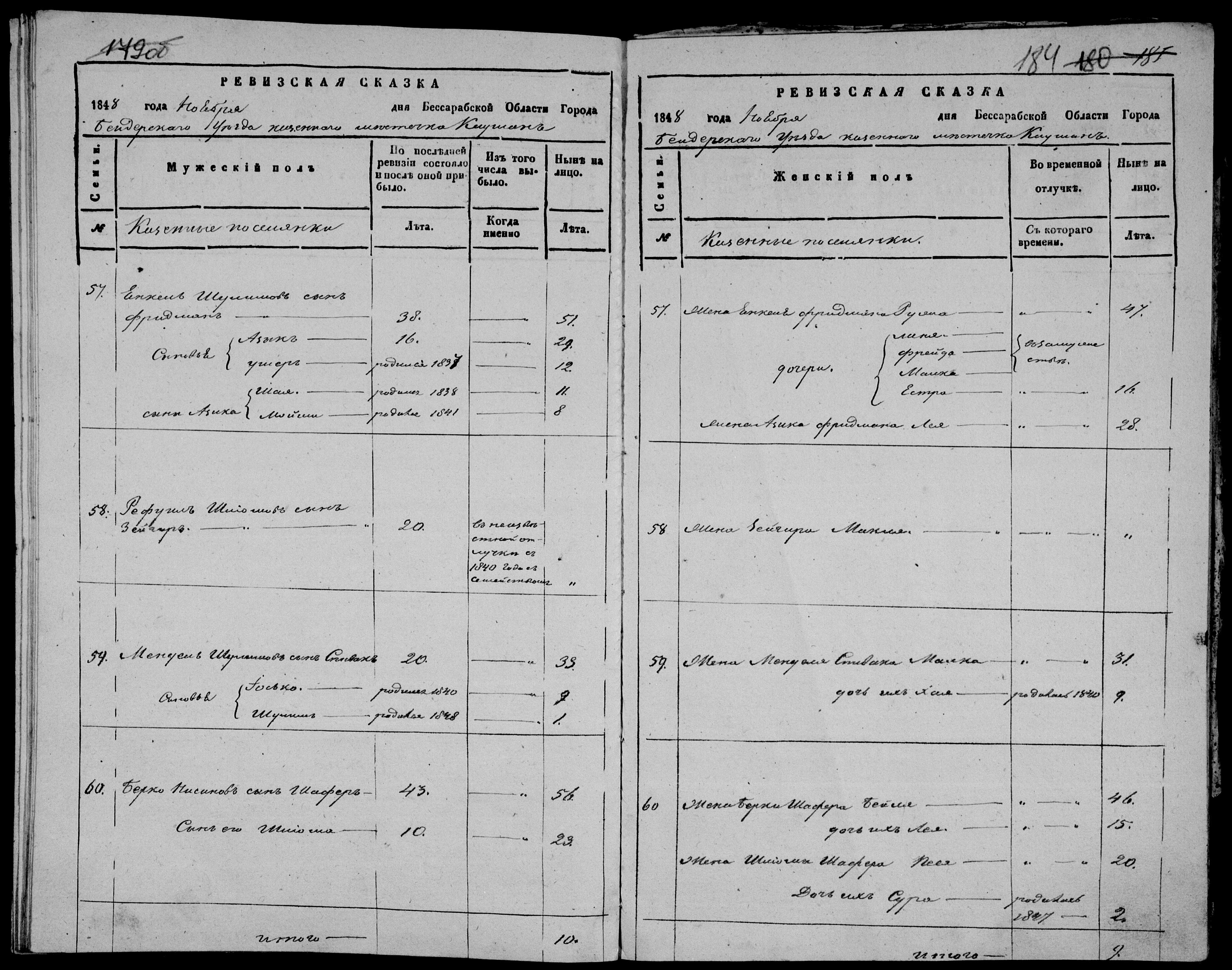
1848: Kaushany, Bendery uezd. Very good handwriting.

1848: Kaushany, Bendery uezd. Last page with signatures of four Jewish community members in Russian and Yiddish.
Acknowledgements
Translators, Transcribers, and Validators: Emilia Alexeeva, Galina Antonova, Patrice Bensimon, Sasha Berkovich, Yackov Berkun, Vladimir Bokser, Mark Chulsky, Yuriy Daylis, Milla Donet, Victoria Farahan, Sheli Fain, Banai Lynn Feldstein, Elizabeth Fortun, Lara Friedzon, Leonid Fruman, Janet Furba, Bianca Gamarnik, Svetlana Ganik, Eti Ganin, Deborah Glassman, Igor Gory, Genny Imas, Gary Khusidman, Mike Glazer, Svetlana Kononov, Talia Kogan, Martha Koster, Yoni Kupchik, Terry Lasky, Sammy Lerner, Michael Levin, Alan Levine, Julia Lombardo, Julia Maksimova, Alex Martin, Leonard Meleger, Misha Massov, Marina Medvedovsky, Juliana Murray, Vladimir Oksman, Nick Perper, Anna Pevsner, Olga Potap, David Price, Michael Richman, Anna Royzner, Ella Romm, Alex Rusakovskiy, Tamara Rushansky, Mitja & Sasha Sherman, Irina Shikhova, Avi Shteinberg, Elena Shturman, Maya Smundak, Polina Spector, Claire Stuart, Alan Shuchat, Felix Tsedulko, Ira Tulchinsky, Inna Vayner, Evgeniy Veretennikov, Ada Voskoboynik, Ilana Voloshin, Eugene Weinstein, Liliya, and Yefim Kogan.
Claire Stuart dedicates her work to her grandparents, Jacob (Yankel) and Anna (Chana) Trachtenberg, and to their family members who died in the Holocaust.
Mark Chulsky dedicates his work to the blessed memory of the WWII veterans, MIA, and Holocaust martyrs Shaya, Josef, David, Yuda, Leib, Kalman, Gedaly, Boruch and Lev Chulsky, haKohanim.
Yefim Kogan dedicates his work to the blessed memory of his father Abram Kogan, who inspired his interest in family genealogy.
Sasha Berkovich dedicates his work to the blessed memory of maternal grandparents Simkha ben Nota Polonsky and Khana bat Leib Leikin.
Inna Veiner dedicates her work to the blessed memory of her grandfathers, Boris Dekhtyar and Gersh Vayner, who died in combat during World War II.
Searching This Database
This database is searchable via the JewishGen Unified Search and the JewishGen Romania Database.
To volunteer for this project, you need to read handwritten Russian (Cyrillic) and be able to enter information into an Excel spreadsheet. Contact Yefim Kogan (Project Coordinator).
Databases like this one are made possible entirely through volunteer effort and generous donors.
Support the Bessarabia Research DivisionFor questions, contact Yefim Kogan or the JewishGen Bessarabia Research Division.