 |
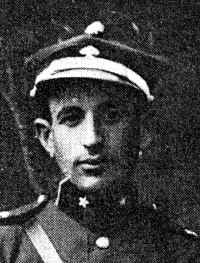
(in a firefighters uniform)
|
|
[Page 365]
Shoshana Nishri – Berkovich
Translated by Rivka Matz (Shoshana's daughter)
Edited by Mike Kalt
At the beginning of the 1930's Volozhin became the district (poviat) town of the region with close to six thousand inhabitants, among them four thousand Jews.
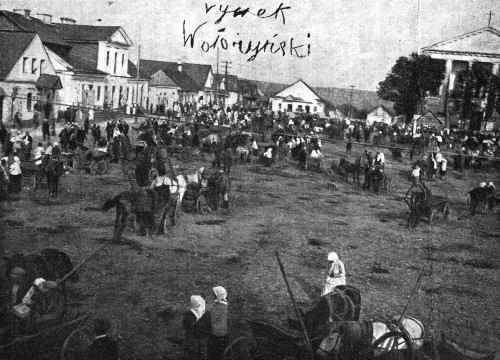
One part of our town was located on a hill. It was called Arooftsoo (uphill). The other part, located on the descent, was called Aroptsoo (downhill). The market square, on the town's center, was in the upper part. It was a spacious square area, which contained mostly Jewish stores and the Catholic Church. All the national ceremonies of the non- Jewish population took place there. (See map in the section “Volozhin Childhood”)
The Christians celebrated their holidays in the city streets. The Polish Independence Day, May 3rd, was very impressive and I don't have enough words to express our sense of jealousy when we saw the joy and happiness on the faces of the celebrants.
Close to the Market Square, on its northern side, were located the Etz Hayim Yeshiva, the Hebrew Tarbut School, and the main Synagogue. The public Christian school, the government offices, and military barracks were located on the its southern side
The market place was filled every Thursday. with harnessed horse carts in which the farmers brought their peasant products, fruits, and hand made fabrics to sell.
The farmers were White- Russians (Orthodox), primitive in their way of life and education. Their garments were unique. The women had long wide skirts, one on top of another. Obviously the nicest was the outside one. They banded their hair with colorful kerchiefs. The men wore embroidered shirts (known in Israel as Russian shirts) and trousers tucked in high boots.
They spent the market day earnings buying holiday clothes and other necessities. They ate their meals on the carts. The main nutrition was pork fat, bread, milk, and potatoes, accompanied with strong vodka.
During market day there were many drunkards who could hardly stay on their feet. Most of them kept quarrelling and cursing. Many times these exchanges ended in fights.
White Russians lived also in the suburbs; most of them in Ponizhe on the eastern side of the town.
[Page 366]
They were influenced by the city atmosphere and were more educated. The bureaucracy was composed of local and western Poles.
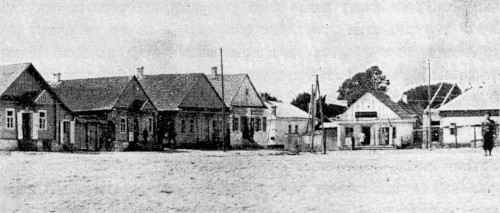
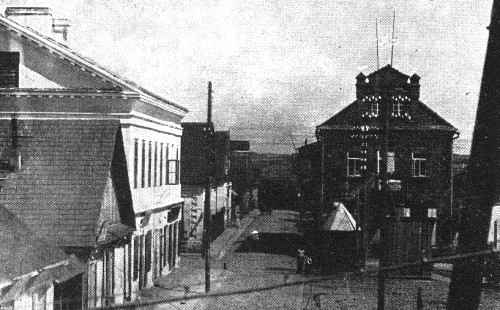
Most of the houses were single floor buildings constructed from wood. The houses were surrounded by vegetable gardens. Many houses had cowsheds in the yard and the cow's milk was consumed by the owners. The vegetables were stored in caves, kept fresh by the cool temperature. There were also a few two-story houses near the market. There were some buildings with a room in the attic. In one of them dwelled the musician Mr. Ratner, with his wife. He organized a string orchestra in the Tarbut School and the firemen's wind orchestra. In the other house lived my family. The nicest buildings in town were the Government and Military buildings. They once belonged to Graf Tishkevitsh, whose estate included Volozhin.
There was no running water in town. Water was carried in buckets from wells. A pair of buckets attached on a rod, which was carried on the shoulders, and brought home. The water was kept in barrels, which stood near the entrance during summer. In winter the barrels were placed in the kitchen, to prevent freezing. There was no bathroom, no bathtub, and no shower inside the house, so people bathed in the municipal public bath house. Once my father tried something unusual--he ordered a bathtub made of tin and we filled it with hot water from the stove. This procedure was very tiresome and long. That is why a few family members bathed in the same water, first the women, later the men. Finally we decided that it wasn't worthwhile and for the time being, we continued to visit the public bath-house.
|
|
(in a firefighters uniform) |
|
|
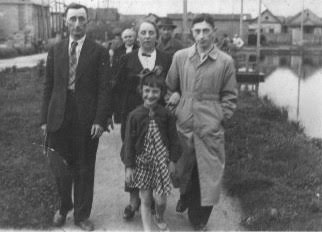
Berkovitsh's (author parents) house the fourth from left |
[Page 367]
The stoves were built from bricks. One stove “Aristocrat” was covered with china, and was used to heat the appartment. The second, a simpler one, was in the kitchen and was used for cooking and baking. The housewife, even though she dedicated much time to raise the family and contribute to the income, found time to bake during the end of the week. A special homemade bake was the “Bonda” kind of bread made of chopped potatoes with flour and yeast. They baked the “Bondas” in special baking boxes, and to prevent sticking, they used to spread big yellow leaves at the bottom.
Some families baked regular bread. The ingredients they baked with were eggs, flour, milk, butter and sometimes jam. We never knew chocolate or cream cakes. The jams were made by the housewife herself. In the forest fruit seasons, the female farmers came with buckets full of raspberries and black berries, which they picked in the forests.
In those times the housewives stood near the stoves in front of the “Mednitzes” (wide, flat brass bowls specially made to fry jams). Those bowls had a stand (Dreifus) ,and they stirred the fruit mixed with sugar.
We didn't know about refrigirators or ice coolers. It was necessary to cook daily. Truly our mothers' lives were tough. We, their sons and daughters, often wonder about their diligence and work ability.
Electricity was introduced only in 1925. Before it, the houses were lit by kerosene lamps, and the main streets were lit by kerosene lanterns. Hand lights were made with candles and only few had battery-operated lights.
The city had a large public park; a large part of it contained fruit trees. A small shallow creek ran through the city, it was called Volozhinka. The townspeople enjoyed dipping and swimming in it. The bushes around it were used as “changing rooms”. On the side of the main street was a nice lake which was frozen in winter; its surface was used for ice skating. People skied also on the surrounding hills. Sleds were used at the crossroads of the streets that connected the upper and the lower part. It filled the Jewish youth with joyous occupation. It was a small low sled for two riders with their feet outside from both sides of the sled. The feet guided the sled like oars of a boat. A third person pushed the sled down.
The main street was called Vilna; it started from the center in the direction of Vilna,
[Page 368]
the nearest big city. The streets were covered with irregular unpolished cobblestones and walking or riding on them was difficult. The sidewalks were made from wood. The building owners themselves kept the sidewalks and the adjacent roads clean. The public places, like the market, were cleaned by workers. The shopkeepers who sat in their open stores got warm by the “fire top“ - a pot full with burning coals.
Few buses and cars appeared; and then only in the thirties. Before that, the horse cart was the only means of transport. The train station was 17 km away, and people went there by horse carts. Any ride to the near cities and villages was by cart, because there was no train or bus service.
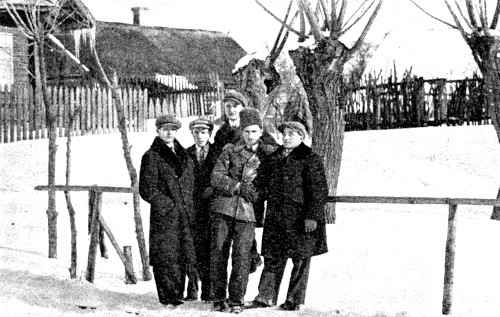
The climate was almost northern. Rain fell also in summer. Fall rains were heavy. In winter snow fell frequently. Deep snow covered the earth. People wore warm leather boots to keep their bodies warm.
Commerce was the main source of Jewish income. Most shops were owned by Jews. The trade in linen was important economically. Flax grew in the fields near Volozhin. The businessmen sent it as raw material to the big cities.
Cultural life in this time was scarce, despite the thirst for knowledge. Youth education usually ended in elementary school; only a few went to Vilna to continue their studies, because tuition and life in the city were expensive, far beyond the possibilities of many.
Very pleasant memories are bound with the Matza baking. The baking took place in private homes, which were evacuated during the days between Purim and Passover. In one room was prepared the dough. In the big room of the apartment, girls sat on two sides of a long table and used to round the dough and cut it into Matzot. The Matzot were baked cooperatively. The work was done precisely and the Matzot were tasty. A part of the Matzot was prepared to make Matze-Mell (Flour) mostly for kneydlakh (dumplings). These Mazot were crushed with a pestle in the “Stupe”, a wooden recepticle of conic shape. The ones who were lazy were threatened by not having Kneidleich.
Volozhin Jews were united in times of mourning and trouble. As I said before, the houses were built of wood. The roofs were made from wood tiles. Some roofs were of straw. When a fire broke out (a most difficult and frequent disaster) it spread quickly. Its location and extinguishing was difficult.
[Page 369]
It required quick action of many people. Our city people always acted with devotion to save human life and property.
When a person died, almost all the town inhabitants participated at the funeral. Crying and wailing, they accompanied the dead. As much as mourning was everywhere, so was also the joy. A wedding in the town was a source of joy for everyone. The wedding started generally in the big room of the bride's parents. The bride would sit in a chair, on her head a white veil, and on both her sides stood women who were relatives and friends. The groom, who waited at his parents' house, went to the bride's place accompanied by his nearest men. There they greeted him with “Mazal Tov”. After that, the bride and groom walked at the head of the crowd, accompanied by musicians (Kleizmers) to the chupa ceremony. At the end of the ceremony, the couple went to the “party house”. At the entrance, two women raised trays above their heads. On each tray were candles and large cakes. Inside the house, tables were set with all kinds of homemade delicacies. Food and delicacies were also distributed among the kids who gathered around the house. On Saturday, the bride went to the Synagogue. In the evening there was a dance ball; most of the young people participated in it. They danced until dawn. For seven days (”Seven Blessing”) the participants continued to celebrate among the family.
The feeling of a common destiny and mutual assistance was one of the most admired qualities which our parents possessed. Their descendants desire to imprint those superb qualities among their children.
Pesach Berman
Translated by Meir Razy
Donated by Anita Frishman Gabbay
“I will remember and pour out my soul”:Psalms 2:5
“I had tears in my eyes day and night”:Psalms 2:4
The Volozhin legend
At times, I think of it as if it were all an illusion and Volozhin itself some lost mirage. It appears as a noble world where reality existed in a different dimension. Then, the pain stabs my heart, reminding me of all that was lost; the Torah sages, the Torah learners and all the simple, ordinary, everyday people.
Now, after everything has literally gone up in smoke, their lives came back to me as if in a dream. I see them and hear their plea to set down their lives in writing so that their existence once filled with so many joys and sorrow, will not just disappear. Therefore, I shall write the Volozhin story for everyone, a legend for both adults and children.
Rabbi Yaakov Shapiro and Simchat Beit Hashoeva in the YeshivaWhenever I think of Volozhin I remember the enlightened personality of Rabbi Yaakov Shapiro Z”L, who was loved by everyone in town. He was a member of the Volozhin rabbinical dynasty that had started with Rabbi Chaim of Volozhin. Rabbi Yaakov was the son of Rabbi Raphael Shapiro who married, in succession, Sara, Resha and Dreizel, the three daughters of the NATZIV (Rabbi Naftali Zvi Yehuda Berlin).
The festival of Simchat Beir HaShoeva was a happy celebration, indelibly linked to Rabbi Yaakov in my mind. We, the students of the Yeshiva, used to go to his home, carrying lamps at night, to bring him to the Yeshiva. We carried him on our shoulders, a Chuppa–like canopy over his head, singing and dancing all the way. The entire town's Jewish population celebrated with us and the Rabbi's face shone with happiness.
My heart still pounds when I think of the celebrations that followed inside the Yeshiva. The teachers and the students were singing during the HAKAFOT (dancing with the Torah) and I remember the voices of Motel Traber, Leibel Klachker, and that of my cousin, Rabbi Shlomo Kozlowski, who had made a special trip from his own Yeshiva in the town of Mir.
The celebration peaked when Chaim “the tailor” gave everyone an apple. He had the “right” for doing so. He used to buy apples from the owners of the apple orchard, hide the apple boxes inside the synagogue and finally, distribute them to everyone.
[Page 371]
Rabbi Chaim was a remarkable person. He participated in all the charities, was a member of many committees and was the Treasurer of the Burial Society.
Groups of Scholars
|
|
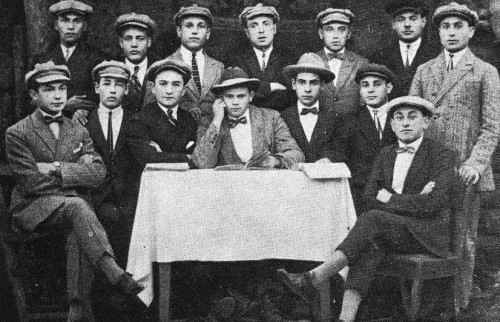
Standing (right to left): Moshe Golob, Motel Traber, Moshe–Simcha Traber, Shmidt (from Vilna), Margolin, Chaim Bergman, a Student from Slabotka Sitting: Herchel (from Rakov), Yoseph Goldstein, a Student from Lomza, Meir Berniker, Tkatch (from Grodno), Arie Charutz, Leinel Perski (from Klatzk) |
I would like to mention some of the students of the Yeshiva. The head of the Yeshiva at that time was The Gaon Rabbi Yitzhak Weinstein (we wish him a long life), and under him studied groups of scholars. One of them was Motel Traber from the town of Trab (Traip). He was one of the outstanding graduates of the Yeshiva.
Another important person was Rabbi Yehuda Avraham the Slaughterer, who was very old. As a young man, he met the NATZIV. The walls would tremble when he raised his voice, calling “holy” during prayers.
[Page 372]
I remember the visit of Daniel Perski Z”L, a famous writer who was a relative of the slaughterer. Rabbi Avraham welcomed him with the “Shehecheyanu” blessing, thus greeting his relative who had just come from Eretz Israel.
|
|
I remember the beautiful sundial that was built on the East wall of the Yeshiva building. It had a large hand and black numerals. Over time, the outside of the building deteriorated. One day Mr. Yoseph Sochobolski of Bialystok, who had once been a student in the Yeshiva and later on became a prosperous contractor in the U.S.A., revisited our town. Seeing the condition of the building he paid for the necessary renovations, including its outside appearance. This made the sundial even more striking and distinctive.
The Great Synagogue stood on the east side of the Yeshiva while the house of Rabbi Yaakov Shapiro stood on a hill to the north. Next were the homes of both Naphtali Arotzker, a bookbinder and owner of the stationery and newspaper store, and of Pesia Bakshet, whose food store fed the students of the Yeshiva.
Rabbi Yaakov Shapiro's House, his Death and FuneralWe all remember the wedding celebration of Rivka, the daughter of Rabbi Yaakov Shapiro, to Rabbi Chaim Walkin, a son of the rabbi of Pinsk. We remember the groomsmen, dancing in the streets, accompanying the couple on their way to the wedding ceremony. The wedding party included a non–Jewish couple dancing in front of the wedding couple, holding two buckets of water. The young couple was both tossing coins into the water for good luck and happiness.
The Rabbi's house was large and spacious and when I entered, I felt the holiness and awe of the surroundings. The Rebbetzin asked me what I needed, which was always a Kashrut question my mother had sent me to ask. I remember one very serious question. My mother had bought meat for Passover and unintentionally placed it a non–Pesach towel. She wanted to know if that meat was still ‘kosher for Passover’. The Rabbi answered that if it was not yet salted and washed with water – it is kosher.
|
|
Rabbi Yaakov Shapiro was not a healthy man and was under the medical care of Doctor Avraham Tzart. The doctor did all he could but the Rabbi's condition continued to deteriorate.
[Page 373]
At some point, the doctor decided that the Rabbi needed to see a specialist in Warsaw. Although it was a Saturday, the rabbi and the doctor took the bus due to “Pikuach Nefesh”. After his condition improved somewhat, they returned to Volozhin. Unfortunately, the rabbi's condition continued to deteriorate. Once more he went back to Warsaw but there he passed away.
|
|
The news of the Rabbi's death spread quickly across Volozhin and the neighboring villages. The leaders of the community wanted to bury him in the local cemetery. The government insisted that his body would be transported by a dedicated vehicle. An agreement was reached and his body left Warsaw.
All the businesses were closed while the citizens gathered at the town's entrance. Some people climbed on top of the tall monument to watch for the approaching bus.
The town's leaders, headed by Rabbi Israel Lunin, went to meet the bus. They unloaded the casket and carried it on their shoulders to the Rabbi's home. Rabbis and yeshiva students from Volozhin and the surrounding area came to pay their respects. The next day, the casket was placed in the Yeshiva while many people gathered to eulogize the Rabbi.
[Page 374]
The casket was then taken to the Great Synagogue where the Chazan performed the funeral service. Rabbi Yaakov Shapiro was buried in the section dedicated to Volozhin Gaonim.
|
|
In his famous poem, Hamatmid (the Eternal Learner), Bialik wrote that the daughters of Volozhin were redheads while the women of the surrounding villages were “full and fat”. Our national Poet distorted the image of the young Volozhin women, but I want to write about all the young people of Volozhin. Who formed its spirit? Who ignited the desire for Eretz Israel? The answer is: the teachers in the Tarbut schools and the Guides and troop leaders in the different Zionist youth movements. I can see the mentor and math teacher Chaim Golovenchick (and wish him a long life). When he moved to Montevideo before settling in Israel, his departure from Volozhin was hard on his students. I also remember other teachers: the science teacher Binyamin Shishko, Moshe Bram who taught us the Polish language and Chaim Portnoy, the Hebrew teacher.
[Page 375]
I remember the building of the Tarbut School, the heating stoves that kept us warm in winter, and Mania, the Christian housekeeper, who kept the classrooms impeccably clean. I fondly remember the punishments we received for not completing our homework. There were different penalty levels, from standing in the corner of the class facing the wall to copying ten pages from the textbook. These punishments were trivial when I think of the pleasure of learning. The school was the place where we developed our love for Zion, desire for Jerusalem, and dedication to the Hebrew language. Our Student Council had passed a resolution that a student caught speaking any language other than Hebrew would pay a fine and that money would be donated to the Jewish National Fund.
We must remember the sacred work of the Melameds (teachers for the younger grades) in the Hederim and the Talmud Torah Schools. For example, Rabbi Bezalel “the Melamed” was an excellent teacher who taught young children everything from Aleph–Bet to the three main parts of the Bible: Torah, Prophets and the Writings. His home was modest and he instilled respect and a sense respect for the holiness of the printed page of Jewish books. He taught us that torn pages of Holy Books are sacred and must be buried in a proper ceremony. He taught us to feel for the poor, the lonely and the neglected and that they too were created in God's image. Above all, he taught us to respect our parents.
This teaching bore fruit. Each Thursday, at the end of the Market Day, we collected the money that the merchants had set aside to help the poor. Rabbi Avraham Itche Schwartzberg dedicated his time to the “Bread for the Poor” Charity, an organization that fed people in need in Volozhin.
The Zionist Youth Movements and the Love of Eretz IsraelBEITAR, Hashomer Hatzair (the Young Guard) and Hechalutz (The Pioneer) youth movements collected donations for the Jewish National Fund. The money was used to buy the land where houses would be built, orchards planted and roads paved. All of this was for the one purpose: resurrecting the State of Israel. People rejoiced when some of us immigrated to Eretz Israel. However, we feel our pain that our parents, those who had instilled the love of our country in us, did not survive to enjoy it.
Some days were special. These were the days when young men and women left town on their way to Eretz Israel. The town escorted them to the train station, dancing in the streets, believing the Messiah would soon be coming.
[Page 376]
I remember the departure of Moshka Rogovin, Etel Shacker and Fania Kivilevich. The departure of my brother Shlomo is etched in my memory too. A long convoy of horse-drawn carriages, full of his friends, all of them singing, came to see him board the train.
The convoy made a stop in front of the home of my grandmother. With tears of happiness in her eyes, she said, “all my life I prayed for this day”.
Purim and Pesach in VolozhinPurim is not one of the three main Jewish Holidays, but Purim was a major Holiday in Volozhin. A spontaneous “ad–lo–yada”, the Purim parade and carnival developed as young and older people put on costumes, walked in the streets and sang their song near different houses: “Today is Purim, tomorrow it will be over, give me a nickel and chase me away”. They dedicated the collected money for buying land in Israel. The reading of the Megilah (the book of Esther in the Bible) was a happy event, especially for small children. Everyone stood at attention holding our clappers and pistols, ready to make a lot of noise when the name of Haman was read.
What type of pistols did we have? We took a large house key, filled its cavity with heads of matches and inserted a large nail to block the cavity. When this device was swung against the floor, it caused the matches to burn and explode. This produced a loud bang while the smell of burning filled the synagogue.
Several weeks before the start of Pesach, its holiday atmosphere began to descend over the town when people started baking their matzah. Many people volunteered to help. Some were rolling the dough, some were marking the holes, some carried the flour, some mixed it with the water, and others packed the matzahs in special baskets that protected them from Chametz. The baskets were kept in locked storage or on top of cabinets and dressers until the Holiday.
The night before Passover was special. We slept on the floor on a layer of straw. The beds were washed and “Kosher” so we were not allowed to even touch them. We could not use the plates and utensils that were ready for the SEDER and everyone just grabbed something to eat.
The morning before Passover arrived was the time to search and burn the Chametz in the house. All the Chametz was collected in one place. The rooms were kept dark and father lit the special candle used for the search. With a big ladle in his left hand and goose feathers in his right hand, he recited the blessing “who ordered us to burn the Chametz” and checked under the tables and the cabinets. He knew, of course, he would not find any Chametz there.
[Page 377]
I am longing for the special cooking pots used to make kugel and Kramzalach, the different nuts that our parents kept out of our sight. I remember the special sweet raisin wine that was made in the attic that we children used to sneak into and taste.
The Food We Used to Eat in VolozhinDuring the year, we drank pure cream that was made of milk, not yogurt, which was stored in large clay jars. Lazar “the Baker” and his wife Fruma baked wonderful breads and semolina rolls. Other bakers were Yoseph Ribels and Sheina Lunin, the wife of Rabbi Israel.
The supplier of fish was Rabbi Gershon “der Bunier”. His fish were not always very fresh and frequently people felt sick after eating them. He used to have many “special sales” trying to get rid of smelly, deteriorating inventory.
Bread Winning [Livelihoods] in VolozhinMost of the Jews in Volozhin earned their living in trade, shopkeeping or peddling. Most of the activities took place in the market on Market Day each Thursday. The peasants sold linen, wheat and buckwheat, milk and milk products. Jews did not trust the Kashrut of the milk so every family kept a cow and hired a shepherd who led a group of cows to the hills outside the town. It was nice to see how each cow knew which way to return to the right “home” at the end of the grazing day.
During the summer, people collected berries and hay for the cows' winter feed. In winter, people used to warm bricks on the in houses' stoves and place them next to the cows' feed in order to keep it warm.
Different stores stood in the market area. Each store specialized in a particular set of products and merchandise, from shoelaces to herring, to stoves and glass jars. One special store sold glass plates for windows. The peasants would bring their windows and the glassmaker replaced the broken panes in the store. I loved the screeching sound of the diamond cutting the glass.
[Page 378]
|
|
[Page 379]
The shopkeepers wore heavy winter coats and carried shawls around their necks in winter, to protect themselves from the cold wind that came through the open doors. However, these measures were not enough and every store kept a “firetap”, a pot full of smoldering coal. The men wore special boots made of wool or felt.
There were two hotels in town. One belonged to Eliyahu Moshe Brodna, and the other – to Shlomo Chaim Brodna. Many clients of the hotels were merchants who came to town to trade timber, linen and agriculture products. Many important deals were signed in these hotels.
People got water from deep wells. One well was at the Market near the home of Itche Rogovin. Raising water from the well was not an easy task. People had to pull up a bucket full of water, tied to a rope. The rope regularly tore and the water supply operation ceased until a volunteer descended into the well and brought the bucket back. In winter, ice formed around the well and presented a serious risk of slipping or even falling into the well. I remember the yoke that people used in order to carry two buckets as well as the large barrel that stood in our kitchen and the copper cup we used to ladle water from the barrel.
At some point, a man named Herschel “the water pumper” started a business delivering water. He placed a big barrel on a cart that was pulled by his horse, and started selling water “by the bucket”. The horse, which was blind, had been very cheap to buy. The women of the town started praying for the health of Herschel “the water pumper” as well as that of his horse.
Mutual Aid of the Jews of Volozhin
The brotherhood of the Volozhin Jews touched the heart. Here are just a few facts. Reb Shlomo-Chaim Brodna's inn would host the draft committee. The shkotzim [a derogatory term for gentiles] of Volozhin and the area also appeared before the committee. The days of appearing before the committee were days of fear and terror for the Jews of the city. After they were found to be fit to serve, they were given permission to drink vodka. After they got drunk, they ransacked through the streets and also broke into the houses. At that time, Volozhin looked like a city under siege.
When a Jewish lad appeared before the committee, especially an only son, or the son of a family with lots of children, and was found fit for service, the Jewish of the city raised an uproar in order to free him from army service, or at least to obtain a deferral (srotzka). If all this did not help, and he was taken to the army, he would be received with warmth and love when he came home for the Sabbath or for a vacation for the holidays.
There was an army camp in Volozhin in which Jewish lads from various cities of the country service. A kosher kitchen was set up for those soldiers. When the kitchen was closed on Sabbaths and festivals, the soldiers were invited to celebrate the festival in Jewish home, and thereby to somewhat assuage the sadness and longing for their homes and families.
[Page 380]
Love for one's fellow reached a very high level during the period of the smuggling of Yeshiva lads from Russia to Volozhin. Many Yeshiva lads desired to study in an “Upper Level Yeshiva,” and would therefore cross the border and come to our city. Crossing the border usually took place on Thursdays, so that they would be able to arrive in Volozhin for the eve of the Sabbath. Many of them were caught by the border guards and imprisoned in the Volozhin jail. My father, Yitzchak Meir, took advantage of his good connections with the authorities, and freed the arrested people. However, it was necessary to sign an appropriate document of guarantee in order to gain their freedom. I recall that my father refused to sign so as not to desecrate the sanctity of the Sabbath, but Rabbi Yaakov Shapira permitted him to do so, for the commandment of redemption of captives overrides the Sabbath.
The trait of tending to guests was rooted in the hearts of the Jews of our city. Rabbi Yaakov Shapira implanted this trait within us. He imbued us with the concept of tending to guests. When we left the Kleizl or the Great Synagogue after the service of welcoming the Sabbath, we would see indigent Jews who were not local. The look on their faces made it clear that they were waiting for a house and a meal. The shamash would bring these guests to various houses. No such guest ever slept outside in Volozhin. At times, a householder would complain to the shamash about why he was eating his meal himself on the Sabbath, without a guest. Great was the Jew of a Jewish Volozhiner when he merited to host a scholarly guest.
Words of Jest
I will conclude my memories with a joke. An elderly charity collector named Velvel Leib lived in the women's gallery in the Kleizl. He would exchange earnings from the market day for money documents. He would keep his entire “treasure” between the pages of the Gemara in the synagogue.
The following story is told about him: Once he went to Zabzeze to collect donations. He felt weak along the way, and lay down to take a nap. He placed his shoes pointing toward Zabzeze so he would not lose his direction. He turned about as he slept, and his feet pointed toward Volozhin, without him noticing. When he woke up, he went in the direction of his shoes, and returned to Volozhin. However, he was certain that he had arrived in Zabzeze. Reb Velvel was surprised that the landscape looked the same, and that the Jews of Zabzeze are as similar to the Jews of Volozhin like two drops of water. He groaned and said: “If I did not know that I was in Zabzeze, I would say that I was in Volozhin.”
By Yaakov Kagan of Tel Aviv
Translated by Jerrold Landau based on an early translation by Moshe Porat that was edited by Mike Kalt
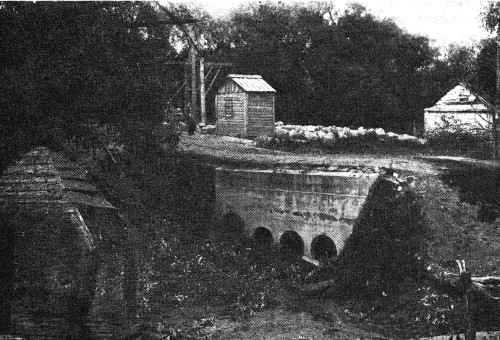
The source of the river is from the area of the Brilki village, about three kilometers from Volozhin. It crosses the fields of the town of Hordinovo and the Shapoval estate and arrives at the suburbs of Volozhin (Moszczyki Street[1]). It crosses a section of the area at the edge of the city, where on one side is Polak's gristmill, and on the second side several houses, including the Aroptzu Synagogue. Its waters reached Pilsudski Street. There was a bridge on that street that connected the two sides of the city. Rappoport and Perelman's gristmill stood next to the bridge.
The river continued parallel to Novogroski Street on one side, and on the other side, it passed the military sports field. It continued flowing to the village of Kelvitch, until it emptied into the Islatch River. A rivulet flowed into the river (the source was in the village of Bondara) in the area that crossed Moszcyki Street).[2]
The Minsk-Vilna trail passed over a wooden bridge constructed over the river. The creek continued to flow southwardly between Ponizhe on its left and the Military sports stadium on its right side, then through the Kelvitsh village until it emptied into the Yislotsh River, fifteen kilometers from town.
The river served an important role in the life of the residents. It served for bathing and also for washing laundry.[3]
|
|
Standing (right to left): a) Shabtai Baksht; b) Yisrael Berkovich; c) Hillel Sharira; d) Barich Mordehai Meirson; e) Efraim Rogovin |
[Page 382]
The villagers would beat their flax on its banks. Those who lived on or close to its banks would wash and polish their household items there.
The river was shallow. Children could also bathe there without danger of drowning. However, before Passover, with the melting of the snow, its appearance changed. It became strong, its waters overflowed its banks and flooded the nearby houses.
The deep areas of the river were a bit far from the city. In the summer, it served as an area of pleasure. Many of the residents of the town when there to enjoy water sports. The village of Hardinova, next to the river, would treat the bathers to its good fruit.
The shore was primitive and neglected. Tall shrubs grew on the banks, which served as a dressing room for people to get undressed and dressed. At the beginning of the 1930s, when a military unit was set up in the city, the local authorities turned their attention to improving the shore of the river – to the pleasure and benefit of the soldiers. They deepened the land of the river and built a dam to separate the deep water from the shallow water. That is where the gentiles bathed, men and women together. It served as a place of enjoyment for swimmers and lovers of water sports.
On the Ten Days of Penitence, it also served holy purposes, for purifying the soul. On Rosh Hashanah, the Jews of the city would gather there for Tashlich.
The river also has some sad memories. There is an ancient Jewish legend that the river claimed a victim every year. If anyone bathed there during the period of Sefira[4] and the river swallowed him – it would be seen as a confirmation of the legend. I recall the drowning of Devora Perski. The deep area of the river was not fenced, and there was no sign there warning about the dangers of drowning. Dvora entered the water and disappeared immediately. They pulled her out dead.[5]
Translator's footnotes:
|
|
Mr. Yani Garber, the first Volozhin Judenrat head, the first victim shot on the first mass slaughter –October 1941, walking on the Sazhelke borders with his son Dania (the pianist) his sister in law Etia Perlman and her daughter Sonitshka. Behind them, Yani's mother in law Malka Perlman -Itskhakin (Rabbi Itsele's G. Granddaughter) with her son Yossif Perlman |
The three mass slaughters on the Volozhinka borders -Translator's note
The Nazis created the Volozhin Ghetto on the western shore during the summer of 1941. They accomplished the first mass slaughter at the Sport Stadium on the same shore to the south in the autumn of the same year.
The Volozhin Jews spent the winter of 1941 in relatively quiet conditions, enclosed in the Ghetto, where from they could see the last snow-thawing flood of their life.
Some days after that flood, when the roads became passable, an SS team did a reconnaissance tour in Volozhin. They looked for a place for the “Great Execution”. They found it near the ancient Jewish Cemetery, on the Volozhinka's rivulet. The main mass slaughter of 2,000 Volozhin Jews took place on the Volozhinka western shore a month after the spring flood, on May 10, 1942.
In the third (last) mass slaughter, the Nazis executed the remaining 300 Jews from the second great shtetl near the Veehon, on the east shore of the Volozhinka riverbed, in August 1942.
The Volozhinka river carried away with its waters a large amount of innocent Jewish blood and ash. Return
|
|
JewishGen, Inc. makes no representations regarding the accuracy of
the translation. The reader may wish to refer to the original material
for verification.
JewishGen is not responsible for inaccuracies or omissions in the original work and cannot rewrite or edit the text to correct inaccuracies and/or omissions.
Our mission is to produce a translation of the original work and we cannot verify the accuracy of statements or alter facts cited.
 Valozhyn, Belarus
 Yizkor Book Project
 JewishGen Home Page
Copyright © 1999-2024 by JewishGen, Inc.
Updated 24 Jul 2023 by JH