 |
|
|
[Pages 577 - 582]
By Sarah Chinsky (née Eckstein)
Translation from Yiddish by Irwin Keller
The tragically destroyed hometown, “Kolonye Izaaka” lay 14 km from Sokolka, between Amdur and Krinek.
She numbered 30-40 Jewish families: two families Epshtayn, three families Kapusta, Treshtzianski, three families Ekshtayn-Shteyerman, three families Ash, Yanovitz the shochet, two Goldshmit, three families Yashinovsky, Knishevitsky, and more.[1] Over these people we will weep eternally.
How beautiful and interesting was the Kolonye and all of the kolonisten – field workers, very few tradesmen. They sowed and reaped, planted, and gathered the beautiful fruits and vegetables. The beautiful apples and pears, red currants and raspberries. Cherry trees with large cherries that already appeared in the month of May alongside the flowering lilacs. The blooming gardens of the “Allee” – as we small children used to refer to the single lane, lined on either side by poplars. Not even in the darkest of night would you bump into a tree. Also the grains, the potatoes, and the hives full of bees that didn't sting you even when harvesting the honey. Everything was lovely and sweet.
I am reminded of the cheder where all of the kolonyer children, large and small, learned communally from the melamdim: Kunsht from Sokolka, Nochum Levin whom we'd call “Nochum Captain Dreyfus,” Kaminsky from Krinek, who came from the famous Kaminsky family – the Yiddish theatre players – and others. Each of these would teach and live in the Kolonye, and thanks to the good room and board offers they'd receive, they didn't go back to their families for Shabbos. We would assemble on Friday night indoors and learn the weekly parasha, or read aloud a book of mayses, Afterward, the teacher would go on to retell it. In this way the teachers used to inform us about the Land of Israel. Then Chemiel Sochanitsky and Meyshl Knishevitsky would go around with the pushke for Keren Kayemet (Jewish National Fund), collecting pennies for the Land of Israel. And I always used to see the smile on their lips and hear their words: “Jews, give something more so you can come to the Land of Israel!” However, because 'lo kol adam zocheh' (Hebrew: “not everyone is so privileged”), they themselves did not, sadly, live to see it.
I recall the beautiful custom of Shabbos, which each Jew believed in, heart and soul; how despite the tough conditions under which we lived, no sooner had candles been lit when all the Jews would run into the shul, and all of the work – for instance milking the cows, heating the yeast, warming up the houses in winter – would go to Gentile hands, for a slice of Jewish challeh and a plate of tsimmes. When a child would be playing on the road and would find a penny, the adults would not allow Shabbos restrictions to be lifted. Instead they would place a pebble over the spot to mark it until it became “not-shabbos.” Shabbos morning, leaving synagogue, one used to go in to the family to make Kiddush and eat cholent. And after that a Jew goes to rest! However, where does a kolonyer Jew rest? In the orchard under the trees or in the barn on the hay. In the evening the kolonyer women would sit on the threshold and the men would go to mincheh, listen to a maggid who would come from the province, and every kolonyer Jew was interested in bringing home a Shabbos guest.
Meanwhile we young people, on whom the lust for life had already made its mark, would look for how to entertain ourselves, for we knew that in just a couple hours it would no longer be Shabbos, and then our parents would turn to the everyday tasks: milking the cows, feeding the ducks and geese, and we girls and boys would gather together and go out to Odelsk – a shtetl 1.5 km from Kolonye, numbering 15-18 Jewish families. We used to meet up there with friends with whom we'd studied in the Odelsk public school. There was no movie theatre there.
I can see Monday right before my eyes: the parents would go off with the fruit, small cheeses and butter to the market in Sokolka. Then each child felt a self-reliance, because each colonist was blessed with several children, and even the small children had to participate in the duty of helping out in everything: the cows, sheep, poultry, gardens and fields, which every day called for much work and great supervision. Every growing child would take pains to excel in the work, so that Mameh and Tateh would be happy when they returned at dusk from Sokolka. With great impatience, we eagerly awaited their return with the good things they purchased there. How delicious were the floured bread with potato skins and herring for which one waited all week! All these friends, comrades every one, perished so bitterly, tragically. I still remember their last words as they took leave of us: “You are going away; by you it's good!” As if they felt the black cloud approaching.
One always prayed to God that everyone should be successful, and that no one should be sick, because we had no doctor among us. Everything unfolded through God's wonder and miracles. If a person became sick, one would run to the old Libeh-Baseh, peace be upon her. She would, with her finger, smear honey down the person's throat. She served as both a doctor and a nurse to us. One used to go to Zayde Itzik-Ayzik[2], may his memory be a blessing, to exorcise an Evil Eye, or else altogether to Chaneh-Basheh for an abomination – that is, a rubbing with the holy bones that she would find on the field. They would be held in a bundle in a white kerchief and with this she would rub the wound and whisper a quiet blessing, and by this act would someone be helped.
Our dear young people numbered, taki, rather few. But appreciate this fully – we drew the attention of all the villages around, and their many young people from around the province frequented our Kolonye. In the evening, when our young men and women were still in the fields, who should arrive for a visit but a whole company of Krinker meydlach and bechoyrim, of Amdurer chevreh, and of Sokolkers. Just as if they had all agreed to organize a surprise for the Kolonye youth. Suddenly, like thunder and lightning it would start, and our youth would come hurriedly back from the field, their sickles and scythes in their hands and with empty waterskins which one used to take with to revive the heart from heat and fatigue. Soon all the youth had assumed a general yontifdik appearance, had greeted all the guests, eaten, drunk, sung and danced until late at night. Then would come the question of how each person would get home. So they would all take themselves out and sleep in the haylofts.
On a day when a simcheh took place on the Kolonye, for instance a wedding, klezmorim would come from Krinek, and the Sokolker photographer Abramovitz or Zalman Stoler. One lived with hope that the tiny Jewish Kolonye – along with her young people – would triumph and be a pride, which would make itself known from a faraway corner of Jewish hearts. But then came the Evil One and scorched and destroyed everything as if it had never been. But they will always be in our memory in the company of our deepest feeling – the sadness of our broken hearts.
It was a simple life of great people on that single road that was called “Kolonia Izaaka.”
Translator's Notes
Gedaliyahu Weismann
The Founding of Kfar Malal
Translated by Selwyn Rose
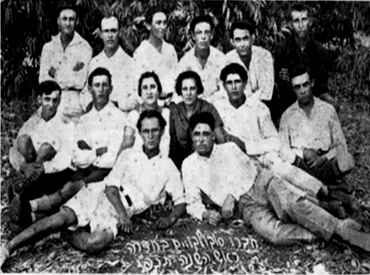
After staying in Kyriat Anavim about a year and a half, the Sokółka group moved to settlement in the Moshav-Ovdim (workers' settlement movement), named Ein-Hai (spring of life), now known as Kfar Malal, named after Moshe Leib Lilienblum. The core group was established while they were still in Hadera by its first members led by Avraham Shapira. Known originally as “Dilb”, our work was reforesting the hills in the area, under the auspices of the Keren Kayemet L'Yisrael.
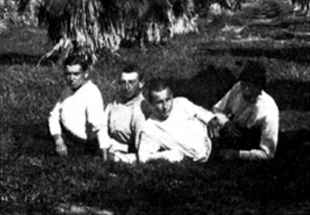
After debates and arguments, Ein-Hai, near Kfar Saba, was chosen as a site for our settlement. Ramata'im and Magdi'el did not yet exist; Ra'anana was building her first cabins. A few of the members left the group and moved to Haifa. The members remaining in Ein-Hai were: Arieh Shapira and Zippora (Kowalski), Avraham Khinski and Mascha Shapira (Z”L), Eliezer Even Stein (Z”L), Arieh Even. Baruch Hayut and Gedaliah Weisman; at a later date, we were joined by Hanna Margalit (Korkt) Avraham and Rivka Korkt (Schmidt).
|
|
We arrived at Kfar Malal with packing-cases large and small, that we used as tables and benches. We had iron beds and everyone had brought from home blankets and sheets, etc. There were already people from the Second Aliya and the Hebrew Brigades and we continued south in the direction of today's Ramata'im.
The land of Kfar Malal was purchased in 1912 by farmers from Petah Tikva from the Bedouin tribe abu-Kishk and is about 10 kilometers from Petah-Tikva. The Arabs called it el-Wawa – meaning Crocodile-den. Tens of dunams (1 dunam=1000 sq.m.) were planted with almonds and groves of Eucalyptus by Arab workers brought from Petah-Tikva. Yehoshua Cheinkin bought for the KKL a large area intended to house a workers' settlement. Each of the workers received 50 dunam to prepare for settlement. When war broke out in 1914, we were forced by the Turks to leave the place and everything was destroyed. When the British conquered the country, a victory in which the Jewish Brigade also participated, a new era began. The Balfour Declaration on one side and the destruction wreaked in Europe by the war, which destroyed many communities in Poland, Russia and Lithuania on the other, brought about the Third Aliya.
In 1919, we built two houses in Ein-Hai because all the edicts from the days of the Turks were canceled. The help of American Jewry was impressive and the Jewish youth of Europe immigrated to Palestine in their thousands, essentially via the “Hehalutz” movement, and in direct response to the Balfour Declaration and the immigration movement, in 1920 the Arab disturbances, which impacted the newcomers as well, began. Among the injured was also one from Sokółka – Eda Levine, in an attack on Ein-Hai from the near-by Arab villages. We had some arms, of course but because of the hostility of the British military police, everything had to be done underground methods and in secrecy.
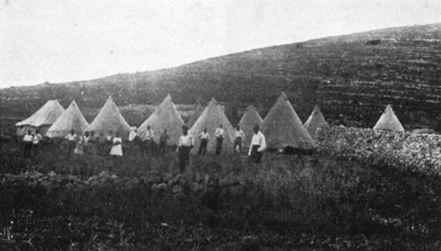
In 1924 we left Kyriat Anavim and joined Kfar Malal. The place was deserted and desolate, the sand came up as far as the knees and the jackals howled outside the tents. Water we brought from Kfar Saba and Ra'anana, where they were erecting their first cabins.
|
|
We each received a loan from the Jewish Agency to purchase a mule. We bought a big plow to work the citrus grove. Twelve pairs of mules were harnessed to a heavy chain that was fixed to the plow. Two of us continued with hard this work from dawn to dark. In the summer, we would sleep in the field alongside the wagons and in winter we would return home, sometimes, in the torrential winter rains. We did work in Ra'anana, Ramat Ha-Sharon, Herzliya and other places. In time, we began to work the land that had been allotted to us, as well. On more than one occasion, the strong winter winds whipped the tents off from over our heads and we found ourselves under the heavens and the torrential rains of winter. The building materials for our cabins we brought from Tel-Aviv on wagons hauled by the mules – about a six-hour journey. There were also incidents of theft and robbery by Arabs en route. It also happened that we erred on the way and instead of arriving at Kfar Malal, we found ourselves in an Arab village. We also had a tragedy: while digging in a Wadi, a large part of the wall
collapsed on Eliezer Even (Stein) and he was killed on the spot. He left behind his wife and a baby and he was among the first group from Sokółka.
In 1929, we planted our first citrus grove. We had a well but no canalization or pipe supply, therefore we hauled water in barrels or buckets. After six or seven years the trees began to yield fruit. The fruit was exported and in place of hardship came profit. We built nice houses, the families grew, the Moshav began to take on a pleasant aspect. The road that ran through it was the Tel-Aviv – Haifa road. Today we are no longer a small group; we have prospered; we have added children and grandchildren and over-all – we won a Jewish State.
|
|
Arieh Shapira, Eliezer Even (Stein) z”l |
|
|
JewishGen, Inc. makes no representations regarding the accuracy of
the translation. The reader may wish to refer to the original material
for verification.
JewishGen is not responsible for inaccuracies or omissions in the original work and cannot rewrite or edit the text to correct inaccuracies and/or omissions.
Our mission is to produce a translation of the original work and we cannot verify the accuracy of statements or alter facts cited.
 Sokółka, Poland
 Yizkor Book Project
 JewishGen Home Page
Copyright © 1999-2024 by JewishGen, Inc.
Updated 3 Nov 2012 by LA