 |
|
[Page 402]
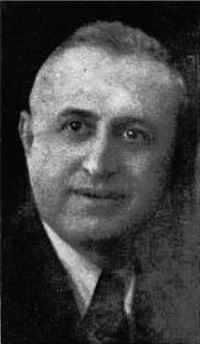
Born in Lida about the date (1890), to father Rabbi Neta, and to mother Ethel.
Translated by Avivit Jacobson and Hagai Frid
His father was one of the most unique characters in the world of street commerce in commercial Karibia [1]. He was one of the most respected wholesalers in the city. He was energetic, straight and honest. He put a lot of his warm and dynamic temperament into his merchandizing. And at the same time he was always busy in other aspects of his life: his public affairs (he built up a company called Mishmeret Cholim “Guardian of the Sick” to help sick, poor people, and he was the spirit of that organization) and mainly was the Cantor in the Synagogue until his death in 1917. His most famous public quote, “if I didn't have to worry about making a living, just think what I could have done for the city”…
This trait, seeing beyond his own benefits for the good of society he, Rabbi Israel Aaron inherited from his father, together with his mother Ethel's gentle and tender character.
In a (Jewish) traditional religious school and later in the (Jewish) house of study, the young Israel Aaron drank from the fountain of ancient Judaism. Together with that, stuck in his heart the new Hebrew literature opened new horizons for him. New and old together blended together without inner conflict.
There was an atmosphere of Zionism in Lida [2]. And Israel Aaron gave himself with all his heart to action. He opened a Hebrew library and for some time, until he found a permanent resident (for the library), he stored it in his family apartment (that wasn't very roomy). This act was illegal! He founded, together with his active friend, Rabbi Hikel Vinshnivsky, the modern tutor, a group called “Lovers of Hebrew Theater” and they organized together Hebrew balls (dances). And primarily he was the living spirit for the Jewish National Fund [3]. When the Tsarist Russian government made the collection for the JNF forbidden the directorate of the JNF was facing a serious problem to continue working within the Russian cities. Collecting money in the major Russian cities became very dangerous because the police had one eye open on all the Zionist businesses [4]. Therefore, it was decided to choose one of the smaller cities near the railway junction. The choice was Lida as a center. And Israel Aaron Shelubsky was the active center for these underground activities. Thousands of boxes came to Lida distributed on trains (camouflaged) somehow hidden, and from there went to every corner of Russia, where there were Jews, under forged documents. After all these actions were extremely dangerous, and more than once Israel Aaron had to leave his house for fear of being arrested. Israel Aaron Shelubsky's name was well known in the Zionist center in Vilna [5] and mainly in Becklan [6] in Germany, which also was the central office of the JNF. In 1913, he participated in the Eleventh Zionist Congress.
It wasn't until 1935 that he fulfilled his childhood dream and immigrated to Israel with his family. The leaders of the Zionists, Alexander Goldstein and Lev Yaffe, remembered his benevolent work and Zionist activities, and by their recommendation he was given a special immigrant certificate to come to Israel. [7]. He succeeded in continuing the work he started in Lida with his great dedication, only now in the new Israel. And there was no end to his happiness and uplifting of his soul [8]. He wasn't satisfied with his usual work routine, but he gave his all above and beyond the call of duty.
He was horrified by the fate of the Jews in Lida. It seems he was the first one who was aware of the need to organize a support organization for the survivors of Lida in Israel. And when it was founded, and even before it was founded, he put all his effort together with the late Rabbi Shlomo Podolsky and the late Yosef Darshan and the rest of the committee (SHIBLA) for the actions of helping the survivors who were displaced persons. He was the first chairman of the organization for the survivors of Lida until his death in 1947.
Translator's footnotes
[Page 404]
Translated by Sara Mages
|
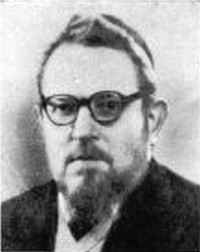
R' Shlomo Podolsky z”l was born in Lida in the year 5668 to his father, R' Nachum, an honest man who made a living from his hard physical work (as a mechanic in Zelig Vilenchik's tobacco factory). He was educated first in chederim[1] and later at the local yeshiva founded by Vaad HaYeshivot[2], under the management of R' Yakov Neiman (now head of “Ohr Yisrael Yeshiva” in Petach Tikva). At the advice of the head of the yeshiva the boy was sent to the central yeshiva, Novardok Yeshiva in Bialystok. Later he studied in Warsaw. In both places he earned a name for himself for his diligence and talents and was liked by his teachers and friends. After completing his service in the Polish army, he wandered again to a place of study - to Mir Yeshiva. Later he moved to Novogrudok [Belarus], this time - to help manage and strengthen the yeshiva that returned to its place of origin, and by then he was already a qualified teacher and was also offered the position of a rabbi in one of the towns. But his desire was Eretz Israel - although he far from the Zionist movement and, for a certain period, he was among its aggressive opponents in the spirit of Agudat Yisrael in Poland. Despite this, he never stopped dreaming of immigrating to Eretz Israel, and when he grew older - he got up one day - and immigrated to the great surprise of the Zionist circles in Lida.
In Israel he immediately found his place in the circles of religious Judaism, first as Reish Metivta (head of a yeshiva) of “Porat Yosef Yeshiva” in Rehovot, and later as director of financial affairs at “Yeshiva Heichal Hatalmud” in Tel-Aviv. He was a man of many qualities, both as a preacher and a man of action and, at the same time, a sensitive man of distinguished character who used his creative talent for educational and public activities. With his organizational skills he greatly helped to the development and the strengthening of “Yeshiva Heichal Hatalmud,” and by the virtue of his personality knew how to influence young and old alike. Under his influence, a wealthy man, who owned a building on Yehuda Halevi Street, volunteered to dedicate his building to the establishment of a religious institution under the management of HaRav R' Shlomo. In this manner “Yeshivat Torat Moshe,” which was intended for immigrating youth, was established. Next to it is a synagogue for worshipers from the surrounding area, an institution that exists to this day. He received every person with kindness and his heart was always open to anyone who needed his help.
With the arrival of the first news about the fate of the Jews of Lida, he was among the first initiators of the Organization of Former Residents of Lida in Israel, and the founders of Kupat Gemilut Hasadim [Interest-Free Loan Fund] to help the few survivors. He took it upon himself to provide help to those in need, by sending packages to the exiles who wandered around the world, and providing first aid to those who arrived in Israel, in the form of loans on favorable terms for their first arrangement.
After the passing of R' Yisrael Aharon z”l, the organization's first chairman, R' Shlomo Podolsky z”l filed this position with devotion and a sense of fulfilling a sacred duty until the day of his passing, on 25 Iyar 5719 (2 June 1959), and he was only fifty-one years old.
Translator's Footnotes
A. L.
Translated by Sara Mages
|
Yosef Darshan z”l was born in 1899 to his father, R' Shamai, and his mother Reizel Darshan (grandson of the “Maggid of Kelm,” famous in his generation, R' Moshe Yitzchak Darshan). He acquired a good traditional Jewish education from the best teachers in the city (R' Ezra Altshuler among them), and general education in Russian from private teachers. During the years of the German occupation he managed the public library (together with his friend, Yosef Shpilkovski, may HaShem avenge his blood), and found satisfaction in this work which brought him closer to the world of literature that he loved. After the First World War he joined his father in his businesses. In 1933 he immigrated to Eretz Israel together with his parents. He engaged in trade: the import of fruit. Later - the supply of various minerals. From his childhood he excelled in his kindness and his honest character which was also revealed in his commercial talents. He was among the initiators of the Organization of Former Residents of Lida from the day of its establishment. He devoted his heart and soul to helping the former residents of Lida wherever they were. First - by gathering news about them and providing information, sending packages of food and clothes, etc. Then, by extending help in Israel in the form of direct aid, or a loan from Kupat Gemilut Hasadim [Interest-Free Loan Fund], which was a also founded with his active participation. Every person from Lida, who needed help, always found an open door and an open heart. He passed away on 20 Adar 5716 (3 March 1956). His wife, Miriam, may she live long, continues his work in the management of Kupat Gemilut Hasadim for Lida's immigrants. He left behind a son and a daughter.
[Page 405]
A. L.
Translated by Sara Mages
Shmuel Bernholtz arrived in Lida when he was already middle-aged and in the fullness of his spiritual development. He grew up outside the city of Lida. In his childhood he was a student in a cheder in his hometown, Ostrów Mazowiecka, and later at Slabodka Yeshiva. In his adolescence he studied at Yeshivat HaRav Tchernovitch[1] (Rav Za'ir) in Odessa, (a place where, among others, he took lessons on Hebrew literature from Bialik[2]). Then - years of self-study on the Torah and education. He excelled in quick perception and a wonderful power of memory, and his knowledge from his youth and adolescence, was well preserved in his memory in a harmonious combination with the education he acquired in his adolescence years. He decided to dedicate himself to teaching, and after a short period of working in elementary Hebrew schools, in his place of residence and in Tomaszów Mazowiecki, he was invited to teach at the Hebrew Gymnasium in Bialystok. From there, he moved to the Hebrew seminary in Vilna [Vilnius]. In 1925, he accepted the invitation from Lida to take over the management of the Hebrew gymnasium “Tarbut” which, at that time, was at the beginning of its development.
During his years of activity in Lida, he acquired the right of a full-fledged citizen in the city, not only due to his role as a teacher of Jewish children, but also for his lively activity in the public and cultural life of the city in their various manifestations. He was an excellent speaker with clear articulation, and soon became the main speaker at every national and Zionist cultural event in the city. He was a typical polemicist with a quick and accurate response to the target. In all the numerous debates that took place in those years on the Jewish street, between the Zionists and their opponents, between right-wing and left-wing Zionists, between the Hebrew speakers and the Yiddish speakers, he was the Zionist “cannon” and won respect and even admiration among the members of his camp, from the General Zionists, and also from many of his fellow members, who appreciated his talents and his Zionist zeal. But, he also bought himself quite a few fierce and hostile opponents, because of the sharpness of his language and his blunt and whipping style. His lectures on the Bible and topics from the Hebrew literature always attracted a large audience. He also initiated the publication of the local (weekly) newspaper, Lider Woch, and was its editor during his entire stay in Lida.
|
|
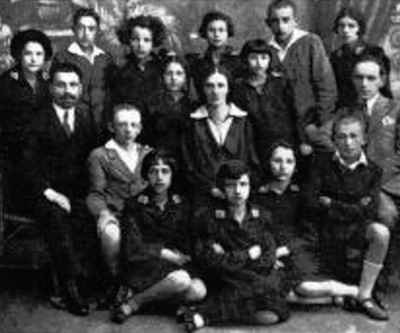
| Shmuel and Edith Bernholtz with the teacher Yeruzalemski in the company of a group of students |
In his role, as the director of the gymnasium, he was helped by his wife, Edith, who was also the official principal of the institution. She was born in Eastern Galicia and studied in Brody, a city that was known for its ancient Jewish tradition, but was influenced, especially in the new times, by both German and Polish culture. As a student of these two cultures since her youth, young Edith acquired a lot of Western culture during her school years at the University of Vienna, especially in the field of literature. The influence of the Zionist circles in Vienna, together with the Jewish tradition from home, turned her into a devoted Zionist. She met her future husband when they worked together at the school in Tomaszów. She continued her pedagogical work together with him also at the seminary in Vilna. With her broad education and her good taste, she greatly helped her husband in raising the level of the Hebrew gymnasium in Lida during its years of its existence. Over the years she made efforts to acquire knowledge also in the Hebrew language, but it was difficult for her. On the other hand, she had a lot of knowledge of Hebrew literature, either from the original, from the translations, or from social contacts in the circles of writers and teachers. In her daily life she was somewhat distant from the society in Lida and many saw this as stiffness, but those close to her knew how to appreciate the delicacy of the soul that was beneath the rigid outer crust. The Bernholtz family raised their two daughters (Ruth, may she live long, lives today in New York, and Aviva who died in 1938 at a young age) in Hebrew, something that was still rare in Lida at that time.
With the cessation of the operation of the Hebrew gymnasium in Lida, and its reduction to the framework of an elementary school, Bernholtz continued for several years in his position as director of the institution (with a short break when Mr. Fishman served as director in his place). Then, he handed over the management to his favorite student, Baruch Sternberg, may HaShem avenge his blood. The World War found the Bernholtz family in Vilna, where they had moved shortly before. and the circumstances of those chaotic days did not bring them to their desired destination - Eretz Israel. After many wanderings through Russia and Japan they arrived in the United States (as he told to the writer of this columns during his visit to Israel in 1953, he was on the Zionist committee in Vilna that dealt with the distribution of certificates for immigration to Israel among the thousands of refugees who gathered at the time in the city that was handed over by the Soviets to Lithuania. He remained at the end of the line and was unable to immigrate). It was difficult to adapt to the new and foreign environment. Nevertheless, Shmuel found a place of action in his field, as superintendent of Jewish schools. In the years 1944 and 1945, he published there in the Jewish quarterly Gendank aun Lebn [“Thought and Life”] monographs about M. L. Lilienblum and Y. L. Peretz, and also a monograph about Bialik in Hebrew and in Yiddish. The “new beginning” was more difficult for Edith, who remained deeply wounded in her soul from her time in Lida when their little daughter, Aviva, passed away. Her health deteriorated since then, and the wanderings around the world completely destroyed her. She passed away in 1947 after a long illness and was buried in New-York.
A few years after his visit in Israel, as mentioned above, together with his second wife, Shmuel's health also weakened. His lost his eyesight in his last years and after a lot of suffering he passed away in 1966. Hundreds of people from the world of Hebrew education, and from the Zionist movement, accompanied him to the cemetery. His student, Leon, may he live a long, (director of The Zionist Organization in the United States) eulogized him and praised his rights as a Hebrew educator and a Zionist activist.
Translator's Footnotes
[Page 406]
by A. Lando
Translated by Ronald I. Greenberg and Roslyn Sherman Greenberg
The eldest son of Reb Shlomo Yudlevitz ( “Shlomo the Yanover”). He was the brother of the “HaBimah” actress Temima Yudlevitz of blessed memory, of Gershon Yudlevitz of blessed memory from Genigar, and of Joseph Yudlevitz from Kfar Saba, Israel.
His father hoped that he would be a Rabbi in Israel, but the son turned aside to the Haskalah, and in particular did research on the Jews in the days of the Talmud.
In the year 5666, the “Haskalah Distributing Company” in Peterburg published his book “The Lives of the Jews in Neherdaa.” On the advice of Professor Harkavy from Peterburg, he went to Berlin to complete his studies in history and archeology. On the heels of the outbreak of WWI, his studies were disrupted, and since he was a Russian citizen in Germany he was considered a prisoner of war. Despite this, he was able to devote a lot of his time to doing research in libraries and institutions of learning. After the war, in Warsaw, he taught in a Hebrew religious school. He then returned to the city of his birth, Lida. He married a daughter of the city, MALKA from the LANDO family. Just before the outbreak of WWII, he made aliyah to the Land of Israel. Here he continued his research in history and published his writings through the observant press “Sinai”, and also books. Among them:
The City Sura, its environs, the economic and industrial life, the workers – “Sinai”, 5697, Part 2He didn't have the means to bring his wife to the Land of Israel, and in the meantime the war broke out, so he stayed with my relatives who were also his relatives. Alone, away from the tumult of the outside world, he sat and worked on his research. He didn't make demands on the world (Torah was his remuneration). He didn't ask much of life, and all his happiness was that he was given the chance to see the fruits of his research, history books appropriate to Zion. He died in Tel Aviv in 5711.
The Pompadita Yeshiva – Tel Aviv, 5695
The City Pompadita in the time of the Amoraim – Jerusalem, 5699
The City Kitrin – “Sinai”, 5701, Part 8
The City Acco in the days of the Tenaim and the Amoraim –“Sinai” 5703, Part 13
The City Lod – “Sinai” 5702, Part 11
The City Neresh (in Babylonia) in the time of the Talmud – “Sinai” 5704, Part 14
The Messianic Age – “Sinai” 5703, Part 12
Tiberias – Jerusalem, 5710
Mechuzah -- Jerusalem, 5707
by Abraham Gelman
Translated by Roslyn Sherman Greenberg
He was born in 1909 to his father Zalman and his mother Gerta (nee Podzimsky). His father was a prosperous industrialist, but Avrasha did not take to commerce. After he completed his studies in the high school of MOSHE DEVORETSKY of blessed memory, he delivered himself to the political activities of “Poalei Zion”, “HeHalutz”, “Dror”; and he immersed himself in working for Keren Kayemet, Keren HaYisod, the work collective in Lida, etc. Understandably, all this he did without expecting to receive any reward and without any thought for his own comfort. Even so, he didn't like to put himself forward in order to open or to manage collections. Members of the central Boursha or messengers from the Land of Israel who visited Lida, benefited extensively from the actions of Avrashah.
He reached the Land of Israel on the eve of WWII and entered the kibbutz Tel-Yosef. During the time of the war, when it became known to him that friends and acquaintances from Lida had been sent to exile in Russia in concentration camps, he urged that institutions give copious donations and he sent many parcels to help friends in distress.
Several years later he left the kibbutz for Ber Sheva. Here he had his last illness. In spite of his condition, he bore his pains quietly.
On Friday, May 8, 1969, he died in Ber Sheva leaving a wife, a teacher in the high school; a married son who was an engineer (of Army age); a married daughter, and grandchildren.
On the 8th of June, when the thirty days of mourning ended, his friends from Lida gathered, together with his family, to remove the cover from the tombstone on his grave. Eliahu Demshek prayed with moving words for his repose, and called the work he did to collect money in Lida a miracle. May his memory be blessed!
|
JewishGen, Inc. makes no representations regarding the accuracy of
the translation. The reader may wish to refer to the original material
for verification.
JewishGen is not responsible for inaccuracies or omissions in the original work and cannot rewrite or edit the text to correct inaccuracies and/or omissions.
Our mission is to produce a translation of the original work and we cannot verify the accuracy of statements or alter facts cited.
 Lida, Belarus
 Yizkor Book Project
 JewishGen Home Page
Copyright © 1999-2024 by JewishGen, Inc.
Updated 10 Aug 2022 by JH