 |
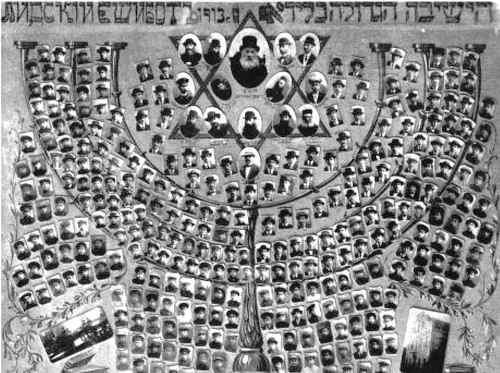
The Yeshiva of Rabbi Reines 1913 - Its Leaders, Teachers and Students
|
|
[Page 29]
|
|
| The Great Yeshiva in Lida 1913 The Yeshiva of Rabbi Reines 1913 - Its Leaders, Teachers and Students |
Assimilation? God forbid! Matters had not yet reached that point. Tens of teachers continued to teach Torah to the children of Israel, and even the parents of the students of the new government school for the children of the Jews saw to it that in the afternoon they would take lessons from the mouth of a teacher or private “Hebrew teacher” (a new position on the Jewish street from the Enlightenment period.) Nevertheless, cracks appeared in the structure of traditional Jewish education, and by way of these cracks, new trends and ideas also began to make inroads.
Lida's rabbi, the Rabbi the Gaon Rabbi Yitzchak Yaakov Reines, saw with worry the trend of Jewish education in the new era, which was divided between sacred and secular,[125] and who knows if at the end of the matter, the future of the foreign secular foundation would determine and bring the young generation to complete assimilation, God forbid. He came to a conclusion that it was possible to mend the tear, and to offer the two fundamentals in one meeting place, where the “secular” foundation would be subject to the supervision and guidance of the “sacred.” And the conclusion, a yeshiva that united within it Torah and general education, in which the young people of Israel would be educated complete in their faith, and perfect in their education.
After an attempt (which did not last long) at the time of his service in the rabbinate of the city of Svencionys, and after a second attempt in Lida in the year 1895, which didn't achieve full realization due to various difficulties, Rabbi Reines did not let go of his idea until he overcame all of the obstacles, and in the year 1905, “The Great Yeshiva in Lida” was opened, which was publicized in the Jewish world by the name “The Reines Yeshiva.”
Lida became filled with hundreds of Jewish youths from all over the country of Russia; Lithuania, Poland, Volhynia, Podolia, and more. Young Jews arrived even from the Caucus Mountains in their black robes and dagger belts, to acquire Torah in Lida. This was a new type of yeshiva boy, in his dress, in his gait, and in his aspirations. And similarly, there was not a town more fitting than Lida to serve them as lodging, with its traditional atmosphere and with this, its enlightened tolerance, and in it, knowers of the language of Ever and readers of the new Hebrew literature and subscribers to the Hebrew periodicals. Also the “Chibbat Tzion”[126] movement had already struck roots in the city from the beginning of Rabbi Kalischer's activity.[127] With the rise of the Herzelian[128] movement, Rabbi Reines was one of its first flag bearers. Zionist lecturers, from among the leaders of discussion on the topic of the movement, visited Lida from time to time.
The students of the yeshiva influenced and were influenced. They influenced with their presence, with the atmosphere of their spiritual aspirations (which was nurtured by the faithful hand of their distinguished teacher and educator Reb Pinchas Shifman - Ben Sira,[129] may his memory be for a blessing), and were influenced by the communal activism of the place, in which many of them actively participated. Zionist publicity activity, in (illegal) activity
[Page 30]
for the benefit of the Keren Kayemet L'Yisrael[130] under the guidance of the devoted businessman Reb Yisrael-Aharon Shlovski, may his memory be for a blessing, in the organization of Hebrew banquets (within a group of youth who established “The Group of Lovers of the Hebrew Stage” with the participation of Reb Y.A. Shlovski and the modern teacher Chaikel Vishnevsky,[131] may his memory be for a blessing, and the like.
|
|
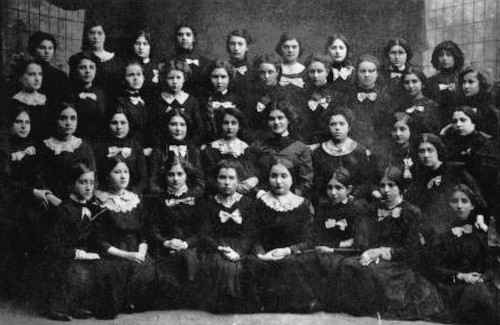
Among the students are identified: Back row: Bluma Kiblevitz (fifth from right); Bashel Shapira (sixth from right); Breina (Berta) Gervedzavski – Shif (first from left) Row below it: Bluma Ilotovitz (first from left); Sonia Golub (second from left) First row: Bat Ester Kaminetzki (second from right, kneeling); Frida Pupko (second from left); Nadia Migdal (first from left) |
Lida was enriched by spiritual forces: Torah forces that Rabbi Reines acquired to serve as R”M[132] in his yeshiva, and at their head Rabbi Shlomo Politchik, may his memory be for a blessing, (the prodigy of Meytchet),[133] who acquired a name for himself in the rabbinic world as one of the excellent geniuses, and superb teachers of the professions of Judaism outside of Gemara, legal decisors and tanakh; Reb Pinchas Shifman, who we have already mentioned; Moshe Cohen ( who served for a period of time as secretary of the “Mizrachi” federation), and Koplovitz (the eccentric knowledgeable person, who besides his expertise in all the rooms of Hebrew literature and the history of Israel had command of the Russian, German and French languages, wrote a book on mathematics, and had a hand in general philosophy). Pinchas Shifman and Moshe Cohen took an active part in the public life of the city, and enriched its cultural life by their participation.
Lida aspired to emerge from the presumption of “town” and to resemble a “metropolis.” Currently, there is nothing new about the opening of a cinema, but the opening of the first motion picture at the beginning of our century (we imagine that it was before the year 1910, established by Alter'keh Poltzek, a young son of wealthy parents, an adventurer with initiative), was something of an event in the life of the city. The Jewish youth streamed to “The Lando Theatre,” in the market square, to see the tragedy of “Estherke Bleichman” and the mischief of Max Linder in the dark hall (after the “Lux” lamp was taken out of it). The movement of the machine was, of course, by hand. A second, more advanced, motion picture was established a short time afterwards at the initiative of the Jew Yablonski, in partnership with his Polish colleague Romeiko. This time an electrical station was also established, which moved the movie machine, and at the same time also provided lights to the nearby streets.
The aspiration for learning and enlightenment grew stronger among the Jews of Lida. Besides the traditional education in the old chadarim,[134] and the traditional national-academic education in the Reines Yeshiva, the children of Israel in Lida were scattered among the general high schools. The government school for Jewish children (Yevreiskoya Otzilishcha),[135] instilled education for 7 elementary grades for boys. Within certain limitations, Jews were also accepted into the city school (Gorodskoya Otzilishcha), and when there weren't enough places for Jews, the children of Israel migrated to other towns in the area. Wealthy people were able to send their children to the progymnasia[136] of Plau (and his converted Jewish wife), to acquire education in four grades of high school. A few, who had parental connections, were accepted into the city gymnasia, which opened in the year 1912 or 1913. Many migrated to Vilna, to learn in Kagan's private Jewish gymnasia, and to other cities, where there were more comfortable conditions for the reception of Jews (Vilkoviski, for example). Daughters of Israel, who were not satisfied with four grades of Tzifkin's progymnasia for girls, constituted a high percentage of the learners in Novitzki's private gymnasia.
[Page 31]
Despite all the difficulties, and with all the heavy burden on parents who were far from wealthy, the city became filled with male and female gymnasia students of all kinds, alongside the students of the Reines Yeshiva – two communities, which here and there came into contact with each other, learned from each other, and mutually influenced each other, and together made their mark on the special social-cultural landscape of the city of Lida.
The partisan activity was not kosher in the eyes of the government. Nevertheless, the Zionist groups found ways to organize Zionist lectures in the study houses or camouflaged as social gatherings in the tea-house (Chinese) or in the HaZamir[137] clubhouse, and likewise to conduct activities of the Keren Kayemet L'Yisrael in the accepted ways in those days: bowls in the synagogue on the evening of Yom Kippur, mail to transmit blessings for Rosh HaShanah, blessing telegrams for weddings, and the like. All these were activities which, more than their monetary value, were known for national-educational importance. Thanks to Rabbi Reines, Lida won the right to host, in the year 5663 (1902), the “Mizrachi” conference and also to serve, over the course of some time, as the center for this young organization.
Again, a few buds of aliyah to the land of Israel. In 1903 Yosef Yudelevitz went up, a man of the second aliyah,[138] currently a resident of Kfar Saba, and about nine years after that, Chaim Krofsky (Ariav), may his memory be for a blessing, and after him, Elimelech Zelikovitz, (Major-General Avner),[139] may his memory be for a blessing, and, may he be distinguished for a long life, Yaakov Shifman (Ben Sira), the Tel Aviv City Engineer until his retirement.
Aliyah, in its necessarily limited manifestations, due to the conditions of that time, came only from the elite national group in the city. Migration to the United States gained broader dimensions, for it enchanted everyone who lifted his soul to improve his material situation.
The Revolutionary Movement
The social-spiritual fermentation that spread amongst the Russian intelligentsia in the middle of the previous century[140] and which took on a sharp form at the beginning of this century, with its sweeping away with it extensive groups of educated young Jews, also did not skip over Jewish Lida. Already in the years of the nineties, it is possible to find the literary expression of the new movement in Lida with the Lida writer Yitzchak Goide,[141] for whom the way of life of the city of his birth served as the backdrop for his creations in a few of his stories that are about the crooked fate of the toiling person.*[142]
In about that same period, the “Zhargo-Nesher Committee” was organized in Lida, founded by David Pinsky in Vilna (1895), a library of the books of jargon (at that time they didn't see anything wrong with that name in the Yiddish language), similar to the libraries that were founded in it at the time in a few other towns in this area (Oshmany, Smorgon), and whose purpose was not only educational but also, and maybe principally, propogandist-educational.[143] At the beginning of the present century, we already find in Jewish Lida seeds of socialist political parties in their hues and tendencies: the “Bund,”[144] “Poalei Tzion,”[145] (whose center was in the yard of Kontzevitz), S”S (Zionist-Socialists) who were meeting in Bichvit's house), and also there were Lida youths who were members in the Russian revolutionary parties, the Socialist Revolutionary, and others. At the Poalei Tzion conference, which was in Vilna in the year 1903, representatives from Lida also participated.
There was not much material about the history of the socialist movements in Lida. Yet from the words of the Vilna committee representative of the “Bund” in the Sixth Congress of the Socialist International, which assembled in Amsterdam in year 1904, it is known to us that he represented, in his words, 400 members from Lida (out of a total of 5200 from Vilna and the surrounding area). It is difficult to check the degree of accuracy of this number, which seems to us, regarding Lida, according to the size of the Jewish population, and its socialist component, a little exaggerated. And maybe the “Bund” saw itself as a general representative of the Jewish socialists in the town?
The few details that are known to us from this period, the names of the speakers of the movement, or the different movements that merged into the revolutionary stream, the way of life in those days and their events, came mostly from oral stories, conversations with the elders of the city (who at that time were young). From among the activists the names of the Vilensky brothers are remembered the sons of Reb Ozer Vilensky, a well-known teacher of Tanakh and Gemara to the children of Israel in Lida, one of whom was a member of the “Bund,” and one, it seems, was from another party; the teacher Tziglenitzki (a member of the Zionist-Socialists); Miss Podolskit; Zalman Meltzer,[146] a student at the Volozhin yeshiva, “learned and left,” who was one of the heads of the Poalei Tzion party in Lida. Among the members of the Socialist Revolutionaries are remembered the names of Stolovitzki,[147] Puchalski, Duvkovsky (a son of Zhetel, but he visited frequently, in connection with his revolutionary activity in Lida),[148] the daughter of Shafer, the educated grocer.[149] More from the Bundists: Tevke (Tuvia) the Hunchback (even though he was not at all a hunchback, but we don't question nicknames in Lida…), Yankele Gedaliah's, and more. And none forget to mention the mischievous Dobele,[150] the dwarf, who despite her physical deficiency, made waves in the city with her fiery speech, when she stood on a chair on the bima of the synagogue, or when she was carried on the shoulders of her friends in a street demonstration.
The forests of Molukubshczyzna served as a center for secret meetings of the movements (sachadkes), and the synagogues that were in the city were comfortable places for mass propaganda, which was not for the benefit of the worshippers, who were unable to oppose it… The members of the Zionist-Socialists also penetrated in their activities into the yeshiva of Rabbi Reines, while trying to organize the members of the yeshiva and draw them into their party. With the influence of activists of the movement, strikes were held in various workplaces, over shortened work hours (for shop assistants, the frikaztschikym, until 8:00 in the evening instead of 10:00), additional wages, and the like. In one of the work-houses (with the tailor Vallach), an assistants' strike was held by the son of the shop owner himself, and they emerged victorious.
There is no need to say that the ways of the revolutionary movement on the Jewish street, which mostly supported breaking the yoke of religion and tradition and opposed Zionist ideas, were not desirable to the religious groups in the city and especially to the rabbi of the place, Rabbi Reines, in whom were joined together the fire of religion and an ardent Zionist spirit, and his sermons, which came as a countermeasure, aroused against him more than once than anger of the leaders of the “Bund.”[151]
The disputes between the Zionists in Lida and the propagandists of the
[Page 32]
revolutionary party increased, and matters reached the point of provocation “to cause anger,” which, presently, is hard to say who began it.
|
|
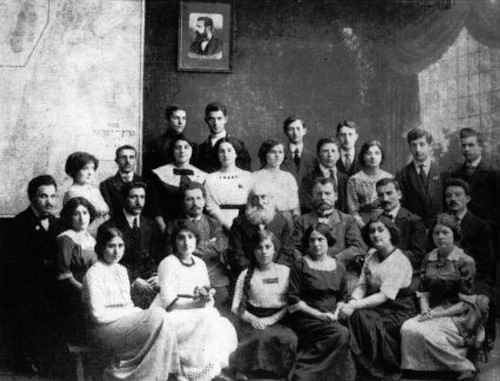
(About 1913) [Note the photo of Herzl] From right to left: First row from the back: Yehudah Berlovitz; unidentified; Avraham Rubin, Yosef (Ben Tzion) Darshan Second row from the back: Kliko; unidentified, Liza Levin (Berlovitz); Gedaliah Tzartok, Breina Gervedzavski; Sonia Golub; Liuba Golub; Yakir Lando; Devorah Goide Third row from the back (seated): Solomiak; unidentified; Pinchas Shifman (Ben-Sira); Shmuel Kaminetzki; Moshe Cohen; Levin; Feigl; Dov Dvoretzky First row (seated): Ana Pupko (the daughter of Pupko the Teitsh); Nechama Moltchedesky; Chaya Nechimovski; Shoshana Yudelevitz; Guta Krofsky; Stolovitzki |
An event on the 20th of Tamuz, at the time of the memorial for Dr. Herzl in the Great Synagogue, which was full of a vast assemblage. Suddenly, a call was heard: “Fire!” Only by a miracle there were no mortal victims due to the panic that arose, especially in the women's section. The Zionists blamed the Bundists for an act of provocation.
Again there was an event in a Bundist gathering in the Butchers' Synagogue, on Shabbat night. Suddenly a stone was thrown and shattered the glass of the kerosene lamp, and of course a panic arose. The speaker, Dobele, was taken out through a window. This time, the Bundists blamed the Zionists.
In the year 1905, when street demonstrations were held throughout all of Russia, a demonstration of this kind was also organized in Lida, with the participation of hundreds of people from the Socialist movement, red flags in their hands and songs of the revolution on their lips. The police felt itself too weak to scatter the multitude, and called for help from the army that was encamped in the city. To the luck of the protesters, in the meanwhile a strong rain began, the protesters scattered, and when the army arrived, it did not find any congregation for its “action.”
We wondered if in the history of the Russian Revolution there would be allocated a place for the demonstrations of the Jewish Socialists in Lida, and the bold slogans that were heard in it (according to a story that was widespread in Lida, one of the women protesters yelled: Doloi Boktata, and the intention – a policemen by the name of Boktata, who in her eyes was the embodiment of the Czarist Police). And also, certainly the strikes in Dushman's beverage factory will not be remembered, nor those at the tailor Vallach. In any case, we will sin in objectivity if we don't see in every chapter of those days revelations of idealistic youth who seeks his way to repair the world, for a life of freedom and justice.
Many of the young youths were drawn to the heroism of the underground movement and even revealed activism in various auxiliary roles, in danger of imprisonment and everything connected with it. So we heard from the mouth of Reb Mordechai Nivolski,[152] may his memory be for a blessing, of an event that took place in 1906, when he was a 15-year-old mischievous child, and was almost imprisoned by the Gendarmes when he had in hand copies of the “Vyborg Proclamation”[153] together with a “spirograph,” which folded it for distribution. Searches were conducted
[Page 33]
that same day in a few Jewish houses (among them in the house of the Berlovitz family). The young Nivolski hid himself from the Gendarmes in the cellar of Feigel the milkmaid, and thanks to that he was saved from imprisonment.
The years of the revolution were full of fears amongst the Jewish population in Lida too. Pogroms that were likely to break out were talked about. From fear of fires starting at night, groups of “householders” organized a sort of “civil guard,” unarmed, of course, but equipped with a sort of noisemaker, for summoning help in the event of any kind of surprise, while the young people began to prepare for self-defense. Firearms, that is to say a pistol (in the jargon of those days – “a shpayer”) hard to find. Spoken of, for the most part, were cold weapons – iron whips – “iron nails.”[154] Yehoshua Lidski (now in Canada) told us about the manufacture of this kind of weapon (which was composed, apparently, of a coil of thick iron wire on top of a wooden grip, and at its end a lead block). The owner of this “industry” was the son-in-law of Reb Moshe Bar the Teacher, and the children of the cheder volunteered of their own volition to help him. To the luck of Jewish Lida, this wave of pogroms did not reach it, and the defense “weapon” did not come into action. This time the Jews of Lida were saved…..
In 1906 there was great preparation for elections to the first Russian “Duma.” 30 men from among the residents of the place were appointed to the municipal election council, and among them 13 Jews from “across the city.” There was in this a kind of accomplishment in those days (although, according to their numbers in the city, the Jewish population in the city reached a much higher percentage). And maybe in this fact there is something to indicate the expected relations between the Jews of the city and their Christian neighbors.
The First World War and the German Conquest
August 1914 – and tens of Jewish mothers in Lida are accompanying with tears their sons who were drafted into the war with German and Austrian “enemy.” Which enemy? Whose enemy? Opinions were divided among the politicians in the synagogues, there are “Germans” and there are “Russians,” that is to say – inclined to this side or to that side. For the most part, the “Germans” had the upper hand in these disputes, since the man of the people suffered from the heavy arm of the Russians landing on them, while they knew about the Germans who, according to the rumor, were liberal and cultured people, and in general – it was good there for Jews (certainly the Jews of Lida will be retroactively forgiven for their lack of patriotism for Russia, especially since many of the Russians supported the slogan that everything the worse, the better.) The old Rabbi Reines, who had stayed in Germany for reasons of healing at the outbreak of the war, and returned from Germany in those frenzied days, by winding roads, broken and shattered, was not of that opinion. He already saw then a different Germany than that which was depicted in the imagination of innocent Jews, and talked with disappointment and bitterness about the demonstration of cruelty that he saw on the part of the supposedly enlightened Germans.
In its beginning, the war was conducted at a distance from the Lida area, and its events were far away from it. Yet the summer of 1915 arrived, and with it the heavy failures of the Russian army. Lida became filled with hordes of Jewish refugees, who were evacuated from the western districts that were adjacent to the front, by order of the Supreme Commander, the Prince Nikolai Nikolayevich. The Jews of Lida immediately organized kitchens in which free food was distributed to the needy.
Lida was a key position, and its streets were full of the profusion of soldiers who streamed endlessly to and from the front. On one clear morning, the city was shocked by cannon shots that were aimed at one airplane, which floated for some time among the white clouds that were created by the explosions of the shells that were around it. It left after it dropped two or three bombs on the city, which killed one Russian soldier and wounded a few Jewish civilians (as it seems to us, the daughter of the merchant Gorfung, and someone else who name we don't remember). The great retreat of the Russian army began, a panic to leave the city began, eastward,
|
|
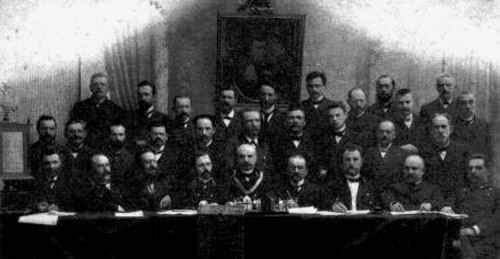
The Jewish Members of the Committee in the first row seated from left to right: 1. Sh. L. Dukur; 6. D. Ginzburg In the middle row: 1. Y. Pupko; 2. M. Kantor; 3. Dr. Schottenstein; 4. N. Gurvitz, next to him Tzipkin 6. Ch. Guber; 7. L. Pupko |
[Page 34]
southeastward, and northeastward: to Minsk, Orsha, Charkov, Yekaterinaslav, the district of Tambov, and even beyond that.
Amid this chaos and confusion, on a day of unceasing downpour,[155] the Jews of Lida accompanied their esteemed rabbi to his eternal home, the Rabbi the Gaon Reb Yitzchak Yaakov Reines, whose experiences within his hasty escape from Germany shocked his soul and entirely destroyed his health, which was weakened as a result of the incurable disease that nested within him.
To leave or to remain? Among those preaching to leave the city was also the rabbi's son, Reb Avraham Bar, may his memory be for a blessing, who relied on the mitzvah of not remaining in a place of danger. With his advice and efforts, the Yeshiva, its teachers, and the Head of the Yeshiva also moved to Russia – to Yelisavetgrad. Hundreds of families left the city. Many sent part of their family to Russia, the women and children, while they themselves remained in place. This is what the son-in-law of the rabbi, Reb Aharon Rabinovitz, did. But he himself saw the mitzvah precisely in his staying in the place, with the remaining community.
|
|
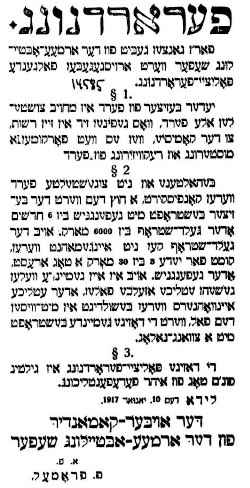
in Lida on the confiscation of horses (January 1917) (All the commands were issued in three languages: German, Russian, and Yiddish) |
Gloom descended over the city, which was emptied of most of its residents, the Jews and the Russians. At night the Jews were shut in behind locked doors, and well-bolted and well-closed shutters, from fear of the Russian soldiers, who were moving westward in great numbers, tired and filled with bitterness, and in this mood, many of them were ready for all kinds of acts of violence. As precautions, an order was given by the army authorities to empty into the river all the stock of alcohol that was stored in the yeast factory, the sale of which had been forbidden from the start of the war. The order actually went into effect, but despite the excellent guarding, soldiers drunk on wine were found wallowing in the ditches, drunk on the beverage which had been forbidden to them for this great long time.
In the middle of September 1915, the city was left without any state or local government. A number of businessmen, Jewish and Polish, who remained in the city, assembled in the municipal “Duma” building to consult on how to make contact with the military authorities, who alternated in the mornings, to prevent the riots of the passing soldiers. But their efforts came to nothing. Meanwhile, death spread in the streets. Three Jews were murdered by Russian soldiers in various parts of the city: Rubenstein from Vismonti,[156] Berdovski, the son of the owner of the “Dagmara” Hotel, and the Jewish provisor of Bergman's drugstore. Suddenly the skies reddened: groups of saboteurs, following an order or for the sake of “entertainment,” lit a fire in the pharmacy that was in the house of Chanan Pupko (the corner of Kershiva-Kamionka), and in Levin's house (the carpenter from Voronovo) on Vilna Street. The fire, which threatened the entire street, brought the youths out of the houses, and with the primitive means that they had, without extinguishing machines, it fell to them to somehow prevent the spread of the blaze.
When the Jews of Lida awoke, after a night of terror, a strange quiet prevailed; no policeman (these had already left the city some time ago), no soldiers, no oppressor of any kind – zero government! One by one they began to emerge into the streets of the city, by the light of a warming and illuminating fall sun. And here – a horseman in a grey uniform, a helmet on his head, and a short rifle in his hand, progressing very slowly on the back of his horse for the length of Vilna Street, surveying the street and the alleys on both sides of him. When he approached a group of men who were looking at him with curiosity, he let slip towards them the words: “Gutten morgen.”[157] The Germans reached the city. September 20, 1915.
On that same day, a not large company of mounted soldiers reached the city. Businessmen of the city, Jews and Poles, were invited to the Military Commander, and after a short speech, in the style of: we have come not as enemies but as friends (nicht alles feinde zandran alles Freunde)[158] sent them to their homes, except for two who were detained as hostages for some time (it seems, Dr. Varshavski and the Polish pharmacist Bergman), but they too were quickly released.
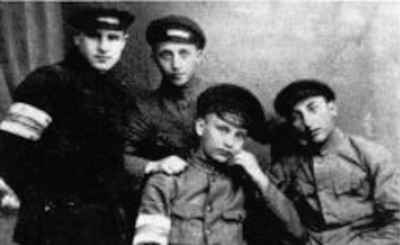
On the next day, September 21, a citizens' committee was organized (“Berger Committee”), which was designed to mediate between the new government and the population, and likewise a civilian militia was established, headed by Zelig Ilotovitz. The militia men, Jewish and Polish, were equipped with a blue and white band for their sleeves, as a symbol of neutrality.
The Jews felt respect for the Germans, and prepared for the renewal of economic life. It seems that the first for commercial contact with the conquering army was Meir Pupko, a seed trader, whose warehouse was in the courtyard of Pesach Dvoretzky, on Karziva Street. He immediately won visits from the officers of the “Rostopstella” (center for raw materials) which were interested in raw materials
[Page 35]
of all kinds. (“everything that begins with an aleph,” according to the Yiddish saying). They knew that he had inventory of linseed. Meir was happy about the unexpected turnover, but his disappointment was great when, in exchange for all his merchandise, when it was emptied within a few hours onto army trucks, instead of money he was offered “shein” (acknowledgment of receipt) written in incomprehensible gothic letters. The payment was promised for some time in the future. Complaints were ineffective. Other merchants learned from this lesson and began to hide their merchandise. The farmers in the area also avoided bringing their produce, and in the city there was a shortage. One commodity was still plentiful during that time, and that was meat. The reason was simple: the farmers tried to get rid of excess cattle, which was difficult to hide from the eyes of the German soldiers, and was expected to be confiscated in exchange for “shein.”
The Germans laid their hands on all sources of supply (to the degree that it was not properly hidden from their greedy eyes), and rationed to the local population an extremely meagre diet, far from satiety. If, however, the population was sustained somehow, apparently this was primarily thanks to the transgressing of the German orders, despite the danger that was bound up in the matter. Illegal commerce began, on the one hand with the village, and on the other hand with the soldiers who were encamped in the place, in the dwellings of the residents and in the barracks. A new class of merchants arose: the “toisherkes” (women who were engaged in barter with soldiers in the barracks. For men the approach was more dangerous.), and the “shmuchlers,” the smugglers, who engaged in transferring merchandise from place to place; that is, transferring from a place of less scarcity to a place of more acute shortage, such as Vilna, where real hunger prevailed, in danger of imprisonment and sometimes even mortal danger. Bringing food needs out of the city was, of course, to the detriment of the residents of the city, and this matter sometimes aroused scandals. One time a protest demonstration was even organized by those who prayed in the study house. This took place on Shabbat, and the protesters, in their tallitot,[159] and at their head the Maggid from Lubavitch (who settled in Lida after the destruction of his city in the battles of 1915), marched to the offices of the “Burgermeister” to demand of him that he take control with harsh measures regarding the smugglers (among whom, according to what was told, was also one of the businessmen of the city). A demonstration like this in times of a military regime, had in it the possibility of a dangerous outbreak, however when the plan became known to the Burgermeister, he ordered the protesters to disperse, and with this the problem was eliminated.
|
|
(from the period of the German conquest in the First World War) From right to left: Yisrael Pupko, Moshe Yitzchak Darshan, Yaakov Tziglenitzki, Baruch Uscinski |
The relations with the Germans in general (in speaking of simple soldiers and part of the low-ranking officers) were decent, even friendly. Soldiers and officers were housed, by order of the “Quartermaster,” in private houses, some of them as permanent residents, and in many instances friendly relationships developed, and the tenants became members of the household of their hosts. But the official spirit was to force on the population a feeling of the superiority of the German conqueror. One of the first orders of the command (which was published in three languages: German, Russian and Yiddish) was in the matter of the obligation of the residents to doff their hats in front of every German officer. Anyone who violated this order was expected to be imprisoned. The commander of the section of the front, the General Von Fabek (who set up his headquarters in the house of the doctor Dr. Rennert) was very strict on the fulfillment of this important order. There was an incident when the old shochet[160] Reb Mordechai Aharon did not look out for the car of the general as it passed in the street, and did not have time to remove his hat before him; the commander ordered that the Jewish transgressor be arrested and imprisoned. Other officers from those days are remembered who frequently went wild in the streets of the city with their whips, Von Bussel and his friend, who was known to the Jews of the city not by his name but by his symbols – the “shaved head,” arrogant and sadistic thugs. Seeds of the Nazism to come were already then revealed in these disgusting faces, in the years 1915-1917.
Various forced labors were frequently imposed on the residents, by official order or also by the private initiative of every officer who needed some kind of help, connected to his role or for private needs. And who will say to him “what can you do?” And if in most of the instances there still was, nevertheless, despite the rough military connection, a certain measure of humanity, there were also places in which people were forced to work in inhumane conditions (already then!). The chapter of Konstantinova is still remembered by the people of Lida, when young and very old residents were sent in the winter to work in the forests in the mentioned area, and there they dwelt in cabins that were unheated and open to the wind. Many of them returned from there with their limbs frozen.
The contempt for the residents of the place and their feelings were manifested in various areas. So, for example, the setting up of a place of “entertainment” in one hotel for soldiers on one of the main streets, in which there lived whores who were brought from various cities especially for this purpose. All for the wellbeing of the German soldier… here too, a hint of the future.
That same distinction, between various types of Germans, was also possible to make among the local administrative staff: the one appointed over the city (Shtadhauptman. Not exactly “head of the city,” Burgermeister, which was his description at first.) Albers, not a high official before the war, who rose to this greatness, apparently, by merit of his aggressive and domineering nature. In his contact with the residents of the place, a relationship from on high, according to the official military line. With this, gentler to people who knew German, such as the elder Reb Yitzchak Yeruchmanov, who by merit of his speaking German (he was a native of Kurland) knew how to influence him and to acquire a number of leniencies for the good of the residents, in matters of supply and the like. By his side – his assistant, Dr. Fogel, intelligent, but with a weak manner and little influence. Incidentally, this Fogel wrote a booklet in German about Lida and her history, (“Lida Eyst Und Eytst” published by the local German newspaper Di Vecht im Austen.)[161] Among the rest of the administrative workers
Footnotes
|
|
JewishGen, Inc. makes no representations regarding the accuracy of
the translation. The reader may wish to refer to the original material
for verification.
JewishGen is not responsible for inaccuracies or omissions in the original work and cannot rewrite or edit the text to correct inaccuracies and/or omissions.
Our mission is to produce a translation of the original work and we cannot verify the accuracy of statements or alter facts cited.
 Lida, Belarus
 Yizkor Book Project
 JewishGen Home Page
Copyright © 1999-2024 by JewishGen, Inc.
Updated 08 Jan 2023 by JH