 |
|
|
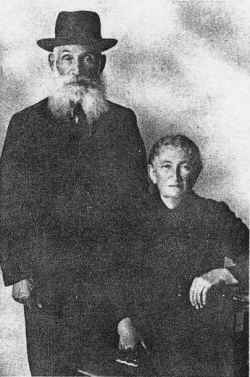
| Mordekhay Chasid and His Wife, Shprintse | 8 |
| Zev Chasid | 10 |
| Dr. Yisrael Tsinberg | 23 |
| Yurik Pikhovits | 28 |
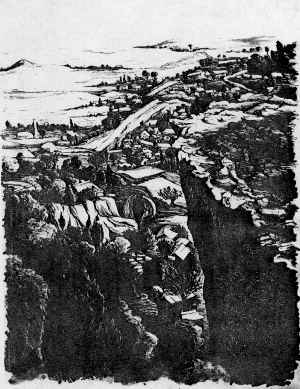
| Mountain of the Virgins | 32 |
| Pesach Litev (Litvak) | 54 |
| Arye Bedolach | 57 |
| David Katz | 58 |
| Mordekhay Goldenberg | 60 |
| Leyb Apelboym | 61 |
| Aleksandrov, Hilel | 25 |
| Ami (husband of Ilana Rayzman) | 45 |
| Apelboym, Leyb | 61 (photo), 61 |
| Apelboym*, Rachel | 61 |
| Apelboym, Sonya | 61 |
| Apelboym, Zina | 61 |
| Argaman, Avraham | ii, 35, 43 |
| Averbakh, Dr. | 62 |
| Avidar, Dana | 44 |
| Avidar*, Yemima | 44 |
| Avidar, Yosef | 44 |
| Bakimer, Chayim | 62 |
| Bakimer, David | 35 |
| Bakimer, Shifra | 62 |
| Baleban*, Shifra (née Bakimer) | 62 |
| Baleban, Yisrael | 62 |
| Barshap, Avraham | 44 |
| Barshap*, Dara | 45 |
| Barshap*, Masha | 44 |
| Barshap, Mula | 44 |
| Barshap*, Yael | 44 |
| Barshap, Yakov | 45 |
| Barshap, Vovke | 20 |
| Bar-Ziv*, Leya (see also Fidel) | 44 |
| Bar-Ziv, Mikhal | 44 |
| Bar-Ziv, Moshe (see also Fidel) | 44 |
| Bar-Ziv, Yitschak | 44 |
| Bedolach, Arye (Leybel) | 57 (photo), 57-58 |
| Bedolach*, Sara | 58 |
| Berger | 66 |
| Berkovits-Teper, Chanokh (see also Teper-Berkovits) | 62 |
| Berkovits-Teper, Talya (see also Teper-Berkovits) | 62 |
| Berman | 35 |
| Berman*, Batya (née Tsukerman) | 44 |
| Berman, Shraga | 44 |
| Berman, Yuval | 44 |
| Bernshteyn | 35 |
| Bialik, Chayim Nachman | 57 |
| Biberman brothers | 14 |
| Biberman family | 62 |
| Biberman, Avraham | 36 |
| Biberman, Feyga | 36 |
| Biberman, Leyb | 36 |
| Biberman, Nachman | 36 |
| Biberman, Yitschak | 36 |
| Biberman-Bihem (husband of Nechama) | 44 |
| Biberman-Bihem, Chagit | 44 |
| Biberman-Bihem, Nechama | 44 |
| Blit, Sh. | 14 |
| Bronfeld, Emanuel | 45 |
| Bronfeld*, Manya (née Lerer) | 45 |
| Burshteyn, Yosef | 9, 10 |
| Chasid family | 1, 3 |
| Chasid, Avraham | 8 (photo), 8, 9, 10, 37, 44 |
| Chasid, Chanan | 44 |
| Chasid*, Eti | 44 |
| Chasid, Feyga | 9 |
| Chasid, Mordekhay | 8-9 |
| Chasid, Shiri | 44 |
| Chasid*, Shprintse | 8 (photo), 8, 9 |
| Chasid, Yakov | 9 |
| Chasid, Zev | 9, 10 (photo), 10-11, 37, 66 |
| Dayan, Mikhal | 44 |
| Dayan, Nechemya | 44 |
| Dayan*, Nira (née Vishniov) | 44 |
| Dayan, Tal | 44 |
| Desser, Max | ii |
| Desser, Nachman | 20 |
| Dubnov, Sh. | 24 |
| Dugim | 35 |
| Epshteyn, Yakov | 43 |
| Eshkol, Levi | 56 |
| Etinger, Shmuel | 21 |
| Fadve, Dr. | 15 |
| Fayer, Chayim | 49 |
| Feler, Ada | 44 |
| Feler*, Dana (née Avidar) | 44 |
| Feler, Mike | 44 |
| Fidel*, Leya (see also Bar-Ziv) | 44 |
| Fidel, Moshe (see also Bar-Ziv) | 44 |
| Fishman, Eliyahu | 60 |
| Fridel, Avraham | 36 |
| German*, Feyga (née Chasid) | 9 |
| German, Nechemya | 9 |
| Geva, Avraham | 44 |
| Geva, Ofer | 44 |
| Geva*, Tsipora (née Landsberg) | 44 |
| Gokun, Avraham (Avrasha) | 35, 44 |
| Gokun, Mira | 44 |
| Gokun*, Shoshana | 44 |
| Golberg, Yehoshue (Shayke) | ii, 35, 38, 48, 58 |
| Goldenberg, Avraham | 60 |
| Goldenberg*, Chana | ii |
| Goldenberg, Etil | 60 |
| Goldenberg, Manus | ii, 3, 16, 28, 20, 35 |
| Goldenberg, Mordekhay | 60 (photo), 60 |
| Goldenberg, Tsale | 60 |
| Goldfarb (school principal) | 10 |
| Goltsberg | 35 |
| Goltsberg*, Ada | 44 |
| Goltsberg, Mordekhay | 44 |
| Goltsberg, Rachel | 44 |
| Goltsberg, Yitschak (Kitsi) | 44 |
| Gorodetski brothers | 62 |
| Gorodetski, Rachel | 62 |
| Gun, Grishe | 13 |
| Gur, Yosef | 11 |
| Gutman, Rachel | 62 |
| Halperin brothers | 14 |
| Hofshteyn, Duvid | 36 |
| Kamendant, Zelik | 20 (photo) |
| Kapuzer, Shayke | 13 |
| Kartman | 10 |
| Katsir, Efraim | 12 |
| Katsman | 35 |
| Katsnelson, Yitschak | 20, 21 |
| Katz, Adva | 45 |
| Katz, David (Dosya) | 58 (photo), 58-60 |
| Katz, Marcos | ii |
| Katz, Mark | 66 |
| Katz, Mordekhay | 49 |
| Katz, Munek | 58 |
| Katz, Reya | 59, 60 |
| Katz*, Rut | 45 |
| Katz, Shimon | 59, 60 |
| Katz*, Shlomit | 45 |
| Katz, Tamar | 59, 60 |
| Katz, Yosi | 45 |
| Kendel, Mr. | 36 |
| Kesler | 35 |
| Kindzior, Gedalyahu | 35 |
| Klorfayn, Leya (Leytsi) | 62 |
| Klug, Nachum | 13, 14 |
| Klug, Rachel | 13 |
| Klug*, Rut | 13-15 |
| Kneler, Aba | 45 |
| Kneler, Arye | 45 |
| Kneler*, Rachel | 45 |
| Kogan, William | ii |
| Koler*, Zina (née Apelboym) | 61 |
| Koler, Pesach | 61 |
| Kot | 30 |
| Kremenetski | 35 |
| Kristal (father of Arye Bedolach) | 57 |
| Landsberg, Avraham | 44 |
| Landsberg*, Chana | 44 |
| Landsberg, Tsipora | 44 |
| Langleyr, Rivka | 44 |
| Lerer, Manya | 45 |
| Levinzon, Yitschak Ber, R' (RYB”L) | 24, 35 |
| Levotshkin, Amichay | 44 |
| Levotshkin*, Chagit | 44 |
| Likht, Menucha | 45 |
| Likht, Nachman | 45 |
| Likht, Sara Batya | 45 |
| Limonchik*, Leya (Leytsi, née Klorfayn) | 62 |
| Limonchik, Shraga | 62 |
| Litev | 35, 43 |
| Litev, M. | 66 |
| Litev, Pesach (see also Litvak, Pesach) | 36, 38, 54 (photo), 54-56 |
| Litev*, Polya | 54 |
| Litvak, Binyamin, R' | 56 |
| Litvak, Pesach (see also Litev, Pesach) | 36, 38, 54 (photo), 54-56 |
| Lopatin-Tsirlevits, Leya | 62 |
| Maharshak, Beni | 62 |
| Maharshak*, Rachel (née Gutman) | 62 |
| Manusovits, Asher | 11 |
| Margalit, Yosef | 66 |
| Margolis | 10 |
| Margolis, Markushe | 14 |
| Meir, Yechiel | 45 |
| Milgrom*, Cherna | 35 |
| Montgomery, General | 31 |
| Montgomery, Mrs. | 31 |
| Mordish, Chayim | 49 |
| Nigar, Sh. | 24 |
| Nudel, Chayim | 60 |
| Otiker, Yisrael | 1, 20-22 |
| Pesman, Mr. | 55 |
| Pikhovits*, Tsipora | 31, 33 |
| Pikhovits, Yurik | 28-33 |
| Pinchuk, Meir | 29, 30 |
| Polonski, Mire | 14 |
| Portnoy | 35, 36 |
| Portnoy*, Chinya | 29, 33 |
| Portnoy, Izya | 29, 33 |
| Potilov | 23 |
| Ran (grandson of Meir and Chaya Zeyger) | 44 |
| Rapoport, David | 1 |
| Rayz brothers | 60 |
| Rayzman | 35 |
| Rayzman*, Alina | 45 |
| Rayzman, Fayvel | 45 |
| Rayzman, Ilana | 45 |
| Rokhel | 35, 43 |
| Rokhel family | 62 |
| Rokhel, Avraham | 11 |
| Rokhel, Ido | 45 |
| Rokhel, Moshe | 36 |
| Rokhel*, Ruchama | 36 |
| Rokhel*, Sarka | 45 |
| Rokhel, Yitschak | ii, 20, 23, 34, 36, 45, 54 |
| Rokhel, Yuval | 45 |
| Rothschild, James (Baron) | 11 |
| Sada, Yitschak | 32 |
| Shafir | 1 |
| Shavit, Uzi | 43 |
| Shcheybal, Professor | 38 |
| Shcheybal, Vladek | 38 |
| Sher, Sonya | 62 |
| Shifman*, Sonya | 62 |
| Shifris | 35 |
| Shklovina, Dr. | 14 |
| Shklovina, Sheyne | 14 |
| Shmueli, Ami | 44 |
| Shmueli*, Rachel (née Goltsberg) | 44 |
| Shnayder | 36 |
| Shnayder, Moshe | 62 |
| Shnayder, Shmuel | 67 |
| Shnayder, Zev | 66 |
| Shpal, Aharon Shimon | 11 |
| Shtern | 35, 36 |
| Shumski, Zev (Velya) | 58 |
| Skolski, Shlome | 34 |
| Slutski, Yehuda | 23, 25 |
| Sofer, Avraham | 49 |
| Stern, Isaac | 36 |
| Tami (granddaughter of Meir and Chaya Zeyger) | |
| Taytelman | 35 |
| Teper | 35 |
| Teresova | 67 |
| Tesler, Metet | 33 |
| Troshinski, Moshe (Munek) | 62 |
| Troshinski*, Rachel (née Gorodetski) | 62 |
| Tsinberg, Eliezer | 8, 23 |
| Tsinberg, Yisrael, Dr. | 1, 8, 23 (photo), 23-25 |
| Tsirlevits, Dvora | 62 |
| Tsirlevits, Hinda | 62 |
| Tsukerman | 35 |
| Tsukerman, Amir | 44 |
| Tsukerman, Batya | 44 |
| Tsukerman, David | 44 |
| Tsukerman*, Sima | 44 |
| Tsukerman*, Sonya | 44 |
| Tsukerman, Zev | 44 |
| Vakman, Yitschak | 45 |
| Vasil the shepherd | 10 |
| Vaynberg, Yakov | 45 |
| Vays, Arik | 44 |
| Vays, Avraham | 44 |
| Vays*, Chaya (née Zeyger) | 44 |
| Vays, Yitschak | 44 |
| Vilderman | 35 |
| Viner | 35 |
| Vishniov, Hertsel | 44 |
| Vishniov, Nira | 44 |
| Vishniov*, Shifra | 44 |
| Vorer, Bruria | 62 |
| Vorer, Shaya Shilem's (see Vorer, Yehoshue) | 62 |
| Vorer, Yehoshue | 62 |
| Yardenski-Shukhman, Avraham | 49 |
| Yukilis | 35 |
| Zalts, Yosef | 60 |
| Zats, Avraham | 29 |
| Zeyger*, Chaya | 44 |
| Zeyger, Dana | 44 |
| Zeyger, Giora | 44 |
| Zeyger, Meir | 44 |
| Zeyger*, Pnina | 44 |
| Zeyger*, Rivka (née Langleyr) | 44 |
| Ziger, Meir | 35 |
[Page 1]
Editorial Board
We finished the Editors' Note for booklet 11 with the hope and expectation for a peaceful and stable era. Indeed, neither peace nor stability has come to us; we have been shaken by grave events here and abroad. Nevertheless, life goes on; creativity and productivity advance and develop in all areas, and we find strength in this. Our small world, the world of the Kremenets emigrants in Israel, joins the creative atmosphere and does its part in the assorted branches of occupation.
And here we present to you Voice of Kremenets Emigrants, booklet 12, which is a bit different from the previous ones. For one thing, the articles and the information are given in two languages – Hebrew and Yiddish – together. Secondly, and this is the main thing, the booklet is arranged by topic. We open with an extended section with articles about the Chasid family. The second section includes memories of the past: the ghetto, young Jewish men in the Polish army, and reviews of important books written by Kremenetsers Yisrael Otiker and Dr. Tsinberg. The third section is about events among Kremenets emigrants in Israel: Shafir, Yurik Pikhovits, Mosaic, the scholarship fund, and the review by David Rapoport. The fourth section mentions members who have passed away. The fifth section enumerates events among our townspeople and members of the organization. The sixth section is intended for our members in Argentina, and the last section is for financial reports.
If members accept this form and these changes in structure, we will continue with them, and we hope that from now on the booklets will arrive at the proper time.
Following an enormous rise in prices, we are forced to increase the booklet price to I£10 instead of I£6.We appeal to members to please send us – without delay – their subscription payment, and to those who owe for previous shipments, to add that sum so as to ensure the publication of the next booklet.
Translation by Theodore Steinberg
Dear Kremenetsers, this time the pangs of childbirth for our booklet were harder and longer than ever, verging on years. Our number of members is smaller, and the burden is heavier; the environment that has dominated us since the Yom Kippur War often disturbs the equilibrium that we need for our efforts. Furthermore, the rising prices of printing and of paper have led to a deficit. It has been hard to concentrate.
Without the booklets, we are likely to lose contact with our landsmen here and abroad. We hear this from them in their letters and at every encounter.
And so here is our booklet–in contents and format–an honored indicator of the vitality of our organization.
This booklet reflects not only our organization's stable undertakings; one also sees the dynamic activities, manifested in regular board meetings, frequent meetings of the different committees, and receptions for our landsmen, guests from abroad, and new immigrants, not to mention the yearly memorial service that is at such a high level.
Let us conclude with the words of a dear Kremenets immigrant from Russia about our activities.
Hearing about all of our undertakings, he enthusiastically proclaimed: “It seems like one cut-off community has merited to exist, because our people have always differed from others. Possibly the beautiful nature of the place played a part!”
by M. Goldenberg
Translation by Theodore Steinberg
Among the memories from my early childhood, the following episode is deeply engraved: it happened on a frosty Chanukah evening; the snow squeaked under our boots. But with the Chasids in their house, it was warm and bright. The busy R' Mordekhay Chasid, in his neat, forked beard, received every incoming guest with a booming “Welcome!” Today something unheard of in Kremenets was occurring in his room: a festivity. Today the students of the Burshteyn and Sireyski schools would perform a Chanukah program in Hebrew for their parents. Today their parents, the city's Enlightened ones, and the study hall boys would hear their children declaim and present in the language of Mapu, Perets, Smolenskin, Yehuda Leyb Gordon, and others.
Around the room sat the guests. Opposite them, tables had been set up as a stage, and a curtain had been fashioned from sheets. First, Duvid Barak recited with pathos a poem by Yehuda Leyb Gordon. Then came Yoski Shnayder, who was also eloquent.
Then came a line of smaller students. Frightened, they stood in a row, from right to left: Bozi Kesler, of blessed memory, Avraham Chasid, Yechezkel Fleks, and me. Each of the four children was to recite a poem of four stanzas describing the four seasons of the year. My portion was the spring. I screwed up my courage and said aloud: “The snow goes away. The sparrow arrives.” (The word for “sparrow” also means “freedom.”) Then there was a racket at the door, and the chief of police burst in with two policemen. “What kind of secret meeting is this?” he cried out angrily. Mordekhay tried to explain that it was a teaching celebration.
[Page 4]
But the police chief did not want to hear it, and he took Mordekhay into custody, from which he was released only in the morning, thanks to the efforts of the city's leading citizens.
That episode made a big impression on us children and played no small role in our development and appearance.
The Chasids' house was at the edge of the city. It had a bountiful, green garden, with a cow for milking. Coming there was like coming to a village. There was a quiet, peaceful air, with the sound of a piano. Also village-like was the friendly welcome to guests by the generous Shprintse, of blessed memory, R' Mordekhay's wife.
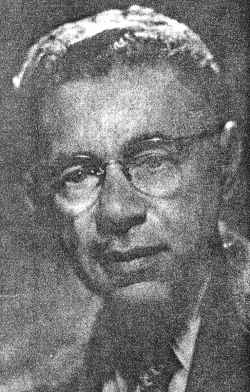
Mordekhay and his family came to Kremenets from a village. There he was the manager of an estate. Then he dealt in wood and lumber. Mordekhay raised his children in a nationalistic spirit and gave them some education. From their father they inherited an attachment to the land. When his sons came to the Land of Israel, they realized their father's dream. Yakov (Yankele) Chasid, may he rest in peace, was a member of Kibbutz Kinneret until his early death. Avraham Chasid, may he live long, runs a workshop at Moshav Herut. Avraham's son, Mordekhay's grandson, follows the same path.
Mordekhay's older son Zev (Velvel) was sent to the Land of Israel by his parents in 1913. He graduated from an agricultural school In Petah Tikva. Being away from home, after the outbreak of World War I and during his studies, he had to struggle to exist.
When the Jewish Legion was formed in 1917, Velvel volunteered for it. When the Legion was demobilized, he went to California and entered Berkeley University.
[Page 5]
Being totally alone, without means, Velvel endured terrible hardship on his chosen way. But thanks to his prior difficulties, since he had left his home, he achieved his goal.
He graduated from the agricultural school and remained there to work. Eventually he was nominated to be a professor of biochemistry. He was beloved in this role by his students and colleagues. He did research in biochemistry. His studies had an old-worldly dignity and were praised in the American press. Velvel was also nominated as a member of the American government's Academy of Science.
Professor Chasid decided to visit Israel several times, sometimes as a guest lecturer at the Weizmann Institute in Rehovot, to which he was devoted.
His parents had decided to come to the Land of Israel several years before the outbreak of World War I. But only R' Mordekhay was fortunate enough to see Zev. His mother was no longer alive. The terrible fate of their children who had remained in Kremenets drove her to an early grave. It could be that hearing of his son's great success in science and his devotion to Israel reminded R' Mordekhay, as it reminded me, of that Chanukah evening that I described earlier. Through him those seeds were sown. And they justified the hope that he had placed on them.
On his last visit to Israel, Zev visited our hall in the College and the Levinzon Library at Tel Aviv University. Those of us who were fortunate enough to meet with him will always remember and marvel at his deep feelings for everyone who was associated with old Kremenets.
[Page 6]
And after so many years! He maintained a regular exchange of letters with us. He received each edition of Kol Yotsei Kremenets with warmth and supported the work generously. The excerpts from only a selection of articles that appeared in American newspapers after Professor Chasid's death filled the hearts of Kremenetsers with pride.
Zev's life-partner Leyle died several years before him. She was also an important personality. He fruitful activities in the areas of music, literature, and theater were often praised in the press. She was a leading figure in the woman's organization Hadassah and was often honored as an academic in Berkeley. She had a special interest in Yiddish poetry and very successfully translated Yiddish poems into English. These poems were published in English-Jewish newspapers across America. For 10 years, she presented a monthly radio program on Yiddish folklore to millions of listeners.
The home of Zev and Leyle Chasid was on the Berkeley campus. Academics on campus would often meet there and enjoy the cultural atmosphere that dominated there. Israelis who studied at Berkeley found a warm home at the Chasids.
Here is what Professor Efraim Katsir said about the Chasids in his condolence letter to Zev after Leyle's death:
“Dear Zev,
I just learned of Leyle's passing. I mourn over your great loss and the loss to her friends, comrades, and listeners.
[Page 7]
I will never forget my first meeting at your home in Berkeley when Leyle was so gracious and energetic, and her beautiful personality enchanted all your visitors. I was taken with the breadth of her knowledge, her interest in music, poetry, and prose, her natural curiosity, and her sincere will to know everything that goes on in Israel and the world. When I came into your home, I felt as though I were at my home. There I found a sacred feeling for all, which is so dear to me: the love of mankind, of knowledge, of Jewish traditions, a concern for human fate and for the future of the Jewish people in the state of Israel ….”
Comments:
Barak: In 1919, along with Zhinzhirov the barber's son, at the head of a few hundred Ukrainian partisans, he smashed the Hetmans in a bloody battle and then opened the Kremenets prison and freed the political detainees, among whom were several Jews.
Yosef Shnayder, in secret in 1920, organized a rebellion against Petliura's army in a number of villages around Kremenets and Dubno. He then became a member of the Revcom [Revolutionary Communists], and people said he was among the first liberators of Kiev, which was then under the control of the Denikin pogromists.
Avraham
|
|
2 Tamuz 5734 was the 25th anniversary of the passing of R' Mordekhay Chasid, of blessed memory, a veteran Zionist who lived most of his life in Kremenets. He was – if we can call him so – from a close-to-the-earth Jewish family in the Diaspora; he spent most of his days in the forestry profession and the cultivation of grain on land cleared by harvesting wood for lumber. In his youth, he worked as a foreman on estates Jews had leased from landowners and learned about agriculture. He also worked as a clerk in the leased estates of R' Elazar Tsinberg, father of Dr. Yisrael Tsinberg, the well-known historian of Israel's literature. When Yisrael visited his parents during school vacation, they would tour the fields together on horseback. R' Mordekhay's house in Kremenets was on the edge of town. Close by were a fruit orchard and vegetable garden, of which his wife, Shprintse, of blessed memory, took loving care. A milk cow was always in the yard. As he was steeped in agriculture, his soul's desire was to immigrate to the Land of Israel and live there farming the land. In Kremenets, he gave a helping hand to any Zionist activity, which had to be conducted in secrecy under the czarist regime. The first Zionist meetings were held in his house, mostly at the close of the Sabbath, where literature was read and discussions on assorted national topics took place. During those meetings, a family member would stand guard, making sure no unwanted person appeared and informed the police of the meeting.
[Page 9]
For such an event, the meeting was camouflaged as a birthday party, and the table was spread with refreshments and sweets. When Yosef Burshteyn's Hebrew students held their first party in his house on Purim, it was stopped by the police, who suspected that it was a political meeting. R' Mordekhay, who was held responsible for the party, was arrested, but thanks to the intervention of the town's politicians, he was released the next day.
In preparation for immigrating to the Land, he sent his son Zev to study at the agriculture school in Petach Tikva and entrusted him with the task of researching property suitable for agriculture that the whole family could work on. Alas, World War I contravened his plans, and the family remained in the Diaspora. He succeeded in immigrating with his wife, Shprintse, of blessed memory, but only in their old age in 1936, after their sons, Avraham and Yakov, and his daughter Feyga, with her husband, Nechemya German, and their children.
Even in Israel, he did not stay idle: Ramat Yitschak, the community he lived in, had no place for the public to pray, so he initiated a campaign to build a synagogue and remained with the project until it was finished. He worked to establish a benevolent fund to help the needy and to incorporate the suburb of Ramat Yitschak into the city of Ramat Gan in order to enable its development and an increase in services. When he visited his son Yakov in Kvutsat Kinneret, he was highly impressed with the technical improvements and modern systems employed in working the fields and was disappointed that he had immigrated too late to be able to work in agriculture. His wife, Shprintse, was his right hand in his activities for the public benefit. She passed away in 1942 after a heart attack she suffered when she learned the annihilation of Kremenets Jews, among them her two sons and her daughter with her children.
R' Mordekhay passed away in 1949 after being privileged to see the reestablishment of an independent Israel. He was also privileged to see his son Zev become a world-renowned scientist. He came from the United States to visit him at the end of World War II, by then being a professor at the University of California, Berkeley.
May his memory be blessed.
Avraham Chasid
|
Zev was born in 1896 in the village of Lisk[1], on the border of the Ostrah district. In 1903, his family moved to a farm near the village of Orsk, which was owned by the partners Margolis and Kartman and managed by our father. On this farm, grain crops and a large herd of dairy cattle was raised, but the main work was in forestry and lumber, as forests were abundant in the area.
I remember Zev at the age of 11. There were already a few children in the family who needed to be educated, and for that purpose, a teacher from town was hired. This was an educated young man who lived in our house and taught us Jewish studies, and he also taught the older children general studies. Zev did not show much desire to study; he was attracted to walking in the forest, climbing trees, catching birds, collecting plants, and especially drawing horses and colts. During the summer, he liked to spend most of his days in the cattle pasture, in the company of Vasil the shepherd. Father used to scold him for slipping away from his studies: “What will your future be? See, you will turn into a shepherd.”
When the children grew up and needed a formal education, the family moved to Kremenets. Our father would spend the weekdays on the farm and come home for the Sabbath. Zev entered the government primary school for Jewish boys under the administration of Goldfarb, where they were taught general studies but not Jewish studies. On weekday afternoons, he studied at Yosef Burshteyn's school. When public school ended, the problem arose of where he should continue his education; the only high school in our town was the School of Commerce. But there they studied on the Sabbath, too, and our father did not agree to have his son violate the Sabbath.
[Page 11]
So Zev continued to study with Asher Manusovits as an external student and to pursue Hebrew studies with the teacher Aharon Shimon Shpal. A year later, the decision was made to send Zev to the agricultural school in Petach Tikva, in the Land of Israel, where his friend Avraham Rokhel was studying. At the end of the first school year, he planned to go home for summer vacation, but he contracted typhus and could not leave. In the meantime, World War I had begun, communication with the Land of Israel was halted, and Zev, at 18 years old, was left in Petach Tikva, cut off from his family, weakened by his ailment, and with no financial support. Zev supported himself by working in the afternoons at local farms. At the time, the country was under the cruel Turkish regime. Sickness and dire shortages were prevalent, and Zev, like the other students who were cut off from their parents, suffered from hunger. When the British army conquered the southern part of the country in 1918, Zev volunteered to serve in the Jewish Brigade that began to form then, as did most of the young men in the country. Unfortunately, because he was weak and frail, the medical examination board rejected him. The head of the recruitment board at that time was Baron James Rothschild, who served as an officer in the British army. Zev approached him with an appeal, and he gave an order to enlist him. Indeed, after a few days of eating properly, he recovered his health and functioned as a regular soldier in every way. In the army, Zev rose to the rank of corporal, and his pay was increased above that of a private. He was thrifty and saved for the time after his discharge.
Following the advice of the agronomist Yosef Gur, a graduate of the University of California and also a member of the Brigade, Zev decided to go to California to study natural science. The money he saved was sufficient to get him to California, and with the diploma from the school in Petach Tikva, he was accepted at the university. His knowledge of English was insufficient to understand the lectures, so he had to supplement his knowledge with outside help. He met with sympathy from the university's administration and was helped by its staff, too, in his studies and with employment. A year later, Zev began studying at the University of California, Berkeley. Although he had a hard time economically, he advanced and received first and second degrees in chemistry, supporting himself with any job he could get.
His master's thesis showed suitable achievement, and he was appointed a teaching assistant at the University of California, Berkeley, where he continued to study until he received a doctoral degree in biochemistry. His work was successful, and he was appointed a tenured professor.
[Page 12]
While teaching at the university, he did research, too, making many discoveries in the field of biochemistry, and published close to 200 articles and books in this science. He achieved the rank of senior professor in the university and was elected to the American academy and international academies.
In the past 30 years, he has visited in Israel four times. He was a visiting lecturer in the science institutes here and was always received with pleasure. Many Israeli scientists who did postgraduate studies in the laboratories under his direction were greatly helped by him. His house was like a mini-embassy of Israel, where students were received with much warmth. But his private life was unlucky.
In his later years, he suffered from a heart ailment. His wife, who was his devoted helper, passed away three years ago after a long ailment, and he was left alone and sick without progeny in a foreign land far from his family.
In his last letter, he wrote to us that after the last treatment he had received at the hospital, his condition had improved, and he was continuing to work in his laboratory. We were hoping to see him again in Israel and enjoy his bright personality, pleasant demeanor, and simple ways. In spite of his distinguished achievements and fame in the world of science, he was no stranger to humility, nor did he feel above others.
On May 1, we received the bitter news that he had passed away from heart failure in the hospital.
We received letters from his university colleagues, the rector, the university chancellor, and his many friends expressing their condolences and sadness, noting the great loss they personally felt – the loss of a man with exceptional gifts and a distinguished scientist. Telegrams of notification of his death were received by the Weizmann Institute and Israel's president, Efraim Katsir, who was his friend and who did his graduate work in Zev's laboratories. In his replying telegram, the president wrote that with Zev's death, a great scientist and a noble soul had been lost.
May his memory be blessed.
Recounted orally by Mrs. Ruth Klug
Prepared for publication by Yehudit Shtern and Yitschak Portnoy
Translation by Theodore Steinberg
Related by Ruth Klug, who was born and lived in Warsaw until the outbreak of the German-Polish War.
I arrived in Kremenets from Warsaw in 1940 after a weeks-long, terror-filled journey that would be a story in itself.
|
My husband, Nachum Klug, was in Kremenets. He worked for the Haynt newspaper, and in Kremenets worked with Grishe Gun and Shayke Kapuzer in editing Stalinskim Shlyakham. For a little while we lived under Soviet control. I had received a five-year Russian passport, which was a rare privilege for “refugees.”
When the war between Russia and Germany broke out and the Germans came to Kremenets, on the streets of Kremenets, near the Odzialuvke restaurant, there was heavy fighting between the remaining Red Army and the Germans. After several days, they began to seize Jews at random and take them to prison at the Dubno city gate, from which they never returned. I was then just out of the hospital with my newborn child–Rachele Klug. Life became more difficult. We were forbidden to buy milk and vegetables, everything was forbidden, and to exist one had to avoid the forbidden. Each day we would hear about arrests and shootings.
[Page 14]
On one dismal morning, they put almost all the young people and intelligentsia in the prison and the Tivoli Garden. Among those arrested were my husband, Nachum Klug, Markushe Margolis, the two Breytman brothers (their father sold sewing machines), Mire Polonski, the Halperin brothers, and many hundreds of the youngest and finest of Kremenets' sons and daughters. At that time, I was with my sick child at Dr. Shklovina's. She sent her daughter Sheyne with 12 others to bring food to those who were arrested. They were also seized and killed along with the detainees. After that, systematic plundering of the Jews began. From morning until night, people dragged carts around and took from the houses whatever they could lay their hands on.
They also began to force people to labor, during which they abused them. I saw how they forced one old man, an elder, to dance as they pulled out his beard. People would return from the labor half dead from hunger. Those who had some luck would bring home a little bread or potato.
After three months, they began to organize the ghetto. The Jewish Council assigned homes on Kravietska and Levinzon streets and part of Gorna. The Christians left their houses. Then people began to take Jewish families into the ghetto. Five or six families were in each house. The crowded conditions were beyond description. The ghetto was surrounded by a wooden fence. There were Ukrainians on the outside and Jewish police inside. The commander was Sh. Blit. In the ghetto, I cut and sewed yellow patches.
The gate, the entrance to the ghetto, was near Gandel the dentist's house. Life in the ghetto was difficult and bitter. We received bread only at the beginning of the ghetto.
[Page 15]
After two months, they stopped providing bread. There was a lack of water–going out to work and returning was beyond human endurance. In the ghetto, there was a communal kitchen that provided a few spoonsful of soup once a day.
There was an edict that the residents of the ghetto had to make payments in goods, down blankets, money, jewelry, and even grain. The Jewish police and Jewish Council had to deliver these things. They were helpless. I will put in a good word for them, because they did everything under terrible pressure. These were good Jews who suffered with everyone else. I knew a son and nephew of Dr. Padve from Czechoslovakia who were in the Jewish police.
After some time, I received permission to leave and work outside the ghetto. I worked for Mrs. Marye Savitska, a nurse who lived on Beser Street. I also worked for the teacher Legentsevits. Mrs. Tamara, who had worked for the courts, also lived there. I must describe how she lived her life. She would wear a large apron with big pockets. She would wait for Jews who worked outside the ghetto and give them bread and other foods, at great danger to herself.
The liquidation of the ghetto took place while I was with the breadgiver–I saw the flames from the ghetto. Good Mrs. Tamara would not let me go back and hid me in the stable. But her husband threatened to turn me over to the Germans. He took Mrs. Tamara to their village, Veselivka, and drove me away.
I hid in a garden among the bushes and ate what I could steal: a carrot, a beet. It was the rainy season, and I had no shelter.
[Page 16]
Also, the Germans' tracking dogs scented me out, and the soldiers shot at me. It was all the same to me, so I went out into the street. I did not look Jewish, so I went out, and people wanted to help me. I wandered to the train station and back. When it got late, I went to the post office, not far from which lived the postman. I went to his neighbor, who hid me. I was with them for a short time, and then I wandered through many towns and villages in Volhynia by myself, and so I survived until the war's end. When I then traveled home, with little hope that anyone from my family was still alive, I was thrown from a moving train. I remained an invalid for the rest of my life.
|
|
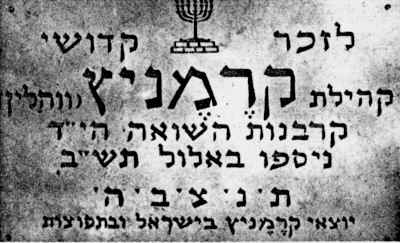
[In memory of the martyrs of the community of Kremenets, Volhynia, victims of the Holocaust, may God avenge their blood, who perished in Elul 5702. May their souls be bound up in the bond of eternal life. Kremenets Emigrants in Israel and the Diaspora] |
by Manus
Translation by Theodore Steinberg
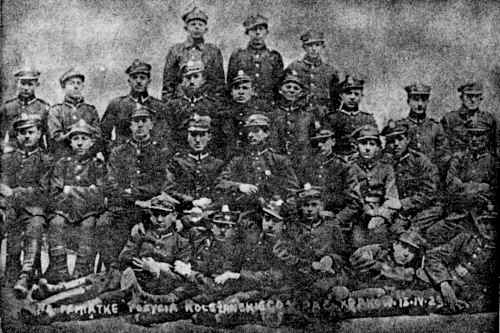
At the beginning of 1921, after the storm of the civil war, the Poles began to mobilize young Jewish and Christian men in the territories they occupied into their army. At first they called up those born in 1899 and 1900, and a few months later, those born in 1901, and so on.
[Page 17]
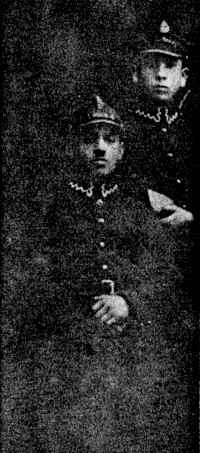
The number of Jews called for military service at that time far surpassed the number of Jews who used to be called up for the czar's army. In this we can see a new phenomenon in the city. I remember that when there was a Jewish holiday on Sheroka Street, it would be flooded with pedestrians, and at every step one would see the pretty banners of the Orlafnikes wound around their relatives and friends, some of them sporting ringing spurs on their shiny boots and some with feathers, the symbol of the Podolia Fusilliers on their four-pointed hats.
|
|
The young Jewish men from Kremenets and rest of Volhynia earned admiration from their officers, who had a prejudice about Jewish soldiers. “Volhynians,” they were called, but they won awards in all areas.
[Page 18]
Some of them were sent to various officer schools, even though these were forbidden to Jews by unwritten laws.
Some of them were assigned to the military administrative office, where they impressed people with their intelligence and quick adaptability. They were much praised there.
In spring 1922, the group born in 1901 was called. Some of the recruits, mostly Jews–I was among them–were not sent to the infantry, as earlier, but to the Fifth People's Heavy Artillery, which was stationed in Krakow. Some of the higher and lower officers there came from the German and Austrian army. The training period, which lasted six months, was hard and painful. In our battery alone, two recruits, Ukrainians from our area, took their own lives. During those six months, none of us thought even for a minute of leaving the barracks area. The atmosphere and regime there were like those in the concentration camps; and amidst our despair, dejection, and homesickness, our angel of redemption appeared in the form of the engineer Nachman Desser, who was then a student at Krakow University (and is now in America).
As he now tells with amazing sensitivity when he attends anything related to Kremenets and Kremenetsers: “In September 1921, I came as a student to the Jagiellonian University. A few months later, I received a letter from my mother saying that several young men from Kremenets were in the Fifth Heavy Artillery, and they ask, in the name of their parents, that I should see them and try to bring them to the city for a few hours.
[Page 19]
The same day I received the letter, I took a carriage to their barracks. I was wearing a typical Polish student hat. At the gate I showed the guard my student identification card. He called, and soon a lieutenant stood before me. I told him that several of my fellow citizens were there, among them Avraham Vaynshteyn, my near cousin, whom I would like to see.
A short time later, the lieutenant returned, together with Vaynshteyn and several other Kremenetsers. Then I suggested that he allow me to take the Kremenetsers to the city. I assured him that I would accompany them. I also told him that they could stay at my place if they were permitted to remain in town after their training. I showed him a letter from my Polish roommates saying they had no objection to my friends staying there if they chose to remain in the city. “You soldiers, since you have such a relative and friend, a student from Jagiellonian University, be sure you follow his directions and everything will be fine.” With these words, the lieutenant happily addressed the group of Kremenetsers who were in the exit. For them, this was the way to go from slavery to freedom [quoting from the Haggadah], their first encounter with the civilized world after months of total isolation under the exclusive authority of sadistic lower officers.
Among the Kremenetsers were Avraham Vaynshteyn, Vovke Barshap, Bozi Kesler, Hokhgelernter, Yefim Shifris, Mendel Fishman, Leyzer Dobekirer, Manus Goldenberg, Zelig Komandant, Hershel Viner, and a few others.
[Page 20]
Twice I changed my room, and the Kremenetsers accompanied me. I invited them to student dances. Vovke Barshap was really taken with dancing, especially the kazatsky.
What is amazing is that I often cannot recall the names, places, and dates from a short time ago, but I can remember the smallest details from 53 years ago.”
Thus end Nachman Desser's recollections, which carry a deep feeling of nostalgia for those years. We have a picture that recalls our association with Desser on his last visit to Israel with his wife.
Almost everyone we see in that picture is no longer among the living. May it, and the impression they made, serve as a monument.
|
|
Y. R.
The life work of our distinguished member Yisrael Otiker, of blessed memory, extends not only over areas of various activities in the Land and abroad. It was accompanied by writing that contains much to educate the younger generation. This began with Kremenitser Shtime and the Pioneer booklets in Hebrew and Yiddish in the Diaspora and continued with his contributions to assorted periodicals in the Land and now with his phenomenal book, The Pioneer Movement in Poland, 1932-1935, with 230 pages, published by Ghetto Fighters' Publishers, named for Yitschak Katsnelson in December 1972. This book earned its author the title of graduate in arts and sciences from the Hebrew University of Jerusalem.
[Page 21]
Following are three sections: from the publisher's preface to the book, the foreword by Professor Shmuel Etinger, and the author's introduction.
Here is a summary of the contents:
(a) The Numerical Development of the Pioneer Federation up to 1935; (b) Pioneer's Humanitarian Theme; (c) The Formation of the Training Kibbutz; (d) The Spread of Training Kibbutzim during 1932/33; (e) The Demographic Composition of the Training Kibbutzim; (f) The Social Background of Training Kibbutz Members; (g) Addendum, Including the Klosova Anthem in Yiddish and Hebrew.
From the Preface – The Publishers
The book offered here to readers was written by Yisrael Otiker, a member of Kibbutz Naan and a lecturer and active member of the Efal Institute. Although the scope of the research presented here is limited in subject and period, it is complete in itself, the first of its kind. The Pioneer movement archives – housed in Ghetto Fighters' Publishers (named for Yitschak Katsnelson) – consider this work appropriate for the beginning of a series of research and commemorative volumes they will publish on the Pioneer movement.
From the Foreword –Shmuel Etinger, history professor at the Hebrew University of Jerusalem
From the beginning, the Jewish population in independent Poland was exposed to riots, assaults, and a policy of injustice – aiming toward expulsion of the “superfluous Jews” and the transfer of traditional branches of Jewish economic livelihood to the hands of government and citizens of the ruling nation… The Land of Israel turned out to be the only ray of hope for this Jewish community in strangulation. This was the main reason that Pioneer, at the beginning of the 1930s, developed into a mass movement, a movement of thousands. It seems that Otiker's main research is dedicated to a statistical and demographic description of the movement.
[Page 22]
But in fact, the collective's spirit is revealed, as well as sacrifice, cultural activities, and the learning of Hebrew, which were all necessary to maintain the existence of Pioneer members in Poland during the long period of waiting for immigration and preparing them for their future pioneering role in Israel… Only thanks to the active and energetic activity of the national current and Pioneer, which led the flow of those who fulfilled the dream and immigrated before the Holocaust, and those who heroically overcame the British blockade at the gates of Israel immediately after, was the long and glorious tradition of the Jewish community in Poland interwoven with the continual historical activity of the Jewish nation. In this chapter, with its historical succession of the nation and its self-awareness, Yisrael Otiker has made a considerable contribution, which could have been much greater if his life and activities had not ended.
From the author's introduction:
From 1932 to 1935, the Pioneer movement saw a rapid increase and broad dissemination in Europe. In 1933, of 83,000 members worldwide, there were 41,000 in Poland (not including Galicia) and 17,800 in Galicia, which means that about 70% of the members were within the borders of the Polish nation. The movement in Poland had a considerable influence on the consolidation of the organization and was the model for training activities in other countries. The Pioneer federation in Poland excelled in many practical initiatives and clarification of ideas. Because of this, it carried a great weight among the world movement… We deal here only within the framework of the Pioneer federation in Poland, whose center was in Warsaw, the capital of central Poland, that is, Congress Poland, and the eastern regions, called Krasi. We do not deal here with the Pioneer movement in Galicia, which until World War I was included in the Austro-Hungarian Empire. This chapter is a subject for a separate discussion.
In addition, we have to emphasize that there is no claim in these chapters to present an all-encompassing history of Pioneer in Poland. That history is still awaiting its time, and without a doubt, it is a subject for many research projects.
Y. Rokhel
|
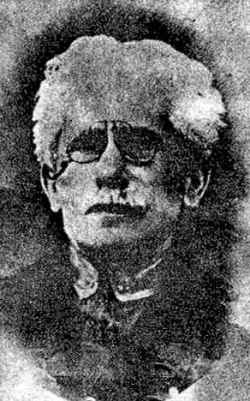
Yisrael Tsinberg – famous mainly for his monumental work The History of Hebrew Literature, published and reprinted several times in Hebrew and Yiddish – was born in 1873 in Kozachuk village near the town of Lanovits[2], Kremenets district. His father, Eliezer, who rented the local landowner's estate, was somewhat interested in the Enlightenment and took care to give his son a good education. He hired one of the best teachers from the rabbinical institute in and brought him to his home in Lanovits. When he grew up, Yisrael studied in a Russian high school, and after he graduated, he studied at the Polytechnion in Karlsruhe, Germany. He earned his doctorate in Basle and did postdoctoral work in a chemistry laboratory in Germany. In 1898, he returned to Russia, settled in Petersburg, and was appointed the administrator of Potilov's large factory, where he worked for about 40 years. He achieved a high rank in his profession, published scientific articles, and authored a textbook that had two printings. He received the honorable Soviet title Hero of Labor.
In 1938, he and a large group of Jewish scientists and writers were arrested and sent to a detention camp near Vladivostok. At the beginning of 1939, he fell ill and passed away in that city's hospital; no one knows where he is buried. Only after the 20th Communist Party Convention did his family receive a notice that his name had been cleared.
This, in short, is the biography and bitter end of Yisrael Tsinberg; his was a life path that many Jewish scientists and writers in Soviet Russia traversed, with their only transgression being that they were Jewish.
[Page 24]
But in the scientific field, and even more in literature, Tsinberg's life path was very glorious; the native of the remote village Kozachuk left a literary legacy that will never be forgotten.
Tsinberg saw his work in the chemistry laboratory of the factory as the mundane part of his life and saw the main essence of his life as his literary work. This had two parts: articles about politics and public affairs, of which he wrote many in the years until the October 1917 revolution, and research into the history of Jewish literature. In Petersburg, he joined the Russian-Jewish intelligentsia circles, which were centered on the Society for the Spread of the Enlightenment and the Jewish magazine in Russian, Voschod. Very soon, he was offered a regular column in Hebrew and Yiddish in the weekly Survey of Jewish Journals, a review that encompassed myriad problems caused by the times. Throughout the history of the Jewish nation in the Diaspora, Tsinberg saw two opposing factions: one of logic and the other of emotion: law against legend, the Rambam against Yehuda HaLevi, Mitnagdim against Hasidim. Tsinberg was on the side of the emotion faction, in whom he saw the embodiment of the folk instinct. Being a strong follower of the Narodniks, he saw the core of goodness in simple people, and from this came his positive attitude toward the Yiddish tongue as the language of the masses. At the same time, he was far from having the negative attitude developed in those years by many Yiddish devotees. His attitude toward the Zionist movement was one of respect and honor, but with criticism; he saw it as “an ideal for the distant future.” Due to those views, he supported the Folks Party, and in 1912, it started to publish the monthly Yiddishe Velt, edited by Sh. Nigar, for the purpose of making the Yiddish the language of the Jewish intelligentsia, too. With the establishment of the Soviet regime, Tsinberg was forced to write his column on civic matters.
From his first literary work, Tsinberg saw his main mission as scientific research on Jewish literature throughout the generations and in assorted languages. His first composition in this field was a monograph on Y. B. Levinzon (RYB”L). In 1900, he joined the staff of the Jewish Encyclopedia in the Russian language as editor of new Jewish literature in Hebrew and Yiddish, and published about 300 tractates. The historical collection of Sh. Dubnov's Yevreyskaya Starina[3] contains Tsinberg's extensive research papers on RYB”L and other writers of the Enlightenment period.
[Page 25]
But the pinnacle of his research is the book History of Jewish Literature. He had two problems: time span and languages. After some consideration, he decided to limit his work to the European period – from its flourishing period in Spain up to the publication of his book – about 100 years. As for languages, the deciding point was his integral understanding that Jewish literature was a single unit no matter the language in which it was written (Hebrew, Arabic, Spanish, Aramaic, German, Yiddish). Tsinberg had a rule: “I write only according to original sources. I will not write about any book that I do not have or that I have not read.” The other rule is that the book would encompass Jewish literary creativity in all its forms: Kabbalah and philosophy, folktales, religious poetry, and secular poetry. In all of them, he saw threads of the same cloth.
The book was begun in Russian, and in 1919, the first five chapters were published in Petersburg. The complete book, with eight chapters, was published in Yiddish in Vilna between 1929 and 1934. The book was more successful than expected, and while the volumes were out in stores, a second edition was printed. From 1964 to 1968, a third edition in Yiddish was published in Buenos Aires. In 1957, Hilel Aleksandrov, the well-known historian, discovered the handwritten, unfinished manuscript of the ninth volume, containing only eight chapters, in Leningrad. A photocopy of the manuscript arrived in America and was printed there in Yiddish in 1966.
Tsinberg did all his literary work after a full day's work in a factory, in the evenings and during vacations. He continued it diligently – during the war, hunger and cold, years of persecution, and Stalin's “cleansing” – for in that he saw his life's destiny.
From 1960 to 1965, six volumes of the book were published in Hebrew by Sifriat Hapoalim, and the seventh volume was published in 1971.
Yehuda Slutski concludes his preface to the seventh volume with these words:
“May this book be a memorial monument to a unique Jew, who remained loyal to his nation and its culture under conditions of loneliness and separation…”
M.G.
Translation by Theodore Steinberg
During all the years we have been in contact with Kremenetsers, wherever they are, many have asked about their friend and teacher Yakov Shafir, who, because of his health, has long been housebound.
Well, I can relate, having visited Yakov over the intermediate days of Passover, that I found him surely aged, but that is only a kind of covering. Under that covering, in our long conversation, the old Shafir, whom we remember so well, appeared, the Shafir who was a singular factor in the community and cultural panorama in Kremenets in the Sturm und Drang period of the years after the revolution.
He reminded me of several interesting episodes from that time, with which we could fill a whole booklet. He and Bozye Landesberg were at the center of the celebration in Kremenets at the laying of the foundation of Jerusalem University 50 years ago by the Jewish residents of Yoveli. One episode, as he remembered it, lit up his eyes with a youthful fire, as he spoke with his former enthusiasm. I, too, remember it well and joined in his enthusiasm and nostalgia for those romantic days of the February Revolution.
It was the first of May in 1917. In Kremenets, the council of workers, farmers, and soldiers' deputies had planned, for the first time in the history of the city, a mass demonstration.
It was a beautiful, sunny day that filled our hearts with joy. Along Sheroka Street, from the Bazeliana, there was a line of many hundreds of Jews, gentiles, and soldiers extending toward the Tivoli Gardens.
[Page 27]
Above the singing crowd fluttered red, Ukrainian, and blue-white banners. Yakov Shafir, who had just returned from the front, where he had fought the Germans for three years, was still wearing his military uniform. Holding his nationalistic banner high, he marched proudly at the head of the demonstration. When the demonstration halted by the flower-and-banner-bedecked stand in Tivoli, its end was still at Kostsial.
Bozye Landesberg and Yakov Shafir were among the speakers. Their speeches, in Russian, electrified the crowd. When soldier Shafir finished, the chief speaker, a Ukrainian soldier, stepped forward. He grabbed Shafir and kissed him. I believe that the hospitable Chanulye, Shafir's wife, at that moment, as the story was being told, saw before her only Yakov and Manus from those happy days. So her tears indicated.
When we had recovered from the magic of that nostalgia, Shafir said, “And after all this, you write in your Kol Yotsei Kremenets that I came to Kremenets from Dubno!”
He was right. Who was more of a Kremenetser than Shafir? One of our last centenarians. Until a hundred and twenty!!
Manus
Starting in 1973, the name Yurik Pikhovits appears among the 400 names of Kremenets emigrants in Israel. Yurik was the son of a respected Catholic family in our town. He arrived in Israel in 1947, but we found this out only recently, and for the first time, he was invited to join us in the annual memorial to our town's martyrs. I introduced him to the assembled people along with the guests and newcomers, as is our custom every year.
|
From our first meeting, I was charmed by his personality. His round, full face is lit up by the light shining from his blue eyes, their smile expressing magnanimity and generosity. Among the assembled were those who remembered Yurik from Kremenets. Others studied with him at the Lyceum and saw him at sporting events there. His joy in meeting them here was boundless; it was a great experience for everyone.
[Page 29]
I saw Yurik for the second time shortly after the memorial, at a wedding given by one of our members. He was there with his wife, already a full member of our organization. I now had another opportunity to talk with him and see how similar our experiences were in relation to the surrounding landscape during our childhood and youth. How great is the nostalgia that floods us in equal measure at every meeting; it is the same for him. It was a quick talk but had enough in it to convey the feeling that his life experience encompasses the tragic and heroic period of the Holocaust and the rebirth of Israel and that he has forever bound up his fate with that of the nation of Israel. Therefore, I asked Yurik to tell us everything that had happened to him during the years before he settled in Israel. For that purpose, I made a date to meet him in his town, Haifa. In Chinya and Izya Portnoy's home – where a friendly, homey atmosphere always prevails whenever a person from our town visits them – Yurik's story flowed. Those who listened to him, now and then, felt like one of his heroes when he talked about events in Kremenets before the Holocaust.
Yurik was born in 1919 in Kiev. From there, his parents moved to Lodz, where they lived until 1926. This was the year of the great economic crisis in Poland, and his father lost his assets and became impoverished. The family moved to Kremenets, where his father got a job as an administrator in one of the Lyceum's estates in Smiga[4]. Yurik studied at the Lyceum, where he made friends with the few Jewish students lucky enough to be accepted there. He also had a connection with Jewish youth in the sports fields and in the Lyceum's band under the direction of Avraham Zats.
After his graduation, he was inducted into the Border Protection Corps, and in 1939, he was to be sent to the air force. In that way, he would later able to continue his studies in the Technion, with the tuition paid by the government. But just then, the Germans invaded Poland, and with the disintegration of the Polish army, Yuri returned to Kremenets, which by then was under the Russians. With the help of the Polish teaching staff that remained there temporarily, he was accepted back into the Lyceum. Meir Pinchuk, whom the Russians appointed as the inspector of the Lyceum – a high-ranking position that in the past was given only to persons of high position in the upper echelons of the Polish government – took him under his protection, and he was permitted to live in the dormitory and eat his fill. His parents had escaped from Kremenets to the Vilna area as soon as the Red Army had taken it, and Yuri no longer had a home.
[Page 30]
Before long, worrisome rumors began to spread among the people about the Germans' plans. Pinchuk then advised Yurik to escape. While he was on the road, the German invasion of Russia began. In one of the trains, he met some young Poles, and they decided to cross into Poland and join the anti-Nazi underground. As they crossed the border, German soldiers opened fire on them, but they managed to escape and reach Warsaw. There they were accepted into the fighting organization Wolnost under the leadership of a Jew named Kot. This organization had caused great losses to the Germans, who advertised a large prize for whoever extradited Kot on large posters in town. Kot was caught in Lvov[5] after the Russians had left, and he was killed, but the organization continued to function after his death. Yurik and his five friends were sent to a German army camp as glaziers, though only one of them was really a glazier. It was a very sought-after profession at that time, as most of the windows in town were shattered from bombardments and shelling. Their task was to remove from the camp all the material needed to manufacture bombs. The famous explosion in the Adria coffee shop, where dozens of German officers were killed on Sylvester night, was executed with the help of the materials they removed from there.
Yurik's group had also executed assignments such as this in other camps, but when two of them were caught, the organization ordered them to escape to Hungary and then to join the French underground. In Krakow, the center of the Polish underground, each of them was furnished with a bag of products so that, if caught, they could say they were dealing in the black market. In addition, they received some valuables to help support themselves.
During a heavy snowstorm, loaded down with heavy sacks, the group made its way in the darkness of night toward the Slovakian border. As they tried to cross, they were caught by Slovakian soldiers, who then handed them over to the Gestapo. In spite of being severely tortured, they continued to insist that they were dealing in the black market. The Gestapo had gathered about 150 people with the same goal as Yurik's group – to join the underground in France. Of them, only 25 men and 1 woman were left alive. Among them was Yurik's group. They were transferred to Tarnow; from there they were sent from one concentration camp to another. While in Zaksenhauzen, Yurik saw few hundred young Jews from Greece at the prisoners' assembly; these were, apparently, the young men whose heroic deeds were only now made known to the public. After they were transferred to Auschwitz, they were ordered by the SS to work at the crematorium, but they refused to do so, preferring to be incinerated instead.
[Page 31]
In Zaksenhauzen, they could feel that the end was near. After a heavy bombardment by the allied force's airplanes, the SS gathered the 500 prisoners, Yurik among them, guided them out of the camp, and under heavy guard started one of the famous marches towards Liubek, Germany. Of the 500 who started the march, only 70 reached Liubek. The rest perished on the way, some from thirst, some from hunger, and some from exhaustion – anyone who lagged was shot to death. Later, when he was free, Yurik met Tsipora, his future wife, in Liubek, Germany. She had arrived there with another death march.
In Liubek, Yuri worked in the British army kitchen. There he met a female officer with the rank of colonel, Mrs. Montgomery, the niece of General Montgomery, commander of the British armed forces. She was very interested in Yurik and Tsipora's fate, and when she heard of the formal difficulties imposed on them by their wish to have a civil marriage, she put pressure on the British authorities, and they performed the marriage. Mrs. Montgomery gave them gifts; the most valuable among them was assorted provisions so that, with her, they could celebrate the occasion in as grand a way as possible in those years of austerity.
Sometime later, Yurik and Tsipora joined Operation Escape. They moved from Germany, via Austria, to Italy. In Milan, Yurik was put in charge of a crossing point on the refugees' escape route to the Land of Israel.
He was given a 25-room villa, where he received transports from Trieste and Vienna. His job was to supply gasoline for their vehicles so that they could continue on their way, and gasoline, as is well known, was extremely hard to come by in those days.
Yurik did this from 1945 to 1947. He took part in all the meetings held by the heads of Operation Escape in Europe and was their confidant.
In 1947, while they were still in Europe, their son was born and was entered into the covenant of Avraham our father.
When he came to that point, Yurik said, “Concentration camps with all their atrocities on one hand, and the most beautiful human relationships under those horrifying conditions on the other, have made me indifferent to matters of religion and race. I am interested, mainly, in the humane side of people.”
[Page 32]
That year (1947), Yurik's small family arrived in the Land. After some struggles, they succeeded in getting established: his wife, a graduate of the Hebrew High School in Krakow and a nursing school, got a job in the hospital in Afula, where she still works. Yurik worked as construction worker in Haifa. After a few months, they moved to the hospital.
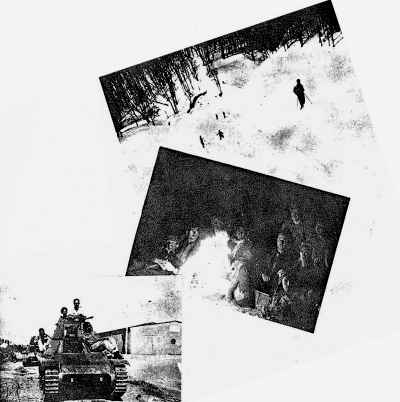
When the War of Independence began, Yurik worked at building fortifications at different places. When his activities in Europe became known, he was recruited to the Overseas Volunteers[6]), and from there he was transferred to Armored Brigade 82 of the Palmach, Yitschak Sada's brigade. He took part in many battles, among them the battle on Falujah, which was under the command of Nasser. After the successful elimination of the Falujah pocket, Sada's brigade was sent to its base in Lod. On the way, the armored vehicle where Yurik sat had a lethal accident. Some of the passengers were killed, and Yurik's back was seriously injured. He had a series of surgeries and was in a cast for about four months, after which he developed some complications, and he suffered greatly.
After the War of Independence, Yurik worked as a foreman in Ein Harod's stainless steel factory.
Now the family lives in Haifa. Yurik works there in the military industry, but for obvious reasons does not talk about his job.
His wife continues to work in the Afula hospital. Their 27-year-old son, who returned from the Sinai just a few days before this interview and was one of the first to cross the Suez Canal, is a graduate of the Hebrew University of Jerusalem and works at the board of education as an IBM programmer. Their daughter, who was born in the Land, graduated from the Technion's trade school and serves in the standing army.
After his last surgery, Yurik visited his sister and brother-in-law in Poland. This brother-in-law was a longtime prisoner during the Stalin regime. Yurik says that during the Polish students' anti-Semitic riots in Vilna, before World War II, when the Jewish students were forced by the hoodlums to sit in special places designated for them, he moved to the Jewish side as a protest against this humiliation. For this act, the university expelled him.
During that visit to Poland, Yurik had a dramatic meeting at the Israeli embassy in Warsaw: Yurik went to the embassy to take care of some papers. When a formal difficulty arose, he was taken to the ambassador's office. Slowly Yurik approached the wide desk, behind which the ambassador sat, and when their eyes met, both retreated; like lightning the same thought came to them, and immediately they fell into each other's arms.
|
|
[Page 33]
The ambassador was none other than Metet (Tesler), his schoolmate from the Lyceum.
Yurik's mother, who fled to London during the war, visited him a few years ago, before the election of the previous Knesset. She read the daily Polish newspaper published in Israel and learned about the platforms of the competing political parties. Being a devoted Catholic, she demanded that he vote for the National Religious Party.
That evening, the hands on the clock moved with jet speed. It was very late when Yurik finished his story, and it was hard to leave that faraway world that is so very close to our hearts, in which all of us (Yurik, Chinya, Izya, and I) were immersed for few hours, joined in a great experience.
“I used to come with my wife to assorted meetings of people from Krakow, and now she will come with me to the meetings of Kremenetsers, whom I belong to,” said Yurik, standing on the threshold of the house.
Yurik brought me to the bus station. I parted from the man along with his family, who were now so close to my heart, and I think that I am to theirs.
|
|
JewishGen, Inc. makes no representations regarding the accuracy of
the translation. The reader may wish to refer to the original material
for verification.
JewishGen is not responsible for inaccuracies or omissions in the original work and cannot rewrite or edit the text to correct inaccuracies and/or omissions.
Our mission is to produce a translation of the original work and we cannot verify the accuracy of statements or alter facts cited.
 Kremenets, Ukraine
 Yizkor Book Project
 JewishGen Home Page
Copyright © 1999-2024 by JewishGen, Inc.
Updated 05 Mar 2023 by JH