 |
|
|
[Page 365]
Latitude: 55º07' Longitude: 26º50'
As told by the Postavy partisans who survived and came to Argentina
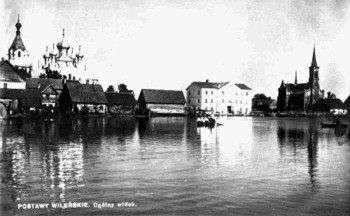
The shtetl Postov, (Postawy/ Postavy today in Belarus) was part of Vilna Province. It was located at a distance of 120 km. Northeast of Vilna (Vilnius- today in Lithuania). A railway station, also called Postov, was situated 2 kilometers away from town. The railway line ran from Vilna east to Vileika and from Vilejka north to Glubok (Glubokie). A river gashes through the shtetl. The river commences at Narutsh (the illustrious Narutsh Forest) and empties into the Dvine river north. During the summer the trees were cut down in the surrounding forests and the locals floated logs on the river north west to Riga.
The shtetl is situated on high ground enveloped by lush forests. Because of this luxuriant nature, the shtetl and the surrounding area were considered a resort region. Vilna Jews would congregate there for rest and recuperation during the summer. Students, who studied in the big cities of the region, would also come there to relax in nature. There was a grand dazzling park where the Graf (nobleman) lived near by the shtetl. The graf owned most of the buildings in the area, as well as the surrounding fields. In the midst of the shtetl there was a small lake, which was called the “Blind River”. The lake never dried up. There were all kinds of legends about it. Some of the legends connected the lake with the Turkish War.
The shtetl had four main streets and many smaller streets brunched out from them. There was a large busy market in the center of town. Every Monday was the weekly market day and farmers from the area would come to exchange goods and produce.
Postov was part of White Russia (Belarus) which was part of the Russian empire before the First World War. After World War I ( c 1920), it became part of Poland. There were approximately 4,000 inhabitants, 2,500 of whom were Jews and 1,500 White Russians. Jews and Christians lived in peace.
Jewish life in the shtetl followed the stringently traditional pattern for hundreds of years until the onset of World War I. There were 3 synagogues in which the Jews prayed: The Beth Midrash (House of Study), the “mixed” synagogue and the Great Synagogue. Every day, when it had barely
[Page 366]
gotten light, shortly before dawn, young and old Jews, would ran to synagogue for morning prayer. In the afternoon you could also see Jews leaving their businesses they were joined by Jewish laborers and all would be rushing to synagogue for the afternoon service. Between the afternoon and evening services one would plunge into a holy book, looking into a Gmara (Talmud), Ein Yaakov (Talmudic Legends), or Mishna, and some would recite the Psalms.
There were 2 Rabbis In the shtetl one was Hassidic and one a “misnaged” (opposed to Hassidism). There were 3 shochets (ritual slaughterers).. There was a “Chevra Kadisha” (Jewish Burial Society), an “Hachnasat Orchim” and “Linas Ha'Tzedek” (Hospitality committee and a bed for the night establishment, all free of charge). People would volunteer to sit with the sick through the night, especially the ill that were alone and had no family in town. There was also a local doctor. The Jewish occupations in town were diverse. There were storekeepers and laborers. Some were loggers who sent products to the faraway cities. Many made a living from the market day. The peasants from the surrounding villages would bring grain cattle and other products to sell. Wagoneers made their living by carrying passengers and products to and from the station, which was 2 kilometers away.
There were some traditiona1 Heders for biblical studies. There was also a Russian elementary school with 7 grades and an Officer's school.
At the time of the Beylis trial (In the year 1913, the infamous lawsuit of Mendel Baylis took place in Kiev, Beylis was falsely accused of murdering a young Christian boy in order to use his blood for ritual purposes) This story took place at the same time in Postavy. There lived in the shtetl a Christian man who used to bake sugar ca tier daughter would sell them in the train station. When a train would arrive she would enter the coaches to sell her wares. One time shortly before Passover, she got involved with a purchaser in a coach. The train left the station and she couldn't get off. She got to the next station at Heidut There she met the Postov bagel-baker, Avraham-Itze. He took her in his cart in order to bring her home. They arrived in Postavy very late at night.
Meanwhile, her mother had run to the Rabbi screaming that Jews should return her daughter. Since it was just before Passover the Jews must have kidnapped her daughter. She knows Jews do this kind of evil, since such a trial of the Jew, Mendel Beylis, is now taking place in Kiev.
[Page 367]
A large crowd of Christians had gathered immediately and became enraged. The Jews were extremely frightened. Late that night the Christian girl rode in the shtetl with the bagel-baker and all quieted down.
The following story took place in about the same time c 1912. There was in shtetl a young Jewish lady named Chana-Laike. She fell in love with a non- Jew and wanted to marry him. When her father found out about it, he beat her. Chana-Laike ran away to her non-Jew lover and told him everything. He discussed the matter with the peasants. They decided to avenge her fathers' beating, on the entire Jewish community. On a Monday, they decided to rob and kill the Jews. The Postavy Jews discovered this plan in time. A number of young Jews organized. They drove the turbulent peasants with sticks out of the market area. This was how a pogrom was prevented during that time.
|
|
The onset of the War hit the Jews of the shtetl worse than all other shtetls in the area. At the outbreak of the war the Christian neighbors began eyeing the Jews and looking at them unfavorably. Every misfortune and tragedy that befell on the residents was charged as associated with the Jews. When there was a shortage of silver money it was said that the Jews were hoarding it. The same type of blaming was true of other events.
[Page 368]
The most serious blame was the charge that Jews were in contact with the Germans. The youth was mobilized to revenge. Life became very hard for the Jews.
On the eve of Yom Kippur the Germans entered Postov. Many of the Jews fled east to Russia. The Germans advanced towards Glubokie. Few German troops were left in Postovy. Eight days later the Russians launched an offensive. A mounted unit of Cossacks burst into the shtetl and with piercing shouts galloped towards the barracks on Vilna Street. No German troops were to be found there. The Christians joyfully congregated the streets in order to greet the Cossacks. The Jews hid in their homes in great fright. The Christ started to make up all sorts of stories about the Jews: That they are hiding Germans in their homes and that they had closed their stores in order to hide their merchandise for the Germans.
Suddenly there was an order announced by the Cossack commander; “All Jews must gather in the marketplace No Jew was to remain in his home. ”
The Rabbi advised all to go to the marketplace and he himself went. Even the ill Jews were carried over to the marketplace. From the marketplace the Jews, with the Rabbi leading, were led to the open field behind the barracks, where all were supposed to be shot. They took only the men, but the women and children chased behind them.
Rabbi, Shneur-Zalman approached the commander and attempted to convince him that the Jews were innocent. With that, the righteous Christian, Zacharov, in whose house the Rabbi lived, approached the commander. He was a retired Russian Army officer, who had been decorated with a gold medal, which was now pinned to his breast, and with the documents of extra ordinary service of the czar in his hands, he announced:
” All of my life I served the Czar, Nicholas. For my honesty and devotion I was given this medal.”“What do you want to tell me? Speak!” the commander said.
“ I want to tell you that the Rabbi and the Jews are innocent. Everything that is being said about them is false. I plead with you to spare their lives. If you are going to shoot them, then shoot me together with them.” (With these words he embraced the Rabbi and wouldn't let him go.)
” Zacharov, let it be as you desire But with the condition that the Jews show us where the Germans are and that they immediately open their stores.” Said the commander.
[Page 369]
The stores didn't need to be opened by their owners. The Cossacks had broken in and told the Christians to take what they wanted. Quickly all the merchandise was stolen.
The Germans returned again two days later and the front remained stationary for a long period of time. The region of Postavy remained volatile for 3 years. Because of the crossfire and the constant fear it became impossible to continue living in the shtetl. The Jews fled Postov during the 10 Days of Penitence (between Rosh Hashanah and Yom Kippur) in 1915. Many went to Vilna and many settled in Panevezys ( Lithuania, The native Jews of Panevezys were sent to Russia earlier). There was no lack of hunger and need for the refugees. They lived with the hope that they could return to Postavy as quickly as possible.
|
|
When World War I ended most of the Postavy Jews returned to their demolished homes in Postavy. Nothing remained of their possessions. The buildings were so badly damaged that it was impossible to repair them. In spite of all Jews began to build new homes.
It didn't take long before a new war broke out between the Poles and the Bolesheviks. For a year the shtetl was besieged with fighting troops. The area kept passing from hand to hand, from the Russians
[Page 370]
to the Poles and vice-versa. Each of them would search for their enemies in Jewish homes and businesses. The Christian population supported the looting and helped both sides and once again the shtetl was looted and impoverished. The population suffered famine and temporarily fed themselves only on vegetation.
The war came to an end and the region became part of Poland c 1920. Shortly, the Jews began again to revive the economy, community and cultural life. A bank for storekeepers and businessmen was founded. A free loan fund was established for Laborers and craftsmen. A burial society, a synagogue for prayer and an elementary school, for the majority of Jewish children were founded. Even though there were free Polish schools, the parents made the effort and sent their children to the “Tarbut School,” in order to get a Jewish education in Hebrew. When the school could no longer support itself by tuition alone the Jewish youth organized a drama circle and preformed plays and charged the audiences in order to helped the school financially. They presented Yiddish Theatre. A large library was established, in Postavy. The library contained Yiddish, Hebrew and Russian books.
Zionist organizations started flourishing in town. There was a children's' club and Chalutz organization in the Tarbut school, which gave the children a Zionist education. When the school officials couldn't agree on the language of instruction, Yiddish or Hebrew, the Yiddishists broke away and set up a school under the auspices of the Jewish Socialist Bond. The Tarbut School remained under Zionist supervision. This split led to greater accomplishments. Each side sought to bring in the best teachers for the children and the best lecturers for the adults. The youth benefited from the cultural creativity. The Yiddishists maintained that Jewish life must be improved for Jews wherever they lived. The Zionists prepared the youth in Hachsharo (training camps for communal and agricultural living); for the aim of Aliyah (migration) to Palestine/ Eretz Israel. Many youngsters did indeed go on aliyah. They are scattered throughout the land of Israel. Several young people went to Argentina, where they set up their homes.
Expanded up to the year of 1933, a peaceful period involved for the Jews. When Hitler came to power in Germany, the ill Nazi “spirit” also invaded Poland and even reached the small shtetl of Postavy. The Polish anti-Semites set up picket lines at Jewish stores and businesses. Jewish artisans were denied work. Jewish children weren't admitted into Polish schools. Often, Polish and White Russian hooligans administered beatings to Jews.
[Page 371
A self-defense Jewish circle was formed. All parties were united. The struggle was difficult, but eventually the Jews felt more secure. So it went until September of 1939, when Germany invaded Poland….
As soon as the news arrived that Germany had invaded Polish territory, the Christian hooligans beat and robbed the Jews.
|
|
|
|
JewishGen, Inc. makes no representations regarding the accuracy of
the translation. The reader may wish to refer to the original material
for verification.
JewishGen is not responsible for inaccuracies or omissions in the original work and cannot rewrite or edit the text to correct inaccuracies and/or omissions.
Our mission is to produce a translation of the original work and we cannot verify the accuracy of statements or alter facts cited.
 Hlybokaye, Belarus
 Yizkor Book Project
 JewishGen Home Page
Copyright © 1999-2024 by JewishGen, Inc.
Updated 18 Mar 2021 by LA
![hly368.jpg A street in Postavy [22 KB]](images/hly368.jpg)
![hly370.jpg Postavy Jewish cemetery [23 KB]](images/hly370.jpg)