 |
[From Hebrew column 361]
|
|
[Columns 657-660 Yiddish] [Columns 361-362 Hebrew]
Asher Reichman
Translated by Yocheved Klausner
Every town has its own ways, figures and personalities, with all sorts of names and surnames. The unique way of life in our town was expressed by the somewhat mocking nicknames given to some of the Dubno people, while for others the nickname would be an asset, making his personality lovable.
Many and varied were the types walking around in the Jewish streets of Dubno. A great number of them deserve to be remembered forever - they have earned that. These figures are standing now before my eyes, as if they demand rehabilitation: please tell our tale, so our nation would know about us, because everything flies by and vanishes, new people and new events come about, a new generation turns up and the old one goes away, and all is forgotten. And it is a pity, a great pity, that so many are not any more.
It may happen, that your child will ask you tomorrow: How did the Jewish town in the Diaspora look? Or, out of ignorance, the child will mock and ridicule the residents of the little towns and villages of bygone days in Russia, Poland, Lithuania, Latvia, Romania and elsewhere.
[Columns 659-660]
So you must tell the child, explain and describe the life of the Jewish community, which did not have a tight budget or many paid clerks - and still the community would make sure that every hungry person would have a piece of bread and every needy would have some clothing, and the sick would be seen by a doctor and given the needed medicine. Even the dying and the lonely were not abandoned. All this, thanks to willing and warmhearted people, always ready to help others.
Days and years will pass, and our children may not be aware that in the town where their parents were born such compassionate people existed, Jews with good qualities, respected and of good spirit. They are the ones who have forged the Golden Chain of the generations, and later they pitched their tents in the Homeland that has come to life again.
So, who were the Jews of Dubno?
Most of them were simple Jews, modest, without pretensions or special demands. Not many well-to-do among them; many of them were poor people. Providing for the next day was everyone's worry, and their living conditions forced them to work hard and be content with little. Together they pulled the livelihood-cart: the head of the family, the mother, the children - who were mostly undernourished. They were peddlers, day laborers, handymen and middlemen; they made a living by trading with each other and bartering with the peasants from the surrounding villages. They tried to educate their children as best they could - in the Heder, in the Talmud Torah or in the public state-school, and tried to make sure that the child knew Yiddish and a bit of “Yiddishkeit” and not abandon the ways of their father-and-mother and the Jewish 613 commandments.
The densely populated narrow streets created close neighbors and brought together the hearts. Everyone had a good friend, with whom he could talk heart to heart and share his joys and sorrows. This nearness caused people to assign their friends nicknames, sometimes mockingly sometimes fondly - all according to the circumstances and the feelings. Sometimes the nicknames were taken from their occupation or their origin. When a Jewish woman would say “I am going for a while to Black Bashe” or “to grandma Yente” she meant that she went to her closest friend.
The names would be inherited from generation to generation, from the great-great-grandfathers or grandmothers. From those who originated in certain places, I remember the names: Shmuel Matchever [from Matchev], Leibke Patchayever. Or by the character or a special trait of the person - Shalom God-forbid, or Don't-worry, or The-money-smells. There were nicknames by the occupation or profession: Binyamin the carpenter, Welwel the cobbler and so on.
This was how the nicknames became a matter of everyday use. Through them, a special feeling of closeness and sympathy for the person was expressed.
|
|
[From Hebrew column 361] |
Asher Reichman
Translated by Yocheved Klausner
In general, the biblical verse in Genesis 3 “In the sweat of your face shall you eat bread” can very well refer to the majority of the Dubno Jews, who have been chasing after their livelihood - parnasa - and never fully reached it. Their occupations were numerous and varied: commerce on a big scale as well as small businesses, brokers, peddlers, grocers; doctors, lawyers, teachers and the like; employees and independent workers; and a significant number of people whose profession or occupation could not be exactly defined. They were the people who have been laboring hard, doing difficult physical work - the water carriers, the carriage drivers, occupations that were practiced only by Jews.
They managed to keep proper and respectable relations, in spite of the harsh competition. A special group of people, albeit not officially organized, was able to protect the interests of the workers, just as if they belonged to official unions. Actually there were three such unions: the carriers or porters, the carriage drivers and the cart owners. The more privileged among them
[Columns 661-662]
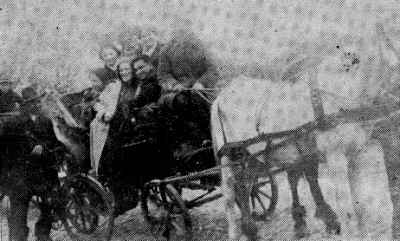
were, naturally, the carriage drivers. They, too, could be divided into those who possessed beautiful, ornate and well kept carriages and those who had the old and worn out ones, which begged for repair and refurbishing. Their work was to drive passengers to the train station (a distance of 5 kilometers from the center of town) and back, bring the sick to the doctor, or take families to a joyous event - a wedding or a party, or just a visit. Thanks to their type of work they were in contact with many residents of the town, and befriended many of them. They were always ready to tell a joke or some funny characteristic story about one person or another. They were the primary source of every “secret” that had ceased to be a secret, because it was told “secretly” in the ear but it rolled from carriage to carriage and from street to street, and of course every person added a bit of information to the story..
Another type of people were the “balagules” [owners of hauling carts] whose work was to transport heavy loads or deliver merchandise that would arrive from other towns. They were simple folk, “everyday Jews,” but their material situation was a better one. Their center of activity was mostly in the suburb of Surmitch, but they worked in other neighborhoods as well. Their apartments were better and more comfortable those of other people in the same social class.
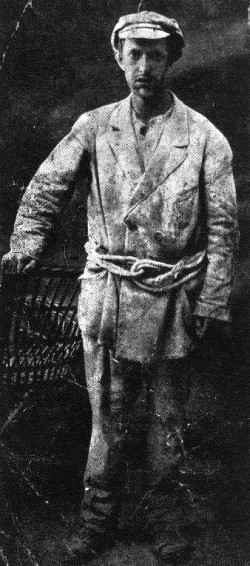
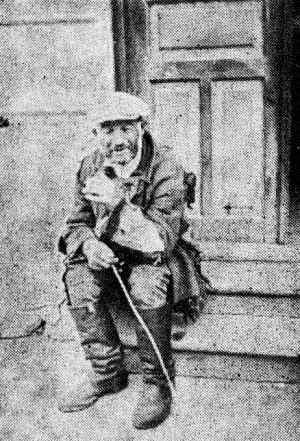
The main assembly-point of the carriers and porters was at the end of Shiroka Street, near the court house, always ready to go at the first call to load or unload wares, carry loads from one place to another or transfer furniture from one apartment to another. Their clothes were simple - an old and mostly torn jacket, pants tucked in their boots, which they wore summer and winter, a cap and a long rope tied around their middle: this was their working tool. Their back betrayed their occupation: it was always bent - this form given to it by the sacks of flour it had carried. In the hot summer-days they would catch a short nap in the shade of some house, in the winter they would jump and dance and pat themselves on the shoulders to get warm.
All those Jews, however, simple and humble as they were, possessed a strong Jewish-national consciousness, warm hearts and a feeling of sharing in joy and compassion in sorrow. They were hard-working Jews, who made their living with what God in Heaven had given them, friendly, ready to help each other and forgive and make peace in the case of a conflict or misunderstanding. They had their own synagogues and prayer-houses where they would feel “at home,” and on the Sabbath and Holidays they felt certain that the “Shechina” [the Divine Spirit] was dwelling upon their houses of prayer.
But dark days have reached the town - not days of reverence, but of horror and pain. And all those strong, robust men have perished, died “Al Kidush Hashem” - for the sanctification of the Name of God.
|
|
[From Hebrew column 343] |
| Surname | Name | Nickname |
| LEHRER | Aba | |
| BEIDER | Avraham | |
| WOLITZER | Avraham | |
| Avreimenyu | With the papers | |
| BARUCH | Ide | From the eggs |
| Idele | Shmaltz [chicken-fat] | |
| TESSLER | Aizik | |
| IVANIER | Itzi | |
| COLLECTOR | Itzik | |
| MARKILECHES | Itzik | |
| Itzik Eli | The smart | |
| Itzik | The bald | |
| PERSITZ | Itzik | |
| KOSS | Itzikel | |
| Isser | Cobbler | |
| SIDIBITCER | Alter | |
| Ester | The server | |
| TCHOYESCH | Efraim | |
| Asher | Tzimbele [cymbal] | |
| Bubbe [grandma] | Yente's | |
| Bassie | The black | |
| PALTIS | Buky | |
| Boronio | ||
| Binyamin | The tall | |
| Binyamin | The carpenter | |
| Binyamin | The kid (young goat) | |
| MARKILECHES | Bentzi | |
| Bratke | ||
| ZGATAVTCHIK | Gedalyahu | |
| TZONDEK | David | |
| The little weasel | ||
| The cotton dealer | ||
| The ticker | ||
| The Turk | ||
| Henie | Dudich's | |
| Henie | The buck (goat) | |
| Henie | From the geese | |
| Henietchke | ||
| TELIGISHNIK | Hersch | |
| Hersch | The pitcher | |
| Hersch | The rope turner | |
| Hersch | The Shames (synagogue attendant) | |
| Herzl | The Torah reader | |
| Welwele | The cobbler | |
| Zibele (born prematurely) | ||
| Zisl | Grabulke | |
| Zalman | The yellow | |
| Zalman | The black | |
| Chantzi | The mad | |
| Chaia Machle | With the blue lips | |
| BATIST | Chaim | |
| Chaim | The bridge maker | |
| Chaim | The nouveau-riche | |
| BENEDIK | Yankel | |
| SIFTSHICH | Yankel | |
| Yankel | Beilitchke's | |
| Yankel | The tall | |
| Yankel | Kugel | |
| Yankel | Kishke (gut) | |
| Yankel | From the eggs | |
| Yankel | without the hand | |
| Yosel | Toibe's | |
| FIDEK | Yosel | |
| Yosele | Esav [Esau] | |
| Yona | The glazier | |
| Yehoshua | The yellow | |
| Yente | The Golden | |
| Yosel | The rag dealer | |
| BODYONI | Israel | |
| Luzer | The deaf | |
| TOTZ | Leib | |
| PATCHYAVER | Leibke | |
| MALIER | Leib | |
| SCHREIBER | Leib | |
| PIVNIK | Leizer | |
| POLIAK | Leizer | |
| Matye | The watercarrier | |
| Motel | The crooked | |
| LEWITZKER | Motel | |
| Meir Moshe | Chaia Feige's | |
| MORTCHIK | Meir | |
| Meir | Knak | |
| Menye | The fat woman | |
| Mechil | The tavern keeper | |
| Mechil | The tall | |
| Meir | Tavern keeper | |
| Malka | The fat woman | |
| Motel | The red | |
| Moshe | "Trough" | |
| Moshe | The skinny | |
| FILLER | Moshe | |
| FLITT | Moshe | |
| SHKALIK | Nachum | |
| Nisel | The doctor | |
| Nosie | The driver | |
| COLLECTOR | Nachman | |
| Sofer | With the base [music] | |
| Stisie | The fat woman | |
| Srulik | The world lier | |
| Spritiche | ||
| KORIK | Etti | |
| Pitti | The mute | |
| Peisie | Shikele | |
| Fishel | Yosi's | |
| Pasternak | ||
| Pesie | The grandma | |
| Kaye | The rag | |
| Money smell | ||
| Kobenyu | Cobbler | |
| Krupnyares | ||
| The Ratchiner | ||
| Shamay | The rag dealer | |
| Shmulik | Dogpusher | |
| Shaul | Katchkes [Ducks] | |
| SHREIBERS | Shlomo Leib | |
| Shalom | Halila [God-forbid] | |
| Shmendritchke | ||
| OCHS | Sara'nyu | TZAK | Shefi |
| Shtchupak |
[Column 665 - Yiddish] [Column 339 - Hebrew]
by Moishe Katchke
Translated by Pamela Russ
[ ] note from translator
( ) note within original text
There was a musical band in Dubno. They played at Jewish weddings and at farmers' weddings, as well as in the courts of the aristocrats.
The last of these bands were murdered by the Hitlerist demons of torture – may their names and memories be erased.
Dear Jews, musicians of Dubno – God will avenge the spilling of your innocent blood…
Of the musicians in the band in Dubno at the beginning of the current century, I have the following individuals etched in my memory:
Reuven Tzimering, who played the clarinet, and was a genius at writing musical notes. He augmented his livelihood in that he also acted as assistant cantor in the large synagogue in Dubno. Having no choice, he was also a Torah reader in one of the shteiblech [informal, smaller synagogues] which was near the shul [synagogue] where, between the evening and night prayers [mincha and maariv] he would run in for a few minutes and also learn a chapter of Mishnayos [Oral Law].
Reb Eli the musician, Eli Struner, who played the second fiddle, a God–fearing man, was the sexton all his life in the shoemakers' Beis Medrash [Study Hall].
Reb Mendel the musician, Mendel Katchke, played exceptionally well on the cornet [trumpet], and was very skilled in writing musical notes. In Nikolai's army, he rose to the rank of sergeant. In the military band in Loitsk, he played the cornet. His religion went so far that during the four years of his service to the Czar he never ate from the army “food.” In his circle, during the High Holidays, he would lead the Musaf [afternoon] prayers for the congregation.
The other musicians in Dubno were similar to that – people with pure character and masters of the smaller arts [of music].
In the 90s of the previous century [1890s], there were ten men in the band. There was a badchan [Jewish professional jester, entertainer, rhymster; uses Torah overtones in lyrics; performs at Jewish weddings, festive events, etc.], and a first fiddle. If a good fiddler was missing, then they would hire another fiddler for “a time” [temporarily], that
[Column 666]
stretched from Shavuos [month of June] until the High Holidays [late September], because the summer season is a prime time for weddings. The towns around Dubno belonged to these musicians as a chazakah [right of ownership, after performing or enacting an event three times, this becomes a “chazakah”]. No other musicians from outside the town played there. At that time, when it was impossible to imagine a wedding without musicians, the monies they earned were not bad, especially since the weddings lasted almost a week. This is how they went:
For about one month before the wedding, two musicians, the most popular of the band, would visit the father of the bride to set the terms for the wedding and then also come to an agreement about the “payment.” All this was – according to the status of the mechutanim [parents, in–laws of bride and groom] (beginning with 10 ruble, up to 50 ruble). Included with the calculations of the payment were:
“Seating the bride, meaning leading her from the place of the wedding to wedding canopy in the large synagogue, and then back home – along with the sounds of “festivities.” Often the wedding procession would wind through several streets, until the mechutanim were also escorted home, thus the musicians would be playing with the so–called “extended motives.”
The musicians allowed themselves such a grand escort only through the streets inhabited by Jews, until reaching the wider street. So, in the streets Alexandrovka, Koscielna, Panienska, and Zamkova, these kinds of wedding processions could not take place because these areas were already mixed with non–Jews and also because the Jews there were already of a different type.
All these ceremonies were included in the “payment” but the monies for the dancing was extra. Until World War One, these were the dances:
A “quadrille” performed by four couples, it cost four kopecks, and lasted about fifteen minutes. This was a respectable dance, with a slow tempo.
Then there was the “Sherele,” [the “scissor” dance”; see “Helen's Yiddish Dance Page” for details. One source of this dance's name is that it is originally a tailor's guild dance with the figures meant to represent a pair of shears and threading the needle.[1]
[Column 667]
They took about 10 kopecks from each couple. The “Sher” was a dance that started with a slow tempo and ended with a stormy gallop.
A “Freilachs”[2] was a dance for only two people, a man and a woman, or two people of the same gender. In the beginning, the dancers would distance themselves four meters from each other; when the music started, one person danced toward to other, in various directions and steps, the hands positioned downwards, and the feet swinging in all sides, back and forth. They danced so long, until they fell from exhaustion. At that moment, one of the dancers would change partners by raising his hand and taking the place of the exhausted one, trying with all his strength and efforts to surpass the former dancers until both would be fired up and collapse in ecstasy, throwing their hands onto the other person's shoulders.
Then the musicians would speed up the tempo of the music and without stop, the mechutanim would clap their hands with appreciation and acknowledgement. The women fanned themselves with their scarves and with that, they showed their understanding of which dancer outdid his partner. This type of “Freilachs” cost – 20 kopecks.
There was also the “Kossak” that was the same price. These were all folkdances for adults and for the wedding families. The youth would demonstrate their capacity with waltzes, Krakowiaks [traditional Polish folk dance], and so on.
They also used to dance a Boston Waltz, and a Lezginka– Czerkes dance with a knife in hand, that was received with wild applause.
The majority of the dancing took place before the chuppah [wedding ceremony], and a smaller portion of the dancing was after the chuppah, about eleven o'clock at night. After that, the tables were prepared for a festive meal. Special cooks were ordered to prepare the food. The honey cakes, fludens [fruit and nut pastry], and koumiss rolls [made from fermented brew] had an especially delicious taste.
First, they would bring the gefilte fish to the table. Then the roasted meats. Then came the lineup for the famous “golden wedding soup,” with baked
[Column 668]
almonds made from pure wheat flour. And then, at the end, everyone enjoyed a delicious compote [apple sauce dessert].
During the entire festive meal, the musicians were not idle, and they played for the guest and for the young couple the “Dobra Nocze” (“A Good Night”). Before the beginning of the melody, the badchan [the entertainer, rhymer, singer] would call out loudly:
“In honor of the respected, important in–law…” (This was done in Hebrew.) When the melody was over, the badchan would once again remind everyone for whom this music was being performed.
For playing the “Dobra Nocze” the musicians were paid extra.
After the meal, the badchan recited an accounting of the dowry for the couple – all kinds of furnishings, dishes, and silverware. Then they would move the tables to the side, the musicians would play something joyous, and everyone joined in to dance the polka.
One of the chassidim held the corner of a scarf in his hand and the bride held the other corner – and that's how they danced the “celebration of the bride and groom.” Meanwhile, it began to get lighter outside, and the musicians would escort the parents to their home.
The Czar's police, and later the Poles' police, were not disturbed to have these wedding ceremonies. In the street, where the wedding took place, the police also came to have a look at how they were dancing. When the mechutanim saw the representatives of the authority, they opened the doors and invited them in, poured a double shot of whiskey and gave them a bite of food. The waltzing was “allowed” to go on, and then the couple was thanked [by the police] for having been their guests…
The mechutanim were proud of the police's visit and commented:
“A real honor…”
If the musicians were invited by a wealthy person or by an “intellectual,” they immediately went to “polish up” their instruments. They would also organize themselves, dressing in their best, and
[Column 669]
|
|
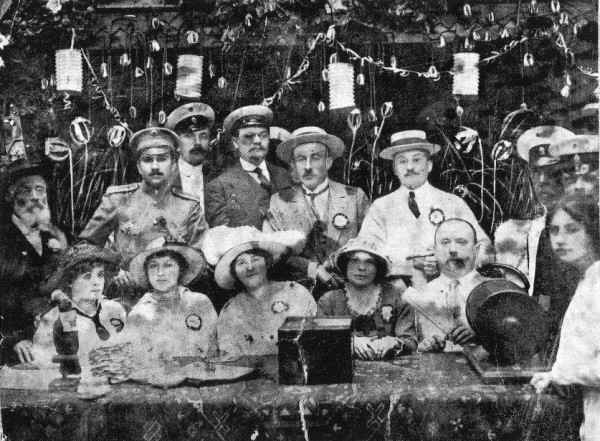
| Jewish–Christian Committee for Charity Work (Doryanski Club) |
most beautiful that they possessed. None of the musicians was allowed to be missing from this wealthy wedding. If there was no choice, they would borrow an extra player from the Czech neighbors.
In particular, the musicians would look out for a butcher's wedding, because a butcher would organize a wedding as for a king and his hand was generous for the musicians. The payment alone was high and the “accessories” were many because the “Freilach” dance of the butchers was a dance with great passion. And their favorite theme was “Tzirele.” During this dance, the dancers stomped rhythmically with their boots and sang along with the musicians.
“Tzirele, Mirele, hold the sack,
I will throw you a parsnip.”
The musicians would leave the butcher's wedding with a profit of 60 or 70 ruble, aside from the agreed payment. They would bring along with them a closed box into which
[Column 670]
all the “accessories” had been tossed in. When they came home, in the presence of three or four players, the box was opened, the monies counted, and was left with the “treasurer” to divide it all up. This dividing up took place once a month. The income was not given out just like that.
The good musician received a portion and a quarter, and many times, even two portions. Mendel the musician would get two whole portions and the bass not more than one portion. Sometimes – even less.
Generally, the “treasurer” was ignorant, but for dividing up the money, he was an expert. In Ukraine, the musicians had their own “alphabet” and numbers and the dividing up was done according to this “alphabet,” exactly to the last letter.
During the division, the members of the band would take small shots of whiskey and then each one of them hurried home, bringing his wife of the “blessings” for
[Column 671]
which she was keenly looking out. For this “blessing,” the small merchants and storekeepers were also keeping their eyes open, those who used to sell on credit, as was the melamed [children's teacher] and the landlord – one for tuition and the other for rent.
It was also accepted that the musicians would play for the pritzim [princes, aristocrats] in the area and for the farmers. A wedding for the farmers brought in from 20 to 30 ruble – and that was the tradition.
The groom, in the company of his escorts (“kum”) [generally his parents], came into the city and went right to the musicians, and then negotiated the price with them. On the wedding day, a special wagon rode through the city and took the musicians into the village. The troupe was expert in wedding music of the non–Jews, and played whatever the hosts wanted.
With the farmers, the tradition was that when an important guest crossed their threshold, the band welcomed him with a “march,” even if because of him they had to interrupt a dance. Because of that, the guest donated money to the musicians, as much as their hearts and pockets allowed…
Often, the farmers' weddings ended with scandals and fighting. More than once, it happened that the musicians had to grab up their instruments and run home through the windows, barely alive.
If it happened that a circus came to town, the musicians quickly polished their instruments until they shone, and they played their music according to the needs of the circus. Even though the musicians were religious people, they knew when and how to play at every opportunity.
They did not leave behind any inheritance for their children and their sons did not follow in the ways of their parents, because the livelihood of the musicians was small and poor…
Translated by Pamela Russ
|
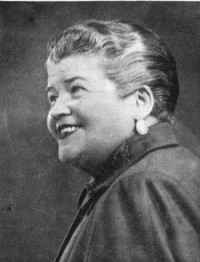
While still a young girl living in her parents' home, Dobe left Dubno and crossed the ocean, to the longed for country of America. This happened about fifty years ago, when Dubno was still under the Czarist empire. She, and several of her friends, just got up one day and left. What sort of spiritual, traditional, and domestic baggage did the young Dobe take along from her home town to the United States?
In the course of fifty years, Dobe lived a cultured life in this big country, spoke its language, incorporating the local habits and manners. The problems of that country were as close to her as to the native born citizens. She established a multi-branched family that planted deep roots in the free world. What tied her to her past in Dubno?
During and after the last World War, Dobe knew where to find survived members from Jewish Dubno and brought them as much help as she could. She became the address to search for and find relatives from across America, and at the same time, she dedicated herself to charitable society work. She was active in women's organizations for aid and education, and thoughts of her birthplace did not leave her mind even for one minute. Despite her living in the United States for 50 years, she still sees herself as a component of the Jewish settlement in Dubno, that left its signature on her childhood years. The economic prosperity in which she lives did not make her forget the need of the flower-lined streets, and she cannot remain indifferent and cold towards the pain of others.
When she found out about the destruction that befell the European Jews and which also brought the destruction of the settlement in Dubno, she gave her contribution to perpetuate Dubno among the destroyed Jewish communities – with the publication of this Yizkor book. She also encouraged friends to collect material and financial support, and that's how she helped materialize the idea. And to her credit, it should be said that: She served – and continues to serve, after our book has already been published, as an example with her open hand – and she has a prominent share in the realizing and publishing of this book. A great thank you!
Translated by Pamela Russ
|
|
| A man of the people A real pauper with a Modest soul, He was grateful for Having sent him two dollars from America. This song of thanks is an original In its style and words. |
[Columns 684-686 Yiddish]
| A blessing to you for your trip to America, for Mrs. Dobe Tabachnik
Since your trip here
May your trip pass
Many good wishes and blessings
Many sums of dollars
The dear God will
This is a person's obligation
You must and have to want
And to my close friends
Travel in good health, and arrive in good health, |
|
|
JewishGen, Inc. makes no representations regarding the accuracy of
the translation. The reader may wish to refer to the original material
for verification.
JewishGen is not responsible for inaccuracies or omissions in the original work and cannot rewrite or edit the text to correct inaccuracies and/or omissions.
Our mission is to produce a translation of the original work and we cannot verify the accuracy of statements or alter facts cited.
 Dubno, Ukraine
 Yizkor Book Project
 JewishGen Home Page
Copyright © 1999-2024 by JewishGen, Inc.
Updated 10 May 2021 by LA