 |
|
|
[Page 95]
by Motl Wenger (Montevideo)
Translated by Judie Ostroff Goldstein
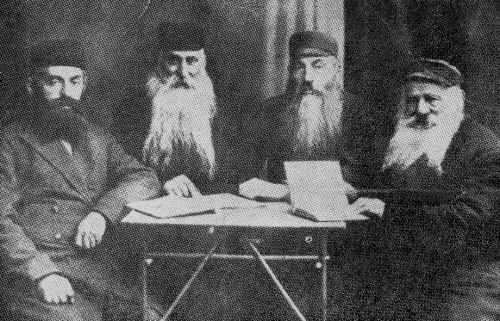
in Honor of Rabbi Szmul Cywiak
Wyszków was renowned as a Jewish and Hasidic city. This name was absolutely right. To catch a glimpse was enough, especially of the market place and main streets during shabes [the Sabbath] and yontoyvim [religious holidays] in order for every Jew's heart to be filled with pride. Everything was closed. The Jews, dressed in their best and finest clothes, with tales [prayer shawl] bags under their arms streamed in large numbers to the bes hamedresh [synagogue, study and meeting hall], to the Hasidic shtiblakh [small Hasidic prayer house] and minyonim [groups of ten men needed to make a prayer quorum]. However the progressive youth quietly strolled and chatted about world, polish and local events. When people arrived by train in Wyszków, Jewish porters were there to offer their help.
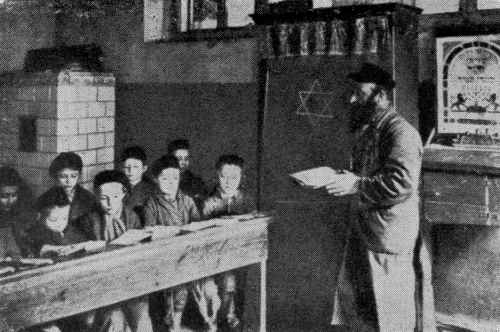
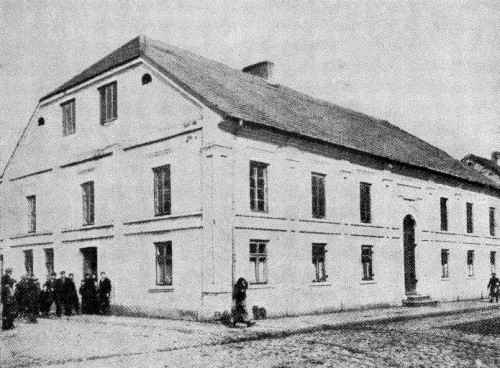
The shtetl was rich in religious institutions. The seat of honor was occupied by the large bes hamedresh located in a large building with a courtyard. The Jewish kehilla [community council] was also located there (president, Icchok Epsztejn). Among its many functions was overseeing the permits for slaughtering animals…the Talmud-Torah [free schooling until age 13 for poor boys] was located in the same building, under the direction of Reb Boruch Cywiak hy”d [whose death god should revenge-used for Holocaust victims]. The shtetl's poor children studied there in four groups. There were people coming and going all day and during the evening. Members of various khevras [societies]– ein yankev [Ein Yakov-Jakobs Spring. One of the best knows works of rabbinic literature-collection of legends, fables, moralistic passages and commentaries by Rashi], medresh [Midrash, homiletical exposition of the scriptures], mishnayes [ and others studied on their own or with melamdim [teachers].
The gabe [synagogue trustee] of the large bes hamedresh was Reb Jechiel Mejer Domb. The shamosim [sextons] were Reb Tuwia, Reb Szmul and others. Assistant shames – Reb Herszynke also woke everyone for slikhos [morning prayers said during the High Holidays]. There was a large bookcase in the bes hamedresh containing religious books which were used by those who came to study – from the well versed in Torah to the simple artisan. The tables were overwhelmed with tallow candles. To the left and upstairs was the women's section which was full every shabes and yontef [religious holiday].
One floor up was the Yeshiva Bes Yosef. During the summer, the tasty sound of their studying carried forth from the open windows. Their speech was Litvak and they studied musar [morals, ethics studied by Misnagdim, the opponents of Hasidism]. The yeshiva director was Szymon Chafetz, a very religious, good-looking man who inspired repentance especially during the month of elul [Aug/Sep – last month of the Jewish year], the month before rosheshone [Rosh Hashanah – New Year]. For a while the yeshiva director was Reb Szymon Srebrnik. He married in Wyszków and became a resident.
The list of religious institutions located in the bes hamedresh building does not end here. The mikve [ritual bath] was in the courtyard. The female bath attendant controlled all the Jewish wives, making sure they observed tares hamishpokhe [laws of cleanliness that applied to the family]. The men had to furnish their own brooms to beat themselves. As the water in the mikve always had to be moving, the last bather was Jechiel Mejer Rampa. During the first days of the Second World War, the Germans shot him near the mikve.
Against the mikve was the poultry slaughterhouse. Every erev [eve] shabes and yontef, especially erev yonkipper [Yom Kippur, Day of Atonement], the courtyard was full of women who arrived with a fowl to be killed. More than once a slaughtered hen, with its last strength, had stood up and even walked around flapping its wings…
The hakhnoses-orkhim [free room and board for poor travellers and the impoverished] was also in the same courtyard and had two rooms – one for men and one for women. The overseer was a small, blond man who also had another job: shoemaking. He and his family lived there. Next to him lived the town shames, Szmul with the nickname “mvaz” (Yiddish“red”) [“speak”] because the rabbi didn't know any Polish so once he was called to speak for the rabbi during a visit by a government official. Szmul shamas also had another job. He had a stand at the exit of the bes hamedresh courtyard where he sold cooked beans, peppered chick peas, candy and apples, by weight, measure and by the piece…the majority of his clients were yeshiva students and boys from the Talmud-Torah.
Neighboring the courtyard was Rabbi, Reb Jakob-Arja Morgensztern's house. He was the Wyszkower rabbi. Every year at sukes a long suke was put up in the long courtyard. Wyszków was certainly worthy of it as our rabbi filled the place of the Lomozer and Radzymin rebbes. During yontoyvim a great number of Hasidim would come to him and a large suke was necessary. There is a story that when the Wyszkower Hasidim wanted to build a brick suke [Sukah, wood hut with branches for a roof where Jews eat and sleep on Succot, the Feast of Tabernacles], a
|
[Page 96]
rich Jew donated the roof, another the windows, a third the walls and still another the floor. But they couldn't find anyone to donate the foundation – so the suke was never built…
The so-called small bes hamedresh was on Strarzatke Street next to the town fire station. There was a custom there, upheld by the khevra tilim [Psalm society] that before praying the men gathered to say tilim [Psalms].
|
and then they prayed together. Abraham melamed taught his grammar students there all day long. Reb Zysze Kaluski taught there between minche [afternoon prayers] and maariv [evening prayers], along with the khevra tilim. There was always a large crowd.
Every erev rosh hodesh [start of new month] the khevra kadisha said yonkipper kotn [eve of the new month was a fast day for religious Jews]. There was a women's section in the small bes hamedresh. The gabe was the gravedigger and the shamas drove the hearse. Every day the shamas rapped with the pushke [charity box similar to the blue and white box for Keren Kayemet] and begged for several groschens [pennies] to be dropped in…he kept the black hearse in the bes hamedresh courtyard.
The wealthier Jews prayed in Eli Mejer's bes hamedresh – on Kosciusko Street – but only on shabes and yontoyvim. There had been a modern heder there previous where modern Hebrew was taught.
The Hasidic shtiblakh are a separate chapter. A large number of Hasidim travelled to their rebbe for yontef. Often there were divisions of opinion between the Aleksander and Gerer Hasidim. The Gerer shtibl, neighboring the small bes hamedresh had its own building with two large rooms and a large number of followers. Every day several minyonim prayed there. Men studied there the entire day and there was no shortage of religious books. The Radzolower melamed also taught his heder [grade school for boys] there. The Lubowiczer Hasid, Reb Chaim Lis gave lessons while another group studied a page of gemore [gemara part of the Talmud that comments on the Mishnah] led by the Dean of Yeshiva Chochmei Lublin, Rabbi Reb Mejer Szapira. The Gerer shtibl was also known for beautiful melodies heard there especially when they celebrated shaleshudes [third meal eaten late in the day on the Sabbath].
Above the Gerer shtibl were the orthodox organizations Agudas Yisroyel, Poeli Agudas Yisroyel [Orthodox Zionist organizations-established later than other Zionist groups] and the political party Agudas Yisroyel. Each organization had its own room and its own library. The men went there every day to read the daily orthodox newspaper that was published in Warsaw (“Togblat”). Poeli Agudas Yisroyel also sent its young men to Hakhshara [trained Jewish youth for life in Israel for all Zionist groups] and then to Israel.
Another Gerer shtibl was located on Kosciusko Street, in Szolom Zysman's courtyard. The split among the Gerer Hasidim occurred due to honest differences of opinion. The Kosciusko Street group was more progressive.
The Aleksander shtibl was on Senatorska Street at Reb Fajwel Szron's house. They were a small group of Hasidim, but were like one family. They studied the entire day and all of them were acknowledged scholars.
There are still other shtiblach to enumerate: the Warker or Otwocker shtibl in Fiszer Street. Open all day long, men studied regularly from religious books kept in the large hall. The Amszynower shtibl was on the market place at Fefke Szuster's. The well-to-do, dear Jews and scholars studied and prayed there. The Radzyminer shtibl was the rabbi's neighbor, located in the same house. They were large in number. Among the Hasidim who studied there was Reb Symcha Sznek – murdered during the first days of the war [Second World War].
In Gdalia shokhet's [ritual slaughterer] courtyard there was a Bes Jakob School for girls from religious families. Many volunteers such as Jakob Josef Plonczak, Bercze Oldak, Boruch Cywiak hy”d, Chaim-Benjamin Wiernik (died in Israel in 1961) and others made sacrifices in order to establish this school.
Among the community organizations one must mention the Merchants' Union on Strarzacka Street, opposite the fire station, where people could borrow at discounted interest rates. The Secretary was Mosze Josef Abramczyk and the President, Zelke Rozenberg. People said that he was a most honest man and gave generously to charity. The gmiles khsodim [loans without interest], bikur holim [visiting and caring for the sick-there wasn't a hospital, people were taken care of at home] and other philanthropic institutions helped a great deal in providing for the needy Jews and they attracted a large number of volunteers especially women, who worked for the good of the community.
The Aleksander Hasidim were famous in the city, not only as scholars but also as people who behaved as if they were one family. They made sacrifices for each other and offered help regardless the cost to themselves. Unfortunately I don't remember all of them, but every one of them should be inscribed in the Memorial Book.
[Page 97]
I would now like to share with you what I do remember.
The first I would like to immortalize is my father Jechusza a”h [olev hasholom – may he/she rest in peace]. My father's family had been Wyszkowers for many generations. His father, Icchok Hersz Wenger played a large role in building a lot of religious institutions. There was a hakhnoses orkhim for impoverished men in his house. My father grew up in this environment. My father married the Sterdyn rabbi's daughter, my mother Rywele a”h. Reb Eliezer haLevi Ajbeszyc was a rebbe of the last Aleksander rebbe, Reb Menachem Mendl. He took my father to Aleksander to teach him Hasidus. What I remember is that every shabes, summer and winter, in the morning after the mikve, the majority of Aleksander Hasidim gathered at our house, drinking tea from the shabes kettle which was prepared Friday before sundown. They told Hasidic stories about helping one another. The first to arrive was Reb Benjamin. People called him that because he was a “stutterer”. He lived across from the large bes hamedresh and was the gabe for the khevra mishnayes and the first to open the large bes hamedresh. Reb Benjamin gave away the last of his money as an anonymous gift and then became a great man at hakhnoses orhim. (His wife's name was Basia).
The second was Reb Szymon Srebrnik (Szymon melamed). He really studied day and night and learned everything by heart. He was a great Jew. Before his death I met him in Bialystok running from the German murderers. One of his cheeks was bandaged. He told me that the cruel murderers had ripped off half his beard.
Then comes Reb Mordchai Kaufman (Reb Mordchai, Chone's [son]). He was always the khevra medresh rebbe and Dean of the Hasidic yeshiva. All questions concerning religious law were referred to him. When Reb Mordchai died in Warsaw a eulogy was given for him in the large bes hamedresh as he was a great, poor man. He took care of everyone. I would also like to mention his son Israel who was truly a simple human being and also a great scholar and teacher. He only knew the way from his house to the Aleksander shtibl.
The Aleksander Hasidim's Cohen, Reb Wilenski a”h, arrived later. He was a great Torah scholar and loved by the entire community. With his patriarchal beard, calm pace and behavior in general – he gave the impression of being a high priest who cared for all of the Jewish people. He always said that men must always help one another. He wife Bejla, a woman of valor, helped him in his dry goods store. She also took part in his anonymous donations to help Jews. That is how their sons and daughters were brought up and how the entire city was reflected. They grew up to be scholars and community activists and they continue even today.
Then Zysze Kaluski, Motl blacksmith's [son] arrived. His pleasant way of teaching attracted a lot of Jews. He studied with the khevra tilim in the small bes hamedresh, neighboring the Gerer shtibl. A lot of Hasidim came to study with him. I would like to add that in his old age the wealthy Wiszkower, Dawid Gurner studied with Reb Zysze and began attending the Aleksander shtibl and gave large amounts of money to Jewish charities.
Our neighbor Reb Fajwel Szron, a brother-in-law of Reb Szymon Srebrnik, also came [to our house]. Reb Fejwel's wife argued with him about why he devoted himself to providing for every Jew except those in his own house. He brought all the Aleksander Hasidim to his house and it became the Aleksander shtibl. He took care of everyone. Fate wanted that this Jew, Reb Fajwel live his entire life as a Hasidic Jew, even in Russia. His son was a high-ranking officer there who provided him with kosher food. He had the privilege of coming to Israel and lived there to a very old age.
The Porember rabbi arrived after. He was the moyra-hoyra [rabbi who decides matters of rabbinical law] in Wyszkow. His lesson in Hasidus was – help one another and the Most High will also help. The Lord of the universe wants only good hearts.
Langer [tall] Lejbl also came [to our house]. (I've forgotten his family name). People called him the Warsaw genius. He was a Hasid who never thought about earning a living. His wife drove to
|
[Page 98]
Warsaw to sell poultry (already dead), while he sat in the shtibl studying, went to the rebbe's and sniffed a lot of tobacco.
Then Reb Leizor Sapirsztejn arrived. He lived near the railroad station. He was one of Zelman Grosbard's neighbors. People called him the Rebbe of the Wyszkower Aleksander Hasidim. When there was a leisure day [a holiday], a Hasidic yontef, or a yahrzeit [anniversary of a death] for a rebbe, a rosh hodesh, shushan purim [celebrated only in walled cities, Purim is when Queen Esther saved the Jews from Haman] the men went to Reb Leizor's. He was a very charitable man. My father a”h told me that before Reb Leizor died he called together his closest hasidim and begged by father, who was a shoykhet, to kill a fowl for him so that he could perform a mitzvah before dying. It was as if he wanted to fulfill the entire Torah. Then he asked for nine measures of water to immerse himself in, then ordered the great genius to say a chapter of mishnayes with him – and quickly died. A remarkable thing: his wife the rebitzin [rabbi's wife] (as people called her) went in the same way.
One must also add Reb Icchok Hersz Rotbard, Reb Szlama Frydman, Reb Henech Brzoza, Reb Jechiel Kaluski (one of Zysze Kaluski's sons who died in Acco [Israel]), Reb Zelman Felner, Reb Jechiel Szulc and Herszl Szulc (the Szulc's decided to go to the Gerer shtibl when the Aleksander Hasidim were without a shtibl for several months) and Reb Berl-Dawid Kwiatek.
All the Aleksander Hasidim were distinguished scholars, studied with khevras, were active in public service, were sextons, rebbes, etc.
When the moyra-hoyra (the former rabbi in Poremba) was alive, for shaleshudes the men sang shabes hymns at his table and listed to Torah. After his death, the shaleshudes was celebrated in the shtibl.
I have written only about the Hasidim I remember.
by Velvl Olenberg (Haifa, Israel)
Translated by Sarita Zimmermann (Bethsheda, MD)
Reviewed by Frida Grapa Markuschamer de Cielak (Mexico City)
Translation donated by the Historian Enrique Krauze (Mexico City)
Wishkov/Wyszkow[1] was a religious observant-Hasidic[2] city, which in the course of hundreds of years, was ruled by various “good Jews,” “observant-Hasidic Jews” and their followers. Like in hundreds of Polish towns, there were also widespread wonderful and amazing stories in which the people looked for comfort, hope and a place for their suffering and happiness. I will not stop here for the various legends, which were widespread by the different religious Hasidic groups, about the greatness of their Rebbe[3]. In every religious house they told about them during the “three Shabbat meals,” “Melaveh Malkos” (meal at end of Sabbath) or on the anniversary of the Rebbe's death.
The most distinguished shtibelakh[4] from the Hasidim were: the Gerer, Alexander, Otwotzker, Amshinower and Radzyminer. Wyszkow also had its own Rebbe (on Pultusker avenue) who used to accept “kvitlekh”[5] and “pidyoynes.”[6] He used to gather two prayer quorums of Jews for the daily prayers. He was an itinerant-Rebbe. He used to travel for the most part of the year.
The “Khevre Kadisheh” (Burial Society) had a municipal character and did not participate in political issues. The gaboim(wardens)[7] of the synagogue were: Butche “the baker” Stolik and Moishe-Aron Olshaker/Alshaker. They were held in high esteem and had everyone's acknowledgment.
The main “Khevres” (groups of scholars) were the Khevre Talmud, Khevre Mishnoyes[8], Khevre Toireh (Torah), Khevre Khok L'Israel (laws of Israel), Khevre Midrash[9] , Khevre Mesilas Yeyishorim (dedicated to Justice and Equity), who used to pray in the main synagogue. The small synagogue belonged to the Book of Psalms Group. The said groups used to “buy a Rebbe” for themselves, for him to study with them and be their spiritual leader. Each small Hasidic house of prayer and study(shtibl) and society-group used to elect the wardens(gaboim) who were in charge of the budget, pay the monthly dues, sell “Aliyahs” (the honor to be called to the Torah) and established special cashbox of funds for “gmilas-khesed” (good deeds). They used to help the “downhearted or fallen” with a single action, to help them “stand on their own two feet.”
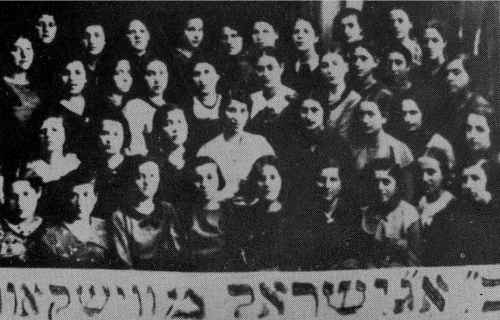
A big change took place with the creation of the “Zionist Beis-Medresh,” (a gift from Eli-Mehyer/Eli Meier Goldman) under the management of Henekh Kaluski, Yakov Yakubovicz/Yakubovitch, Dovid Gurni/Gurner, Leybish Pshetitzki/Pszhetitski, Yitskhok “Itche” Ba'harab/Barab, Yakov Nayman/Najman/Neiman and others. They were in charge of “Keren Kayemet” and “Keren Hayesod”, helped create the organizations and clubs: “Ha'khalutz”, “Hashomer Hatzair”, “Maccabi”, “Gwiazda”[10], “Betar”[11] -- and hereby received great support and backing from the population.
The Jewish Community was made up of representatives of all sorts of circles. President - Yitzkhok Epsztein/Epsteyn; Vice-President - Mordkheh-Mendl Olenberg/Alenberg; Secretary - Moishe-Yosef Abramczyk; Management committee group: Yitzkhok-Ber Rozenberg/Rosenberg, Yitzkhok Mondry, Shmuel Elboim, Bertche/Bercze Oldak, Henekh Kaluski, Dovid Gurni/Gurner ande Haim-Nisn (Natan) Vengrov. The community did not provide for a Jewish school. All children received a religious education in kheydorim[12] or had private teachers (girls also used to study with private teachers). With the founding of the Tarbut School by the Zionists, the “Agudah” society established the “Beis Yakov” school (for girls). The government used to support the elementary schools (powszechnej)[13] with Jewish teachers.
For the poor families that wished to give their children a religious upbringing the city established a Talmud-Toireh[14]. About 120 children studied there and also received bread and hot cacao every morning, a lunch at midday - and holiday clothes and money. The Talmud-Toireh-school committee was made up of Mordkheh-Mendl Olenberg/Alenberg (President); Yitzkhok-Ber Rozenberg/Rosenberg Yitzkhok Epsztein/Epsteyn; Mordkheh-Mendl Domb. And the first founders of the Talmud Torah: Shloime Fridman (Alexander
[Page 99]
-Hasid resides today in Canada) and Mendl Epsztein/Epsteyn/Epsztejn/Epshtein, today (i.e., in 1964) in America. In order to support the teachers and melamdim (learned-men; teachers) the committee established dues to be paid by the Jewish community. The expenses for the kitchen at the Talmud Torah and clothing for poor and needy children was taken care of by the “Joint[15]” and the Wishkever Committees in America.
The more important of the institutions (in Wyszków) was the General Gmilas-Khesed Kasse (philanthropic cashbox of funds), (President --- Shaike Posztolski/Postolski, who emigrated to Eretz Israel in the year 1943 after long wandering thru Russia with his family, he died some time later. He took part in the founding of the “Irgun Yoitzeih Wishkov b'Israel)[16]. The members of the administration of the Gmilas-Khesed Kasse were Borukh “Benny” Dobres, V. Grabina, Henekh Kaluski, Yakov-Dovid Pshetitzki/Pszhetitski (from the founders of the “Irgun Wishkever Organization in Israel” and cashier until the year 1957), Mordkheh-Mendl Olenberg/Alenberg and others.
In Wishkov/Wyszków there was also a Yeshiva[17] “Bais Yosef,” a Novorodker Yeshiva lead by Rebbe Shimon Arie Heifetz/Khofets. Over 50 students from Wyszków and its surrounding area, studied in this Yeshiva. The out of town students used to eat “teg”[18] in the homes of different wealthier members of the community. But the main support for the Yeshiva, the Talmud-Toireh (school system) and the Gmilas-Khesed philanthropic fund came from America. Also the Wishkover Committee in New York, under the direction of Mrs. Rokhl Radziminski/ Radzyminski, sent every year $1,000.00 dollar for Passover, from this - $100.00 went for the Talmud Torah, $100.00 - for the Yeshiva and $100.00 for the Gmilas-Khesed Kasse The remaining $700.00 was distributed among the poor for the Holiday. The people who belonged to the Wishkover Committee that distributed the money received from New York were: Yitzl/Itzel Radziminski/Radzyminski; Mordecai-Mendl Olenberg/ Alenberg, Yitzkhok-Ber Rozenberg/Rosenberg and Henekh Kaluski. This Passover aid had a great meaning for the poor citizens.
The Zionist Organization revived the town. The young people were mostly Zionists. Also the religious jews began to prepare leaving for Eretz (the Land of) Israel (then called Palestine), specially with the tide of the third aliyah[19](Yisroel Itzhok Tik and his family, the Shenberg/Szejnberg's and others). Tik was an Otwotsker (from Otwock) Hasid, and the Otwotsker Hasidim sent with him letters for the Warker (from Warka) Rebbe, to the grave of the old Otwotsker Rabbi Reb Mordechi-Melakhem Kalish ztz'l[20] in Tiberias whom they used to call the Rebbe from Eretz Israel, one of the founders from general “Kolel” in 1863.
The great Zionist (Movement) revival, the Ha'halutz[21] movement and the third aliah were the main initiatives of the “Agudah” (association). Also the Bund (Union of the Jewish Labor Party) was at that time a big force and its adherents used to travel thru the Americas, instead of Eretz Israel.
After the death of the Wishkover Moreh Horeh (the decider of matters of rabbinical law), who was a Hasid of the Alexander Rebbe, the Gerer Hasidim wanted to install one of their Hasidim as Moreh Horeh. This started a difficult struggle of the selection of the different candidates, who needed to give sermons. The Otwotsker Hasidim presented their candidate, the Alexander supported the Otwotsker candidate, and their opinion decided all the issues. The Gerer conducted a bitter struggle against such said candidate. The Otwotsker Hasidim took advantage of the oportunities from the Gmine-President Itzhok Epsztein/Epsteyn/Epsztejn/Epshtein (a Gerer Hasid), when he travelled to Ciechocinek[22] for health reasons, and the Vice President of the Jewish Community (Kehileh/Kheila) Mordechai-Mendl Olenberg (Otwotsker Hasid) proceded with the election of the Otwatsker Hasid as an enlightened teacher and received the confirmation of the position as the person in power.
At the same time the Aleksander Hasidim put forth their candidate as a Shoykhet (kosher butcher- slaughterer) Reb'[23] Yoshua Vengersh, a popular man, who also had the support of the Zionist prayer group, so therefore the Gerer Hasidim decided not to allow him to win. This struggle of the Aleksander Hasidim which continued for a long time was backed by the Otwotsker Hasidim and by the enlightened people. All these Hasidishe Group dealings had deep reverberations …
Footnotes
by Freyda Kaplovitch, Buenos Aires
Translated by Pamela Russ
This happened in the year 1916. I remember it as now: The youth in Wyszkow had started to become less religious, crawling out of their daled amos [small space, literally “four cubits”], freed themselves of fanaticism, established clubs, libraries, and all kinds of organizations and parties. Among the activists were – also my sister Hinde (killed by the Nazi murderers).
One day, one of the youth organizations decided to invite the world renowned cantor Gershon Sirota for a concert. They rented a hall on Strazhaczka Street, right opposite the Gerer shtiebel [small, informal synagogue] where my father prayed. A tumult broke out in the town: What was this! Such heresy! In those times, in the eyes of our parents, this seemed to be worse than conversion.
That evening of the concert, all the Gerer chassidim set themselves out on both sides of the street that led to the hall. They wanted to see the children who were prepared to don the heresy so that later their parents could give them their dues. My father was not of the …
[Page 100]
… terribly fanatic ones. But he knew that if we children would go hear Sirota then the Gerer chassidim would chase him out of the shtiebel, and maybe even excommunicate him… So he quickly went home where he found the children preparing for the concert. After his pleas and calm explanations we decided not to make any trouble for our father. We did not go to hear Sirota… Our father was greatly delighted. He said:
“Now I can say in the shtiebel that my children are not heretics, like those which have recently flowered in our town…”
I remember Yom Kippur of the year 1919. At that time, our town already boasted all kinds of cultural institutions and youth organizations, among them – the Bundist “Zukunft” [“Future”]. For musaf, [early afternoon prayers], when the religious and even the free–thinking Jews filled the synagogues, study halls and shtiebels in Wyszkow, a rumor spread that in the Zukunft location on Rynek (market place), there was smoke coming out of the chimney. That's what it was. They were cooking there on Yom Kippur.
The town was in a storm. My uncle Mendel and another few Jews went immediately to the Bundist club to determine whether it was really true that Jewish youths were moving to lessen the holiness of the day. They found some youths there and admonished them strongly for this behavior. In addition, he spoke to the conscience of the elder chaver Smietanka (now in America). He demanded of them that they not do this sort of thing again.
The following day, when I came to my uncle, he – usually quiet and reserved, turned to me and said in these words:
“Yesterday, when I went to the Zukunft location to see if they were cooking on Yom Kippur, I had a heavy feeling and an embittered heart. God forbid, maybe I'll find my nephews there. My joy was great when I came there and did not see any of you. I am proud that my nephews did not shame me …”
by F.M.R.
Translated by Pamela Russ
When the new educational institution was established in Wyszkow, the so–called Kheder Metukan, our parents' intention was not only to give Jewish children a religious education, but also to light a fire in their hearts to be proud Jews, soaked through with the love of Israel.
The Kheder Metukan was located in the small building on Wonske Street (near Retken), where in the spring the tree blossoms were fragrant, and in the summer the apples with the red spots whetted our appetites.
The dear teacher and unforgettable resident Yitzkhok Skarlat, of blessed memory, learned Tanakh [the books of the Torah, Prophets, Writings], and aroused a love for the Land of Israel and for the People of Israel. He would always direct us into a dreamland. We soared to somewhere in the blue skies… With wide open mouths, we swallowed up his interpretations about learning and practicing the virtuous behaviors which we received on Mount Sinai, about the heroic fighters in the Tanakh, and about all those who beautified and enriched our history.
Who can forget our dear teacher Yosef Peczenik, with his Jewish aristocratic demeanor, when his tar black forelocks would sway in rhythm to the Hebrew songs that he taught. Each of his words rang with love and conviction.
I don't remember one sad day in the course of those several years studying in the Kheyder Metukan, except for one that reminded us of the destruction of the ancient Temple. That day, tears ran steadily from my childhood eyes. Other than that, it was when our dear teacher Shapiro with his graceful figure, bid farewell as he was returning to his family in Pinsk. My childhood heart sensed that this goodbye was forever … In a short time, he actually did die.
Thanks to these types of parents and educators, our town was a ripe field for Zionist activity. The sports club Maccabi was established, thanks to which we marched on Lag b'Omer [a Jewish holiday celebrated on the 33rd day of the Counting of the Omer between Passover and Shavuot, which occurs on the 18th day of the Hebrew month of Iyar] with the blue–and–white flag across the streets Stodolne, Wonske, Kosciuczko, Rynek, and the bridge, until Skusew. In our eyes, this was … a march to the Land of Israel. As I was at the head of the children, my mother dressed me up in a white dress, a blue band, and blue–and–white beads.
The worldly and nationalist–Jewish education of Kheyder Metukan left visible impressions on the spiritual development of a part of the Wyszkower children.
|
|
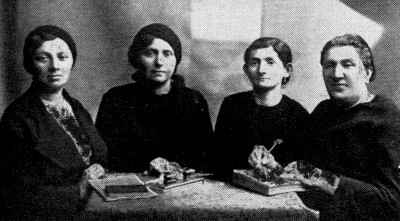
[non–profit organization that takes care of the sick and the families' needs] (Right to left) Elke Goldman, Nekhama Stern, Rebbetzen Morgenstern, Faige Male Abramczyk |
by Khaim Umyal
Translated by Chava Eisenstein
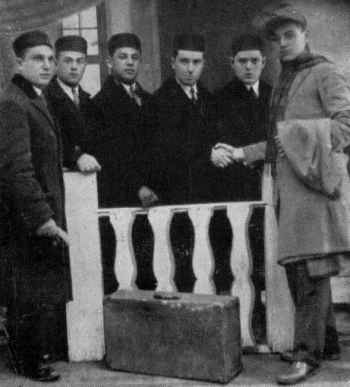
A year prior World War 1, the Radzymin Rebbe, who served as dean of the “Kollel Polin” announced the opening of a yeshiva in Wyszkow with the name “Darkhey Noam.” The students were promised two entities: “Wedding Saving” while studying the full term: and in case of immigration to Eretz Yisrael, they will land a position, at the “Kollel Polin” office in Jerusalem. He even sent out special messengers to various Polish provinces with the appealing offer, and Jewish youth came flocking to the yeshiva in Wyszkow.
At that point, I was residing in Zyrardow, and it happened that the Rabbi of Klimontow, Simkha Gelernter came to our town, which was famous for its fabric industry. At a fiery speech he held, the Rabbi turned to all with the following words: “The voice is the voice of Jacob – and the hands – are Esau's… At the time when Jacob's voice will go strong with Torah, the hands of Esau will fall weak”. Who better than us, Zyrardow's youth, knew and felt Esau's hands?! Our parents held on to those promising words and enrolled us in yeshiva.
One evening in the spring, we went on a ride with the “Omnibus” hitched to horses, on the Radzymin – Wyszkow lane. At dawn, we reached the wooden bridge over the Bug River. That's where the Jewish part of the city began. Instantly we had our answer to the enigma, why is a gentile called “Klipa” – the shell? For they reside on the outskirts of the town, whilst the Jews live inside the town, they are the kernel inside…
Our yeshiva was on Przedmiescie street, within an orchard, the Polish guard strictly ensured that none of the fruit dare go along with us. Therefore, the garden rightfully earned its name we gave it “Hanukah Candles”… that are to be seen but not to be used. That served us as a great lesson to overcome our inclinations. Besides this gentile with his hands of Esau, we didn't encounter more of this species in Wyszkow, and we repeated the Rebbe's words: with our Torah voice high, we will diminish the wicked hands…
Our accommodations at the yeshiva were strictly modest, the boys ate “Days” meaning, they ate every day at a different home. I remember favorably the Tuesdays, when ten of us ate at the home of Mr. Joseph Jacobowitz the lumber trader. After supper, he would give each of us one “didke” (3 kopeks) for pocket money.
On the first day of Elul we traveled again with the wagonette to the Radzymin Rebbe, he will test us, and after that, we shall enjoy a festive meal and receive our diplomas. Upon receiving our certificates, the Rabbi requested from us to bless him with a son, that shall serve as successor after him, in exchange, he would bless us to elude being drafted to the Czars army. That's when the Rebbe and the boys including me, burst out at once: we shall all be soldiers in the army of the Messiah… and not only once did it happen, standing at duty for the “Haganah,” weapons in hand facing the hooligans, I thought to myself, perhaps our prayers at that time, were accepted. But there wasn't a son to accede the Rebbe…
I remember an incident that happened in those days: in Wyszkow lived a very wealthy Jew, he owned the biggest house at the market place. Rabbi Morgenstern, too, lived in the house, which stretched over two or three streets. It so happened that this Jew fell ill, and was about to die. Being childless, he bequeathed the entire house for the Radzymin Rebbe. The end was that the man became well again and his wife gave birth to a son. The woman and the child demanded the Rebbe should return the house to them. Since the reason for the inheritance has abolished. The issue went from one court to another. How shameful…
On the Shabbat prior the ninth day of Av, we were visiting in the late afternoon at Jacob-David Zatorski's home, not far from the synagogue, we were enjoying chickpeas and beer when we were alarmed to hear yells and the bell siren of the fire engine. “Fishke with the kishke” (rubber hose) - the only Jew in the fire department, was running at the head of the team towards the shul to save the woman of the woman's-section that was collapsing. Three woman were injured heavily, and we gained a new joke, of the “Shlosha Imahos Nizokos” - three wounded women, since we were studying at that time the tractate of “Arba'ah Avot Nezikin” – the four chief (fathers) of damages…
The town's medic was rushed over, to save the wounded women, that all too familiar medic, Mr. Berel Kerner, who once plucked off my tooth… in the center of the market was his clinic. On the door, he hung up three copper plates. “Medicine” was his occupation: he plucked teeth, shaved beards, laid fire-cups, dressed fractured bones, softened wounds, etc., a private practitioner in small…
by Paul A. Kramer
Translated by Pamela Russ
In the yeshiva “Beis Yosef” there were about 84 students. The largest percent were from Wyszkow. The rest were those who came from cities and towns around Wyszkow.
Harav Reb Shimon Aryeh Khafetz, as principal and head of the yeshiva, conducted the classes along with four other teachers. They all had to live [make a living]. Their payment for the year was a total of seven thousand six hundred and eighty zlotys. That meant, for each individual teacher fifteen hundred and thirty six zlotys per year. A set sum of three hundred and seven dollars in American exchange; approximately six dollars a week. With that, one can be sure that these teachers would be the happiest if they would receive these meager wages regularly each week.
Aside from supporting the poor boys with clothing and food, there was also the cost of rent, heat, light, and other small expenses.
From the city of Wyszkow, an approximate sum of one thousand seven hundred and twenty zlotys was brought in; from tuition throughout the year – one hundred and fifty zlotys. A few paid ten zlotys, a few five groshen
[Page 102]
weekly. There were also those who could hardly pay even one zloty, or those who paid fifty groshen a month.
The Wyszkow women's union of the yeshiva annually raised about fifteen hundred zlotys.
In total, the yeshiva Beis Yosef had an annual income of 3370 zlotys.
According to this calculation, not only was their meager salary of six dollars not enough for the poor teachers, but even half of the lamentable profits was not either.
So – how does one survive?
The answer: “This is the way of learning the Torah. Eating bread and salt, drinking measured amounts of water, and sleeping on the bare ground.”
But to buy bread and salt one also needed to have the means; and to sleep on the bare ground you still needed a place to live, and not be on the street.
There was really a holy obligation on the residents of Wyszkow to support the Wyszkow Torah institution Beis Yosef and to support them [the boys] to their best abilities in their need, so that they [the boys] shouldn't live a life of difficulty as they studied Torah.
by Rabbi Shimon Arie Kheyfetz
Principal of the Yeshiva “Beis Yosef” in Wyszkow
Translated by Pamela Russ
|
In the golden country – Thanks to the Wyszkower, For your noble hearts filled with love, Support the children Who are learning with eagerness In the Wyszkower Beis Yosef yeshiva.
The only ray [of light, hope]
There were times
You gave shoes and clothing,
So, continue to help us, Wyszkow; May 5, 1936. |
Original Footnote
by Shimon Zakharia Malowanczyk (Tel-Aviv)
Translated by Hilda Rubin Rockville, MD)
Reviewed by Frida Grapa Markuschamer de Cielak (Mexico City)
Translation donated by the Historian Enrique Krauze (Mexico City)
Our Yeshive, although it was to be found in Wishkov/Wyszków[2], it was supported by the (big) city. It bore the name “Nevordiker Yeshive[3]” and was run in the spirit of the moral teachings of Rabbi Yisroyel Salanter[4], according to an ethical way. There were about 200 young men students in six classes.
From 5 in the morning till 9 at night the students were immersed in learning. From very early in the morning their learning took place till 7:30 am, then the students would davn shakhres[5] (pray the morning prayer) with much enthusiasm. A group of students would stand a good half hour saying the shmone-esreh (the 18 benedictions). After their praying the students would go and eat breakfast in the kitchen, which was supported by a group of Wishkever[6] householders and was run by a special women's committee that was very active in this field. To the householders' committee belonged: R'(eb; i.e., Mister) Eyli Rozen, who worked day and night for the good of the Yeshive; R' Avraham Lerman, R' Borukh Stolik (also known as Butche), and R' Alter Szukegnik. In the women's committee were active: Khaveh Markushjamer/Markuschamer/Marcuschamer, Leyeh Ostrovyak/Astroviak and Dvoyre, the rope maker (knitter). Their worry was, that the Yeshive-bokherim[7] should have where to eat substantially and also have a bed where to lay their heads. They (these ladies) decided in which Wishkever household the boys would go “esn teg”[8]. The members of both committees, the men's and the women's, truly served as “fathers and mothers” for the Yeshive-boys.
From 9:30 till 2:30 the students studied with intensity.
[Page 103]
The walls from the Yeshive and from the Beis-Hamedresh[9] absorbed the scholarly words of the Torah over the many long years that the Yeshive was housed there. It also happened that, for a group of Yeshive fellows who also studied through the long winter nights, the “outside” world was only an antechamber for them - as compared with the spiritual world of their Yeshive. If a Wishkever Jew wanted to experience the feel of the spiritual life, he would enter the Yeshive and would experience complete fulfillment.
At 1:30, psalms-lessons were recited at the classrooms. From central Bialystok through the auspices of Rabbi Avrom Yafo Shlit'a[10] very special brilliant teachers and scholars were sent to Wyszkow such as: Rabbi Nakhman-Dovid Landinski, Rabbi Leyzer Levinsky, Rabbi Aron/Aharon Stolner, Rabbi Noyekh Stolner, Rabbi Yosef/Yoysef Lomzher, Rabbi Abraham/Avrom Tsitrin/Cytrin/Cytryn[11]. They were all fine lecturers and taught with much scope and vision.
The spiritual head of the Yeshive was the Rabbi Shimon Heifetz our headmaster, and Rabbi Avrom Tsitrin/Cytryn served, too. Rabbi Shimon was absolutely a saint, who was unconcerned with the outside world. He could live on bread and water. His major teachings were concerned with “Midas Toibes”[12]. Rabbi Shimon would lead discussions twice a week, after which each student would select two more fellows and in threes, they would stroll back and forth discussing what it took to be good Jew. They would talk about how to avoid doing evil and how to perform only good deeds. These strolls were called “birzshes.”
Every day for one hour the students learned how to look at themselves with an eye for self-criticism. And each time before Rosh-Khodesh (Beginning of the Month) a committee was formed to work on self-critique. The leaders would conduct interesting discussions. Then afternoon prayers were said with much enthusiasm and strong feelings. The “Our Father-Our King” (special Rosh Hashone, i.e., Jewish New Year prayers) also were recited.
In its early years the Yeshive was conducted in the Beis-Hamedresh. Later on the synagogue a special building was added to serve as the Yeshive. That entire building served as a temple for the people of Wyszków. It was people from our city in America, who sent money for this endeavor.
Also, Rabbi Abraham/Avrom Tsitrin/Cytryn gave fine lectures with appropriate moral teachings that had a lot of influence on the local townsfolk who would come to hear them. One of the local landlords very much wanted Rabbi Avrom as a son-in-law - and he succeeded in this. He took him into his home and treated him as he would his own son[13]. The Germans murdered Rabbi Avrom. It is told that before he was shot he was able to accuse them in a speech and threaten them with terrible consequences for the deeds they were committing against Jews. He died (as a martyr) on Kiddush-Hashem[14]. May his memory be blessed!
On Shavues[15], at night, the entire Yeshive would be on alert. Everybody would be studying intently and saying the special Shavues prayers. At 4 in the morning they would all go to the mikve (the ritual bath) and then davn (pray) with much enthusiasm. After the praying, there was a repast with the blessing of the wine. And then, there was Hasidic dancing done with such enthusiasm that everyone felt at that moment they were able to communicate with the creator himself… From 12 noon, till 5 in the evening everyone rested. Then there were evening prayers in the Yeshive and all enjoyed themselves studying. These Shavues celebrations were conducted by: Rabbi Avrom Tsitrin/Cytryn, Rabbi Noyekh Stolner and Rabbi Shimon Heifetz.
When the month of Elul arrived the spirit of holiness truly entered the Yeshive. The students attacked their prayers with great devotion and the learning intensified. All sorts of prayers were recited - much repentance sought. After an awakening of a spiritual morality, the lights would extinguished so that each person could take
|
a self reckoning and weep quietly as he communed with the creator… One could truly feel the approach of the Yom-Hadin (Day of Judgment) and that the holy sparks were flaring with more power.
With a particular loyalty feeling to the Yeshive a group of community activists, among them Avrom/Avraham Lerman Avraham z”l (of blessed memory), distinguish themselves by looking after the families of the teachers and the master teachers who taught the students. A. Lerman organized some groups of religious Jews who used to collect weekly-money for the Yeshive from the different stratum groups from the population. If someone couldn't go on his collecting shift, Avrom Lerman would take his place. Not only would he go on the rounds collecting from the homes, but also if the collecting were “short” he would give from his own pocket the missing sums. And of course, extra money was always needed…
He would deliver the collected money to the wives of the heads of the Yeshive so that they could prepare the Sabbath meal. Not once, but many times did the he, the principal from the Yeshive, Rabbi Shimon Heifetz say:
-“Reb' Avrom, G-d should give you strength for what you do for us. If not for your devotion, who knows how we would manage. In all our dire moments you come to help us. We shall always remember what you have done for us!”
Thanks to the loyalty and devotion of those Jews, it was possible to continue and maintain, without interruption, the teaching of Torah to the students at the Yeshive in Wyszków.
To hear, test and examine the students at the Yeshive, would come the Rabbis: Reb' Dovid Bodnik, Reb' Khaim Stetchiner and Reb' Hillel Vitkind. For the testing, everyone prepared himself day and night for weeks. It was the ambition of all to receive an outstanding certificate.
Such was the life at the Yeshive in Wyszków.
Footnotes
by Arie Shtelung Sokol (Buenos Aires, Argentina)
Translated by Hilda Rubin (Rockville, MD)
Reviewed by Frida Grapa Markuschamer de Cielak (Mexico City)
Translation donated by the Historian Enrique Krauze (Mexico City)
The Society of the Keepers of the Shabbes (Sabbath)[1] was founded in 1922 in the shtetl Wishkov/Wyszków[2]. My father, Khayim-Henekh (Shtelung/Sztelung) was one of the most active members in the society. Their purpose was: to make sure that no one in the shtetl would defame Shabbes.
At that time I was living and working in Warsaw. From time to time I would visit my parents and family. The most inconvenient way to get there was by train because there were only two departures a day: morning and evening.
Once, I arrived in Wyszków on Friday evening. It was already 5 minutes after the candle lighting. My father knew that I would arrive with a “shtokh in Shabes” (a “stich” in Shabes) and so he had warned my mother that she should feed me immediately upon my arrival and not wait for him. The reason for this was so that he would not have to eat with a defamer of Shabes when he arrived from his prayers. He did not want to sit at the same table with such a person.
My mother (Esther-Mindl Sokol) was delighted to see me since we hadn't seen each other in a while. She wanted me to sit down and eat. As she put out the food she told me about my father's decision not to eat with me. In no way did I agree with this attitude. After all, a son comes to his parents for Shabes and the whole family would not sit down together at one table?
Seeing that I was so adamant, my mother gave this advice -- that I should immediately stand and davn(pray) and finish my praying just as my father would arrive from shul[3]. I should then greet him with a “shalom” and that he would then forgive me my transgression.
However, my father was a stubborn man and additionally was a devoted member of the Society of the Keepers of Shabes. He couldn't allow himself to go back on his decision not to wish me “shalom” nor to sit at the same table with such a one who would defame the Sabbath.
I finished praying the ‘Shmone'esreh’[4] as my father came in I held out my hand to him. He ignored my hand and stated that according to the law he could not extend a “shalom”[5] to a defamer of the Sabbath. And he ordered my mother to serve my food to me, separately.
This infuriated me and I left he house. But -- where should I go?
My two older brothers lived in shtetl[6]. Both were married. Moyshe (the older one) and Yakov, the younger. I decided not to go to either one of them. I wandered silently around the street for a while and then headed for Avruml Markuschamer who had a restaurant. His restaurant was a meeting place for members of various groups and organizations-- mainly the Bundistn, (because Avruml himself was a Bundist[7].
Entering Avruml's place at a time when everyone else in the shtetl was sitting down to their Friday-eve festive meal, was a puzzle for Avruml. But I quickly explained the reason for my “visit”. He and his wife[8] greeted me warmly and insisted that I sit down and eat together with them. When I wanted to pay them for the meal, (after all this was the way they earned their living), but they wouldn't take any money. (Today [i.e., in 1946], he lives in Mexico (Monterrey) and I send him my thanks!)
After that, I went into the street looking for my pals - Zindl/Zundl Elboim, Avremke Burshteyn/Burshtin, Itche Shayke and others. (They were all killed in the years 1939-1945)[9].
A stroll on the Wyszków bridge on a summer's night was really quite wonderful. However, that was something that disturbed the Shabes Keepers Society. The Society members would follow every one of us like shadows watching to see if we were smoking cigarettes. Once I was caught smoking on a Friday night. The next day, on Shabes morning, it was reported to my father as he was davening (praying) his morning prayers in the Gerer Shtibl[10] that I, his son, I was smoking on a Friday night. My father denied the accusation, because he thought, that I did not smoke at all…
On Saturday nights after the Sabbath there was theater in Wyszków. It seems to me that it was Yakov/Yankev Vayslits and his troupe. The performances were held in the fire-fighters hall and the tickets were sold - in the fire-fighters “salon” that was located across from the Gerer Shtibl.
One Shabes in the morning I met my friend Sorotche Bzhoza (Khil Bzhoza's sister). We both went to the “salon” to buy tickets. There was already standing a Shabes Society member - a former teacher of mine. He stopped me with a question:
- “Where are you going Arie?”
- “I'm going to find out what's playing tonight,” I replied.
But he didn't let me go in. He grabbed me by both of my lapels and held on tight. I really had to struggle to get out of his grasp.
Of course, this incident was reported immediately in the Gerer Study House, where my father was to be found.
This was the way Shabes went on. The Shabes Society Members were dogging my every step.
For the second night I still didn't sleep in my parents' home, but at my brother's. Quite early Sunday morning, my father arrived and waited for me to get up. As I awoke he came over to me and extended his hand in “sholem”[11]. At this point I teased him saying that I really couldn't shake his hand, because it was… Sunday. The two of us went home. As we walked he tried to get me to understand that he couldn't have acted differently.
My father obeyed the learned books. He was a smart man and had strong feelings for his family. He was never silent about any injustice. That entire incident really bothered him. My mother Esther-Mindl, was also upset over the fact, that her son, coming all the way from Warsaw as a guest, had to eat at a stranger's table. At the end of my visit, my father took me aside and entreated me that I should do him a favor in the future and please not come on Shabes to Wyszków…
Footnotes
by Borukh Yismakh/Ismaj, Buenos Aires
Translated by Pamela Russ
One autumn evening, in the year 1925 (or 1926) in the large Beis Hamedrash [Study Hall], beside burning black candles, an excommunication was declared against a respected Jewish businessman in town. This event caused a great uproar. This was the first occasion of an excommunication in the history of Wyszkow; second, this Jew had made great contributions in many social areas: He was the chairman of the committee to support the yeshiva of the Lithuanian youth, who in the time of the years
|
|
… 1914–1918, were chased from their home towns. They stayed in Wyszkow. The abovementioned Jew provided the yeshiva boys with whatever they could possibly need.
In the town, people far and wide commented on the event. It was difficult to believe that Rav Morgenstern would elicit such a harsh judgement.
The story began with a … marriage match. A son of the mentioned Jew married a girl from the neighboring city of Malkin. The bride was very beautiful. In the beginning, the young couple lived happily. But after that, peace in the home was disturbed. The arguments became more frequent and sharper, until finally the young man left the house. Actually left everything behind. The wife, understanding that her husband had run away from her, alerted her relatives in the town who were close to the Rav. The Rav decided to summon the father of the fugitive husband to Jewish court of law. They demanded that he bring back his son. Despite his objections that he did not know where his son was and that the son was already an adult, and on top of that a married man over whom a father no longer had any influence – the judgement was passed nonetheless. In the course of eight days, the father must return his son and at the same time pay the daughter–in–law a large sum of money. And if these demands would not be filled in all details, they would take severe measures against the father.
It was impossible to carry out the judgement simply because the son was already in another country.
After the eight days had passed, there was a gathering held with the Rav, where it was decided to deliver the harshest punishment for a Jew who did not carry out a Rabbi's judgement. If, in the course of the next three weeks he would not carry out the verdict, he would be excommunicated …
The sentenced Jew, just as the majority of Jews in town, did not believe that this harsh judgement would be carried out to its fullest. So, Friday night, as the overseer, he went to the large Beis Hamedrash to welcome in the Shabbath. Just as he was approaching his usual place (called “the city”), he suddenly heard three bangs on the podium, a sign that they wanted to announce something important. And immediately, the voice of the beadle was heard:
“Today we will not welcome in the Shabbath because the excommunicated one is here in the Beis Hamedrash. One is not permitted to stand in his daled amos [immediate space]!”
The terrified congregation ran off to their homes. The Jew, broken and downtrodden, went home alone. That Shabbath in the town was a disrupted one not only for the judged victim, but for many, many Jews. There were two factions: one that sided with the Rav, and another that protested against the unfair judgement. There were also people who tried to find a way to annul the excommunication and to appease both sides. They even tried to assemble a minyan [quorum of ten men for prayers] in the home of that Jew, and after the prayers there that first Shabbath and after drinking a le'chaim [a shot of whisky with blessings to life] – the excommunication decree was withdrawn…
|
|
by Y. M. Tzembal/Cembal, Buenos Aires
Translated by Pamela Russ
A meeting was called in the Rav's home where it was decided that on the first Shabbath Khazon [“Shabbath of Vision”; the Shabbath before Tisha b'Av] the Rav would give a speech expressing opposition to these heretics. And that's exactly how it was. Before they took out the Torah scrolls for reading, the Rav arose to the podium, banged on the table, and shouted out:
“Jews! There is a fire!”
With this call, a great tumult arose. The Jews quickly put away their prayer shawls and began rushing to leave. But the doors were locked. The first gabbai [sexton, beadle] in the town, Yekhiel Meyer, calmed the frightened Jews:
“Don't run! Yes, it is burning, but not on the ground, only in the heavens. Listen to the Rav's speech. Where are you running?”
And the Rav? Standing on the podium, repeated these words:
“Jews! There's fire! It's linked to a plague! It's already invaded kosher Jewish homes. What should we do? The heretics are enjoying themselves as they are spreading their plague at every step. I don't want to lie in the cemetery next to such heretics. We don't have to have such neighbors in the cemeteries. You can't even allow them into the cemeteries. So we have to enclose a special place in the cemetery for these may–their–names–be–erased ones. And that's where they should be buried. Tomorrow, Sunday morning, right after prayers, you must come to the cemetery, where we will put up this enclosure. In this merit we will all be helped and live until the Days of the Messiah, speedily and in our days. Now let us take out the holy Torah from the ark and read the portion of the week.”
The following morning, after prayers, the Rav, along with his congregants and several of the gabbaim [beadles] from the Khevra Kadisha [Burial Society], went to the cemetery. They made a circle not far from the fence, dug out small ditches, and hammered in some poles. They enclosed this place with some wire and placed a small board with this inscription:
“This is the place for those who desecrate the Shabbath.”
After reciting several chapters of Psalms and the Kaddish, they all left with the conviction that they had done holy work, and that the honored Jews, who were already in the ground, would not have to be neighbors with these heretics…
Now there was a real danger that these worldly Jews would actually lie outside the fence. So they decided… not to die. Time passed peacefully. The grass on the separated area grew taller and completely covered the board that was nailed in with the inscription. The Burial Society unfortunately remained without work…
A group of friends used to come to my home, activists for the “Society's Evening Classes” and from the Sports Club “Stern” [Star]. I was chairman at the time of the abovementioned Society, administrator of the Sports Club, and instructor of gymnastic exercises. Within this group there was also a member of the Ruzhiner Sports Club who worked as a baker for a Wyszkower Jew.
At these meetings we would discuss many different social issues. Once, we also discussed the issues of the separated place in the cemetery. A Ruzhiner Jew says:
“If there will be a conflict about where to put you, Comrade Tzembal, I will give my head and not let them bury you in the separated place.” (The Ruzhiner comrade was a tall and physically strong man.)
I answered jokingly, that if he would die, then I, as chairman of the Society, would arrange a beautiful funeral and not permit him to be buried behind the fence.
Again, weeks and months passed. The heretics completely forgot that there was a separate section in the cemetery for them. The activities of our “Society's Evening Classes” continued to expand. Every Shabbath morning, when the religious Jews were in their synagogues praying, we went into the forest, had discussions, and did gymnastic exercises. After eating, we went to the place of the Society, where we held meetings and debated all kinds of issues with cultural, social, and economic character. There were also lectures. After that we went into the woods, had discussions, and at the end we formed rows and marched back into the town.
Once, on a Friday morning, when it was very hot, after working all night the abovementioned baker decided to go for a swim in the Bug near the bridge where the road split into two directions: one to Warsaw through Radzymin, and the other – to Łochów–Bialystok.
At the same time, I went to my mother, …
[Page 107]
… who at that time was in her summer house in a village not far from Wyszkow. She was a religious woman, but since she was a working woman, she actively participated in all the discussions that we had in our home. For that reason, they called her “the mother of the Tzembalists.” More than once, the Rav would reproach her for her participation in our activities – but she didn't listen to him.
I stayed over at my mother's in the village, and only returned to the town in the evening. As I approached the bridge, I noticed a large number of people who were looking down at the water. Soon I realized what this was. Our comrade, the baker, had drowned. Jewish fishermen were searching for his dead body. Meanwhile, a messenger from the Rav had arrived, and he told the fishermen to stop their search because searching for a heretic did not warrant desecrating the holy Shabbath…
I immediately summoned a general meeting of the administration of the Society's Evening Classes and Sports Club. We decided to find the body as quickly as possible and to turn to the professional unions about declaring a strike at the time of the funeral – a strike that would go across town. We also had to get our comrade's family's consent. The family lived in our town – the sister and brother–in–law. We decided to conduct the funeral ourselves and not allow the Burial Society to deal with it. It was clear that the Rav was waiting for the first heretic to fall into his hands in order to bury him in the separated plot, behind the fence…
We made an agreement with the Polish fishermen in the village of Rybniki, that on Shabbath morning they should spread out their nets so that the dead body should not float too far out. For that, we promised them payment. In fact, we found the dead body not far from that fishing village.
After Shabbath [Saturday night] the Rav summoned a gathering. He thought that because the deceased did not have family in the town, no one would oppose the burial behind the fence. But he forgot that we, the baker's friends, would not allow the Rav to carry out his plans.
Sunday morning, we paid Dr. Weikhart and sent him off with a wagon, along with the police commissioner, to write out a death certificate. We made an agreement with the sister of the deceased that she would permit us to do the burial. We explained to her that if the dead body would be given over to the Burial Society, they would bury him in the cordoned off ground. But at the same time, we would give him a nice funeral and put him with all the other Jews. She gave her consent.
We also turned to the police commissioner about permitting the funeral to take place. The county official was in Pultusk – and Sunday no one worked there.
The Rav from his accord called the sister of the deceased and promised her financial support and a lot of … place in the World to Come. He also called the police commissioner, gave him some money, and asked that he not permit the funeral wagon to cross the town because that could cause a plague since a dead body was being carried on a bed! For hygienic reasons, a dead body must be in an enclosed wagon belonging to the Burial Society (and he was certain that the Burial Society would not give him the wagon).
But the commissioner did as the Rav requested. When the funeral wagon approached the city, the commissioner stated that he did not permit the wagon to cross town because this endangered the residents, unless the dead body would be taken in an enclosed wagon. The funeral procession stopped and a delegation went over to the Burial Society to ask for a wagon. They refused, and demanded that we give them the body – saying that they would bury him. So we demanded one of two things from the commissioner: either he forces the Burial Society to give us a wagon, or he permits us to go across town. The commissioner became a little scared, because it was the first time that he'd ever seen such a large funeral in Wyszkow, with the participation of so many people. So he ordered the Burial Society to give us the wagon.
Meanwhile, the Rav received news of this large funeral. He went out on his balcony to see this with his own eyes. We passed his house with the wagon – with raised and clenched fists…
At the cemetery, we found the gates locked. Two people from the Burial Society were in the purification house [where they ritually prepared the body for the burial]. We asked them for the keys to the gate. They refused. Once again we were forced to turn to the commissioner, and on his order they opened the gate. A few of the comrades from the funeral committee entered the cemetery, selected a place, and began to dig the grave. We knew that once a grave was dug out, you were not permitted to replace the earth unless there was a body buried in there.
Meanwhile, the commissioner ordered the police that were present to hold off the burial, and along with the Burial Society, he went to see the Rav. Once again, they summoned the sister of the deceased and told her that they would perform the appropriate purification rituals, even though you did not need to do this for a drowned person – and in this merit, he would fly straight up to Heaven … She had only to agree that they bury him where they want. And if not – she and her husband and children would lose their place in the World to Come.
In the end, she broke, and signed the agreement.
There were waiting for the police commissioner at the dug–out gravesite. The Rav's judgement was that since those “whose–names–should–be–erased” had dug up the grave – then the grave is not really a grave, only a ditch, and you are permitted to refill a ditch.
[Page 108]
The commissioner returned from the Rav and told us that the sister of the deceased gave full consent for the Burial Society to bury her brother. He did not know what to do, so he ordered them to seal up the body until Monday morning so that he would be able to ask the mayor what to do…
The mayor's decision was: to give the body to the Burial Society in accordance with the will of the sister.
Under heavy police guard, with bayonets on their guns, the baker was buried behind the fence.
This was a victory for the Shabbath observers.
by Eliyahu Y. Brukhanski, Tel Aviv
Translated by Pamela Russ
In the year 1921, under the initiative of five head synagogue wardens – president Yisroel–Yitzchok Wystiniecki, vice–president Shloime Bamasz, and Eli–Meyer Goldman, my father, Reb Khaim Malkhiel, of blessed memory, who at that time live in Zakroczym, was brought down to Wyszkow as the khazzan [cantor], shokhet [ritual slaughterer], and mohel [circumciser].
One day after Sukkos, Eli–Meyer Goldman, of blessed memory, came to Zakroczym, and completed the negotiations with my father about accepting the position. The negotiations did not take long. Eli Meyer left my father a large sum of money for the travel expenses of the choir that he was to bring with him to Wyszkow. It was agreed that on the Shabbath of the Torah portion reading of “Lekh Lekha” [“Go for you,” Book of Genesis; Abraham travels to Canaan], he would come and assume his new position. Until that time, my father was to prepare the choir in Zakroczym, 12–15 people, youths and adults.
Not everyone went at the set time. But the most important members of the choir did go. Among others, were: my uncle (my father's brother) Reb Menakhem Brukhanski, of blessed memory, who at that time was the khazzan in Serock. He had a beautiful baritone voice; my other uncle from Lomzhe, Reb Moshe Brukhanski, of blessed memory, who was a wonderful singer. In the later years, my uncle Moshe would come for the High Holidays to participate in my father's choir.
That first Shabbath, there were 13 people in the choir. We were living in the home of Reb Moshe Bamasz. The first appearance of my father's choir made a wondrous impression on the Wyszkower Jews who were not accustomed to such singing. They were like hypnotized. The young and old kept on singing and repeating the melodies they heard that first Shabbath. It is worth mentioning that it was the same in the town of Zakroczym. Children of wealthy, aristocratic parents became part of the choir and sang with them for many years. Khazzanut [cantorship] evolved into a fashionable item. Among others, Reb Avrum Bzhaze from Makow remained with the choir for a long time. This was a Jew with a beautiful tenor voice. A wonderful soloist, he did not leave the choir until they were able to train new singers.
After the first Shabbath, it was decided to hold a Khanukkah concert in the Wyszkower synagogue. The choir rehearsed with an orchestra in which Henokh Ihrlikht and Yakov Jakubowycz performed. Both were very talented violinists. Henokh Ihrlikht completed music conservatory and studied with famous violin maestros.
At the Khanukkah concert, Wyszkower singers who participated were: Shimshon Ihrlikht, who had a beautiful baritone voice, and sang with his heart. The crowd was captivated by his solos; Berele Bzhaze, with his alto voice, was exceptional with his singing from his childhood years on. Later he sang as a tenor; Yeshayahu Gureni was of the first to sing (tenor).
Of the Zakroczymer, two children remained: Nakhman Dorembus and Yehuda Esterzon. The older singers from Zakroczym used to come to Wyszkow and from time to time would join the choir whenever necessary. There was also a Naszielsker young man who would join the choir, a student of my father, Reb Moshe Binyomin Zhepka. He had a baritone voice and was an excellent soloist (today he is a khazzan in Argentina).
The two abovementioned children in the choir stayed in Wyszkow. They were registered in the Tarbut school [secular Hebrew language school] and ate at the homes of respected people of high standing. These two children were well taken care of, even with pocket money. They sang with the choir for a few years, until their voices changed – and then were forced to stop singing. These were two gifted, musical children.
The first Khanukkah concert was not able to take place at the set time. It actually did start on the designated time, but it was not possible to continue because of the huge crowd. The city's curiosity of the concert was so great, that young and old came to the synagogue to hear. The synagogue was too small to hold such a large crowd. There was a terrible frost outside, but inside it was so hot that the violins were actually soaking in water. Because of the pushing and chaos, it was impossible to continue the concert. It was even worse in the women's gallery. All the women wanted to stand near the window and peer into the men's part of the synagogue. Wigs [of the married women] flew off many women's heads, and there was no shortage of slaps, arguments, and loud women's voices. There was no other …
[Page 109]
… choice, but to interrupt the concert and continue another day. It was decided to empty out the synagogue. All the benches and tables were removed so that there would be more space for the crowd to stand. The women's gallery was locked up because most of the disturbances had come from there.
The concert actually took place on that next day in a tightly packed hall. Everyone was standing, but all were charmed by the beautiful, heartfelt melodies of the choir.
This concert was the beginning of my father's cantorial activities in Wyszkow. From that time on, there was always a choir in town that consisted of Wyszkower and Zakroczymer youth. Among others, there were: Itche Holand, who had a beautiful tenor voice and was a fine singer; Avrohom Markuskhamer, tenor, sang with his heart and with emotion; Yisroel Beharav, tenor; Krystal Khaim, soprano; Avremel Beharav, soprano.
In the later years, others joined: Yisroel Grosbard, baritone; Yisroelke Bronstajn, tenor; Simka Nowominski, tenor; Mashke Toib, tenor; the young Motele Ihrlikht, the younger brother of Henokh and Shimshon, was already singing in the choir at that time. He had an alto voice, and was very musical. At that time, there was also a young man from Pinsk in the choir, Kohanowycz (homeless, until his departure to America); my brother–in–law Mikhel Brame also sang in the choir; Yitzkhok Nodel, tenor; Yisroelke Rotbard, baritone; Yitzkhok Aron Holand, tenor.
Of the first singers, there should also be mentioned: Mendel Stelung, alto; Shultz Pinkhas, alto and later baritone.
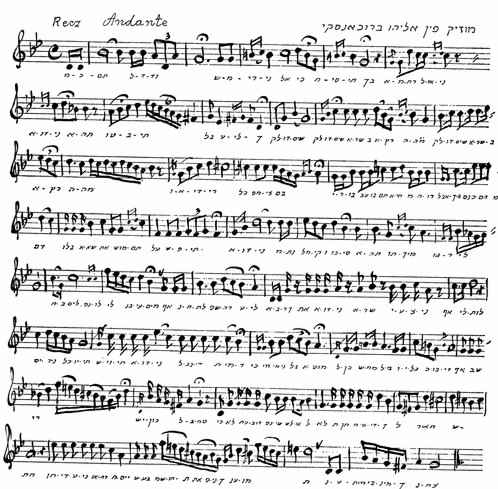
During different times, …
|
|
[“Psalm for the Song”] composed by Eliyahu Brukhanski [second line is Hebrew, same as Yiddish] |
[Page 110]
… the Malczyk brothers joined. As children, they began singing as sopranos, then later as tenors.
Leybtche Stajnberg sang as a soprano as a child, and later as a tenor. Moskowycz, soprano; the Mondry brothers, altos; the scribe's son Yakov Yosef, alto; Velvel Jakubowycz, soprano; Daniel Jakubowycz, alto.
When a Hechalutz [Jewish pioneer movement for settling in Israel] organization was established in Wyszkow, I created a youth choir that gave concerts at all kinds of events. Now there were also girls who participated in the choir. We performed on Herzl evenings [evenings of recitations], at Chanukkah evenings, Lag be'Omer celebrations, and other Zionist events.
In this choir, among others there were: the sisters Yokheved and Golde Fromowycz, sopranos; the three Bzhoza sisters (Esther and Rivka sopranos; Yocheved, alto), all three musically talented girls; Khava Blum, soprano, had a beautiful voice and sang well; Yisroel Kaluski, baritone; often there were some men who also sang in the choir, members of my father's choir. Among others – also Henokh Ihrlikht.
In these times, when I was working in the Tarbut school as singing teacher, I would organize Herzl and Lag be'Omer evenings with the students of the higher grades. The profits of these types of evenings were designated to the Tarbut school.
by Yosel Popowski, Buenos Aires
Translated by Pamela Russ
In the market square [Rynek], on Kosciuszko Street, stood a one–level house where Rav Morgenstern lived. In that same house was the barber shop of Khaim Bursztyn – a small, narrow, and long shop, with three armchairs for the customers and a narrow, long bench for those who had to wait.
After Khaim Bursztyn's death, Moshe Avrohom, his son, took over the business. But the widow, Mindel, saw that the son was unable to manage the business, so she took in Markus Szwarcz as a partner. He used to work for the medic Malowanczyk.
Once, on a Friday morning, Shmule the beadle came to the barber and asked if he could go to the Rav and give him a haircut. At that time, I worked as a tutor. Szwarcz told me to pack up the utensils in a small sheet and go. I felt very proud of myself. In honor of the Shabbath, I, myself, would cut the Rav's hair! Reb Khaim the polisher!
When I came upstairs, I was met by Shmule the beadle, and he directed me into a room near the kitchen. Through the open kitchen door, I saw how all kinds of foods were being prepared, from which came wonderful aromas. In my whole life, I had never smelled such wonders. I remained intoxicated from the smells. Suddenly I heard:
“Why are you standing there? Get to work!”
This awoke me from my stupor, and I saw how my client, the Rav's son, was sitting and waiting for me to service him.
I began working with the machine, and did not notice that his peyos [sidelocks] started at the top of his head, taking up half the head. When I saw, long twisted hair laying on the small sheet, my hands began to shake. The client already understood what had happened, and he began to scream:
“My peyos!”
With this, the Rebbetzen [Rav's wife] came running. Seeing the peyos in her son's hands, she covered her face and gave out a moan:
“My eyes should not see this. My son's peyos! What did you do?”
I trembled like a fish, unable to respond. After completing the cut, the Rebbetzen said to me:
“Come after Shabbath and I will pay you.”
When I returned to the barber shop, my boss asked that I give him the few groshen [coins] that I had earned. I told him that the Rebbetzen did not pay me. So one of the customers who was sitting being shaved, said:
“The payment is lost. The Rebbetzen has a heavy hand…”
At that time, the Shomrei Shabbath group [Guardians of Shabbath] was created. One Friday evening, it was already ten minutes after candle–lighting time, a Jew came to the barbershop and ordered him to lock up – It's Shabbath. Szwarcz replied:
“We'll finish up our work and then we'll lock up the shop.”
The Guardian–of–Shabbath left. I shut the outside door. Soon another Jew came, and screamed:
“You are non–Jews! You have no shame! You are desecrating the Shabbath!”
He kicked the door and left.
A short while later, a group of Jews came, at the head of which was Rav Morgenstern. Some remained standing at the entrance; others along with the Rav, came inside. All of them were talking at the same time, screaming, some even threw up their fists. We heard a loud voice of one of the Jews:
[Page 111]
… “In our Rav's house, you dare to desecrate the Shabbath?”
In the small barber shop, chaos broke out. Markus Szwarcz tried gently to calm everyone, but without success. They did not let us finish our work. Szwarcz, now angry, ordered that the police be called in. I barely pushed my way through the people, out onto the street, and called the tall Sobolewski who was just then staying right near Mondry's tavern [inn]. When Sobolewski came over, he told everyone to leave. Szwarcz asked him how late he could keep the shop open. Why did they come to bother him at work? Once again, there was chaos. The police saw that he would not be able to calm down the Jews with easy methods, so he took out his book to write down punishments. He asked: “The Rabbi also?” And Szwarcz answered, “Yes.”
That very minute, the door opened and a Jew looked in. When Szwarcz saw him, he called him in and turned to Sobolewski:
“Write him down too!”
When the Jew heard this, he began to tremble and pleaded:
“Mr. Szwarcz, I did not come to disturb, only to look!”
“Having a look costs money,” replied Szwarcz.
Sobolewskyi wrote down his name as well and told him to leave. We completed our work peacefully.
A few days later, every “Guardian–of–the–Shabbath” had to pay a fine: eleven zlotys.
The following Friday evening the “Guardians–of–the–Shabbath” did not bother us but went to the Tenenboim brothers who had a barber shop on Yatke Street. They disturbed the work there too. The third Friday, the “Guardians–of–the–Shabbath” group hung up a note in in the Beis Medrash [study hall] with a black border, where it was written that the Tenenboim brothers are desecrators of the Shabbath and so they should be boycotted…
When the youth in town found out about the note, they went to the Beis Medrash and tore it down.
All week they were talking about the Tenenboims and the boycott. Some followed the call of the “Guardians–of–the–Shabbath” while others went to get haircuts at the Tenenboims – but through the back door.
On Shabbath day, after the daytime meal, the “Guardians–of–the–Shabbath” gathered in the marketplace near the bridge, and disturbed the youth who were out strolling. They also found out that Jewish young boys were playing football in the horse marketplace. So they went over there with the Rav and wanted to disrupt them. When the players saw them coming, it became almost festive. Some of the young boys even invited them to play…
The “Guardians–of–the–Shabbath” expanded their work but had no success. There was already a well– advanced youth in Wyszkow.
|
|
|
JewishGen, Inc. makes no representations regarding the accuracy of
the translation. The reader may wish to refer to the original material
for verification.
JewishGen is not responsible for inaccuracies or omissions in the original work and cannot rewrite or edit the text to correct inaccuracies and/or omissions.
Our mission is to produce a translation of the original work and we cannot verify the accuracy of statements or alter facts cited.
 Wyszków, Poland
 Yizkor Book Project
 JewishGen Home Page
Copyright © 1999-2024 by JewishGen, Inc.
Updated 12 Sep 2016 by LA