 |
|
|
[Col. 65]
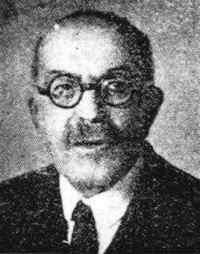
Shimon Bushkanyetz
| A long line of those who came out of Sventzian, who glorified its name in the
world, because they were its spiritual core. They were the hidden treasures of
the town; and when they left to go out into the wide world, they were the
moving force behind [many] great accomplishments.
|
|
Avraham Solomyak of Sventzian was one of the most prominent figures in the first immigration to Israel. He studied in kheder and in the public school of our city and graduated from the Government Teachers' Institute in Vilna. The pogroms in Russia, which started in the 1880's, influenced him and transformed him from an extreme free thinker into an ardent Zionist. (This according to someone who graduated from the Teachers' Institute mentioned above.) He joined those in the first immigration and arrived in the land of Israel in 1885 together with Michael Halperin of Vilna, who even paid for his trip.
When he arrived, he was one of the founders of Gedera, and tried very hard to get used to agricultural life. But despite his best efforts, he was unable to become a farmer. And when he saw that all of his efforts were in vain, he left Gedera and came to Jerusalem. There he at first worked as a translator/secretary in the Russian Consulate. While living in Jerusalem, he maintained his ties with the first immigrants and represented them in all the government institutions and consulates.
Abraham Solomyak is mentioned in the memoirs of most Zionist leaders in connection with various Zionist activities.
Dr. Theodore Herzl mentions in his diary an interesting conversation he had with Abraham Solomyak in the year 1898. While he [Dr. Herzl] was in Jerusalem, he met with him and had both long and short discussions about the life of Israel.
Yitzhak Ben Tzvi (President of the State of Israel from 1952-63) wrote an article containing a few words about Abraham Solomyak in the book The Second Immigration. The article is entitled, “The Beginning: Poaley-Tzion* and Public Life”:
So that I would be able to get the job as a teacher in Jerusalem in 1904, I received the recommendation of Ben Tzion Mosinzon to become a private tutor to the children of Abraham Solomyak, who was at that time the manager of the Russian post-office and chief translator in the Russian Consulate in Jerusalem (p. 593 ibid).At the end of the summer of 1908, a few community leaders came together who were not afraid of all the difficulties, and they came to the conclusion that a Hebrew high school should also be built in Jerusalem.
In the beginning, we were 4 teachers: I, who taught Hebrew Language and Bible Studies; Rachel Yanait (wife of the President [of Israel]), who taught both Jewish History and World History; Mr. Hulevitch, who taught Mathematics and Sciences; Mrs. Solfian, who taught Painting. A committee of parents was formed to handle the finances; among them were: Yehoshua Barzilai, Dr. Vayts and his wife, Mr. Abraham Solomyak and other qualified people (p. 610 ibid).
A. Solomyak was active in all aspects of public life. He was at the head of the committee against the British Mission. He was one of the founders and supporters of the high school mentioned above. He was one of the founders and supporters of the cultural center in Jerusalem. He was the chairman of the local committee of the Jewish United Fund.
When Zev Jabotinsky called for volunteers to establish the Zionist Revisionist Party, Solomyak was one of the first to join this movement and establish the party in his house in Jerusalem. He was among his friends and supporters all of his life, but he never turned his back on the fund-raising activities of the Jewish United Fund.
In those days, Mr. Solomyak was considered the unofficial representative of the new settlement and villages which consisted mostly of new Russian immigrants.
Mr. Solomyak received many awards acknowledging his excellent service from Russians, Turkish, Serbians, and Greeks while he was chief inspector of postal services in the area of the Black Sea and the Mediterranean. From the Russian representative, he received the title: “Eternal Honorary Citizen.”
In his final years, the Zionist leadership awarded him a monthly salary for being one of the survivors of the first immigration, but he declined it. (He died in 1945).
More About the Great Torah Scholar Rabbi Yitzhak Yaakov Reines, the Head of the Jewish Tribunal in Sventzian
Articles appeared in newspapers and magazines of the 1900's (HaMelitz, HaTzefira, History of the Commentators, and Kiriya Ne'emana) which shed light on the activities of the immediate area of the town at that time. For example:
The Great Torah Scholar, Rabbi Yitzhak Yaakov Reines, was appointed head of the Jewish tribunal in the city of Sventzian even before he reached the age of 30. Sventzian was always important in the rabbinic world. In 1869, Rabbi Reines replaced the great and brilliant Torah scholar Rabbi Yehoshua Heschel, whose nickname was “Iron Head.” He was the epitome of a great man. (According to the “History of the Commentators,” he was in the same category as the great scholar, the author of “ Shulkhan Shlomo ” [Shlomo's Table] and going back to the later writers of the Talmud, Rabbi Yokhanan Hasandlar, and even going back further to King David, may he rest in peace.) While still young, Rabbi Y. Y. Reines sympathized with the plight of the Hebrew teenager and devoted himself to the question of education and enlightenment in a revolutionary way. He was not afraid of tackling the problem of Jewish teenagers in the city who wanted a secular education.In 1881, against the will and traditional approach of the ultra-Orthodox factions, Rabbi Y. Y. Reines established the great progressive yeshiva in Sventzian. There the yeshiva students studied secular subjects in a way that was not antithetical to Torah, so that they would remain devoted to G-d and His Torah while at the same time getting the educational tools to live in the modern world.
Although he himself was a G-d fearing person, Rabbi Reines was the target of the rabbis because of his innovative educational ideas and activities, which became widespread and caused great conflict among members of the Jewish community, which was still loyal to the restricted kheder and to its tradition, which might as well have been surrounded by the Great Wall of China. Most of them [in the Jewish community] looked at these innovations with angry eyes.
In the book The History of the Mizrakhi Movement, Rabbi Y. L. Hacohen-Maymon (Fishman) wrote the following:
It is hard to describe all of the problems that he went through because of this yeshiva. He had to overcome many obstacles to achieve his goal. . . . His opponents gave him no rest and in the end, despite all of his efforts, he was forced to close the yeshiva, which had been his dream, after only 4 years. When he moved to the city of Lida located near Vilna, Rabbi Reines had to be satisfied with a smaller yeshiva on a more simple scale. He was caught between an exciting vision and hard, cold reality.
But this was not the end of all the accomplishments of the Head of the Judicial Tribunal of our city, Rabbi Y. Y. Reines, of blessed memory:
His historical mission did not release its hold on him. In this era, there arose a very strong desire for enlightenment, freedom, Socialism and so forth on the part of the general public in Russia. And along with this there came great disappointment in the government of the Czar. So we see our teacher and rabbi as a typical revolutionary man, who started a parallel movement among the Jews with calls for their return to Zion. He used his position in Svinstyan to stay in constant touch with the leaders of the international movement, “Love of Zion” and with the people of the first settlements in Israel (see the History of Mizrakhi mentioned above). His advice and plans for establishing the settlements were well received and his idea for preparing before immigrating to Israel was also adopted in this place. The young people of Sventzian were involved in all the movements--“The First Immigration,” “Redeeming of the Land,” [for example] and they were continually immigrating.
Rabbi Reines was among those people who laid the foundation of Zionism and helped found the Orthodox Zionist Organization called “Mizrakhi.” As the head of this branch of the Zionist Movement, he gained power and raised the flag of revolt in order to change the teaching methods in Hebrew education, and in the year 1904, Rabbi Reines again opened a large, magnificent yeshiva in which the teaching was according to his original methods. This was a continuation of the historical yeshiva that had been in the city of Sventzian. The secular curriculum met the needs of the times and the demands of the government.
|
|
The Road from Sventzian to Vilna |
|
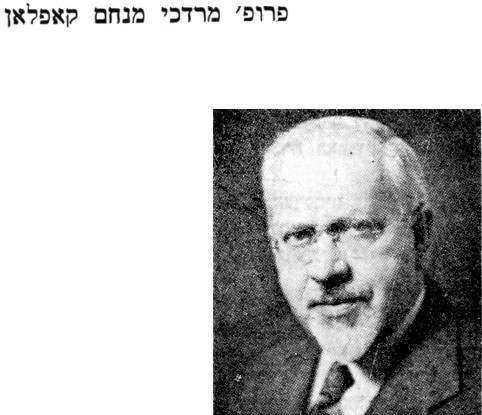
Professor Mordecai Menahem Kaplan (born in the year 1881 in Sventzian) was a rabbi and philosopher in the school of pragmatism outstanding in the following: as a rabbi, a teacher, an organizer, a writer, and a theologian. His books include: Judaism as Civilization (1934) and The Meaning of God in Modern Jewish Religion (1937). His knowledge found significant expression in the Reconstructionist Movement, an organization that he established to advance Judaism.
His major philosophy: Religion is basically social form that contains the step-by-step development of the religion of the Jewish people. The ceremonies of the religion constantly require a new approach in keeping with the highest values of the culture of our time.
His knowledge found ways to influence the views of rabbis, educators, and ordinary intelligent people who were not professionals in Jewish fields or in institutes of organized Jewish life. He was not satisfied with conservativism and he led the people of our city down the road of liberalism to Judaism, drawing sustenance from Jewish tradition, from human nature, the modern world, and new discoveries which humanity needs so much.
The way he thought was important and necessary so that the Jews who believed in Socialism and progress would be able to stay with Judaism without feeling an inner conflict.
M. M. Kaplan was and still is [1] one of the most prominent intellectual and spiritual leaders in American Judaism and one of the greatest leaders of the Jewish people in our generation.
Close to the time of the publication of this memorial book of Sventzian, we
received a letter from the charming, honorable, elderly Mr. Mordecai Menahem
Kaplan, may he have a long life, who was 84 years old. It is quoted below:
This wonderful city is still in my memory even though I left it when I was 8 years old in 1889.
My parents, may they rest in peace, imbued my blood and my memory with their stories about the community, the culture, and the exceptionally high spiritual level [of the city], etc.My father told me that he himself was a student and friend of Rabbi Y. Y. Reines, (the great Torah scholar mentioned above, may his righteous and holy memory be a blessing), who founded, in our home town of Sventzian, his famous modern yeshiva for whose sake he fought using his pioneer spirit in order to give the people the education that the times demanded [Torah and (secular) knowledge].
In these times, my father had the courage to send his daughter (my sister) to study in the school with boys. This was a rare occurrence in this era. This gives us a picture of the life of this community, a unique picture. This sister of mine read Hebrew books by one of the scholars of our city ( I don't remember which clearly) practically every day after her studies.
When I met Rabbi Reines in 1908 in Frankfurt-am-Main in Germany in order to get a teaching certificate, Rabbi Reines remembered Sventzian and asked me if my mother still remembered the Gemara that his students (the yeshiva boys) learned and repeated. [He said,] “She always remembered the melodies.” (She was very happy when I repeated the words of the rabbi to her.)
Among other things that I told him was that I remember that on our way to America my father brought me to the city of Kovno, so that the great rabbi and Torah scholar Rabbi Yitskhok Elkhanan could bless me. And my father now holds the position of Judge in the Jewish Tribunal of New York under the Head Rabbi of the community, Rabbi Yaakov-Yosef.
|
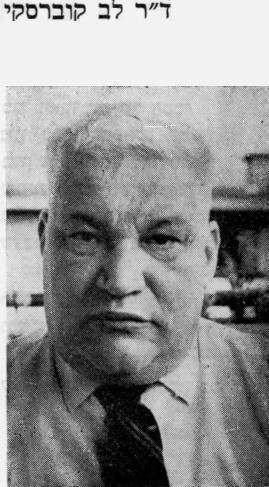
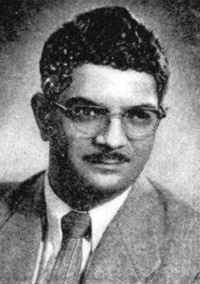
Doctor of Engineering, Lew Kowarski, was a famous French physicist and engineer. He was the son of Natan of Sventzian (grandchild of Asher Kovarsky).
Lew was born in 1907 in Petersburg (Leningrad). He graduated from the high school in Vilna. He studied in various institutes of higher learning: in Belgium at G.A.N.D.[2] and in France in Leon and Paris. He received his degree in Chemical Engineering from the University of Leon and received his doctorate in physics from the University of Paris.
During the years from 1937-1940, Lew Kowarski worked as the chief assistant to Professor Joliot-Curie, the most famous physicist in France.
With the defeat of France by the Nazis, this citizen of our city became a world hero. He took a very courageous step involving great personal risk. Lew saved all the patents and the heavy water that were in French hands and transferred them, with great difficulty involving crossing mountains and borders, to [safety in] England. At this time, this was the only quantity [of heavy water] in the entire world, and this material is well known for its great importance in atomic research.
As a result of his courage, he prevented the risk of having secrets of this research leak out to the Nazis, and it is possible that this changed the fortune of the world forever.
These details are given for the first time by Margaret Gowing in the official report that is based on official documents. She was the administrator of the archives of the Department of Atomic Energy in Britain. In her book Britain and Atomic Energy:1939-45 (published at the end of 1964), she describes Britain's struggle to use the atom in times of war, and among other things, she released details about the scientist Lew Kowarski, who occupies an important place in this historical event. (The information was known before but unofficially.)
In England, Lew Kowarski joined the “DZ'YR”[3] as chief scientist/officer working in the British Department of Scientific and Industrial Nuclear Engineering Research. His contribution is greater than anyone else's in this area in the world to date. In addition, without this historical fact of saving the research and the heavy water, etc., it is possible that the atomic bomb would not have been ready until after the war.
Doctor of Engineering Lew Kowarski, was awarded the Medal of Excellence by the French government, making him a Knight of the Legion of Honor and giving him the position of head of the Department of Nuclear Engineering in the Department of Atomic Energy in France. He was responsible for building the first two French nuclear reactors (designing the building and the layout of the lab.)
Lew was [also] in charge of building the first Canadian reactor “tshmk” when he was at the Department of Scientific and Industrial Research in Montreal (1945) and in Cambridge, England (DZ'YR).
Dr. Kowarski wrote much about nuclear subjects including nuclear physics, the physics of reactors, technology of reactors, and about the organization of nuclear research. He was also a member of The American Society of Nuclear Scientists and belonged to the American Physics Society.
He was the scientist/administrator of the French delegation to the European Organization for Nuclear Research Commission of Nuclear Energy, or CERN, near Geneva, Switzerland.
|
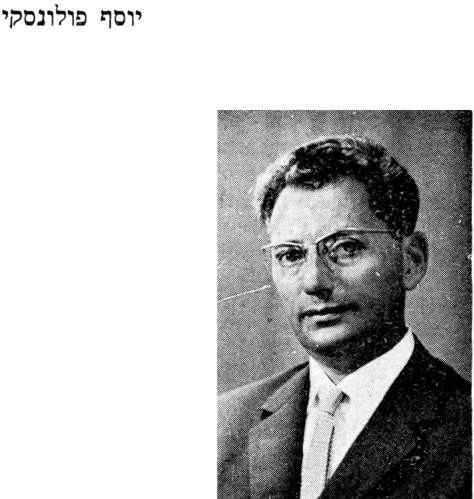
Engineer Yosef Polonski, the son of a rabbi [who served] in the holy city of Sventzian [from] 1922-32, was born in 1913 and graduated from high school in Sventzian, after which his family moved to Libau, Latvia, where his father, Manus Iser, became the chief rabbi. At that time, Yosef moved to France to study in the Technical Institute in Grenoble.
As an engineer, he worked at the top levels of the service for radio signals in the French Company, Thompson-Hussin. Now he is the chief technician and administrator of the television department of the French radio company. This department does research, builds and plans television and radio facilities (studios, receiving equipment, Hertz equipment) commercial, and military television as it involves radar.
Y. Polonski was a member of the advisory committee of the French Electronic and Radio-electric company. He was in charge of the television courses and of the Electronic Institute in Grenoble.
He was excited about all the questions in cellular biology, and he devoted some of his time to developing electronic tools which combine biological sciences and electronics.
In the year 1958, he published a detailed article on the functions of living cells and electronics in cybernetics. He also wrote 2 papers for the Danish Academy of Sciences about the electronics of DNA in the major molecules of genetic chromosomes.
Mr. Y. Polonski was also a member of the International Federation for Medical Electronics and President of the Department of Biological and Medical Electronics in the French company Electronics and Radio and Electricity.
|
Professor Ze'ev (Bill) Reznick was born in Chicago, the son of Raphael ben Ze'ev Reznick of Sventzian. He studied at Purdue University and at the University of Michigan. He taught in the Technical Institute of Illinois in the United States.
National loyalty comes naturally to the people of our city and is inherited by their children.
Israel's getting its independence encouraged him to immigrate to Israel. He immediately joined the academic staff of the Technion[4] in order to share with his people his wide knowledge of chemical engineering and his many years of experience. Young engineering students who graduated from the Technion tell about it. They worked with him in the field of chemistry in the laboratories of Haifa and the Weitzman Institute of Rekhovot.
Ze'ev Reznick was appointed vice-president of the Technion in Haifa and Dean of the Faculty of Chemical Engineering. He is still Vice-President in Charge of Research.
He was recently appointed to teach in the new Faculty of Chemical Engineering that was established by the Wolfson Foundation –– as a special gift to Israel.
Meyer Matzkin is a Jewish artist, and this word has magic in it to the people of the city from which he came. He brought to the Western World Jewish themes as they are expressed in the best artistic technique and strong, independent representation.
|
||
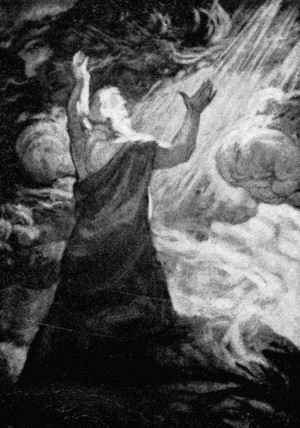
Moses Our Teacher |
Meyer Matzkin |
|
One of the typical characteristics of Meyer Matzkin, who came from our city, is the expression of Jewish pride. He is almost never satisfied with merely painting a biblical or Jewish character. He sees himself obligated to show his audience the Jewish characteristics of these figures.
In the composition of biblical subjects, he emphasizes the image of Moses in ecstasy. In this image, he found the pathos and poetry of the dream and the longing.
Matzkin knows how to express the [feelings of] introspection and asceticism, the ecstasy and the turning inward and finally the monumental richness of the media.
The paintings of Meyer Matzkin belong to those art works that attract every eye, because they express the esthetic values of the human soul. They bring people closer to art, because they reflect a great soul.
The spiritual background of Matzkin's paintings is expressed in the attitude that I would call the environment of Sventzian. The foundation of the artist's belief, the sensitive ideals that he depicts in his oil paintings follow the ideals of Sventzian and he shows this as a great artist who glorifies the name of our city in the world.
|
|
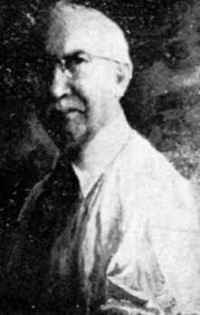
Meyer Matzkin |
The painter Meyer Matzkin of New York was born in 1881 in Sventzian to his parents, Khaim and Pesya-Reyze. When they saw his talent as a painter, his parents transferred him to Vilna.
Already in his youth he excelled in his work. He began with charcoal drawings and paintings of nature panoramas to which he gave a romantic character by adding mythological images, and with rare talent he painted human figures, for the most part in a bold style.
In 1904, he moved with his family to the United States and settled in Brooklyn.[6] His connection to his people expressed itself in compositions of biblical and Jewish subjects. According to one critic, he painted in an original style (the Matzkin style). His images excel in powerful and dramatic movement, and he is considered a typical portraitist.
His famous paintings used to be successfully exhibited in Pennsylvania, in the Art Academy of Philadelphia, and in the Art Institute in Chicago and in the Museum of Fine Arts in Boston as well as in other locations in the United States.
The Yiddish Humanities High School--The First in Poland
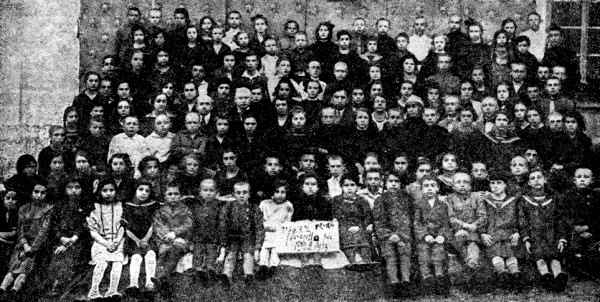
“The first humanities high school in Poland for boys and girls [taught] in the language of Yiddish.” These are the words used to describe the high school in Svinstyan in the government Office of Education and it appeared in the same way in the Central Committee of Yiddish Schools: “TISHA”[7] in Warsaw, and also in the county organization : Ts. B. K.[8] in Vilna.
Sventzian is truly a symbol for the famous yeshiva which was founded by Rabbi Y.Y. Reines. [From that] we arrived also at the first high school of its kind in the language of the people, which became the cultural language “Yiddish” from a “jargon.”[9] It possesses a literature, a variety of newspapers, high-school and college curricula (public university) and also a chain of progressive and new cultural achievements in education --the first in the history of our people. [The high school] in our city was the first in the history of our people, but it spread also to the little towns of the surrounding area.
|
|
The Yiddish High School in Sventzian (1922-1923) |
|
|
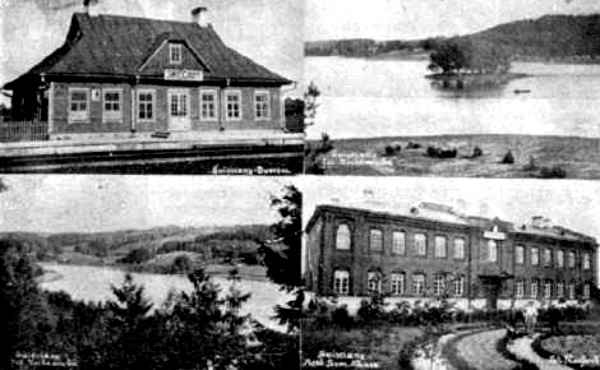
[Upper left, clockwise: railway station, Kochanovka Lake, teachers seminary building, Berzovka Lake. Ed.] |
Translator's and Editor's footnotes:
|
|
JewishGen, Inc. makes no representations regarding the accuracy of
the translation. The reader may wish to refer to the original material
for verification.
JewishGen is not responsible for inaccuracies or omissions in the original work and cannot rewrite or edit the text to correct inaccuracies and/or omissions.
Our mission is to produce a translation of the original work and we cannot verify the accuracy of statements or alter facts cited.
 Svencionys, Lithuania
 Yizkor Book Project
 JewishGen Home Page
Copyright © 1999-2024 by JewishGen, Inc.
Updated 3 May 2019 by LA