
|
[Page 8]
a.
For two score years, we yearned to create – in the form of a megilah book – a memorial, a Yad Vashem, for our sacred Radomsk kehile (community), which is destroyed and exists no more. After a long time, full of temptations and difficulties, we have the honor of finishing this [sacred] book. We deliver it into the hands of our fellow townspeople in the land of Israel and outside, and into the hands of the scholars of the Holocaust period.
This book is the highest achievement of our landsmanschaft in its efforts to immortalize the memory of the martyrs of our city, an effervescent Jewish city, which drew its magnificent spiritual pride from the Tiferes (Magnificent) Shlomoh on one side and from Zionism and socialist progress on the other side.
Radomsk, in comparison with Piotrkow, was a new kehile, with its genesis at the beginning of the previous century (until then Jews were not permitted to live in Radomsk). However, Radomsk, in the course of her existence, was one of the most prominent Jewish communities in Poland, popular in the world of Hasidism and noted for a great love of Zion.
Thanks to the Radomsker Dynasty, which began during the time of Tiferes Shlomoh, the first Radomsker Rebbe, our shtetl was transformed into a great Hasidic center even before the First World War. Hasidim by the hundreds would be drawn to Radomsk every Shabbos throughout the year, and thousands for yom-tovim (religious holidays) and other holy days.
The Radomsker Jews became well known because of their religious ecstasy for the idea of emigration to Eretz-Yizroel, at the end of the century. This religious ecstasy drew its source from Tiferes Shlomoh's strong love of the Holy Land. Incidentally, this was strongly expressed by the emigration of his daughter Rivkah and his son-in-law Yehieil to Eretz-Yizroel and their settling in Safed. Emigration to Eretz-Yizroel embraced our city at all times. Wide circles of the religious observant and 'free thinkers,' Zionists and non-Zionists, were drawn to the land, until the coming of the catastrophic times. The majority of the survivors of our destroyed kehile, immediately after the Second World War, went to Eretz-Yizroel. This again confirmed the customary view from even before the war, that Radomsk was one of the Zionist cities in Poland, and they fulfilled the Zionist commandment of emigration. We were sure that hundreds of our fellow townsmen escaped from Hitler's annihilation thanks to this, and personally brought near the redemption of the land, and grew to be at home here. They fought in the war before the liberation from the foreign yoke and helped strengthen and invigorate the Jewish population in Palestine.
Because of the great many difficulties in publishing this book, it was decided that it should be supported, but that we would dwell upon the two essentials.
The idea for publishing a Yizkor Book was initiated by our dear Chaim Goldberg,
of blessed memory. He committed himself to this holy work immediately with the
end of the Second World War when the enormous tragedy for European Jewry and
the scope of the extermination of the Jews of Poland was revealed to us and it
became clear to us that only a few of the Jews of Radomsk remained alive.
[Page 9]
Right then, Chaim Goldberg was the first among us to help the survivors of the calamity and simultaneously he began to
immortalize the memory of the kehile, which had been destroyed. He began to receive the details about everything
that had happened to our townspeople during the war from the surviving
Radomsker Jews who arrived in [Israel]. Thus was born his idea for publishing a
book with a broad scope, which would entrust to the [future] generations the
multifaceted history of the Radomsker kehile.
During a meeting of Radomskers at the beginning of 1948 in the apartment of our townsman the writer and activist Dovid Klei, of blessed memory, the manner of collecting the material was decided. A general plan for the book was drafted, too (Dovid Klei died a short time after the meeting and did not have the honor of being the editor of the book). However the practical work of collecting the material for a comprehensive book stretched out for many years and required an inconceivable super-human effort. At the start, we did not have any historical sources about Radomsk, nor any newspapers or kehile-pinkeysim (community record books or registers). Then in 1963, an opportunity became available to copy informative and educational journalistic material from the collection of the weekly newspaper Undzer Zeitung ('Our Newspaper') in the National Library at Hebrew University in Jerusalem. It had been published in the years 1925-1927 in Piotrkow and Radomsk. We used the material to complement the articles about the social and economic life of the Jews in Radomsk during the [first] twenty years of the century. However, the reconstruction of the details of kehile life on the eve of the Holocaust (in the thirties) was done by the townspeople alone, from memory.
While preparing the material, we did not spare any effort to [record] the memories of all of the survivors with all of the distinct diversity that characterized our community. Particular attention was given to the history of the 'Radomsker Dynasty' and the institutions, parties and youth organizations, which, directly and indirectly, influenced our Jewish life in Radomsk. With [maximum] effort, we succeeded in collecting from our townspeople, the few survivors of the catastrophe spread all over the world, the documentary material about the horrible Hitler era. Chaim Goldberg collected and assembled this material for almost twelve years, and as he was not destined to complete this work, his successors, Yehuda Liberman and his assistants, made an extensive effort to finish.
The second difficulty in publishing this book was on the financial side. In 1958, a critical situation occurred, which put into question the realization of publication. Due to a lack of money, work [on the book] was discontinued. It was only at the end of 1959, after an internal reorganization, that a general solicitation among the landsleit in Israel and the Diaspora was announced. Then, the work was renewed. Despite the positive response to the idea of a general solicitation by the landsleit in New York, Los Angeles, Buenos-Aires and Paris, [which encouraged us,] the collection of contributions lasted for years.
In spite of all the difficulties that were encountered by Chaim Goldberg, of
blessed memory, and his successor, Yehuda Liberman, and several other
townspeople who were dedicated to the project heart and soul, we can underline
with satisfaction, that everything that was necessary was done in order to
carry out the plan for the book as it was drafted twenty years earlier. In
fact, it was surpassed in certain ways.
[Page 10]
And let the fact be emphasized that some one hundred collaborators, most of them
townspeople, of all strata and of different ages, took part in [creating] the
Yizkor Book.
The material in the book is presented in two languages, Hebrew and Yiddish, just as the collaborators originally wrote it (certain material was translated and it appears in the book in both languages). Among the authors and writers were those who raised their writing to a high literary level. All, in general, made an effort to bring to the world not just the factual realities as they were, but also the deep feelings of experiences, which are bound up with the past in the burden of sorrow and sadness that we carry in our hearts in everlasting memory of the martyrs of our kehile.
Living and dead go arm-in-arm in this book. Nevertheless, one expressly sees the boundary, which divides two parallel compilations in regard to the number of chapters and book pages.
The first eight chapters (approximately 290 pages) comprise the history of our city and of the 'Radomsker Dynasty.' It describes the way of life from the near and distant past, reflects the economic and social life, gives an overview of the political parties, youth organizations, social and charitable organizations, cultural and educational undertakings, remembers the writers and artists born in Radomsk or who had an effect there, and all of this, from the beginning of the seventeenth century until the outbreak of the Second World War in 1939. It should be remembered in relation to the compilation the outstanding part of Dr. Tzvi-Mair Rabinowitch, the son of the Plawner rebbe and the grandson of the Tiferes Shlomoh, lecturer at Bar-Alon and Tel Aviv Universities, whose two studies of the history of Radomsk and of the Radomsker Dynasty adorn the first two chapters of the book (also present are other smaller treatises written by T.Z. Rabinowitch in connection with the histories of shtetlech and Hasidic courts in the vicinity of Radomsk in the twelfth chapter of the book). We should also mention the [participation in the] compilation of Chaim Goldberg, Yitzhak and Yehezkeil Grosman, Sarah Hamer-Jaklin, Comrade Yehieil Weinberg, Shlomoh Zeura, Yehuda Liberman, Yehieil Poznanski, Dovid Koniecpoler, Dovid Kroize, Shlomoh Krakowski. Each of them adapted central themes.
The compilation of eyewitness testimony and descriptions of the Holocaust era
and acts of revenge, and the writings and pictures in connection with
perpetuating the memory of our martyrs comprises chapters nine, ten, eleven and
twelve (approximately 200 pages), including the chapter about the area around
Radomsk. It gives a reflection of life in our community in the last years of
its existence and in the years of its destruction. It provides material, too,
for investigatory work about the destruction of Polish Jewry, in general. In
the compilation, the works “The
Megillah of Suffering” written by Dr. Simkha Hampel and Issakhar Minski, “The
Day Book of Horror” of Miriam Khaszczewacki and “The Glowing
Coals” from the literary [legacy] of Tovia Borzykowski, must be
emphasized, along with all of the other descriptions of those saved from death,
whose testimonies and descriptions are concentrated in the compilation.
The last three chapters of the book are the natural links that complete
the interrupted life chain of the Jews in the city of Radomsk, the chain that
was cherished in the world, and was forged anew in the Land of Israel. The
compilation also contains records, descriptions and pictures to express clearly
the deep love of the basic theme and purpose, to erect through this book an
eternal matzeyve (headstone) and memorial for our townspeople, the martyrs of the
Hitler-annihilation and for our relatives and friends,
[Page 11]
Radomsker landsleit who left the world. Their memory is cared for through us. Among the last must
particularly be remembered our townspeople in Israel, who were involved in
preparing this book, who gathered and prepared the materials for printing and
did not themselves live to see the fruit of their work. They are: Tovia Borzykowski,
Chaim Goldberg, Dovid Kroize, Shlomoh Krakowski, Tovia Rubinsztein and B. Ymini
(Karmazin), of blessed memory.
We express our thanks to all those who have helped us carry out this work, institutions and Jews in [Israel] and outside. The list is too long for us to enumerate everyone. At the head of the list of institutions are Yad Vashem, Jerusalem and Bet Lochome Hagetaot – Yitzhak Katznelson.
Let us remember, with appreciation, the editor of the book, Mr. L. Losh who did everything necessary in molding the contents and the shape of the book.
A deep thanks to Mr. Aryeih Shintal (a comrade and friend of Chaim Goldberg), a heartfelt blessing to our landsleit Yushua Kalka, who contributed to the printing of the edition with help and editing and Dovid Koniecpoler, who revised and put the finishing touches on different materials. A well-done to our landsman, the publisher and graphics [designer] Tovia Ahruni, for his professional consultations and magnificent work.
Here should also be remembered the Moskowicz family of Buenos Aires (the daughter of Szmul Faris of Radomsk), whose generous contribution facilitated the publication of this book according to the original plan.
And let us bless the members of the book committee, whose names appear on the
title page of the book, who worked together in the committee during the various
eras of its existence.
With the appearance of the book, we end our great undertaking to immortalize our martyrs. In this Yizkor Book, we have erected a monument for our fathers, mothers, children, brothers and sisters, relatives and friends, comrades and acquaintances, who were torn away from us by profane hands and who did not live to see the rise of Israel.
We ask you dear townspeople throughout the whole world, read this book and memorize its chapters with your children and children's children, who did not personally know our destroyed community and its Jews. Acquaint your children and children's children with the source from which our parents and forefathers drew strength and power to resist all fateful calamities and hardships from their foes in Jewish exile. Acquaint them with the creative initiative and courage with which they excelled in deeds and with the life of individuals and with the community of the former Radomsker Jews, as an organic part of Polish Jewry which no longer exists. They were the same Jews, some of whom infused with national consciousness understood the need to leave their home city in time. They arrived in Eretz-Yizroel and showed her all of their good qualities by creating and building, by taking part in the Haganah and in the war for independence and sovereignty of the Jewish land.
Let the memory of our Radomsk kehile be protected among us and
let the holy souls of our martyrs remain bound for eternity with the coming
generations who continue and strengthen [Yiddishkeit].
[Page 12]
Translated by Hadas Eyal
|
At the gate of this Radomsk community Yizkor book, we honor the memory of one
of us – Chaim Goldberg z”l – whose virtue was imperative to the
publication of this book. He was torn from us midway into its preparation, a
commander-leader who did not live to see the fruits of his victory achieved by
his burning love to our city, the piercing pain he felt in its destruction, and
his deep passion to commemorate its memory.
One of the first and main founders of this project and its most enthusiastic shaliach-messenger amongst our town folk, Chaim Goldberg dedicated his incredible devotion and sacred loyalty to making it happen. The Radomsk Yizkor book was his holy mission. As such, he persuaded and urged, inspired and motivated, worked and stimulated others, prompted and insisted everyone contribute and take part: collect photos and documents; think back; talk; write. It is thanks to his infectious enthusiasm and faith that we created this headstone for our beloved obliterated community.
Pre-destruction Radomsk buzzed with public and Zionistic activities, one of the liveliest among the Jewish communities in Poland. It will not be an exaggeration to say that Chaim Goldberg's stamp is clearly embossed in all the events of that period. In this our book, in the long entries describing the public-Zionist activities our town excelled at and its intensive social and cultural life - you will find Chaim Goldberg's name as an initiator and implementer, a leader and a worker. There were others who excelled as he did in their public involvement but it is doubtful that anyone in Radomsk at that time compared to him in their wholehearted dedication, endless devotion and tireless energy to any community project. His personality radiated upon everyone and everything that took place in our town during that period.
With his disappearance from the Israeli Radomsk landscape, not only did we lose a beloved and cherished friend, gone was the central figure that symbolized our town life and its loyal lamenter.
Chaim Goldberg – the man who did so much for our town and its memory – did not live to see the completion of his life-mission: this memorial project for our townspeople and it's many Kdoshim.
May his soul be bound in the bond of the souls of our beloved Kdoshim whose
memory we carry eternally in our hearts. In their honor we establish a memorial
in this Yizkor book.
[Page 13]
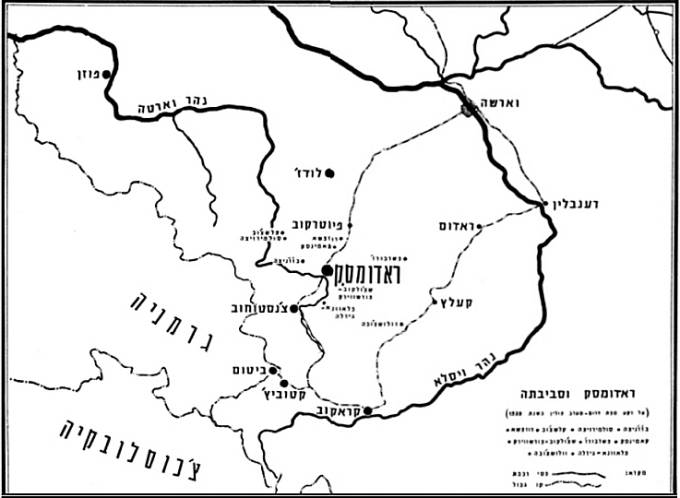 |
| Map of Radomsko and vicinity |
Translated by Hadas Eyal
God full of mercy, defender of widows and father of orphans, grant true rest upon the wings of the Divine Presence, in the great heights of the holy and pure as the brilliance of the heavens give light and shine for the souls of the holy community
Our parents, brothers and sisters, relatives and acquaintances, people, women and children, all holy and pure, were killed and slaughtered and burnt and suffocated and buried alive by the murderous Nazis and their helpers during the Shoah of WWII in sanctification of G-d's name.
All holy and pure, among them intellectual righteous cedars of Lebanon and Torah nobles.
The master of mercy will shelter them under His wings for eternity and bind their souls with the bond of life, in the Garden of Eden be their resting place. G-d is their heritage and will remember their binding. Their righteousness will stand for us and all of Israel.
Land – do not cover their blood and may there be no need for their cry because it will be thanks to them that the scattered Israel will return to their estate and their holy memory be eternal before G-d in peaceful repose on their resting place and may they rise to life at the end of days and let us say: Amen.
Exalted and sanctified be His Great Name
יתגדל ויתקדש
שמה רבא
|
JewishGen, Inc. makes no representations regarding the accuracy of
the translation. The reader may wish to refer to the original material
for verification.
JewishGen is not responsible for inaccuracies or omissions in the original work and cannot rewrite or edit the text to correct inaccuracies and/or omissions.
Our mission is to produce a translation of the original work and we cannot verify the accuracy of statements or alter facts cited.
 Radomsko, Poland
 Yizkor Book Project
 JewishGen Home Page
Copyright © 1999-2024 by JewishGen, Inc.
Updated 11 Aug 2022 by OR