 |
|
|
[Page 104]
“Hibbat Zion” [Lovers of Zion] in Korelitz
Translated from the Hebrew by Ann Belinsky
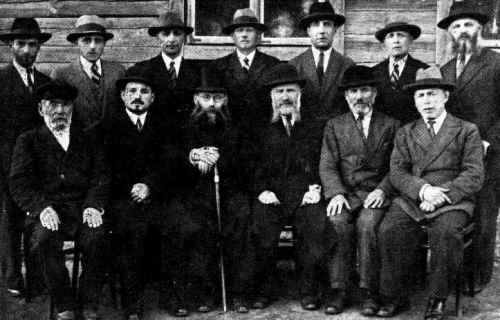
Korelitz announces: that at the recent Festival of Pesach they celebrated the anniversary of the establishment of their “Hovevey Tzion” association, and indeed they can be happy. For their hope was not disappointed and, in a town as small as theirs, they managed to collect over the year one hundred and sixty rubles for the benefit of their lofty idea. An amount of money that they never dreamed they would collect. And the heads of their association can be happy that they saw fruits of their labor. And indeed they labored and toiled very much, and not only in their own town, but they also worked to spread their ideology to other places. They wrote arousing letters and sent them to other towns in their area, so that they too would be aroused. And indeed their words were successful, and people as far as Novogrudek, Mir and other towns were aroused by their call and honorable associations were established in these places as well.
“HaMelitz”, 27 Iyar 5658 ( Edition 100, 19th May, 1898)
|
|
On the second intermediate day of Passover many of the townspeople gathered in one of the Batey Midrash where the accounts were presented to them, and they also read from some pamphlets which discussed Zionism. And the people were satisfied. The listeners were surprised by the pleasant sermon of one of the heads of the association, the scholar, Moshe Haim Cohen, son of the local Rabbi, who is both the writer for their association and also the editor of the florid letters which were sent around the country. Although Mr. Moshe Cohen spoke a short time, his words were very effective. And after refreshing their hearts with fruit of the produce of our Holy Land, the assembled people returned home happy and goodhearted with the name of Zion engraved on their hearts. Mr. Cohen agreed to the request of those imploring him, and promised to preach his words another time on Zion and on the seventh day of Passover a huge mass of people gathered again in a private house. And after they read the speech of Dr Herzl, who had lectured in London in the Maccabee Hall, Mr Cohen spoke for two full hours. His words spoke to hearts of the listeners and were very effective, for on the day following Passover many more joined the association. Those who had never imagined that they would support the organization, did so.
“ 25 Elul 5658, (12th September, 1898, Edition 195)
Morasha, the Odessa Committee in Korelitz, Moshe Avraham Volpin, the ritual slaughterer, collected contributions from the people of Korelitz as follows for the good of the settling the Land of Israel for the aims delineated below.
On Shabbat Nachmo 5658 (1898) the Chovevey Tzion assembled here in the synagogue to pray and when they were called to the Torah, they thought of Jerusalem and donated for the good of “Gan Shmuel”.
These included: the Rabbi, head of the local rabbinic court, Yeshayahu Kishelevitz, Shmuel Baltermantzer, Nissan Veinshtein, Moshe Avraham Volpin, Haim Issar Shimshelevitz, Aharon Davidovitz, Reuven Leib Mesliavsky, Leib Polack, Yosef and Nechemia Friedman, Gershon Zhochovitzky, Shlomo Volpovitz, Moshe Pomirtchik, Moshe Yitzchak Toybsh, Shimon Yitzchak Greenfeld, Yaacov Karelitzky.
Avraham Meyerovitz from Korelitz married Osnat Rivkah the daughter of the Rabbi, head of the rabbinic court in Rakishok, and his brother Dov David Meyerovitz donated to “Gan Shmuel” on this occasion.
Nissan Veinshtein mentioned above appears again as a donor to “Gan Shmuel” on the occasion of the marriage of his cousin, the daughter of his uncle Mordechai Veinshtein. The above mentioned Leib Polack donated to “Gan Shmuel” on the occasion of the marriage of Pessia Beilin's son Moshe.
The above mentioned Shlomo Wolfovitz again donated to Gan-Shmuel on the occasion of the wedding of his cousin Moshe Greenvald, the prayer leader, in Turetz.
At the wedding of a daughter of the Chorgil family to her chosen bridegroom, Yitzchak Shimonovitz, which took place in a hall in Erozevitz, a donation was made to "Gan Shmuel" by Gershon Leib Ostashinsky and Yitzchak Yossilevitz and also by Rachel Halavnovitz and Sarah Kaplan and Rivka Tzonzer.
An anonymous donor donated a total of 150 rubles to “Gan Shmuel” in memory of the Second Zionist Congress in Basel.
“Chovevey Tzion” made a special donation by planting a citrus tree in the name of the Gaon Eliyahu from Vilna on the centenary of his death (5558 - 5658) and also donated towards our commitment to plant a tree in the name of the late Professor Tzvi Shapira from Heidelburg. The trees planted are ethrog (citron) trees.
by Rabbi Y. Nissanboim
Translated from the Hebrew by Ann Belinsky and Harvey Spitzer z”l
At a distance of three parasang [a parasang is about 4 miles -AB] from Novogrudek stands the city of Korelitz. A small town numbering about 400 Jewish households. Its houses are low and poor and the "poverty" is discernable in every direction. If you desire to see in actuality the model of a small town in Lithuania that Dr Mandelstam spoke about in his speech to the Congress which you conceive in your mind's eye, so come here and this model will be in front of you.
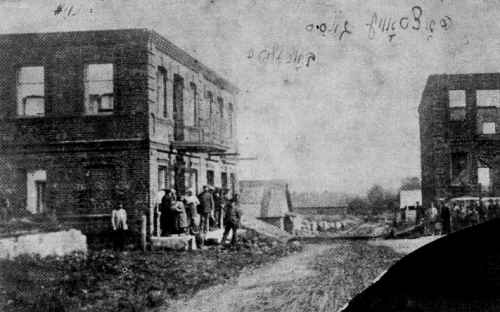
The most attractive building is the “Bet Mirchatz” (Bath-house), which cost five thousand rubles! Where did they obtain this amount of money, Korach's fabulous wealth? Did they get it in K(orelitz) itself or from other towns which came to their aid? Whoever knows, knows! But either way, a large, two-storey high building stands ready for people of the town to wash their bodies and to remove their grime and no-one can ever say that it is cramped.
Also the “Talmud Torah” and all the other charity organizations are found in K(orelitz) as in all Jewish towns.
The Zionists in K(orelitz) do their loyal work and especially outstanding in his work is the representative of the supporting company - an honest and innocent man, loving the settlement in Eretz Israel with a pure, strong love, and without external enthusiasm, without thunder and noise, he does his onerous work most quickly and skillfully.
This man is the ritual slaughterer, grandson of a ritual slaughterer and great-grandson of a ritual slaughterer, but he didn't like his trade and did not think to try to be officially appointed the ritual slaughterer of the town until several people came and thought of robbing him also from his “rightful claim”, and in order to defame him in the eyes of the community, several townspeople began to say that he was a heretic who was sending letters that he received from Zionist centers. The Zionists heard this and did not rest until he had been appointed the official ritual slaughterer. The Zionists in K(orelitz) are down-to earth-people, innocent in their ways and practices, “simple Jews” without the addition of (the extremes) of either abstinence or “enlightenment” and they are as all of the House of Israel.
HaMelitz, 3 MarCheshvan 5661 (26th October 1900, No. 223)
Translated from the Hebrew by Ann Belinsky and Harvey Spitzer z”l
A Mazal-Tov greeting to Mr Baruch Shimshilevitz from Korelitz on the occasion of his marriage with his fiancie Ms Chana Ostashinsky, from his friends in Korelitz: Shalom and Breina Cohen, Mordechai and Binyamin Yosilevitz, Sarah and Liebeh Kliatzkin and Yisrael Cooper.
“A group of Zionists in the above town”
A large meeting in the town of Korelitz was arranged in honor of the confirmation of the Mandate. The local Rabbi R' Yosilevitz, may he live a long and happy life!, spoke about the significance of the Mandate. During the prayers, Psalms [Excerpts from Hallel -M.Tz,] were recited by the ritual slaughterer R' Moshe Avraham Volpin and the secretary of “Mizrachi” of our town, Mr Shlomo Volpovitch. Two hundred and ten thousand mark were collected at this meeting for the benefit of the Jewish National Fund.
“HaMizrachi”, 6 Tishri 5683 (No. 39, 1922)
A letter of congratulations from Korelitch - on the occasion of the Jubilee of “Hatzfirah” (1862-1912, 5622-5672) from a faraway town, far from man and city, to which only “Hatzfirah” brings us light and pleasure, we send our most sincere blessings to the great author and noble individual, Mr Nachum Sokolov, and his honorable assistants for the celebration of the Jubilee of “Hatzfirah” we bless the periodical and pray that it will continue with its fertile work to fight the true war and protect our persecuted and unfortunate people, to encourage our spirit and to stand against the flow of hardships and distress which have surrounded us from every side. May “Hatzfirah” be worthy of lightening our way also when our people soon will be in our dearly beloved land.
The readers of “Hatzfira” and its admirers: Moshe Avraham Volpin; Yisrael Cooper; B. Shimshilevitz, A.M. Avramavitch, Lieba Kliatzkin, Sara Kliatzkin; Sh. and B Cohen, G. Yellin; Chaya Hirshavitz.
“HaTzfirah” 13 Tammuz 5672 (28 June, Issue 134, 1912)
A. Ten measures of poverty were given to the world, nine of which were taken by our town Karelich; for there is no poorer town in all the Country of Greater Lithuania than our town.(Today Korelitz is in Belarus, which was once part of Greater Lithuania. H.S.) Traders will not succeed and will go overseas, and all the people of our town have joined those who sit idly at the street corners. And little does it matter if a man celebrates his wedding. It's only a sign that a new store has been created, and if he's the son of a rabbi, he'll become a teacher and a few weeks later, “this bridegroom” will become a storekeeper or a teacher of beginners.
There are nearly as many stores as there are residents. And seven women or townspeople hold one buyer, one on his left side and one on his right side. It is obvious that the competition is great and there is little profit to be had. The wise men would have done well if they had made peace between them and decided on a price for every item. Then they would not do business in vain and God's name would not be desecrated in public. And competition, which is not useful but rather a source of heartache and pain, would come to an end. But instead of peace, everyone is trying to make a livelihood.
B. As is the material situation, so is the spiritual situation: the stomach is empty, and the soul is unable to soar. And therefore the paths of education are languishing in our town. Hebrew periodicals will not come (except one subscriber to “HaMelitz”) and the greater deficiency is that there is no library in the town. Several times we thought of requesting the “Disseminators of Education”] Mefitsey Hazkalah[ company to support us with educational books, but we knew that our toil would be for nothing and that our request would be rejected because ten years ago the above company sent books here to read and it was the fault of the head of the library that the books were lost.
The first youths sinned and should we suffer for their iniquities?
“HaMelitz” 24 Shvat 5650 (Issue 28, 1890)
Levi Berman
Karelitch
The “Hospice for the Poor”[Linat-Hatzedek] society was founded a year ago by several of the honorables of the town who put all their attention into the project and made every effort to set it on a firm base, and their work paid off, for many of the townspeople took upon themselves the obligation to sleep over in the house of a sick person and anyone who couldn't carry out the order of the gabbays will pay back the association, and they will send someone else, or he himself will hire another person to do this.
Every week the collectors will walk around the thresholds of the houses to collect the weekly payment from the members and this money will buy the essential equipment needed by the sick person.
The number of members is one hundred and fifty people, and women, too, have joined forces to come to the aid of sick women, and the number of members in our society is one hundred and ten women.
“HaMelitz”, 2 Sivan 5659 (Issue 96, 1898)
M.A. Oberoyansky
|
|
Malka Faloozshski – Kfar Saba
Translated from the Yiddish by Harvey Spitzer z”l
| 1. A small town – Lithuanian, on the bank of the Rootke. A little river – small, turning like a ribbon. Without ships, without barges, even without boats. Jews lived there and were happy.
2. Just a little town, as usual as others,
3. What did the Jews live on in that small town?
4. A few Jews - were gardeners.
5. On a winter morning, the snow screeches,
6. Calmly, measured, life flows
7. The youth in the small town – united in friendship,
8. They danced the fiery hora, all as one
9. Rabbi Moshe Avraham in his old age
10. They hold a bazaar for Zionist purposes.
11. The teachers of the Jewish schools take part
12. They hold seminars, give lectures.
13. Life would have gone on in this way
14. This horrible episode passed Korelitz by,
15. The pioneer then became the proletariat.
16. Life would have still gone on slowly,
17. The little houses stand silent, no more sounds are heard.
18. Everything has vanished, as though it had never been.
19. At the memorial ceremony, by the black candles, |
by Hassia Turtel–Oberzhansky
Translated from the Hebrew by Ann Belinsky and Harvey Spitzer z”l
My birthplace, Korelitz, which was set, like a pearl, within the patchwork of small Jewish towns spread around the forests, swamps, hills and rivers of White Russia, can serve as an example of the classical historical phenomenon of a tapestry of original Jewish life. From within the ruins of thousands of Jewish towns, the city of my birth is depicted in all its glory, its beauty and its tragedy, its roots buried within the historical background of Polish and Lithuanian princes, heads of the Czarist regime, anti–Semitic clerks and German executioners.
Despite all the restrictions and the persecutions of the foreign regime, the town succeeded in creating a web of life and forging link after link in the chain of generations. Here is the market place square with its two rows of shops. Here is my father's old–new house, which over the years became a type of public institution. Here is the Tarbut school, the Rabbi's house and the other public institutions in the town. The trait that characterizes the town is the shared and unifying awareness of the spiritual and national war of existence for the sake of the continuance of the generations.
The Jewish youth was the center of gravity where the memories of the long historical past and the daily struggle for material existence merged and crystallized, placing the proud young generation opposite the hostile foreign regime. The young people strove towards a future in which they would shape their own personal life within the framework of a general national, social and spiritual revival. Their awareness and experiences, their whole soul and spiritual face, suckled inspiration from the feeling of national Zionism.
Zionism did not come to the youth as a result of propaganda and education. Zionism was transferred as a family and national possession and constituted its entire general essence. Its energy, soul and spiritual strength were invested in the Zionist youth movements: HeChalutz, HeChalutz HaTza'ir, HaShomer HaTza'ir, etc. The youth were active. Every move and step was directed towards one aim – personal and national redemption.
The life in the town was bustling, alert and flowing. All our activities had an impact on the community. The youth organized the library and enlarged it with the purchase of children's books; the dramatic club; evenings dedicated to discussions on all sorts of literary and political subjects were part of the living spirit and the stimulus of my town.
I see the Jewish youth on the rise in Korelitz, boys and girls, friends from school days, the youth movements – together we wove the golden dreams of redemption of the nation, freedom of man and building of Eretz–Israel.
The youth of Korelitz was consistent, to the point of self–sacrifice on the altar of its idealism. The youth of Korelitz contributed much to aliyah, to pioneering and to building the land of Eretz–Israel. It may be that the desire to move out of the narrow framework that filled the souls of the youth raised them also outside the boundaries of the national redemption. The Russian Revolution overflowed and flooded also the Jewish youth, whose eyes were blinded by the historical event of shaking the foundations of the Czarist regime and the establishment of a new society, enthusiastic and endearing young people who wanted to force the issue of the coming of the Messiah. There are those who went astray within the fields and acquaintanceship of the national Zionist environment and moved over to the Russian revolutionary movement.
The nationalistic feeling was the strongest and most original. In aliyah and pioneering, they saw the realization of the ideal of National–Jewish Revival and the establishment of a society based on justice and honesty.
My town of Korelitz, destroyed and ruined. We, the remnants that were saved in various ways and had the privilege to come to Eretz–Israel, let us bow our heads before our slaughtered brothers and sisters.
Let us unite in the memory of our friends, together with whom we dreamed the dream of Jewish heroism and National Redemption.
|
|
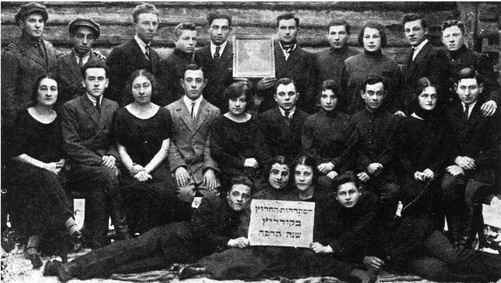
Row B: Yitzchak Stoller, Sonia Kaplan, Yosef Portnoy, Moshe Eliyahu Shuster, David Portnoy, Pessia Ephroimsky, Mordechai Levine, Shaindel Farbolotsky (Kuznitz) Row C: Moshe Gershonovsky, Berel Lipshitz, Hershel Zalamansky, Yehuda Levitt, Abramovitz, Noach Gershonovsky, Matel Lipkin, Lama Ben–Haim, Kalman Bezalel Osherowitz |
[Page 114]
|
|
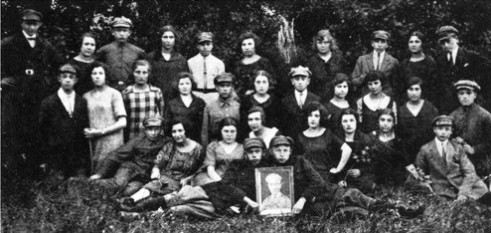
Row B: Avraham Gorodisky, Chaya Mordechovitz, Henia Izralit, Fanya Lipshitz, ----, Leah Treievitsky, Chaya-Leah Sharshevsky, Itay Lipshitz Row C: Moshe Stoller, Miriam Shkolnik, Menucha Abramowitz, Yehudit Berkowitz, ----, Shirka Dushkin, Yosef Portnoy, Elka Berkowitz, Sarah Zalmansky, Leah Gershonovsky, Michael Yellin Row D: Chaim Bolutnitzky, Chassia Oberzhansky (Turtel), ----, Freidel Kuznitz, Friedel Shapira, Yeshayahu Bolutnitzky, Sarah Zalmansky, Yona Yellin, Leah Kaplan, Yehuda Meirovitz |
|
|
Alter Bayarsky
Translated from the Yiddish by Harvey Spitzer z”l
Korelitz had a lovely landscape. Surrounded by mountains and valleys, with smaller and larger forests and numerous villages and hamlets, the small town was home to a few hundred Jews who led a quiet, traditional life.
Regarding the founding of the small town, it is known that, hundreds of years ago, a nobleman by the name of Karelitz -a friend of the Jews - decided to develop his estate in the area. For that purpose, he brought a Jew from Minsk and he settled him there as a farmer with a lease. The Jew brought his relatives and they opened a tavern by the highway and Gentiles began to show up. Later, Jews began to settle in the small town. They leased fields and woods and they dealt in wheat and garden produce, and the Jewish population grew from year to year.
The most important ways of earning a livelihood were trading in produce from orchards and gardens, owning larger and smaller stores, and working as craftsmen, “the common people”. The grain merchants and wood traders were the most privileged in the small town. Jews also dealt in dairy products. The cheeses from Korelitz were renowned in the whole region.
Before its long history, the little town developed nicely and built up. Korelitz had very lovely panorama. The center- the market place- was located on a hill, and all the streets and lanes extended downhill from there. At the end of the small town, the huts of the better-off Gentiles spread out with their orchards and gardens.
A wide road cut through the Zalamanke Streets, the market place and the Post Office Street. The road to Novogrudek started from there, and in the other direction, to Turetz and Mir. The distance to Minsk, the capital city, was 110 km.
|
|
Korelitz had a very old cemetery with tombstones of Jews of noble lineage. The old synagogue was a great work of art, built of wood and decorated with lovely artistic carvings. The synagogue was high and spacious. The holy ark was a great, lovely work of art in the old style, adorned with various figures. This was the only Kalte synagogue in the area, and the Jews of Korelitz were very proud of it.
Opposite the Kalte synagogue was the large study hall. This was the synagogue for the “common people”. The small shopkeepers and craftsmen prayed there. Above the market place, across from the rabbi's house, was the second study hall. The wealthiest Jews of the town prayed there: the grain merchants, dry goods merchants and other privileged people. Opposite the cemetery and downwards was the little Koidinav prayer house for Chassidim. Only Chassidim prayed there. Most of them were butchers, cattle merchants and just plain Jews. Downwards from the Chassidic synagogue as far as the cemetery fence was the town bath house. Further downwards, past the cemetery, was the town slaughter house. At the corner of the lane, by the synagogue yard, stood the rabbi's house, and the Rabbi's Lane started from the rabbi's house and ended at the market place.
The market place was the town's center and was paved. In the middle of the market place stood rows of stores which belonged exclusively to Jews. One could buy whatever one needed in the stores. Gentiles from the villages would come on market day- Wednesday- and buy everything they needed: salt, herring in _____, ________, sugar, soap, kerosene and other things. The Gentiles, on the other hand, sold their wares: wheat, chicken, eggs, butter and cheese. Market day gave the Jews a livelihood for the entire week.
At the beginning of the rows of stores, as far as the church and between the houses at the beginning of the market place, was a big town well which had to be monitored all the time and people seldom drew fresh, pure water from it. The Jews of Korelitz, however, had their own big well filled with fresh water in the synagogue yard, and the water was clean. Down Zalamanke Street, which led to Novogrudek, there was no well, but only a spring. It was called a spring because one could draw spring water from it. The spring was located between the two taverns which Korelitz possessed. That was always the gathering point for people and horses. The horses could drink up the cold water and the Gentiles -brandy. The Korelitz police were always there. Both taverns were a source for the latest news – especially when, at that time, it was not customary to read a newspaper. Jewish wagon drivers, who used to travel to distant places, would bring the latest news from the world. In those years, people talked about pogroms, persecutions and misfortunes and occasionally one would hear good tidings.
On Zalamanke Street, on the hill, next to the Korelitz nobleman's courtyard, stood the only Russian Orthodox church with its tall steeples. On Sundays and on Christian holidays, the area around the church was filled with Gentiles and wagon drivers in their national dress. After the prayer service, the Gentiles would go to the Jewish stores to buy various items.
Jewish life throbbed with intensity: there were many “chederim” (relgious elementary schools) where young boys studied Torah: Bible and Oral Law. From the “chederim”, the boys moved on to the “yeshivot” (schools of higher religious learning). Jews would also study in the study halls. There were several groups of learners: Psalms group, traditional laws group, Oral Law group. One would study a page of “Gemara” (Talmud) or a chapter of Mishna (compilation of traditional laws and their interpretations) between the afternoon and evening prayer service. Some of the leading rabbis of the time always occupied the position of town rabbi.
Prior to the first revolution in Russia, the “Enlightenment” movement had also reached Korelitz together with the first sprouts of socialism. Various political groupings were established which were laden with various ideas: socialism and Zionism. Working men and poor people dreamed of better times: liberty, equality, fraternity. A library was founded in the town. Young people started reading little books. Money collection and discussion evenings were organized. People attended lectures on various subjects: sociology, political economy, Jewish, Russian and Hebrew literature. A dramatics club which performed various plays was also set up.
At that time, illegal circles would gather to read illegal literature. Former yeshiva students would give fiery speeches about revolution. Every Sabbath, people would go into the forest and have “meetings”. The Roodishtch forest was the center of freethinkers and radical socialists who wanted to topple the Czar. Friday night, after welcoming the Sabbath, when their parents were already asleep, young people would tear off the lock to the study hall and would discuss various subjects, mainly about the Czarist regime.
On a summer Sabbath afternoon, after taking a nap induced by eating “tcholent” (Sabbath stew), the Jews would walk downhill to Mill Street to get some fresh air in the forest. The road was always crowded, especially with young people. This was how the Jews of Korelitz lived with their joy and sorrow, with their aspirations and worries and hopes for better times. This was the manner of the hundreds of Jews from Korelitz and of the Jews from the hundreds of little towns in the area.
Korelitz produced many great personalities, both scholars and fighters. They knew how to live but also knew how to fight for the existence of the people and their country.
Mordechai Meyerovitz
Translated from the Yiddish by Harvey Spitzer z”l
Prior to the First World War, Korelitz was a small, lively Jewish town. About 2,000 Jewish people lived there. As in all small Jewish towns, there was a rabbi, ritual slaughterer and just plain Jews -scholars who had received rabbinic ordination. In the center of the town was a synagogue quarter, with a synagogue, two study halls and a small synagogue house for Chassidim. Many Jews, yeshiva students, would always sit and “learn” in the study halls.
There were various societies and charity organizations in Korelitz such as a people's bank, a hostel for the poor, a burial society, a group of reciters of Psalms, a free loan society, a Zionist organization, thanks to which many Jews left to settle in Palestine, the Land of Israel.
Every year on the 15th day of Kislev, the burial society would hang up fruit on the walls of the study hall and after the fast, and when the penitential prayers were over, the burial society members prepared a lavish meal. Women were also in the burial society and would make their separate feast.
There was a “fire brigade” in Korelitz which was organized and run by Jews. The fire brigade musical band had a good reputation in all the surrounding villages and small towns of the area. Korelitz would hire out the band to play at weddings.
The town itself was situated in a lovely, rich area, surrounded by forests, orchards and fields. There were many villages around Korelitz and every week, on market day, hundreds of wagons would arrive at the market place and business was lively. Besides that, there were 15 fairs every year. The fair in Korelitz had a particularly good name in the area. Merchants from far and wide would travel to Korelitz together. The small town profited from these fairs.
Personalities and events in Korelitz
There was a shopkeeper in Korelitz whose name was Shaye Brankes. He was a good prayer leader. He organized a choir made up of many boys. His praying was renowned in the area. On the eve of the holidays, many Jewish farmers who lived in the villages would travel to Korelitz with their families to hear Shaye Brankes the Cantor with his choir. One could feel the holiday spirit in the small town.
There were sons-in-law in Korelitz who would “sit on the boards”. Prominent Jews would travel to yeshivot to choose yeshiva students for their daughters. Shaya Brankes had 7 daughters and he took yeshiva boys who were ordained as rabbis for each of them. He gave them the opportunity to sit and study until they became a rabbi and found a position.
There was a righteous woman in Korelitz - Devorah Farashisker. She helped the yeshiva students in whatever way she could.: she arranged “eating days” for them at the homes of wealthy Jews, washed their linen and saw to it that they had something nice to wear.
My father, may he rest in peace, as well as Aharon-Yankel the Teacher, would devote themselves to helping yeshiva boys, or “monks”, as they were called.
I remember a certain Pupko. He was a well-read, conscientious, cultured young man. He was nearly blind. Young men with revolutionary ideas (this was before the first revolution in Russia in 1905) used to come to him and hold meetings and also read prohibited books and pamphlets. When he died in 1907, many young men and women arrived from the surrounding small towns to attend his funeral. He was eulogized and his social activities were recalled.
There was a Zionist in Korelitz, R' Moshe-Avraham, the ritual slaughterer. He was very active before WWI. He used to collect money for the JNF (Jewish National Fund) and organized a Zionist organization in the town, which made the police very suspicious. One Sabbath afternoon in 1907, R' Moshe-Avraham noticed through the window the police chief with policemen coming to his house. He understood that they were going to conduct a search. In the house were books, material and blank forms for the JNF. Before they managed to open the door, he stood by the wall and pretended to be praying and didn't even call out a word to them. The police chief and policemen waited for him to finish praying.
Just then his wife went out of the house and called a few little boys. I was also one of those boys. We sneaked through the stable into the house and from a side room, unnoticed by the police, we carried out the bookcase with the books and material and brought it into the stable of a neighbor, R' Asher-Moshe, the glazier. We covered it with hay and dung and put the cow there.
R' Moshe-Avraham finished reciting the afternoon prayers, went over to the police chief and asked him what he wanted. The police chief replied that he came to conduct a search. They looked in every little corner and, of course, found nothing. They also looked in R' Asher-Moshe, the glazier's stable. It never occurred to them that the materials they were looking for were hidden in the place where the cow was standing! The police chief ordered R' Moshe-Avraham to appear before the inspector in the small town of Mir. In our small town there was a well-to- do man, R' Leib-Eliahu, who spoke a fine Russian. He convinced the police chief to let him stay home. R' Moshe-Avraham continued his work for Zionism. After the incident with the search, Zionism became even dearer to him. He asked the Jews of the town to help him collect money for the JNF.
After World War I, the Polish authorities allowed the Jews to carry on Zionist activities. It became legal. They rented a place, arranged meetings, listened to lectures and readings about Zionism and Palestine. Zionist thought had a great influence on the Jews in Korelitz.
There was a tradition in Korelitz that following the afternoon prayer service on Yom Kippur, they would sell the honor of opening the doors of the Holy Ark for the “Ne'ilah” (closing) service. A fellow Jew, Berl-Dovid, lived on Mill Street near the river. Year after year, he would buy the honor of opening the Holy Ark. Once, the congregation got together and would not let him buy the honor of opening the Holy Ark for the closing service. They purposely bid such a high amount of money that Berl-Dovid could not afford to pay. There was a commotion in the synagogue. Berl-Dovid got angry, but the congregation would not give in to him.
That Yom Kippur, a very wealthy man who had stopped in Korelitz on Yom Kippur was attending the service in the synagogue. Since there was a great tumult, he asked what was going on. They told him that every year R' Berl-Dovid had the claim on opening the Holy Ark for the “Ne'ilah” service, but this year he had become poor and couldn't afford to outbid the others. The rich man thereupon called out that he would pay the sum of money on Berl-Dovid's behalf so that Berl-Dovid could open the doors of the Holy Ark that year as well. And so the rich man would send Berl-Dovid the money every year so that he could carry on the tradition of buying the honor of opening the Holy Ark for the “Ne'ilah” Yom Kippur service. This went on until Berl-Dovid's death.
A rabbi came to Korelitz. This was Rabbi Kagan, who took over the position of town rabbi. R' Chaim-Nata, the teacher, came to see him one day. He stayed there a little while and left. After he left, Rabbi Kagan noticed that 100 rubles had vanished from the table. The rabbi gave orders to call R' Chaim-Nata back. As soon as R' Chaim-Nata came into the rabbi's house, the rabbi told him that he suspected him of taking the 100 rubles from the table. Thereupon, R' Chaim-Nata the teacher, took a Gemara (holy book) off the table and swore that he never saw any money on the rabbi's table. The rabbi gave R' Chaim-Nata a powerful slap and said that he was the only one who could have taken the money. R' Chaim-Nata became ill because of the great shame.
One Friday, Mrs. Farashisker, the lady who looked after the yeshiva students, came to see a yeshiva boy who was staying at the home of a resident for his period of “lodging”. She brought him clear underwear. The lady noticed that the yeshiva boy was ill. He asked the kind Jewish lady to take out 20 kopeks from his pants and buy castor oil. The lady took out 99 rubles, took the money and came to my father and said, “R' Nachum-Kopel, I found 99 rubles in the ‘monk's’ pants. This must be the rabbi's money which disappeared.” In former times, 100 rubles was a considerable amount of money and how is it that a “monk” should have so much money? My father took the money from her. He understood that the rabbi had wrongly suspected R' Chaim-Nata of theft. On Sunday, my father went to the rabbi and told him that the money which had vanished from his table was found in the possession of the “monk” and not with R' Chaim-Nata, the teacher. The rabbi remembered that on the same day that R' Chaim- Nata came to his house, the “monk” had also been there. The rabbi exclaimed, “What should be done with R' Chaim-Nata? I wrongly suspected him of stealing.” My father replied that the rabbi had to ask R' Chaim-Nata's forgiveness before all the people and the community. And so R' Chaim-Nata was called to the pulpit in the synagogue and the rabbi publicly apologized to him. The rabbi added that R' Chaim-Nata was a righteous man and that the righteous must suffer in this world - this was R' Chaim-Nata's suffering in this world.
A short time later, R' Chaim-Nachum passed away. The whole town gathered at his funeral. He was given many eulogies. After that incident, the rabbi himself became ill from a lot of aggravation and never had any pleasure from his life until his death. This happened in 1899. My father told me this story.
My father related another incident to me: in 1870, on the first day of Shavuoth ( Feast of Weeks), the sexton went to open the synagogue. Entering the synagogue, he saw that the window was open and near the window stood a small basket. The sexton was frightened and went to the rabbi, Rabbi Eliahu-Baruch (that was his name). The sexton told him that someone had thrown a small basket into the synagogue. The rabbi ordered the sexton to bring him the basket. The sexton took the basket and, wrapped in a prayer shawl, brought it to the rabbi. The rabbi opened the small basket and saw that there was a silver crown with golden bells and a silver pointer lying inside the basket. The rabbi ordered the sexton to put all these things on a Torah scroll in the synagogue. When the Jews came to the synagogue to pray and when the Torah scroll with the beautiful crown with bells with taken out of the Holy Ark, no one knew where such a treasure had come from.
Forty years passed. Many Jews of that old generation had already died and no one solved the riddle of the silver crown.
Merchants from the surrounding small towns would travel together to the fairs as well as horse traders from Ivenitz.
Once, after a fair, the horse traders from Ivenitz remained in Korelitz to spend the night and, as is customary among Jews, they went to the synagogue to pray. When the Torah scroll with the silver crown was removed from the Holy Ark during the morning service, the horse dealers from Ivenitz noticed that it was the crown which had been stolen from the synagogue in Ivenitz many years earlier. There was a great commotion in the synagogue.
The rabbi said that since 40 years had already gone by, the thing was already considered abandoned without any hope of being found and that this was a matter of Jewish law. The Ivenitz horse dealers related the incident to their own rabbi. The rabbi from Ivenitz immediately came to Korelitz and insisted on having a rabbinic court decide the matter. A few more rabbis were invited to the court of Jewish law, including the rabbis from Novogrudek and Mir. The rabbis decided that the matter of the stolen crown was a case where the missing item was considered hopelessly lost with no chance of being recovered and that the silver crown with the golden bells should, therefore, remain in the synagogue in Korelitz.
In 1908, a Gentile baker came into Korelitz. He would display his baked goods for sale in the market place and in other places. His baked goods had a good name and, besides that, he would give every buyer a free glass of tea. At that time, things were going badly for Jewish bakers and they couldn't make a decent living.
A Christian man, a big drunkard, then lived in Korelitz. His name was Mikolai Maritchevski. He lived near the bathhouse and all the Jews in Korelitz knew him. This drunkard would incite the Gentiles against the Jews, telling them to shop only in Christian stores and buy baked goods from Gentile bakers only. The Jewish bakers took a few other Jews with them and went to the rabbi in Slonim, who was renowned in the district as a great scholar and very righteous man.
The bakers from Korelitz poured out their embittered hearts before the rabbi from Slonim, and they asked him to bless them. The rabbi blessed them and told them they could go home calmly.
When the Jewish bakers returned to Korelitz, they found out that the drunkard, Mikolai Maritchevski, had hanged himself. The Gentile baker died a short time later. And thus Korelitz was rid of both anti-Semites - the Gentile baker and the Maritchevski, the drunkard. The Jewish bakers once again earned a suitable livelihood.
In 1915, the Germans seized Korelitz. The Russians built fortified positions near the Beroza River, and the war front remained there for three years. Nearly all the Jews from the small town had been evacuated to various towns because living there was very dangerous, due to the incessant shooting from both sides of the front.
After the 1917 revolution, the Jews from Korelitz began returning home, but there were no homes for them to live in. The Germans had taken apart the wooden houses and built trenches. Some houses were burned. The Jews took apart the trenches and used the wood again to build the houses.
Life returned to normal. Commerce flourished and the craftsmen also had something to do. However, as after every war, various epidemics broke out and spread and many people died.
Jewish relief committees were formed and people were helped with medicines, clothing and loans as well. The small town quickly built up and Korelitz became lovelier than ever. Korelitz also suffered from fires. After every fire, the small town would be built up and become prettier and better.
|
|
(Seated from right to left): Getzl Yellin, Pesach Kaplan, Yitzchak Aharonovski (ritual slaughterer and examiner), Rabbi Yitzchak Weiss, Tobolski (cantor), Tuvia Shimshelovitz (Standing from right to left):________, Berl Basel, Leibel Farblotzki, _________, Hershel Jishin, Yitzchak Berkovitz, Avraham Chaim |
Reuven Obseivitch
Translated from the Yiddish by Harvey Spitzer z”l
Prior to the outbreak of the First World War, life in Korelitz was similar to the life of Jews in many cities and small towns. The opportunities that people had to reach their goals were limited. For some Jews, small town life was too confining, and so they tore themselves away and ventured into the wider world. There were then no special difficulties involved in emigrating. Whoever had money to purchase a ship ticket could leave, as the borders were open. It didn't matter whether one was travelling with or without a visa. Jews found a way to leave and it was especially easy to emigrate if one had an invitation from a relative living abroad.
The situation was quite different after WWI. The world was closed and the doors of many countries were hermetically sealed. In order to emigrate, one needed a passport with a stamped visa as well as an invitation from a close relative in the country where the emigrant wanted to live. An exception was Brazil and Argentina, but few people were eager to go to these countries. Finally, even these countries began to impose certain restrictions with regard to immigration, so that in the last few years before the Second World War, the doors of both these countries were also tightly shut.
Korelitz had the “privilege” of being the place where the war front stopped in 1915, and the Jews were actually very happy about that. That was because the air was so poisonous in the last years before the outbreak of the First World War that the situation became unbearable. There was a new decree every day. It began with the uprooting of a long established Jewish family from the place, or a pogrom in the city or small town, a blood libel and the Beilis trial, which shook the whole world. The village hooligans would throw stones at every Jew going through the village and would sing anti-Semitic songs at the same time.
When the Germans came into Korelitz during the Intermediate Days of the Sukkot festival, the Jews breathed more freely. First of all, they were rid of the better-off Gentiles, drunks and Jew haters. The Jews thought they could get along with the Germans, but they were quickly disappointed.
The front stopped permanently in the town so that the positions of the combatants on both sides - Russian and German - were situated on both sides of Korelitz and, as a result, the shooting was heard incessantly every day.
About three weeks after the arrival of the Germans, the German commander ordered the evacuation of the entire population. Those who left the town in time and moved to Novogrudek were lucky. At first, one could still get an apartment, but later the evacuees had no place to rest their weary heads. It was still possible for those who had a horse and wagon to save the little they possessed, but most people left whatever they owned in their houses and went out of the small town with nothing. Three years went on in this way. The elderly and feeble died off little by little from want and hunger, and the survivors began returning to Korelitz little by little.
Korelitz was entirely destroyed. The wooden houses were taken away, the wood being used to build trenches. With the exception of Zalamanke Street, not one house remained in the small town. However, nothing but the walls and roofs remained even of the houses on Zalamanke Street. The Germans had dragged out everything from the houses. They even took apart the ceiling.
Little by little, the small town began to be rebuilt. The first to return were those who had suffered the most being away from Korelitz. Among these was my family: my brothers, sisters, my mother and grandmother and I myself. At first, life in Korelitz was very hard, but people accepted the hardships with love. We had tortured ourselves so much on foreign beds that our own little corner was now very dear to us. Korelitz built up year after year. Various institutions again began to function such as the people's bank and study halls with two rabbis instead of one as before. The sources of livelihood were very limited so that the young people, who were mostly attuned to Zionism, strove to go to Palestine, the Land of Israel. However, only a few had the privilege of obtaining a certificate enabling them to settle in Palestine. The doors were locked in other countries so young people went around the streets idly and had no way to expend their energy.
Many jokes circulated about Zalamanke Street. People joked that there was only one pair of shoes on Zalamanke Street. Therefore, a person who would go to the market would put on the shoes and, after returning, would put the shoes in a certain place, and each person would wear them in turn. This characterizes the extent of the poverty there was in our small town, but it also brought out the intimacy and spirit of togetherness of the Jews of Zalamanke Street.
In the winter, people had to heat their homes because of the cold weather, but in the summer, everyone wanted to save by burning as little wood as possible. For this reason, when one would see that the oven was burning in their neighbor's house, they would bring over a pot of food to cook. My wife, Chaya Bayla, of blessed memory, would welcome every person very courteously. She was the incarnation of politeness and kindness. She was also a good merchant as well. It was a great joy for her to have a guest for the Sabbath, and she considered it a “mitzvah”, performing a good deed. She seated the poor person in the best place and gave him or her the finest and best food.
My dear son Michel possessed the qualities of a diligent Jew. He knew the entire prayer service inside out. When he was eight years old, he would run to the earliest prayer service to be part of the quorum. My dear son Yudele would do likewise. He would always show everyone where Argentina was located on the map and where father was. My dear Temele was also an exceptional child. The years I was in Argentina, my brother Binyamin, of blessed memory, could not stop praising her. The German beasts exterminated everyone.
My brother Binyamin, who was a good teacher in Novogrudek, was also murdered with the martyrs. My sister Sarah-Nechama was murdered with her children in Ivye. My sister Bashke was murdered with her children and grandchildren in Baranovitch. I thus remained an orphan and in sorrow for the rest of my life. May God punish the criminals for shedding the innocent blood of my brothers and sisters.
Shalom Cohen
Translated from the Yiddish by Harvey Spitzer z”l
After the cease-fire agreement was concluded between the Germans and Russians and after the Germans moved eastward from the positions they had occupied since the end of September 1915, some of the several hundred Jewish families who had been expelled to Novogrudek by the Germans from the front area (including the small towns of Korelitz, Lubtch, Deliatitch and Neishtot) began to return to their former places. A committee was established for that purpose, and on May 17, 1918, it was approved by the German authorities. The committee was made up of 18 members, 17 of whom were representatives of the four above-mentioned small towns and the 18th, the chairman, was Rabbi Menachem Krakovski. Later, one representative from Horodishtch was added. The committee's rights were 1) to organize the return of the homeless to their former places, 2) to give financial support for rebuilding and renovating houses, 3) to organize community life in the above-mentioned small towns and to build synagogues and other institutions, 4) to maintain contact with the Central Support Committee in Vilna (Chairman, Rabbi Rubinstein), and 5) to serve as a body representing the homeless before the German military authorities.
Being from Korelitz, I was naturally more interested in my small town. My first task was to find families capable of working and possessing a little produce as well as a horse and cow. The area around Korelitz was a wasteland with uncultivated fields and communities in ruins (including Korelitz). Those who returned had to be ready to cultivate neglected ground and build homes in the ruins which remained in the small town. Our selection included about a dozen families who were in the villages around Novogrudek. In order to encourage them to move and also in order for them to receive various relief measures and easy conditions from the committee, another committee member and I went out to the villages. The relief which we requested consisted of the following: 1) to provide them with grain for three months in advance, 2) to permit them to take out their horses, cows and calves to graze, 3) to permit them to come at harvest time to reap the grain that had been sown the previous year and to dig up the potatoes that had been planted the same year (we visited them in 1918) and 4) to give them wagons at no cost to transport their household goods to Korelitz. The commander, Miechov, had a reputation in the whole district as a wicked person and murderer. We arrived very early at his “residence”, a lovely nobleman's palace in the middle of an orchard. As soon as he saw us, he welcomed us into his consultation room, listened to us and took our written request. A month later, when a few of the families moved to Korelitz, it appeared that our mission had been successful.
In April 1918, I composed and sent a memorandum to the Central Support Committee in Vilna regarding the return of a number of homeless people to their former places and requested money for that purpose. The memorandum was forwarded to the 5th Ob-Ost Department (Director,Lieutenant Dr. Struk)
On May 30, 1918, the Central Committee sent us a communication from the head commander of the 10th Army ( dated May 27th) informing us that all the authoritative bodies had received instructions to supply building wood to the returning wanderers with which to build their houses. On May 11, 1918, we received DM 15,000 for those returning to Korelitz, Lubtch and Neishtot. Regarding the return of the homeless from Korelitz, there were obstacles on the part of the German commander. Rabbi Krakovski, myself and a representative from Korelitz received a certified order to come to an understanding with the commander. Already 12 km before one got to Korelitz, the devastation which the war years had caused was visible - a real wasteland. There was a sign hanging from a post on the side of the road 8km from Korelitz with writing in two languages – German and Russian: “Whoever crosses the line will be shot”.
The “fire zone” started from that place. 3 km before we came to Korelitz, the first cement trenches began to appear, and the last 2 km, we went through a large number of wire fences. As we entered the small town, we were stopped by a soldier with a gun. He ordered us to go back to the quarter where the commander lived. Not finding the commander at home, we prevailed upon the writers in the “service house” to permit us, in the presence of a soldier, to look around the small town of Korelitz with its few remaining lonely ruins; with its market place overgrown with yard-high grass; with the “____” little woods on the squares and yards; with the cemetery, open on all sides, in the middle of the synagogue quarter through which wild cats were wandering, and when frightened, running away and hiding in the cemetery mausoleums. Even the sidewalk from the synagogue quarter to the bath house which the Germans had laid down with the tombstones broken off from the graves - I completely lost. Rabbi Krakovski consoled me and spoke about the rapid rebuilding of the small town - which has now, in about 6 years, become a reality. Only one ruin of a building remained on the long street leading to the front. The whole street and everything around it and further ahead created an impression of a wilderness, with trenches and holes and dug up bushes. The commander sent us to the district officer, who was stationed 6 km from Korelitz.
Before leaving the small town, I wanted to clarify another matter which concerned many residents of Korelitz. Before the war, our town had quite a number of students. They each had a lovely library of books (Talmud, responsa literature and books of sermons) which they didn't manage to take with them. Many other books (Hebrew and Russian) were also left behind in our small town.
On Yom Kippur 5677 (1917), there was a pastor among the German visitors in our synagogue. Several of the worshippers turned to the pastor concerning the fate of their books. On October 1, 1917, we received a letter from him which gave us hope that our books were preserved and protected from destruction. I showed the letter to the commander and he immediately handed over the keys to the oldest writer and ordered him to take me to the place where the books were kept. The writer took me to the Russian Orthodox church and we went inside. No trace of destruction…. What a contrast to the ruins of the remaining Jewish study halls (synagogues) with the doors and windows taken away, chopped up interior walls, floors and ceiling and sawed away balconies! The study halls themselves now served as stalls for horses, and two heaps of manure made entering very difficult. The books, which were supposed to be in the cases behind the altar, were instead a few thick books on “Slavic Churches”. I still haven't found the Jewish books and surely they were used by the soldiers to heat the trenches or for worse purposes.
The district officer sent us to the district economy officer, Lange Bekmann. We visited him the following day, and he told us that we would receive an answer in a few days. The reply came, but I don't remember its precise content. All I remember is that it was very unclear. We understood the representatives of the German authorities better when they issued orders and not when they spoke unclearly and gave us vague answers in our negotiations with them. The Germans in the summer of 1918 were no longer the same as they were in the autumn of 1915. During those few years we were oppressed by the laws of occupation which were enforced without mercy. We now sensed a weakening in all directions. On Shavuoth (Feast of Weeks) 5678 (1918), the first 4 families from the villages returned to Korelitz and, by the autumn of 1918, there were already over 30 families. After May 31, 1918, however, we received a refusal from the German command to our request to allow more families to return. The introduction to the refusal was as follows: “All of the small towns lie in the zone of closure (between the first and second positions). The return of the homeless is completely forbidden,”
The orders, however, were not carried out in real life. The officials, soldiers and officers were happy that people were settling in the devastated area. They hoped that the renewal of life in the district would make life easier for them as well. The soldiers and officers began selling wood and boards from the trenches to the returning homeless. The work involved in taking apart the trenches was remunerative for the Germans and beneficial for the returnees. For just a little money they obtained boards, bricks, iron, doors, windows, etc. The Germans also hired out their horses to the homeless so that they could till their fields. Others were able to get materials from the near-by forests using the horses.
At the same time, we had difficulties with the higher command. The economics bureau made life hard for the homeless. If, for example, a resident of Korelitz needed to go to Novogrudek, he had to be accompanied by an officer stationed 6km from Korelitz and then by an officer stationed 10km from the Korelitz-Novogrudek road.
On June 11, 1918, we received DM 25,000 from the Vilna Central Committee. On October 26, 1918, we received DM 2,000 from Herman Struk with which to teach children of poor homeless families. On December 2, 1918 (3 weeks before the German withdrawal and the seizure of our area by the Bolsheviks), we received the last DM 2,000 from the Central Committee. In addition, we received money from several individuals from Minsk (collected by Rabbi A. Abavitch and N. Bakaltshuk) and from several smaller towns from the State of Minsk (collected by Z. Kliatshkin and M.Yoselevitch). We received smaller amounts from Radon, Stutshin and Varanova (State of Vilna) and from the small town of Luna (State of Grodno).
The process of determining who should receive financial support and how to divide the money began on May 22, 1918. The largest amount of assistance was set at DM 200 and later at DM 300 paid in two installments. To cultivate a field or sow a garden, DM 40. Later, support was also given for buying a horse or other farm animals, to purchase agricultural machinery or work tools, to pay a teacher for teaching children, for renovation of synagogues and baths and for other town needs as well as for help in buying medicine. We received the last DM 20,000 from the Central Committee at the beginning of the winter. Before the arrival of the Bolsheviks, this money was distributed for the last two kinds of assistance during the winter and spring of 1919 until we received support from the “Yekopa” from Vilna.
There was one house with windows and doors in Korelitz at that time. This house served as a gathering point for all the homeless. There were two baking ovens. There was not a living soul nearly 15km all about. There wasn't a place to get even a kernel of grain. Bread was scarce. The houses were in ruin. Wolves played havoc in the trenches around the town and they carried off not one goat from a poor Jew…
A new front was in place in the summer of 1918. The bullets fired by the Bolsheviks reached right into our small town. The Bolshevik regime brought with it hunger and unemployment. The activity of "Yekopa" started at the beginning of the summer of 1918. When they became aware of our difficult situation, they sent us a sum of DM 10,000. At the beginning of the "Yekopa" work in our region, they focused their activity on the following: bread for the hungry and medicine for the sick. We are now beginning to receive - together with the money for renovation -sums of money for an elementary school, library, savings and loan fund and later for wood for construction.
* According to records of “Yekopa”, Province reports and reminiscences, p. 502-22.
Noach Gershonovski - Givatayim
Translated from the Hebrew by Ann Belinsky
At the beginning of the nineteen-twenties with the return of the inhabitants of Korelitz from the expulsion of the First World War - they found the town in ruins and ravaged. It was necessary to start “from the beginning”. The people who returned were hungry, lacking clothes and elementary means of existence. The first question was: a roof over their heads, a place to lay their heads and among the first worries was also to find a drop of milk for the babies. The inhabitants began to solve the problem in an original manner - to buy a cow or goat to tend and get some milk from it for the baby. But quickly sources of relief and assistance were opened. The Jewish institutions began to give aid: the first organized aid came from the “Yekope”, a Jewish aid institution giving long-term loans and with low interest for the first steps of organization. After that, there was help from the “Joint”, which sent necessities and clothes to the poor. Immediately a committee was organized which dealt with receiving the goods and fairly dividing them amongst those in need. The same committee began also to care for the many children not only for requirements of food, but also for education and culture and thus the Jewish school was started, where the children studied and also received a hot meal every day. Slowly the inhabitants began to arise from the ruins of the town, houses were built and shops were set up around the market. A pharmacy was opened managed by Mr Ellisberg, who also was an enthusiastic and devoted public figure who quickly became a central public personality in Korelitz. His house became the home of the committee and a center for public business in the town.
Art and Cultural Clubs
New strengths that were added to our town gave a push to promote the artistic-cultural life in the place. Shabbtai Klutzky, the son-in-law of Moshe Kaganovitch, who was gifted in the area of stage arts, began to organize the dramatic society. He was the founder, the organizer and the director of the club that proceeded well and indeed after a short time, succeeded in establishing a dramatic club that was well known in the whole area for its acting of works by Goldfadden, Shalom Aleichem, Gordon etc. At the same time a local orchestra was also organized. Here, the founder was Shimon Mollier, an excellent musician and himself a violin player. At present he is in the United States and is in keen contact with people from his town in Israel. He is the man who aroused the youth with his love for music of all instruments. He organized special lessons for learning musical notes under the direction of Mr. Weiner. Young and talented resources were discovered there, who dedicated themselves and succeeded well in the orchestra. There were many cases where whole families participated in the orchestra with much success. Among the families that excelled in playing various instruments, the Gershonovsky family and the Lipshitz family must be noted. Baruch Zelkovitz was the conductor. At the beginning, the orchestra was an institution by itself but quickly it moved to the patronage of the fire brigade. Apart from the artistic organizations, other institutions were founded such as the local bank with Yitzhak Meir Klutsky as the manager of accounts and a charity fund. One of the prominent and important institutions was the library with about 4000 books. There was a rich Yiddish library on all topics.
In 1929 the town was burnt down, and the library too went up in smoke, but when the town was rebuilt, a new library also arose quickly, with the active help of Alter Greenfeld. He was a man of the book and an author who dedicated himself especially to this enterprise.
Mordechai Malchieli-Krolavetsky - Hod HaSharon
Translated from the Hebrew by Ann Belinsky and Harvey Spitzer z”l
I was born in Korelitz, however at the young age of seven, I was uprooted from there with all my family following the outbreak of the First World War. The town was conquered by the Germans and the inhabitants were expelled. My family moved to the nearby city Novogrudek and there we lived until things calmed down. With the conquest of the area by the Poles we returned to Korelitz, in 1921. Therefore I lived, again, in our town but my heart was already somewhere in Eretz-Israel; I was already completely brainwashed by Zionist idealism until I made aliyah in 1926. Here I want to tell about two episodes, types of chapters from the close and distant past.
The tailor's strike in the 18th century
As I said, I made aliyah to Eretz-Israel in 1926, I was still relatively young and my aliyah was made possible only after I added a few years to my age in my documents. It is natural that the longings for my hometown and my friends were great and anything connected to Korelitz “bounced” me. How surprised I was, when at one of the workers assemblies in Petach Tikva where I lived, I heard from the speaker an interesting story about Korelitz in the context of the topic “The development of workers movements of the Jewish people in the Diaspora”. The story told was that one of the first strikes in the 18th century in the Jewish community was in Korelitz, and goes as follows: On one of the Sabbaths, the tailors and their apprentices appeared in the synagogue of the town dressed in long coats of Shabbat from the same long coats that were sewn for the important householders in honor of Shabbat. The tailors walked up to the eastern wall near the Holy Ark and asked permission to pray together with the honorables of the town. Immediately the community leaders got up and expelled the tailors and their apprentices from the synagogue. In response, the tailors announced a strike and that they would no longer sew long coats for the honorables of the community until their right to pray with the honorables would be recognized, as they had tried to do. How the same strike ended I do not remember exactly, but I assume that the tailors won this war.
Later when I visited the town in 1935, I spoke on this matter with the person in charge of the Pinkas Kehilah (community record book), the ritual slaughterer R' Avraham Volpin, and he confirmed the truth of this story.
Everything about the Keren Kayemet [Jewish National Fund]
And from that story taken from the past, to the closer period and this time it is about the Zionistic enthusiasm of the youth in our town. I have already told, at the beginning of my words, the story that my family returned to Korelitz in 1921 and I remained in the town 5 years, until 1926, the year of my aliyah to Eretz-Israel. During those five years I was completely immersed in the Zionist issues, one of the basic principles of Zionistic work was: collecting money for the Keren Kayemet (Jewish National Fund). We had a difficult problem: the town was poor and our enthusiasm to collect money was great. What to do: we decided that the teenagers would go to work and the money that we received would be transferred to the Keren Kayemet. But we Jewish youth couldn't even find work in those days and here came a good chance: at that time an elementary school was opened in the town and we offered our services to sweep the rooms and heat the stoves in the night for the pupils who came next morning to the school. Thus we got up, each according to his turn, in the night and washed floors, cut wood and worked in starting the stoves until the morning light appeared, returning home tired and happy: we received an income for the Keren Kayemet.
We also found another job for the Keren Kayemet in the Jewish community and that was to bake matzot for Passover. In the town there was a custom that immediately after Purim, the preparations for baking matzot for Passover began. We, the pioneering youth, took upon ourselves to do this work “podrida”. In other words we were “contractors”. The matter was quite complicated: we needed to overcome the opposition of the bakers; to get the Rabbinical kashrut and naturally the agreement of the important house owners. But we overcame all the obstacles and our happiness was great; we saved the honor of the town outwardly: we collected money for the Keren Kayemet. Indeed, the romantic Zionistic days - where are they, those fine days?
[Page 136]
|
|
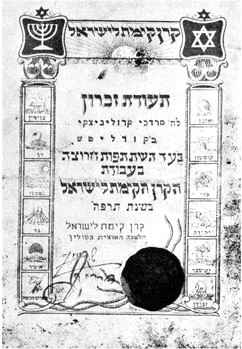
(Keren Kayemet Leyisrael)
A Memorial Certificate
The Jewish National Fund |
Y.A. Malchieli, Petach Tikva
Translated from the Hebrew by Harvey Spitzer z”l
| Out of the ancient mists of childhood Slumbering in somnolent meditations, Between reality and illusion, This is the little town - Korelitz.
Perhaps it's a dream or maybe what it really was_ _ _ |
I was a four year old toddler when I left Korelitz with my parents and went into the wide world. I suckled my mother's milk within the walls of its tiny houses where I took my first steps of life. Since then, my life has flowed in new streams, and the days of my childhood and my youth passed by in various occupations without my paying any attention to the “rock whence I was hewn” (Isaiah 51). This period of childhood sank into my consciousness in darkness and was covered with new layers which came in turn and covered one another.
However, from time to time, at the earliest age, flashes of memories and blurred fragments of vision from the not too distant past lurked in the enclosures of my soul. With the passage of time, these memories also grew dim and vanished, leaving behind a deposit of sub-memories, that is to say, a faint trace of the old memories. Pictures of memory in their visual reality disappeared from the library of memory which the Creator of man fixed so wondrously in our brain and (these pictures) completely disappeared as though they had never existed.
And if I try to raise to consciousness some of these sub-memories, there is no doubt that fiction and illusion will grasp most of the picture. There may also be a crude mixture of words which were absorbed in my consciousness, not from my own memory but from stories and from fragments of words which reached my ears directly or indirectly in family conversations and perhaps even from reading and especially from my looking at the life of these small towns on winter days when I was at the Radin Yeshiva under the administration of the “Hafetz Haim” (Rabbi Yisrael Meir Kagan, 1838-1933), of blessed memory. At that same period, I also made a short visit to my hometown of Korelitz for the purpose of obtaining a passport for a trip to Eretz Yisrael, and I glanced at the place through the eyes of a guest. I went there with my heart pounding, my emotions overwhelming me like rushing waters ahead of my meeting with my birthplace, the magical land. However, I didn't find an interpretation to my dreams as I conceived in my imagination which was far removed from the existing reality.
| …Sometimes I see your residences, Wooden shacks providing little warmth; Inside, your faces are beaming, So delicate, soft, innocent_ _ _ |
How do I remember my small town in my somnolent memories hidden under piles and accumulations of existence and occurrences of time which have elapsed since then?
I see the small house made of thick wooden beams which were brought straight from the forest and still retained their fragrance. These beams were only slightly planed so that they could be joined to each other. I don't remember if they were plastered on the inside, or if they were whitewashed. There was no floor. The tenants walked on tightly packed or loosened earth, on which they would sprinkle yellow sand in honor of the Sabbath or holiday. The sand was brought by a farmer in a wagon. As he made his way among the houses, he would call out his merchandise and housewives would buy a pailful of yellow sand for one kopek or more.
I remember the study hall, whose windows looked out onto a different world cloaked in mystery and fear. There were simple wooden tables and benches on which the children would jump and among which they would play hide and seek and show off their bravery in demonstrations of jumping and running. The shacks in the gardens were wrapped in straw and served as permanent homes for all kinds of fowl and four-legged animals. Between the “straw hat” of the house and the walls, lay thick beams which served various uses including that of a pantry for all kinds of spices and concoctions as well as a place for concealing different valuables, and there was also a full storehouse of stock of all kinds. I don't remember if they used closets then because the clothes were always hanging on the walls unguarded and uncovered.
I remember that my grandmother was always confined to her bed which she didn't leave until the day she died. Not far from the bed, in the middle of the room, stood a plain, rough, wooden table around which we youngsters sat, bent over all day long, and learned the alphabet and reading from the mouth of our grandfather, Rabbi Eliezer Reuven Marishinski, of blessed memory, who was called, “Marishiner”. He used to treat the children with tenderness and humility and never raised his hand or voice.
It seems that in the same house, opposite grandfather's room, there was an entrance way to the home of my Aunt Shifra, my mother's, of blessed memory, sister. In my remote memories, images have remained of those many colored biscuits and crackers, sometimes made in the shape of birds, which she baked and displayed in the window. I loved those baked goods and I remember that a few years after leaving Korelitz, I could still see them, and they demonstrated their magic before me whether I was awake or dreaming.
I remember a broad, open yard between houses - yards had no fences - in which we, boys and girls, played together. Was that the synagogue yard or my grandfather's yard or maybe a yard common to both? A girl scratched my face and I cried. I don't know who the girl was. Is she still alive and perhaps among us, or was she struck by cruel fate and killed together with her brothers and sisters and undoubtedly with her offspring as well in that same awful mass destruction of the Jewish People?
I don't have memories of my parents in this field of vision because, being with them all the years afterwards, traces have not remained from the past except for those abrupt experiences which have stayed in my memory from the period of my illness, my second illness, which claimed the lives of two children in our young family. In the delirium of my very high fever, I saw terrible sights on the wall, and my father, of blessed memory, wanted to calm me by hitting the wall with a rod and chasing away the demon who instilled his dread and fear in me.
When I returned to Korelitz in 1924 to obtain my birth certificate as I mentioned earlier, I found a world different from what I had imagined. Among my relatives, were my Uncle Kalman, my aunt and their daughter. I stayed at their home the day I arrived. My father's sister, Chana Layzorovitch, was also there. She was a “woman of valor”, active in many areas, a person who endeavored to improve the lot of our people as much as possible, may her memory be for a blessing! Looking back now, it has become clear to me that my aunt had suffered many bitter experiences. Several years later she asked me to bring her son Yankel-Yudel and his family of many children who lived in Novogrudek to Israel, but it didn't work out. I was then busy bringing my parents, brothers and sister and other cousins to Israel and I didn't manage to devote time to her request. They were all subsequently killed in the Holocaust.
There was also another family that was related to our family in Korelitz. This was the Oberzhansky family. The father of the family was the one who helped me procure my birth certificate from the local authorities. Is there anyone from that family in our country (Israel) today?
My poor little hometown was destroyed in the smoke of death together with thousands of Jewish communities, large and small. How great is my pain and heartache knowing that I did not “remember the affection of your youth” (Jeremiah, 2:2) and I disparaged you on that winter day when I visited you 46 years ago! Who could have imagined that the end would come, the end of all your sons and daughters, men and women, old and young, that you would all be consumed by fire, the fire of the inferno, the torments of hell?
Where is the writer who will describe all the hundreds of days and nights, thousands of hours of hunger and distress, disgrace and humiliation, suffering and agony, when you were led from evil to evil and from death to death? My heart goes out to all of you, wretched in life and sold to death, for whom the sun, which rules in the world, withdrew its light and the moon its radiance, and you were all sent “like an abhorred offshoot” (Isaiah,14:19) to mass graves and were “dung upon the open fields.” (Jeremiah, 9:21).
Are there reparations for the dread of these atrocities, for this eternal murder?
Is there yet revenge in the world which can atone for these terrible things?
“I see him (it), but not now; I behold him (it), but not nigh” (Numbers 24:17). “for hidden are the ways of Providence”.
And together with Rabbi Kolonymus, son of Rabbi Yehudah, let us mourn the slain and lament their tragic deaths:
|
(Unrhymed translation)
“Oh that my head were waters and my eyes a fountain of tears (Jeremiah, 8:23),
And you answer: Woe unto me! |
|
|
JewishGen, Inc. makes no representations regarding the accuracy of
the translation. The reader may wish to refer to the original material
for verification.
JewishGen is not responsible for inaccuracies or omissions in the original work and cannot rewrite or edit the text to correct inaccuracies and/or omissions.
Our mission is to produce a translation of the original work and we cannot verify the accuracy of statements or alter facts cited.
 Karelichy, Belarus
 Yizkor Book Project
 JewishGen Home Page
Copyright © 1999-2024 by JewishGen, Inc.
Updated 3 Oct 2014 by LA