 |
|
|
[Page 313]
[Page 314]
|
|
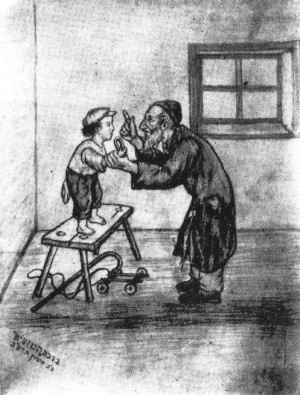
| Old Kagan's painting: Say the “Motzy,” little boy |
by Frank Sirek (America)
As is known, the Czarist regime drove out all the Jews from the Kovno Guberniya at the outset of the First World War. This also included all the Jews of Yanova. Those who did not travel deep into Russia, but rather stayed in the Vilna Guberniya, returned to their homes as soon as the Germans took over Yanova.
People were separated from their homes for more than a year. They had liquidated their sources of livelihood and workshops, and the issue of livelihood was very difficult. The smuggling business developed during the years 1915–1917. It was called by the name “malina” and its practitioners were known as “malinashchikes.” The chief malinashchikes were the Shapira brothers – Shmerka, Binka, and Avrhahmka, the Girshevitz brothers accompanied by “the Turks” Izak Nachumevich and the small “Stinkes.” The main smuggling material was grain, which was smuggled to the Vilna Guberniya, where there was a famine and where the German authorities perpetrated great persecutions. Therefore, almost all of the grain storehouses were emptied, and Izak Segalovski's mill could not produce the required quota of what to provide the city bakers with bread. In one word, hunger threatened the population of Yanova.
The rabbi called a meeting of the householders, and it was decided to forbid the export of grain. Anyone who did not obey the ban would be placed into excommunication. Nothing helped, and the householders and the rabbi decided to declare an excommunication. The entire community was summoned together in the old kloiz. Black candles were lit and the text of the excommunication was read. Rabbi Silman then threatened that if anyone violates the ban, it will not only take effect on that person, but also on future generations.
Some time passed. Some people were deterred, but the more daring people began to supervise the smuggling. In the marketplace in town, in the kloizes between mincha and maariv, at the group of Psalms reciters – there was only one topic of discussion –– the excommunication and those who disobeyed it. They would point with their fingers and show that so and so is disregarding the ban and is smuggling that which the world requires. The more heretical people did not pay attention to it. The observant people and the masses of ordinary people, especially the wives, followed the warning to obey. They saw G–d's punitive hand in every small issue and tribulation.
It happened that Falka the son of the smith died, as did Shlomo Kadish's son. Shmerke Moshe Tzvia's got an illness in his feet. The horse of one of the malinashchikes died. Lastly, Sirek was murdered by a murderer while on the way. The believers understood the need to obey the ban, and saw the dark hand of G–d's punishment.
[Page 316]
At this point, the opponents of Rabbi Silman at that time began to complain about the rabbi and the householders who were his adherents: That is, how could the rabbi be so daring as to place a ban of excommunication upon his flock?! He must clarify himself well, or remove his excommunication. The old communal battle once again flared up.
When Rabbi Silman died before his time many years later, people in the community whispered that he fell victim to the demons set loose by the ban of excommunication that he had issued. Even his adherents did not agree with the tactical means used by that scholar, in invoking such a cruel means as a ban of excommunication.
by Frank Sirek (America)
The following is an event that took place:
After the First World War, almost every resident of Yanova owned a cow as a protection against hunger. Our Yanovers looked like residents of some large village when they used to get up very early on summer mornings, and the women took out the cows and accompanied them down the highway to the shepherd at the collecting point. Cows and calves would gather from all streets and alleyways, accompanied by Jews and Jewesses with sleepy faces. The picture was very pastoral. The cow was the chief source of livelihood for the middle class. People would sell milk, and manufacture cheese and butter for themselves, their family and for sale. Moshe the Smith (Baron), who lived near the Vinitzkys did this. He had two cows –– a mother, and a daughter. The mother was a rare example, a record breaker. She produced six pots of milk a day, and supported the large family in an honorable fashion. On an early winter morning, when the cow was giving birth, to everyone's surprise she gave birth to twins – two calves in one stroke. In the early morning, when I was in bed, my mother came to me and told me about the wonder – that Moshe the Smith's cow gave birth to two calves. I responded that I had read in some holy book that this was a danger, similar to the case when a hen begins to crow.
Mother went to Moshe the Smith and told him about my suspicion. In order to verify the accuracy of the stories, Moshe the Smith went to Rabbi Silman to ask for advice and guidance. As soon as the rabbi heard the story, he issued a decision that the cow must be slaughtered. Moshe complained and begged that the rabbi have mercy and repeal the verdict. A trifle? A family of six or seven people earn their livelihood from her. If the verdict has been issued from the rabbi's mouth, it is difficult to change it. A scream came, the wife arrived with weeping and pleading. Rabbi Silman, who was always stringent, finally understood the pressure on the desperate family. He peered into the books. Wrinkling his brow, he saw that a misfortune might overtake him, Heaven forbid. After a great deal of self–reflection, he finally changed his original verdict, and ordered that the cow be sold in this case. Even the lighter verdict fell upon the head of Moshe the Smith like thunder. Is it a trifle? It was a record breaking that had supported the family for many years, and now their
[Page 317]
source of livelihood would be lost all at once. However, in the small towns in those days, Jews believed strongly that a verdict from a rabbi was like a verdict form heaven. With a heavy heart, Reb Moshe finally had to part from his cow, and sold her.
In the town, people later told that a similar case occurred in a different town, and the question was posed to the rabbi of Zasliai. The Zasliai rabbi did not make such a big deal about it. He heard the story and issued a verdict: go home in good health, and continue to milk your cow.
Heard and edited by Yitzchak Burstein
by David Friedman of Vilna
|
My dear Jonavers, I present to you a gallery of Jonava personalities with all of their foibles and comical sides. I do not mean, Heaven forbid, to poke fun at them, but rather to mention them as a memorial. What person does not have his foibles? People understood this, and conducted themselves properly in public, as well as within their own realities.
Rebbes
“Hirshe the Teletze”
Our rebbe was called Hirshe the Teletze. He was the eighth son of Chaim the Teletze. The source of his nickname is unclear. Apparently, it was inherited through several generations. That rabbi had a foible of taking naps and sleeping. He learned a few lines with us, and once again dozed off. We would take a stick or a stone and give a hard bang on the table. He would wake up in a great fright. Forgetting where we were, he began to teach the verses of Chumash from the beginning. A few minutes later, he would doze off again and begin to snore. Apparently, he was only able to afford very meager meals from his earnings as a rebbe, and he would enjoy his sleep before his meals.
[Page 318]
He was very prone to anger. He would shout and administer beatings more than teach. He would speak into his large beard, and it was very difficult to understand him. His wife died in his latter years. Since it says in the verse[1], a man should not be without a wife, he decided to marry for a second time. If he was already getting married, why not take a young wife? He indeed found such a young widow. She made a condition, however, that he must give her a promissory note of 1,000 Litai. So as not to struggle with the evil inclination, it is better to write a promissory note and to get a young wife for the house.
He sobered up a few weeks later, and realized that the young woman had taken advantage of the older man by demanding a 1,000 Litai promissory note. He demanded the promissory note in return. He did not retrieve the promissory note, but he did get a bill of divorce.
The Rebbe Yose-Ber
He was called Yose-Ber, or the Kaplitzer Rebbe. His cheder was in his private dwelling. This was a house with many occupations – a conglomerate in miniature format. Yose-Ber would conduct class with his students. His wife would occupy herself with the hen business. She would purchase live hens, slaughter them, and sell them already plucked. An elderly Jew who worked as a gaiter stuffer lived in a second room in the house. In the same room, the gaiter stuffer's wife would bake bread for sale.
Aside from studying, Yose-Ber's students had an additional special job. They had to help Yose-Ber's wife catch the hens to slaughter. For us, this was the best activity. We would chase the hens over the table. They would jump into the window, and the feathers would fall all over the room. The noise was so loud, and the attention to the work was so minimal, that Rebbe Yose-Ber would always get involved in the matter and send us home.
The Recluse
The biggest mischief-makers in the town would learn in his cheder, such as Yoshke Girshevich, Lipke Cherneman, Lielke and Motke Joselovich and others. The greatest
[Page 319]
delight of the students was the shacharit service before beginning their studies. When the recluse would stand for Shmone Esrei and sway back and forth in devotion, the students took advantage of that time, and during those moments, the cheder looked like a madhouse. The students did as their hearts desired. They would bang on the tables with their hands and with sticks. During the winter, they would roll a snowball and bring it into the cheder. At Purim, they would shoot large keys stuffed with matches, which would explode with a loud bang. One could become deaf from the explosion. In addition, we would shoot at our rebbe's long kapote with toy guns.
Once, after such a Shmone Esrei, when we broke sticks and conducted such a concert over the tables and benches, the recluse was at Oseh Shalom[2], pacing a few steps back, when somebody suddenly threw something. He grabbed the stick from the perpetrator, and snatched it from his hands. It was some sort of a sporting match: the recluse from one side, and on the other side the students who had moved aside. As we were talking together, we tossed the stick once more. The recluse fell on the floor with his feet upward, and we all quickly turned toward the door.
The Hiltzerner Rav[3] (Fleishman)
The era of the cheders ended. Modern schools were founded. Yavne was one such school. Aside from the modern teachers, there were still some of the typical rebbes. One of them was the “Hiltzerner Rav” whom we also called by another nickname, “G-d is Atzig.[4]” The Hiltzerner Rav read Hebrew poorly. Instead of saying “Hashem oz leamo yiten”[5], he would say, “Hashem aiz leamo yiten”[6] The group of jokers from amongst the students would translate “Hashem Eiz” as “G-d is a goat,” and the nickname took hold.
In his later years, he became preacher who traveled from town to town. Once, he arrived in a town on the very day when the 500th anniversary of Vytautas the Great[7] was being celebrated. Gatherings took place everywhere, and, as well, the rabbis sermonized about the issues of the day in the kloizes. The Hiltzerner Rav began to deliver a sermon in that town. His words began as follows, “Five hundred years ago, Vinchuk the Great died, may it be for many years[8]. Everyone burst out in laughter, and the gathering ended.
The Enchanted Craft at the Prayer Leader's Podium in the Beis Midrash
a.
Several people served as prayer leaders: Kremer, Furmans, Kirzner, Schmid, Buchalter. Meshel Ivensky, who had a fine voice, also wanted to bestow his cantorial skills upon the congregation. He had a beard like a very pious Jews. However, the gabbai always invalidated him from being a prayer leader; there was one small thing, he was a freethinker, and therefore, they spread gossip about him that he had a fondness for married women. In invalidating him, the gabbai meant, but was not bold enough to actually say… Meshel Ivensky had some connection with money and credit in the People's Bank… And that is why he was able to benefit us with his fine tenor.
[Page 320]
When Pesach the furrier engaged in cantorializing in the kloiz, everything was quite cozy. The primary coziness came on Simchat Torah, when they took advantage of his cantorial skills. First, they would give him a cup of liquor, and he would get the courage to go up to the podium with self assurance, as if to clip and shave. Pesach the furrier used to begin high, with a festival tune. However, Tevchik Jaffa the photographer sat behind him, and, as if to incite, he would break out in a weekday melody. He did not have a tuning fork, the noise reverberated in his head, and it was very easy for him to move over to a false tone. Laughter and a racket broke out in the kloiz. Thus did the group of jokers take advantage of him. Others would tie him to a lectern with a towel, while still others would bombard him with wet towels. The feeling of a veritable Simchat Torah pervaded in the kloiz.
c.
The kloiz had two strong competitors – not, Heaven forbid with regard to livelihood, but rather for the sake of Heaven – that is, with regards to cantorializing. These were Yankel-Leib Landsman the carpenter and Yosel Levin the smith. As was the custom, Yankel-Leib the wealthy man had more access to the podium than Yosel the Smith.
One Friday night, when Yankel-Leib was preparing to don his tallis and begin to sing Lechu Neranena[9], the group of jokers headed by Tevche Jaffa, began to incite a rebellion and spur on Yossele the smith.
“Well, why do you let him lead you by the nose? He is indeed a wealthy man, but everyone is equal before G-d. Why must he always lead the services, and you not?”Before Yankel-Leib got started, Yossel the smith was standing at the podium, and singing out “Lechu Neranena Lashem” in a loud voice.
The next morning, during the time of the reading of the Torah, a group was standing in the synagogue yard, discussing both competitors. Some supported one side, and others supported the other. One of the jokers shouted out:
“Reb Yankel-Leib, being a smith who bangs all week with an anvil, was so embarrassed yesterday before the entire congregation? An unacceptable shame!”Everyone laughed, and continued to incite them on.Yankel-Leib shouted out, “What do you want from a cold smith. He knows how to forge shoes for a horse, but with respect to leading the services, he is no good.”
“Reb Yankel-Leib,” called out Yossel the smith, “Perhaps you are better with smithing together the rendition of the festival service, but with regard to the Sabbath rendition, I am ten times…”
Berele the Goat and his Assistant
They would call him Berele the Tzig [Goat]: Berele because he was short and lean, the goat – because he had a stretched out form and a small, pointy beard on his chin, and therefore, he would bleat like a goat during his prayers. He was occupied with various trades. He was the shamash [beadle] in the synagogue, and he taught Chumash to children with obtuse minds. He conducted lotteries for miscellaneous objects, such as a large, 10 kilogram pike, old candlesticks and other sundries.
[Page 321]
G-d had endowed him with an abundance of children, and in order to earn a livelihood, he would go to the villages announcing that a famous cantor was to come. He would post notices in the local kloizes that the famous cantor would be conducting services. Eventually it became clear that the famous cantor would not appear. On Friday night, he would bleat out the services with his cantorial rendition. On Saturday morning, they would promise to pay him for not leading the services.
Berele the goat had an assistant, a deputy shamash. He was a former Cantonist[10] who served Nikolai for a full 25 years. That deputy shamash also had the role of the summoner to the synagogue. He was tall and thin, with a large, thick beard that he never combed. He would run through the streets of Jonava like a Czarist general on Friday at candle lighting time, shouting, “Go to the synagogue!” A group would follow him from behind, and help him shout, “Go to the synagogue!”, and throw prickly burrs at him. At the end of the march, he would look like a shield of burrs.
Mottel Salanter
a.
At one time, he was a shoemaker. He had a double name: Mottel Salanter, or Mottel Glaz. Later, he became a fisherman in a sadovnik[11]. He also occupied himself with matchmaking. What did he not do to earn a living? He was a prankster. He was always cheerful and at ease, and jokes would always issue forth from him. He would tell about his attempts at matchmaking. He proposed a match for a small-town lad with a young girl who lived with her parents in a village. He was not that appropriate according to the rules of matchmaking. He indeed pushed the match through, but the villager was not able to come up with the matchmaking fee before the wedding. The villager did not hurry to pay his obligation. Later, when he requested of him the fee, the villager took out a package of Czarist money that was no longer valid currency and said, “Here, you have your matchmaking money.” The matchmaker looked at the money, looked at the villager, and thought, “He must be out of his mind.”
“Why are you staring at me?” called out the villager, “am I guilty for the fact that you have delayed proposing a match for ten full years.”With a lowered head, the newly minted matchmaker left after his first failure.
b.
He once proposed a match for a girl with a coachman. The parents were willing, but the girl was stubborn, saying that she was not interested.
“Why?” they asked her.“What will I do if his horse dies?”
c.
He proposed a match for Meirke the Miller, who was not all that astute, with an older girl from a village. The match went through, and the wedding was to be celebrated. The wedding ceremony was to take place in the synagogue courtyard. For the young people, this was immensely surprising – that is – Meirke the miller is going to the wedding canopy! The group crawled over the
[Page 322]
surrounding rooftops, and when Meirka recited “Harei at”[12], brooms and wet cloths were tossed from the rooftops. The groom did not maintain his composure. He went forth from the wedding canopy and chased after the crowd with curses.
That same Meirka took on the task of painting the kloiz. As the rabbi of Jonava was walking by the synagogue, he made a comment about his work.
“Rabbi, you understand this type of work like a rooster understands noodles. And in general, rabbi, a fool does not understand half the work.”
Dvora Leah the Reciter[13]
Dvora Leah sat in the women's gallery of the synagogue on Yom Kippur, surrounded by a group of women who unfortunately could not read. She served as the reciter for them. The old women reminded her together:
“Dear Dvora Leah, do not forget to remind us when we are supposed to begin to weep.”Dvora Leah the reciter was very pious. She had two daughters, Michle and Itke, both old maids. She was not well disposed toward Itke. One day, after an argument with Itke, she summoned all the women to the synagogue. When the crowd came to pray, she went up to the Holy Ark, knocked on its door, and started to recite:
“Good morning, dear G-d. Your servant Dvora Leah is standing before you and I beg of you: Give us a good groom for Michle, for she is unfortunately a girl getting on in years. For Itke – a malady, for I have had years of suffering from her.
An Example of Stinginess
Reb Mende Tzemach's, may he forgive me, was very stingy. When they constructed the sidewalks in Jonava and every householder was required to plaster his own segment at his own expense, Reb Mende Tzemach's got to work. He would stand with a broom in his hand and refuse to permit anyone to walk on his sidewalk, lest they wear it out, Heaven forbid.
Fanning the Evil Eye
Feiga Kriger of Breizer Street owned a goat from goatland. Jonava had never seen such an udder as this goat possessed. When Feiga would walk her goat, a group would run behind her and shout, “Feiga, the goat has a large udder.” Feiga was afraid of the evil eye, and therefore fanned the goat ten times to ward off the evil eye.
A Glutton and Exaggerator
Reb Moshe David Mauer, the former Stirnik[14], had an open house. Better guests would always come to them. His wife Sara-Batya was a wonderful cook, and the guests would always have good food, such as a good roasted duck or gefilte fish. The problem was that Moshe David was a healthy man, tall, thick, and therefore had a hearty appetite. Their restaurant
[Page 323]
fed him in a legal and illegal manner. When Sara-Batya would leave the house, Reb Moshe David would go to the oven, snatch a freshly roasted duck or a freshly stuffed fish, and quickly wolf it down. He would wash his beard and moustache, take a few Litai and place them on the shelf. Sara-Batya would return, go to the oven, and notice that a duck was missing.
“Moshe David, who ate the duck?”Moshe David, like his brother Avraham the Stirnik, were both known as exaggerators. When one of them would tell a story in an exaggerated fashion, he would immediately call the other brother as a witness. And when the second would pester someone, the first brother would help him. They would tell stories about travelling in America. Reb Moshe David tells:“A little while ago, a guest came who was a glutton. The money is over there.”
“When I went to America, I befriended someone on the ship. It was Friday during the day. We were sitting together in the coach and travelling for such a long time that the Sabbath began to approach. Tell me my friend: Before we travel home, let us travel to the kloiz, and you will see how fine and beautiful our kloizes are. We entered the kloiz, and my friend began to whisper to some people, and then I heard that they had called me up for maftir[15]. The bima was so far away that I had to sit in the coach and drive. If you do not believe me, ask my brother Avraham.” He called to Avraham:“You will all believe me about the 'American thief.' A fine thing happened to me in America. Immediately after arriving there, my friend said: 'Get up, Avraham, I want to show you an America style mikva [ritual bath], without the Jonava mud.' I will no longer punish myself. I went to the mikva, and saw a veritable sea before my eyes, and I jumped in without fear. I knew how to swim well as a Stirnik. I used to swim back and forth across the Vylia, and this to me was like a piece of sugar cake. I decided to take a swim in the mikva. I started to swim, fathom after fathom, and then I noticed that I can no longer see the shore. My hands and feet became shaky, and the thought came to my mind that I might drown in the mikva, Heaven forbid. Suddenly, a miracle took place. I noticed an island in the middle of the mikva. I grabbed onto its shore with both hands and was saved. Is this not true, Moshe David? You saw this yourself.”
Someone who Made Calculations
When the policeman, the labas[16] would give Mote Flaks a ticket for failing to clean the street, bringing with it a fine of ten Litai or three days in jail, Reb Mote Flaks would calculate that it was cheaper to sit for the three days. He would send his sister's husband, who worked for him in the grain warehouse, and earned a small salary.
An Overheard Conversation
Dr. Ran, the chief physician of the Jonava hospital, became a good friend of the administrator Glaz. They were once sitting during a break and conversing. Dr. Ran called out:
[Page 324]
“My wife is young, and only wants to have a good time. Here in Jonava, she is lonely. She likes to go on vacation in Kovno. She goes to the theater, and she goes to the opera. You understand, this costs me a lot of money.”The administrator Glaz with the long beard answered him.
“On the other hand, my wife is old and sick, and does not let me enjoy life. I no longer want to save money. Sir Doctor, do you know what? You are a bit miserly, as is my wife. Your wife wants to live it up, as do I. Let us make an exchange, and we will both gain.”
A Wealthy Man – A Haughty Man
a.
Reb Leibe Wolfovich states:
“Today, I picked up a new suit for my Meir (14 years old), from Meirke the tailor (44 years old).b.
“Itzke!” (Referring to Yitzchak Burstein.) “Did you see my Hershele?”
It Does Not Pay to Exchange
One Friday night after services, I was walking with Reb Leibe from the large Beis Midrash. We were walking and chatting. He was talking his heart out to me, and, as usual, he began with his well-known expression:
“Did you hear, beloved brother? When I lived as a youth with my parents in Taraker Kretshme (the village of Trakai between Koplice and Siesikai), I recall that I went around to the villages all day, but not to make purchases. Did you hear, beloved brother? I was a very poor person, and I toiled hard. I would carry a calf on my shoulders from the village to Tarak, where I would slaughter it and sell its meat in town. I would return home only on Fridays. Mother would prepare for the Sabbath. She would spread a thick, linen tablecloth over the table, and put out the brass candlesticks. She would make thick noodles from coarse meal for food. Did you hear? Then I began to sense the pleasure of the Sabbath. And what is it like today? In my home, today is like yesterday, and tomorrow is like the next day. There is no difference between the weekdays and the Sabbath. The fine, white tablecloth is on the table every day. We have a good lunch every day of the week, beloved brother, and I get no enjoyment from the Sabbath of today.”After such a lecture, I worked up my brazenness, and said:
“Reb Leibe, it is not all that difficult to return to your former lifestyle. If you agree, I will arrange for it. I will talk to Yose the Tzimmes or old Shlomo Itze's to arrange an exchange with you, at least on a trial basis for one year. It could very well be that after a good Sabbath, they will want to go back to the impoverished Sabbath.”“Truth be told, Davidke, the exchange does not interest me. Let things stay as they currently are.”
Translator's Footnotes
by Yisrael Yaakov Pogir
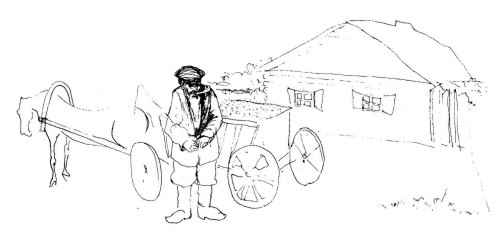
Like his ancestors, he lived on Breizer Street. His wealth consisted of a house that was given over as an inheritance from generation to generation, until Areh Yankel received it. The house stood across the street from the new, fine building of the Talmud Torah.
G–d blessed him with a young, beautiful daughter – with a head of black, curly hair, smiling lips and eyes as beautiful as diamonds: Rashe–Etl. Her nickname was Rashetke Areh Yankel's. She knew how to hold her own. In addition to her traits – tall and beautiful – she also procured a machine to knit socks. She would nimbly move the machine back and forth. She would put the raw materials for a sock into the opening of the machine, and a sock would slowly grow. She would remove the sock, put it down, and begin a second one. That is how Rashetke produced socks.
In the winter, when the streets were full of snow, Areh Yankel's window was covered with frost and ice, nobody could see in. However, when summer came and Rashetke opened the window, the noise from the sock machine and her singing attracted everyone's attention, and all the passers–by peered into Rashetke's window. They would also see Areh Yankele with his horse. Areh Yankel was recognized and known on account of his horse.
Areh Yankel was already getting old, and he could no longer be a wagon driver. His grey, pointy, sparse beard and his pipe that was always on his lips also looked old, as if they had been passed down as an inheritance from generation to generation. When he had to answer or talk to his horse, his worn–down teeth bit down on his pipe, so it would not fall out. Then, his words would be uttered in anger. However, Heaven forbid, Areh Yankel was not prone to anger. He was a good person, who was content with his lot.
Areh Yankel's Sources of Livelihood
He worshipped with the first minyan. After that it seemed as if he was grabbing at his heart as he hitched up his horse and waited near his house. Perhaps something would come of it. A neighbor might have not paid his rent, or might have joked around with a female neighbor, and then would have to move to a different house. Such things happened even in Yanova, and one would have to transport the baggage: a pair of benches, a three–legged table, a dismantled bed with a bit of straw – that still looked very important when all bundled up on the cart; a heavy kettle which one would use for the Sabbath tea and cake, still filled with water; a few clay pots, at times a samovar – but one does not put a samovar in Areh Yankel's wagon, but rather carries it by hand, for it is too large. Then one would summon Areh Yankel and hire him. This was always a good source of income.
In the event that a day was not so lucky, Areh Yankel sat down on the three boards of his wagon, took
[Page 326]
the reins and drove off to Keidainer Street, near the cemetery on the way to Varnepke. That was where there was a hill with the golden sand that was light in the eyes. He filled the wagon with the fresh, yellow sand, sat down in the wagon, and picked up the reins. The horse did not take offense. The way was hilly. It would relax a bit, until it returned to Breizer Street. On the weekdays, there were not too many people interested in the yellow, sandy merchandise, except for the women who were searching for bargains – two shovelfuls of fresh, yellow sand for a kopeck. On the other hand, on Friday, the eve of the Sabbath, Areh Yankel never had enough sand for all his customers. What is the wonder? When my father was about to leave his tailor shop on the eve of the Sabbath, he covered the new machine with a white tablecloth and swept the room. He then sprinkled the black floor with the yellow sand. When the mother blessed the candles, and sat down to relax, she would give a blessing to Areh Yankel: May Areh Yankel live long, and the yellow sand be a light in the eyes.
Our town had many fine traits, but it was lacking one thing: Even in Yanova one could not live forever, and therefore we had a Chevra Kadisha [burial society] with shamashim and pallbearers, who fulfilled the adage, “we will carry you with our hands…” The Chevra Kadisha, with Yankel Henech as the Gabbai [trustee], then decided that the pallbearers must fast on all the fast days of Mondays and Thursdays in order for them to perform their service. They must also not leave the synagogue or kloiz on days that Psalms are recited. But for those who are only interested in eating, but have no time for the “lift up your hands”[1] – for such people, being a pallbearer is like a blessing in vain. The Chevra Kadisha decided that Yanova must have a single casket platform, and no banging should take place. There also must be a horse with a rider – therefore we have Areh Yankel.
From that time, Areh Yankel did not harness his horse immediately after the first minyan. Instead, he would wash his horse and give it some soup, so that it would look, so to speak, like a proper person. He would then wait until after the second minyan to make sure that nobody would come to him with any news. Only then would Areh Yankel go out to search for customers with baggage, or to collect sand. And if something happened with the neighbors and they had to receive a “blessing”[2] they would say that G–d should make it that Areh Yankel would soon come with his horse and cart, and take a walk through Keidainer Street… Nothing more was needed…
Areh Yankel Brings Rashetke to the Wedding Canopy [Chupa]
On Saturday night after Vayiten Lach[3], nobody wished Areh Yankel a good week. He would walk alone. He would go ahead, and people would walk slowly so as to avoid chasing him. If he approached, people would flee. Rashetke was cheerless, and she stopped singing even the sad songs of longing. All of the lads who were shoemakers, tailors, smiths, and furriers were running off to America. Who remains? The damaged goods. They were not good finds. Therefore, things got more serious for her. She would sit there manufacturing socks, waiting for a widower, or she too would have to run to America, and escape from what? From the sock machine? She had just recently acquired it.
However G–d is a father. G–d prepared for Rashetke Leizer Micha's (Katz), a fine lad. He would help his elderly father as a wagon driver. He was drafted as a soldier in the Russian Army. Now, he had returned on leave. He was visiting with
[Page 327]
his brother, the most honorable wagon driver in Yanova, Alter Micha's (Katz). He noticed Rashetke, tall and beautiful, knitting socks like an angel. He truly fell in love with her.
The few weeks of furlough passed, and he had to return to serve the Russians. Leizerke promised that he would he would come from Slizovo, he would travel here with musicians from Keidaini, to the Karabelnikshe Kloiz for the chupa.
Rashetke sat at the open window, and the machine was still nimbly and slowly knitting socks. She sang her songs louder, and her songs sounded more beautiful. The joy became greater with the approach of her groom's discharge.
On a summer Friday afternoon of Shabbat Nachamu, the in–laws of Breizer Street went to the reception for Leizerke Micha's, and the Keidainer musicians led Rashetke to the chupa. No bride went to the chupa with such pride as did Rashetke. She held herself high, her beautiful head of hair with her white slippers. When an in–law murmured with jealousy, “Such luck… they are leading the bride to childbirth with musicians,” Rashetke does not even hear, and she is circling around the groom with joy. A new Areh Yankel, a middle class in–law, led his daughter to the chupa with a candle in his hands, as well as his pipe.
After Shabbat Nachamu, a different picture was seen near Areh Yankel's house. A different girl was sitting in Rashetke's window, knitting socks and singing new songs.
Two horses were standing like lions opposite Areh Yankel's door, and two wagons were hitched up. The middle class wagon driver left the house with a whip and a smile, and slowly closed the door.
Areh Yankel stood in the alleyway with his horse and wagon, talking to his neighbor Shlomo Itze. From there, Areh Yankel went out to the sandy way as he held the reins. Shlomo Itze was among the customers for the sandy merchandise.
Translator's Footnotes
by Yitzchak
Leibe the Wagon Water
They lived on the Highway Street not far from the Vilya, in the house of the Wolk family. He was of average height, docile and chubby. She was smaller, but not thinner. Both moved about with difficulty, while at the same time, vibrant in mind. I would say that they were a pair from G–d. She was from the Wolk family, and remained an old maid, and was gaining in years and intelligence. As G–d runs things, she was sent a match from heaven from some Lithuanian town. They remained childless, but they took care of each other. I do not know how they earned their livelihood. It was said that the relatives from America supported them. They would always walk arm in arm, mainly at the banks of the Vilya. They would walk slowly, pondering G–d's world, explaining to each other their logical explanation of all goings–on.
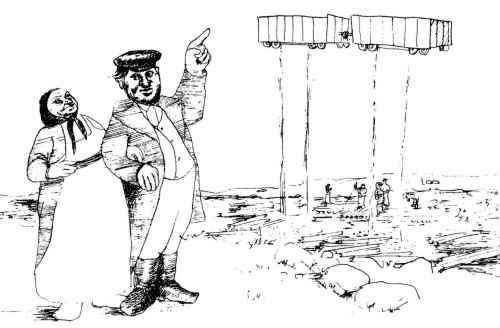
One summer afternoon, when the water in the Vilya was quite dried out, they suddenly stood still and looked up. Before their eyes was a picture, like rafts taking off in flight, which seemed, like a trick, to be full of sand. They seemed as if they wanted to offer some advice, and Leibe thought of his own invention: “Chasia,” he said, “one can bring a wagon with water, and it will float up in the air.” Scoffers overheard him, and from then on, he was referred to as “Leibe the Wagon Water.”
[Page 329]
|
|
|||
| The Fine Singer |
Yose the Tzimmes
He was a water carrier by trade. (There was no water system in Yanova in those days.) Who did not know him? He was of average height, slender build, with a half–long pointy beard and a moustache. He wore a long, torn kapote [frock], with large, crooked boots. He wore a rope as a belt around his kapote. He carried the semicircular pole with the two tin pails on his shoulders.
It is said that his name came to him because when he was carrying the water on Friday, every mistress of the house would treat him with a plate of tzimmes. He had many customers, and on that day he ate a world of tzimmes, as he was not willing to refuse his customers.
Yanova inherited a motto from him: Yanova is a city where there are many householders, but when it comes to carrying water, one turns only to Yose the Tzimmes.
He was no great scholar, but here he hit the mark.
The Fine Singer
He himself was not a resident of Yanova, but since he was always travelling, and he visited our city several times throughout the year, he belonged to the Yanova landscape.
He had a short beard, a moustache, and yellow teeth. He wore a long kapote and boots, and on top, a katelak hat. His face was dark brown due to the wind, sun and frost. He was an eternal wanderer,
[Page 330]
unemployed, a character similar to the gallery of characters in the dance of the beggars in Anski's “The Dybbuk.” He was also knowledgeable in the black characters[1] – chumash, Bible, and gemara. His special calling was in reciting rhymes. If someone asked him to recite a rhyme about Yitzchak or Moshe, he would produce a set of rhymes about the name for 10–15 minutes. Then he would stop, and would be given a payment so he would calm down.
Shachke
Who did not know him – the average height, thin lad who suffered from a nervous disease? He would wander about the streets all day with his right hand smacking his right cheek. Eventually, that cheek sprouted a large, black spot. He would shout “doloi” with every smack on the cheek.
Later, his parents bought him a bicycle so that his hands would be occupied and he would stop hitting himself. Within a few weeks, he learnt how to ride. He would hold the handlebars with one hand, and continue with his “profession” with the other hand. I would often stop him, and discuss with him that he should better spend his time reading books, and to forget about it. He was very understanding, and heard me out. He looked at me with intelligent eyes and smiled, and answered with a smack on his face and a shout of “Doloi Itzka.”
Mainly at gatherings, when discussions were heard between Yanovers on street corners, he became more agitated and would smack himself and shout “doloi” even more. When the Soviets arrived, the custom was that there were gatherings every day with orchestras singing “Long live Stalin.” When the agitators approached him, he would be the first to shout “Doloi Stalin,” even during the time of Nikita Khrushchev[2]. The police would arrest him. Later, when they realized his illness, they never charged him.
Lozer Poleit
Who did not know the night guard who guarded Pogirsky's iron enterprise as well as Pogirsky's daughter Masha Granewicz's business for a generation? Later, when the house was taken over by Hershel Koper, he also guarded his fashion business. Who does not recall the small, thin, refined man with a small, grey beard and a moustache, with red eyebrows, inflamed from lack of sleep, with a cane in his hand and a small dog as a partner in the guarding?
The people of the night knew him better, because he would rarely be seen during the day. If the notion of honesty and decency exists, Lozer was the embodiment of this notion. He did not require any special clocks to regulate himself. His consciousness controlled him, and it never happened that he took a nap while he was carrying out his duties.
We, the youth, who also filled certain roles as night watchmen and wandered around until the late hours of the night, often encountered him.
He knew all of the night secrets: who was walking with whom on side lanes, and whose wife committed an impropriety with a young man at night. If you found him at his post, walking around Pogirsky's business until Chaishel Koper's he would stop you and share with you the latest secrets from the center of town: nighttime secrets and minor intrigues that he had noticed.
He was murdered along with all the others.
Translator's Footnotes
[Page 339]
by Frank Sirek
Thursday evening in the small towns, as is known, was a dark and worrisome evening for women. A trifle, one prepared for the Sabbath. One had to make the challa. One had to prepare flour, yeast, eggs, and raisins, make the dough, and prepare the oven. One had to let it stand until dawn, then warm the dough, kneed it, roll it, braid it, light the oven, and place the challa in the oven. Now you can imagine what the evening must have been like for Meita the baker (Levin), who baked challa and bread not only for herself, but for a large part of the city.
One day, on a winter Friday, our Meita woke up before dawn, hastened out of bed, lit the kerosene lamp, and went quickly to the dough which was already beginning to hang over the edges of the wooden boards. In her great haste, she forgot to put on her dress. She was wearing her thick, cotton bloomers with a slit in the rear, in railroad fashion. The oven flickered with large flames of fire, as if holy spirits were blowing beneath it. One could hear Meita knocking and panting, as she conducted her holy work in honor of the Sabbath. Meita moved the hole-filled dough from the boards, cut it with a knife, tossed it onto round boards, sprinkled it with white flour, beat under the dough with her hands, kneaded and rolled it, twisted it, braided one side into the other, tossed the dough into forms, spread it on the bottom and on the top. The work was conducted with such ecstasy that she could have been, of course not literally, the High Priest engaged in the holy service in the tabernacle.
Early in the morning when the darkness had not yet abated, the table was already covered with boards laden with various baked goods in various shapes and flavors. The fire in the oven was already dying down, and the flames were calming down, and the top of the large Russian oven had already darkened. The only thing left to do was to clean out the ashes and place down the challas. Suddenly, she realized: “Oy vey. I don't have any pomele[1].” She did not think for long. She ran out the back door and off she went to the nearby market. Outside, it was the gray of early morning. The zealous woman was wearing her bloomers. She did not even notice that she was running
[Page 340]
with her cotton pants… She bought the pomele and ran home. Then she noticed that someone on his way to the first Minyan was looking at her and smiling. She then recalled that people were also laughing at the market. Then she realized what had happened: she had forgotten her dress, and she appeared in the street in pants. As she arrived at her home, young jokers laughed at her out loud and made merriment. She ran into the house with her head covered in shame.
Word of that episode spread throughout Jonava that Sabbath, and the jokers of Jonava nicknamed her from then on, “Meita the Baker with a Crack in her Underpants”, or for short “With a Crack”. Told over by Yitzchak Burstein
Translator's Footnote
[Page 347]
by Yisrael Yaakov Pogir
For a thirteen year old boy, being an assistant[1] was an honorable profession – something of a trifle!
After Sukkot, when I went after services to Velvel Filvinsky, he treated me to a glass of tea. First he taught me how to make a glass of tea: one puts in a third of concentrated tea essense, a third milk and then fills it with hot water. The dwelling was on the second story. On the first day, I made eight glasses of tea! One went up and down on the steps.
Once I was silly and made it the opposite way – first the water, and the essence at the end. He noticed it and did not drink it, and I had to bring him another glass of tea.
Once I opened the door angrily with a glass of tea in my hand. He closed the door with great anger and gave me a smack on the hands. The saucer remained but the glass fell victim. I returned and brought another glass of tea; but he continued on with his anger and told me that today's glass of tea would cost me dearly. The wonder is that in carrying 8 glasses of tea for 300 days, I only broke one glass.
When did the day of a 13-year-old assistant end? In short, I did not study the Code of Jewish Law. I had to wait until Filvinsky closed the business. However, Filvinsky waited until Elazar Levi Itzik's (Yudelevich) closed his business. I would go to take a look every few minutes to see whether Eliezer Levi Itzik's[2] closed the lamps. Perhaps he was waiting for Filvinsky? In the meantime, I sat there until approximately 10:00 p.m. No customers came. Therefore, I was happy when Leib Gronevich, Alter the lawyer with his powerful voice, Moshe Itzik and other businessmen came to converse.
During the evenings, I waited. I used to sit in the corner on a sack of sugar and listen. They talked about the Governmental Duma, Hamelitz, and Jewish tribulations. Today I think about the stories that they used to tell! They laughed so much. Were I to have known this then, I would have collected the Jonaver humor, and I would have sweetened it today. Alter always had the last word. Since he talked loudly, he won all the debates. My boss had candies and nuts, but he never treated his guests who sustained him. He finally let out a smile…
A day came when an agent from “good things” for the Krasna market arrived. Before the Julians arrived, the Barishnies came to search for sons-in-law and vice versa. The events took place before the Polish church, right in the place where Filvinsky was sitting[3].
[Page 348]
The agent came in the evening and left his merchandise, various types of sweets. Immediately thereafter came the humorous customers who talked about G-d and his Messiah, about trees and stones. They were the experts about the candies. They continued sampling and ate up his entire stock. The agent shouted that they ate everything up. I quickly fled home, cursing all the businessmen. If G-d desires, I would not longer be an assistant[1]. Eating a Vilna Jew out of his livelihood? Such businessmen I could not tolerate.
Every Monday was market day. As Filvinsky waited to sell and not to purchase, his business began after midday. In the evening after the commotion, Filvinsky sat down to count the hard tens, the silver 20 kopecks, the guilders – and tie up the packages. He handed me a heavy load:
“Go off to Sarel Blume's (Pogirsky), give her the 85 rubles and small change, and ask her for a full hundred. She owes me 15 rubles to pay a promissory note.
For her I would never lend, even if I had to go hungry; and for him I had to shamefully borrow, all for a ruble a week!
Sarel Blume's gave me a hundred ruble bill and told me not to lose it. I brought him the money. First I had to go to Moshe Tzvia's (Lukman) in the hotel, find Yankel Asher's and ask whether he was travelling the next day to Kovno with the coach. Then I had to take the hundred ruble bill and trudge on to the businessman who was traveling to Kovno, telling him to take the money to koznochistova and pay the Filvinsky's debt.
On Monday evening, I did not have to wait for Elazar Levi Itzike's to close his business. When I returned home, Lozer's (Elazar's) business had already long been closed…
Translator's Footnotes
|
|
JewishGen, Inc. makes no representations regarding the accuracy of
the translation. The reader may wish to refer to the original material
for verification.
JewishGen is not responsible for inaccuracies or omissions in the original work and cannot rewrite or edit the text to correct inaccuracies and/or omissions.
Our mission is to produce a translation of the original work and we cannot verify the accuracy of statements or alter facts cited.
 Jonava, Lithuania
 Yizkor Book Project
 JewishGen Home Page
Copyright © 1999-2024 by JewishGen, Inc.
Updated 30 Apr 2015 by JH