 |
|
|
[Page 383]
Latitude: 55º47' Longitude: 27º27'
Translation supplied by Eilat Gordin Levitan
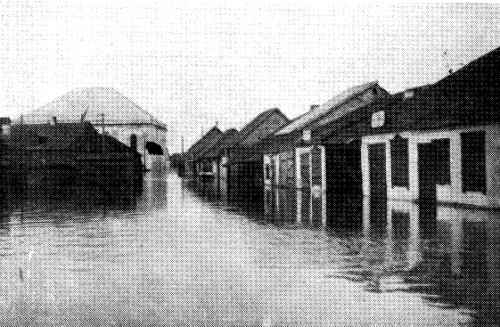
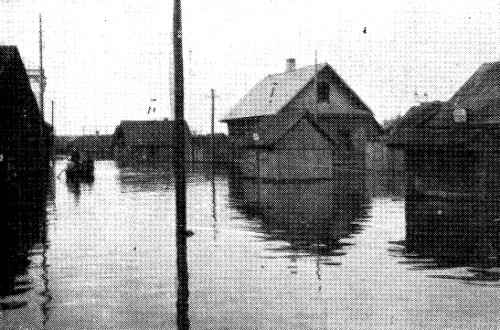
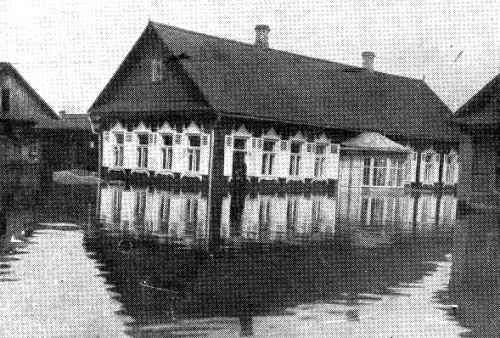
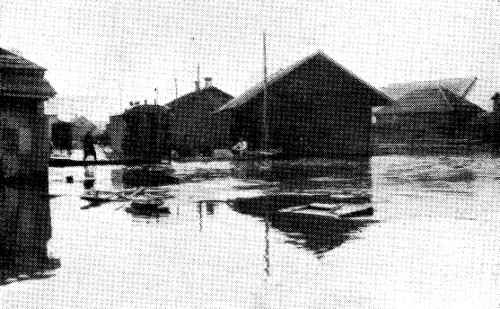
The shtetl Druya lies on the border of Latvia and Belarus. It was part of the Disna County in the Vilna Province before the war. The river Dvina splits the shtetl into two parts. It flows from Druya, passed the Latvian border, through Dvinsk (Denenberg), Riga, and then empties into the Baltic Sea. Droike, another small river, flows out of the Breslav Lake and ends in Druya, where it empties into the Dvina River. The shtetl was divided into three parts: Druya, Zadroye, and Zadvine. Before WWI, Druya rested on the borders of four provinces of the Russian Empire; Vilna, Vitebsk, Kovno, and Kurland. During the year between the war the Vilna province was in Poland, Kovno in Lithuania, Kurland in latvia and part of Vitebsk in the Soviet Union.
A favorite saying in Druya was; “When a rooster crows in Druya, all four provinces hear it.”
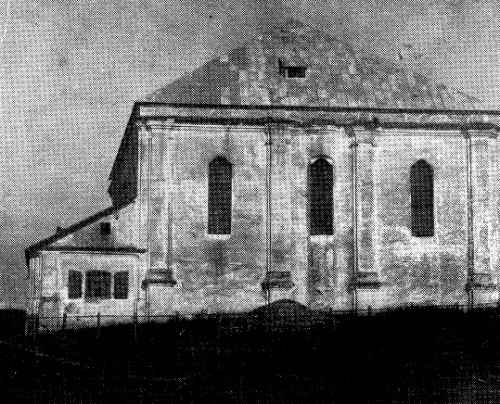
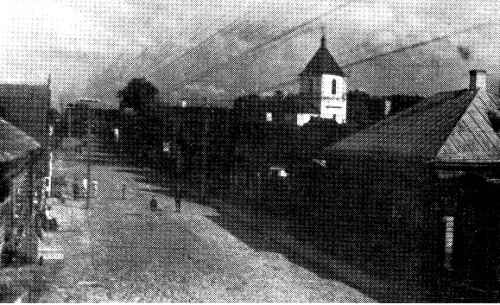
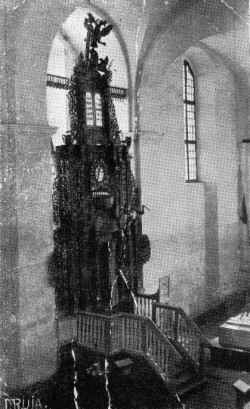
Druya had two railway lines, a small local line running from Dukst and the second one, which was a major line, was completed in the year 1935. It went through Varpaieve, Vilna, and Warsaw. About 4,000 souls resided in Druya in the year 1939. About 2,500 inhabitants were Jews and 1,500 inhabitants were Christians. There were eight synagogues. The Great Synagogue with its about 250 years of history, was famous throw the region since it had the largest and most beautiful ark in the entire Vilna district. The ark was topped with a Russian-Romanov style eagle which stood on top of the heads of two lions. The Synagogue had been built by Duke Sapehi as a gift to the Jewish population. At that time, he had also built a Catholic church. The second synagogue, which was called the Great Beth Midrash, stood opposite the Great Synagogue. There was a house of study on its premises, where there once had stood a yeshiva. In later years, the scholars and Mithnagdim used to pray there. The third synagogue was called the Hassidic Minyan. Those worshippers had their own Rabbi and they conducted themselves as Hassidim of Shneur-Zalman's sect, the (Lubavitsh) Chabad. The remaining synagogues were the Kapustzer Minyan (Hassidic), Kalman's Minyan
[Page 384]
(Mithnagdim), Ishe-Meir's Minyan (Mithnagdim), Zalman's Minyan, and on the other side of the small Zadruike river, a very small synagogue. Besides Heders, there was also a Talmud Torah for the poor children.
|
|
Among the well-known Jews in the shtetl was David the Cantor. He and his son were both accomplished musicians. Shmuel Moldin was famous as a prayer leader, while Getzl, the sexton, was well-known as a sermon giver. He would lead study groups in the Beth HaMidrash. He also had the first Jewish
[Page 385]
library in the shtetl and for a small fee he would lend his books out. The prayer leader in the Great Synagogue was Itze-Leib, the ritual Slaughterer.
The following organizations existed in Druya:
|
|
Aside from the cheders, there was a Talmud Torah for the children of the poor.
[Page 386]
The Druya Folkshule (school)
|
|
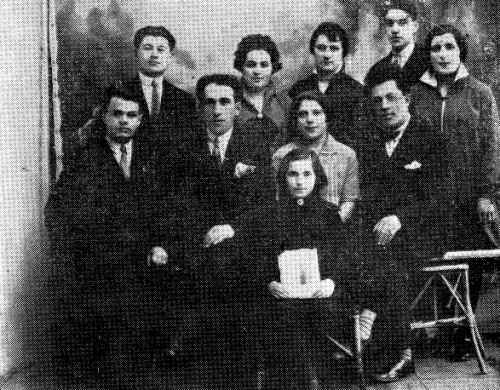
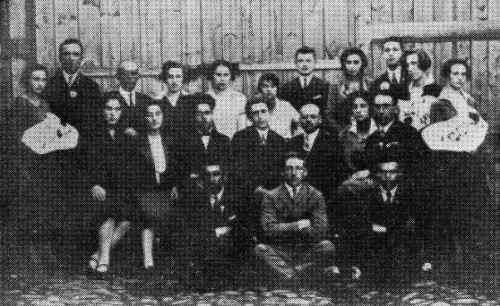
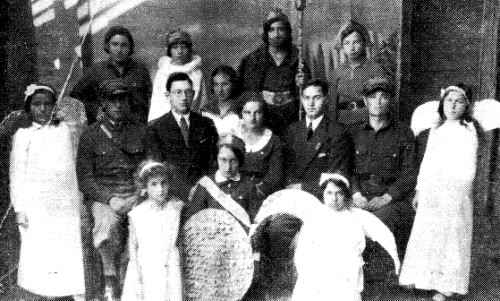
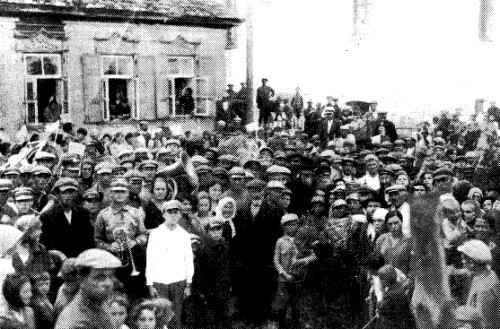
The Druya Folkshule was conduct by Tzisho (central Jewish school organization) and seventy-five children attended this school. The school was supported by a small tuition, which was paid by some of the parents, and by the occasional performances of the Drama Circle. The Drama Circle had twenty members of both genders. They would present the plays created by Yaakov Gordin, Kobrin's “Village Boy,” Schiller's “Robbers” and others. Ephraim Kogan directed it (now he lives in Argentina). One of the participants was Benjamin Feinweitz (also in Argentina). The Drama Circle worked very hard to support the Jewish Folkshule (school). The Folkshule also had a wind instruments orchestra that played during weddings and arranged-dance evenings. All the income went towards supporting the Folkshule.
[Page 387]
Some members of the orchestra (Kasriel, Benjamin Feinweitz, and Baruch-Zalman Entin) reside today in Argentina.
The Volunteers of the Fire Department
We know that the fire department existed in Druya for a long time, but today no one remembers when it had begun. Most of the members were Jewish and it was run by the Tubman family. Some of the former members live in Argentina now.
|
|
The Youth Organization (Hechalutz)
HeChalutz youth organization was founded in 1925 and concerned itself with Hachshara, preparing pioneers for immigration to Palestine. They would engage in agriculture, logging, and the training at various other trades. The income supported the organization itself. There were about thirty members.
The Society to aid the Sick
This organization helped the destitute sick. The contributions of
[Page 388]
shtetl Jews and Jewish merchants who came to the shtetl supported it. This organization had a doctor who would treat the sick people free of charge. In its final years, the organization was run by Ephraim Kogan (now in Argentina).
Beitar (Revisionist youth movement)
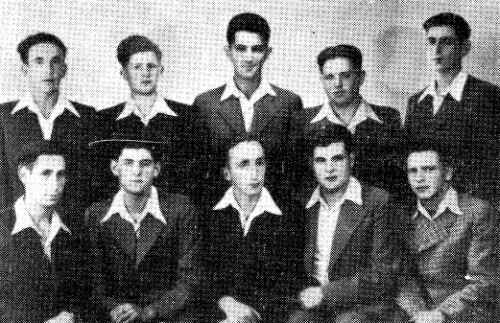
A branch of this organization was founded in 1934 and named for Trumpeldor. Shlome Levin (who perished) was the leader and it contained about 250 young members. A considerable number went through Hachshara before the war and went to Israel, where they are found today. (One member, Leib Entin, is in Argentina.) They had a Drama Circle, a library, and a choir. They would dress in their brown uniforms for most activities.
|
|
Vocations in Druya
There were many shopkeepers and laborers, but there weren't many large enterprises in Druya. There was a beer brewery, which belonged to the Tubman family. The beer brewery supported the livelihoods of many Jews. There were Jews who dealt in wood, flax, seeds, grain, hides, geese, etc.
[Page 389]
About twenty families subsisted on agriculture. The farms were mostly privately owned and they planted corn, oats, barley, potatoes, and alike. Besides this, there were also Jews who managed vegetable gardens, leased orchards, and owned tanneries. A public library was located near the bank.
From September 1939
Leib Entin relates:
The Russians entered Druya in September 1939. The Jewish as well as Christian populations welcomed the Russians with joy. They commanded that the shops remain open, and that the merchandise be sold for Polish zlotys. Then they declared that only 100 zlotys per person can be exchanged for 100 Russian rubles. The remaining zlotys that people had were lost. Private business was destroyed in that manner.
|
|
After that, the regime ordered that cooperatives and Artels be set up. Everything belonged to the regime. Some merchants were hired as employees. Others worked at manual labor.
[Page 390]
The tradespeople, such as tailors, shoemakers, and furriers were organized into cooperative workshops.
The ruling authority was formed from the local population. The police chief was a Jew. Later, he was sent to Siberia with his family. Thus was his family saved. Today, they are in Israel.
The Great Synagogue was turned into a grain warehouse. The Jewish Folkschule was turned into a Russian school.
Alter Drunanov
Druyanov Abba- Avraham- Asher (Alter) was the son of Eliyakum- Pesach - Getzel. His father, Pesach-Getzl, and grandfather, Yaakov-Mendl, were the rabbis of Druya. On his mother's side, he was also descended from rabbis.
|
|
Author, folklorist and Zionist public official. Alter was born in Druya in 1870 and studied in the Volozhin Yeshiva. Later he moved to Odessa and was the secretary of HaChultz. Member of the center of the Russian Zionists. Editor of “HaOlam” (1909-1912), “Reshumot” and “Miyamim Rishonim”. Published “'Ktavim Letoldot Chibat Zion Veyeshuv Eretz Yisrael”, “The Book Of Tel Aviv” (1935), “Pinsker and his times”, He also worked for different Hebrew periodicals. His Yiddish works appeared in Peretz's “Yom-Tov Bletter” (Holiday Pages), in “Yid”
[Page 391]
and in “Friend.” His two volumes on Jewish folklore were published in Hebrew and printed in Odessa and in Jerusalem in 1922. He also published a large collection of Jewish jokes (more then 1,400) in 1922. Three-volume anthology of Jewish humor, Sefer HaBdikha ve-HaKhidud [Book of Jokes and Wit]
He also edited the chapters of Modern Hebrew literature, folklore and geography of Eretz Israel in the Hebrew and German Encyclopedia “Eshkol”. He died in Tel Aviv and his grave can be found near Bialik's grave, since they were intimate friends. A collection of his assays “Ktavim Nivcharim” was published in two volumes in Tel Aviv.
Toviev Yisrael Chaim
Yisrael Chaim was a writer and a linguist. He was born in Druya to a well to do family. When he was still a child the family moved to Riga. He received a Jewish education from private tutors. Graduate of the Technion in Riga; department of economic and commerce. Wrote assays in “Hamelitz” and was renowned by the readers for his rich and expressive language, and his unique style. Wrote educational books; “Eden Hayeladim”, “Moreh Leyeladim”, “Torat Hanigud”, Hamachin”, Egron Lebnay Haneurim” (all published in Warsaw). “Ozar Hasira ve Hamelitza” was published in Tel Aviv. All his books were very well received.
|
|
In 1905 was a member of the editorial committee of “Hazman”. Was the publisher of “Hachaver” a newspaper for the youth. He was very dedicated to the Hebrew language. During the First World War he settled in Moscow and translated some classical French and English literature to Hebrew. (Oscar Wild, Charles Dickens, Mark Twain, Viktor Hugo)
In Moscow he experienced some great tragedies, the Bolsheviks murdered his son and his son in law died at a young age. He returned to Riga were he died in 1920 of a heart attack. Books written by him;
'The writing of Y. B. Toviev- research topics of literature and language” (Berlin, 1923)
“Ozar hameshalim vehapitgamim” (Odessa) “The Hebrew origin in the jargon” “Jewish Names”
two plays; “Bimkom Drasha” (Warsaw) and “Hashorer Bebeito” (Piotrkow)
[Page 392]
Chaim Tzernovitsh (Rav Tzair)
He was a well-known Hebrew teacher and writer. The author of a basic work on the Talmud, he was a son-in-law of a Druya inhabitant, Kisin. His wedding took place in Druya and he also lived there for a short time.
|
|
Moshe Paikin
Paikin was the first owner of the only bookstore in Druya. He was an intimate friend of S. Anski (Yiddish author and playwright of “The Dybuk”) and Dr. Chaim Zhitlovsky (Yiddish writer). His son was the Israeli Consul in Iran.
Hillel Vichnin
Born in Druya in 1879, Vichnin translated Leo Tolstoy's booklet, “Whose Faith is Better?” into Yiddish. He was editor of “Der Folksfriend” (Vilna, 1901). He emigrated to North America in 1901, where he worked for a while for the “Jewish Daily Forward” and the former Philadelphia Yiddish daily, “The Jewish World.” His son, Yisroel Vichnin, is known as a piano virtuoso.
Footnote
From speeches during the 20th Anniversary
At the beginning of the first school year, the school managed with much difficulty to find a location to be held. There was also a general shortage of teachers. Not many wanted to move to “our Siberia”. (The northern part of the Vilna region was called “Polish Siberia” because it was the coldest and furthest part from the center of the Polish Republic.) A month passed and finally some teachers came. Intensively, they worked on the curriculum, and did everything with great enthusiasm. The school was their scene, their center of life. “What we ate gave us energy!” Day and night they worked at the school. The children bound themselves to the teachers and acknowledged them with great love. The fathers and mothers were blessed to have them. The school administration and the teachers formed one big happy family for a while. Then, all of a sudden, the teachers lost favor in the eyes of the administration. They were all fired!
|
|
[Page 394]
The school was closed and a deep sadness engulfed the children, parents, leaders, and friends of the school.
The beloved Chaim Buzak wrote the school administration letter after letter, demanding that teachers would be rehired. Each word held a pained cry of “Have pity and save the school!” as if a mother, who is saving her only son, uttered the words. There were still no teachers. Weeks flew by and dispatches were sent out. Heartrending letters continued to be issued. Chaim Buzak threw aside his own matters. He traveled to Vilna's Central School Board, and demanded, “I can't and won't go home without teachers!” The school reopened. All was fine, but the rent still needed to be paid. The financial situation of the school was desperate. What could be done to improve it?
|
|
[Page 395]
The members of the school administration and close friends of the school came together and raised a limited sum of money. During those years a livelihood in Druya became grievous and with much obstacles, so they managed this feat only with great toil and headaches. However, with the school in danger, would there have been any excuse not to give? They gave! But why did they give? It was not just to fulfill an obligation or to get notoriety. The newspapers didn't publish names and they didn't dream of recognition by the powers that be. They gave because of their love to the children!
|
|
B.
As months passed the teachers were not able to pay their rent. They've come to the limit of their credit lines at the grocers. A proposal from the administration came: “we must raise the tuition!” The devoted and loyal female teacher Kazvan was opposed. “This cannot happen,” she argues. “The parent's livelihoods becomes smaller day by day. Poverty grows and we are increasing tuition? What for, to increase the salaries of the teachers? It is bitter for the parents. We do not have to be a privileged group. No gestures or poses! No declamations! We give from the depths of the heart!”
[Page 396]
And so they continued to serve the Jewish secular school.
This was the way that a small group of stubborn teachers and supporters worked, day in and day out. It is easy to mention twenty years of the past, but for these twenty years, there were all sorts of obstructions and complications. There was a constant effort made to survive the events, to struggle with problems as they come and not to break . . . not everyone could do this! Our school was honored by these sacrifices. Let us all therefore stretch out a hand, put our shoulders to the wheel, and help support the school in its difficult struggle to exist. Let us become partners to this sacred work of the Druya school officials!
|
|
The Soviets came to our area first. They annexed eastern Poland.
Leib Entin relates the story of the Russian arrival, September of 1939:
The Russians came to Druya during the month of September of the year 1939. The Jews, as well as the Christians, greeted the Russians with joy, since they were fearful that the Germans would take control of the area. However, soon they were displeased with the system. The Soviets first ordered that stores would stay open and that merchandise could only be sold for the Polish zlotys. Afterwards, it was announced that only a hundred zlotys per person would be exchanged for one hundred Russian rubles. The remaining zlotys which people had plenty of, completely lost their value. Private enterprises died immediately. Later, the government ordered that co-ops and workmen's associations be set up. Everything belonged to the state. Some merchants were hired as managers and others as common laborers. Skilled craftsmen such as tailors, shoemakers, and carpenters were organized into cooperative workshops. The regime was made up of members of the local population. The former police chief was a Jew and his entire family was sent to Siberia as a punishment. Because of this sentence, the family survived and they now live in Israel. The Great Synagogue was turned into a flour warehouse and the Jewish Folkshule became a Russian school.In June of 1941 Germany attacked Russia. As the Germans arrived they established two ghettos in Druya. One was actually in the shtetl and it began at Leib Pukin's house at the bank of the Droike River. The second ghetto was beyond the cemetery. Unfortunately, we weren't able to gather more details here in Argentina, since very few escaped and survived the slaughter. All the rest were shot and all the Druya Jews were buried in one common grave. The slaughter took place on the second day of Tammuz 5702 (July 17, 1942). For more details read the Druya Yizkor book which was published in Israel.
Footnote
|
|
JewishGen, Inc. makes no representations regarding the accuracy of
the translation. The reader may wish to refer to the original material
for verification.
JewishGen is not responsible for inaccuracies or omissions in the original work and cannot rewrite or edit the text to correct inaccuracies and/or omissions.
Our mission is to produce a translation of the original work and we cannot verify the accuracy of statements or alter facts cited.
 Hlybokaye, Belarus
 Yizkor Book Project
 JewishGen Home Page
Copyright © 1999-2024 by JewishGen, Inc.
Updated 2 Apr 2021 by LA