 |
 |
 |
|
|
[Page 238]
Translated by Miriam Leberstein
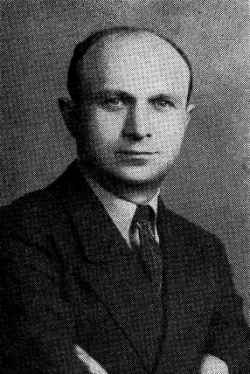
As chairman of the United Grayever Relief Committee, I take this opportunity to thank and congratulate the active members of the committee and our landslayt [people from the same hometown] who have helped us in the work of stretching out a brotherly hand to our Holocaust survivors, who lived through Hitler's deluge, which inundated all of Europe and annihilated six million Jews, among them our flesh and blood, our parents, brothers, sisters, and their families.
The political conflict now raging all over the world between two opposing camps and ideologies could not spare our landslayt in America. The distrust, the suspicion, which each side has of the other has spread into the realm of the work of aiding the needy survivors and has made it more difficult to organize a more active relief committee. So I would like to note, with exceptional satisfaction, that I have been able for my entire tenure as chairman to maintain the requisite balance, and through the committee to establish harmony between both sides.
It is a pleasure for me to point out that since the committee renewed its activity at the end of the last world war, not once has there occurred, for whatever reason, a clash, or even a difference of political opinion, over the collection of money or the distribution of aid. The
[Page 239]
committee functioned as one friendly family and this was reflected not only in its relief work, but also in the personal relationships among its members. In the work of the committee, the ongoing dispute was forgotten.
I have the feeling, that my non-partisan approach, especially towards relief work, significantly affected the harmonious cooperation. Like other landslayt, I was impelled to engage in this work with total commitment by the tragedy that I personally experienced. The loss of my parents and my entire family that had remained in Grayeve and Varshe [Warsaw] turned me into a fierce advocate, devoted to helping those few Grayevers who through fortunate circumstances remained alive.
The active members of the committee worked with devotion and self-sacrifice. They were not deterred, either by the work, or by the indifference which they sometimes encountered while collecting money or clothing, or selling tickets to events.
I want to mention here at least some of the active members and officers of our committee:
Our honorary president, Hyman Blum, whose profession makes it impossible for him to attend every meeting is in constant contact with our secretary and helps us enormously in carrying out our work.
With great sorrow we note the loss of our vice-president, Ab. Mlavski, who has left us so prematurely.
Our friend and active member A. Klayman does everything possible in every area of activity.
Our treasurer, Friend [term of address in Jewish communal organizations] Mendel Kohn, deserves a lot of praise for his good work, and especially in raising money for landslayt.
Friend Mrs. Fannie Mishkof, our recording secretary, keeps the minutes at our meetings and whom it is a pleasure to hear speak.
Other members of our executive committee perform their duties with complete devotion.
I want to express special recognition for our tireless financial secretary, Irving Sapirstein, a truly devoted social activist who, for all the years that he
[Page 240]
stood at the helm of our relief work, has never flagged in his enthusiasm and in his practical, methodical work. It is difficult for me to imagine the relief committee without his active participation.
Finally, I want to thank those who have worked to produce this great work, which we are publishing for our landslayt – the Grayever Yizkor Book – the monument to our martyrs and to our town Grayeve as we remember it, where our cradles stood, as it was before the two wars, but where our relatives and friends were murdered in such a horrific manner. In the work for the Yizkor book, our friend G. Gorin was chairman and H. Blum and Sh. I. Fishbein were on the editorial committee.
I hope that our future relief work will not have to be limited to helping the needy, but will also aid in building, and in constructive endeavors that will entirely eliminate poverty and homelessness, that our landslayt, along with all the Jewish survivors, will be able to settle in new homes, where they will stand on their own feet, and will no longer require aid.
Isador Shiller, Chairman,
United Grayeve Relief Committee
[Page 241]
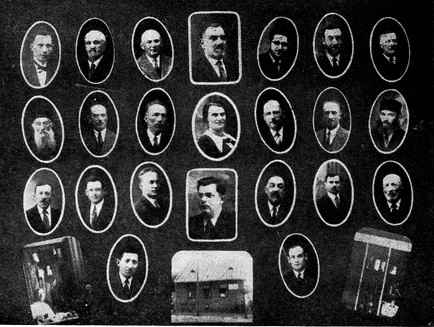
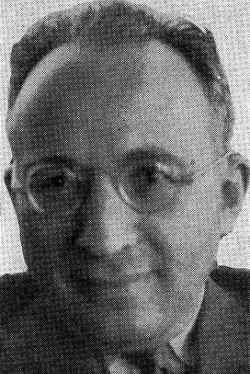
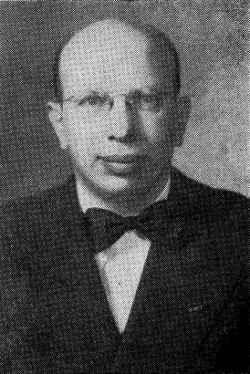
The Editorial Board of the Yizkor Book
|
|
|
|||||
(From 1915-1921)
H. Blum
Translation by Miriam Leberstein
Anyone who ever went to kheyder [Jewish religious school] is familiar with the Bible story in which our father Jacob's sons sold their brother Joseph into slavery in Egypt. It later turned out, that with this act, they saved themselves and their aged father from dying of hunger, after they had long given up hope of hearing of Joseph ever again.
A similar historical occurrence happened before our eyes with the great Jewish emigration from Eastern Europe to the new world, to America. The new Jewish settlement in America was destined to play a decisive role in the future fact of Jewish people overseas. From the beginning of the 20th century, when the economic and political condition of the Jews of Eastern Europe began to deteriorate at an ever accelerating pace, and later, when the climax came in the First World War, and the terrible aftermath, it fell to the American Jews to play the role of the long ago Joseph, to relieve the hunger of those Jews who had been unwilling or unable to leave the lands where most sources of livelihood were closed to them. And so it also was with the Grayever landsleit [people from the same hometown] here in America.
This writer arrived in America in 1906, during the first years of a significant Jewish emigration from Grayeve. There were then just a few
[Page 243]
Grayevers who had been here for a longer time, and even fewer of these had managed to better their economic circumstances. Almost all Grayevers here worked in the needle trades or as peddlers. They had strong ties to their home town, from which they had only recently arrived and from which they had not yet entirely uprooted themselves.
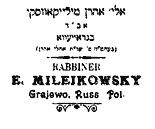
It should be noted that even before the development of relief activity here in America, this writer, himself a greenhorn, after receiving news of a fire in Grayeve in 1909, called a meeting of landsleit through a notice in the Yiddish newspapers. Sixty-six dollars were collected at the meeting to aid the victims of the fire. I am including a photograph of the letter of thanks from the then rabbi of Grayeve, the deceased Rov A. Milikovski. Today this would not be considered a significant amount of money, but when one takes into consideration the small number of landsleit and their economic situation, it could be considered a great success.
But the real activity by the Grayever landsleit on behalf of their home town first began with the beginning of the First World War. As soon as the war broke out, even before the establishment of communication with the cities and towns that were occupied by the Germans, a relief committee was immediately established for the landsleit of hundred of cities and towns. The newspapers were full of notices of mass meetings of landsleit associations, and our landsleit were no exception.
Since the Grayever and Shtutziner [Szczuczyn] landsleit already had a shared synagogue and ladies' auxiliary, it was natural that the relief effort, which had its offices in that synagogue, should also be a joint committee. Apart from the synagogue and ladies' auxiliary, the longstanding Shtutzin Young Men's Benevolent Association and the Grayeve Young Men's Benevolent Association also joined the relief committee.
But shortly after the founding of the committee,
[Page 244]
|
||||||||||||||
it turned out that the marriage was not a happy one. Conflict broke out between the Shtutziners and Grayevers. The local patriotism of each group heated up. At that time there were already a significant number of prosperous Shtutziners in New York, which wasn't the case with the Grayevers, who felt like poor relations in a rich family.
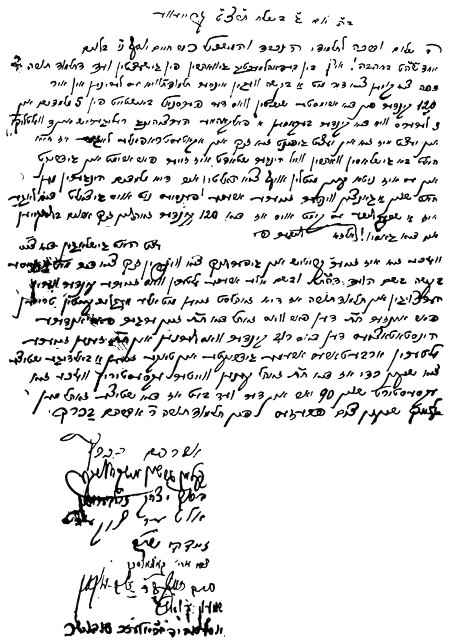
Just at that time, there arrived the first appeal from Grayeve, sent on November 17, 1915. The letter was sent to Herr Khaym Katsprovski, who was a devoted community activist in Grayeve and who had just recently
[Page 245]
|
|||||||||
returned to New York. The letter, which we reproduce here, was signed by the Grayeve rabbi, M. Amiel, by the religious authority Itsik Yeshaye Rozenboym, and by Avrom Mordkhe Piurko, and called for help for the over 200 Jewish families, “who find themselves in dire straits… so that they will not die of hunger.” This letter provided the final impetus for the founding of a separate Grayeve relief committee. The following were elected as officials: Aron Levintal, Chairman; Khaim Katsprovski, Vice-President; A. Rotboym, Treasurer; and Hyman Blum, Secretary. Among the other active members whose names I recall,
[Page 246]
|
||||
[Page 247]
were: Avraham Gilari, N. Kaplan, Sore Goldshteyn, Hyman Goldshteyn, S. Brikman, Dovid Litof, Phillip Morrison, Benny Bagish.
To my regret, I cannot provide the exact sum of money that was raised. The books remained with the treasurer, who died several years after the committee dissolved and the books were no longer kept. But I believe that I won't be far off the mark, if I say we raised about $8,000 during the five to six years that the committee was active.
In order to provide an idea of what it meant to raise such a sum, it is important to note that the largest sum received from a single person was $50 (from Mr. Charles Witkop-Witkovski) and three or four $25 contributions. The rest came as one, two, three and five dollar contributions. The dollar was then worth more; it was hard to earn a dollar. But for that reason, it was worth a lot when it arrived overseas.
It should also be noted that this writer conducted a correspondence with landsleit in 90 cities in 19 states for whom he helped to locate relatives, and who also sent contributions. The work of connecting relatives was difficult and many-faceted. From the beginning of the war until America also entered the bloody whirlpool, a portion of Grayever landsleit were scattered in various parts of the enormous Russian Empire and in Germany. Through various means we found out their addresses and connected them with their landsleit here in America. But that became very difficult after America entered the war. We did everything we could to maintain contacts until all the connecting threads were broken.
After the war ended, our relief work consisted mostly in helping Grayever institutions. We were in contact with the Grayever Rabbi Amiel and with a committee that at various times consisted of Eliezer Zilbershteyn, Avrom-Mordkhe Piurko, I. Papovski, Mordkhe Abramski, Mordkhe Rinkovski, and from time to time, we would receive long letters from Moyshe-
[Page 248]
Dovid Zaydberg, who would send us news from “behind the scenes” about relief work in Grayeve itself. Elsewhere in this book we reproduce a portion of the large number of letters which we received from Grayeve during that period.
In 1920, the Grayeve Rabbi Amiel visited London on behalf of Mizrakhi [religious Zionist organization] of which he was a prominent leader. We invited him to come to America on behalf of relief work. He accepted the invitation, but immediately after that, he was appointed rabbi in Antwerp and he had to give up the planned trip. Several years later, he went to Tel Aviv, where he was appointed Chief Rabbi, a position which he held until the last days of his life. (Incidentally, at the same time that Rabbi Amiel was the Chief Rabbi of Tel Aviv, the head of the Rabbinical court there was also a former Grayever rabbi, Rov Eliahu Aron Milikovski).
|
|
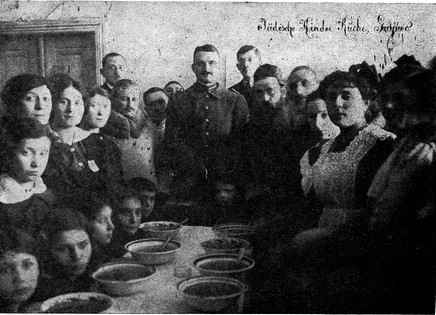
| A kitchen for poor children in 1918. Among the leadership, we recognize (from right to left): Alte Vilenski, Zilbershteyn, Rabbi Amiel, Sore Ziberski, Rokhl Piurko and Rabbi Amiel's wife. |
[Page 249]
This period of relief work ended in 1921, when the situation in Grayeve more or less normalized. Relatives in America supported their needy relations in the old home, and interest lessened. Thus ended the first chapter of relief work in Grayeve, with the hope that it would not be necessary to renew such work. Who then could see the dark clouds that had already gathered, and predict that only a short time later the same activists would have to get back to work and continue their efforts for Grayeve. And who then could imagine the bloody deluge that inundated the world and extinguished the lives of all the Jewish men, women and children in Grayeve, in all of Poland, as in all the Eastern European countries?
I leave it to my friend, the tireless secretary of the Relief Committee, Irving Sapirstein, to write about the second period of relief work.
|
|
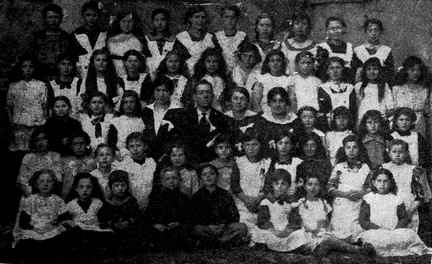
| A group of Jewish girl students in the city [public] school in 1917 The teachers (right to left): Stusha Kolko, Mishanznik, Papovski, and Kurievavski) |
by Irving Sapirstein
Translated by Miriam Leberstein
After the situation in Poland had stabilized somewhat and the wounds of the First World War had healed a bit, the activity of the Grayever Relief Committee tapered off and during certain periods stopped entirely.
It is very characteristic of the history of the Grayever Relief Committee that most of its efforts resulted from calls for help from Grayeve, both from private individuals and institutions. Thus it was that the Committee was reactivated in 1925–26 for the first time in the interwar period. From 1926 to 1937, the committee practically did not exist. There was no solicitation of money, no programs were carried out, and the connection to the Grayeve Jews temporarily ceased entirely.
In 1937 there began a new period of activity for the Relief Committee, which continues to the present day, when the United Grayeve Relief Committee was created through the merger of the Grayeve division of the Workman's Circle Branch 35 and the International Workers Order Branch 56. The activity of this Committee continued from 1937 to 1939. Between 1940 and 1946 there was no contact between the United Grayeve Relief Committee and Grayeve Jews.
[Page 251]
Immediately after the Second World War, when letters began to arrive from Grayever refugees, the committee was reorganized. This was in 1946, and the Committee has been active from that time until the present.
We will provide here a number of details about the activity of the United Grayeve Relief Committee here in New York during the various periods noted above, as well as about the utilization of the Committee's financial resources in Grayeve. Elsewhere, we print some of the letters and documents from Grayeve institutions which will shed light on the situation of the Jews of Grayeve, especially in the last ten years before Hitler's holocaust.
In 1925 and 1926, a series of very sad letters arrived from Grayeve, telling of the poverty and want of many Grayeve Jews. The economic and political situation in Poland was in crisis. There was mass unrest across the country. The reactionaries responded with Pilsudski's march on Warsaw, and the beginning of a semi–fascist regime in Poland. These letters describing the situation and how it affected life in Grayeve, came from institutions, such as the kehile [organized Jewish community], the library and others, and also from private individuals.
A group of Grayeve landslayt [people from the same hometown] from Branch 35 of the Workmans' Circle organized a ball. They also collected money among themselves and from acquaintances and the proceeds were sent to Grayeve. We will here mention only some of the most active members of the group: A. Sapirstein, Sh. Fishbeyn, A. Klayman, and F. Sapnovits. But the work of this group did not continue long and between 1926 and 1937 there was no active relief committee.
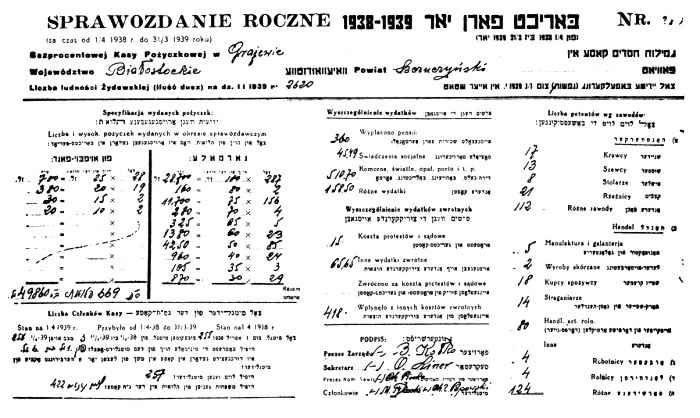
In October, 1937, a call for help came to New York from the Grayeve Jewish kehile, to which was appended a statistical report about the economic state of the Jews in Grayeve. In response to this appeal, the United Grayever Relief Committee was established. The active members of this committee were the following: H. Blum, A. Sapirstein, S. Barkovski, Fannie Abramson,
[Page 252]
|
|
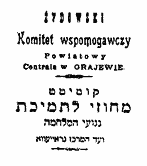
| Executive Committee of Lines Hatsadik [organization providing shelter for the indigent] |
Sh.I. Fishbeyn, Max Cohen, Mr. and Mrs. Horovits, A. Mlavski, S. Krinski, A. Klaynman, M. Layzerzon, F. Sosnovits, R. Sosnovits, V. Silverman, and Y. Riba.
The United Grayever Relief Committee carried out two major projects – the balls held in 1938 and 1939. More than 500 Grayeve landslayt attended these balls. At the ball in November 1938, many Grayeve landslayt came together after many years of separation, to talk about their former hometown. The committee took advantage of the opportunity not just to collect money, but also to educate people about the usefulness of frequent gatherings of Grayeve Jews from New York and its environs.
Under the leadership of the committee, Secretary A. Sapirstein (who has been secretary from its founding until the present), and a few active members, they succeeded right from the start in collecting large sums of money for relief purposes. In addition to a second ball in January, 1939, they also
[Page 253]
held a number of smaller events, concerts, gatherings, etc. The result of all this work was that the United Grayeve Relief Committee sent a total of over $2000 to Grayeve in 1938–39.
Even before this, the United Grayever Relief Committee had approached the kehile in Grayeve with a proposal that a committee be organized there, representing all sectors of the Jewish population, so that the money collected could be distributed for appropriate purposes and in a democratic manner. In November, 1937, such a committee was constituted, and the United Grayever Relief Committee in New York received an official announcement of that, which appears elsewhere in this book.
The United Grayever Relief Committee also received a list of 217 people who received aid in small amounts. For obvious reasons we cannot publish this list. We have in our possession signatures from all the people who received assistance. It is sad to note that of the 500 Jewish families in Grayeve, 217 needed assistance. The Grayever Free Loan Society had in its treasury $300 received from our committee. Our United Relief Committee asked the Joint [American Jewish Joint Distribution Committee] to review the activity of the Free Loan Society and to report to us on the need for assistance. The Joint responded with a letter, published elsewhere in this book in English.
Among the institutions supported by money from Grayever landslayt in New York was “Tsentas.” This Jewish–Polish organization devoted itself to helping Jewish orphans, homeless children, and children of the poorest parents in the town. We publish [p.287 in this book] a description of the Grayeve Tsentas
[Page 254]
|
|
| Report of the Gmiles Hesed |
[Page 255]
|
|
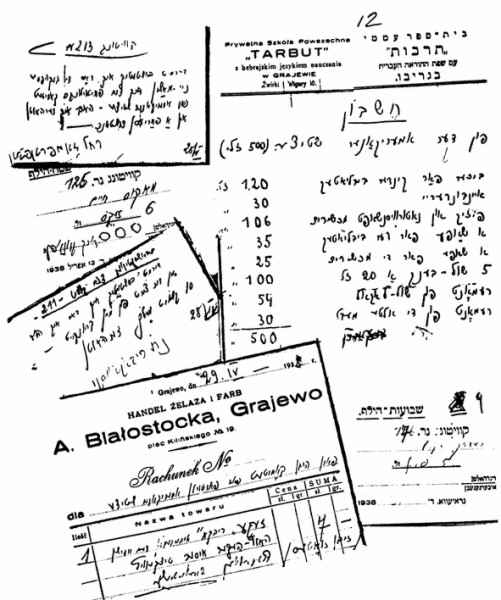
| Various receipts for financial support |
[Page 256]
which we received from I.M.Fromer, a young teacher in the Grayever Tarbut school. This document is especially important, because it shows the great efforts made by the Grayeve Jews, despite the impoverishment of the community, to help these unfortunate children.
In the summer of 1938, there arrived an appeal for help from the Grayever Jews who had been driven out of Germany. They were in the border town of Zbonshin and were living in the most horrible conditions. The letter from the Joint to the United Grayeve Relief Committee already mentioned this issue. The impoverished Jewish community in Grayeve could not help. But our Committee could not help much because of shortage of funds. The response of our landslayt to this appeal was weak, despite the fact that the danger of the Hitlerite storm was already looming over our native town.
The work of the Untied Grayever Relief Committee stopped entirely with the outbreak of World War Two. The situation of the Jews in Grayeve before the outbreak of the war was well known to the Relief Committee from detailed descriptions sent by the kehile and various institutions. Letters also came from individuals. We will mention only a detailed description by Dr. Nekhemie Kuravovski. As a doctor, he had the opportunity to observe, on a daily basis, the need and the desolation of the Grayeve Jews. The war oppressed and depressed the Jewish community both spiritually and materially. Also, the Jewish population diminished. From 5000 Jews in 1917, there remained in 1939 only 2500, and this number had to struggle to keep themselves and the community alive.
Absolutely no relief work was undertaken during the war years. There weren't even any preparations made to provide assistance to survivors after the war ended. The horrifying news of the Hitlerite inferno that reached us robbed us of the courage to do anything of this kind. Grayeve landslayt had begun to think that there would be no one left to help overseas. Not until 1946 did we begin
[Page 257]
to receive letters from Grayever refugees and we felt the impetus to revive the work of the relief committee.
Several Grayever landslayt met in A. Saperstein's office and it was decided to reorganize the United Relief Committee. An Executive Committee was organized, consisting of the following: S. Saperstein, Sh.Fishbeyn, Helen Fenster, Volper, F.Sosnovits, A. Mlavski, Fannie Abramson, Mr. and Mrs. Max Kohn, Mr. and Mrs. A. Shiler, R. Miler, A.Sosna, V. Silverman, A. Klaynmen, and H. Blum. Later were added S. Kohn, A. Vitkovski, V. Margolis, Mr. and Mrs. Mishkof, Mrs. Don and Dr. G. Gorin.
In February, 1947, the Committee organized the first memorial meeting in memory of the Grayever Jews. A large number of landslayt attended. The mood was mournful. People wept quietly when the calamity of the Grayeve Jews was portrayed by the various speakers. The landslayt responded warmly. The United Relief Committee collected $1,800 at the memorial.
Encouraged by the warm response, the Committee set to work on further efforts. In November, 1947, they organized a theater event for Morris Schwartz's production of the play, “Shylock's Daughter,” by the Hebrew writer Ari Ibn Zaav, a Grayever landsman in Israel. A thousand landslayt attended the performance. The playwright also attended. This event raised $1000 for the Relief Committee.
Subsequent fund raising events no longer had such a substantial response. At the memorial meeting in February, 1948, in the Grayeve shul on the East Side, fewer people attended and only $640 was collected. At the memorial in 1947 even fewer people attended and they collected only $195.
Under the leadership of A. Shiler, and with the help of a small number of active members, the Committee made various efforts to bring the Grayeve landslayt together at smaller events, but there was a regrettably weak response.
[Page 258]
In February, 1949, a large ball, the first since 1939, was held at the Hotel Diplomat. Many landslayt attended. The importance of the ball, as well as other gatherings organized by the Committee, must be appreciated from a communal perspective. These events maintained friendly connections among the landslayt, making it possible to carry out further, larger events. We must also gratefully mention the Grayever Relief Committee in Chicago, which donated $300 for the town's refugees.
We have until now described the work of the United Grayever Relief Committee in New York. Now we will provide a brief description of what was done with the money it collected.
In the last few years, the Committee has been in contact with about one hundred Grayeve refugees in various countries. Some of them wound up in the [displaced persons] camps in Germany, others in various cities and towns in Poland, Italy, France, Cyprus, and Israel. The Committee has a large number of letters from the refugees. They all contain the typical stories of shattered lives, great need, and illness, and they all contain an appeal for urgent assistance.
The aid sent by the Committee has consisted mostly of packages of food, clothing, and money. It is distributed, as far as possible, according to the needs and situation of the various refugees. In some cases, the Committee provided young people with a monthly subsidy to enable them to learn a trade and in that way to make a decent living. The trades which the young people learned ranged from shoe repair to the study of medicine. There were also shipment of tools needed to carry on a trade, and medicine, including insulin, penicillin, and even the newest medicine, streptomycin.
Finally, we want to note in this yizkor book, our continuing obligation to our landslayt, the survivors of the Holocaust, in Europe
[Page 259]
and in Israel. It is not yet too late to do our sacred duty. The United Grayever Relief Committee could do much more for the refugees. It could even organize a cooperative for the newly arrived immigrants in Israel, to build a community center named for Grayeve, etc., but our monetary resources are diminished. The Grayeve landslayt in America must now take a greater interest in the activity of the Committee.
May this yizkor book, which is being published by the United Grayever Relief Committee, not only serve as an eternal monument in sacred memory of our martyrs, of our annihilated Jewish community in Grayeve, but also a reminder not to rest until all the refugees from Grayeve are settled and no longer require our assistance.
|
|
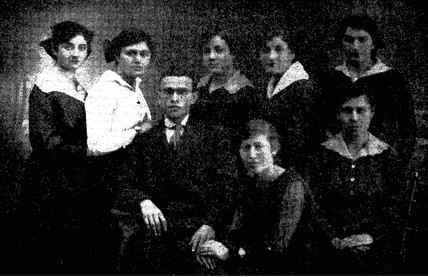
| A group of schoolgirls from the Tarbut school |
[Page 260]
|
|
| A letter from the Grayeve Talmud Toyre |
Hyman Blum
Translated by Miriam Leberstein
The Grayever Branch 35 of the Workmen's Circle was not originally founded as a branch of the Workmen's Circle. Rather, it was first founded as a landsmanshaft [organization of landsleit, i.e. people from the same hometown] organization, in 1907, by Grayever immigrants. By the time it joined the Workmen's Circle, it had already existed for 10 years as the Grayever Young Men's Benevolent Association – with over 1000 members, a fully paid-for cemetery and a significant amount of money in its treasury.
But let us begin at the beginning. It seems like only yesterday, that three greenhorn boys – Sam Krinski, Philip Buzman, and this writer – met up in Hester Park. The three of us, who had been in this country just a few months, felt the loneliness of 17-18 year old boys who had been cast out of their homes into a new world, in a city that sparkled and simmered and bustled, that had no time for anyone. We yearned for a homey environment, for friends with whom to enjoy an evening, after a hard day's work.
The landsmanshaftn associations were then in their first bloom. The “society” was for the newcomer greenhorns, both a club and a home. On the evenings that meetings were held, they would share their impressions of the new country and their sweet or bitter memories of the old home. There, people would help a greenhorn find a room or a job. At each meeting, new faces would appear, just off the boat. The slightly less green ones – those who had been here several months – would embrace the newcomers, receive greetings from the old home and demonstrate how seasoned they were by tossing off the entire dozen words of English that they had managed to learn, in a garbled and confused form.
[Page 262]
The first attempt to establish a Grayever landsmanshaft was made in 1903, when the Grayever Young Men's Association was founded. Although it had attained a membership of about 200, the association expired at the young age of about two years old, for reasons which still remain unknown to me. When we, 17-18 year old boys who had been in the country just a few months, appealed to the Grayever landsleit to join a new association, we were met with mockery and disdain from the “Americanized” landsleit who had already been here two or three years and had worked their way up, having bought a pair of yellow shoes, or moved far uptown, as far as 4th or 5th street, or even as far as Harlem. These “Americans” looked down on us greenhorns, who had gotten off the ship only yesterday.
The Greenhorns
On Friday, April 5, 1907, we held our founding meeting, at which the following were present: Hyman (Khaym Yosef) Blum, Bernard Goldshteyn and Harry Baykovksi, who were elected as the temporary committee; Shmuel Krinski; Rafoyl Kats; Yesokhar Vadovski; Sam Baykovski; Morris Lavender; Philip Buzman; Yosef Rozen; Meyer Berenzon; Nathan Lavender; Yosef Hadasa; Khaym Zimberg; Louis Bialystotski; Benny Bogush; and Meyer Vaks.
The founding meeting was continued on Friday, April 26, when the following were accepted as members and founders: Philip Morrison; Shimen Kolko; Morris Zimberg; Henekh Mishkovski; Sam Kremer; Yoyne Kohn; Harry Amsterdam; Benny Panish; Benny Vodovski; and Jake Baykovski.
Since the majority of the founders were fresh from the revolutionary movement in Russia, and many had recently been “boarders” in the prisons of Tsar Nicholas, it was only natural that one of the goals of the society was to support the revolutionary movement in the old home. We
[Page 263]
all, at that time, were living more in our old home than in our newly adopted country, America. And since we were then all quite young and unmarried, we decided not to accept as members anyone over 35. We considered a 35 year old man to be an old geezer. And it was also natural that we didn't want to admit any married men. We made an exception only for Jake Baykovski, at whose house we held the first meeting. At that time, he was already married, but we did him the favor of not forcing him to divorce his wife.
Obviously, the ban against married men could not be sustained for long.
|
1) Friday, April 5, 1907 Met Friday, April 5 with Kh. [Khaym] Blum as chairman. Heard a report from the provisional committee about the constitution project. Adopted the following provisions: Name: Grayeve Young Men's Benevolent Association Goals: Sick benefitsDecided not to open the fund until October 1. Made a voluntary collection for interim expenses, which brought in $2.65. Elected a provisional committee for the first month, with the following members:
Khaym Yosef Blum
“The first minutes of the Grayever Young Men's Benevolent Association.” |
[Page 264]
The founders themselves, one after the other, followed the example of their fathers and grandfathers. But the mere fact that at its founding the society was limited to the young, alienated large numbers of landsleit, who by then had been in the country several years and had during that time become settled young householders. They joined the more established societies of neighboring towns, such as Shtutzin [Szczuczyn], Byalistok [Białystok] and Lomzhe [Łomża]
At the time the Grayever society was founded, these other societies already had significant sums of money in their treasuries, paid out sick benefits, and had their own cemeteries. At their meetings, they conducted a ceremony, which was at that time very much the fashion in the landsmanshaft societies – using a password, knocking on the door a specified number of times, kneeling ceremoniously to the president and vice-president, and other such conduct – practices that seem laughable to us today, but which were then among the strongest foundation stones on which the societies rested.
The Depression Years
Soon after the founding of the Grayever society, came the difficult economic crisis of 1907-1909. The government did nothing at all to alleviate the situation. The only relief came from the breadlines, free kitchens, etc. Thus, we read in the minutes of the meeting of August 17, 1907, that when the question was raised regarding support for needy members, it turned out that the majority of the members were in need, and that with the grand sum of $79.49 in its treasury, the society could not afford to pay out any money for that purpose.
In September, 1908, the society was forced to strike 27 of its 60 members from its rolls. A portion of these paid the dues that they owed and were re-admitted; the others were out for good. And this was at a time when dues were $1.25 for three months.
Because of its founding at such an inauspicious time, the society was unable to find a firm footing for a long time. During the 42 years of its existence – 32 of them as a branch of the Workmen's Circle – it generally
[Page 265]
made little progress, and never attained a membership numbering in the hundreds. The largest number of members at any given time was, I believe, 150. It is a fact however, that the Grayever Branch 35 of the Workmen's Circle consists of over 80% landsleit, whereas many landsmanshaft societies are that only in name; their members are landsleit of other towns.
There are, regrettably, no great achievements, no important events to note in the life of the society. If I were to portray it with an image from Grayeve, I would say it was like the Kasherovke Brook, that placid stream where we would bathe as children, after we had painfully made our way over 2 viorstn [viorst is approximately 0.6 mile/1 kilometer] on the Raigroder [Rajgród] Road, where many times we were struck by blows or stones by the local Christian boys. Just as quietly, flowed most of the years in existence of the society. And perhaps precisely because of that quiet, that placidity, a number of the more active members ceased to be active, and turned their energy to other areas, where they found a wider scope for their abilities.
There are, however, a few moments in the life of the society, on which we should dwell, and these are as follow.
The Grayever Balls
The yearly balls held by the society were a gathering place for all Grayever landsleit, not just those from New York, but also from nearby cities and towns. Landsleit, young and old, would prepare for the celebration. They knew that on that evening, they would meet all their friends with whom they had spent their childhood years, and whom fate had tossed to the other side of the Atlantic Ocean. The newly arrived would come and meet the “American” landsleit who had come several years earlier, and would convey greetings from the old home. Around each of them, there would form a circle that would eagerly swallow every word, every greeting from their hometown. Young people, dressed to the nines, would dance to the music of a large orchestra, and more than one married couple has the Grayever ball to thank for bringing them together.
[Page 266]
Most memorable was the ball of 1910, in Hennington Hall, where images of Grayeve were projected by stereoscope on canvas. It appeared as if three Grayevers had swooped down into the hall, which held about 2000 people. Many people were turned away at the door, and those who had the good fortune to come inside didn't have room to move, let alone dance.
In time, the social life of the New York Jews changed. In the greenhorn years, everyone chose his friends solely from among landsleit. Later, the situation changed. New friends were made through family and business connections, with neighbors, coworkers in the shops, participation in social activities, etc. And because the landsman had ceased to play a role in the life of the Jewish immigrant, the balls of the landsmanshaft society ceased to play their former role. Fewer and fewer attended, until the event was given up entirely.
Joining the Workmen's Circle
Around 1916, the Grayever Young Men's Association already had a significant membership of around a hundred, and a fully paid for cemetery with a fence, that had cost several thousand dollars. Several members realized it was not advisable for a small society to remain autonomous, but that it must lean on a stronger, more powerful body that could help it weather a storm, should one come along. There were cases of similar organizations that fell apart when their membership got older and began to suffer more illness, more people died, and there was no new blood.
Those who supported joining the Workmen's Circle demonstrated that although the bills would be higher, the members would have a stronger foundation. They would have behind them tens of thousands of Workmen's Circle members; they wouldn't need to be afraid that when they got older the society would not be in a position to meets its obligations. They
[Page 267]
pointed to the institutions of the Workmen's Circle, such as a medical department and sanitariums, and to the organization's cultural activities as well.
It took a long time for the idea to take hold among a large number of members, until finally, in 1917, the society joined the great Workmen's Circle family. Although the expectation by a number of members that entry into that organization would help the society grow was not realized, and the society did not quickly expand its membership, it nevertheless became more solid and secure. Only a few members refused to join the Workmen's Circle and remained local members. Almost all the rest became members of our branch.
Relief for War Victims in Grayeve
A fine chapter in the history of the Grayeve branch of the Workmen's Circle was written in the realm of aid to the war victims in our old home. It is true that the branch was not able to contribute a large sum from its treasury for that purpose, but through its initiative there was founded the Grayever Relief Committee, which, during the First World War and immediately after, collected and sent thousands of dollars to Grayeve. The reader will find a separate article on the committee's relief work elsewhere in this book.
In the period 1926-28, the Grayever Workmen's Circle branch, like many other branches, underwent a split based on political differences between right and left. After a series of heated meetings, it divided into two. Thirty-some members formed a separate branch of the Workmen's Circle – Branch #187- and ninety-some members remained in Branch #35.
Some time after the split, the branch established a very active women's club, at the initiative of the then financial secretary, Sam Krinski. The club carried out very fine social programs, and actively participated in relief work for Grayeve during the Second World War. The club has not been active in recent years.
Irving Kleynman
Translated by Miriam Leberstein
The Grayever Branch 56 of the Jewish People's Fraternal Order is one of the largest and most active branches in the Order. The branch was founded by a small group of Grayever landsleit [people from the same hometown] and now has more than 500 members. This is due to the unification of the landsleit from Grayevers with those from Ostrova [Ostrów Mazowiecka] and Zaromb [Zaręby Kościelne] – all of these towns being in the Lomzhe [Łomża] area.
Branch 56 distinguishes itself first of all by its fraternal activity, providing its members with health insurance, medical assistance, and other fraternal benefits. In addition, the organization carries out systematic programs in the social and cultural fields for its members, their families, and friends. The activities of the branch are in the spirit and best tradition of progressive Grayever youth in America.
The meetings of our branch, which take place every two weeks, are distinguished by their cultural and artistic programs. Lectures are presented by prominent speakers about social and cultural matters. There are also evenings of entertainment and artistic events, with the participation of various artists. At every meeting, various political and literary books are displayed for sale to members, and every possible effort is made to assist in the dissemination of Yiddish books.
[Page 269]
Branch 56 actively participated in all relief efforts to alleviate the poverty of the Grayeve Jews overseas. It contributed both through the Grayever Relief Committee, and through the Jewish People's Fraternal Order, and other relief organizations.
Our branch is especially remarkable for its yearly collections of money conducted by the Jewish People's Fraternal Order for the rehabilitation of Jews in Europe and Israel, as well as for the support of Jewish orphans' homes in Poland, France and Belgium. In the course of four postwar years, Branch 56 collected over $10,000 for these campaigns.
During the war against Hitler Germany, Branch 56 participated in various aid efforts for our own military forces and for those involved in the war effort. Our branch sold to its members and friends war bonds in the amount of over $150,000. We also, with our own efforts and funds, sent a gift for the heroic Soviet fighters – an X-Ray Mobile Unit, which was donated to the Leningrad Hospital.
The aforementioned actions of Branch 56 demonstrate that, in addition to the fraternal aid and insurance which members receive, they also appreciate the importance of the organization's social and cultural work.
The achievements of Grayeve Branch 56 of the Order are the result of tireless effort by the active participants and the devoted leadership. To create such an organization, with over 500 members, and carry out its diverse activities, requires not just intelligence and responsibility, but sacrificial work and effort by the leadership. We must express recognition for the builders and leaders of Branch 56, most of all Friends [term of address in Jewish communal organizations]: I. Magidson, Binder, and others with whom this writer has had the honor and pleasure as well as responsibility of working with in this prolific fraternal, social and cultural people's organization.
H. B-M
Translated by Miriam Leberstein
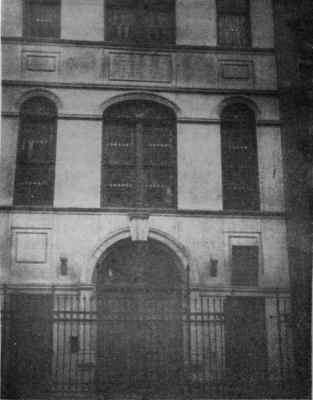
On the Jewish East Side, at 242 Henry Street, near Montgomery Street, stands an unassuming building, which nevertheless stands out from its neighbors, which are tenement houses of various sizes. This synagogue building bears the inscription, “Congregation Anshe Shtutzin [Szczuczyn] and Anshe Grayeve – built in 1910.” The building shows the signs of age and neglect, but there still remain traces of youth and beauty. One can see that not just money went into building it, but also much love and devotion.
The neighborhood is today still mainly Jewish, but practically none of those who built the shul still live there. Some have settled in Brooklyn, some in the Bronx, or in other new Jewish neighborhoods. But the majority of the first builders have already gone to their eternal rest.
Today Henry Street is old and neglected, but 40 years ago, it was one of the most aristocratic Jewish streets. A large number of Jewish doctors of the older immigrant generation, who now have their offices on Park Avenue or Central Park West, then had their offices on Henry Street, where they began their medical practices, and from which they moved after their patients had done so.
[Page 271]
The first Grayever congregation in New York was founded around 1890 and had its shul on Ludlow Street, occupying part of a floor of a building of sweatshops. The founder of the shul was Shloyme Litenberg, one
|
|
[Page 272]
of the first Grayeve immigrants, who was quickly successful and became a prominent cloak manufacturer. He had what one could call a “Grayever shop.” As soon as a greenhorn tailor or aspiring tailor arrived in America from Grayeve, he was immediately brought to Litenberg's shop, where his greenness wore off, and he could decide what to do next. So, the Grayever congregation was formed in Litenberg's shop and Litenberg was for a long time its president. Also active were: Harris Rotboym and Aron Levental, who later also became very active in the Grayeve Relief Committee during the First World War (the first as treasurer, the second as vice-treasurer); Meyer Volf; Meytshe Denenmark; Gershon Zumerfeld; Max Zilbershteyn; Willy Grinshteyn; Leyzer-Hersh Berman; Leyzer and Yehude Mendelssohn; Elye Tobias; and others – there were about 40 members.
At the same time, the Shtutziner landsleit [people from the same hometown] also had a congregation, larger than the Grayever, with a membership of about 60. They had a shul on Forsythe Street, larger than the Grayever shul. In 1906, the two shuls merged. The Grayevers gave up their shul and united with the Shtutziners.
At first, it seemed that the marriage wasn't going to work. There was friction from the beginning. The Shtutziners felt that they were in charge. Their congregation was larger and richer. They had kept their home, their shul, and their prosperous members had the best permanent seats, got the most prestigious Torah portions to read at services, and held the most prominent offices, while the Grayevers, as “guests,” had to make do with seats behind the bime [elevated platform in the synagogue at which the reading of the Torah takes place], with the less prestigious Torah portions, and with fewer and less important offices.
They reached the point of separating. The Grayevers wanted to break away, but the Shtutziners refused to return the money and property that the Grayevers had brought to the partnership. Both sides brought the case before a rabbinical court, consisting of three rabbis, who ruled in favor of the Shtutziners, but who appealed to both sides to make peace and coexist. The appeal was effective. Immediately after, elections were held for officers and both sides obtained appropriate representation in the administration.
[Page 273]
The peace was so well-cemented that a few years later, in 1910, they began to build the above-mentioned synagogue on Henry Street. When they began construction, the congregation had only $1800. At its completion, it cost over $36,000. The chief thanks are due to Mr. Nathan Hamer. Himself a successful builder, he gave all of his time, and found various ways and means to assure that the shul was finished.
The shul is not large, but is certainly one of the most beautiful on the East Side. In the first years of its existence, it was not only a sacred place in which to pray, but also a center for celebrations and other events. During the First World War, it was also a center for relief work.
The first president of the new shul was Moyshe Kronenberg, who held that office for two years; Max Zilbershteyn was vice-president. After that, Mr. Harris Rotboym became president. For about 20 years in a row, the president was Yankl Burshteyn (son-in-law of Borekh-Mordkhe the bath attendant). He made it his job – and made it possible – to pay off the mortgage on the shul.
Almost all of the shul activists were workers – hard-working people who made it their goal in life to maintain a Grayever religious center in New York. Among them were: Isaac Kohn, Moyshe Goldshteyn, Avrom-Itsik Hamer, Yisroel Kleynman, Aron-Yankl Vaynberg, Itshke Rozen, Gershon Kohn, Max Zeligzon, Avrom Abot, Shmuel Brikman, Itsik Alpert, Mikhl Edelson, Alter Faynzilber, the brothers Green (one of whom, Yankl, was also president), Mates Gerson and his children, Moyshe Zilbershteyn, Max Rotbil and his son Benny.
For many years the shul also had an active Ladies Auxiliary, which helped very much with the relief work. Its main activists were Sore Goldshteyn (Sore Monzhes) and Fannie Zilberman.
The current officers of the shul are Moyshe Kohn, president; Sam Birnboym, vice-president; Annie Fayn, secretary; Max Rozentsvayg, treasurer; Yankl Burshteyn, administrator of the burial society. The new officers have recently bought a new cemetery for $3000 and paid over $6000 to renovate the shul.
[Page 274]
by A. Blushteyn
(Former secretary and current president
Of the “Grayever Friendship Society”)
Translated by Miriam Leberstein
When I arrived in Chicago in September, 1913, I found there an association of Grayever landsleit [people from the same hometown], to which a number of Shtutzin [Szczuczyn] landsleit also belonged. I immediately became a member.
At the beginning of the First World War, we began discussing raising funds to assist the victims of the war. A dispute broke out between the Grayever and the Shtutziner members over the question of where to send the money that was raised. Among the Grayevers there were two active members – Dovid Levin, a brother of Bertshe, the melamed [elementary school teacher], who today lives in Los Angeles; and Frank Sevitsh, the son of the Simner [Simnas, Lithuana] melamed, who lives today in New York. The dispute got to the point that the Shtutziner landsleit left the association and founded a separate organization. After they left, the Grayever association died out.
In 1920, a new Grayever landsmanshaft [organization of landsleit; Jewish benefit society] was formed, which lasted no more than a year and a half. At the end of 1925, several Grayever landsleit met at the funeral of a young man from Grayeve, Yudl Dirmish the son of our landsfrau, [woman from one's hometown], Khaye-Perl Dirmish, the daughter of Zelig Smal the tailor and a sister of the Blankshteyns, a prominent family in Chicago. This encounter contributed much to the founding of the Grayever landsmanshaft organization in Chicago, which exists to the present day.
[Page 275]
“The Grayever Friendship Society” was founded on January 17, 1926 at a meeting at the Workmen's Circle Lyceum, which a large number of landsleit attended: Morris Burgler was elected president and A. Blushteyn, secretary. The following were among the first founders and executive board members: Dovid Sigel, Dzh.Sklarof, Benny Kravets, Max Sigel, Herald Grinfeld, Nathan Grosberg and their wives; Esther Sigel; the Blankshteyn family; the Silvershteyn family; the Staynbergs; the Gotlib family; the Nathan family; the Stayn family; the Fishbeyns; Jake Skaler, may he rest in peace; and Beyle-Brayne, may she rest in peace.
January 21, 1950 marked the 24th anniversary of the founding of the Grayever Society in Chicago. During that time, our landsmanshaft participated in various relief efforts on behalf of the needy in our hometown, as well as the needy Grayever landsleit in Chicago. During World War II, when it was impossible to send aid to Grayeve and also after the war, when we learned of our tragedy, we did all we could to help the Jewish institutions that devoted themselves to rescuing the surviving remnants of the Jewish people.
We must, however, express our disappointment that we were unable to organize all of the Grayeve landsleit in Chicago and to interest them in our activity. We have still not given up hope that we may yet accomplish this.
We send greetings to our Grayever landsleit in New York and all the leaders and members of the Relief Committee, on the publication of the Grayever Yizkor book, an eternal flame in holy memory of the holy martyrs, our own loved ones from the old home. We wish you, esteemed landsleit, much happiness. Continue with your humanitarian activities, may you become even stronger, so that you may carry out your noble work of helping to assure the lives of our surviving landsleit and of the Jewish people in the land of Israel. Am Yisroel Khay [Am Yisrael Chai]--May the Jewish people live and outlive all their enemies!
[Page 276]
by Grayever People's Committee to the Relief Committee
of the Grayever Landslayt in New York
Translated by Miriam Leberstein
A Letter
From the Grayever People's Committee to the Relief Committee of the Grayever Landslayt in New York
Friends and Acquaintances!
Afflicted by hunger, need, and difficult conditions, as a result of persecution and economic extermination, we learn that you have offered aid for the impoverished Jewish population of your hometown, Grayeve.
We welcome your initiative and fraternal efforts in carrying out relief activities through all of the organizations of the Grayeve landslayt [people from the same hometown] in New York and surrounding areas. We—the representatives of all of the social strata of our town, who have constituted ourselves as a people's committee –consider it our moral obligation expeditiously to complete the work that you have begun.
The leadership of the Grayever kehile [organized Jewish community] is unfortunately not capable of doing this. Its makeup is such, that it is not able to fulfill its obligations in relation to the poor and their needs. They owe their fortuitous election only to the oppressed mood that results from our difficult living conditions. The masses regard the kehile leadership with mistrust.
Imbued with the necessary understanding of the
[Page 277]
social action required, and of the concerns of for our brothers and sisters overseas, we express our willingness to undertake full responsibility here, for the expeditious performance of your work until its completion.
Without cutting off urgent assistance where it is absolutely necessary --no matter what happens, winter is drawing near-- the central concern must be to assure that the money is utilized not for the dole, but rather for constructive and productive purposes. Thus, the guiding principle and fundamental basis for the allocation of monies must be to rebuild the ruined workshops of the artisans and shopkeepers, thereby providing them with the means to earn their daily bread. There may also arise the need to provide for the town's cultural sphere, in which there are many needs, but that will depend on the extent and regularity of your aid.
Mindful of the goal and manner in which we expect to carry out the distribution of your aid, and not ignoring your wishes and your awaited instructions, we consider we have fulfilled our obligation to the needy workers, shopkeepers, and the indigent. We await your confidence in us.
Our temporary mailing address: M. Stryjew, Grajewo, w. Pildsudskiego 72 [in Polish]
Grayeve, 26 November, 1937
The Constituent People's Committee of all Social Strata of the Jewish Population in Grayeve:
Report
Constituent Committee of all Social Strata of the Jewish Population in Grayeve
To the United Grayeve Relief Committee in New York, Report, which covers the distribution of the second payment of $500 (five hundred dollars) received in the month of April, 1938, for aid to individuals, as well as the payment of $200 (two hundred dollars) received in the month of June, for aid to organizations.
Esteemed friends!
We hereby acknowledge, according to the enclosed receipts, the receipt of $500 from you, which were utilized as follows:
| Polish gilden |
Dollar equivalent |
||
| For Passover Aid | 1543 | 295 | |
| For Shvuot Aid | 1060 | 203 | |
| Remainder (for postage and printing) | 12 | 2 | |
The method of distribution was according to the system previously used: for individuals in need, small sums distributed over a wider range of social strata. As a result, 214 people benefitted from the Passover program, and 195 from the Shvuot program. We permitted ourselves, however, to make certain exceptions and responded positively to the appeals of some artisans
[Page 279]
for assistance in repairing their tools (sewing machines and the like); of market sellers for aid in the vegetable season; and we had also to consider the need for larger sums for operations for those with serious illnesses.
Your recent instruction that the $200 received for distribution at Passover should be distributed to organizations, was unfortunately received too late. We had already made the distribution a few days before we received your revised instruction in response to our question about this matter.
At the same time, we confirm the receipt of the most recent payment of $200, which was distributed in accordance with your direction, to the following Grayeve organizations:
On the other hand, because the sums provided them were too small, the following institutions did not provide receipts for the money they received:
Why 400 gilden to the kehile? After an investigation by a member
[Page 280]
of our committee, along with representatives of the kehile administration, into the condition of the fences around the cemetery, and of the costs of materials and labor required, we determined that the sum of 400 gilden is almost sufficient to (a) erect a fence of cement blocks around the part of the cemetery that is currently unfenced (the part that borders on the new market-place (Torgavika) as well as (b) repair and complete, in stone, the destroyed portions of the fence on the other three sides of the cemetery.
In giving the designated amount to the kehile administration, the committee considered it necessary to alert them that the 400 zlotys must be used exclusively for putting the cemetery fence in order, expressing our wish that, so far as possible, Jewish workers should be employed and that after completion of the work, an accounting of the costs should be provide to the United Grayever Relief Committee. The kehile should soon begin the work.
Why 300 gilden to the lines hatsadek? Taking into account that one should not purchase equipment and supplies in too large amounts at one time, since certain materials, e.g., rubber, can deteriorate and tin items can become covered with rust, the committee supports the position of the representatives of the lines hatstadek and concludes that it is appropriate to allocate no more than 150 gilden for the most needed supplies for the time being, and the remaining 150 gilden should be used for urgent assistance for cases of illness, which the lines hastadek is often unable to properly address with its own resources. In giving the money to the leadership, we informed them how we wish it to be allocated.
Why 165 gilden to the artisans union? The end of 1938 marks the deadline for qualifying examinations for certification as master and apprentice, without which one loses the right to work in 1939. Given the poverty that reigns among the artisan masses and the impossibility under these circumstances of their being able to acquire these certifications, the committee finds
[Page 281]
it necessary to allocate the above sum, to be used exclusively to help the poorest artisans and apprentices obtain the necessary means to assure their livelihood.
Why 120 gilden to the “Tsentas” Society? Recognizing the importance of providing a summer camp for orphans and abandoned children, where in July and August, 60 of the poorest children in our town receive better nourishment, breathe fresh air, and enjoy singing and playing during vacation time, the committee determines it necessary to aid this needy institution with the above sum, which represents the cost of ten days worth of food.
Why only 30 gilden to the two gmiles khesed funds? Without dismissing the social utility and value of both of these institutions, the committee does not consider it urgent to support them for the time being, since, given the limited funds, it is impossible to meet the needs of every organization. The committee also feels that although the gmiles khesed of Binyomen Kolko and the gmiles khesed fund of the artisans union should wait until further aid is received, for the sake of harmonious cooperation and mutual appreciation, they should at this time, share the remainder of the $200 payment, i.e. 60 gilden each.
This completes the financial report, up to the present, leaving 60 gilden in our possession. After disbursing these, as per your further instructions, we will transmit a financial guarantee.
As for your questions regarding [the making of] a moving picture of Grayeve, recent photos, as well as articles for the journal which you plan to publish, we advise as follows:
After inquiry of the appropriate moving picture companies and the local authorities, it would not be possible to make a film. Three hundred meters of film costs about 700 gilden. Moreover, according to new regulations governing traffic across the border, it is possible that we couldn't obtain the necessary permission from the government.
Regarding recent photographs, we will send these at the beginning of October, along with articles about socio-economic, cultural, and communal conditions in Grayeve.
[Page 282]
To accomplish this, our current committee has called together a conference of all of our skilled writers, and ten of them have committed themselves to writing [an article] by September 15.
In the hope that you will forgive us for the delay in submitting this report, we sign ourselves, with regards:
An Appeal for Aid
In our previous letters, we have several times informed you that the local government is requiring us to undertake a thorough renovation of our communal buildings and institutions, such as the cemetery, baths, slaughter house, bemedreshim [prayer houses, synagogues], talmed toyre, [religious school for poor children] etc. We asked not to be required to do anything until the spring, and our request was granted. Now, however, winter is over and spring is here. Today we were visited by a committee, including the staroste [local official] and the mayor, and they demanded that we complete the required work within two weeks. If not, all the institutions and establishments will be closed. The renovation will cost 5000 zlotys, and the kehile treasury is
[Page 283]
empty—it contains not one cent. We haven't paid our officials (whose salaries amount to pennies) for several months, not to mention providing support for such institutions as the talmed toyre, lines hatsedek, and orphan care. It's been a long time since they have received anything from us. The situation in the town is truly catastrophic. The poverty is indescribable. We are unable to do anything. Our only hope is to turn to you, since, according to what we have learned, you appreciate the importance of this matter, and look upon it favorably.
We appeal to you in these straitened and difficult times, asking you to turn your good will and intentions into action soon and to send us aid by wire, so that our institutions, like the cemetery, baths, etc., will not be shut down. There is not a shred of doubt that if we don't complete the renovations, the authorities will keep their word and close them. We trust in your sincere interest in this matter, and await your immediate and fraternal assistance, and thank you in advance.
| Respectfully, (Seal): Office of the Kehile of Grayeve Chairman: Nekhemie Piurko Yankev Mlinarski M.Takakh Efroyim Vadovski Shmuel Burovski Secretary, Y. Papovski |
A Letter from the Grayever Yeshiva Bet Yoysef
To the highly esteemed, renowned Herr Mister Y. Blum, N.Y., President of the Grayever landslayt, and of the Printers' Union in New York
For almost 10 years, there has been a yeshiva in Grayeve, with over 50 students who are educated on a high intellectual level. The majority are students who have finished the town's talmed toyre and want to continue further with their studies; they are accepted into the yeshiva and, because of their impoverished situation, are provided with food and drink.
[Page 284]
Obviously, this is very costly, and in the current economic crisis the deficit is catastrophic, without any means to sustain our holy institution. A year ago, when your letter arrived, asking that you be informed of the institutions in Grayeve requiring help, the town committee did not want to include the yeshiva or the talmed toyre because they were religious institutions. The several religious representatives protested in vain, that our brothers in America contribute to religious institutions as well. But because the majority opposed them, the two religious institutions were rejected. This year, thanks to your intervention, the talmed toyre did receive an appropriate sum. Thus, the only large institution of higher Torah learning, the yeshiva, remains disgraced and economically oppressed, alone among all the other institutions, without exception, in our town. This is so, even though the students are all poor and oppressed, and are fully supported by the yeshiva. And that it is thanks to the yeshiva that the talmed toyre exists, because the children there see a future for themselves after completing talmed toyre.
|
|
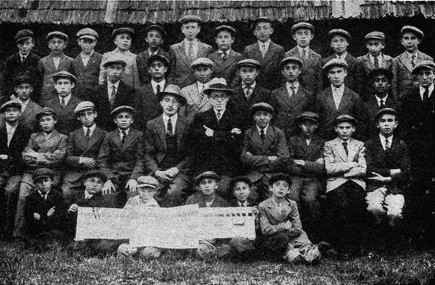
| A group of students from Yeshiva “Bet Yoysef.” |
[Page 285]
We therefore turn to you once again to request, with God's help, that you take into consideration our holy yeshiva and treat it the same as the other institutions, and also subsidize support for the yeshiva to enable it to provide the students with at least some meager subsistence. We are certain you will fulfill our request, because the wrong that was done us was not your fault, because you did not know about it.
We wish you all good things, and success in your endeavors, and may it be given to you soon to see the consolation of Israel and the gathering of Israel on the mountains of Zion and in Jerusalem, and all that serves the glory of the Torah, and its scholars and supporters. The undersigned, the aforementioned heads of the upper and lower schools of the Yeshiva Hakatan [yeshiva for younger and post bar mitzvah aged students] of Grayeve.
The Yeshiva HaKatan, “Bet Yoysef”, Grayeve
Trustee Avrom Bekorekh
Trustee Alter Tsukert
Trustee Nokhem Zaytski, Shoykhet [ritual slaughterer]
Trustee Yankev Vadovoski
Trustee Moyse Menakhem Mishkovski, Shoykhet and Examiner [of meat for kashrut]
Trustee Shmuel Lifshits
Trustee Sholem Zaydenberg
An Appeal
From the Grayever “Tsentas”
Grayeve, 25 August, 1938
To the Grayever landslayt, our brothers in America:
The administration of Tsentas, the institution for the care of orphans and abandoned children in Grayeve, turns to you with the following call for help.
For the past three years, our town has run a day-boarding home for orphans and abandoned children. [Note: The children spend the day at the day facility, eating all their meals there, but they sleep elsewhere. The term “orphan” encompasses children who have lost only one parent, so an orphan may have a remaining parent at home.] At the current time, it provides 32 boys and girls with food, clothing, school supplies and medical care. In addition, during the two-month school vacation, we run a camp for 120 of the poorest children, who recuperate both spiritually and physically,
[Page 286]
forgetting for at least a short time the poverty and gloom in their homes.
The main mission of our institution is to turn the children who attend as day boarders into future productive, self-sufficient people. That means, that after finishing school, they will learn a trade and in that way, break away from their environment, which would turn them into permanent beggars.
In the beginning, we were able to maintain the day-boarding home with our own resources, but because of growing need and the difficult, even catastrophic, economic situation of Jews in Poland, and in our town in particular, it has become much more difficult to run this very important institution. For the last year, we have been running with a large deficit. At present, the situation is such, that if we don't receive material aid from our brothers overseas, we will be forced to close the warm home for these unfortunate, lonely children.
We beg and appeal to you, to help us make of these children of the poor masses into productive citizens, because only with your help will we be able to avoid sending them back to the quagmire from which we extracted them three years ago. We entreat you to send aid quickly, because Autumn is approaching and the children don't have shoes or warm clothing.
We hope our appeal will receive from you the response it deserves, and that in recognizing the importance of our institution, you will immediately undertake a fund raising campaign on our behalf. Your help is urgently needed.
At this time, we confirm the receipt of 120 zlotys, for which we express our warmest thanks on behalf of 32 children.
Respectfully:
President, N.Vasser
Secretrary, Epshteyn
N.B. Please send the money in the name of our president: WMP. N.WASSER,
Grajewo, Pilsudskiego 19.
[Page 287]
A Visit to “Tsentas”
I.M. Fromer
In the street a strong wind was blowing, and people were running as if they were being chased by it. I quickly ran through several small lanes and entered the white “Tsentas” building. A kitchen and three rooms. Clean, and most important, warm. A pleasant warmth struck my face and 30 pairs of childish eyes gazed at me curiously. I entered the first room, greeted the children's woman teacher, took off my coat, and sat down at a table just as they did. I wanted to make myself at home here, just as the children do.
At three long tables sat 30 children – 15 boys and 15 girls – from 6-14 years old, preparing their lessons for the next day. I approached my old acquaintances (students in our Tarbut school) and looked at their assignments. Here they feel somewhat freer than they do at school. There they are quieter, stick together, sit together and never fight. They are good students and do their work easily. I began a conversation, into which I tried also to draw in other children, especially the little ones. They boldly answer all of my questions, and watch to see what kind of impression they're making on me. They say: We feel very good here and we are content. We arrive at 7 in the morning to eat breakfast, and then go to school. At 2 P.M., we come back for lunch and we stay here until 7 P.M., when we eat supper and then go home to sleep. We don't even want to leave here, because at home it's cold, dark and gloomy. Here we have our friends; here it's warm and bright. After lunch we prepare our lessons and we play all kinds of games.
Against the wall, there's a cupboard, holding warm clothing. Today they're giving out clean, washed and ironed winter underwear. Some children receive shoes, galoshes, and even winter coats with fur collars. All are wearing heavy winter hats with earlaps to cover their ears. Chaim takes out small, colored Chanukah candles and he makes the blessing over the candles. All the children sing out “omeyn” [amen] in response.
[Page 288]
They want to sing and recite something for the teacher (me!) to hear. Please do! Hershl recites a poem by Zalmen Reyzn. He speaks well, loud and brave, and everyone claps bravo! Sorele sings a Yiddish folksong. The melody flows through the room, the lovely childish voice swaying rhythmically. The others join in the cheerful refrain and the whole room is singing. The portraits and pictures on the walls are singing, the big health posters on the wall are singing, the books and the notebooks are singing, and over it all you can hear Sorele's sweet voice. Then more songs and recitations, in Yiddish, Hebrew, Polish, and finally a rousing march, the anthem of the summer camp, full of light, sun, air, and water.
“During the summer camp, our family grows larger,” says Moyshe. “More than 100 children participate. There it's lively, cheerful, pleasant. But when camp ends, and a portion of the children leave, they envy us, because we stay for the winter. They promise that they'll expand the day-boarding home but.…” I go into the next room, and ask a member of the administration why they don't fulfill that promise.But we don't have the heart to reduce the number of children.“You have to understand that it's very hard for us to support even these 30 children. The town covers barely 25% of the budget. The central office of Tsentas provides 50%, and we borrow the rest, covering our debts with promissory notes that are always being renewed.
“How long has the day-boarding home existed?”[Page 289]“Three years. Among the children there were several who were psychologically delayed. We had to pull them out from under their beds; they were lying there like feral cats. That little girl over there couldn't even speak, even though she was five years old. Today she's in second grade, and she reads and writes and even sings”
“What happens to the children after they leave the home?”
“We try to enroll them in a trade school, but it's very difficult for us, because that costs a lot. There's no trade school here in Grayeve, so we have to send them to Bialystok.”
“Are there more candidates who want to enter the home?”
“They're beating down the doors. Grayeve has recently become very impoverished. The number of poor children is growing and growing and we remain
helpless. If we could accommodate even another 20 children….” sighs the woman from administration.I interrupt this sad conversation and return to the children. They're eating heartily and their faces are happy, full of holiday cheer. I approach the blackboard and read the notice: “What we're having today for lunch: soup, kashe [buckwheat groats] with meat….” It's truly amazing that with what meat costs these days, they don't eliminate it, but try to serve it to the children at least several times a week. I've heard in town that the administration puts in great effort and energy, and I'd like, on behalf of the children, to thank them, and entreat them, on behalf of the children who await admission, to let them join.
The meal is over. A few more songs. And slowly and reluctantly the children get up and get dressed. In the kitchen are waiting several fathers or mothers who have come to take home the little ones. Poor workers who have toiled all day and are exhausted. Now they stand and gaze as if entranced at the small faces of their clean, well fed children. We all leave together.
The snow squeaks under our feet. The children walk quickly, disperse among other small lanes, and I am left with only the sad melody of Sorele's folk song, and it plays and plays in my cold ears.
|
|
Standing: Avrom Nevadovski, Avrom Vayngrov, Perl Kaminski |
|
Warsaw, October 21st, 1938 American Joint Distribution Committee, Paris. Dear Sirs: “The town of Grayewo numbers about 9,000 inhabitants, in this 2,500 Jews (i.e. about 500 families). Jews are mostly engaged in small trade and crafts. The local G. Ch. Kassa was established in 1927 and has actually 252 members. The Board consists of the following 9 persons: 1. B. Kolko, chairman. 2. H. Kohn, secretary. 3. A. Abedinski. 4. S. Gurowski. 5. M. Wapinski. 6. B. Zaberman. 7. I. Tenenbaum. 8. I. Zakrzewski. 9. A. Liner. The Auditing Committee consists of: 1. Tikocki. 2. N. Piurko. 3. I. Popowski. As regards the actual status of the Kassa, it can be inferred from its balance-sheet on April 1st. c.y.: The number of loans granted during the period under review was 640. On the whole, the Kassa shows an intensive activity. This can also be seen from the following statement of returns:
In 1936 there were 600 loans granted tot: 49.417 zl |
|
|
JewishGen, Inc. makes no representations regarding the accuracy of
the translation. The reader may wish to refer to the original material
for verification.
JewishGen is not responsible for inaccuracies or omissions in the original work and cannot rewrite or edit the text to correct inaccuracies and/or omissions.
Our mission is to produce a translation of the original work and we cannot verify the accuracy of statements or alter facts cited.
 Grajewo, Poland
 Yizkor Book Project
 JewishGen Home Page
Copyright © 1999-2024 by JewishGen, Inc.
Updated 30 Mar 2014 by LA