 |
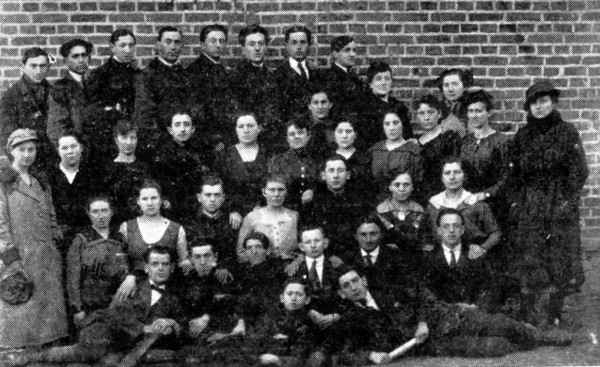
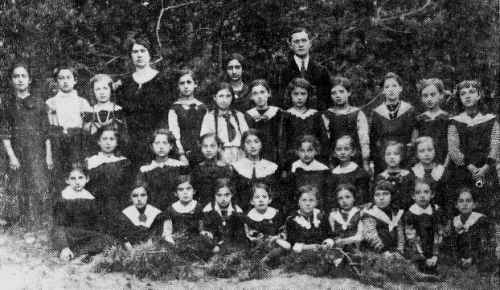
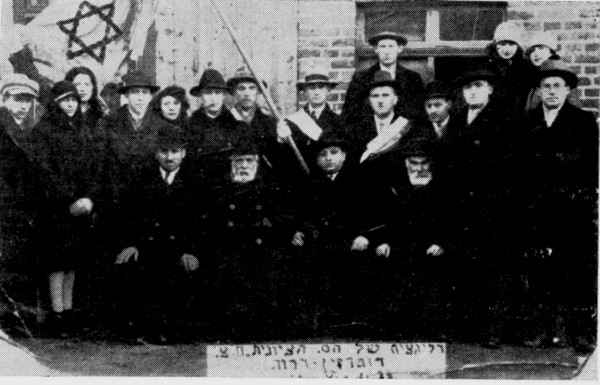
headed by Mr. Yitzhak Moshe Offenbach (first row, second from left)[6]
|
|
[Page 76]
[Pages 76-78]
by Yehuda Rosenwaks
Translated by Allen Flusberg
A. Economic Activity
Earlier, Dobrzyn was no more than a town within the province of Rypin; but after the establishment of an independent Poland following the end of the First World War, it became a more independent city because of its unification with Golub.
Railroad tracks and organized transport connected Dobrzyn with the cities Wloclawek, Lodz and Warsaw, aiding its economic development. And indeed, thanks to its convenient shipping connections, it became a thriving commercial city that attracted other residents from the surrounding areas.
The animated economy impacted the social and cultural development of the place. As time passed, a fairly broad class of young intellectuals arose, leaving an imprint on the life of the city.
Thanks to the well–organized transport, many of the townspeople found their livelihood in trade with Germany—in the grain business and in agricultural manufacturing—leading to a boom in Dobrzyn–Golub. Even so, there was no shortage of poor people; but in general the economic situation of the city, as opposed to that of others in the vicinity, was good.
As their economic activity continued to expand, the tradesmen needed additional investment capital, whose absence became more and more critical. And then a few businessmen toiled relentlessly to establish a bank that would be able to provide services to the residents. Indeed this bank, a kind of funding lender, served the townspeople well, and its imprint was rapidly felt in the business life of the place.
The influence of the twentieth century began to be felt in Dobrzyn–Golub not only economically, but in its social–cultural life, as well. As also in the large cities, various political parties with a large number of members arose. Nearly all the young people joined one of these parties. Each group would get together almost every day, particularly on Saturdays, in the movement's meeting hall. At these meetings they would listen to lectures and have discussions and debates with the passion characteristic of youth.
Competition between the parties was fierce as each sought to attract more of the young people. These struggles occasionally led to a great deal of tension and to embittered relations between some of the young people.
B. Educational Activity
As was usual in most of the towns of the House of Israel in the Diaspora, Jewish children in the past received their initial education in the “cheder”[2], where the “melamed”[3] taught his young students religious texts, often with the aid of a strap.
This education was restricted to boys; parents didn't actually give much thought to their daughters' education. It sufficed that a girl should know how to read the prayers, so that she would not need to have the prayers read to her out loud by another woman in the women's section of the synagogue. Parents sought to educate daughters to make them suitable as mothers who knew their place and their role in life. Their entire education did not have to go beyond an ability to read the siddur[4] and the machzor[5], without even understanding the meaning of the words. The more liberal parents made certain that their daughter would learn to read and write Yiddish, and would even be able to recognize the letters of the Latin alphabet, so that she could address envelopes in the official language of the country. And in those days that was the sum total of a girl's education.
In the 1920s the first cracks in the rigid walls of tradition began to appear. Secular schools with modern methods and goals were established, and libraries containing books in different languages were founded. The young people, who were no longer willing to follow their elders' dictates verbatim, began to make their own way. Many streamed into the new schools, seeking to acquire knowledge of various cultures. Some continued their studies in high schools and even in universities.
The cultural activities and the spread of the secular schools also significantly influenced traditional education. Recognizing that they could no longer remain isolated from the demands of the times, traditional schools were forced to introduce secular learning within the framework of Jewish studies. Indeed, the reformed cheder, which broke open a window to secular culture, continued to enroll a large number of students. They emerged enriched by both Judaism and general culture.
It should be noted that Zionist activity also began in this period. It was expressed in the study of the Hebrew language and in the departure for Zionist pioneer training camps in agricultural farms, to prepare for aliya to Israel. Jews who owned farms were found; they agreed to make their farms available for this purpose, greatly assisting not only the training of the youth in agriculture, but also enhancing the influence of Zionism on the town. It is fitting to mention the following farm owners who helped found the training camps and encouraged the young people: Yitzhak Yaakov Szmiga, Yaakov Rojna, Poleder, and Hershl Dobrzinski. The training camps served as greenhouses for Zionist pioneers from all over Poland who then immigrated to the Land of Israel and were rescued from the bitter fate of their brethren in the Diaspora.
|
|
| Delegates of the Zionist Organization in Dobrzyn–Golub, headed by Mr. Yitzhak Moshe Offenbach (first row, second from left)[6] |
Translator's Footnotes
by Avraham Dor (Dobroszklanka)
Translated by Allen Flusberg
For as far back as I can remember, Dobrzyn, the town in which I was born and raised, was a quiet, peaceful corner of the western part of Congress Poland[2]. When I think back to the days of my childhood and adolescence, trying to recall memories from the remote depths of my past, images of Dobrzyn come back to me: Dobrzyn, with its houses, alleyways and courtyards, with its good, compassionate people, with its distinguished, welcoming Jews who were well known throughout the surrounding area as affable, hospitable people. Many times I happened to overhear people from other towns conversing, extolling the townspeople of Dobrzyn for their benevolence. And from various itinerant Jewish preachers[3], who used to make the rounds of the towns of Poland, I have heard remarks of praise for the philanthropy of my townspeople.
An image comes back to me from the days of World War I, a period in which a great famine raged throughout the large cities of Poland. Thousands of Jews, most of them miserably poor, descended upon the towns and villages of the country to find food and satisfy their hunger. Dobrzyn was one of the first towns to come to the aid of these refugees. The soup kitchen that was right next to the “Otwock shtiebel”[4] gave meals out all day to all who asked for them. The women of the town toiled to prepare these dishes and to distribute them among the needy. How wonderful it was to feel the great animation affecting all the townspeople; all were happy to partake in this mitzvah[5], and the most dedicated were the women volunteers, the pious women who did not spare themselves any labor or toil to provide a bit of joy to those in need.
When the war ended and life began to get back to normal, most of the refugees returned to their places of origin. However, some of them, captivated by the town, were unwilling to leave, and they settled there. These were mainly craftsmen who had managed to make a good living among us. Many years later, after they had become respectable residents, they lauded the many acts of generosity that the townspeople had done for them while they were impoverished, miserable refugees, penniless and starving.
Indeed, the words of Mendel Sonabend, who was the son of the town rabbi, Rabbi Judah z.l.[6], were particularly succinct when he spoke in memory of our town and of its residents, saying: “Dobrzyn was heart, Dobrzyn was feelings, charity, anonymous giving…In Dobrzyn there were no wretched or deprived people, because all the people who lived there were like a single family.” (Footnote: These words are excerpted from a speech he made in a general meeting, held in Tel Aviv, of Dobrzyners in Israel.)
[Page 80]
The Community Council
As in other Jewish communities throughout the Exile, The Community Council of Dobrzyn was a particularly respected institution whose influence was discernable not only in the religious domain but also in other areas of life. Thus it is not surprising that many a time attaining representation in it led to bitter struggles. It was customary to appoint the members of the Council from among the elders and wealthy of the city, who would decide among themselves who would be selected. Generally they held sway and remained in office for an unlimited length of time.
After World War I ended, the influence of the newly wealthy and powerful, who had made their money during the war, was on the rise. Supported by the Hassidim of the shtiebels, they were able to impose their authority on the veteran members of the community.
The elections for the Community Council were an important event in the life of the town. These elections were accompanied by an enormous ruckus as each side tried to prevail over the other, whether in the synagogue, the Beit Midrash[7], the shtiebels, the streets, and even the mikva[8].
At the end of World War I a group of young people from among the members of the World Zionist Organization of the town organized themselves, attempting to take an active role in the life of the community. The following were in this group: Lemel Rojna, Klein Lichtenfeld, Kutner, Perger, as well as others. Of course these young people had to struggle to obtain appropriate representation in the Community Council. The veteran members as well as the rich and the powerful were not overjoyed to fulfil the desire of the young people; it was only after a lengthy struggle, and after more democratic elections were held, that these young people managed to get a single one of them, Lichtenfeld, on the Council. The “Bund”[9] and “Poalei Tzion”[10] also tried to expand their influence via representation on the Council, but in spite of all their efforts they were unable to do so. Their ideologies were still much too novel for the townspeople to accept.
The rabbi of the town, Rabbi Yehuda Leib Sonabend, who was considered a great scholar, had an especially lofty and respectable standing. He distinguished himself not only in his vast and wide-ranging knowledge, but also in his compassion and other noble qualities that made him a popular leader. With his amicable, popular approach, he was able to bring all the residents of the town—people of all persuasions —closer to him. He would lead the community with the wisdom and humility that was so very characteristic of him. For the townspeople he was not only a spiritual and religious leader, but more than that—a father…
And indeed, after he passed away, the town remained without a rabbi for a long time, in spite of all the attempts to find someone to replace him. Of course there was no shortage of candidates. Rabbis from as far away as Lithuania applied, but none was judged to be suitable to inherit Rabbi Yehuda Leib Sonabend's position. In this period the “Dayan”[11] filled in for the rabbi who had passed away; he tried to continue the tradition of good relations with the townspeople. And indeed the Dayan was a God-fearing Jew, a seeker of justice who was well liked by the people.
[Page 81]
Movements, Organizations and Parties
Parties and movements did not arise in the town all at once; rather, they developed fairly slowly, concentrating around either a single figure or a group of people who were dedicated to a particular idea and who tried to find members who would be faithful to it. I recall that this is how R. Feibush Lipka z.l. and R. Hirsh Wolf Laks initially represented the movements “Hibbat Tziyon”[12] and “Hamizrachi”[13], respectively. Small groups represented the “Poalei Tziyon” party on the one hand, and the “Bund” on the other. It was only after World War I ended that the activities of these movements and parties intensified and their membership increased.
The Balfour Declaration served as a stimulus to organize a large Zionist movement, headed by R. Yitzhak Moshe Offenbach z.l., a prominent figure in Dobrzyn; the Zionist concept was deeply ingrained in it. Zionist activity was concentrated in the club “Hatechiya”[14], which had been organized in Shperling's house. In this club the elite of the young people of the town got together. On Sabbaths they would listen to the lectures of R. Yitzhak Moshe Offenbach z.l., mainly on Herzl-type Zionism, but also on various other topics. And similarly they would listen to the overviews presented by Aharon Zudkewitz, the representative of the young people. Every now and then invited speakers, including some from the Warsaw Center, would also appear in the club. In addition, the members took an active role in working on behalf of the Zionist funds: the Jewish National Fund and Keren Hayesod[15].
Another important activity that was conducted in the “Hatechiya” Club was familiarizing the young people with the Hebrew language. Among those who taught night courses was Mr. Shaul Blum, the son-in-law of R. Nisan Melamed. (Later on he taught Hebrew to the well-known Polish writers Pszuwieszewski and Zeromski[16], who lived in Danzig.) The living spirit behind this education of the youth was Mendel Sonabend, who dedicated his utmost energy and talent to enhancing the prestige of the Zionist youth of the town. His good humor and skill were deeply appreciated by the young people with whom he toiled to prepare performances, particularly just before the traditional holidays. Standing at his side in this praiseworthy work was Esther Kranz-Groner.
In that period a scout movement was also organized. It was led by Shmuel Baruch Rusk. After a short period of activity Rusk left Poland, and the scout movement was transformed into the “Hashomer Hatzair”[17] movement. I recall the first “ken”[18] that was set up in Elka-Chana's house. Here we gathered together, mainly on Sabbaths, for various cultural activities: group singing, talks led by Hirsh Hartbrot z.l., and other things. The hall was always too small for everyone to fit into, and many of us wound up standing outside. Other movements that grew out of this one included “Hechalutz”[19] and later the sports club “Hakoach”[20].
[Page 82]
Hechalutz
In the early 1920s, with the spread of the “Hechalutz” movement throughout all of Poland, a branch of the movement was also set up in Dobrzyn. The beginning of its establishment is connected with the lecture by Pinchas Rashish, from the Warsaw Center, who passed through the towns of Poland lecturing on the political platform of “Hechalutz” and working to establish branches of the movement. (Footnote: P. Rashish later served for many years as the mayor of Petah Tikva, Israel.) The response was strong, and many joined the movement as members. The main activity of “Hechalutz” was preparing the young people for Aliya and ensuring that they obtain entry visas (“certificates”) to the Land of Israel. Later, Hachshara[21] centers were established for those who were candidates for Aliya. (Footnote: The first group from Dobrzyn that immigrated to the Land in the early1920s did not actually have the opportunity to go through the “melting pot” of Hachshara. Was the failure of some of them to take root in the Land possibly attributable to the fact that they did not experience Hachshara?!)
The members of the branch in Dobrzyn took part in all the activities of “Hechalutz”, carrying out all the instructions they received from the Center in Warsaw. We were always alert to take action, and we followed the instructions that we were given swiftly and precisely. I recall how we were once given a difficult mission: collecting a large sum of money for the Center (500 zloty, an enormous amount of money for our small branch[22]), and we were able to do so, although not very easily. We invested a great deal of hard work to come up with schemes to collect the requisite money. During our committee meeting one of the members suggested that we invite Kipnis and Zeligfeld, a pair of folk singers who were popular in our community and who were then living in the resort city of Czechocynk, to perform in the town. We worked very hard to organize this event, calculating the revenues and expenses, and distributing the tickets. It was with a great deal of trepidation that we took on this very serious obligation of bringing the pair of musicians to the town. But our great enthusiasm and confidence in the reputation of these singers throughout Poland served us well. And indeed our hopes were not dashed. The tickets, which had been given out to be distributed by representatives of the various organizations, were already sold out several days before the performance.
I recall how the town was decorated for this event as if for a holiday. The townspeople came to the evening performance dressed in their finest clothing. The firemen's hall, an auditorium containing more than 600 seats, was completely full for the show. The performance by these artists was a great success, and we emerged rewarded: we covered the expenses, we sent the Center the requisite sum, and quite a respectable amount of money was actually left over for our own treasury. This successful activity was met with great approval in all the surrounding towns.
Among the other acts to benefit “Hechalutz”, we should also mention our activity in organizing Hachshara. When the Warsaw “Hechalutz” Committee made the decision to establish centers of Hachshara, training camps for pioneers who intended to immigrate to the Land of Israel, the estate owners of Dobrzyn, influenced by our local branch, were the first to provide places on their land for young pioneers. May R. Yitzhak Yaakov Szmiga be remembered favorably for allowing pioneers from all over Poland to be sent to his estate “Szitna”[23]. His concern and that of his family for these young people was not forgotten by them even many years later, when I ran into them in Israel. They remembered very well the sympathetic attitude that they got not only from the owners of the estate, but from the all the people of Dobrzyn.
With the development of the pioneer movement in Poland the number of members of our branch rose, and with it also the demand for entry certificates to the Land. Obviously it was not possible to satisfy the increasing demand for certificates, especially after our branch's standing was somewhat weakened with the failure of some of our first pioneers to acclimate and be absorbed. I myself was already in the Land then, and although I did my best to try to dissuade these comrades from their hasty step, I was not successful; they returned to Poland, and they were among the millions who were cut down.
[Page 84]
The Sports Club “Hakoach”
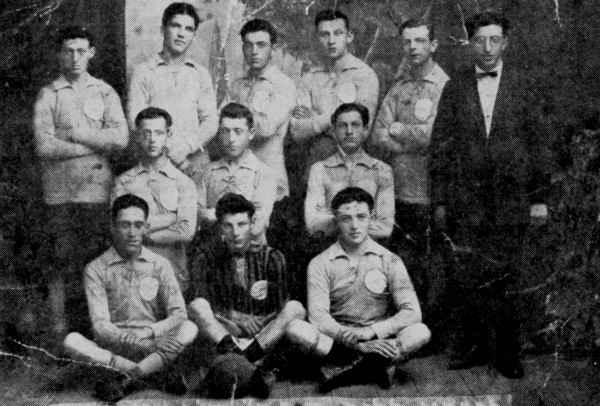
In the early 1920s a group of young people took the incentive to lay the foundation for a sports club in our town. Within a short period of time dozens signed up for membership, and football [soccer] players were selected from among them. Very quickly these players learned the rules of the game, and they distinguished themselves in their ability to score a goal. Their first win against the veteran local Polish team was a surprise to the spectators. Our team continued to improve, and it was considered one of the best in the entire area; nevertheless, it had to struggle hard to endure, since initially all its revenues derived from membership fees only. Its survival was ultimately ensured by money raised from Chanukah and Purim parties that were very popular in the town.
[Page 85]
Education
Until the early 1920s, no substantial educational institutions had been generated in our town, with the exception of several “cheders”[24], run by “melamdim”[25] who taught the little children to read at an early age; and then, as the children grew older, the melamdim taught them chumash[26] with Rashi's commentary. They were taught each word of the text followed immediately by its translation, the translation being, of course, into Yiddish. Among the students, there were those who continued their education by studying gemara[27] with renowned melamdim who were sharp and proficient; among them were: R. Nissan Melamed, R. Tanna Levinson, R. Yisrael Shimon, R. Beryl, and others. On Sabbaths the rabbi of the town, together with several of the esteemed members of the community—men learned in the study of Torah—would test the achievement level of these students. The names of those who excelled were on everyone's lips, the townspeople being extremely proud of them.
There was a school for studying the Yiddish language and arithmetic; it belonged to R. Abba Yosef, a dedicated teacher and a very likeable person, who provided his students with the basic knowledge of reading and writing in Yiddish. For many years this school was located in the home of Rachel Leah Cohen. After World War I ended, a reformed[28] cheder was established by the brothers Mendel and Avraham-Hirsh Kohn; it introduced a variety of new teaching methods.
At the beginning of the 1920s the first elementary school, with all eight grades, was established under the administration of Hartman, a teacher from Warsaw. Many of the graduates from this school continued their education in high schools outside Dobrzyn; and some of them even succeeded in studying in universities and in obtaining degrees far beyond the borders of Poland.
Trade and Craft
As in most of the towns of Poland, trade in Dobrzyn was concentrated in Jewish hands. The Jews dominated here in the trade of wheat, textiles, wood and leather, and in the trade of grocery items. The Gentiles stayed away from these sectors, shying away from competing with Jews who were experienced in them. The farmers of the area, who came to the town on market days, went to the Jewish stores to shop, trusting those merchants with whom they had established connections of friendship. This tradition of connections with merchants was passed down from father to son within the farmers' families, who knew the shopkeepers by their special nicknames. When—after Poland achieved its rebirth[29]—a business boycott against Jewish merchants was proclaimed and anti-Semitism spread throughout the entire country, the farmers from the area tried to maintain business connections with the Jews, in spite of threats made by Polish vandals.
The Jewish wagon drivers, who delivered supplies from far away, played a special role in the business of the town. To sustain their families, they wound their way along the roads for days and weeks on end, transporting their heavy loads, whether during the deep winter frost or in the blazing summer sun. How truly noble these simple Jews were: when, completely exhausted after their long journeys, they would bring their heavily loaded wagons back on a Friday afternoon, they would still take the trouble to change out of their unattractive clothing and put on their Sabbath best, rushing to the synagogue or shtiebel for Kabbalat Shabbat[30].
The number of craftsmen in Dobrzyn was small. Blacksmithing, locksmithing and carpentry were almost not at all within the line of work of the Jews of the town. Because of their contempt for these professions, Jewish parents avoided sending their children to serve as apprentices to Polish craftsman. The lines of work that were acceptable to the Jewish middle class were watchmaking, sewing, and silversmith work. There were also professions that were considered less desirable and that were adopted by the poorer people who were part of the working class. If indeed the latter may have been viewed as a specific group from a social standpoint, in their day-to-day lives they were not set apart from the other residents of the town. Reuven the shoemaker and his children; Sina the tailor and others—may they be remembered favorably, for they were well liked by the townspeople for their honesty and integrity. They and their children were happy with their lot and lived peaceful lives in the town. One generation followed another, yet the town practically did not change its appearance: the quiet and tranquility so characteristic of the town were reflected in its inhabitants' way of life.
Many generations could have recounted stories about figures who worked for the public benefit in various ways, whether in maintaining the ethics of the town or in ensuring mutual aid; so too they could have told about the pious women who oversaw the anonymous giving of charity. The women volunteers who worked at the beginning of the twentieth century to help the poor and needy of the town deserve much appreciation; they include: Rivka Aleksander z.l., who passed away in the United States, and Sarah and Chana Lichtenfeld, z.l., who did not spare themselves any toil in their concern to provide clothing and money for the needy. Their dedication to those who were suffering and in need was boundless. Much more could be recounted about the self-sacrifice of these two wonderful individuals, who during their lives made a name for themselves by supporting the impoverished of the town. May the memory of their deeds endure forever.
The town of Dobrzyn was not one of the larger towns, and its Jewish community was not one of the most distinguished among the Jewish communities in the Exile; yet even in it exemplary Jewish lives existed, lives full of activity and charm, of which a great deal could be recounted.
The end descended upon the town, sealing it like a grave. But under the ashes of destruction the coals of remembrance are still glowing: a memory of a past spanning hundreds of years, a memorial that will last forever and will never be left abandoned.
|
|
| A “Poalei Tzion” group[31] |
|
|
From right to left and back to front: Row 1: Aharon Zudkewitz, Menashe Dobroszklanka, Hersh Topol, Nisan Fogel, Giorg Riesenfeld, Avraham Lipka Row 2: Yosef Turkewitz, Leib Szeinbart, Avraham Dor (Dobroszklanka) Row 3: Aharon Lipka, Yosef Shperling, Mordechai Goldberg |
Translator's Footnotes
by Yehudah Rozenwax
Translated by Sara Mages
A. The Synagogue
The synagogues, Batei HaMidrash, and the assembly of scholars were the glory of each Jewish town, and each and every member of the community was blessed with them. Indeed, in the harsh Diaspora, which sated her Jews with bitterness even during their so called days of “tranquility,” the synagogues and Batei HaMidrash were a place of “spiritual importance,” and every person poured his bitter words and his prayers in them.
|
|
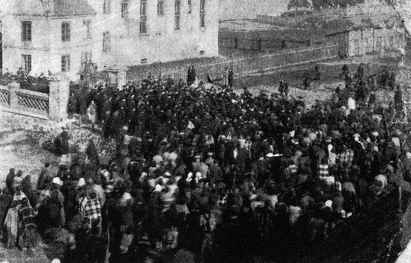
Dobrzyń was also blessed with a big and handsome synagogue, which was the glory of the community. It was built in the 18th century, but for another purpose - a factory. The members of the community, who purchased it, gave it a grand look, as befits a Jewish synagogue.
Paintings, the work of artists, decorated its ceiling and its walls, and colorful stained glass windows, which drowned it with splendor of sacred tradition, adorned its windows. The colorful mosaic floor was very nice and was considered, at that time, to be a masterpiece. Above all stood the big and beautiful Aron Hakodesh, which was the focus of the worshipers' hearts.
[Page 88]
Also the women's gallery, which ran along three walls - south, west and north - was tastefully built and decorated with crystal lamps, as befits a modern synagogue.
The building itself stood on a high elevation, near the river, and was surrounded on all sides by a stone fence. The entrance leading to the synagogue was wide and astonishingly pretty.
The wedding ceremonies were held in the synagogue's courtyard, opposite the grand entrance, and the bride and groom were brought there from their homes accompanied by a large crowd. A band delighted the celebrators and a comedian scattered his sayings and jokes. Also the cantor didn't sit idle and sang in honor of the couple.
There was also a choir in the synagogue that accompanied the cantor in his prayer, and as it was proper and required, a conductor conducted it. I now recall two members of the choir who were its pillars: Moshe Schlesinger who now lives in the United States, and my late brother Yitzchak of blessed memory.
B. Beit HaMidrash
Beit HaMidrash served as a place for prayer and a place to study the Torah and the Gemara. They gathered there three times a day to pray, and studied the Torah in the hours between Mincha and Ma'arive. Most of those who came to Beit HaMidrash were craftsmen and just Jews, who came to pour their emotions, listen to a commentary on the Torah in order to forget their poverty, sufferings, and daily concerns.
On the Sabbath, the preachers preached before the congregation. Many times, preachers and scholars, who weren't local, appeared in Beit HaMidrash and managed to gather a large crowd who drank their words of wisdom and their teachings.
Indeed, the religious subjects that were studied together, were seasoned with words of morality. They pulled the hearts, warmed them, and awakened the community members to perform good deeds - to take care of the poor and the weak.
Beit HaMidrash was a gathering place not only for prayer and Torah study, but also a place for secular conversations, when everyone sought the closeness of the other and natured together their confidence and faith.
Beit HaMidrash, like the whole town, was erased from face of the earth by the malicious hand of the wild beast, Hitler's soldiers and their defiled helpers. The magnificent synagogue was also destroyed, and the cruel hand didn't skip the cemetery. Again, there is no marking on the graves of our beloved parents, brothers and sisters…
[Page 89]
C. Rabbis and Slaughterers
The Rabbinate was a very respectable position in the Jewish towns, and the rabbi had a significant influence on the community's life. Therefore, it is not surprising, that the election of a rabbi served as a debatable ground between the various sectors of society - especially among the Hassidim who belonged to different rabbinical courts.
And so it was in Dobrzyń that her Hassidim belonged to various rabbinical courts: Gur, Aleksander, Otvosk and more. Each group wanted to appoint one of its members as a rabbi, and that caused quarrels, strife and hatred, and soured the atmosphere in the town.
I remember the running around and the intensified struggle in our community after the death of Rabbi Sonabend, the righteous of blessed memory. Various rabbis appeared before the public with their sermons, to show their strength and their knowledge, because this is how a rabbi was examined. Due to these quarrels, the town was left for a long period of time without a leader. In addition, it wasn't easy to find someone worthy to assume the high office after HaRav Sonabend, who was one of the great Torah scholars of his generation.
The situation worsened when two rabbis, who didn't receive the community's appointment, settled in Dobrzyń. Even when I left the town, in1925, on my way to Israel, there was still chaos in the town and a new rabbi wasn't elected.
Also the appointment of the slaughterers was accompanied by a struggle between the various Hasidic groups, each seeking to appoint one of their members. Indeed, tempers flared, from time to time, because of such natters, as if the members of our nation didn't lack worries, troubles and suffering, that were their lot in the Diaspora…
(The “Heder”, the “Melamed”-the Rabbi, and the advanced teacher)
Shmuel Meiri (Miniwski)
Translated by Sara Mages
“If you have learned much Torah, do not take credit for yourself---it is for this that you have been formed” [Ethics of the Fathers: Chapter 2:8]. This view, which saw the highest value of Torah study, was the guideline for the Hassidic education that grew and developed in Poland in the first half of the 19th century.
The teaching language in the old “Heder” was Yiddish, and the Hebrew language - the “Holy Language” was only a secondary study, because it was only intended for prayers by the “ordinary people,” and for understanding the writings of the Holy Scriptures. The girls didn't go to school, and only later a separate school, “Beit Yaakov,” was established for them.
Dobrzyń was renowned for its large number of old style “Hadarim,” which were intended for students from prestigious rich families, or for students whose parents belonged to the “Shtiebelekh” of various rabbis.
A daring step to change these “long-standing practices” and the ancient tradition, which took root in the old “Heder,” with all its faults and benefits, was done at the beginning of the 20th century with the establishment of “Heder Metukan” [“Reformed Heder”] by a small group of dignitaries from the city of Golub. This “Heder” was much more advanced, the study of the Hebrew language was added to its curriculum, and the teachers paid attention to the national-religious education. However, the existence of “Heder Metukan” was a bone of contention between the city treasurers and its leaders. Many of them saw it as a “dangerous Heder,” improper, wasteful and non-Jewish in its nature. They boycotted it and fought against it with bigotry, war to the death…No wonder that the “Heder Metukan” couldn't hold out, and again, the old “Heder” for the children of the poor and the needy, remained in control.
According to tradition, at the end of the “period,” during the intermediate days of Passover or Sukkot, the rabbi ran around, knocked on the doors of the parents, the masters and the benefactors,
[Page 91]
to get new students. The “Melamdim” [teachers] received tuition for each “period,” and extra gifts for the holidays and festivities. The sons of the rich studied individually, sometimes with teachers in their own homes. However, the primary educational institute was the “Heder,” which was located in the rabbi's home. The studies started early in the morning and continued until nightfall. The rabbi maintained a strict discipline and used punishment to deter those who violated the discipline, without all the educational measures that are in effect today.
|
|
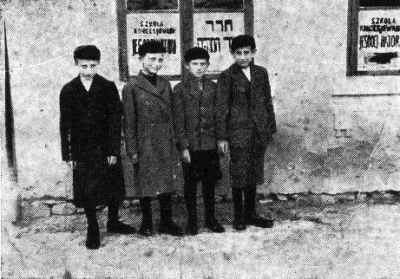
From the right: Schlechter, Yehoshua Flusberg, Alter Piaskowski, and Avraham Natan Postolsky |
However, when we look back at the education in the old “Heder,” which have become the laughingstock of the intellectuals of the previous generation, we have to admit that this “Heder,” with all of its faults, was the forefather of the new school, in all of its forms and phases, in the Diaspora and in Israel. After all, it was the very basic concept of the elementary school. If not for this “Heder,” the children of the ordinary people wouldn't have studied the Torah. As it is says in the Gemara about Yehoshua ben Gamla who ruled: “There should install teachers of small children in every district and town, and they should bring him at the ages six or upward…at the beginning, the one who has a father learns the Torah from him, and the one who has no father, won't learn the Torah…”
The old style “Hadarim” were located in the various Batei-HaMidrash of the Alexander and Gur rabbis, next to the synagogues, and mostly - in the rabbi's house. From early morning, young children, destitute children, and just
[Page 92]
Jewish children sat and learned the Torah and the prayers from the “Melamed” [teacher]. The textbook was the Siddur, and the studies merged with the prayers, which were said on the spot. It was a traditional religious education, in the holy language which was translated to Yiddish.
It is my duty to mention one old “Heder,” the exemplary “Heder” of my relative, Rabbi Meir Fajwel, son of Yehudah Bromberg of blessed memory, who was a biblical scholar and an inspiration. He had a deep and sincere love for the abandoned, lonely, and the orphaned child. Innocence, nobility and greatness merged in him, in the modest R' Meir Fajwel, who taught the Torah in his “Heder” to the children who came from poor homes, and if not for him, they wouldn't have learned the Torah at all.
The headstone on his grave, in the old cemetery, is unique in its Hebrew style and content, kind of a tender elegy written in the language of our ancestors. It testifies to the magnitude of his soul, and the modesty of a person who dedicated his life to teach the Torah to the children of the poor.
The wife of Rabbi Meir Fajwel, Rachel Leah the “Melamedet” [female teacher], was a special person in the history of female teachers. She was endowed with special lofty qualities, and was her husband's helper. Indeed, she rewarded him well all of her life and it can be said that: “Her value is far beyond pearls, her husband's heart relies on her and he shall lack no fortune...” She divided her food between the hungry school children, who crowded in the room, dressed them and fed them.
I remember the time when the rabbi called his wife, the “Melamedet,” to help a slow student. She sat him down at the table, that a Siddur was placed on, and whispered in a calm motherly voice “My child, if you learn well, the good angels will come to serve you! And now repeat Aleph-Bet-Gimel.”
After the death of her husband she continued his life work as a “Melamedet” with great success.
Her three daughters; who absorbed the value of Judaism and love of humanity in their home, took care of sad incurable women, who were left widowed and lonely.
Their daughter, Pessie Bromberg, married the teacher Yitzchak Yaakov Lewiston, a progressive teacher who taught in the Polish State School (a great achievement for a Jew in those days). He taught the Russian and the Polish languages to the Jewish children, and also taught various religious and secular subjects to the students who came to his home in the afternoon.
[Page 93]
He used to open the school day with the song: “Children, we have gathered at school…” Of course, he was an excellent teacher, who projected his charming personality on his students. His body was weak, but his teaching ability was excellent. He wore a modern hat on his head and a small thin beard covered his pale face.
Many of his students are in Israel today, and some of them immortalized the community in this memorial book. Even today, they still remember his lovely, gentle and charming image and remember him with admiration, because his heart and his home were always open for them.
These teachers, and others like them, laid the foundation for the progressive schools. Afterwards, these schools were a source of inspiration for Judaism, and undaunted faith in the Jewish nation and the Land of Israel.
|
|
|
|
JewishGen, Inc. makes no representations regarding the accuracy of
the translation. The reader may wish to refer to the original material
for verification.
JewishGen is not responsible for inaccuracies or omissions in the original work and cannot rewrite or edit the text to correct inaccuracies and/or omissions.
Our mission is to produce a translation of the original work and we cannot verify the accuracy of statements or alter facts cited.
 Golub-Dobrzyń, Poland
 Yizkor Book Project
 JewishGen Home Page
Copyright © 1999-2024 by JewishGen, Inc.
Updated 2 Oct 2017 by LA