 |
|
|
by Noakh Rozevitzky
Translated by Lillian Leavitt
I left Koydenov in 1920. After experiencing the changes of the First World War, I came to America. But the town with its hills and streets, my old friends and the residents of the town were always right before my eyes. I always longed for them.
When the Second World War broke out, I, like most others from our town, was extremely worried about the situation of the Jews in Koydenov. I was very much relieved when the news that the Red Army had freed Koydenov reached us. But what had happened to our relatives and friends? How many were left alive and how many had died? We couldn't get news about that in the early days.
It occurred to me that I might turn to the Post Master in Koydenov and ask him to bring a letter to the Jews in town, to let them know they could be in touch with me. My letter worked. I received a reply from Shimon Elye the butcher.
Shimon Elye was a neighbor of mine back home and I remember him quite well. His letter, which I received with great joy, also brought me the tragic news that of all our Koydenov Jews, only nine were left in Koydenov. The Nazi murderers had killed 1600 Jews. A number of Jews managed to escape to the woods, or survived in the Red Army, but in the early days, no one knew where they were.
Soon letters of surviving Jews began to arrive: around twenty each week. The question was: what could be done to help them? I went to the Koydenov Society, but had no results. Every society had its own special assignment and obligation to its members.
I went to talk to my friend, A. Evans (Avrom Evanchik, back home) and he promised to call a meeting at his home with some of the townspeople. There I had the most unexpected surprise of seeing my friends from back home - Louis Shulman, Yosef Heller, Morris Binder and Peshe Gitlen, friends that I hadn't seen in 25 years. It was a moving moment. We kissed and cried for joy.
We immediately went to work and called up the first memorial meeting on the 21st of October, 1946, in the fraternal club house.
Several hundred townspeople came- all with the same thought: to help their surviving townsfolk. At that point, the Relief group under the name of “The United Koydinov Relief” was founded.
The first officers were: Gershon Singer, Chairman; Avrahom Evans, Co-chairman; Bernard Grossman, Treasurer; Leyb Shuman, Co-treasurer; and Yosef Heller, Secretary. I was chosen to maintain the connection to the Koydenov survivors on the other side of the ocean. Abe Evans received the assignment of sending help, and Morris Binder was chosen to arrange activities.
Our dear friend Abe Evans volunteered to use his business office as the office for the Relief. He also donated his time to watch over the work of the Relief. Peshe Gitl Fraynt did a two-fold job: help me write letters and help send out the packages.
We immediately started sending food and clothing packages to the address that we had and we received replies and greetings saying that had received it all.
At this point, we have addresses of 460 surviving Koydenov Jews. The majority of them are in Minsk and in Koydenov; others are in other cities in the Soviet Union. In addition to the regular packages that we sent we also sent out several hundred matzo-packages.
The responses we received and the joy of the surviving Jews were our greatest rewards. For me personally, every letter we received from a survivor was a joy. It was like the arrival of a new- born baby in the family. I walked around carrying the letter and showing it to every one of our townsfolk.
“Our town Koydenov is rebuilding itself” wrote Yosef Siratkin (Zarekh the tailor's son), Berl Glazer, and Zaritzky (Rakhmiel the mason's grandson). “The economy is improving. ”
It won't be long before the Jews of Koydenov no longer need our help, but we must not abandon our organization. We need to broaden it. First of all, as Koydenover we can do helpful work for the state of Israel, which needs help. We've already sent off several hundred dollars to Rehoveth where an orphans' home is being built. There will be a room in it dedicated to the 1600 Koydenover martyrs. We plan to send more aid. Secondly, the Relief has brought us Koydenovers in America closer together. We have found friends and old friends from back home. We are bound together in helping our townsfolk on the other side of the ocean.
The Koydenov Relief has given us Koydenover the opportunity to find 460 surviving Jews from our beloved old town; martyrs that lived through the Nazi hell and came out alive. They are very dear to us. We stand united with them and we will assist them as much as we can. The Koydenov Relief has also bound us more tightly together and found old hometown pals and friends.
At this point, I don't want to write about the Koydenov of my youth although I would have a lot to say about that. What I want to talk about here is the importance of the Relief, and what it means to me.
We need a center, where all the Koydenov folks, regardless of which society he or she belongs to, can get together for one purpose: for the Koydenov hometown community. We could also use the center for general Jewish cultural activities for our folks. We could build a youth division and interest our children in the life and traditions of our hometown.
We need to always stay in touch with the surviving Jews of Koydenov, to show interest and friendship toward them even when they no longer need our help. We want the name Koydenov to remain not only as a memory in this book! No, rather, we want it to become a living memory through maintaining ties with the Koydenov folks in America, as well as with Koydenov folks throughout the world.
I also want to mention the chairman of the Koydenov Youngmen, my friend and townsman Nathan Klumak. Through his initiative the Yizkor gathering in October, 1946 raised 迼. In 1950, it was through his initiative that the Relief committee became known as the “United Koydenov Association” and he is the chairman of the organization. We wish him the best of health and that he continue working in the organization for the Koydenov folks and also for the state of Israel.
|
|
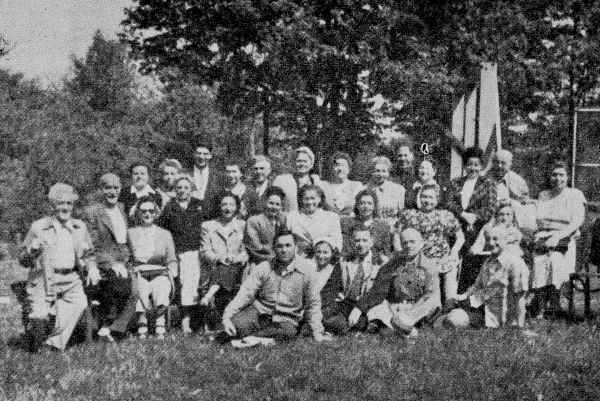
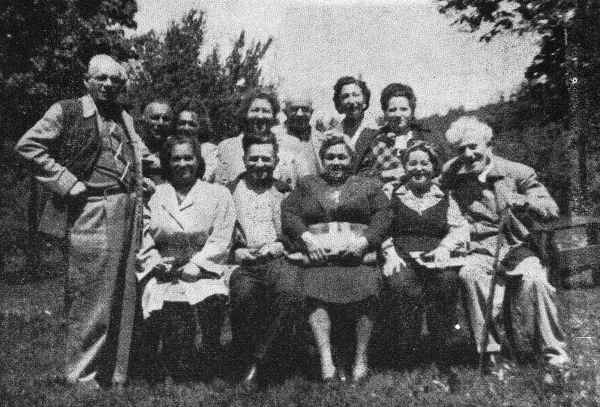
| Gathering of the United Koydenover, in Evans Hotel, Kiamishe, New York, 1948 |
|
|
| Gathering of the United Koydenover, in Evans Hotel, Kiamishe, New York, 1948 |
by Avrohom Evans (Avremel Evenchik)
Translated by Pamela Russ
In order to give you a picture of the town Koydanov – if we would draw a circle around the area of the town – we would find the stores (small shops) that are found in the marketplace right in the center. The stores are set out in the shape of the consonant “khes” with a “patakh” (the “a” vowel sound) under it. The marketplace is sprinkled on all sides with all sorts of stores: groceries, gallantry shops (better goods and materials), manufacturers, hardware stores, stores with pots and pans, second-hand clothing stores, stores for shoes, for skins and furs, for herring, for dairy products and for meat. These stores gave a certain charm to the appearance of the town. The entire economy of the Koydanov residents was dependent on the business that went on in and among the shops, and understandably, also on the business that the farmers brought from the surrounding villages. They brought their grains, wool, flax, etc.
The houses in the marketplace belonged to the successful Jewish businessmen in the town. The Russian church was also there (a brick building), with five domes and an iron gate around it. Six streets stretched out from the market. Two were parallel, called New Minsk and Old Minsk, and another two parallel that were called Slutsk and Rubizewycz, then one street called Vilna, and another called Parabotsk (or Stankov). I just want to remark that at every corner in the market where there was a street, there was a building (actually a large storehouse), that had a very characteristic structure and served as a designated place for the aristocracy and wealthier peasants to park their wagons and coaches. There were a few of these structures in the middle of the streets.
[Page 18]
The shul's courtyard had a prominent place in the town. It started on the corner of Slutsk Street in the market. That's where all the shuls in the town were located – the brick building of the Beis Medrash (place of learning) that held the new Beis Medrash, the tailor's Beis Medrash, and also the small Beis Medrash. They were all in the same building as the brick Beis Medrash. At the edge of the shul's courtyard was the khassidic shul with the Rebbe's courtyard. In that same place was the town's bathhouse, with the famous flowing waters all around that was called the “metzula” (“deep waters”). Also, this was a place of recreation for the children during the winter, for those who would go skating, particularly on Shabbos, when they were free from school, and the Rebbe and their fathers would not see them, because the skating was behind the khassidic little shteibel (small house of prayer).
Other than the few main streets, there were also a few smaller streets, which were called the “humnes” (or the barns), that were parallel to Slutsk Street. Also Sadowa Street (Orchard Street) near Rubizewycz Street. Also there was a small street between the new and old Minsk streets that was called the Tatar Mountain Street, which had an old cemetery from a long, long time ago, when the war befell the entire Russia.
The judicial district held a real prominent place at the edge of the town, where there was the Polish church with its famous “tall mountains” (spires) with the Calvinist seminary, and the match factory that was called Stronginz factory. There were also some small streets that had no name and that were populated with Jewish residents. One such street was between the shul court and Parabotzk Street, and also between New Minsk and Old Minsk streets, and also between Slutsk and Rubizewycz streets. This last one was called Model Street.
At the end of New Minsk Street, there was a bridge that stretched to the train station. Here the Koydanov Jews would stroll on a Shabbos afternoon to watch the arrival of the express train as it passed through without stopping. At the end of Vilna Street, a village became visible that stretched for a few versta (a little more than one kilometer), and there only farmers lived, because Jews were not permitted to live there.
[Page 19]
This village was called Makoitchitz. Two Jewish brothers inherited the rights to live there from their parents. Their names were Shloime and Beryl Kahan, and they were really called by the name Makoitchitzer. The villages and courts need also be remembered, that is those that belonged to the Koydanov volost (Soviet rural administrative division), with a population of about 35,000 souls.
A very prestigious place was held by Stankov that belonged to the famous Count Chapski, the governor of Minsk. He owned many courts, but the one that made the greatest impression over us was the small court of Halinka, because that had the closest river for us to bathe in, or float on a raft. Or Krisow Novisyolok – the big one and the little one, Useh and Dzalnje. We also have to remember the Kaider forest where the older Jews used to say that Napoleon's wars took place.
Koydanov was a very old town. All the houses were made of wood. There wasn't even one brick house other than the Beis Medrash building. And amongst us, the youth, this question always came up: Why, in many towns such as Styopecz and Mir, there were many fires, but never here in Koydanov. The older Jews would say that that was because of the blessing (bracha) given by the Rav of Minsk, the Shagat Aryeh, to the town of Koydanov as he went through here. The blessing actually remained until the end of the World War One when the Polish bandits set fire to the stores in the marketplace and the main streets.
* * * *
The destruction of the city began at the time of the first World War, on Tisha b'Av, 1914. Suddenly, all of the men aged 20 to 45 were drafted, and all left for military service, in Rennenkampf's army. (Rennenkampf was a Russian general who served in the Imperial Russian army for 40 years, including during WWI.) Almost all of the soldiers were taken prisoner by the Germans in East Prussia. The war went on for two years far from Koydanov.
[Page 20]
We saw many soldiers pass through the Koydanov station, and many of them wounded from the front. But the Germans started marching closer to Koydanov, and many Koydanov Jews began to evacuate. The fright was really for nought, because the front stopped at the banks of the Nieman River, and Koydanov remained under Russian rule as a strategic point for providing military support and provisions to the front. Tens of thousands of soldiers from all corners of Russia arrived in Koydanov, and were placed on the echelon trains and sent to the front.
In February 1917, the Revolution broke out, and a provisionary government was established. The Russian army on the front became very demoralized, and the Bolsheviks used this as an opportunity to capture the power from the government. The soldiers began to leave the front, and many hooligans began to rob the Jews of their goods and belongings. Our organized group for self defense, which we had established at the time, didn't help at all. It was then that our first victims fell. These were Leizer Romanover, Feigel Rein's daughter, and Akiva Heshel's daughter.
| Four Generations of the Family Evans | ||||||||||
|
|
|
|
|||||||
| Zachariah (Charles) | Abe | Yechiel | Zachariah | |||||||
[Page 21]
by Moyshe Khaim Einbinder
Translated by Pamela Russ
My dear beloved town Koydanov, it is so dear to me to remember your name, and more so Rebzewycz Street, where I say the first rays of light from the big light of my yet unknown world. Koydanov! Where my poor carriage stood, and where I lived through all the pains and joys of my childhood years. How dear and sweet it is for me to remember your prominent name. What has happened to you, my dearest town Koydanov?
Koydanov was the most aristocratic town of all other surrounding towns like Rebzewycz, Rakow, Ivenetz, Uzde, and even Styopecz. Forget about Swerznje or Wohlme, and we would say half in jest but with some truth, that we could hardly be called a town!
We were proud of our large marketplace and the “in between stores” with the six streets and roads, with the rows of trees, the three Batei Medrashim (places of learning), a shteibel (small shul), a total court! An entire kingdom!
Many of our fellow townsmen remember the melodies, especially Mikhele's melody, when he would raise his head, place his thumb under his chin, and wait for the Rebbe's wink to begin singing his melody, without words. And the melody has gone into the Jewish folk music under the name of “the Koydanov melody.”
And, on the other hand (le'havdil, not to compare Jewish to non-Jewish), the Russian Orthodox Church with the Polish Church and the Calvinist seminary with the organ. And a few times, in all honesty, we heard fine music. The elders and religious people said that we weren't allowed to listen because ….
by Rabbi Israel Kravitz
Translated by Lillian Leavitt
The famous French poet Anatol Frans said that he was very much surprised by people who've told him they couldn't remember a thing about their childhood. In his book “Le Livre deu Mon Ami” he describes the earliest years of his life in the most dramatic colors.
The memories of my childhood in my birth city left a fierce impression on me as well. It's true that various episodes occasionally feel like far away dreams in a very far away past. Nonetheless, they are engraved deeply enough in my memory so that I can still describe them as if they had occurred yesterday….
My earliest memory takes place as I lay in my crib in our apartment at Leyke Ahron Leyb's on New Minsk St. I'm lying there and crying and am inconsolable. I hear rapid footsteps from afar. It's Father coming home from “Tiferat Bakhorim”, after evening services. He runs toward me quickly singing “Sleep my Flower, my Sweet Child, Because I Created You”. He rocks me and sings so tenderly that the song becomes permanently imprinted in my soul. To this very day, I remember all the verses of that Hebrew lullaby, filled with love for Israel and her land. Today when I think about that song, I think why in the world did my father (a strictly orthodox Jew) sing that particular song? It was such a fervently Zionistic song. But I do recall that it was not the only song my father sang.
I see before my eyes a cold, winter night; snow falling, shutters on the double boarded windows waving and heaving fearlessly. We children are huddled in front of the oven trying to keep warm despite the frozen tiled walls. On the other side of the room the old fashioned clock with its weighty pendulum creaks hoarsely. Our spirits are heavy and forlorn. Suddenly, Father, who has been lost in a big book of Gemora jumps up and starts to sing. “The moon is out and shining, the stars sparkle….my old book is open before me…a voice is heard and promises my people that they will be as numerous as the stars in the sky…” A delicious sense of comfort and sweetness begins to flow through my body and limbs, and awakens a longing in my soul as all of us dreamily sing along.
And will I ever be able to forget Friday nights at our house? What a spiritual atmosphere- the house clean and sparkling, the table covered with a clear white tablecloth, Father making Kiddush with his rich voice, Mother, may she rest in peace, and all of us children with our glowing faces, standing around the richly laden Sabbath table, responding “Amen”. Mother's gefilte fish had the taste of paradise, her own baked khale, the soup, everything – so delicious – and the Sabbath songs? Father sang and we, his orchestra, supported him.
Outside, a crowd of people who'd gone out for a walk, stopped in front of our window, mesmerized by the Friday night songs. Saturday morning, after a cup of chickory and a bite of honey biscuit, we'd be off for prayers at “Tefirast Bakhorim”, a sort of Young Israel which was organized by the youth of Koydenov, with my Father as the spiritual leader. The supplicants, mostly young men, would get together at Reb Avrohom Itche Rosevitziki's home. The atmosphere was joyous. Noakh Rozevitzki would read the Torah, his reading beautiful, in the homiest fashion. I can still hear it as if it were yesterday. My Father prayed the Musaf service in his unique way, everyone shook hands heartily – Good Shabbes! Good Shabbes! And we'd be off for home. I can practically see Rebzevitz Street, Farabotzk Street, Vilna Street, Old and New Minsk Streets, the broad market place and its shops. We'd pass the shul yard and see people leaving various shuls – the big Shul, the new Shul, the “shtibl”, people running by, Taleysim under their arms, or still wearing them; everyone greeting one another, rushing home to enjoy the delicious Sabbath foods…
Shabbes afternoon, a beautiful summery afternoon, people would walk to the enchanted looking hills on the outskirts of town. The old castle with its walls cast a fright on my childish mind. They somehow looked as if they had ancient secrets to tell. We would spend many happy hours surrounded by nature and return home happy with the world.
And do I ever remember Simkhas-Torah in our town? Not completely, but I well remember the way the crowd would gather at our house on Shmini Atzeret. It was sort of a community feast. Right before the holiday, various delicacies would be brought to our house. My mother, may she rest in peace, loved people and she would beamingly greet everyone who came in. Right after Musaf on Shmini Atzeret, people would start coming to our house. Everyone sat quite democratically at the table in the living room which was kept for special occasions. There were no status seekers among the men of Tiferet Bakhorim. Everyone ate and drank together, singing Simkhas Torah songs. Father's “From God's Mouth Israel will be Blessed” and “May God be Great” were especially popular, with special Sephardic melodies that Father allowed himself to sing just that one time a year.
We ate, drank, sang, danced, and jumped around until we didn't know if it were Shmini Atzeret or Simkhas Torah! At that point we would get ready to go to Shul for Simkhas Torah “Hakufot” (Ed: 7 Circular ceremonial dances with the Torah). The strongest men in the crowd would link hands, creating a chair of sorts, and cart my Father off to Shul….
Yes, whenever I think about the beautiful brotherhood of Tiferet Bakhorim, I think that even today's modern Young Israels could learn a thing or two from us. It seems to me that the young people of Koydenov were not that culturally deprived at all.
Furthermore, I want to say that Father's Khumash and TaNaKH classes, under the auspices of Tiferet Bakhorim, were very well attended. Not only did the young men stream in to hear a Dvar Torah at night after work, but the older gentlemen and even the rabbi, Reb Shmuel Nakhum, of blessed memory, used to come hear and observe with the greatest pleasure as the young people practically inhaled a chapter of TaNaKH or Khumash, as only my father (The Rov Yitzkhak Kravitz) could deliver……
[Pages 27-32]
B. Grossman
Translated by Lillian Leavitt
Childhood is the most beautiful and sweetest time of life which is why a person's birthplace is so important. It's the place where one's cradle stood and where one first opened his eyes to see the glorious world.
You never forget the time and place in which you receive your first impression of the world and people, and where you get your earliest education. You always love the memories and places in which you wove your young dreams and celebrated youth.
So how can you possibly forget the place and the atmosphere in which you were born?
It's been almost half a century since I've been away from our birthplace, Koydenov. I've experienced many things and spent a lot of time here in America. Still, I've never forgotten Koydenov. I remember all the places, all the people, all the details.
The town, as well as the name Koydenov, is no longer here. The people are also gone. The storms of time and two horribly bloody wars have destroyed all things and murdered the people. But in my mind the town still lives as I remember it. All the places and houses, all the people and personalities, and the entire life of that time are right before my eyes.
My thoughts pass to those times, to that piece of land that was called Koydenov. I see the marketplace and the stores, the six streets and alleys, the schoolyard and schools, the fence, and the rabbi's courtyard.
I also see, please forgive the comparison, the church, the rows of trees along the walks, the tall mountains, all the orchards and gardens, and all the stores and houses from one end of town to the other.
It's worth noting that I've been living here in a community for over thirty years and know very few families and people. But even now, I can list almost every house in Koydenov and the people who lived in them; their names and childhood names and even the nicknames which every one of them had. This shows how people lived in small towns, bound together in a brotherhood with friendship and love for one another.
They brought that brotherhood with them to America and founded communities of their former lives, named for their towns. They will continue to exist for as long as those who came here are alive.
It really is a wonderful love and devotion that those townsfolk have for one another. Considering the tragedy that struck our Jewish nation overall and our town Koydenov in particular, it is no surprise that our townsfolk responded as helpfully as they did to the people who managed to survive Hitler's hell.
Let's hope that this help will continue on and on until the world gets back to itself.
This took place at the end of the last century, around 1890, when, in Jewish towns and villages, it was still a sin, a crime, to read a book. It was considered illegal and revolutionary. But the enlightenment movement that had started at the end of the last century ignited the desire in the young to become educated and learn languages. The pressure for education spread across the entire country and reached our town Koydenov.
Young people began to learn. Some studied Russian, some Hebrew. And they carried out other acts of opposition as well. Everyone wanted to become an educated person. We, therefore, needed teachers, but there were not enough teachers in Koydenov.
There were, in fact, teachers of Hebrew: Khayim Yehuda Merlish, Slavin, Drabkin, as well as “Yakhenaz”, the well-known writer and feuillitonist whom the wealthy Mikhel Zavelevitz had brought to town to teach his children and his grandchildren, the children of Aaron Zisl Yoselov.
There were also good teachers of Russian, such as Marshak, Valakh, Kelman, Akkon, Feygenson, and others. They were also teaches of Russian and Yiddish, such as: Avraham Reisen, Shloymeh Khayim Plimak, Yoseif Haznovitz, Yitzhok Moshe and many others.
In addition to these teachers there were also teachers in the schools that used to teach Talmud and Gomorrah as well as writing and arithmetic. For example: I studied beginners' writing with Yisroyel Artzik, a teacher of Tanakh and Gomorrah. However, our famous resident and writer, Yosef Shloberg also studied with that teacher and participated as a student. In this way, young people educated themselves and there was a great demand for books. But where could we get books to read?
There were even some businessmen, enlightened men, who owned books, such as Zavelevitz, Yoselov, Avraham Khayim Kasel, Yeshaye Heller, and a few other people – but how could one access them? So several of the progressive young people got together and decided to found a general library – for everyone. All the young men and women in town were called together, informed of the goal and subscribed as member. They were to pay a certain sum each month and using these funds, books would be bought.
It didn't take long before a sum of money was collected and books bought. The number of books grew each month and that is how a library came into being. They rented a room from Itshe Vaynshtayn on Vilna Street and books were lent out from there, several hours a day.
The leaders of the library were: Feygl Ahron, Zisl's daughter, or as we used to call her, Fanye Yoselov, a girl educated in Russian and Hebrew, a democrat even though her father was a rich factory owner. There was also a young man, Valakh, an assistant to the town pharmacist Sayiet; Marshak the teacher; myself and others.
We got together often to discuss which books were the most necessary. Some thought Hebrew was the most important, others – Russian. Yiddish was not yet recognized at that time. There was also no great demand for Yiddish books at that time and so we had very few of those.
We used to hold our gatherings at Valakh's house. He had a very large room in Matte Zinger's new house on Nayminsker Street. We simply had to bring our own chairs.
There were various movements among the Jewish youth. It was the time of Zionism and Bundism. A lot of people were Zionists, followers of Dr. Herzl's and we often had open Zionist meetings. There were also Bundists, declared Socialists, who used to hold secret meetings in the woods. But these differences didn't matter as far as the library was concerned. We were all united as well as tolerant.
At times we were worried over the fact that the library was illegal according to Russian law. Although all the books had passed censorship and were considered kosher, we were supposed to have special permission from the government and that was not that easy to get.
In the meantime, we kept up the library for a period of time until a strike broke out in the match factory in town. Then everything became strictly controlled. This frightened Feygl Yoselov. She therefore, rented a wagon, loaded all the books onto it and delivered them to me. One early morning, she arrived at my house, pale and frightened, worried about what to do with the books. Where could they go?
I found a solution. What could I possibly do?
We had a flour granary. So we put all the books against one wall and covered them with sacks of flour, so that they were not visible. That's how they stayed for months until Madame Sayiet, the pharmacist's wife, took responsibility for the situation and got a government permit. She also rented a new locale for lending books to readers. The library started functioning again. The number of books began growing.
That was 1900, the year I left for America.
[Page 33]
|
Translated by Lillian Leavitt
|
Wandering, roaming My alienated life was spent, Weary and downhearted, The many years went…
Oh, those great cities
Yes, graves! Tugging and beckoning
So, I left that great world
I knew you at once, dearest shtetl.
Ever so rich was Khayim Leyzer,
I'd often go to that balcony
Bad times! Khayim Leyzer
Nor did I forget the schoolyard
“Which difficult burdens twist
I wanted to see our old shul,
“Dearest Son!” He replied at once
Further into the shul, off in a corner
I left the shul sadly.
“Greetings, Dearest River,
Yes, to you I've always been drawn.
Coming home to grandfather's
How I loved the flavors
Shabbes morning I was off
Oh how passionately did that cantor sing,
Sunday morning, off I went
Among the many merchants
I remember the dreams you entrusted to me
She responded terribly sadly
I heard the women in town whispering
Very little joy, my dearest shtetl, |
|
|
JewishGen, Inc. makes no representations regarding the accuracy of
the translation. The reader may wish to refer to the original material
for verification.
JewishGen is not responsible for inaccuracies or omissions in the original work and cannot rewrite or edit the text to correct inaccuracies and/or omissions.
Our mission is to produce a translation of the original work and we cannot verify the accuracy of statements or alter facts cited.
 Dzyarzhynsk, Belarus
 Yizkor Book Project
 JewishGen Home Page
Copyright © 1999-2024 by JewishGen, Inc.
Updated 6 Sep 2013 by LA