|
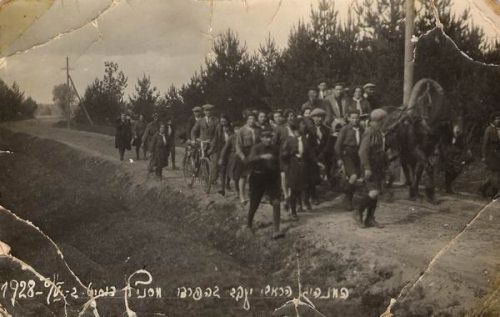
The way leads to Antaliepte, through the Skinaiki Forest. Among the members are Micha Baron, Rivka Melamed and Chava Shub.
|
[Page 105]
“Before WWI Dusiat traded with Dvinsk (Daugavpils) by means of wagon. After the war, Dvinsk was incorporated into Latvia. Trade increased with Rakishok (Rokiskis) since Ponivez (Panavesyz) was too far away. Dusiat did not have a railway station. The nearest station was Abel (Obeliai). Up until WWI the railroad was barely used, and afterwards most rode horse-drawn wagons… ”([35] Chaya Malka Kruss-Glussak and Nachum Blacher. From Our Shtetl Dusiat, pp. 336-345, in Yizkor Book of Rakishok and Environs, Johannesburg, 1952.)
Levi Ron: I was a shaliach (emissiary) for Hashomer Hatzair in Lithuania and would travel from shtetl to shtetl, visiting the centers of the youth movement. For me it was a very moving experience to travel by wagon and hold a conversation in Hebrew with the driver. In contrast to Poland where I grew up, in Lithuania this was a common phenomenon.
|
|
| Leader Yaacov Gotlieb (top center, in a suit) taking leave of the members of Hashomer Hatzair in Dusiat, May 6, 1928 The way leads to Antaliepte, through the Skinaiki Forest. Among the members are Micha Baron, Rivka Melamed and Chava Shub. |
|
|
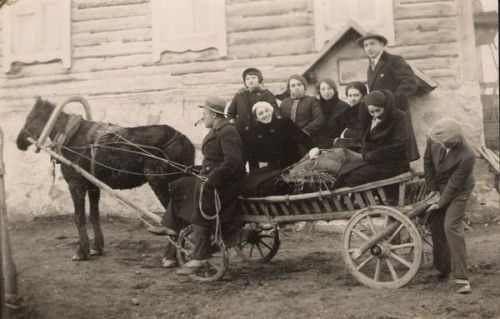
| Taking leave of Batya Levin before Aliya to Eretz Yisrael
Antalipte, Purim 1935 From left to right: Teacher Yehuda Slep, Batya Levin and her sisters Feigele (the youngest), Reinke and Yehudit; Rasya Kagan, Sara-Itel Levin and her brother David (standing) |
Batya Duchan (Levin): Micha Slep put a spoke in the wheels to prevent my leaving …
[Page 105]
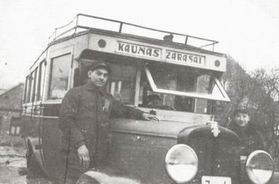
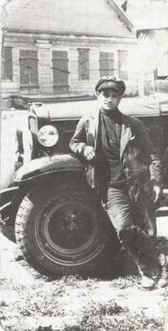
Like all the other children, I too studied at cheder. Then right after my bar mitzvah I began work as a wagon driver. In 1928 I enlisted in the Lithuanian army, and upon my release bought a “half bus” for six people plus luggage. I arrived in the shtetl on the eve of Passover. All the shtetl folk ran out to greet the bus. Horses were scared by it and went beserk…
Every morning I would travel from Dusiat to Kovno (Kaunus). I would sleep there and return the following day. I was given orders for different agents, and even money to pass on, as well as other missions. My brother Bentzke and I managed the line honestly.
We started with a small half-bus, and then grew to a 16-seater, and then a 35-seater. The trip from Dusiat to Kovno was considered expensive, 18 lit, so most people only traveled just before the holidays. There were regulars who worked outside the shtetl. Kahath Slep, for example, worked in Rakishok as a bookkeeper. He would leave on Sunday and return on Friday. There were others as well.
When the Russian-German war broke out, that same Sunday morning, my brother Ansel and I left the shtetl with the bus, not knowing that it would be the last time we would travel that line.
Rivka Levitt: The first time a car came into our village (probably government officials), we thought G-d had descended from heaven…Reuven Milun: I remember Krut's bus well, even the headlights that shone. We stood rubbing our eyes in disbelief at this amazing sight…
Henia Sneh: The Krut family was in the headlines at that time. All of us, youngsters and kids, ran over and asked Baruch and his brothers, Ansel and Bentzke, to let us on and drive us a bit…
Rivka Shteinman: Every evening with the arrival of the bus, we would all go out to see whether a guest had arrived…
Malka Gilinsky: Everyone would go out to the square to see who had arrived. It was part of our entertainment.
Shayke Glick: In the 1930's there were bigger and smarter buses; according to regulations they had to carry both a driver and a conductor.
On Shabbat when the Kruts wanted to rest, they would occasionally choose one of the youths to act as conductor. It was an experience to travel through the shtetls, until reaching Kovno… I must point out that this trip was done secretly, without the parents' permission, because of desecration of the Shabbat…
And only I, the smallest, hadn't been given the honor, until one day when there were no other contenders because they'd all seen Kovno, they came and offered me the job. It was an honor for me, the feeling was grand; I'm already big!
That Shabbat my mother went away to the Levin's of Antaliept. I was afraid she would catch me in my dereliction, so I asked Bronka, the non-Jewish driver (who was said to be a big anti-Semite), to avoid Antaliept and not enter it. Bronka did not do as I requested, and as soon as I saw that he hadn't diverged from the route, I dived out of the moving bus and rolled in the dirt. I was badly scratched. I went home…
I knew the route well. Already as children we would play “horse and cart”; we would “gallop” to Antaliept until we could see the church steeple. We would then return to Dusiat…
Malka Gilinsky: We had many and varied forms of entertainment. We would walk along the Milner Gass and Unter Dem Brik. We didn't like walking on Maskevitcher Road. Maybe because it was a non-Jewish area, or maybe the road was too short. At the end of the road was the chapter of Hashomer Hatzair, next to the rabbi's house. He would ambush us and chastise us for breaking the Sabbath, so we avoided that spot.
Rasya Tal: The walks in the streets were part of our entertainment, even for our age group. We would meet a group of kids in the street, and I remember in our childhood the boys would annoy the girls by lifting their skirts and peeking… also as we grew older we would “patrol” the streets back and forth, gossiping and laughing. We would always find a “victim” to make fun of…
Shayke Glick: And Rasya knew how to laugh! She had a wonderful, rolling laugh that would go on and on, and we would be infected by it…
Kovno-Zarasai Line |
|
|
JewishGen, Inc. makes no representations regarding the accuracy of
the translation. The reader may wish to refer to the original material
for verification.
JewishGen is not responsible for inaccuracies or omissions in the original work and cannot rewrite or edit the text to correct inaccuracies and/or omissions.
Our mission is to produce a translation of the original work and we cannot verify the accuracy of statements or alter facts cited.
 Dusetos, Lithuania
 Yizkor Book Project
 JewishGen Home Page
Copyright © 1999-2024 by JewishGen, Inc.
Updated 9 May 2009 by LA