 |
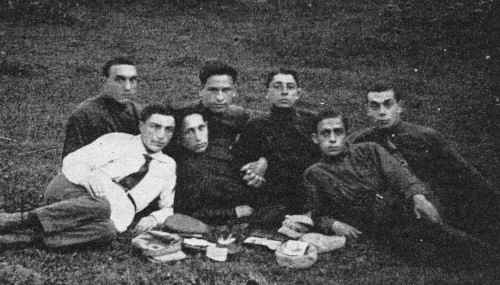
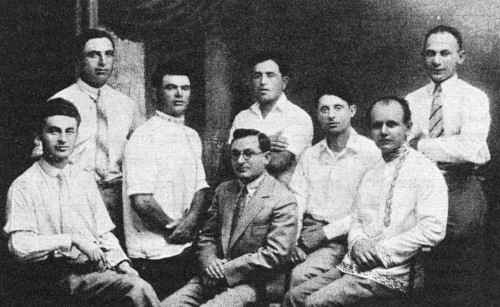
From left to right: Mordechai Malot, Shlomo Bunimovich, David Yitzchak Kantorovitch, Zeev Shaker, Tzvi Rogovin, Meir Yeshaya Meltzer, Yechezkel Glik.
|
[Page 391]
[Page 392]
[Page 393]
Written by Shlomo Bunimovich of Karkur and Tzvi Rogovin of Tel Aviv
Translated by Jerrold Landau based on an earlier translation by M. Porat z”l
that was edited by Judy Feinsilver Montel
The Tzeirei Zion chapter of Volozhin was founded in 1918 and was one of the earliest in Russia. Volozhin was near the front, and thousands of Jewish youths were hosted in Jewish homes for the festivals. Some of them were educated young men who were members of various parties. They conducted mass meetings under the open sky, where the representatives of the various parties attempted to prove the correctness of their political path. There were Zionists among the speakers, who proved that our nation has no chances in the Diaspora, and therefore one must make aliya to the Land of Israel.
The major influence in this area was the appearance of the poet Shaul Tchernichovsky in Volozhin. He appeared in our town in the year 5676 (1916) in the uniform of a Russian captain, and lectured in the Great Synagogue about Zionism and the revival of the Hebrew language. His words left an unforgettable impression. The Volozhin youth were educated from their early childhood in the spirit of Zionism and Hebrew. My parental home was full of stories from Grandfather and Father, who told about the great students who studied in the Yeshiva of Volozhin, and were the first of Chovevei Zion. The teacher Avraham Gorelik played a key role in the forging of the Zionist reality. (He married the sister of Yosef Kahanovitch). He founded a Hebrew school in 1910 which utilized the “Hebrew in Hebrew” [i.e., Hebrew immersion] methodology. That school educated in the spirit of Zionism and love of the Land.
The general atmosphere that pervaded in Volozhin of that time was of the Messianic Days, of the final generation of slavery and the first of redemption. Even the gentiles talked about this. There was a legend circulating amongst them about a wonderous man amongst the Jews named “Pompador” (referring to Yosef Trumpeldor), who will bring the Jews to the Land of Israel.
The founder of the chapter in our city was Osher Malkin. He participated in the Tzeirei Zion convention in Russia. He assembled a group of activists, which included: Shlomo Bunimovitch, Tsipa Gelman, Chaim Deretshinski, Noah Horovitz, Yosef Tabachovitch, Olya Swirski, Yisrael Rogovin and Tzvi Rogovin.
The chapter issued a Journal “Der Bezem” (The Broom), edited by Shlomo Bunimovitch and Tzvi Rogovin, which dealt with an analysis of events of Volozhin, youth, education, and other matters. The writers called upon young people to make aliya to the Land of Israel.
In its first days the group numbered approximately eighty persons, male and female. We rented a club in Galia Perski's house in the Lower Town (Aroptzu). We organized an amateur theater group. Our group successfully performed several shows, among them “Di Pintele Yid” (The Jewish Point of Essence), “The Mechasheyfe” (The Witch), King Lear, and “Mirele Efrat.” We also held literary debates. The most memorable was the debate
[Page 394]
on Sholom Aleichem's “Menachem Mendel,” the purpose of which was to prove the miserable situation of our people who lived among the gentiles, living a life based on ethereal pursuits. The main activity was in the realm of culture. There was a library in Volozhin, headed by Russophiles (lovers of Russian culture). Anyone who visited was obliged to speak only Russian. We stormed this library in order to turn it into a Zionist library. To this end, we registered all our members, and we became the majority. A leadership committee was formed, consisting of Avraham Gurwitz, Tzvi Zeltzer, Akiva Potashnik, and Tzvi Rogovin. The library became bilingual in Hebrew and Yiddish.
Our victory greatly advanced the activities of the chapter, for in those days, the library served as a “spiritual center,” serving not only as a place for reading books, but also for the exchange of ideas on various issues.
We received news on what was taking place in the Land from the Achdut anthologies that arrived from the Land of Israel. They served for as material for lectures on what was taking place in the Land. Local people also helped us. Mr. Yehoshua Horwitz, a scholar and a Zionist, responded positively to our invitation, and explained the essence of the Zionist idea in his lectures.
|
|
From left to right: Mordechai Malot, Shlomo Bunimovich, David Yitzchak Kantorovitch, Zeev Shaker, Tzvi Rogovin, Meir Yeshaya Meltzer, Yechezkel Glik. |
[Page 395]
Our party, despite being socialist, organized a special Minyan for its members on Simchas Torah. Yosef Tabachovitch served as the prayer leader for Shacharis, and Avraham Berkowitz did so for Musaf. He also served as the Torah reader, and recited the Mi Sheberach prayers for donation pledges that were pledged during the aliyos to the Torah. The income was dedicated to the expenses of the chapter.
Our chapter organized “Pirchei Zion” from which Hechalutz in Volozhin sprouted. The workers organized themselves into the national workers organization. Shlomo Bunimovitch participated as a delegate to the convention of the tradespeople that took place in Warsaw. We also collected money for the benefit of the Fund for the Workers of the Land of Israel, and participated in Tzeirei Zion conventions.
One Friday after the Mincha service, we affixed in the synagogues long manifestos that ended with a revolutionary call: “You will not be the ones to run the civic affairs!” Our action evoked a positive reaction from the community. The communal council was disbanded, and democratic elections took place. A new council was elected, which included two of our members: Yosef Tabachovitch and Yeshayahu Kaganovitch.
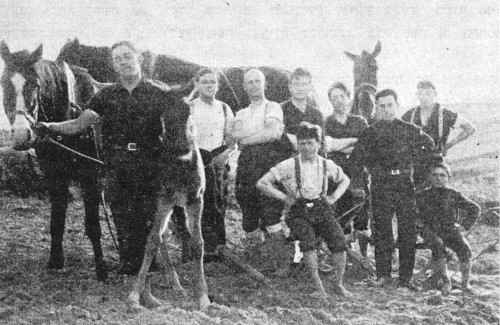
From its beginnings, our party believed that the interpretation of Zionism is a person living in Zion. In order to translate our outlook into a practical language, we founded an agricultural Hachshara group in the village of Rudnik. We worked in Michla's farm. She was a Zionist woman who had purchased land in the Land of Israel.
Mr. Aharonshtam was in Volozhin in 1924. He organized a seminar there for party members and sympathizers. His influence was quite noticeable in the city. His successful educational activity led to the growth and strengthening of the chapter. In 1925, we received a directive from the Tzeirei Zion headquarters in Vilna that we were to go to the city of Lida, where the committee for issuing permits for aliya resided. About fifty of us went. Most were certified for aliya. In the year 5686 (1926), Meir Baksht, Shlomo Bunimovitch, Tzvi Rogovin, and others made aliya to the Land.
Written by a group of pioneers
Translated by Jerrold Landau based on an earlier translation by M. Porat z”l
that was edited by Judy Feinsilver Montel
The beginning of Hechalutz in Volozhin was based on “Cherut Vetechiya” [Liberty and Revival], a non-partisan Zionist youth organization, comprised mainly of studying youth of the age of 15-16. It was founded in 5681(1921). Its living spirit was Moshe Zalman Luntz (Ben Sasson), a scion of the dynasty of Rabbi Chaim of Volozhin. Its purpose was to educate the Jewish youth of Volozhin toward Hebrew and Zionism. This movement created a revolution in the way of thinking of the youth in our city. When we were studying in cheder and later in the Tarbut school, a picture of the Land of Israel as something founded in legend was drawn before us. Hebron, Shechem, and Beer Sheva were names only written in the Torah, and not existing in reality. Cherut Vetechiya educated us to cleave to our homeland and to negate its desolation through the work of our hands.
|
|
First row, right to left: Shlomo Berger, Shneur Kivilevitch, Binyamin Shishko, Yechezkel Glik Second row: Chaim Kahanovitch, – , Shimon Tabachovitch |
Its main activity was expressed in the sale of stamps of the Jewish National Fund and the collection of money for that fund. A children's library existed alongside Cherut Vetechiya. It was established through the donations of books that we collected in various houses. It was located in the house of Chaim Hirsch Perski on Vilna Street. Chaim
[Page 397]
Potashnik (Eshlagi) served as the librarian. The first Hebrew book obtained by the library was “Memories of the House of David” by Avraham Shalom Friedberg.
Cherut Vetechiya put on performances for the broad community in order to support its activities. The first play was “Der Darfs Yung” (Child of the Village) by Kobrin. The announcements were published in Hebrew and Yiddish. As there was no printing press in Volozhin, Avraham Berkovitch volunteered to draw the announcements. The performance took place in one of the buildings of Count Tyszkiewicz in Aroptzu (next to the river). The performance was very successful, and was performed several times.
Moshe Zalman Ben Sasson founded Cherut Vetechiya from an educational and ideological perspective in order to make the publicity efforts easier. Moshe Zalman published a satirical newspaper called Der Shtelk Dreier. Members of the editorial board were Moshe Zalman Ben Sasson, Esther Shaker, and Chaim Binya Kahanovitch. The newspaper included criticism of life in the city, issues of the day, and politics. The purpose of that criticism was to emphasise the life of atrophy in the city, and to educate the Jewish youth to changes of values and aliya to the Land of Israel.
|
|
From left to right: Noach Perski, Shlomo Berger, Moshe Zalman Ben-Sasson (Luntz), Binyamin Shishko (Shapir) Chaim Binya Kahanovitch |
Moshe Zalman preached properly and also fulfilled properly. He made aliya to the Land in the year 5683 (1923). The activities of Cherut Vetechiya weakened after his aliya. However, this decline was only temporary. The pioneering seed
[Page 398]
planted in the hearts took root, and Hechalutz, which was founded in the year 5683 (1923) sprouted from it.
The great poverty that pervaded in Volozhin pushed us into the ranks of Hechalutz. We opened our eyes to see and understand that we have no place on foreign soil. Our youth was consistent in its conclusions, and began to prepare energetically for new life in our ancient homeland.
The first members of Hechalutz were: Yaakov Girzon, Nachum Gelman, Mendel Volkovitch, Shimon Tabachovitch, Chaim Binya Kahanovitch, Eliezer Lavit, Leibel Luboshitz, Zelig Meltzer, Rachel Meltzer, Chaim Potashnik, Akiva Potashnik, Etl Paretski, Eliyahu Hershel Perski, Yitzchak Perski, Sonia Kozlovski, Fania Kivilevitch, David Yitzchak Kantorovitch, Eliezer Kaplan, Ben Zion Kaplan, Musia Rogovin, Esther Shaker, Mordechai Yudel Schwartzberg, Benyamin Shishko.
|
|
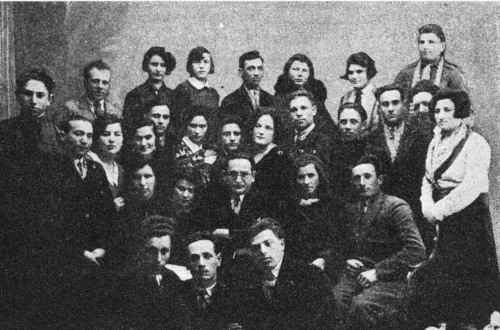
Standing at the top (alone): Eliya Ber Girzon First row from the top (right to left): Zelda Rappoport, Sara Rudnitzki, Liba Dolgov, Aharon Mordechovitch, – , Yehoshua, Leibel Perski, Shlomo Berman, Yosef Bernstein, Shmuel Rogovin Second row: Sara Meltzer, Hinda Mordechovitch, – , Lea Kivilovitch, Dobe Bernstein, Fruma Rogovin Third row: Feigel Kagan, daughter of Yitzchak the smith, Liba Luboshitz, Dov Lavit, Bella Shaker, Yitzchak Perski, Rachel Rogovin, Yosef Schwartzberg, Sara Malot, Batya German, Rachel Dolgov Fourth row: Leiba Berman, Yosef Girkop, Yaakov Berkovitch, Leibe Daul, Baruch Simerenitzki |
[Page 399]
We contacted Yosef Bankover in Vilna, who were for the “Palestine Office” (The Land of Israel Office), and we requested that he visit Volozhin. We convened a meeting in the house of Mordechai Potashnik on Vilna Street, in which approximately thirty members attended. The first meeting place of Hechalutz was in the house of David Lipkovitch on Smorgon Street. We began to operate in the area of culture. The teacher Tzvi Zeltzer and Noach Perski taught us Hebrew. We received Hapoel Hatzair and Heatid [The Future] from the Hechalutz Center (the central newspaper of Hechalutz in Poland) from the Land of Ysrael. David Yosef Kantorovitch received the booklets of Achdut Haavoda, read them to us, and explained their content. Zeltzer lectured about knowledge of the Land. Even the teacher Chaim Golobanchick did his part in the cultural activities of the chapter.
|
|
Standing right to left: Kehat Segalovitch, Mordechai Schwartzberg, Tzvi Perski, David Yitzchak Kantorovtch Seated: Chaim Derechinski, Simcha Perski, Yitzchak Perski, someone not from Volozhin, Meir Baksht Next to him: Tvi Tzart |
We did not merely suffice ourselves with cultural work. We knew well that Hechalutz required the soul, that is, aliya to the Land of Israel. In the year 5684 (1925), Bankover visited Volozhin once again and lectured in the Kleizl on the topic of “What I saw and heard in the Land of Israel.” In his lecture, he called upon us to go out to the
[Page 400]
Hachshara Kibbutzim to prepare ourselves for a life of labor and creativity in the Land of Israel. His words enthused the hearts. The result was the founding of a Hachshara group in Aroptzu, which was called Hakovesh. This group was composed of people from Smorgon, Rakov, Vileyka, and Oshmiana. From among the members of Hechalutz who participated in this group, we remember the names of Eliyahu Schneider (Shnay). The group was housed in the house of Bernstein the smith. Liberman from Smorgon, a member of Hapoel Hatzair, served as secretary. The group members earned their livelihoods from work in the flourmills and sawmills of Volozhin. The wood was brought from the Fishlivitz Forest, and we worked at cutting it. The group existed for about a half a year. Members of Hechalutz also founded a Hachshara group in Jezupol.
|
|
Right to left: Shneur Kivilovitch, Eliezer Lavit, Etl Shaker, Shmuel Polak, Musia Rogovin |
We also searched for other means of Hachshara. There was a vegetable garden in Aroptzu. We worked there, and also guarded it at night. David Yitzchak Kantorovitch, who had agricultural knowledge, served as the guide. Chaim Potashnik and Chaim Binya Kahanovitch taught the trade of sawmilling. Eliyahu Weisbord and Shimon Tabachovitch taught sawmilling in Oshmiana. There was also a Hachshara group there called Arza where carpentry was taught under the direction of a counselor who was sent from the Hechalutz headquarters. Mordechai Yudel Schwartzberg worked in Jezupol with Shiff, and Ben-Zion Kaplan went to Hachshara near Rakov.
[Page 401]
|
|
From right to left: Standing (right to left) Zelig Meltzer, Fania Kivilovitch, Shimon Tabachovitch, Eliezer Lavit, Yaakov Girzon Seated: – , Chaim Binya Kahanovitch, Chaim Potashnik, Esther Shaker Seated on the ground: – , David Yitzchak Kantorovitch |
In order to strengthen the activities of the chapter, we made sure that several of our members would make aliya to the Land. Chaim Potashnik was certified for aliya, and he made aliya in May 5684 (1924). About a half a year later, Nachum Gelman and Chaim Binya Kahanovitch made aliya. In 5685 (1925), Yaakov Girzon and Fania Kivilovitch made aliya. Fania was accepted as a member of Kibbutz Ramat Hakovesh.
After Chaim Binya Kahanovitch made aliya to the Land, Yitzchak Perski was chosen as chairman of the chapter. Yitzchak was very fit for his task. The chapter grew during his tenure. This growth placed two problems before us: cultural and economic. Yitzchak concerned himself with both. There were several lads in Volozhin who had graduated from the Tarbut Seminary in Vilna. Yitzchak enlisted them for work. First, he brought his brother Noach, who was a teacher, into this job. A painful and worrisome gap in the area of cultural activity was formed when Noach left Volozhin. Yitzchak attempted unsuccessfully to attract various members to this activity. Therefore, it was decided to hire a teacher for pay. He hired the teacher Zeltzer, who taught
[Page 402]
us Hebrew, knowledge of the Land, history of the Zionist congresses, and the history of the new settlement of the Land of Israel.
The members who were certified for aliya placed before us serious financial issues, for some of them were lacking in means, and it was necessary to finance their aliya to the Land. Yitzchak organized a performance, the income of which was dedicated to the aliya of an impoverished pioneer who was liable to lose his certificate.
Yitzchak Perski stood on guard as a faithful soldier until he made aliya to the Land in the year 5682 (1932). Shlomo Berger, Etl Chritzki, and Mina Perski also made aliya that year. After Perski made aliya, Shlomo Avraham Liberman was chosen as head of the chapter. The chapter was located in the home of Dovka in Aroptzu, and numbered about fifty male and female members. Later, it moved to the Tarbut school building.
A regional convention of all chapters of Hechalutz took place in Horodok in the year 5682 (1932), with the participation of Yeshayahu Pundik. His aim was to encourage the members to go to Hachshara and to make aliya to the Land.
|
|
Standing right to left: Aryeh Luboshitz, Aryeh Shulman, Chaim Potashnik, Shimon Tabachovitch Seated: Tzvi Rogovin, Yaakov Girzon, Meir Baksht |
Members of the chapter also participated in the summer moshava that took place in Smorgon. Approximately three hundred members, male and female, gathered there from all chapters of the region. The moshava took place in the forest. The participants lived a life of difficulty. They slept on the ground or on attics, and crowded into a small, abandoned house. All this was to inoculate the participants to the difficult life conditions awaiting them in the Land of Israel. The moshava took place
[Page 403]
under primitive natural conditions. A ditch was dug, and a sort of round “table” was formed. The ditch served as the chair for everyone, upon which they sat around the “table” and ate.
This moshava contributed greatly to the increase of the pioneering tension. It cut the participants off from city life. They stopped finding content and interest in such life. From that point, their entire desire was to go to Hachshara and to make aliya to the Land of Israel. Indeed, they began to go to Hachshara. Batya Botwinik, Esther Grynberg, Chaim Tzvi Potashnik, Fruma Rogovin, Sara Rudnitzki, and Sara Rappoport went. They were certified for aliya and returned to Volozhin after about a year. The chapter then grew and developed greatly.
|
|
Standing right to left: Shlomo Skliot, Sara Rudnitzki, Chasia Daul. David Yitzchak Kantorovitch, Sara Rappoport, Sonia Dolnov, Rafael Skliot, Aharon (Areh) Rogovin Second row: Liba Dolgov, Chasel Perski, Avraham – , Matityahu (Mates) Skliot, Chaim Perski, Gitel Perski, Simcha Perski, Sonia Perski, Chaim from Vyshniva, Eshka (Esther) Rudnik, Batya Botwinik, Michael Perski Third row: Leibel from Vishniva, Esther Shaker, Chaim Stkolshchik, Rivka Polak, Etl Paretzki On the ground: Yosef Schwartzberg, Yitzchak Perski, Chaim Botwinik |
Since the Zionist leadership was forced to expedite the exodus of the Jews from Germany –
[Page 404]
not too many certificates remained for the Hechalutz movement. For this reason, Sara Rudnitzki and Sara Rappoport returned to the Hachshara Kibbutz and waited for approval for aliya.
|
|
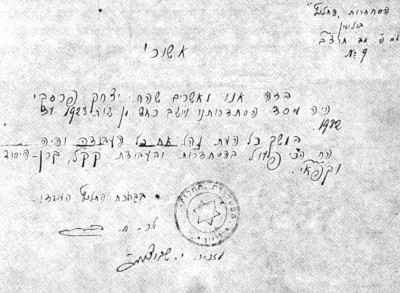
“5 Av, 5692 [1932]. Number 9. We hereby confirm that Yitzchak Perski was the founder of our organization and chairman from 1923 to 1932. He led all the activities through all that time, and he was the most active member in the organization, in the work for the Jewish National Fund, Keren Hayesod, and the fund for the Land of Israel. With greetings to Hechalutz Haoved!
[unsure of main signature] |
Winds of agony began to blow in Volozhin. Anti-Semitism raised its head. The Jews were under the staff and at the mercy of those wicked people. Means of livelihood were closed. However, our dear families lived their day-to-day lives without considering that they were standing on the threshold of the end of days.
The decline of Hechalutz in Volozhin began in the year 5698 (1938), the last year before the outbreak of the Second World War. The lack of certificates was the decisive factor to this decline. The members had waited for aliya for many years. Despair overtook them when their hopes were dashed. They stood before a sealed wall, without means of salvation.
The members of Hechalutz walked about dismayed and mourning. They were locked between their desire for the Land and the necessity of remaining in Volozhin. They bore in their hearts the flame of hope to be graced with the soil of the Land – until it was extinguished with the Soviet invasion of our city.
|
JewishGen, Inc. makes no representations regarding the accuracy of
the translation. The reader may wish to refer to the original material
for verification.
JewishGen is not responsible for inaccuracies or omissions in the original work and cannot rewrite or edit the text to correct inaccuracies and/or omissions.
Our mission is to produce a translation of the original work and we cannot verify the accuracy of statements or alter facts cited.
 Valozhyn, Belarus
 Yizkor Book Project
 JewishGen Home Page
Copyright © 1999-2024 by JewishGen, Inc.
Updated 05 Dec 2023 by JH