 |
|
|
[Page 65]
Shmuel Spigler of Tel Aviv
|
|
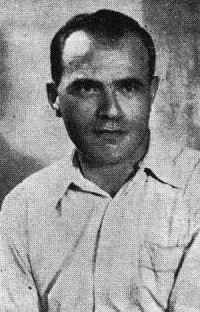
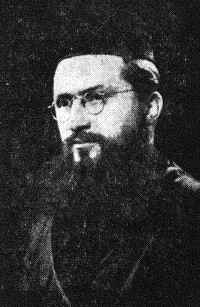
| Uncaptioned. Shmuel Spigler |
| My annihilated father and mother, Aharon and Feiga Spigler of blessed memory; My sister Pesha with her delightful child, who were killed; My murdered brothers Yehuda and Moshe In memory. |
Once again I can see the small, wooden houses with the shingle roofs, the large houses and the various businesses, the market place, the Ulica, the Targowica, the upper town, the Beis Midrashes, synagogues, cheders and Talmud Torahs; as well as various organizations, including Hitachdut, Hechalutz, and Hashomer Hatzair. The people of the town, its scholars, teachers, shochtim (ritual slaughterers), musicians, toilers, shoemakers, tailors and water carriers. The wise men and orators – a treasury of personalities who lived and breathed, created and worked in our small town of Turka.
I again see it during the six days of the week, during its secular times as well as during its Sabaths and festivals; in its times of agony and sadness as well as in its ebullient joy, hoping and believing. I again breathe the sweet pleasantness of the forests, the flowing of its hidden streams, and the green meadows in which we all used to sit together, dreaming and believing in a finer and better world.
Friday in Cheder
It was wintertime in the town. White snow covered the entire town like a large, white sheet. It was neat and clean. All of the roofs
[Page 66]
of the large and small houses were covered with deep snow. The windows were frozen, and covered with various forms of ice flowers. It was the eve of the Sabath. We came from the upper town, and went around the mountain on sleds, until we came to the wide, wooden bridge. The river was frozen over, and children were skating over the wide river. The old, gentile water carrier would stand by the edge, filling up pails of water, loading them onto the wagons and carrying them to the Jewish houses in honor of the Sabath.
The frost “burnt”. We walked on. The snow crunched under our feet. Suddenly, we see the bridge. We turned to the left, and went through the Czortkower, Belz and Sadagora Kloizes. There was an old, crooked, run down cottage not far from there. We would stand there and peer through the small, frost-covered windows – yes, this is him, our schoolteacher Yisrael-Leibele Kilowocz, as he was called in the town. We go through the wide, low door, and dressed in our kitzmes[1] fur coats and boots, and sit down on the wooden bench around the table. The Rebe with his bamboo stick, begins. We open up our Chumashes and review the weekly Torah portion for the last time before the test.
The Rebe begins: “Repeat, children, once again: “vaani – un ich…”[2]. We all began to recite out loud, with voices clanging like bells filling up the small, cold room: “Vaani – un ich.” Although I am troubling you with my burial, I was not able to do so for your mother Rachel, for. “Bevoi” -- as I was coming from Padan Aram, “Meita – is geshtorben”, “alay – oif mir”, 'Rachel – your mother Rachel…” Thus did we repeat the entire Torah Portion of Vayechi verse by verse. After that, we reviewed the Torah portion with the cantillation. We finished quickly, got dressed, went out the door, and went out side with a tumult. Then we played in the snow and ice.
With the Rabi
It was as if by magic that the small house, the rabi, the cane, the long, wooden table and the benches disappeared – and we, hand in hand,
[Page 67]
went further on… And then we were standing before a house not far from the Sadagora Kloiz, where the rabi of the city, the Gologower Rabi, Rabi Eliezer Mishel, lived upstairs. He was a great scholar, sharp and expert also in secular subjects, and known throughout Galicia.
We went inside. There were two Jewish women with hens in their hands in the anteroom, about to ask a Halachic question. The rabi was very lenient, only very rarely declaring something non-kosher. We entered the large room. The rabi had a splendid countenance. He was dressed in a long frock with a warm Spencer atop, sitting on a leather stool around a long, oak table, covered with a tablecloth. There were four large, silver candlesticks on the table. His two wise, dark eyes were peering into an open book before him. His high forehead wrinkled and pondered. His long white beard flowed over the Spencer. There was a large, silk yarmulke over his grey, hoary head. On one side there was a closet going up to the ceiling, packed with books. The entire room smelled like yellow parchment, holiness and erudition. A calm pervaded.
Both of his sons, great scholars themselves, sat in the second room. The oldest – as people whispered about town – even went out to a bad crowd and looked into the “books”. Along with Talmud and Halachic decisions, he studied mathematics and philosophy, and would get together with youths who would discuss and debate what is above and what is below, attempting to clarify matters…
I recall as if today how our fathers used to partake of the Purim feast or spend Simchat Torah with the rabi, as we absorbed his scholarly general conversation, filled with wisdom of life, depth and sharpness. The rebetzin would look into the room from time to time, enter the room, with love and respect place a piping hot glass of tea in front of the rabi, and exit.
In the Bathhouse
The frost was biting. We remain downstairs, breathe in again in the house and the “dwelling”, and walk on further… Then we find ourselves
[Page 68]
not far from the bathhouse. Jews of the town, old and young, with bags of underwear and towels under their arms, run to bathe and take a steam bath in honor of the Sabath. They would cast off the toil of the entire week, cast off the yoke of livelihood, the trials of childrearing and other tribulation, at least for one day.
Sabath eve at the bathhouse
We enter. It is warm and stuffy inside. There is a warm mist in the air and it smells sour. It was stuffed with people. The bathhouse was the only place where the entire town was equal… there is no eastern wall… there is no sixth aliya or maftir… there is no rich and poor. Everyone is under the same vapor, which they loved, and which
[Page 69]
was refreshing… The well-off householders sit on the upper bench along with the shoemakers and tailors – everyone whom G-d had created. They sat there with the pails of cold water in their hands, flaming red faces, and sweat dripping down. Chazkele stands as always next to the wood stove. He was an elderly Jew who loved to tipple. Whether at a wedding or a yahrzeit observance, he would be chief among the drinkers. He stands there, pouring the pails of water onto the oven. He then smacks the hot mist, which sprays all the way to the upper benches. Everyone calls out, “Ah, ah ah, hu, hu hu! Chazkel, another one!” Chazkel does so, for Chazkel does not economize… The heat increased from minute to minute. People would run into the mikva with stony steps and immerse themselves in accordance with custom. It was indeed a kosher mikva, and it was a mitzvah to immerse oneself therein.
It was starting to get late. People left the bathhouse individually or in groups. They got dressed at home and prepared themselves for services.
In the Kloiz
It is getting dark, and night is falling. The holy Sabath candles, kindled by our G-d fearing mothers as they wept and wished good health and livelihood for the entire family, flicker through the frozen windows. We all don our Sabath clothes and walk with our fathers to the kloiz to welcome the Sabath.
Dudi Kardish stands by the prayer leader's lectern in the Sadagora Kloiz to welcome the Sabath, “Lechu neranena Lashem, naria letzur yisheinu… Lechu dodi likras kala, pnei Shabat nekabela.”[3] We recite the Friday night service and set out for home.
Everyone is dressed in their heavy fur coats and streimels. The wealthy people wear expensive karekolen furs[4] and the regular people with fur coats that were shedding. Everyone goes home, some with a guest and some without a guest, to welcome the Sabath in their homes.
[Page 70]
At the Covered Table
Inside the houses, everything is clean and tidy. Every corner smelled. The table is covered with a white tablecloth. The silver candelabra, the wine and the covered challas were prepared. The mother, dressed in her Sabath clothes, with a kerchief on her head and a white apron, sits and enjoyed the surroundings. She enjoys satisfaction because G-d had helped her with everything until this point, and would likely continue to help her – does she have a choice?
The father recites “Shalom Aleichem malachei hasharet,” and then, the heartfelt “Eshet chail mi yimtza” He then fills up the cup and recites the Sabath Kiddush. Everyone sits around the table. Mother serves the fish and meat, and then everyone begins to hum the Sabath hymns with joy and faith, praising His beloved Name. “Kol mekadhesh Shevii karaui lo,” and “Ka ribon alam vealmaya.” The mother glows: it is a pleasure to look at her and her entire house.
The sons and daughters have already long ago left the house. They left their parents at home by the flickering candles, as they were looking into Tzena Urena or a book[5]. The younger generation went out to seek a new way and life, a new content. It began to be constricting in the four ells of the house and the Beis Midrash. New winds began to blow in the streets of the town. The era of seeking and longing for other forms of life began. The G-d of Abraham, Isaac and Jacob, Chumash and Rashi, Choshen Mishpat and Yoreh Deah[6] no longer brought joy. New gods and new ideals began to appear that attracted and carried away the youth.
Thus did Father and Mother remain by the flickering candles, with their old faith in the G-d of Abraham – as their daughters went out from the nest to seek new food, new spiritual food to calm the thirsty souls.
New Ways…
We walk on further… We already realize that aside from the Turka of satin and silk, women's head coverings and strands of pearls, Talmud and
[Page 71]
Halachic decisors, Tzena Urena and Ein Yaakov, there was another Turka -- a Turka of vibrant, creative youth, of groups of maskilim vehemently seeking new ways, who began to band together to attack the way of life of the elder generation. A word went around that the Turka skies were covered with rags from which new guests descended during those times, which with the passage of time became old residents and began to be the new trendsetters, penetrating the minds of the youth, bringing new notions and problems of G-d and man, man and the world, Schaffenhauer and Nietzsche, Hegel and Kant, Freud and Wininger from one side; Iveson-Strindberg, Roman Rolon-Barbis, Tolsoy-Dolstoyevsky-Gorki; and with them, the entire precious haskala literature in Hebrew and Yiddish: Mapu, Smolenskin, Feuerberg, Mendele, Shalom Aleichem, Asch and Bergelson – from the second side. They, the new guests, formed a new way of living and a new form of man. These were all factors in the creation of a national-worldly way of life for the youth of the town.
The return to Zion, the Land of Israel, the Western Wall – which were once so far, were no longer a dream. They began to take on flesh and bones. Zionism was no longer a hollow notion, but rather became a subject around which the youth began to form various groups, the strongest and most influential of which at that time was, without doubt, Hashomer Hatzair. Already a that time, it played a significant role in Jewish life throughout all of Poland, and especially in Galicia. Throughout the large cities of Congress Poland and Galicia, Hashomer Hatzair was composed for the most part of academic youth whose mother tongue was Polish both at home and on the street. They brought that atmosphere into the movement, and the entire scouting and cultural work was conducted in the Polish language, and only partly in Hebrew. However, the development of the youth of the small towns in Poland, especially in Galicia, was entirely different.
[Page 72]
The youth of the small towns in Galicia who filled up the Hashomer Hatzair organization and bound their way of life and weltanschauung to that movement, stemmed primarily from the petite bourgeois classes of society, small-scale merchants, tradesmen, observant houses, where Yiddish was the mother tongue both in the home and on the street.
Those small-town youth brought elements into Hashomer Hatzair that were strange and lacking in the larger cities. Those elements included Yiddish Literature, Hassidic enthusiasm and devotion, and the popular melody and song. Those youth revealed the “hidden light” of the Beis Midrash and the Jewish home to the movement. They further branched out from the historicity of Judaism, from old content to new forms. In that sense, Turka stood out among Hashomer Hatzair throughout Galicia. With time, the “way of Turka” broke out of its borders, and moved beyond.
In Hashomer Hatzair
… It is a warm, summer night. We are strolling through the town and are now close to the Hashomer Hatzair meeting place – and a calm, heartfelt melody reaches us. A tune – long, stretched out, full of longing. It is full of longing and the agony of the world. We enter, and unite ourselves with the others. It is a small, dark room. Avraham Monaster, Leibush Mandel, and David Langenauer, all Beis Midrash students who found their path into Hashomer Hatzair, are sitting there. They are all sitting, crowded together, and singing with their hearts and souls, as if one was observing the third Sabath meal on the Sabath afternoon. Hassidic melodies filled with devotion and enthusiasm, as well folk songs filled with joy and faith fill that little rom.
On another occasion in the meeting place –
In a large room, they are preparing for a performance which will shortly take place. Melech Brauer, the play director of the town, was a broad shouldered, chuby man;
[Page 73]
but inside him was housed an artistic soul. He is standing in the middle of the room, reviewing the roles of Peretz Hirshbein's “Grine Felder” with zest and enthusiasm. Yetke Reifler, Dudi Wolf, Izik Zolinger and the writer of these lines performed in it.
|
|
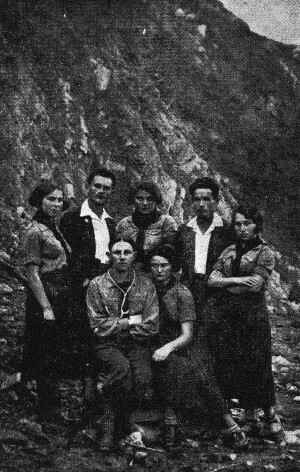
| A group of older members of Hashomer Hatzair during the visit to Turka of Yitzchak Sheiz of blessed memory of Kibutz Merchavia in 1934 |
[Page 74]
And further: In a third room, the counselors sit and hold a discussion with small groups regarding the Land of Israel, Kibutz, Hachshara, and other day to day questions of the organization.
Suddenly, it became bright and light in the entire premises, as a fervent hora began. The circle grew from minute to minute. Young and “old” entered the circle; the singing grew stronger and wilder, and could be heard outside.
*
In this manner life went on, year in and year out, from one generation to the next, in our beloved, small town.
This all once was – and today?...
Mother and father, brothers and sisters, relatives and friends whom we loved so very much are no longer there.
Therefore, let all of us survivors of Turka, here in the old-new homeland as well as in the entire world, continue to give a backward glance to our town, which is no more…
[Page 75]
by Zeev Steininger of Netanya
|
|
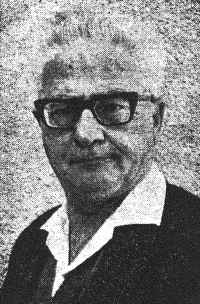
| Uncaptioned. Zeev Steininger |
We felt the festive atmosphere not only on the Sabath rest day, the day on which the city rested from all work, when all the stores were closed, when the streets were quiet without movement. Despite the fact that Turka was a mixed city of Poles, Ukrainians and Jews, the Sabath was felt very clearly, for the center of the city, from the bridge leading to the village until the beginning of the upper area, was settled by Jews, and all of the shops were in Jewish hands. We also felt this atmosphere during Friday afternoon, as the preparations to greet the Sabath Queen were in progress.
Hastening to the Bathhouse…
The shops were closed, and most of the Jewish population hastened to the bathhouse (steam-bath) in order to bathe and immerse in the mikva, to remove their weekday clothes and change them for their Sabath clothes – and to prepare themselves to greet the Sabath.
The bathhouse was housed in a building on the banks of the river that was not overly modern. It operated on Friday with “full steam.” It was in service during the middle of the week as well, but on that day, it serviced the masses. When you entered the dark hall of the bathhouse, you would immediately meet a tall, strong, mustached gentile who was in charge of the oven, which was made of smooth stones. He had a pail of water in his hands. From time to time, he would pour the water on the red hot stones, and the mist would rise upward, upwards… The bathers would be sitting on the broad, wooden steps, beating their bodies with brooms made of leaves. Suddenly, you would hear the call “Iwan, Dowoj” – telling the gentile to pour another pail upon the red hot stones. When the mist rose, you would hear sounds of satisfaction. It seemed like a struggle to overtake the growing heat… Apparently, these sounds housed the secrets of the bath, which, along with the preparation of the additional soul for the advent of the Sabath, was also
[Page 76]
instrumental in preserving the cleanliness and health of the people. (Indeed, the thought would come from time to time that the strong desire of our people to maintain themselves throughout the long exile was related to the set of customs, apparently connected to religion, but also connected to elementary needs that are vital for the physical existence of man.) At the end of the steam bath, they would descend into the mikva of cold water. When you left the mikva, you would drink a cup of “most”, which is a juice made from dried apples – the monopoly of family of Filinger and his sons.
On the Sabath Next to the Post Office…
|
|
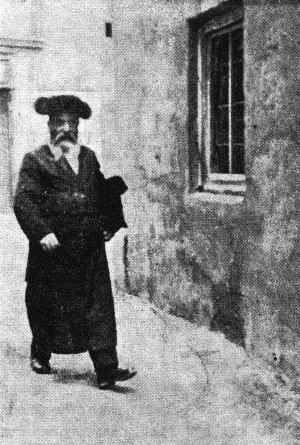
| On the Sabath – Reb Hersh Filinger on his way to the synagogue |
When the Sabath descended, everyone was dressed in their finery, with bekishes and streimels. Everyone hastened to the synagogue for the Sabath prayers. After the prayers, they walked home calmly
[Page 77]
for Kiddush and the Sabath eve meal. Then, most of the youth would gather together in their organizations to spend time in song, dance and discussions.
It was the Sabath morning. The streets were quiet, and Jews were walking along the streets toward the synagogue, slowly and calmly, garbed in their tallises. They went in groups, each group to its own synagogue. A unique experience, as if it was part of the Sabath, took place in another section of the city, where the post office was located. Next to the parapet along the street, the masses, dressed in their Sabath clothes, waited for the post office workers to exit the post office. When the two postal workers left, one turned to the long hallway of the next building, and the other turned to the other corner. The waiting masses were standing around. The postal workers quietly removed letters and newspapers from their large sack, and distributed to each person what was coming to them. In general, the newspapers, political weeklies or monthlies according to their respective parties, would arrive on the Sabath. After a time you would see how each person retreated to his corner, with a newspaper or booklet in his hands, and immerse himself in reading. You would also see groups discussing the issues of the day. These people were from the various Zionist groups, and generally young, progressive people. The Orthodox people and the adults were already at the synagogue at that time.
Synagogues and Houses of Worship
Most of the synagogues of the town were concentrated in one area, not far from the main street that leads upward to the Szymunka Mountain. If you turned to the left, you would find the Belzer Kloiz, which incidentally contained within its walls a large Torah library. On Sabath afternoons, you cold always meet people there sitting next to the long table, studying and deliberating over a chapter of Mishna. Opposite was the Czortkower Kloiz. As you crossed the narrow street, there would also be the central synagogue of the city – a large, spacious, fine building, built during the 1930s. Again to the right, on a small hill, was the largest synagogue – the Sadagora Kloiz. It was a very spacious building. The Tailor's Synagogue (Das Shneider Shulchel) was located next to the central city synagogue.
Of course, all of the synagogues were full of worshippers on Sabaths. Each Hassid went to his own synagogue. Each synagogue had its own eastern wall, and against the eastern wall, each synagogue had its own honorable members. During the High Holidays, another house of worship was added – the “Ochoronka” (Orphanage) – in which, for the most part, progressive folk and Zionists worshipped.
The Rabi of the City
If you would take a few more steps from the Sadagora Kloiz, you would end up at a large, spacious building.
[Page 78]
At least half of it was in ruins, and after you ascended the steps which were literally affixed to the air, you would enter a long hallway. If you turned left, you would enter a small room, and find three or for minyanim of Jewish worshipping. This was the seat of the rabi of the city. During weekdays, the long hallway served as the waiting room for those coming to ask questions or to clarify a matter of law.
The rabi sat in the interior room, upon an upholstered armchair with a ruber pillow. He had white hair, his beard was well-groomed, and he was dressed appropriately. He was always hunched over a Gemara, and he looked into it even during the times of prayer.
At times, we would see the rabi riding in a carriage on weekdays, dressed in a black kapote. He was apparently on his way to some reception or mission to the local authorities. We, especially the Jewish students in the schools, would also meet him on official national holidays. On such days, all of the students would gather in the Sadagora Kloiz for a festive gathering of school students. The students, accompanied by their teachers, would enter the synagogue in rows. Government figures would also be present, occupying places at the eastern wall. Kardish, a Jew who had the established claim for doing so at such events, would then ascend the podium and offer a prayer of thanks for the government and the head of state. Following him, the rabi would ascend, and deliver words of blessing appropriate for the holiday in a weak and quiet voice. It was hard to hear his words exactly. He would only raise his voice at the end, and conclude his words with a call of “Hoch, hoch, hoch.” The Great Synagogue not only served as a gathering place for masses of Jews on Sabaths and festivals, but also served as a gathering place for special occasions.
[Page 79]
by Shmuel Spigler of Tel Aviv
(a section)
… The shops were closed early enough, and the streets were almost empty of people. In every place and every corner, I felt as if something great and sublime was approaching.
Some of the residents of the town went to supplicate at the graves of their dear ones, asking them to be righteous intercessors before the Heavenly court, so that they would be granted a good year, a year of good livelihood, a year of peace and contentment.
Those who were stringent and exacting throughout the entire year about both light and heavy matters, and who would be even more so approaching the great and awesome day, went to the mikva to immerse their bodies and purify themselves for the Day of Judgment, so that they would be spotless when they went to approach the Creator of the World with a serious spirit and broken soul.
The Beis Midrash located in the center of the town was still empty, aside from a few Jews who stood by their lecterns immersed in prayer from the time they arose in the morning. Among them was Reb Berl the shochet (ritual slaughterer).
Reb Berl the shochet was an upright, G-d fearing Jew. He walked with G-d all of his days. Throughout the year, he would earn his livelihood from shechita, and on festivals, especially on Rosh Hashanah and Yom Kippur, he would serve as the prayer leader without expectation of payment. He did not make his prayers into a spade with which to dig[7]. Reb Berl would supplicate with a sweet voice, and it was certain that his sweet prayers emanated from his heart, steering their course among the thousands of prayers that stream heavenward on the night of Yom Kippur, bringing a good year and a positive conclusion of judgment upon the congregation of worshippers.
Just as he knew how to take caution in the laws of shechita, and would sharpen his knife with fear and trepidation every morning before services, lest it have a knick that would cause pain to a living being; he would spend the days and nights between Rosh Hashanah and Yom Kippur in the Beis Midrash with afflictions and prayers, in order to prepare himself for the great and holy night – the night of Yom Kippur.
[Page 80]
During the afternoon, one would find the Jews of the town hastening to recite Mincha (the afternoon service), and then returning home immediately after the conclusion of the services. Slowly the streets of the town would empty out, and no living soul would be seen outside. Everyone was at home, around the table, partaking of the concluding meal, the final meal before the great day. Father and Mother would kiss their children with tears in their eyes and stifled sobs, as they would wish them a good year and a positive sealing of judgment, a year of blessing and not a curse, plenty and not scarcity, a year without illness and evil afflictions. Father donned his white kittel, and put on the leatherless shoes. Mother was resplendent, dressed in a new dress, with a silk kerchief on her head and a festival prayer book under her shoulder – prepared to leave momentarily together with us children to go to the House of Prayer.
The sun was already giving off its last rays, with a reddish hue behind the town. Evening was descending, and the Jews of the town, elders and fine young men, dressed in their white kittels, socks and slippers, their tallises and festival prayer books under their shoulders, and set out for the synagogue along with the women and children.
|
|
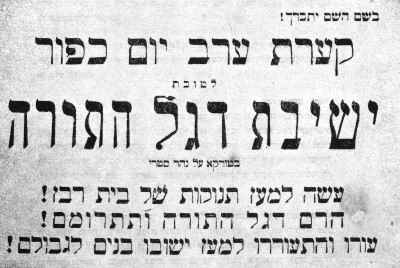
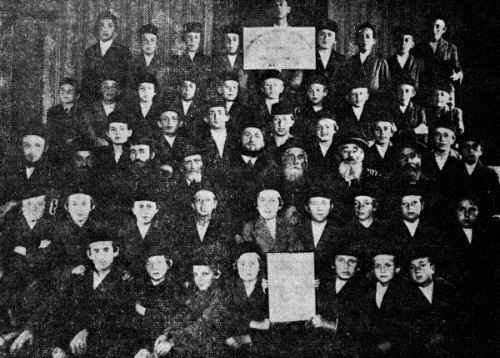
| In the name of the Blessed G-d! The plate of the Eve of Yom Kippur For the benefit of The Degel Torah Yeshiva In Turka on the Stryj River Act on behalf of the students of the house of study! Raise up the flag of Torah and be elevated! Arise and arouse yourselves for restoring the children to their bounds |
[Page 81]
The Beis Midrash of the Belz Hassidim continued to fill up moment by moment. Inside, there was great light from the chandeliers and lit candles, placed in jars, pots and various other vessels. The rabinical judge Rabi Yehuda was already standing next to the Holy Ark, enwrapped in his tallis, with its heavy adornment sparkling from afar. Honorable householders, 'fine Jews” were sitting at the eastern wall. Behind them were the shopkeepers, tradesman, teachers, and other clergy. The horse merchants, wagon drivers, water carriers, and tree hewers sat near the rear (in the “polish”) , all enwrapped in their tallies, with their prayer books before them.
Reb Berl the shochet was already standing at the prayer lectern, as he had already had the rights of serving as the prayer leader for Kol Nidrei and Musaf of Yom Kippur for many years. Silence fell upon everyone. Stifled weeping and sighing could be heard only from the women's section. The Holy Ark was opened, and Reb Berl the shochet began with a loud, ringing voice, in awe and trepidation:
“Light is sown for the righteous, and joy for the upright of heart.” The entire congregation along with the rabi, as one unit, repeated this verse seven times after him with devotion and great love. The melody continued on, breaking through the walls of the Beis Midrash and filling the atmosphere of the town with the splendor of holiness. “With the consent of the Almighty and the consent of the congregation… Kol Nidrei… And the entire house of Israel shall be forgiven along with the stranger in their midst… May our supplication ascend from evening, and may our prayers come to you in the morning…” One prayer chases another, and the entire service with its unique melodies penetrated the recesses of the body. I stood affixed to the side of my father, in awe and trepidation from the great and holy sight that was revealed before my eyes…
[Page 82]
by Rabi Alter Weinberger of New York
|
|
Hassidism is not the monopoly of Torah scholars, of dignified Jews, and of so-called well-pedigreed Jews. Hassidism does not know of such things. The essence of Hassidism equalizes and elevates every Jew, discovers the quintessence of everyone and brings it out to the open, as we say: “He examines and investigates the hidden storehouses”[8] – the Blessed G-d seeks out the good that is hidden in a Jew, even if he is coarse and weekday-like, very weekday-like. However, there is a treasury of good within every Jew, and the Blessed G-d seeks it and draws it out.
This is what I want to say about this: to write about Hassidic life in our city does not only mean to write about specific Hassidim – from the Sadagora Kloiz, Czortkow Kloiz, Belzer Kloiz, Zidichower Hassidim, Komoriner Hassidim, or Blazower Hassidim – and our town was indeed rich with them. The main thing is to write about the influence, the indirect influence that Hassidism had in general on the local synagogue Jew, village Jew, and tradesmen, such as shoemakers, tailors and the like.
As an example, I wish to write here about what took place in our town in 1939. When the Hungarians took over Carpatho-Rus from the Czechs “with the permission of the entire community,” young Jewish people from Carptho-Rus and Hungary began to escape. They fled to seek out better things. They fled and found. For the most part, they fled over the border at Uzhok, Sianki, Volovech, and other such places. The fearsome, well-known Polish police fortified the border guard, and of course captured people and beat them with cruel, deathly blows. Then they came out with a new decree –
[Page 83]
in any Jewish house in which they would find “such merchandise”, they would deal with the entire house, and it would not be honey that they would lick.
Thus it was: At that time, I and all my children, may G-d avenge their deaths, were sick with typhus, may G-d protect us. My following friends happened to be sitting with us at the time: Reb Shimshon Hirsch may peace be upon him, Reb Shmuel Yeger may peace be upon him, Reb Shlomo Heler, Reb Tzvi Filinger may G-d avenge their deaths. Suddenly, my friends Reb Melech Brauer and Reb Matis Maus, may G-d avenge their deaths, entered with great brotherliness, and they shouted: That night, they deported the Krupka family of Jablonka to Sambor. The family included the elderly father Reb Shlomo Yitzchak and his two sons Menashe and Yechiel. Their crime was that they found two young refugees from Hungary in their house the day before. They were undertaking great efforts to arrange to free them. The tragedy was even greater, because the two children Menashe and his brother Yechiel were literally supposed to leave to America on the last ship! Therefore, they begged me to write to Rabi Dr. Mizes, may G-d avenge his blood (who was my friend) that he should intercede on their behalf. I told them, “How can I help, I am lying here with 42 degree fever?”
I asked Reb Shmuel Yeger of blessed memory to write to Rabi Dr. Mizes in my name. Thus it was. Three days later, Reb Melech Brauer and Reb Matis Maus were again here. They said that it was working out well, but we must immediately provide 300 zloty. Then, they would be released, and would be able to travel to America. However, from where could one obtain the money?! I gave them advice. They went and came – the time was indeed very awkward. It was evening, but we were literally talking about the redemption of captives. What could then do?! And here I was tied to my bed, Heaven protect us. I then told my friends Melech and Matis: “Please forgive me, call my uncle Reb David Weinberger, may G-d avenge his blood, and we will talk together about the burning problem.” I then used my good influence on my dear uncle to ask him to procure the money. He went and did so – he sold 300 meters of Kraszniak linen, and gave them they money. Thus they were able to free the prominent Krupka family from prison in Sambor. Menashe and Yechiel, may they be well, set out for America in peace on the last ship.
The Ukrainians assisted the Polish police to capture our Jewish children – and our fellow Jews, all in unison,
[Page 84]
helped and saved them with great dedication. May their memories be blessed.
Hassidic Personalities
I now want to characterize certain personalities from the Hassidic community of our city:
From the Belzer Kloiz:
Reb Yisrael Langenauer – A Jew who earned his livelihood from the toil of his hands in a bakery. He was a scholar, pious in his ways. To look at such a Jew, with his comportment and his pure manner of speech, one would be filled with respect for a Hassidic Jew. May G-d avenge his blood.
Reb Abish Shreiber – A Hassidic Jew from Vilna. Full of charm. Of blessed memory.
Reb David Weinberger – A joyous Hassid. He would bring joy to troubled people, and extend a hand to help everyone with purity, brotherliness, and respect. He was a wonderful host of guests. He led the society that tends to needy brides (Hachnasat Kalla) on Saturday evenings. On the Sabath before someone's wedding, the society would go out on Saturday night with a drum to play a round of Mazel Tov, and make a celebration. They would accept money from a wealthy groom, and give money to a poor groom. May G-d avenge his blood.
My brother-in-law, the young man Reb Yosef Weinberger, may G-d avenge his blood – would give lessons, guard and serve on the leadership committee[9] – all without recompense.
Reb Eliezer Karpiol Was a Modern-Hassidic Jew with a great deal of refinement and sharpness. May G-d avenge his blood.
Similar to them were: Reb Avraham Hirsch, Reb Chaim Hirsch, Reb Hirsch-Leib Schreiber the son of Shmuel, and Reb Shaul Keller.
Sadagora Kloiz:
Reb Gedalia Mandel was a great scholar, a Jew who loved Torah. He served on the Yeshiva committee and used to take great interest in the Yeshiva students.
[Page 85]
Reb David, who was called Dudia Kardish, was a beloved Hassidic Jew, and a fine prayer leader. May G-d avenge his death.
Among them were also: Reb Berish Shochet, Reb Shmuel Rozen.
Czortkower Kloiz:
Reb Shimon Hirsch who was known as Reb Shimon Sanis, was an exquisite, refined personality, who spoke little. May G-d avenge his blood.
Reb Shlomo Heller, a dignified Jew, was very knowledgeable in Hassidism. He was one of the directors of the Yeshiva, without receiving recompense. May G-d avenge his blood.
Reb Shmuel Yeger, was a remarkable Hassid, and a great doer of good.
Reb Avraham Langenauer was a scholarly Hassid, and a refined person. May G-d avenge his blood.
Reb Chaim Aharon Treiber as a fine Jew.
I must say that such a Jew as Reb Leizer Monaster was a fine thing and a jewel for the city. He was full of good, and a sincere prayer leader. May G-d avenge his blood.
*
On a Sabath or festival in our city, all Jews were like one family.
One a winter night in the Belzer Kloiz, everyone, young and old, would occupy a place with a candle, and sit and learn for hours.
If a Rebe was in the town, it was like a holiday for all the Jews for the entire eight days.
The Talmud Torah
The Talmud Torah was admirable, with the discipline, fine behavior and great success in study of its students. We set up the Talmud Torah literally without money. The basis was 25 dollars each month from the Turka Society in America.
We had 170 children distributed among 12 teachers. Half the number of teachers would have also been sufficient. However we did not want to
[Page 86]
encroach on the livelihood of the teachers. It was literally difficult for them. They were not paid with cash, but rather with coupons for the grain businesses, for which we all paid.
Rev Wolftshe the teacher was the supervisor. He would visit the teachers every day. Each term, he would set a major test, with gifts of food for every child in accordance with his knowledge. This was very practical…
A Beis Yaakov (Girls' School)
There was a Beis Yaakov in Turka with girls from the area as well. The teachers were from Tarnopol, the sisters of the editor Dr. Hillel Zeidman, Malka and Rachel. The righteous woman Mrs. Chaitshe Dinstag, the wife of Reb Moshe from Sokolika, may G-d avenge his blood, should also be remembered positively. She was the living spirit of the Beis Yaakov and also of the Yeshiva.
The Yeshiva
|
|
The Degel Torah Yeshiva was fine – the pride of the city
[Page 87]
and region., Approximately 120 students studied there, 80% from Turka, and 20% from the region – from further afield places such as Przemysl, Kozowa, Ostrog, and others. The Yeshiva made a good name for itself. A great deal was written about it from visitors from “Tag” and “Heint”.
The studies were exceptionally good. We sent students to the Yeshiva of Chachmei Lublin knowing the three Bavas (Bava Kama, Bava Metzia, and Bava Batra) by heart[10]. We also sent students to the Keser Torah Yeshiva in Sosnowiec, as well as the Yeshiva of Belz. We primarily sent children from poor homes. We had a special fund for expenses – we sent five zloty per month for each student.
The directors of the Yeshiva:
Rabi Alter Y.A. Weinberger was the founder, the president and Rosh Yeshiva, may he live long. Today he is the rabi and Rosh Yeshiva in Kew Gardens, New York.
Rabi Hershele Nagler, the son of Rabi Yechiel Nagler, was the vice spiritual director and lesson giver. May G-d avenge his blood.
Reb Shlomo Heller was a great help, working 4-5 hours each day, without pay. May G-d avenge his blood.
Reb Shimon Hirsch was the Yeshiva father to every child, with love and affection. His son Moshe ran a special restaurant for the Yeshiva students.
The community, headed by Shua Nachman Meiner, paid a salary of 150 zloty per month to the Rosh Yeshiva, Rabi Weinberger.
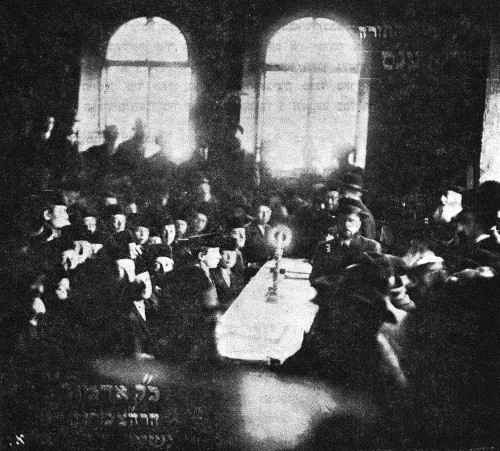
It is interesting to write about a large examination, one of the largest by-heart examinations of the three Bavas, of the highest class, and also of all the classes according to their ability. The holy Gaon Rabi Pinchas Twersky, a Stoller rabi and son-in-law of the Admor of Belz of holy blessed memory, may G-d avenge his blood, came to the festivities of the exam. He had previously lived in Sambor. He examined each student, and was full of amazement. The aforementioned rabi and Tzadik said, “Bring cake, drinks and wine to the celebratory meal, I will pay for it!” The celebration lasted for the entire night.
[Page 88]
The Turka musicians also came and requested to participate. They played the entire night. It was an honor for the town, as well as for the strangers, to have such a guest.
The voice of Torah was heard day and night throughout the entire city.
|
|
A Debate
There was a debate with the Zionist groups of Turka, headed by Reb Shua Erdman, may G-d avenge his blood. With time we emptied things out, bringing nearly all the children out
[Page 89]
from the organizations. Of course, this was not so desirous for the aforementioned groups. When I saw that things began to take on sharp forms I requested a meeting. We got together and talked in a very brotherly fashion. Thank G-d, I won them over with the truth. I told them that the children would like to learn with us today, and the next day they would be prepared to be good Zionists. However, if they go to the organizations today, they will not belong to you tomorrow, but rather to the left, the extreme left – which is sufficient to understand. They understood well – and there was peace upon Israel.
Famous Performers of Mitzvot:
It is appropriate to mention Reb Moshe Hirt and his righteous wife Malka the daughter of Reb Shlomo Erdman of Jasienca, may they live. They helped greatly in providing daily fare on a rotational basis[11] for the Yeshiva and Talmud Torah students from outside the city. Reb Nachman Brenis as well as Intrator-Horovich helped the Yeshiva with wood. May G-d avenge their blood.
Avraham Pelech, the tailor, helped by taking children from the Yeshiva who were not enjoying success in learning the holy Torah and teaching them tailoring. May his memory be a blessing.
Reb Leizer Monaster, a proper Hassid, pious and upright, was a sincere prayer leader, filled with fear of Heaven.
Reb Leizer Bart, was a synagogue Jew, a sweet Jew filled with charitable deeds. He was a good friend of the Yeshiva, and helped greatly.
Reb Tzvi Filinger was a dear man on the Yeshiva committee, who helped greatly. May G-d avenge his blood.
There were two Moshe Rosens. The large Moshe was an important, dear man, and a friend of everybody. The small Moshe, the son-in-law of Reb Tzvi Rotenberg the shochet, was an important, dear man, good to his fellow.
The Rabinate in our City
(From what I know, and from what I have seen in the cemetery.)
The holy Gaon Rabi Shlomo Seredir, the brother-in-law of the holy Gaon of Rozin, may his merit protect us.
[Page 90]
The “Kitfot Haeifod,” the holy Gaon Rabi Pinchas Aryeh of holy blessed memory. All the males born in the year of his death were named after him.
His son, Reb Yankele the Holy One, was dedicated to the wellbeing of the city during the time of the epidemic, may we be protected. It is said that he took it upon himself to redeem the city, and he died that very day. May his merit protect us.
The Gaon Rabi Meir Leibish Langerman, was a man of wonders, a Gaon in both the revealed and the hidden Torah[12], may his holy memory be a blessing.
His son Rabi Nachum Langerman, of holy blessed memory, was a great prayer leader and singer. His took his father's place.
The rabinical judge Rabi Mendele Motkiver, was a great scholar and sage. He once said, “I am not angry about a fool because he is a fool, but I am angry: you fool, if G-d created you as a fool, why do you want to be a sage?!”
The rabinical teacher, the Rabi and Gaon Isserlis, the holy man, the grandson of the Rema'h of blessed memory[13].
The Gaon Rabi Eliezer Mishel, the author of the book “Mishnat Eliezer.” He was sick for ten years and lay in bed. I helped him throughout the entire time. He died around the end of 1939. He was eulogized by the Rosh Yeshiva Rabi Weinberger, and, to differentiate between the dead and the living, Rabi Yitzchak Rubin, the rabi of Sztilka. They made a canopy for him in the new cemetery. May his holy memory be a blessing.
The rabinical judge, the wise and erudite man, Rabi Yudele Roizenheg, the son-in-law of the rabinical teacher Rabi Isserlis.
The rabinical judge, the upright and pure man, Rabi Aharon Wolf Weisblum, the grandson of Rabi Elimelech, may his merit protect us, and the son-in-law of the granddaughter of Rabi Mendele Motkiver, may G-d avenge his blood.
The Admorim in Turka
The rabi and tzadik, great in Torah, the revealed and the hidden, the Vonovitsher Rebe, Rabi Yeshaya Shalom Rokach, may G-d avenge his blood, and the Admor of Sambor, Rabi Avraham Yaakov Jolles, may G-d avenge his blood.
The rabi and Tzadik, Rabi Micheli Brandwein of holy blessed memory lived in Turka for several years, and then went to America. He was a famous worker of wonders.
The rabi and Tzadik, the holy man, Rabi Alter Sopron of Stryj-Sambor. Every year, winter and summer, he would come to Turka and remain of an extended period. He was dear in the eyes of all the Jews and all who saw him. He was righteous and pure. Of holy blessed memory, may G-d avenge his blood.
Translator's Footnotes:
|
|
JewishGen, Inc. makes no representations regarding the accuracy of
the translation. The reader may wish to refer to the original material
for verification.
JewishGen is not responsible for inaccuracies or omissions in the original work and cannot rewrite or edit the text to correct inaccuracies and/or omissions.
Our mission is to produce a translation of the original work and we cannot verify the accuracy of statements or alter facts cited.
 Turka, Ukraine
 Yizkor Book Project
 JewishGen Home Page
Copyright © 1999-2024 by JewishGen, Inc.
Updated 20 Aug 2014 by LA