[Page 127]
Shochetim (Ritual slaughterers)
in Sanok[1]
Translated by Jerrold Landau
From the elders of our generation, we have been told about two Shochtim in our city during the previous era, Rabbi Yacov Yosef Rosenfeld and Rabbi Shlomo Schickler of blessed memory. Both of them were extremely diligent in their responsible positions in matters that were required then, and are still required, by the bearers of that profession: “a scholar and a greater fearer of Heaven than the masses”, with stress on the last word, “than the masses”, for indecisiveness and lack of knowledge have serious consequences. The ensuring of the Kashrut of meat for the Jewish community in the city was always the chief interest of the leaders of the city. According to the Jewish conception, the ensuring of Kashrut came with the promise of ensuring the peace and health of the citizens of the city. On the other hand, they were very concerned, Heaven forbid, about any deviation, breach, or leniency in the laws of ritual slaughter, deliberately or through negligence, at the time of the slaughtering and inspection by the shochet, or afterward by the butcher in the butcher shop or the housewife in the kitchen. All of this was due to simple hygiene or, perhaps more important, due to the severity of the prohibition on eating non-kosher food and the punishment from Heaven for the transgressors. From here came the caution to the point of fear regarding any deviation or borderline of deviation in the laws of shechita, salting meat, kosher animals, etc. From here as well came the recoiling from any words or expressions such as “treifnik”, “consumer of treif”, etc. The fate of a Jew with respect to the eating of kosher meat was placed in the hands, first and foremost, of the shochet. Therefore, the aforementioned qualities were demanded of him. Of course, the degree of esteem of the community for their shochet was proportional to the degree of manifestation of these character traits within him.
Indeed, the members of the Sanok community knew how to relate appropriately to the two aforementioned shochtim, the last in a line of preceding shochtim about whom we have no information, and the first of those who lived with us, in our generation and in our community. We will discuss them in this chapter. These first two were exemplary shochtim, forging the style and founding the tradition for those shochtim that followed after them. Therefore, to our good fortune, we are able to utilize these few but important lines to dedicate a monument to their personalities written by Rabbi Alter Maier of blessed memory, who was almost of the same generation. These lines are important because the writer knew both of them personally and salvaged the few details about them from the risk of oblivion.
Here is the article of Rabbi Alter Maier of blessed memory, entitled “Two Beloved and Pleasant Shubim”.
“The two were Reb Yacov Yosef Rosenfeld and Reb Shlomo Schickler of blessed memory. The former I new only a little bit. Had we not lived in the same house as Reb Eliahu Guttwirt, who knows if I would have known him at all, for more than 60 years have passed since his death. Reb Yacov Yosef was not only among the honorable shochtim in our city, but his name went before him throughout the country. He was a scholar and an honorable Belzer Hassid. He served as the prayer leader on the High Holy Days in the large Beis Midrash. His children were all men of Torah. The eldest Reb Shalom was a notable. One son, Shraga-Feivel who was my age, had literary talents. I recall the following fact. One Friday, when the weekly Hamitzpe newspaper reached us and I opened it, we noticed a feuilleton with the name Feivel Rosenfeld at the bottom. I melted with jealousy and said in my heart: “If Feivel can reach this stage, so can I.” I remember that it was because of this that my diligence in reading and study increased. Within two years my article entitled “The Fine Traits of the Etrog” appeared in the literary section of this newspaper. This was my first literary creation.”
“Reb Shlomo Schickler, the father of Reb Abishel who served in the latter period as a rabbinical judge and teacher in our city, his hometown;
[Page 128]
and of Reb Pinchasl who served as a rabbinical judge and teacher in the city of Tarnopol, lived longer than Reb Y. Y. Rosenfeld. He was also a Belzer Hassid, but he was more retiring. His fame did not extend beyond the bounds of our city. It is possible that this was an expression of his sublime feelings based on the fact that his sons were all very successful, excelling in Torah and fear of Heaven, who with the passage of time became notable rabbis. Reb Shlomo would visit our home on occasion, for he often needed the services of Father, Reb Yisraelche Maier of blessed memory, for some type of intercession with the head of the community, or to obtain a draft exemption for his rabbi sons.”
Our brethren, members of the final generation of Sanok Jewry, we have seen shochtim who served in this role in our generation in Sanok as a continuation of the tradition of shochtim who preceded them. We know that these ones did not lack any of the “appropriate characteristics” of their predecessors. We even saw in them additional generous traits, each of them in their own arena as prominent nuances in the general personalities of each of them. Here they are, one by one:
The Shub Reb Shlomo Grossman of blessed memory
Reb Shlomo Grossman was a loner, living within himself. We did not understand him. He seemed aloof and strange to us. Whoever did not identify with our life, way of life and way of thinking of that time, even only in thought without an external, practical expression, would be considered to be a maskil and “leavened”[2]. We would distance ourselves from such a person. Such a person would have no dealings with the elders or even with the youth. The former distanced themselves from him, and he would distance himself from the latter lest bad rumors about him be brought to their fathers or the fathers of their friends. Such was Reb Shlomo the Shub. He would often visit our home due to the friendship between us. This was always during the hours of the night. He would often sit with a book in front of himself until late in the evening, immersed in reading without paying attention to any movement or noise around him. When people approached him to start a conversation, he would awaken as if from another world. Reb Shlomo was a great scholar with deep understanding of all areas of Torah and Jewish thought. All the pathways of Torah and Jewish knowledge were clear to him as if he had learned to walk on them only yesterday. Hidden matters and revealed matters were clear as a cloth spread before him without any silence or stammering. He hid the essence of his soul and his spiritual being from even his best friends. Rabbi Alter Maier of blessed memory writes the following about him:
“… There is drawn water and there is water of a spring. As plentiful as it is, it is drawn water. It has value but not life. When it stands in its place without movement for a great deal of time it turns green and begins to stink and rot. However water of a spring, even if of a small quantity, will always remain living water. It is always fresh and sweet, and always maintains its freshness. The shochet Reb Shlomo was a type of spring, turned in to himself. He did not befriend others and always remained in his own small world. His only enjoyment in life was from those hours in which he was immersed studying a book, beyond the bounds of time, either sitting or standing. He was completely immersed and cut off from the world and his own surroundings.”
Reb Shlomo the Shochet was quiet by nature and did not enjoy conversation, whether secular or Torah related. Only when he was asked a question by those close to him, the youths of the Beis Midrash and studiers of Torah, or when they asked him to clarify some matter – would he answer briefly and succinctly.
The Shub Reb Chaim Schwerd of blessed memory (The Shub of Bokowsko)
Until the end of the First World War, after the death of Reb Shlomo Schicker, this position remained open for a long time due to the war that had broken out. Many Jews left the city, whether
[Page 128]
as refugees or as soldiers, and organized Jewish life in the city did not function as normal. Only one shochet carried out the shechita – Reb Shlomo Grossman. He was not found fitting for serving in the war, and he remained at home. In the interim, the war ended. General and Jewish life returned to its cycle. People returned home, the population grew, and one shochet was not sufficient. Then, in 1920, Reb Chaim Schwerd was accepted as the second Shochet in the city. He was a shochet from the nearby town of Bokowsko, and was known throughout the region for his Hassidic practices and his high level of professional competency. Reb Chaim the Shub was liked by the entire community here, as he was in his former place. As a scholar and a great fearer of Heaven, he did not waste his free time but rather utilized every spare moment for Torah and prayer. Despite his punctiliousness in Belzer Hassidism “from the womb and from birth”, for his family origins were from the town of Ugarow which was very close to Belz, all of whose Jews were without exception Belzer Hassidim; and that his father, his uncles, and all of his family members were among the closest people to the Hassidic court of the Admorim of Belz – Reb Chaim found it appropriate to frequent the Admorim of other dynasties in the city and surroundings, and to endear himself as well to the Hassidim of these Admorim.
|
|
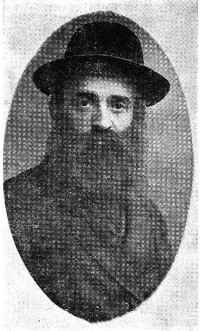
Reb Chaim Schwerd the shochet (in the middle)
between his two sons, Eliezer and Meier
His wife Chaya Sara is between her daughter Yehudit on the left and her daughter-in-law Leah on the right, on whose side is her grandson Pinchas. Sitting at the bottom (from right to left) is their granddaughter Zissel, and their daughter of old age Hinda |
Reb Chaim Shub reached the pinnacle of his excellence in the realms of charity and hosting of guests, which knew no bounds. His home served as a constant guesthouse for anyone visiting the city that was unable to afford to stay in a hotel. The home of Reb Chaim Shub made no distinction between different poor people. All of them were treated with special care in this house. The poor, downtrodden, constant floaters with worn out clothing received the same bed, the same bedding, the same dinner as those poor people who came from honorable forbears[3] or to a “yarud” – a well known concept at that time referring to a wealthy person who had come upon hard times and had become impoverished to the point of bankruptcy. This was his own behavior, and thus did he instruct his family. His wife Chaya Sarah (Sarache the Shochetke) not only served as his faithful assistant, but had her own independence in this area which she apparently had absorbed from the home of her father, Reb Eliahu-Zusha the shochet of Bokowsko. She continued with this custom even after her husband Reb Chaim Shub died in Siberian exile in Dzambul on the 8th of Nissan 5703 (1943). A great deal is told about the charity and kindness that she did for the unfortunate, downtrodden refugees during the years of the Second World War, and even after she succeeded in making aliya to the Land after the end of the tribulations of the Holocaust. When she was old and sickly, living at the homes of her children in Jerusalem, she continued with her good deeds with great diligence.
We have not fulfilled our historical duty and our faithfulness to this book if we do not mention the special care received at the home of Reb Chaim Shub by Jewish soldiers who served in the Polish army and were posted in the large military camp in Sanok. Because of the anti-Semitic and inimical atmosphere that pervaded in the camp in particular and in the Polish army in general, Jewish soldiers suffered greatly in various ways, such as illness, persecution, not being freed from work on Sabbaths and festivals, refusal to be granted leaves to attend synagogues on Sabbaths and festivals, etc. The young son Meier Schwerd, a scholar, great fearer of Heaven, and astute in worldly affairs, worked on all of these matters. Many such soldiers who survived the talons of the Holocaust and succeeded in arriving to Israel told us a great deal about his good deeds toward them. They recall, and recount enthusiastically to this day, his kind concern and loving relationships, his warm heart, his good disposition, his constant readiness to come to the assistance of all of them in any way that was possible, and the assistance that he succeeded in offering them.
[Page 130]
The Shu'b[5] Reb Shalom Rosenfeld
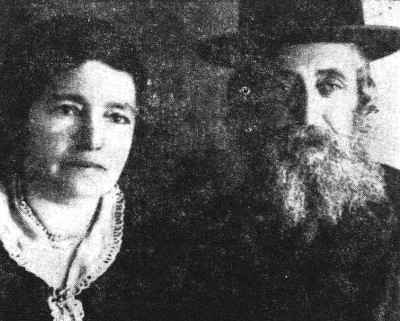
As has been noted previously, he was the firstborn son of Reb Yaakov-Yosef Shu'b. After he married the daughter of Reb Tzvi-Hirsh, the chief Shu'b in the city of Rzeszów and a renowned personality in the circles of Hassidim of Belz, it was logical and accepted at that time that Reb Shalom would continue in this doubled family profession – the profession of ritual slaughter. He indeed began as such at the outset of his independent family life. Since, by nature, he had a high sense of business intelligence, with thoughts tending to modernity, he gave up the shechita profession and began to work in commerce, with significant success. His house was already captured by the spirit of the haskalah, and his children did not identify with the children of the other shochtim of the city, neither from an educational, Torah study perspective, nor from dress and day-to-day life. His eldest daughter married Dr. Y. Knopf (today Nitzani), an important Zionist activist, who was involved in the general Zionist organization of Przemyśl. He continued with this activity here in the Land from the time he made aliya at the beginning of the 1930s. His older son, Yaakov, became involved in Zionism during his early youth. After dedicated Zionist activity in our city, he made aliya as one of the first of the pioneering aliya of Sanok. (He died here in his prime of an illness).
Reb Shalom himself remained whole with himself, with G-d, with his fellow, with his faith and fear of G-d despite all the changes and new winds in his home and in the circles of Jewish youth. He had pure, deep, fear of Heaven.
[Page 131]
Even though he was immersed in his business, he set times for the study of Torah. (As has been stated, Reb Shalom was an expert scholar with a stature in the study of Torah). He would worship in the Beis Midrash of Rabbi Dovidl Spira (The Rebbe of Dynów).
|
|
| Reb Shalom Rosenfeld, Shu'b |
With the decline of Jewish commerce in Poland as a result of the Grabski Decrees[6] during the mid-1930s, there was a drastic decline in the economic status of Reb Shalom – to the point where he was forced to offer his candidacy for the position of Shu'b in our/his town. Along with the family rights of the Shu'b position that Reb Shalom possessed, he also had his own merits, for he was not lacking even one of the traits required for that position. As has been noted, he was known and recognized by all members of the community of Sanok, and was acceptable to them. Reb Shalom was accepted to the position of third Shu'b of Sanok with no difficulty. He filled this role appropriately and according to custom until the advent of the Holocaust, in which he and his family perished.
The Shu'b Reb Pinchas-Yosef Miller
Reb Pinchas-Yosef stemmed from a noble, well-pedigreed, wide-branched family, which included estate and business owners. No less – there were great scholars, rabbis, and Admorim. His paternal grandfather was Reb Shabtai Miller, one of the wealthy Jews of Galicia, a scholar and Hassid who was joined by marriage connections with the Admorim of the Tzanz and other dynasties.
Reb Pinchas-Yosef also came to the position of Shu'b in Sanok after his busines failed during the era of the Grabski decrees. With him as well, not one of the traits required for this position was lacking. He was a scholar and great fearer of Heaven. Especially prominent with him was a blend of the traits of modesty and nobility, which were expressed at every step, especially in his daily conduct with his fellow. He perished in the Holocaust. His wife and two daughters succeeded in reaching the Land after wandering in exile in Siberia.
The Shu'b Reb Yossele
He was accepted as Shu'b in the city after its Jewish population grew with the passage of time, and as a fulfilment of an obligation that the community felt toward the widow of Reb Shlomo Szikler, whose daughter Reb Yosele had married[7]. Reb Yosele was also a Hassid of Belz, and was quite zealous in this area, not forgoing anything. He would never visit another Admor, even the Admorim of the city of Sanok. On the other hand, he would occupy himself with charitable deeds, especially in collecting monetary donations for the poor. He would go door to door on behalf of poor people for whom this was below their honor.
[Page 132]
Reb Dovidl Zukerman of blessed memory, the City Cantor
by Aryeh Lerner (Haifa)
The world of music in Sanok was meager. There was no philharmonic band, opera house, or any other institution or staff for chamber music. There were no radios in Sanok yet, and only a few wealthy people had phonographs, and I had no place among them. Nevertheless, I tasted the taste of music that stormed my soul and brought me boundless enjoyment. This was thanks to Reb Dovidl the cantor. However, I would be deviating from the truth if I did not mention the military band of the second brigade that was stationed in Sanok, which would perform several concerts in the Rynek square during the summer. I was the first to take my place among the musicians, and I listened to the military tunes and marches with great enjoyment. I was also very proud that Sergeant Fogel, who was Jewish, played in this band, and would even take the conductor's baton on occasion. Several sections of these marches were familiar to me, and I would sing them in front of the open Gemara as I sat in the Kloiz and occupied myself with the passages of Abaye and Rabba. However, my primary musical experience was with the compositions of Reb Dovidl the cantor, which I heard from his choir in the Great Synagogue.
I still recall the moments of sublime emotion that enveloped me during the prayers on Sabbath and festival evenings, as I tensely stood in anticipation in the Great Synagogue, which was lit up and full of Jewish brethren, as I listened with a pulsating heart to the singing of the stanzas of Lecha Dodi, Hashkiveinu, Ribbono Shel Olam after the counting of the Omer, or the sections of Hallel. As the [melodies] rang out from the throats of the young singers in their soprano and a lot voices I felt as if I was hearing the songs of the holy angels, and a sublime sense of happiness and sweetness enveloped me and embraced me in my love for the world and that which it contains.
Etched in my memory from among the soloists in Reb Dovidl the cantor are the cousins Abish and Moshe Domb, Avraham Epstein, Shimon Gerszon, Yitzchak Cukerman the son of Reb Dovidl, and Gershon Pipa. All of their voices were resonant and ringing. I greatly admired them. However, I revered Yitzchak (Itchele) the son of the cantor, who was my age and also my good friend, in the manner that a primitive person revered his idol. Indeed, Itchele stood in the shadow of all the singers as a soloist. His voice was wonderful, and he sang with a warm and engaging voice. When his voice sang forth, my heart was proud and gushed with love for him. I followed after him as a dog follows its master. I gave it to everything regarding him for I loved him. My soul thirsted for music, and drank abundantly from the wellspring of Reb Dovidl the cantor.
|
|
| Reb Dovid Cukerman, the cantor of the city, and his wife |
[Page 133]
Reb Mordechai Ascher of blessed memory
Reb Mordechai Ascher was apparently the first secretary of the community in its organized, consolidated fashion. He was no longer a young man when he entered this job. It is said that he had a large repository of experience in officialdom and administrative knowledge. Indeed, his fine talents, his patience, and his calm, levelheaded temperament enabled him to overcome difficulties and to raise up the activities of the communal council offices.
Reb Mordechai Ascher was a scholar, and also possessed secular knowledge. His good relations with the highest echelons of leadership of the municipal council and the government were to the benefit of all in need.
Reb Mordechai Ascher had a great deal of experience in accounting and running treasuries. Despite this, he did not neglect or turn away from the traditional way of life at all. Reb Mordechai was one of the honorable regular worshippers at the kloiz in the Przdamajczia Quarter. There, he was also one of the fine prayer leaders for the Musaf services on the High Holy Days. He performed this task in good taste and with success.
Ascher Anshel Wachtel, the Secretary of the Community by Zeev Tal (Wachtel)
Reb Ascher Anshel Wachtel was given the task of secretary of the Jewish communal council of Sanok in 1929. His excellent command of the Polish Language, his knowledge of accounting, and his talents in communal affairs helped him in filling the role of secretary of the communal council.
During the tenure of my father of blessed memory as secretary of the communal council, a revolution in the administrative protocols of the council took place. With the support of certain Jewish circles, the level of involvement of the government in communal life increased. This was in opposition to the spirit and aspirations of most of the Jews of the city, who possessed national-Jewish consciousness. It is obvious that the clergy were not able to take a clear stand in this area, and it was certainly impossible for them to express an opinion or show an open leaning toward one side or the other. It should be noted that this situation was far more difficult for Mr. Wachtel, as the holder of a responsible and vital role, but he stood up to the test.
In his position of secretary of the council, Reb Ascher Anshel Wachtel would visit the offices of the Polish authorities. He got along well with people and was prepared to serve the community that turned to him. All types of requests for permits, business, manufacturing, commerce, deferral of army service, exemptions from the army or from drafts, disputes about taxes, and the like were settled in the offices of the state with the assistance of the secretary of the communal council. He fled to Rovno with his family in 1939, where he died a natural death of a heart attack in 1941.
[Page 133]
Reb Benzion Feller of blessed memory
To people from the outside, at a distance, it seemed that his connection to his job and his workplace was a connection from birth. We do not know when he began his role, who brought him in, or what were the reasons for entering this job in this workplace. The main thing was -- how exacting his work was in the communal council.
Just as he was accepted into his job quietly, without any proclamations or publicity in the community and outside of it, and without even the knowledge in the Jewish community (literally -- even on his own street, among his neighbors, friends and acquaintances -- who in general knew everything), he similarly fulfilled his task quietly, for quiet and calm were
[Page 134]
the character traits of Reb Benzion Feller throughout all the years I knew him. In every conversation that you might have with him, you would get the impression that you were standing before a man with deep spiritual wealth, with an internal load that is unseen but very valuable. You would also learn from such a contact that he saw no lesser value at all in his work according to its official designation -- a representative, a 'shamash' or, at most, a “technical official” in the pure professional language of today. It was indeed said that often enough, and in an unofficial capacity, the members of the communal council used him as a sort of “secret adviser” since he was acceptable to everyone as a reliable person and expert in civic matters and in all problems related to the Jewish population.
We also do not know about the level of his Torah knowledge, for he also studied Torah quietly and discretely. It was clear that he was within his own isolated world. It is certain to us that he was one of those people who are “few in words but great in splendor” -- the splendor of appreciation and love that every one of his acquaintances felt toward him.
Mr. Alexander Kimmel of blessed memory
He was one of the veteran officials of the communal council, both with respect to the number of years of service as well as the strength of his work and great experience in communal service. He began his work in the role of secretary of the communal council in the year 1924, with 20 years of work in the district courthouse of Sanok behind him as the chief secretary of the court. We should know that his entry into the court work in Sanok was not his first official calling. Prior to this, he worked in such a court in Lwow when it was still called Lemberg, that is to say, still in the days of Austrian rule. He came -- more accurately, he was brought or he was transferred -- to Sanok in 1904. Apparently, Mr. Alexander Kimmel was an excellent official in his work, and his superiors in the government office in which he worked then found him to be the appropriate person, since he was at the right age, middle age, to take on the responsible role in the Sanok court, which at that time was an office of broad scope and broad dimensions, servicing a broad area.
His work as a government official began after two years of study in the Faculty of Law the University of Lwow. The reason for his transfer to Sanok, a transfer that had precedent, can be seen as his excellence in carrying out his tasks. Apparently, this was also the reason for his twenty year long service in this role. We must recall that this was an area of great change and transition, including changes of government, with the government leadership not being noted at all for excessive love of Jews, and who certainly did not look favorably upon Jews working as officials in government service -- even more so as senior officials.
When he reached the age of retirement, Mr. Kimmel left his government position. Apparently, however, his skills and qualities, especially his capability and honesty, stood in his stead when the members of the communal council placed their eyes upon him to bring him in as an official in the communal offices, and even to place such an important role as secretary of the communal council upon him. It is worthwhile to note that he also carried out this task with full success, to the satisfaction of all members of the communal council. During the same period, he was chosen as secretary of the organization of people who were injured in the first world war in the region of Sanok, which included those handicapped by the war, as well as war widows and orphans. This was an honorary appointment, without any remuneration. From this position of secretary of that organization, after some time he was chosen as president of this organization. He fulfilled that position until his final day, also without remuneration. He also served as secretary of Yad Charutzim for two years.
Reb Mordechai Sternberg, the Kashruth Supervisor of the Butcher Shops
He was a Hassid and a scholar, the scion of a family of businessmen in eastern Galicia in the region of Rawa-Ruska, whose Jews generally affiliated with the Hassidim of Belz. However, after he married
[Page 135]
the daughter of Reb Mordechai-Yehoshua Schlisselfeld, the owner of the “Morowanka”, a veteran and fervent Hassid of the Dynow dynasty, Reb Mordechai drew close to that branch of Hassidism, and later became a confidante of the Admor of Dynow.
To our dismay, we did not succeed in obtaining exact details and facts regarding the era in which he was in Sanok, and about his business from the time he came to Sanok until he was appointed as the Kashruth supervisor by the communal council. When he started in that role, he found the purpose of his life therein and strove to fulfill the role faithfully and successfully.
Reb Menachem Schmarlobiski, the Supervisor of De-veining[4]
In another place in this book we note several of his good qualities, typical Jewish qualities, which certainly must be attributed to his personal, Hassidic Jewish as well as general moral behavior, which he naturally imbued from the house of his parents. He was a spiritual vessel of Hassidim from his childhood, both from his home and from his group, which was absorbed within himself from the background of unshakable faith, pure and strong, that came from the Rebbe Tzadik, the Admor of Bokowsk, Reb Meir-Yehuda of blessed memory. His father was an ardent and faithful follower of that Admor as well.
Indeed, even in his day to day life as a worker in the communal council as a de-veiner and supervisor of de-veining in the butcher shops of Sanok in the field of Jewish ritual slaughter, he knew how to get along with his work associates who were near to his profession and who participated in guarding and supervising the kashruth and preventing a mishap regarding forbidden and permitted matters. In general, Reb Menachem endeared himself to his friends and acquaintances.
Reb Menachem merited that after the Nazi hell, including exile in Siberia, he succeeded in coming to us and enjoying the remainder of his life in the atmosphere of the Land and its experiences, seeing pleasure and satisfaction from his children and grandchildren as they established families in the Land and became involved in Israeli communal life. His eldest son Tzvi Shamri is one of the active members of the Organization of Natives of Sanok and its Region.
Reb Yacov Toder
He was employed by the communal council as a supervisor of the income from the Kosher slaughter tax. During the course of carrying out his duties, he would be seen as a modest, level-headed man who shunned the limelight. This was his manner in interpersonal affairs in public, as well as in his relationship with his Creator in the Sadagora Kloiz, in which he was one of the veteran worshippers and a participant in the study classes that took place each evening after the services. We never saw him get involved in communal affairs. We never heard him participate in a debate or express his opinion publicly regarding a party, a movement, or political activity.
However, it seems that the modesty, calm and level-headedness in public did not prevent him from being vibrant, interested and engaged internally within his home and his family circle. There, in the company of his sons and daughters in his home, each within their own organization and realm, he also participated, debated, convinced and decided. Of course all debates were only related to details, and conditions and methodologies of activity. He would not debate at all about the main idea or the essence of the activity. He had a general agreement to the main concepts. Thus, the home was a Zionist home, and the atmosphere was a Zionist atmosphere, for to them, Zionism was the breath of life. From here came his enthusiasm to anything related to Zionism, the Hebrew movement, and Hebrew literature, and from here came his desire to make aliya. To his sorrow, this aspiration was realized only in part, for only the eldest son, Shimon, and two daughters succeeded in making aliya while there was still time. The rest of them, including Menachem, who was the most enthusiastic and engaging of them all, did not merit such, and they perished along with the rest of the Holocaust victims. May G-d avenge their blood.
[Page 136]
Dr. Shlomo Roemer of blessed memory by Yisrael Lembak of Haifa
by Yisrael Lembak of Haifa
He had an athletic image, as if sculpted from marble. He had an exquisite head of white hair, and a high forehead the likes of which one could only find in illustrations. His two clear eyes cast a gaze at you through the lenses of spectacles set in two thick black frames, made of bone. His gaze penetrated to you like lightning, and it always seemed as if he was reading all your thoughts that were formed deep in your soul. If you were asked by him for your view on some matter, you could not hide your opinion from him. You were forced to state the truth, and the full truth. He influenced you with his gaze like the power of a hypnotist. One would always see him dressed in the finest manner. He attracted the attention of every person. His fine body build and his patriarchal motions reminded us of the image of a diplomat from former times. They do not remind us at all of the image of the physician, always illustrated for us as a bent over, wrinkled man, immersed in his thoughts from medical books and other scholarly books.
Dr. Roemer was a communal activist from birth. He was not embarrassed at all in his activism. He had some sort of special weakness and natural feeling for local politics. Since, he served for many years as head of the Hebrew community and a veteran member of the city council, the authority of the entire city was in his hands, and he was the leader and director of the city. His aims were for the benefit of the community, even when there were signs of some small deviation from his straight path. He always utilized appropriate means for his wide-branched work. The prime aim in his activism was the benefit of the Jewish community of the city, and not for his own private affairs. Some internal spiritual force to serve the community pushed him toward communal work. His popularity with Jews, both wealthy and poor, granted him full authority, and opened for him all the paths and gates leading to communal achievements in the city.
Dr. Roemer also had great influence on the gentile community, especially among government circles. This enabled him to carry out all his plans, to realize all his aspirations and ideas for the benefit of the city, and also to offer help to the individual. As he passed through the streets of the city, whether on a stroll or to visit the sick, everyone – young and old, friend or opponent, Jew or Christian – greeted him with expressions of honor and appreciation. He showed interest in anyone he met, having a quick chat, giving a good word, or greeting him with a bright smile. He would ask how they and their family were doing, and how their business was going. At times, he even offered help, intercession, and the like. He wanted to fulfil the desires of everyone, through any manner and means. He earned himself a good name and great appreciation from all the elders of the generation – our grandmothers and grandfathers. They heeded and obeyed every word that came from his mouth. They fulfilled anything asked of them. For many he brought the cure through psychological influence, without any medication. They told
[Page 137]
stories of miracles and wonders about him, as if for a great Admor. He was alert and rooted in Jewish life, and in the small and large problems of the people. He was a living part of the landscape of the city.
* * *
Preceding Dr. Roemer's communal and city work was his vibrant Zionist activity during the time he was a student at the University of Krakow[8]. The first Zionist organization in Sanok was founded through his efforts. He also participated in national Zionist conventions. He appeared there as a delegate and reporter of the Sanok chapter[9]. Indeed, when he entered into civic activity, it encompassed his entire essence and filled the content of is life with the crown of activity and the crown of success.
|
|
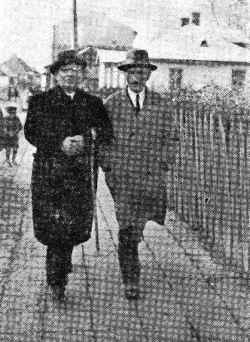
| Dr. Shlomo Roemer (on the left) with Reb Anshel Wachtel |
__________
Translator's Footnotes
- There is a footnote in the text here: “Shubim, the exact term for a slaughterer of cattle and fowl in halachic sources comes from Shochet uBodek (a slaughterer and inspector), for he inspects the lungs internally while they are still inside the body of the animal immediately after slaughter.” For the duration of this article, I will use the word 'shochet' even though the Hebrew text uses the term 'Shu”b' – except in some cases where it is used as a nickname. Return
- I.e. 'soured'. Return
- Several terms are used here for this concept, such as “yachsan” – someone of good stock, “neched” – grandchild (i.e. a grandchild of honorable people), “Bnsh'k” (Bnam shel Kodoshim) – a mnemonic for a descendent of holy people. Return
- Nikur -- the process of removing certain veins and sinews from various parts of an animal to ensure its fitness to the dictates of kashruth (i.e. Ensuring that certain large blood vessels are removed, as well as the sciatic nerve). Return
- Shu'b is the acronym for shochet ubokek (ritual slaughterer and examiner [of the kashruth signs of slaughtered animals]. It is essentially a synonym with shochet. Return
- See https://en.wikipedia.org/wiki/W%C5%82adys%C5%82aw_Grabski Return
- See the article on page 109. Return
- There is a footnote in the text here: See above, in the chapter “The History of the City and its Region” [https://www.jewishgen.org/yizkor/sanok/San017.html] Return
- There is a footnote in the text here: See Dr. N. M. Gelber, “History of Zionism in Galicia” page 206. Return
This material is made available by JewishGen, Inc.
and the Yizkor Book Project for the purpose of
fulfilling our
mission of disseminating information about the Holocaust and
destroyed Jewish communities.
This material may not be copied,
sold or bartered without JewishGen, Inc.'s permission. Rights may be
reserved by the copyright holder.
JewishGen, Inc. makes no representations regarding the accuracy of
the translation. The reader may wish to refer to the original material
for verification.
JewishGen is not responsible for inaccuracies or omissions in the original work and cannot rewrite or edit the text to correct inaccuracies and/or omissions.
Our mission is to produce a translation of the original work and we cannot verify the accuracy of statements or alter facts cited.
 Sanok, Poland
 Yizkor Book Project
 JewishGen Home Page
Yizkor Book Director, Lance Ackerfeld
This web page created by Max Heffler
Copyright © 1999-2024 by JewishGen, Inc.
Updated 31 Oct 2021 by JH
![san129.jpg [41 KB] - Reb Chaim Schwerd the shochet](images/san129.jpg)