 |
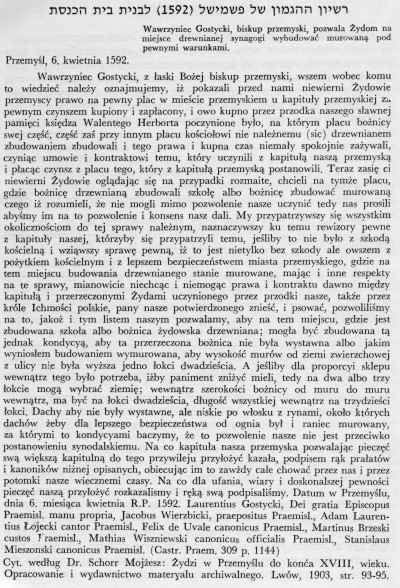
The Permit of the Bishop of Przemysl (1592) for the building of the Synagogue
|
|
[Page 21]
B) Under Polish Rule
by D. N.
Translated by Jerrold Landau
The Jewish Population Before the Building of the Synagogue
Twenty-three years after entering Przemysl and started to rule over the regions of Przemysl and Sanok, and a few years after extending his rule to all of Red Reisin[a] including Lwow, Kazimierz the Great granted a general privilege to the Jews (including foreigners) in 1367 permitting them to settle in any place of Lesser Poland and Red Reisin. This was a very difficult era for the Jews of Western and Central Europe. It was the time of the Black Death (1348-1352). A stream of refugees was attracted to Poland already before the granting of these aforementioned privileges, and increased later. Professor Schor, who begins to describe the history of the city from 1542, does not find and organized settlement prior to that time. He established that at the end of the 15th century, many Jews arrived in Poland from Germany and Czechia, and by the beginning of the 16th century, a significant number of Jews lived in Greater and Lesser Poland, even in cities that were of the second tier in size. He emphasizes that the Jewish immigrants apparently brought with them large sums of money. This fact makes sense, given the agreement of the cities with their new settlers. The Przemysl historian Leopold Hauser believes that many Jews settled in Przemysl at the time of the issuing of the aforementioned general privilege. Professor Schor was asked to bring proof of his premise that Jews settled in Przemysl after the granting of the privilege in 1367. Hauser himself was very cautions in his premise regarding the situation of 1367 and later, knowing that according to the housing registry (Lustracja) there were only 18 Jewish families in Przemysl. In the previous chapter, we presented a great deal of material as proof that Jews lived in Przemysl for at least 300 years prior to that privilege, and that Professor Balaban already had no doubts in 1931 that Kazimierz not only accepted a number of Jewish residents in Przemysl, but also accepted an organized Jewish community. Therefore, any debate regarding this question does not make sense to us. Furthermore, in 1927, Smolka, the archivist of the city of Przemysl, published a catalog of many old files. The files of the adjured court attest to a Jewish past starting from the beginning of the 15th century. Tax lessees are mentioned in these files. According to Professor Schor, these are small-scale Jews who sold merchandise and lent money to Christian citizens. Regarding this, we rely on the statement of Jakob regarding “The Oldest Settlement of Jews in Przemysl” (“Miesiecznik Zydowski”, Volume II from the second year, July-December 1932) that uses sources that were yet to be published. The author of the article stresses that fact that already at the beginning of the 15th century Jews lived in Przemysl on a special street, and that they also had a synagogue near Grodzka Street (today Franciszkanska) in the heart of the city.
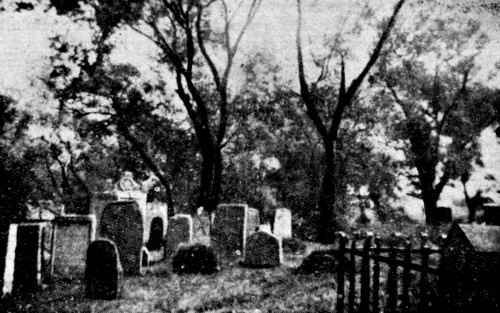
What was the location of the cemeteries from these times and times preceding? Moshe Kramer, in his work “The History of Przemysl in the 17th and 18th Centuries” identifies a specific location of the old cemetery. He provides a description of it, but does not attempt to establish the time of its founding. Professor Schor points out that the Jews had their own cemetery and also a synagogue already in 1559. This fact apparently testifies to the ancient settlement in the city. This opinion is not convincing, but as a proof it uses the words antique and antiquities which were used by King Zygmunt August in his privilege to the Jews of Przemysl from March 29, 1559, as he tries to stress that the Jews already had the right to live in Przemysl from very ancient times, a right that they took advantage of. We know from the aforementioned work of Kramer that in 1559 the Jews had to add an additional cemetery to the one that they already possessed. This cemetery was composed of three sections that were purchased from the “Vicars”
[Page 22]
(assistant priests), from the Ruthenian Cathedral as well as from the Przemysl city hall. The calendar of the “Israelite Unia” (Union) in Vienna from 1907 relates, apparently in agreement with the aforementioned, that Przemysl has three cemeteries (on existed already in 1559, the second was purchased later from the three aforementioned owners, and the third was opened in 1865 after being closed for two years). According to Kahana and Kramer, at that time no old gravestones from before 1575 have been revealed, apparently because these cemeteries were situated outside the walls of the city. The monuments were stolen, apparently by neighbors, from the sections of the cemetery that were no longer tended to because there were no longer any burials or visitors there.
Leopold Hauser wonders about the fact that in the middle of the 16th century (he apparently refers to the year 1542, to the point attributed to Professor Schor) there were no more than 18 Jewish families in Przemysl. Apparently, neither of them took into account the possibility that the Jews did not wish to pay taxes for their houses since they were not owners of houses, and there was a time where they were forced against the law to pay these taxes even as tenants. Therefore, whoever was able to hid during the Lustracja registration of the houses by the representatives of the offices of the Grod. In 1576, the Jews of Przemysl obtained an edict from King Stefan Batory stating that tax payment was not to be demanded from those who do not own houses. According to this edict, in 1542, there were only “found” 18 families, and 23 years later in 1565, there were only 23 families, of whom 13 owned houses and 10 were tenants. It seems that the Lustracjas do not preset an accurate picture. A Jew who did not have a store or a workshop with a large staff certainly knew how to hide – if not in the Jewish section of the city then at last in the “Juridikot”[b]. In Przemysl, like other cities, an important part of the city was in the hands of the nobility and the priesthood. Both of these classes were exempt from tax payment. These sections were called ”Juridikot”. Officials of the “Grod” who polled for the Lustracja did not visit these houses.
The Situation of the Jewish Population in the Year 1594
An additional proof that in the years 1542 and 1565 there were more Jewish families in Przemysl than is noted in the aforementioned Lustracjas can be seen from the fact that in 1594, 29 years after the final Lustracja, a stone synagogue was constructed. The main hall of this synagogue, designated as the men's section, remains unchanged to this day. Bishop Gostycki, in his permit for the building of the synagogue, notes its dimensions as being 20 cubits in width by 30 cubits in length. We know that it had room for several hundred men on the High Holy Days, and approximately 200 men worshipped there on Sabbaths. These numbers give us room to estimate that there were at least 80 Jewish families there during that era, without taking into account other prayer groups of various tradesman and others. It would make sense that during the High Holy Days, families from the villages would join the worshippers of the city. (There were few Jewish villagers at that time.) We have a basis to establish that in 1594 (the year of the building of the synagogue) there were 100 Jewish families in the city. This represents a rapid growth of the Jewish population of Przemysl with respect to 1565, where there were apparently only 23 families.
Przemysl as a National or District Capital
Przemysl enjoyed favorable conditions for economic development. It served primarily as a capital city, at first for the duchy (1084-1145) and later for a 90 year period (1354-1434) as the seat of the Przemysl Palatinate. In 1434, this seat transferred to Lwow. However, even afterward, it remained as the seat of the national district “Ziemia”, one of the largest and wealthiest of the five Ruthenian palatinates.
[Page 23]
However, with respect to the Jews of Przemysl, their city was a capital from two other perspectives. It was the capital of the “Land”, known as the “District” in the Jewish autonomous organization (The Council of the Four Lands). Its task was not only to preside over the communal and religious life in the state, but also to collect the Jewish taxes for the welfare of the state. This autonomous center distributed the sum of the taxes for all the “Lands” (Districts), and the councils of the district Lands would divide the taxes between the communities, who would then divide them up among the individuals and communities. Therefore, the seat of the district “Land” was important also from the vantage point of overseeing taxes, which were not at all light.
Indeed at the beginning of the establishment of Jewish autonomy, the district-Land of Przemysl did not exist, for all of Red Reisin, to the extent that it belonged to the Reisin Palatinate, was at the beginning one autonomous district in Reisin (in those days – one of the found Lands). Therefore, for a significant period, Lwow, the largest and wealthiest area and the capital of this region, held the virtually decisive influence. The other communities were not satisfied with this situation, claiming that the community of Lwow ensured first and foremost that its own members should not pay many taxes, and that the burden of taxes would be imposed on the shoulders of the other, weaker communities. Therefore, a convention was convened in 1664 in a central location in Reisin (Swirz near Bobrka), attended by representatives of the rebelling communities. There were representatives from Zloczow, Brody, Buczacz, Kolomyja, Jaworow and Przemysl. The representative of the city of Przemysl was Reb Shimon Gincburg. Decisions were made regarding the conducting of elections for the district committee, and new enactments were made (information obtained from the Kolomyja book published in New York). Lwow acted cautiously and placated those who needed to be placated. However, several years later a revolt broke out. Several communities that were in the national district of Przemysl, headed by the city of Przemysl, left the autonomous district of Reisin and founded “The National District of Przemysl” of the Council of the Four Lands. The city of Przemysl became the seat of the district council that decided the allocation of taxes, disputes with rabbis, etc. This change took effect between the years 1670 and 1680. In any case, by 1700, the National District of Przemysl already existed. Przemysl, however, did not learn from the experience of Lwow, for a short time after taking rule, communities of the region began to rebel against it. Representatives of Rzeszow, Lezajsk Dobromil, and for some time Jaroslaw, left the district and founded their own district. Some of the disputants, including the community of Jaroslaw, indeed returned, but at the end the chasm reached an extreme situation. All of the communities united against Przemysl, which remained outside of the autonomous organization. It appeared alone as a national district in the Council of the Four Lines.
From a different perspective, Jewish Przemysl remained the seat of the district. After the fire in the Jewish city in 1638, which turned the wooden houses in the area into ruins (only the synagogue, which was built of stone remained), King Wladyslaw IV instituted a new institution in order to assist the Jews of the city in their difficult situation: The Rabbinic Region of Przemysl. A number of the communities of the national district of Przemysl came under the rabbinical jurisdiction of Przemysl as subordinates. These communities were required to participate in taxes for the benefit of the rabbinate and the community of Przemysl. They were also required to pay for the privilege of burying their dead there. They also took upon themselves various obligations, such as purchasing their etrogs[1]] through the agency of the community of Przemysl. Thus, the community gained an additional source of income. Despite the fact that the king wrote an edict making these communities dependent on Przemysl, these communities were not prepared to follow the king's edit with respect to paying taxes to Przemysl and buried their dead in the city. Already by the year 1752, the community of Przemysl was forced to turn to King August III with a complaint of non-fulfillment of the aforementioned obligations. That year, the king issued a proclamation obligating the various communities to change their relationship to their “capital”. It is appropriate to emphasize that August III based the issue of the obligation of the members of the rabbinical district not only on the edict of Wladyslaw IV, but also on the privileges that preceded (Zygmunt III, Stefan Batory, Zygmunt August), and even turned to a number of communities that were outside of the national district of Przemysl (such as Dynow and Dubiecko). However, the communities of Drohobycz and Stryj, which also belonged to the national district, were not mentioned. The obligation to bury the dead in Przemysl was, for all intents and purpose, for
[Page 24]
reasons of taxation or payment of fees for burials that took place outside of Przemysl. Two years later, the complaint did not yield positive results, despite the edit of the king. The community then presented a similar complaint to Sierakowski, the bishop of Przemysl, who was not known as a friend of the Jews (this fact based on the pastoral letters from 1743 and 1753). He threatened these communities with fines if they would continue to be defiant and bury their dead outside of Przemysl.
The Special Privileges of the Kings of Poland
In the political and economic history of the Jews of Poland, we encounter privileges which were granted to the Jews of Przemysl by kings of Poland. These privileges were re-certified by each king at the time of coronation. Professor Schor explains this fact as a general national protocol which established the judicial status of the Jews as well as other classes (the Jews were considered to be a class, or similar to such) based on privileges over and above the general privilege of 1367. Apparently, additional privileges were required for the city. The Jews of Przemysl spent a great deal of money in order to obtain the privilege of March 29, 1559. The king based this on his large number of advisors who requested that he grant this privilege. It is difficult to imagine that they did this out of love of the Jews. The king laid the basis of this privilege as follows: “Despite the fact that the Jews had permission to live in the city in a free manner already since early times, they do not have a privilege stating such either from us our predecessors confirming their right to live in calm and security in that city… we determine that we must constantly guard the situation so that the Jews will have permission to maintain themselves on any street in the city where they had already lived for a long time, without any dispute from any side.”
The History of the Great Synagogue
From documents that were found after the archives in the city of Przemysl were put into order in 1927, we see that according to the words of the writer in his earlier cited article regarding the early settlement of Jews in Przemysl, the first synagogue in the city was already in existence during the 15th century, and stood not far from Grodzka Street (which at that time included what later became Franciszkanska Street). This was certainly a wooden building. According to a Kapitula[c] document of Przemysl from January 1, 1570, which is a quarter of a century prior to the building of the synagogue, the Kapitula and bishop agreed that the Jews would be recognized as owners of the lot upon which the synagogue was built in 1594. This proves that they already owned a synagogue at the time that this document was issued. The details are not clear. It would appear that the Jews turned over their existing synagogue to the Kapitula in lieu of the new, larger lot, and in the interim they built a wooden synagogue for themselves on the new lot. According to what Yosef Kohen-Tzedek gives over his book “Shem Vesheerit”[2], it is known that the community of Przemysl or perhaps only the synagogue trustees of Przemysl had a dispute regarding this synagogue lot in the rabbinical court of Krakow against Jewish neighbors who apparently expropriated some portions of this lot. It would seem that these neighbors also began to build their houses and constructed them in a manner that was liable to obstruct the lighting of or obstruct the access to the synagogue that was built or was about to be built, It is unclear when this rabbinical court case took place, or to which lot this applied.
[Page 25]
|
|
The Permit of the Bishop of Przemysl (1592) for the building of the Synagogue |
[Page 26]
The Community and Sub-Communities (Kehilonim)[3]
The Historian Moshe Kramer, the major student of Professor Meir Balaban, who wrote about the annals of the Jews of Przemysl in the era after the “Flood” in his guide, was apparently the first who explained the meaning of the concept “Przykahlek” in the Polish language, which is translated here as “Kehilon”. This term does not refer to a small community nor does it even signify a jurisdictional body within the autonomous structure of Polish Jewry. On the contrary, it is a segment of an independent community that is situated outside the bounds of the city in which the seat of the independent community is located. It would seem that this section could be a town, a village, or even a lone tavern that is outside the bounds of a specific town. Even if only one Jewish family lived in a town, the term would apply. A “Kehilon” could even encompass several adjacent villages in a specific area of the community.
At the end of the autonomous period (1765), the community of Przemysl had more than 100 sub-communities, and was one of the 33 independent communities that were included in the Land (District) of Przemysl. The independent communities included Dobromil, Jaroslaw, Sieniawa, Lezajsk, Przeworsk, Lancut, Rzeszow, Sambor, and others. Each of them had their own sub-communities.
We will mention here some of the sub-communities of the community of Przemysl from 1765: Mosciska (919 Jews), Medyka (128), Sosnica (63), Bolestraszyce (42), Wyszatyce (40), Nizankowce (39), Radymno (25), Nakło (22) Zurawica (20). In none of these places there existed the standard religious institutions of a community: a rabbinate, public houses of prayers, a mikva (ritual bath) and certainly not a cemetery. At times, such institutions existed in the sub-communities with the agreement of the communal government, or at times without such agreement or even against its will in a revolutionary manner. The experience of the sub-community of Mosciska is especially interesting. It grew in the 18th century and turned into a large community in its own right. However, the rulers of the community of Przemysl did not agree that it should appoint its own rabbi. When its members nevertheless appointed their own rabbi in 1740, the sub-community was excommunicated by the well-known rabbi of Przemysl Rabbi Yechiel Michel, not only with his own initiative, but also with the agreement of the rulers of the autonomous district. The cemetery in Mosciska was founded only in 1759 after decades of difficulties. This was done with the permission of the Starosta and with the request of the Roman Catholic bishop, which aroused the rulers of the Przemysl community to an offensive war against the sub-community.
We must not mix the dependency of the sub-communities on the community of Przemysl with the dependency of most of the independent communities in the district of Przemysl, or even of the two communities outside of it on the community of Przemsyl, which was forced upon them against their will on the basis of the privilege of King Wladyslaw IV from 1638.
According to this privilege, the community of Przemysl and its rabbinate were a second tier to the aforementioned community. These communities required the agreement of the community of Przemysl for the building of a synagogue or the repair of a cemetery. For example, the large independent community of Jaroslaw received permission from the community of Przemysl to repair its cemetery only at the middle of the 17th century; and the independent community of Przeworsk, which numbered 969 people in 1765, was forced to struggle for a long time with the community of Przemysl until it was able to obtain permission to build its own synagogue in the middle of the 18th century. Incidentally, it built its synagogue in the same style as the synagogue of Przemysl. This dependency of most of the independent communities in the district of Przemysl on the community of Przemysl was a unique phenomenon in this district. The independent communities protested this situation, and the community of Przemysl often complained to the kings of Poland and the Roman Catholic bishops in the city about the lack of obedience of these communities. The kings of Poland claimed that this dependency existed de facto prior to the rule of King Wladyslaw IV.
[Page 27]
Changes with Respect to External Trade
A long time prior to the conquest of Red Reisin by Kazimierz the Great, a great change took place in the modes of commerce that was conducted through Przemysl between the west, especially the lands of the Rhine, and India and the Far East. Even before this time, the routes of the Radhanite caravans were shortened. The usual start of their journeys was from Magenza (Mainz), and the final destination was the Russian and Ruthenian lands. When the Khazar Kingdom was destroyed during the latter half of the 10th century, the Russians took control over the passage points of the Jewish merchants from Mainz. Apparently, there were not many opportunities to utilize these transfer points. In any case, we no longer heard about the Radhanites, and in their place, the name Ruzarü appeared. These were merchants who brought their wares to the lands of “Rus”, and were apparently not Jewish merchants from Mainz. It is clear that from the end of the 11th century and onward, these merchants who originated from Mainz disappeared, for Rhineland Jewry was almost completely destroyed by the First Crusade during the 1090s. The final destination of the merchant caravans also moved westward. Instead of the Volga and the Caspian Sea, the destination of the merchant caravans became various ports on the coast of the Black Sea that were ruled over by the Italian city of Genoa, the competitor of Venice. The routes to these areas, through Moldavia were easier. With the change of the points of departure and destination, most of the types of merchandise also changed.
In the meantime, the area of Poland grew during the middle of the 14th century through the annexation of Red Reisin, and at the end of that century by the unification of the rulers or the cooperation of Poland with the lands of broader Lithuania. There had already been broad ranged rural and civic settlement in Poland for some time, partly by settlers from Western Europe. The nobility and the Catholic church started production in large estates – first and foremost agricultural and forestry products for export. The salt mines in the southwest of the country and the salt processing plants in the southeast did not work solely for themselves. In the middle of the 15th century, a new gateway was opened for the export of Polish products: Pomerania was annexed along with Torun and Gdansk, which up until this time was not included in Poland's borders. The Wisla with all of its tributaries, including the San, became a free artery for the export of these products, as well as other types of Polish products, to the Baltic Sea and from there to the east, north and west.
Large-scale business opportunities also increased for Przemysl and its environs. The importance of the ports on the San increased, despite their primitive state. These included Lensk (Lesko), Sanok, Dynow, and Stopnica (today Bachow) near Przemysl, Jaroslaw, Sieniawa, Lezajsk, and Olanow. Jaroslaw became more important than Przemysl from a business perspective on account of its large fairs. However, the eight day fair of Przemysl (Piotra-Pawla) also had economic importance. In addition, merchants and craftsmen from Przemysl participated in the Jaroslaw fair, which was close to their city. When the importance of the Jaroslaw fair declined at the end of the 16th century and the beginning of the 17th, King Zygmunt III attempted to strengthen this fair by temporarily canceling the annual fair of Przemysl; however this action did not save the Jaroslaw fair (Moshe Kramer, Jewish History in Przemsyl during the Period of the 17th and 18th Centuries).
In the interim, the heavy center of manufacturing and export in Poland moved northward, as did the capital city. This increased the importance of the Wisla as the commercial artery of the country. The San found its natural continuation in the Wisla along its northward line. The primary commercial axis – also for business outside of Poland – ran from the northeast to the southwest. Even trade in the direction of the Black Sea moved from north to south, and from there to the southeast; however this was only an auxiliary line in relation to the Wisla-San route. Large loads of Polish wheat were transported even from Gdansk through the Sund to the North Sea and from there to the lands on its shores. This export grew by 50% throughout 50 years. Agricultural products from Przemysl were also sent to Gdansk, as were lumber and salt products from Red Reisin on a larger scale.
[Page 28]
From early times, Przemysl was connected to Hungary through three passes (Dukla, Lupkow and Sianki). The easiest route was through Dukla, through which a good road led to Przemysl through Dynow. It was primarily Jews who were involved in the import of wines and other goods from there. Complaints issued to the government regarding this area are brought down in the sources that were published by Professor Schor in his book “Jews of Przemysl” (1903). According to Kramer, these complaints reached the ears of King Jan Sobieski, who was a friend of the Jews. However, this time he decided against them.
The Wars that Affected Przemysl during the Time of Polish Rule
The Wallachian Hospodar Stephen the Great reached the city in 1498 under the auspices of the Turkish rulers. He conquered the city and perpetrated a great slaughter of its residents. We can surmise that the Jews suffered as well. (See details in the guides of Przemysl and the region by Dr. M. Orlowicz, Lwow 1917, and Dr. K. Wolski, Przemysl 1957).
According to the detailed words of Professor Schor in his book (1903) and in his German booklet (1915), sections of which are included in this book, the city was plundered three times during invasions: during the Cossack Revolt of 5408 (1648/1649) and in the “Flood” (1656/1657) by the Swedes and their confederates. Jewish legions were distinguished in the defending the city from the Swedes. The Jews suffered greatly during these times from various armies (including the Poles) due to the weakening of economic life.
The Tatars, who arrived at the borders of Przemysl in1672 as part of the Turkish army convoy, were defeated by volunteers under the command of the head of the Reformist Monastery, Szykowski. The sole warrior to fall in the battle of that night was a Jew (from the Polish book, “Przemysl Millennium”, 1960, pages 93-96).
During the northern war that took place between 1700-1710 regarding the inheritance of the throne in Poland, the Russians participated on the side of King August and the Swedes supported Leszczynski. Since Przemysl opposed Leszczynski, the Swedes conquered the city and imposed a large financial contribution on the population. The population also suffered greatly from the Russians even though the city supported King August (See Kramer, “Annals”, as noted above).
Religious Libels in Przemysl and Environs
a) Libels based on religion were a part of Jewish life in Christian Europe and Poland from ancient days. They came in a variety of forms. The most dangerous of them were the blood libels: a Jew was accused of enticing a Christian to steal the holy wafer, of purchasing holy artifacts or decorations that were stolen from the church, or of cursing the Christian faith.
b) The history of the Jews of Przemysl and its environs tells a great deal about religious libels, some of them being obscure and clouded. Popular tradition among Przemysl Jews tells of 12 martyrs. Their names, circumstances of death and places of burial are not clear. Professor Schor mentions three libels in “Jews of Przemysl” (1903): 1. Against Moshe Szmulker in 1630, described in detail in the book as well as the sources. 2. Against a number of Jews who had apparently murdered the virgin Oryna from Stara Bircza who worked in a Jewish house in Przemysl. 3. A blood libel against six Jews and one Jewess from Stupnica in 1759, about which only a few details are mentioned in the sources.
c) Sh. M. Lazar tells about his visit to the old cemetery in his article that was published in 1888, in the third book of the “anthology” of N. Sokolow that was dedicated primarily to the selicha written in memory of Reb Moshe Szmulker. He was told that Szmulker's gravestone does not exist at all, but he was shown a specific place next to the fence where his grave exists according to tradition. He was shown the graves of the 12 martyrs, according to tradition, not far from Szmulker's grave. In a response to Lazar's article, Professor Dr. David Kaufman expresses his opinion in “anthology”, (book four, 1889), that there is basis to believe that the 12 martyrs were murdered at one time.
[Page 29]
Professor Kaufman brings the name of a Przemysl Jew who was cruelly murdered in sanctification of the Divine Name – Reb Yehudi the son of Reb Aharon of Premsli, who was also mentioned by Reb Shmuel the son of the holy Reb David (Chesed Shmuel, Amsterdam, 5459, 1699). It must be noted that the name of the city of Przemysl is not explicitly mentioned in this instance of martyrdom.
d) Yosef Kohen Tzedek mentions in his book “Shem Vesheerit” (Krakow 1895) another incidence of martyrdom in Przemysl. It was with Reb Avraham, the father of the rabbi who was the author of “Mateh Moshe”. His son would sign his name “Moshe the son of the Holy Rabbi Avraham of blessed memory, may G-d avenge his blood.”
e) The aforementioned blood libel from Stara Bircza, based on a complaint brought to the rabbinical court of Przemysl, since the maid Oryna who was murdered apparently served in a Jewish house in Przemysl. As a result of the clarification of the complaint that was presented in 1646, King Wladyslaw IV freed the Jews who were accused of murder and punished Oryna's father and the other complainants.
f) In 1664, there was a libel regarding the instigation to steal vessels from the church in Mosciska, which was carried out by a Christian in the church of that village. The thief claimed that the Christian maid who served in the home of the wealthy Jew Avraham Izraelowicz, the lessee of the propinacja (license for the sale of alcoholic beverages) in Mosciska, enticed her. She in turn claimed that Rochele, a relative or maid of Avraham, enticed her. The complaint not only accused these two Jews and two Christians, but also the head of the community of Przemysl Berko Jelonowicz and all of the tavern keepers in the region of Przemysl. The court case was transferred to a court in Lublin, which sentenced Rochele and Avraham to death by burning. They were indeed burned publicly at the stake, while the others were let off as innocent.
g) One of the most frightful libels was the blood libel of Stupnica[d] in 1759 (a port city on the San opposite Dubiecko) against three Jews and one Jewess. They were accused of murdering Christian children, including a three-year-old child, in collaboration with other unidentified Jews. The children were apparently brought to Stupnica and murdered there in order to obtain large quantities of blood “for the purposes of Passover” to send to different places. The accused were brought to court in Przemysl and tortured ten times with four types of torture implements in the presence of the judges. None of them confessed despite the torture. Nevertheless, the court relied on the “fact” that blood appeared on the body of the child at the apparent place of the murder, and they sentenced the six Jews to death. As a “token of mercy”, they decided that the death sentence was to be carried out by decapitation by sword. The verdict was apparently executed immediately in Przemysl. The Jewish woman remained in prison so that she could testify against the collaborators who were still to be identified. It is to be noted that the accusation took place during the year when a debate took place in the Roman Catholic cathedral of Lwow between the rabbinic Jews and the Frankists[4], who claimed that Jews require Christian blood. It is easy to imagine the fear that overtook the Jews of Przemysl during those days.
Spreading Out Beyond the Jewish Quarter
The difficult economic situation of the Jews of Przemysl began in the second half of the 17th century and continued until the end of the 18th. Nevertheless, during that era, the Jews penetrated in to the Christian quarters of the city and rented dwellings, especially houses owned by the nobility and the clergy (“juridikot”). The impetus for this was the crowding and poor sanitary conditions in the houses of the Jewish quarter, and the need to provide houses for married children. However, there were also economic factors, such as the proximity to a warehouse or workshop that was located outside of the Jewish quarter, or the opportunity to engage in work that was not permitted by the civic guilds and that would be easier to hide from the eyes of the guilds in the “Juridikot”. Perhaps the desire to distance economic enterprises from the eyes of Jewish competitors was also a factor. An additional factor leading to the exodus from the Jewish quarter was the requirement to pay high taxes to the Jewish community on account of its debts.
[Page 30]
Due to the mass exodus from the residences in the Jewish quarter in order to evade paying taxes to the community, the case was brought in 1752 to the Wojewoda, Prince Czartoryski, with the complaint that this exodus will weaken the activities of the community. The Wojewoda threatened Jews who moved to Christian quarters with harsh punishments, including corporal punishment, if they refuse to return to their homes. However, this edict apparently had no effect. As a proof of this we see that the city council also began to take action against Jews in the Christian quarters, for there was a battle between the Jews and the city council from generation to generation. However, it became clear that this activity against the Jews was liable to affect the interests of the Christian citizens who were homeowners, for a ban on Jews from renting homes from Christians would affect their ability to pay taxes to the city hall (Magistrate). According to Professor Schor and Moshe Kramer, the Magistrate and the Jews reached an agreement in November 1756 (or 1757) to grant Jews the right to rent dwellings in the Rynek and on streets outside the Jewish quarter in which they had lived until this time. They were also permitted to purchase empty houses without residents from the nobility of the clergy, and to maintain ownership in perpetuity, in exchange for the payment of the taxes of these houses to the Magistrate. This increased the income of the Magistrate, for the former Christian owners did not pay taxes due to the privileges that applied to their classes. The only condition was that the Jews were not allowed to sell these houses to the nobility of members of the clergy, lest the Magistrate lose the income from the taxes owed by the Jews. According to Kramer, in 1765, almost 20% of the total Jewish population of Przemysl lived in the “Juridikot”.
The Results of the War Between the Burghers and the Jews
At the time of the annexation of Przemysl to the Kingdom of Austria in 1772, most of the Jews of the city were poor, and the financial situation of the community was desperate. The situation of the Christian citizens was also quite bad. Starting from the middle of the 17th century, the population of both sections of the city, the Jewish and the Christian, declined. The hand of the Christians was not uppermost in the war between the Christian merchants and the Jews. On the contrary, almost all of the Christian shops disappeared, and Christian commerce declined drastically. Already in the middle of the 17th century, the anti-Semitic writer Miczynski wrote in his book “Mirror of the Polish Crown” (Krakow 1620) that Christian commerce had been completely liquidated in Przemysl due to the activities of the Jews. Professor Schor does not attempt to tamper with the claims of the Poles, but he stresses that it was not to be expected that the Jews forego their own wellbeing in their struggle for existence. He attempts to understand both sides. However, this differed from the Przemysl writer Hauser (1883), who believed that the Jews enriched themselves during this struggle while the Christian merchants became impoverished and dissappeared.
According to a Polish source (“Historia Polski”, 1957/1958, a government publication), the number of Jews in various fields of commerce increased throughout Poland during the 16th century. “In Przemysl, they worked in more than 20 professions and trades, not only in the Jewish market, but also in the local market.” (Pages 454-455). This means that the guilds did not succeed in removing the Jews from their strong position in trades that remained in Jewish hands, despite their privileges and means of coercion.
In tavern keeping, an important source of livelihood (the third), the status of the Christians already weakened at the end of the period of Polish rule.
All things considered, the economic situation of the Jews became more difficult from year to year during the 18th century. The number of Jews who went into bankruptcy increased. Many left the city, as one can see from the records of Jewish population in Przemysl. In the population registries of Red Reisin from 1765 there were 11 cities with Jewish populations of greater than 1,000. Among these, Lwow had 6,159, whereas Przemysl does not appear on the list. (From Mahler, “History of the Jews of Poland, pages 242-244, published by the Workers Library, 1946.)
[Page 31]
|
|
The old cemetery |
The Local Tradition Regarding the Erection of the Old Synagogue
The writer Sh. M. Lazar, the scion of a veteran family of Przemysl, absorbed a large dose of tradition about his hometown from his father's home. He examined the gravestones in the old cemetery which were excavated in 1888 under the auspices of the community, exposing many gravestones that had disappeared beneath the ground. The examiners attempted to figure out the inscriptions upon them. Lazar gives a few details about the results of his examinations in his article about the selicha marking the death of Reb Moshe Szmulker, may G-d avenge his death, that was published in the anthology of N. Sokolow in the year 5648 (1888). There it is stated, “From among all of the monuments of communal administrators in the venerable old synagogue, there is a gravestone which does not mention the name and date of death of the deceased. However, his name is known by tradition. The following is the inscription on the grave: “Torah and greatness were together, united with his good deeds, a leader of the country and the community, he built the poorhouse, the bathhouse, and the women's gallery in fine fashion[5]. He dedicated the synagogue, the Torah scrolls, and the pure silver menorah. His house was also opened wide to everyone. He married off young girls, supported the poor, and lived without complaint. He left a bequest of 100 guilders of charity to the Land of Israel on an annual basis, until the advent of the Redeemer. May his soul be bound in the bonds of eternal life[6]. As far as we know, the name of this leader is Reb Avraham the Sephardi, who built the Great synagogue (in the words of Lazar) in this place, which is a splendid, fine building that stands to this day. According to tradition, his brother, who was his partner in this mitzvah, was buried next to him. According to popular legend, the time of the building of the synagogue was in the first century of the millennium[7], but who knows if this is true[8].”
The inscription on this monument is almost equivalent to that of the first monument that is brought down in this book, according to the article of Avraham Kahana on this matter which was published in “Hatzofeh Lechachmat Yisrael”, Budapest 5688 (1928). The
[Page 32]
important differences are: Lazar wrote “Beit Hedkesh” (The poorhouse) whereas Kahan wrote “Beit Hamikdash” (The Holy Temple); In Leizer's version, after the word “Hagoel” (the redeemer), there are several words which at that time (5648) were not able to be interpreted; In Kahana's version, before “May his soul be bound in the bonds of eternal life”, appear the words “May his merits endure forever”. In Kahana, there is a note about the text on the gravestone, the source of which is unknown to us “form the year 5335 (1575)”. This shows that the man, who was a leader of the community and the country and whose name is not given, died approximately 19 years before the building of the synagogue in the year 5354 (1594) as is known in our time, and approximately 17 years before the issuing of the permit for its building by Bishop Gostycki (1592). In any case, Kahana read the main words as “Beit Hamikdash”. Lazar, on the other hand, does not give a date for the gravestone and surmises that the man himself built the synagogue. In any case, he reads the main word as “Beit Hekdesh”. If we are talking about a poorhouse, despite its honorable function, it cannot be compared in religious importance to a bathhouse and mikva, not only because of the difficulties and the expense in the building of a mikva and bathhouse and the need for piping in water from below ground and for the digging of a collection point for water. In those days, the Jews even had to port water for drinking and cooking from the San. The monument also has no sign of praise for the internal splendor of the building, which was outstanding in beauty even during that time. The monument suffices itself with the statement that the “leader” dedicated a synagogue (that is not nicknamed a “Beit Hamikdash”) along with the Torah scrolls and the pure silver menorah, as if they were the primary matter, and not the building itself. This description is convincing, and not just a guess, that this “leader” built a temporary, modest synagogue out of wood, according to the permit of Bishop Gostycki of 1592, the copy of which is brought in this synagogue. Therefore, a permit from the church was required, which was given by the bishop of that time (Herburt) on January 1, 1570 for the community to purchase a plot for the purpose of building a synagogue. This time, the plan was to build a synagogue out of stone with splendid proportions, which was not proposed in 1570 out of fear of non-approval of the plan by the synod. However, in 1592, even the measurements of the building were detailed, which were not detailed in 1570.
With regards to the tradition that the builder of the building mentioned on the gravestone is Avraham, there is no proof aside from the tradition itself. This is also the case with respect to his Sephardic roots and to the claim that his brother is buried “next” to the grave of Reb Avraham[9]. We do not know anything about the location of the gravestone of the brother. Professor Schor, who does not contradict the basis of the aforementioned tradition, opines that the Sephardic brothers arrived in Przemysl with the stream of Sephardic merchants from Turkey who came to Red Reisin in the wake of the business ventures of Don Yosef Nas in the 16th century and settled for the most part in Lwow but also in Przemysl. They were certainly called “Turks” (Turk)[10]. We should note that the tradition of the two Sephardic brothers is confirmed as well by Rabbi Weinberger, who is a native of Przemysl and is today a member of the rabbinic court of Tel Aviv. He claims that according to the tradition, two Sephardic brothers built the synagogue. However, the text of the gravestone offers no evidence to his claim that it was placed over the grave of the two brothers.
The popular legend that is cited by Lazar and Rabbi Weinberger, that the synagogue was first built during the first century of the millennium, does not contradict other facts, except perhaps the fact that it was impossible that this synagogue would be located in an earlier century on a lot that was only obtained in the 16th century. We still must indeed clarify if the popular legend explicitly implies that the synagogue from the first century of the millennium is located on that same lot. It is known that in 1355, Kazimierz the Great found in Przemysl a Jewish community that had already been organized for a long time before Kazimierz had conquered Przemysl, therefore he was not required to establish it. 1355 is identified approximately with the year 5116 of the sixth millennium, and the first century of the sixth millennium began in 1241 and ended in 1339, which is only 16 years prior to the conquest. Similarly, we must note that among
[Page 33]
the facts that the archivist Smolka published in 1927 (according to the article by the historian Schall), there are those who demonstrate that the synagogue near Grodzka street, which is identified with a part of the street that is today called Franciszkanska, was already in the possession of the Jews in the 15th century.
Jews of Przemysl and their Relations to the Movements within Judaism During the Years 1665-1772
In the literature that encompasses the era from 5408 – 5532 (1648 – 1772) that was written by the Jews of Poland, it is hard to find – except during the 12 year period from 5408-5420) – books that describe the events of the era – even in the form of partial chronicles of memoirs. Such topics are outside of the usual bounds. The Jews of this Diaspora were apparently always tense and awaiting the arrival of the Redeemer, and they felt as if they did not belong to the annals of the nation in the civic life in the lands of their Dispersion. Even their building of their synagogues “Miniature Sanctuaries” were conducted “on condition”. (The Altneuschul in Prague was founded “on condition”.) It is a fact that prior to the era of the Haskalah, Polish Jewry was almost completely lacking in historiography. Only from the era of the tribulations of Tach ve Tat (1648-1649)[11] continuing until the end of the war with the Swedes in 5420 (1660), the era when hundreds of communities were destroyed, many myriads were killed and hundreds of thousands were displaced – times that were like a deluge full of destruction – did a number of Jewish writers in Poland begin to record the terrible events that took place during their time, even writing about some of the events of the time with the perspective of the religious, economic and social background. The best known of them was Reb Natan Nota Hanover, who described the destruction[12] of Tach ve Tat in his book “Yaven Metzula”. He also includes a description of the Cossack attack on Przemysl which was repelled. He calls Przemysl “A great city to G-d of scholars and scribes” (M. Schor, “Jews of Przemysl, 1903, page 31). However this arousal of the Jews of Poland to record the events of their times was brief, and did not even last until the long era of Sabbatainism and the movements that sprung forth from it. It did not renew itself prior to the first partition of Poland. The memoirs of Dov Ber Bolechower deal with the end of this era, but were written after the time by someone who was a partial maskil. Aside from these, we do not have any sources written by Jews from those generations in Poland. We also do not have any memoirs of the genre of Gluckel Hameln. The era of 5425-5532 (1664-1772) was the period of the birth of movements that shook the foundation of generations-old traditions and communal life of the Jews of Poland, especially in the southwest region including Przemysl, a city in Red Reisin. We must not forget that, as is written in other places, during this period the economic and security situation of the Jews of Poland weakened. Wave of persecution based on many harsh religious libels passed through the entire country, including Przemysl, especially during the first half of the 18th century. These persecutions had no match until this point, and often brought the Jews to the point of despair.
We must suffice ourselves with the mention of a number of facts and dates. Shabtai Tzvi appeared as a messiah in the year 1665. Already by 1666 he had converted to Islam, and he died after his expulsion in the year 1675. A portion of his followers remained faithful to this false messiah, even though he had become an apostate, an act that they felt was for external show only. This was even after he had been excommunicated by the rabbis in general, especially in the year 5430 (1670), something which was customary in Poland. Under such conditions, the followers of Shabtai had to hide their faith in Sabbateanism, which became a secret movement, persecuted by the general community of rabbis and by the independent governing councils of the Polish Jewry. The southwestern region of Podolia, which bordered on Turkey and Red Reisin turned into a center of Sabbateanism, especially in the year 5432 (1672), when it was under Turkish rule for 28 years. Strong Sabbatean publicity was also active for many years in Red Reisin, headed by the kabbalistic preacher Chaim Mahalach (or Malach). When Podolia returned to Poland in 1700, a renewed wave of Sabbateanism arrived, which was not easy to suppress. This wave brought in its wake a new prayer rite, created in Podolia during the era that it belonged to Turkey. This was an intermixture of the Sephardic and Ashkenazic rites, and was also accepted by non-Sabbateans.
[Page 34]
Already before those days, a rabbinical judge named Yosef (the son of Moshe) served in his native town of Przemysl. He is not to be confused with the important rabbi that also lived during that era in Przemysl, Rabbi Yosef Segal, the author of the book “Tzafnat Paneach”. This judge, who was also known as a preacher, published a book with a similar name called “The New Tzafnat Paneach”, that was published in Frankfurt an der Oder in the year 5454 (1694). According to Professor Balaban, the man was a Sabbatean, but as a member of the rabbinical court he had to hide his beliefs. In any case, the tenure of this judge and preacher in Przemysl was uncomfortable, and he became a roving preacher until he reached Berlin. In 5460 (1700) in Berlin, he published a commentary to the siddur (prayer book) called “Keter Yosef”, the distribution of which was opposed by the leaders of the generation out of suspicion of the Sabbatean leanings of its author. We can see that the Sabbatean flame was also lit in Przemysl, but its Jews were able to extinguish it while there was still time.
Approximately 60 year later, the Jews of Przemysl once again had the opportunity to participate in a great dispute that took place between the rabbis of Europe in general and the rabbis of Poland about the Council of the Four lands. The dispute came to the fore in the background of the accusation of Rabbi Yaakov Emden against Rabbi Yonatan Eybeshutz, one of the Torah giants of his time, for Sabbatean leanings that were apparently displayed with the publication of amulets with the term “messiah” hidden therein. This dispute divided into two the rabbinic and secular camps in Poland who were faithful to “Talmudic” Judaism, with one side fighting against ht other with an outpouring of wrath. The well-known praiseworthy rabbi of Przemysl, Rabbi Michaeli ben Shmuel (5494-5531 1734-1771), took the side of Rabbi Yonatan. He is described by Professor Schor (in his German article, “The Chronicles of the Jews of Przemysl”, Vienna, 1915) as one of his zealous supporters. The camp of Rabbi Yonatan won this battle. In accordance with a decision taken at a meeting of the Council of the Four Lands in Jaroslaw, the publications of rabbi Y. Emden against Rabbi Yonatan were destroyed in that city on December 31, 1753.
It is not known if the Frankist movement had supporters in Przemysl during its time. It is hard to image that it did, taking into account the stance of the Frankists with respect to the blood libel in the debate in Lwow (The Stupnica libel).
During the 25 years preceding the first partition of Poland, that is in the year 5507 (1747), the large popular Hassidic movement arose with the “revelation” of the Besht in Tluste. This movement was also received by the rabbis of Poland, including Red Reisin, with suspicion. They persecuted it and imposed a ban of excommunication upon it due to its attacks on the community of scholars, and because of its acceptance of the Sephardic-Podolian prayer rite, which aroused suspicions of Sabbateanism. We do not know if the rabbis of Przemysl during that time participated in the battle against that movement. We have basis to establish that among the heads of this movement after the death of the Besht and among those who were attacked by the G”RA (Vilna Gaon) was Levi Yitzchak, a native of the village of Husakow near Przemysl, where his father was an honorable rabbi. This is none other than the Rabbi Levi Yitzchak, who was later called “of Berdichev”. He attempted unsuccessfully to assuage the G”RA who attacked Hassidim. It is not known if Rabbi Levi Yitzchak also worked on behalf of his movement in Przemysl.
Specific Courts of Law for Jews
By virtue of their privileges, the Jews of Przemysl, as in all of Poland, could not be judged in the general courts of the country. If a Jew wished to bring a co-religionist to judgment, other than in cases of damages, he had no recourse other than the rabbinical courts to ensure that the verdict would be executed. However if a Jews was summoned to court by a gentile, the case would take place in a special court (Palatinali) that was comprised of members of the Palatin (Wojewoda) and the community.
Since cases between one Jew and another were only brought before the rabbinical court, there was a necessity for two types of judges in the city, headed by the rabbi and his second in command who was called the head of the rabbinical court. This is how it was in practice. The arrangement of Gittin (bills of divorce) and chalitza (release from levirate marriage) were under the sole jurisdiction of the first component. These two groups of judges also traveled to the fairs that were of importance to the people of Przemysl and the region, especially
[Page 35]
in Jaroslaw, Mosciska and Kanczuga. Contracts between Jews were registered in the ledgers of the court and later publicized by the shamash (beadle) of the synagogue. Contracts that were not drawn up in this manner had no force. Professor Schor finds in the ledger of the judges who began to register enactments for judges in the middle of the 17th century and was edited in the year 5449 (1689), that the jurisdiction of the rabbinical court includes the administering of punishments for religious transgressions or failing to observe the edicts of the community in the areas of distribution of taxes, lease rights, and maintenance.
The Wojewoda, who held high office over a large area, stood at the head of the mixed courts, which dealt with legal disputes related to damages between Jews in addition to claims against Jews by gentiles. (The Wojewoda held power of the Palatinate jurisdiction, which in Przemysl included an area from Lancut in the west to Drohobycz and Stryj in the east.) The Wojewoda of the Ruthenian Palatinate consisted of five regions, of which Przemysl was one. In practice, the Wojewodas of smaller regions in the Przemysl district utilized the mixed courts, which were called Podwojewoda. There were three such sub-courts in the Ruthenian Palatinate, one being for the region of Przemysl. The Wojewoda held the second authority (instancja) for the verdicts of the courts of law that bore its name. The first authority was only for judging exceptional matters that[13] required very serious judicial efforts, such as matters relating to religious libel. In accordance with the privileges granted by the king, for such matters the Jews were granted the rights of judgment in the royal court or in a special court appointed by the king. There were cases where the general courts did not pay attention to such privileges, and took cases based on religious libel into their own hands. This was the case with Reb Moshe Szmukler, who was judged in a court without such authority, despite the objection of the Podwojewoda. The accused was not even given the right of appeal in the royal court, but was rather put to death immediately by burning.
The Wojewoda appointed the Podwojewoda with the approval of the representatives of the Jews, who agreed in a unanimous fashion about the conditions of his work, for the Jewish community paid his salary and provided him with his special needs for the holidays, as determined from the outset. In addition, they also paid to the Podwojewoda a portion of the fines that were imposed upon those judged as guilty. In a unanimous agreement with the Podwojewoda of Przemysl (according to the research of Professor Balaban), the Jews set the condition that the Podwojewoda would not participate often in meetings of the court of which he was the chairman. This was in order to save travel expenses as well as his room and board in Przemysl, which were high with respect to his nobility. The custom existed in the region of Przemysl that the Podwojewoda would be a member of the nobility, a resident of the area, and the owner of an estate.
In the aforementioned letter of appointment, of which Professor Balaban provides a copy, the Wojewoda requests that his deputy take heed of the Jews of his region who of late have found themselves in a low economic situation and make efforts to assist them to the degree possible. This letter demonstrates the sympathetic relationship that the Wojewoda, a nobleman of high rank, had toward the Jews of the region. Aside from the Wojewoda, another Christian who represented the government and familiar with the laws participated as a member and secretary of the Palatinate court. He would conduct the court cases if the Podwojewoda was absent. It should be noted that this courthouse was authorized to register judicial activities about which there was no point of contention between the sides that were authorized to be judged therein. These activities could also be registered before the national court (The Grod Court).
In the court cases that were conducted during the 16th and 17th centuries, two to three parnassim (“elders”) who received their appointments from the communal leadership participated from the Jewish side. The community shamash also participated, but without the right of voting. The Podwojewoda would authorize his appointment by the community. The registration in the ledgers was done by the “elders”. These books were stored in a special bookcase in the court of law (in the synagogue), locked with two locks. One key was held by the chairman and the second one by the shamash. These books disappeared during the attacks on the synagogue that were perpetrated by the Jesuits in 1746.
[Page 36]
Starting from 1549, all of the Jews of Poland, including those of Przemysl, paid a head tax that was imposed only upon them without differentiation between sex, age, and profession. At first the tax was one guilder per person, and later it grew. According to the law, the payment of this tax exempted the payer from all other taxes. However, in practice, under difficult circumstances – and from the middle of the 17th century until the partition such circumstances never stopped – the national Sejms decided that the Jews must participate in the payment of other taxes. Among others, the tax for the housing of the army, which lived in royal estates during times of war, was particularly heavy. This tax, which was imposed solely upon the Jews and Christian burghers, was paid at first by the provision of food. However, from 1605, the tax began to be paid in cash, and the army itself conducted the collection. This was often connected with pillage by the soldiers and beatings being administered to the communal shamashim. From its inception, the collection of the head tax was the job of the Jewish autonomous body.
In the opinion of Professor Schor, the Jews were illegally forced to participate in the payment of all civic fees in exchange for services from the city hall. For example, the Jews of Przemysl paid for the use of the civic water wells. However, they were not permitted to use water from the civic water porters, but were forced to port the water from the San at their own expense.
The Jews of Przemysl also had to pay set fees to various church institutions. This was mainly devoid of legal basis.
Translator's Footnotes
Coordinator's Footnotes
|
|
JewishGen, Inc. makes no representations regarding the accuracy of
the translation. The reader may wish to refer to the original material
for verification.
JewishGen is not responsible for inaccuracies or omissions in the original work and cannot rewrite or edit the text to correct inaccuracies and/or omissions.
Our mission is to produce a translation of the original work and we cannot verify the accuracy of statements or alter facts cited.
 Przemysl, Poland
 Yizkor Book Project
 JewishGen Home Page
Copyright © 1999-2024 by JewishGen, Inc.
Updated 5 Sep 2018 by LA