 |
|
| Sketch of a Mother | 16 |
| An Organization Hanukah Party in Tel Aviv | 36 |
| Yitschak Vakman | 38 |
| Avraham Shafir | 45 |
| Moshe Charash | 47 |
| Avraham Biberman | 48 |
| Yosef Shvartsapel (Sharon) | 50 |
| Sara Bernshteyn-Fiks | 53 |
| Yehoshue Fiks | 55 |
| Leya (Mordish) Efrat | 57 |
| Zhenya Berman | 58 |
| Bronya Karpel (Barshap) | 61 |
| Dov Manusovits | 62 |
| Yitschak Gintsburg | 63 |
| Boris (Berel) Shtern | 64 |
| Abir, Avraham (see also Biberman) | 39, 48 (photo), 48-49, 70, 80 |
| Abir*, Miryam (Manya; see also Biberman) | 18, 48, 49, 70 |
| Akerman brothers | 21 |
| Akerman, Dotsya | 76 |
| Alima, Ori | 67, 68 |
| Alima, Oz | 68 |
| Alima*, Rut (née Vishniov) | 67, 68 |
| Amitay, Chana | 78 |
| Argaman, Avraham | ii |
| Avidar, Yosef (see also Rokhel, Yosef) | 48, 67, 78 |
| Ayzenfres, Miryam | 79 |
| Bakimer, David | 78 |
| Bankir*, Ariela (née Mordish) | 68 |
| Bankir, Dubi | 68 |
| Bankir, Shlome | 68 |
| Barats, Yitschak | 78 |
| Barshap, Avraham | 61 |
| Barshap, Bronya | 61, 61 (photo), 80 |
| Barshap*, Chana (née Kupershteyn) | 78 |
| Barshap, Jack | 43 |
| Barshap, Sonya | 61, 78, 79 |
| Barushek, Yenta | 76 |
| Bat, Sara | 78 |
| Beaupré, Jan | 66 |
| Beker, Moshe | 78 |
| Ben Dov, Ela | 78 |
| Berenshteyn, Tsvi | ii, 76, 83 |
| Berman, Aharon | 58 |
| Berman, Brakha | 58 |
| Berman, Yakov | 58, 79 |
| Berman, Zhenya | 58, 58 (photo) |
| Bernshteyn | 21 |
| Bernshteyn, Riva | 1, 65 |
| Bernshteyn, Sara | 53 (photo), 53-54 |
| Bernshteyn, Yakovke | 53 |
| Bernshteyn, Yonye | 58 |
| Beylin, Y. B. | 7, 10 |
| Beznoski, Brayna | 1, 52, 52 (photo), 65, 80 |
| Bezpoysnik, Ela | 78 |
| Bialik, Chayim Nachman | 42 |
| Biberman, Avraham (see also Abir) | 39, 48 (photo), 48-49, 70, 80 |
| Biberman*, Bela | 48 |
| Biberman, Bronya | 36 (photo) |
| Biberman, Leya | 49, 80 |
| Biberman, Leyb | 17, 18 |
| Biberman, Malka | 78 |
| Biberman*, Miryam (Manya; see also Abir) | 48, 49, 70 |
| Biberman, Moshe | 48 |
| Biberman, Rivka | 78 |
| Blank, Shmuel | 76 |
| Bodeker, Avraham | 78 |
| Britshteyn, Batya | 68 |
| Britshteyn*, Bela (née Zeyger) | 68 |
| Broderzon | 10 |
| Brodski | 66 |
| Brustin, Mark | 58 |
| Brustin*, Zhenya | 58, 58 (photo) |
| Burshteyn, Yosef | 79 |
| Buts, Chayka | 70 |
| Byk, Fred | 82 |
| Chagall, Marc | 10, 26-29 |
| Charash, Avigdor | 47 |
| Charash*, Hinda | 47 |
| Charash, Moshe | 47, 47 (photo) |
| Charash, Senya | 47 |
| Charash, Sima | 47 |
| Charash, Yakov | 47 |
| Charash, Yitschak | 79 |
| Charash*, Yocheved | 47 |
| Chasid, Avraham Dimona | 68, 78, 80 |
| Chasid*, Etya (Eti) | 68, 78, 80 |
| Cornbleet, Harry F. | 37 |
| Dagan, Sara | 78 |
| David (brother of Rivka Mochin*) | 70 |
| Desser, Mark | 77, 82 |
| Desser, Max | ii, 77, 82 |
| Desser, Miryam | 82 |
| Diment, Miryam | 78 |
| Dorfman, Bernardo | 73, 76 |
| Dorfman*, Manya | 76 |
| Dorfman, Martin | 73 |
| Dorfman*, Moni | 73 |
| Dugim , Avraham (see also Dagim, Dugi) | 79 |
| Efrat*, Leya (née Mordish) | 57, 57 (photo) |
| Efrat, Melik | 57 |
| Engelman, Bela | 78 |
| Epshteyn, Arye | 68 |
| Epshteyn*, Tova | 68 |
| Epshteyn, Yakov | 68, 78 |
| Fakher, Chayim (see also Fayer, Chayim) | 71, 72, 73, 75, 76, 82 |
| Falenboygen, Chayim | 76 |
| Falenboygen*, Gitel | 76 |
| Fali | 76 |
| Fayer*, Chana | 72, 75, 76, 82 |
| Fayer, Chayim (see also Fakher, Chayim) | 71, 72, 73, 75, 76, 82 |
| Fayer, Fegya (Felisa) | 72 |
| Fayer*, Fufi | 72, 76 |
| Fayer, Manolo | 72 |
| Fayer, Moshe-Avraham (Alfredo) | 72 |
| Federman*, Dozya (née Rubinfin) | 70 |
| Fefer, Itsik | 6, 7, 10 |
| Feldman*, Adalya | 76 |
| Feldman, Dvora | 24 |
| Feldman, Isak | 76 |
| Feyman, Ester | 76 |
| Fidel-Kinori, Pinchas | 78 |
| Fikhman, Yakov | 30 |
| Fiks*, Sara (née Bernshteyn) | 53 (photo), 53-54 |
| Fiks, Yehoshue | 55 (photo), 55-56 |
| Fingerut | 66 |
| Fingerut, Avraham | 78 |
| Finkelshteyn, Sonya | 50, 51 |
| Fisher*, Chaya (née Kutsher) | 79 |
| Fisherman, Rachel | 78 |
| Fishman, Dvora | 79 |
| Fishman*, Ester | 74 |
| Fishman, Lifshe | 74 |
| Fishman, Manya | 76 |
| Fishman, Nute | 74 |
| Fishman, Penik | 74 |
| Fishman*, Sara | 74 |
| Fishman, Yeshayahu | 70, 74 |
| Fishman, Yitschak | 74 |
| Frenkel, Avraham | 78 |
| Frenkel, Misha | 71 |
| Frenkel*, Vitya (née Kirshon) | 71 |
| Freylikh, Shifra | 71 |
| Frug, Y. B. | 10 |
| Fuks, Shmuel | 43 |
| Gal, Chen (see also Liberman) | 78 |
| Galperin, Tsipora | 79 |
| Garber*, Fanya (Fani; née Reznik) | 31, 33, 75, 76, 77 |
| Garber, Yechezkel | 74, 75 |
| Gerin, Tova | 78 |
| Gershteyn | 66 |
| Gertman*, Sonya (née Barshap) | 61, 78, 79 |
| Gibelbank, Chayim | 7 (photo) |
| Gilad*, Adya | 67 |
| Gilad, Efrat | 67 |
| Gilad, Yisrael | 67 |
| Gintsburg, Aharon | 78 |
| Gintsburg*, Naomi | 63, 80 |
| Gintsburg, Yitschak | 63, 63 (photo), 80 |
| Gletshteyn, Aharon (see also Sela, Aharon) | 79 |
| Gluzman, Eliezer | 70 |
| Gluzman, Yitschak | 78 |
| Gokhshteyn, Chantse | 74, 76 |
| Gokhshteyn, Shmaryahu | 78 |
| Gokhshteyn, Yisrael (cantor) | 76 |
| Gokun, Avraham | 36 (photo), 78 |
| Golani, Sholem | 78 |
| Golberg, Yehoshue | ii, 58, 68, 77, 80, 83 |
| Golcher, Meir | 78 |
| Goldberg, Rivka | 78 |
| Goldberg, Shayke | 41 |
| Goldberg, Yitschak | 67 |
| Goldenberg*, Chana | 69 |
| Goldenberg, Hadasa | 79 |
| Goldenberg, Manus | ii, 6, 11, 26, 29, 38, 40, 44, 46, 47, 58, 59, 65, 69, 76 |
| Goldenberg, Shprintse | 47 |
| Goldring, Meir | 11 |
| Golub, Liova | 79 |
| Gordner, Leon | 77, 82 |
| Goren, Betsalel (see also Gorodiner, Alter) | 13 |
| Gravski | 20 |
| Gurvits, Liora | 47 |
| Gurvits, Mordekhay | 19 53, 55, 79 |
| Gutman, Avraham | 70 |
| Gutman, Leyb | 70 |
| Gutman, Rachel | 70, 79 |
| Halpern, M. | 10 |
| Har-Tsion, Eliyahu | 78 |
| Hauzner, Rivka | 45 |
| Heshkel*, Tsivya (née Shafir) | 80 |
| Heyman*, Malka | 79 |
| Hirshbeyn, Perets | 10 |
| Hofman, Malka | 78 |
| Hofshteyn, Duvid | 6, 7, 10 |
| Horovits*, Miryam (née Diment) | 78 |
| Horovits, Tsvi | 78 |
| Ish-Tov*, Fanya | 67, 79 |
| Ish-Tov, Ora | 67 |
| Ish-Tov, Shraga | 67 |
| Itech, Yakov | 78 |
| Kagan, William | 43 |
| Kaganovits, Malka | 78 |
| Kanfer | 21 |
| Kantor*, Bat-Sheva | 78 |
| Kaplan, Sam | 77 |
| Kaplan*, Tova | 77 |
| Karasik, Gershon, Rabbi | 40 |
| Karkoviak, Shalom | 78 |
| Karlitas | 76 |
| Karpel*, Bronya (née Barshap) | 61, 61 (photo), 80 |
| Karpel, Nitsa | 61 |
| Karpel, Tamar | 61 |
| Katsman | 79 |
| Katz, Bernardo | 72 |
| Katz, Cecilia | ii |
| Katz, David | 66 |
| Katz*, Dvora | 72 |
| Katz, Mordekhay | 69, 74, 75, 76 |
| Kaufman, A. | 59 |
| Kaufman, Chulio (see also Shikhman) | 31, 36 (photo), 68 |
| Kerler*, Anya | 78 |
| Kerler, Yosef | 78 |
| Kesler, Yeshayahu (Shaye) | 71 |
| Kesler, Yitschak (Itsik) | 71, 78 |
| Khemiel* | 76 |
| Khemiel, Boaz | 76 |
| Kindzior, David | 67 |
| Kindzior, Mikhael | 67 |
| Kindzior*, Rachel | 67 |
| Kiperman*, Chayka | 72, 76 |
| Kiperman, Fenlie | 72 |
| Kiperman*, Genya | 72 |
| Kiperman, Nute | 32, 33, 34, 72, 76 |
| Kiperman, Rasi | 76 |
| Kirshon, Vitya | 71 |
| Kishnirov, Aharon | 6 |
| Kligman, Barukh | 70 |
| Kligman, Zev | 78 |
| Kogan, William | ii, 82 |
| Kohen*, Rachel | 78 |
| Kohen, Tamar | 80 |
| Kotkovnik*, Gitel | 76 |
| Kotkovski, Felisa | 76 |
| Kotkovski, Natalya | 76 |
| Kotler, Arye (Leyb; see also Kotliar, Kotlir) | 1, 52, 65, 80 |
| Kotler*, Brayna (née Beznoski; see also Kotlir, Kotliar) | 1, 52, 52 (photo), 65, 80 |
| Kotler, Gidon (see also Kotlir) | 65, 80 |
| Kotliar, Arye (Leyb; see also Kotler, Kotliar) | 1, 52, 65, 80 |
| Kotliar*, Brayna (née Beznoski; see also Kotler, Kotlir) | 1, 52, 52 (photo), 65, 80 |
| Kotlir, Arye (Leyb; see also Kotler, Kotliar) | 1, 52, 65, 80 |
| Kotlir*, Brayna (née Beznoski; see also Kotler, Kotliar) | 1, 52, 52 (photo), 65, 80 |
| Kotlir (see also Kotler), Gidon | 65, 80 |
| Kozin, Moshe | 78 |
| Krants, Shimon | 30 |
| Krasnisier, Chayim, R' | 23 |
| Kravits, Luba | 78 |
| Kremenchugski, Moshe (see also Tsur, Moshe) | 78 |
| Kremenchugski, Sima | 70, 78 |
| Kremenetski | 66 |
| Kremenitski, Yakov | 68 |
| Krementshugski, Dov | 11 (photo), 11-12 |
| Kremer, Avraham | 78 |
| Krivin, Yakov | 78 |
| Kucher, Leybish | 79 |
| Kunzior, Gedalya | 78 |
| Kupershteyn, Chana | 78 |
| Kutsher, Chaya | 79 |
| Kvisko, Leyb | 6 |
| Landsberg | 66 |
| Landsberg, Bozye | 11 |
| Laybel*, Rakel | 74, 76 |
| Laybel, Solomon | 74 |
| Laybel, Yisrael | 74, 76 |
| Leham, Tova | 78 |
| Lerner | 21 |
| Lerner, Berniv, Rabbi | 20 |
| Lerner, Ester | 78 |
| Levi Yitschak, Rabbi | 55 |
| Leviten, Arye | 78 |
| Leviten, Moshe | 78 |
| Liberman, Chen (see also Gal) | 78 |
| Libman, Moshe | 76 |
| Libman*, Zheni | 76 |
| Liesin, A. | 10 |
| Likht, Nachman | 39 |
| Lisi | 66 |
| Lopatin, David | 79 |
| Lopatin, Ruven | 78 |
| Maizel, Nachman | 6 |
| Mandelblat, Aharon (Munya) | 68 |
| Mandelblat*, Bela | 68 |
| Mandelblat, Shoshana | 68 |
| Manusovits | 79 |
| Manusovits, Brakha | 62, 80 |
| Manusovits, Dov | 62, 62 (photo), 80 |
| Margalit, Yosef | 82 |
| Markish, Perets | 7, 10 |
| Marshak, Beni | 70 |
| Marshak*, Rachel (née Gutman) | 70, 79 |
| Mata*, Dobtsya | 76 |
| Mata, Melekh | 76 |
| Medler, Morris | 41, 82 |
| Metiuk*, Leya (née Biberman) | 80 |
| Metiuk, Yitschak | 80 |
| Meyler, Y. | 36 (photo) |
| Miler, Chayim | 32 |
| Milgrom*, Cherna (née Shkurnik) | 70, 77 |
| Milman, H. | 21 |
| Mirmelshteyn | 21 |
| Mochin, Rivka | 70 |
| Mochin, Shmuel | 70 |
| Mordish, Ariela | 68 |
| Mordish, Arye | ii, 57, 81, 82, 84 |
| Mordish, Leya | 57, 57 (photo) |
| Mordish, Shalom | 68 |
| Nadir*, Rachel (née Otiker) | 78 |
| Nenya | 76 |
| Neyman | 21 |
| Nudel, Chayim | 76 |
| Nudel*, Feyga | 76 |
| Nudel*, Sara | 76 |
| Nusman, Aleksander | 78 |
| Oks*, Bronya | 76 |
| Oks, Velvel | 76 |
| Oron, Ilan | 68 |
| Oron, Niv | 68 |
| Oron*, Shoshana (née Mandelblat) | 68 |
| Osovski, Yitschak | 76 |
| Otiker*, Lotka | 70 |
| Otiker, Rachel | 36 (photo) |
| Otiker, Shalom | 78 |
| Otiker, Yisrael | 36 (photo), 70 |
| Ot-Yakar, Mordekhay | ii, 64 |
| Pak*, Miryam | 76 |
| Pak, Moshe | 76 |
| Patishi*, Sara (née Bat) | 78 |
| Peker*, Freyda | 76 |
| Peker, Moshe | 76 |
| Pelets, Menachem | 78 |
| Pesis, Dvora | 79 |
| Petliura | 14 |
| Pilsudski | 19 |
| Plents, Nitsa | 80 |
| Poltorek, Adalya | 36 (photo), 46 |
| Poltorek*, Adina | 80 |
| Poltorek, Chana (Chanulya) | 2 |
| Poltorek, Itsi | 2 |
| Poltorek, Shlome | 46, 48, 79 |
| Port, Izye | 33 |
| Portnoy | 79 |
| Pundik, Moshe | 79 |
| Rabin, Aharele, Rabbi | 20 |
| Rabin, Yosile, Rabbi | 20 |
| Radzivilover, Matus | 82 |
| Rafelovits, Shmuel | 78 |
| Rapoport, David | 34, 40-42, 43, 77, 82 |
| Raykhman, Fayvel | 19 |
| Rayzen, A. | 10 |
| Reznik, Fanya (Fani) | 31, 33, 74, 75, 76, 77 |
| Ridiker, Avraham | 23 |
| Rish, Shonye | 41 |
| Rodenfeld, M. | 10 |
| Rokhel, Yosef (see also Avidar) | 67 |
| Rokhel, Chanokh | 48 |
| Rokhel, Moshe | 67, 71 |
| Rokhel, Sara | 67, 79 |
| Rokhel, Yitschak | ii, 67, 84 |
| Roosevelt, Franklin | 52 |
| Roshtin, Liova | 32 |
| Roshtin*, Tova (Gitele) | 32 |
| Rosye (sister of Sore Shafir*) | 9 |
| Roykh, Simcha | 78 |
| Roykhman | 21 |
| Roykhman, Avraham | 78 |
| Royt, Hinda | 44 |
| Roytman | 21 |
| Rozenberg, Yonatan | 33 |
| Rozenberg*, Zahava | 33 |
| Rozenblit, Bernard (Bentsi) | 77, 82 |
| Rozenblit, Mina | 77, 82 |
| Rozental, Itke | 34 |
| Rozhdestvensky, Robert | 26, 27, 28 |
| Rubin, Hadasa | 30, 35, 36 (photo), 68 |
| Rubinfin | 70 |
| Rubinfin, Dozya | 70 |
| Ruven | 76 |
| Safir, Yosef | 78 |
| Segal, Alter | 74 |
| Segal*, Beylke | 74, 76 |
| Segal, Mordekhay | 21 |
| Segal, Shmuel | 78 |
| Sela, Aharon (see also Gletshteyn, Aharon) | 79 |
| Senderovits, Rachel | 78 |
| Shafir, Avraham | 3, 36 (photo), 45 (photo), 45-46, 80 |
| Shafir*, Chana (Chanulya; née Poltorek) | 2, 3, 45, 46, 70, 80 |
| Shafir, Doron | 45 |
| Shafir, Ilana | 45 |
| Shafir*, Rivka (née Hauzner) | 45, 79, 80 |
| Shafir, Tsivya | 80 |
| Shafir, Yakov (see also Sheyfer) | 1, 2, 6-10, 6 (photo), 7 (photo), 11, 36 (photo), 45, 65, 70, 80 |
| Sharon*, Sonya (née Finkelshteyn) | 50, 51 |
| Sharon, Yitschak | 50, 80 |
| Sharon, Yosef (see also Shvartsapel, Yosef) | 50 (photo), 50-51, 80 |
| Shavit*, Hinda | 79 |
| Shavit, Paltiel | 79 |
| Sher, Ester | 73, 76 |
| Sher, Reyzel | 73, 76 |
| Sheyfer, Moshe Duvid (see also Shafir) | 7 |
| Sheyfer*, Sore (Sonya; see also Shafir)) | 9, 10 |
| Sheyfer, Yakov (see also Shafir) | 1, 2, 6-10, 6 (photo), 7 (photo), 11, 36 (photo), 45, 65, 70, 80 |
| Shifris, Bela | 78 |
| Shikhman, Avraham (see also Yardenski) | 59 (photo), 59-60 |
| Shikhman, Chulio (see also Kaufman) | 31, 36 (photo), 68 |
| Shkurnik, Cherna | 70, 77 |
| Shkurnik, Gershon | 70 |
| Shmueli, Ami | 67 |
| Shmueli*, Rachel | 67 |
| Shnayder, Eliyahu | 78 |
| Shnayder, Miryam | 78 |
| Shnayder, Nachman | 78 |
| Shnayder, Tsipa | 76 |
| Shnayder, Vulf | 34 |
| Shpak*, Ester | 72, 76 |
| Shpak, Shoshana | 72 |
| Shpak, Yitschak | 72, 76 |
| Shpigel, Avraham | 73 |
| Shpigel*, Chayka | 73 |
| Shpigel, Efraim | 73 |
| Shpigel*, Leya | 73 |
| Shpilfogel, Bronya | 78 |
| Shtern, Boris (Berel) | 64, 64 (photo), 71 |
| Shtern, Chayim | 71 |
| Shtern, Dani | 67 |
| Shtern*, Itke (née Rozental) | 34 |
| Shtern, Munya | 67, 71 |
| Shtern*, Tanya | 67 |
| Shteynberg, Bronya | 78 |
| Shufman, Tsvi | 78 |
| Shvaltsman*, Henya | 76 |
| Shvaltsman, Revir | 76 |
| Shvartsapel*, Hinda (née Royt) | 44 |
| Shvartsapel, Meir | 44 |
| Shvartsapel, Yosef (see also Sharon, Yosef) | 50 (photo), 50-51, 80 |
| Shvartsman, Asher | 6 |
| Singer, Dani | 67 |
| Singer*, Dvora | 67 |
| Sitsuk*, Atara | 78 |
| Skolski, Adya | 67 |
| Skolski*, Pelitsya | 67 |
| Skolski, Shlome | ii, 23, 29, 67, 79 |
| Skolski, Yisrael | 23 |
| Sobol, Yitschak | ii, 22, 29, 78 |
| Sofrin*, Ora (née Ish-Tov) | 67 |
| Sofrin, Irit | 67 |
| Sofrin, Yoram | 67 |
| Sokoler, Mordekhay | 79 |
| Spektor*, Naomi (née Fridel) | 78 |
| Stoler, Shimon | 70 |
| Stoler, Yosef | 78 |
| Stupnik, Chayim | 76 |
| Susana | 76 |
| Taker, Yisrael | 76 |
| Talovski | 76 |
| Taytelman, Shmuel | 83 |
| Taytsher, Chayim | 32, 67, 77 |
| Taytsher*, Klara | 67 |
| Taytsher, Rachel Tema | 67 |
| Taytsher, Yashe | 33 |
| Temer, Fishel | 83 |
| Teper, Malka | 78 |
| Teper, Natan | 79 |
| Teren, Yehoshue (see also Toren) | 24 |
| Toker, David | 78 |
| Tolerman, Mary | 82 |
| Toren*, Dvora (née Feldman) | 24 |
| Toren, Yehoshue (see also Teren) | 24 |
| Truman, Harry | 44 |
| Tsernichovski, Shaul | 26 |
| Tshatski, Jack | 43 |
| Tsizin*, Chana | 78, 79 |
| Tsizin, Yehoshue | 78 |
| Tsmerinski*, Dvora (née Pesis; see also Chmerinski) | 79 |
| Tsoref | 83 |
| Tsoref, Bela | 78 |
| Tsoref, Kopel | 21 |
| Tsukerman | 78 |
| Tsur, Moshe (see also Kremenchugski, Moshe) | 78 |
| Tsvivel, Dvora | 67 |
| Tsvivel*, Margalit (née Vakman) | 67, 77 |
| Vakman*, Genya (Glikel) | 39, 67 |
| Vakman, Margalit | 67, 77 |
| Vakman, Yitschak | 2, 38 (photo), 38-39, 40-42, 43, 77, 82 |
| Vayner, Fay | 43 |
| Vayner, Harry | 43 |
| Vaysberg | 59 |
| Vaysman, Sara | 78 |
| Vaysman, Shraga | ii, 81, 82, 84 |
| Vaysman, Zev | 78 |
| Veldberg, S. | 52 |
| Vender, Nechemya | 78 |
| Vinik, Duvid | 37, 37 (photo) |
| Vinik*, Golde-Yente | 37, 37 (photo) |
| Vinik, Shlome | 37, 37 (photo) |
| Vinik, Sosi | 37, 37 (photo) |
| Vinokur, Moshe Halevi, R' | 20 |
| Vinshteyn*, Vitya (née Kirshon) | 71 |
| Vinshteyn, Yitschak | 71 |
| Vishniov, Hertsel | 67, 68 |
| Vishniov, Pesach | 78 |
| Vishniov, Rut | 67, 68 |
| Vishniov*, Shifra | 67, 68 |
| Vitels | 47 |
| Vitshiker* | 76 |
| Vitshiker, Moshe | 76 |
| Yardenski, Avraham (see also Shikhman) | 59 (photo), 59-60 |
| Yaron*, Sima (née Kremenchugski) | 70, 78 |
| Yashpe, Arye | 78 |
| Yergis, Avraham | 76 |
| Yergis*, Freyda | 76 |
| Yisrael Shlome (husband of Rachel Tema Taytsher) | 67 |
| Yokelson | 21 |
| Yukelis, Noach | 79 |
| Yukulus, Mordekhay | 78 |
| Zalts, Yosef | 78 |
| Zaytler, Barukh | 74, 76 |
| Zaytler*, Chantse (née Gokhshteyn) | 74, 76 |
| Zaytler, Hershel | 74 |
| Zaytler, Ite | 74, 75 |
| Zaytler, Mendel (the teacher) | 76 |
| Zeltser, Mendel | 24 |
| Zemberg, Yosef | 58 |
| Zeyger, Akiva | 36 (photo) |
| Zeyger, Bela | 68 |
| Zeyger*, Chayka (née Buts) | 70 |
| Zeyger, Meir | 70, 78 |
| Zeyger*, Y. (née Meyler) | 36 (photo) |
| Zeygermakher, Nachman | 2 |
| Zigelboym | 8 |
| Ziger, Liova | 79 |
| Zikhlin, Pela | 79 |
| Zinger, Itamar | 71 |
| Zinger*, Shifra (née Freylikh) | 71 |
| Zshitnitski, L., Dr. | 6 |
| Zuber, Lion | 78 |
[Page 1]
Our beloved fellow townspeople, this summer we mark our organization's 35th anniversary.
It was 1946 when we discovered the hazy but horrible news about what had happened to our old home.
The initiative to establish the organization came from a number of Kremenetsers under the leadership of Riva Bernshteyn and Yakov Shafir, of blessed memory. The founders' first meeting, at which the organization was established, took place at the Shafirs' apartment. Impromptu meetings of a number of board members took place at Brayna and Arye Kotlir's home in central Tel Aviv.
A few of our founders are already in the next world. Others have stopped being involved for various reasons. Those who have remained on guard are doing everything possible to ensure that Jewish Kremenets lives in the hearts of our fellow townspeople, wherever they are.
When we look back and see everything we have done to reach this goal, those of us who have invested so much time and energy can silence their consciences, which every so often ask why we are better off than our loved ones and were fortunate enough to avoid their bitter fate. This guilt exists in each of the survivors and every year brings many of our fellow townspeople from all corners of the country to our memorial service at the college, in the summer heat. There, for a few hours, we release the nostalgia we have lived with all year long. Even though this phenomenon takes place during the annual memorial services of other organizations, our longing for our old home, our youth, the simple way of life, and the simple working people who lived there is strengthened by the Voice of Kremenets Emigrants booklets, which we have been publishing for the past 14 years. These booklets help us maintain a close connection between our fellow townspeople here and abroad. The responses we receive from our members, here and abroad, after the arrival of each new booklet are exciting and encouraging. They help us overcome the obstacles and stress associated with publishing each new booklet.
[Page 2]
In booklet 3 and those that followed, we could include only a few excerpts from the responses submitted by our members after they received booklet 1. They sent more responses after subsequent booklets.
One response was from our beloved member Y. Vakman, may he rest in peace.
“… Yes, my beloved townspeople!
As soon as I saw the title Voice of Kremenets Emigrants, I had a vision of our Kremenets, with the golden letters above our Great Synagogue, “House of Our Holiness and Glory”; the other synagogues and all those leaders who worked for the community; the Jewish Primary School; the steps of R' Nachman Zeygermakher's (the watchmaker's) house, which were the wagon drivers' favorite resting place, where they felt comfortable; and many other places close to my heart.”
This new booklet carries the title Voice of Kremenets Emigrants 18.
May the symbolic number 18[1] protect us and prevent the great losses we experienced last year.
Amen!
To all our members and to the entire Jewish people – Happy New Year!
This booklet was intended to be published on Rosh Hashanah eve 5742. Eight months have passed since then, and we are only now taking the final steps to publish it. The long, unfortunate delay was not our doing. We were powerless when faced with the reason. We cannot provide the details, and we can say only that it weakened our hands, disrupted our work, and caused us a great deal of worry and anguish.
To our sorrow, a number of our fellow townspeople passed away during that time. We will publish their obituaries in booklet 19, as we note in the Condolences section of this booklet. But we must mention here Chanulya Shafir (Poltorek), of blessed memory.
On various occasions and in our publications, we have mentioned the important part played by Yakov Shafir, of blessed memory, in Jewish society in Kremenets, mostly in the spring of the Russian revolution and later at the beginning of Polish rule there.
Chanulya was a partner in those activities. The meetings of the Jewish student movement took place in the small apartment above the store run by her father, Itsi Poltorek, of blessed memory.
[Page 3]
There, we organized meetings and parades tied to historical events, which were so plentiful then in the Zionist movement.
At all those meetings, we were warmly welcomed by Chanulya, and her homemade refreshments gave them a festive atmosphere.
Kremenets' Youth Guard[2] chapter was established on their narrow balcony overlooking Sheroka Street.
And here, many years later, when we received the news about our town's holocaust, we sat on the Shafirs' balcony, but this time it overlooked not Sheroka but Karmiya Street in Tel Aviv, next to Habima. That meeting was emotional and tearful, and the great tragedy that had befallen our town's Jews was still alive in each of our hearts. That same evening on that balcony, in summer 1946, we decided to establish the Organization of Kremenets Emigrants. It was the beginning of 35 years of existence, as we mentioned at the beginning of our note.
In the early years, we met at the Shafirs' home. There, too, Chanulya created a homey atmosphere that reminded us of the warmth of their home in Kremenets. She continued to do so when Yakov was confined to his home due to his long illness, and Kremenetsers from here and abroad came to visit him.
The writer of these lines and his wife saw Chanulya for the last time at the hospital. Confined to her wheelchair, she welcomed us. It was only a few weeks after the death of her only son, Avraham, of blessed memory, whom we memorialize in this booklet. Her welcome was the same in the past years ….
May her memory be blessed!
Dear Landsmen, this summer will mark 35 years since we founded the Organization of Kremenets Emigrants in Israel. That was in 1946, when the hazy, terrible, unbelievable reports about what happened in our old home proved to be the unrelieved truth.
The initiative came from several then-young Kremenetsers, led by Rive Bernshteyn, of blessed memory, Yakov Shafir, of blessed memory, and Manus [Goldenberg]. Some of the organizers have already passed away, and some, for various reasons, have curtailed their activities. Those who have remained now do everything so Jewish Kremenets will live in the hearts of our landsmen, wherever they are. When we look back and see all we have established to this end, those who dedicated so much strength, time, and energy can simultaneously still their consciences, which often ask why we deserved to escape their terrible fate.
Each of us shares that feeling of guilt and responsibility. And that brings the majority of our landsmen each year, in the living heart and from the farthest corners of our country, to the memorial service for our martyrs.
There we are unburdened for a few hours of the nostalgia that rules us the rest of the year. This comes with moving encounters with our landsmen at the college. For a few hours we are in Kremenets, young again. This phenomenon is common to all landsmanshafts at their memorials, as are love and longing for our old home, our youth, our local, hardworking brothers' simple way of life, in many ways reinforced by the Kol Yotsei Kremenets booklets we have published for 14 years.
Already for 14 years, we have been bound up with our landsmen through the booklets, here and even more abroad. Their responses and those of the members here to each booklet are moving and encouraging. They strengthen us, which helps us with every difficulty and strain we meet in putting out each booklet.
[Page 5]
In issue 3 of Kol Yotsei Kremenets, we offered some responses from members.
Abroad, they received the first issue of Kol Yotsei Kremenets. After each issue, we received numerous responses.
One of the responses in issue 3, from August 7, 1968, was by Y. Vakman, may he rest in peace:
“Dear beloved landsmen–When I saw the words Kol Yotsei Kremenets on the cover, I saw my–our–Kremenets, with the golden letters on the Great Synagogue that read [in Hebrew] ‘Our Holy, Glorious House’ along with all the other synagogues, with so many involved in the community's needs.
The ‘Jewish School,’ R' Nachman the watchmaker's steps, where the coachmen used to sit, and many other familiar images.” There were many other such responses to this booklet.
The new issue, number 18, will have the name Kol Yotsei Kremenets, booklet 18, on its title page.
Let us hope that this symbolic number will compensate our organization for the great losses we have suffered over the past year.
To all our members and the whole house of Israel, happy new year.
This booklet was supposed to appear for Rosh Hashanah 5742, but due to unforeseen circumstances, there has been a long, depressing delay.–The Editors
|
Very few of us Kremenetsers know that among the personalities in whom we take pride is also the famous, unique Jewish popular composer Jacob Schaefer.
In the yizkor book that the Kremenets landsmen published in Argentina with great enthusiasm, Dr. L. Zhitnitski writes in his essay about Schaefer's work.
For the 20th anniversary of Schaefer's death in 1986, the important monthly journal Jewish Culture, then edited by Nachman Mayzel, of blessed memory, published a rich essay by Zari Gotfrid of California. In the essay, the author broadly analyzed Schaefer's musical creations.
We will publish some excerpts from that essay: “There are few artists among us who call forth such love and honor as is the case with Jacob Schaefer, who passed away 20 years ago. Here we are not talking about him, but about how he speaks to us through his music. Schaefer speaks to us through his choral works, which have the vibrancy, freshness, artistry, truth, and ideological import that are, in a deep sense, still valid today.”
Elsewhere the author says: “Few Jewish artists have had the great talent, the creativity–the ability and will for practical organization in composition as Jacob Schaefer. More than anything, Schaefer worked from deep idealism and a belief in a world of freedom and peace ….”
One of his monumental oratorios, composed for specially written texts, uses words by Duvid Hofshteyn, Aharon Kishnirov, Itsik Fefer, Asher Shvartsman, and Leyb Kvitko.
In another oratorio, he uses famous American-Jewish poets.
[Page 7]
At the end of the essay, the author expresses regret that Schaefer died so soon, and he asks, “How many songs and cantatas would Schaefer have created on such themes as the Jewish destruction under Hitlerism, or the tragic fate of the poets Duvid Hofshteyn, Itsik Fefer, Perets Markish, and the others, or about the establishment of the state of Israel?”
Very rich and interesting is the two-volume monograph that was written by Y.B. Beilin entitled Jacob Schaefer: His Life and Works. In the book's 350 pages, the author gives a prominent place to Schaefer's childhood years in Kremenets.
There we find several aspects of the way life was in Kremenets at the end of the 19th and the beginning of the 20th centuries.
“Schaefer was born in 1888. His father was a carpenter his whole life and was very poor. He came from a long line of carpenters. His father was a Hasid and a singer at the rebbe's table and in the Hasidic prayer house.
Always in the carpentry workshop, while he was planning or sawing, he never shut his mouth. Sacred melodies filled the air along with the sounds of work.
|
|
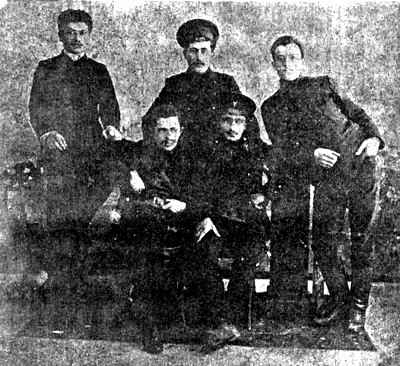
In the middle, wearing a hat, sits Chayim Gibelbank. |
[Page 8]
Or in the living room. It seems that Yakov was born in the workshop, which was both a workshop and a dwelling. The first sounds he heard were either from the saw, hammers, and planes or from his father's melodies.”
Thus Beilin opens his chapter on Kremenets in Schaefer's biography.
Later, in early childhood, Schaefer sang with different cantors in Kremenets and in Brody. For young Schaefer, Brody was a blessing. He developed there in a secular manner and escaped from the four cubits of the Kremenets Talmud Torah.
After he returned home, his father tried to speak with him about studying to be a cantor-ritual slaughterer, but the 16-year-old Yankel Schaefer refused.
Some of Yankel's friends who had studied with him in the Talmud Torah were now the leaders of the Little Bund, which, like the general Bund, conducted underground activities. Yankel was taken into their circle.
He began to become familiar with the young intelligentsia, who assembled in circles for self-education and became close to the Bund. For him, this was a new world.
When Yankel's father died, he took over the carpenter shop. Thus he became a carpenter. But he continued his self-education with great success.
And in 1905 and 1906, when Kremenets caught fire with the general boom in the country for self-motivated organizations, professional unions, cultural institutions, libraries, and dramatic groups, young Schaefer threw himself into such activities and organized several choirs. Schaefer became part of a young group that came together in the house of a young midwife (who appears to have been related to Zigelboym). There the midwife introduced Yankel to a student in the last year of gymnasium who was from a prestigious family in the city. Both were caught in the net of solemn love.
Sonye's parents learned that their beautiful daughter was going around with a former carpenter who once sang with cantors: “What a terrible embarrassment!”
Under pressure from her parents, Sonye began to meet openly with Yankel. They met late in the evenings, on Mount Bona.
One evening Sonye did not come to their meeting. Jacob waited a long time. She did not come on the next evening either. Then he learned from someone who worked for her parents that Sonye had been forcibly sent to another city. The same person helped them reunite, and one beautiful morning he let the town know that Sonye Efrat and her beloved had secretly left for America, right after they had been married. Sonye's sister Rosye had helped them monetarily.
This was around 1910. Schaefer worked as a carpenter.
But he was soon taken into the musical world, first in the liturgical area with well-known cantors, and then he took the risky step of preparing for something else that we heard about at the beginning of this article.
|
|
[Page 10]
After seven years of happy life with Sonye, Schaefer had a great misfortune. His beloved Sonye died during what was supposed to be a minor operation. This was in 1917. Schaefer never recovered from this blow.
Y.B. Beilin, the author of Schaefer's biography, writes about Schaefer's musical dreams and the wonderful landscape of Kremenets. He writes: “A walk in the woods of the Bona and the other hills was not just a walk for young Schaefer. Going around mostly alone in these fields, he would work out his musical dreams. The impressions of Kremenets and its environs stayed with Schaefer until his last years. On a trip that we took together in 1936, several months before his death, we stopped for a brief rest. For a few moments Schaefer shut his eyes, and I asked jokingly, “Yankel, where are you now?” “I am in Kremenets,” he said, embarrassed.” [This reminds us of what Marc Chagall said in the interview he gave in this booklet. M.G.]
In that same year, on December 1, 1936, Schaefer died suddenly at 42. His funeral was on December 5 in New York. It was a stirring display from thousands of Jews from across America for his art and his magical personality. For three hours, thousands and thousands of people went by his coffin in the large room of the opera house. Another 20,000 or more who could not get into the crowded hall for the eulogy waited a long time in the rain for the funeral to begin.
Although Schaefer died young, his musical output was colossal. He wrote music to poems by such famous Yiddish poets as A. Rayzin, M. Rozenfeld, Y. Frug, A. Liessin, Mani Leyb, Broderzon, A. Helperin, Perets Hirshbeyn, Perets Markish, Hofshteyn, Itsik Fefer, and others.
Jacob Schaefer, so famous and loved by the Jewish masses, should always be remembered by Kremenetsers.
Berel-Dov Krementshugski
|
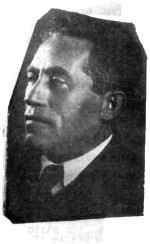
To the unknown soldiers in the Diaspora, thanks to whose devotion, perseverance, and love for the Zionist cause the State of Israel was founded, belongs Berel-Dov Krementshugski, an Enlightened one who was imbued with the ideas of the Enlightenment. He devoted himself entirely to Zionist activities. He was active in all aspects of Zionist labor in Kremenets. Just like Buzye Landesberg and his brother-in-law, Meir Goldring, such service filled his entire being. Even today, when I hear the word “Zionist,” I see the image of Krementshugski, as we see him in the picture, because only such people as Buzye Landesberg, Meir Goldring, Yakov Shafir, and the others have earned the title of Zionist.
More than other Zionists in Kremenets, Krementshugski understood the problems of the Zionist youth in the city. He earned their full confidence through his children, who all belonged to the Youth Guard movement.
It is a terrible shame that Krementshugski, this unknown soldier, like so many soldiers, did not live to see the realization of his lifelong dream or even hear about it. It is a great consolation that his children and grandchildren live in Israel.
[Page 12]
With the same devotion as their father and grandfather, their many-faceted community activities, both in the kibbutz and in the city, they have all remained true to the principles of the movement to which they have belonged from their earliest years.
Krementshugski, of blessed memory, died in 1941, when Kremenets was taken by the enemy. And although his death from cancer as not easy, nonetheless fate took pity on him and spared him the horrible experiences that occurred under the Nazi killers.
May his memory be a blessing!
B. Goren
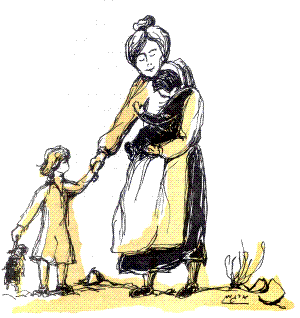
It is morning. Mama has already awakened but has not yet gotten out of bed. She is lying on her back with a four-year-old boy lying on one side, and on the other side is a sweet baby under the age of two who sometime sleeps with Mama. His regular bed is the twig cradle that hangs on a rope from the ceiling, and as babies do, he occasionally cries during the night from discomfort or from pain, and then Mama transfers him to her bed and nurses him, no matter the hour.
A third boy older than two is sleeping in a bed whose legs are fixed on two half-bows, like the base of a rocking chair, so that they rock the bed and to encourage the baby to fall asleep. In the morning hours, he usually sneaks out of bed and lies down next to Mama. Mama is lying between the babies. Her bright face is that of a queen with a big, satisfied smile. Her long golden hair isn't arranged in a bun, the way it is all day, but is scattered around her bright face.
I love looking across the dark corner at Mama's face. It looks like a painting of a queen's head in a golden frame. On either side of her face are two miniature heads with bright faces and hair; what a vision of divine creation! The picture and the silence are so different from what is happening around the ruins of the room, which tightly accommodates nine children. Now, in the morning hours, they're all enjoying their sleep; they're not aware of the bad smells, the filthy linens, and the dirty gowns they wear. Nobody who has not been in the room during the morning hours can enjoy the beauty of this supreme image, because anyone who opens the door from the outside encounters the stale air and bad smells that emerge; his senses become dull, his eyes cloud, and he can't t distinguish the divine beauty from the ugliest place on the face of the earth.
Mama gets out of bed, and the picture of a queen in a golden frame with two bright, miniature heads disappears; the picture is changing now. Mama is dressed in a faded, patched dress and paptsis (the bottom cut from a pair of discarded boots or shoes) without socks. She rolls her hair into a bun, puts a scarf on her head, and takes the smallest baby in her arms, with two or three children of various ages dragging behind her holding Mama's dress in their hands. Mama is rushing to the market to buy a bottle of milk and a few half-rotten apples for the children's breakfast. This is the daily mother, the mother who gives birth, raises her children, nurses them, feeds them, bakes, cleans, spanks, heals, and is diligent and busy from morning to evening.
And in the evening, when her legs hurt and the blisters from wearing paptsis burn her feet like fire, Mama sits on the padded sofa made out of thick, rough wood planks with two supports on the sides. Her body and her feet are on the wide sofa. The baby in her arms is nursing or just playing with her breast, two or three toddlers cling to her knees, and the older ones push to her side and try to grab a place closer to Mama's body, that soft and warm body, to be rewarded with a pat, a kiss, a hug, and a word of affection.
[Page 14]
This isn't a mother who looks like a queen's head in a golden frame. This is the mother who runs to the market with paptsis on her feet. This isn't the mother of the whole day. This is a mother with a scarf tied at the back of her head. Now her bright face is reddened, her blue eyes are dim and seem tired or kind, or maybe both. This is a picture of a mother protecting her tender chicks, who spreads her wings to warm them in the evening chill. Slowly, slowly, they stop laughing and playing games and fall into a peaceful sleep, and then she moves them to their beds. And so the second part of Mama's workday starts. She prepares food for the next day, repairs, patches, does the laundry, and cleans, and in the late hours of the evening, she doesn't lie down to sleep but falls on her bed, asleep.
It was summer, when Petliura's gangs spread destruction and ruin in Jewish towns throughout Ukraine and Galicia. They robbed and burglarized, oppressed and murdered. People were afraid to leave their homes for fear that the murderers would appear on horseback at any moment. Under those conditions, people could not endanger themselves by traveling on business or taking care of even the most basic necessities.
It's been more than a week since Mama has baked bread, because she doesn't have any flour. Nor has she rushed to the market with paptsis on her feet, a number of children holding her dress and dragging behind her, because she doesn't have the few small coins she needs to buy a bottle of milk and rotten apples. This is a different mother, not the one from the morning hours who lies in bed, not the one who rushes to the market, and not the one who sits on the sofa in the evening. This is a mother with a pale, thin face, her wet eyes half-closed, her back bent, making her look shorter than usual. Her voice is different, too. It isn't the clear, commanding voice she used to have, but the voice of a broken person. To the children's demands of “Mama, food,” and “Mama, bread,” she answers in a pleading voice, “What will I give you, my soul?” For two days now, the children have been lying in their beds, unable to walk and weak from fasting. Mama gathers her courage and goes to the market. It's cherry and plum season, and the market is full of fruit that the gentile women have brought to sell. People buy, eat, and spit the pits out of their mouth onto the ground in the Russian way. The gentiles' pigs wander around in the market, and they collect the pits, crack them loudly with their teeth, and eat their contents. Mama returns home, outfits the children with pots, and orders them to collect the pits from the ground. Before evening, whole families are sitting in a circle on the ground, cracking the pits with hammers and stones, and eating their contents. Encouraged by this idea, she goes out with the older children and, under cover of darkness, they dig in the ground with their hands and fingernails to find a potato, a beet, or any vegetable, without fear or fright. Mama breaks wood planks from the fences to cook the vegetables. She's fighting like a lioness protecting her cub; she's fighting the enemy of hunger, and she succeeds in keeping her children alive – except the nursing baby, who cannot eat the contents of the pits and cannot nurse because he's sick.
[Page 15]
Mama draws milk from her breast and gives it to him to drink, and keeps him alive. She saves them from death by starvation, one day at a time, until rescuers arrive. A committee established by the community to help the hungry distributes a few kilograms of flour to each family. The smell of baking fills the room again, a tempting smell that lures the heart and tempts the senses and the appetite: the smell of bread baking in the oven. This is a different mother. In place of her tired, pale face is a serious one, full of energy and decisiveness. Her speech is clear and strong, with the ring of command. She looks like she's ready for battle: her body and back are straight, and she's no longer bent over. This is the mother lioness ready for battle to protect her cubs' lives.
Years pass, and times change. Polish rule is established. The children are getting older, and the eldest son is getting married. What a pleasure, what bliss, to lead her son to the wedding canopy. Blessed is the mother who is so fortunate. She even has a long black dress, fit to her body, a lady's dress in 19th-century style that her brother sent in a package of old clothing from America. Wearing the dress, Mama stands before the mirror, which is covered with black stains. This isn't the fighting mother lioness; this is a woman from a noble family with a firm body, a lean back, a long black dress, a clear noble face, and a high golden bun. Only the feet don't match the body; she's wearing fabric shoes since she doesn't have the money to buy a pair of the leather shoes that would be appropriate for the dress and the wedding. As luck would have it, it rains during the wedding, but her eyes are dry, not crying. Only her feet are wet and crying. This is a mother who's enjoying her child, and most of her children are older now.
World War II has erupted. The Kingdom of Poland has ceased to exist, and the town is under Soviet rule. The family's economic situation has improved. The older boys are working, the little ones study, and two of her sons are gaining respect in the Soviet regime. Now Mama is a mother of the working class. She's dressed in a clean dress made out of simple fabric without patches, and she wears a pair of simple leather shoes, not paptsis. Now her eyes and feet are dry. She's tranquil and secure about her family's future, so she thinks, and then a tragedy happens. Nazi Germany attacks Russia. Mama begs her sons to run away with the Russians and not to fall into the hands of the Nazis. She doesn't want to see how the Nazis murder them, as if her heart predicts what's going to happen. Two of the sons escape and save themselves. The rest of the children stay. All are led to the pit that serves as a mass grave for the whole town. After they remove their clothes, as they're ordered to by their murderers, Mama turns into a lump of clay. She loses her mind, her senses, and the ability to move her limbs. The Ukrainian murderers, the Nazis' helpers, order them to get closer to the pit. Mama doesn't respond or move, so her daughters drag her with them to the gaping pit to save her from the agony of torture in the hands of her killers.
[Page 16]
No, enemies of Israel, you didn't murderer a mother. You shot a lump of clay, a naked statue of a woman. You, murderers of Jews, enemies of mankind, you can't murder a Jewish mother.
The Jewish mother is alive and will exist forever.
|
Kfar Saba, 1/24/1929
From the not-too-distant past, another letter from the series that Leyb Biberman wrote to his parents in Kremenets.
My dears, here it is winter, too, but snow does not crackle under our feet. One's nose does not run, and steam does not come from one's mouth. But it's cold. The heavens weep bitter tears. God has taken pity on the dried up, thirsty earth. I've already been in Kfar Saba for three weeks. An unceasing groan comes from the fields. It's dark. So the village seems to me. But on a nice day we go out to work in the fields. A new kind of world. New ideas of work. No more gravel or stones. Stony but homey Jerusalem welcomes me! The ground is full of weeds called “inzhel.” We have to get rid of it, but it doesn't want to come up by the roots. And God forbid you should leave a piece. From one “eye,” dozens more grow and take up all the moisture from under the trees. We all stand there bent over and pulling and hoeing in the soft, wet ground, totally absorbed in the hard but interesting work. On the nearby train line, a train goes by, and we straighten up and watch as the panting locomotive and creaking wagons disappear somewhere far in the hills. We hear the call for lunch.In our great dining hall, our little family of 10 sits at a long table. Our appetites are large, and the aroma of the soup tickles our noses. Today I'm on duty. I cut large slices of bread, since these guys have large mouths. After the salad and soup, I make tea, which we drink until our stomachs are swollen. In the evening I have a new bit of work, washing the dishes. If you're on duty, it's worse to wash the floor. I wish that job on all my enemies. I have no talent for it.
But enough of that. You want to know how I spend my time.
[Page 18]
Kfar Saba is a colony. Its spiritual center is the store. One gets sardines there. The proprietor speaks Russian. In Berdichev, he surely spoke Yiddish. The young women in Kfar Saba wear knitted stockings, for which they have my full sympathy. One can get three glasses of soda water for a piaster. It was worth coming to Israel. We are also building a cinema. In short, Kfar Saba isn't too different from Tel Aviv. Nu, that's enough. Yisrael, don't stop sending the Heynt newspaper. On our long winter nights, it is prized here.Shalom! Say hi to my friends.
Your Leyb
Mordekhay Gurvits
(There was much light there; the light faded, and the shadow inherited its place.)
The town of Shumsk was mentioned for the first time in 1149 (Encyclopedia Povshekhna, 1867 edition). It lies on the bank of the Vilya River, which empties into the Horyn River. To the northeast, pine and white birch forests stretch as far as the suburb of Ostrah and the town of Rovne[3], and on its southwest side are the Ukrainian plains, which are blessed with wheat, sheep, cattle, creeks, and fish.
Around the time of the Holocaust, the town's population was around 5,000. Most of the residents were Jews, and the rest were Ukrainians and Poles.
Small groups of Jews lived in the nearby villages, among them the large village of Rachmanov[4], which had a synagogue and a slaughterer (there were rumors that the reason for the large number of Jews in the village of Rachmanov was that it was established before Shumsk).
The main source of income for Shumsk's Jews was small trade. There were a small number of medium-sized factories, such as those for coarse wool (the Buder family), bricks, and cement tiles; two water-operated flourmills; textile factories; grain production; a leather tannery; and a sawmill owned by the authorities and located on the road to the village of Surazh[5].
The weekly market (fair) day (Monday) provided the stores, restaurants, and teahouses with their main income. Local farmers came with their agricultural produce and purchased their families' basic necessities with their profit.
Also, Jewish merchants from cities near Shumsk, such as Kremenets, Ostrah, Vishnevits, Lanovtse[6], and so on, offered their products during market day, and some of Shumsk's merchants traveled with their merchandise to the nearby towns.
Like all the towns in Volin, Shumsk experienced a change in power in the years after World War I. When the borders were set in 1919-1920, the town was transferred from Russian to Polish rule (during the Pilsudski period), and the population began to rebuild the ruins and rehabilitate themselves economically and culturally.
[Page 20]
The Jews did not recover fast enough from World War I, and the economic situation was not good (Shumsk was also an annex town, located 5 to10 kilometers from the Russian border). The situation worsened during the 1930s with the heavy tax burden (the period when Gravski was the treasury minister) on one side and the establishment of Polish cooperative food stores on the other.
Anti-Semitism, which had been asleep and wrapped in a soft cover, woke up in Europe with the election of Hitler as the chancellor of Germany and the dissemination of his Nazi doctrine around the world. It was mostly accepted by the Ukrainian population, which waited impatiently for the arrival of the “savior” who would rescue them from the burden of the Poles and Jews.
With the restoration of the ruins and the economy came the restoration of society and cultural life. This was expressed in the establishment of the Tarbut Hebrew School. The Polish authorities caused many difficulties, and studies took place in secret (by the teacher Safir – books) in the “women's gallery” of the Great Synagogue. After a great deal of lobbying by community leaders, a license to operate the school was granted under the condition that the school's director be a teacher certified in the Polish language.
Graduates of those classes turned to high schools in Lvov and Rovne, and some to the ORT school in Kremenets or yeshivas in Vishnevits and Korits[7].
With the establishment of the school, the traditional Jewish cheder started to fade away.
While the Jews were occupied with organizing their community and their leaders, one of the town's spiritual leaders, Rabbi Berniv Lerner, may the memory of the righteous be a blessing, passed away. This canvas is too small to list all the wonderful things he did to benefit others, especially sacrificing his own life to save Jews from the hands of their murderers. His home was a gathering place for scholars and was open to all.
Rabbi Yosile Rabin, son of Rabbi Aharele of Lanovtse, took his place on the rabbinical seat, and a second rabbi by the name of R' Moshe Vinokur Halevi also served the community. With the establishment of the community, various religious programs were organized and functioned under its patronage. The community delivered food to the needy, and charitable funds were established: a homeless shelter, visits to the sick, and a Talmud Torah, where the students received a free hot meal every day.
[Page 21]
In addition, a merchants' union and a trade union were established, and their representatives brought members' problems before the local and district authorities.
The Zionist ideal and the national funds were established and developed in Shumsk, and very quickly, a local leadership was formed, including H. Milman, the movement's ideologue, Mordekhay Segal; Kopel Tsoref; Yokelson; the Akerman brothers; Neyman; Kanfer; Lerner; Roykhman; and Bernshteyn.
The Zionist youth movement was active in the movement's projects and the national funds. A magnificent library opened. It was housed at the Roytmans' home and contained a rich collection of books in Hebrew and Yiddish. A drama club was also established, and later on a theater. The most outstanding, important personalities in the theater were members of the Mirmelshteyn family.
One of the most beautiful and thrilling chapters was written by the Pioneer movement, which was legally established in 5684 (1924). The Pioneer movement was a guiding light for Shumsk's young people, who hated their lives in the Diaspora and wished for a productive life and immigration to Israel. To achieve their vision, the young members left for pioneer training camps before immigrating to Israel.
Everything mentioned and described here took place before the eruption of World War II, when the sword was raised against Shumsk's Jews.
For that I cry; my eyes shed tears.
I have tried to describe the image of our town and her Jews, their activities, and their way of life. May their names remain in our hearts for eternity and their memory be written in our nation's book of life, because with their death, they ordered our lives – we are sorry for the loss and we will not forget.
I say to the revival generation: remember, and don't forget what Amalek[8] has done to us.
Yitschak Sobol
The First Years after World War I
It was 41 years ago when on a blizzardy winter night, after midnight, I was arrested by the NKVD. I was guilty of being involved in Zionist activities. I was taken from my warm home, from my dear wife and four-year-old daughter, who were the richest treasures of my life. After that night, I never saw them again, because they were killed by Hitler's murderers.
In 1941-42, my city suffered such horrors as had not been seen before. The Nazi and Ukrainian killers killed all my fellow citizens. It is terrible to try to understand, to grasp how they could fire on and kill living people.
Forty-one years have passed, but I still stand in my town, an afflicted man with a broken heart, as I mourn my people, my dearest ones.
To be truthful, my town as a physical place interests me not at all. I will never be able to part from the three mass graves. Therefore I will write about my Jewish Pochayev as I remember it from age 11 to 31. (When I was older, I was taken from my home.)
In 1922, Pochayev was taken over by Poland.
The wounds of World War I had not fully healed. I see ruined homes, some more, some less. The economic situation was at its nadir.
After a year and a half, the economic situation improved. Those who had saved money began to rebuild their fallen houses. Others were happy with what they had and just renovated. And some remained living in harsh conditions and hoped.
[Page 23]
Those citizens who spent the years of evacuation, 1914-1918, in different areas of Austria and saw a more worldly way of life there began to reorganize themselves in order to make changes in their old way of life. They began to take the first steps in that direction. A group of young people started a drama club. Their first production was Dos pintele yid.
The question of a theater, which had never existed in the town, was answered by R' Chayim Krasnisior. His buildings were hardly damaged in the war. He turned one building into a large hall, and he leased it to the drama club for a good price.
It was quite a hall. At night, before the performance, Jews rushed to buy tickets. Those for whom no seats were available shed copious tears. Having no other choice, they stood. The result was that people enjoyed themselves. They laughed and cried and applauded ….
The performance was something more than a theater piece. It was a holiday in the town. For days, people discussed their impressions. As I recall, they then put on Chasye the Orphan; God, Man, and the Devil; and other plays.
The drama club encouraged an important cultural step: people established a Tarbut library with the help of income from the performances.
The library was in Avraham Ridiker's home. One room was the reading hall, in which literary evenings were held. The library itself was in another room. Every evening the rooms were full of visitors. People took books and read newspapers and journals, Yiddish and Hebrew.
The leaders of these cultural activities, who spent many hours and days on the work, labored voluntarily.
About two years later, a group of 12- to 14-year-old children decided to organize a children's library for readers of 10-15 years. The children's library was in a room–a room that R' Yisrael Skulski (father of Shlome Skulski, who is active in the landsmanshaft) had designated for this purpose. This library developed quickly.
[Page 24]
To get financial means to enlarge the library, its founders organized a drama club that gave children's performances. Masses of children came. With the income, people bought new books. After several years, the children's library was incorporated into the Tarbut library.
At that time, Zionist groups also began. The Zionist organization and Pioneer were founded, and the young people undertook intensive activities. Some of them traveled to training kibbutzim to prepare to immigrate to the Land of Israel.
One of the Zionist organization's activities was the choice of a Jewish National Fund committee, whose first successful step was bringing in blue and white boxes to almost every Jewish dwelling. They raised money in various ways. They conducted flower days, came to weddings, and brought fruits from the Land of Israel on Tu b'Shevat.
In 1928, the youth organization Betar was established. The intensive activities of Betar hastened the organization of HATZAHAR (the Revisionist Zionists).
As we can see, little Pochayev made great strides in transforming old town life.
The first to go to the Land of Israel was Yehoshue Teren (then Toren). His wife was Dvore Feldman from Kremenets. He immigrated to Israel in 1920. In 1922, Mendel Zeltser immigrated to Israel with his large family. I remember the cold, snowy day when they left town. Hundreds of us accompanied them with songs and tears. Mendel Zeltser, our village elder, and his family merited to go to the Land of Israel.
At that time there were more than 300 families in town. Everyone knew each other. Most were close or distant relatives.
In this article I have given the frame and, on its canvas, a picture of my town. Its different colors need to be painted: Sabbath in the town, holidays, Hasidim and their opponents, a wedding with the Radzivilov klezmer and jester, market days, fair week, and so on.
[Page 25]
All this was part of town life. Although every town had its own way of life, it is important that all be recorded, because doing so refers to the past lives of generations who lived in these ways and who came to such a tragic end, to our great regret.
|
[Page 26]
Manus Goldenberg
We offer here in a free translation from Russian a poem by the Soviet poet Robert Rozhdestvensky that is, in fact, an interview with Marc Chagall. The poem was published on 10/15/1980 in the Literary Gazette.
In the interview, Chagall notes in a moving way his longing for his birthplace, Vitebsk, which he left over 60 years earlier.
Each of us who reads Chagall's lines feels the same as he feels about his old home. We could replace the names of the places he lists with the names that are bound up with our childhood and youth … with everything and everyone that lives in our hearts. More than ever we remember what Shaul Tsernichovski said: “A person is a reflection of the landscape of his birthplace ….” This poem-interview is a free translation into Hebrew by me, Manus.
Literary Gazette, No. 42, 10/15/1980
Robert Rozhdestvensky
[Page 28]
Robert Rozhdestvensky
| He is old
still in his solitude. He does not feel like talking about the weather. Immediately he starts with a question. “Aren't you from Vitebsk?” The lapels of his old coat are rubbed. “No, I am not from Vitebsk.” A long pause. And after that – these words, which are monotonous and melancholy: I work, and I am sick from time to time … An exhibition – in Venice …” “So you are not from Vitebsk!” No, I am not from Vitebsk …” He looks to the side. He is not listening, he is not listening. He is distant, out of place, he is breathing. As he tries to connect with his childhood, carefully … Cannes and the blue coast vanish. And the glory of the present … is bright and confused. He is drawn to Vitebsk, like a plant … To his Vitebsk, which is dusty and hot, and attached to the ground, near the firehouse tower. There are weddings and funerals over there, prayers and fairs. Apples are ripening over there, they are especially big. And a sleepy carter gallops in the square. “So you are not from Vitebsk …” He is silent, and suddenly he announces, as if it is the most important thing, the names of the streets: “Smolenskeya,” “Zemkovya,” as in Volga. He praises the river in Vitebsk waving like a child with his transparent hand. “So you are not from Vitebsk …” We need to separate. Return home – quickly … The trees are standing at attention along the way. It is getting darker … …what a pity, I am sorry that I am not from Vitebsk. |
Manus Goldenberg
At the annual memorial service for the Kremenets and Shumsk martyrs in the year 5741, there were more members than there were last year. This was the second year that our memorial was held with the Shumskers.
The warm meeting between the Shumskers and Kremenetsers at the joint memorial shows that both landsmanshafts have a close friendship.
The evening's program was appropriate and met the needs of the moment. The attendees did not hasten to leave after the official part of the memorial. It was a pleasure to remain longer in the comfortable atmosphere of Kremenets and Shumsk ….
Pochayev Will Join Us
The negotiations continue between our board and the representatives of Pochayev about unifying our two groups. The Pochayev representatives are already active in the our board's work and in editing Kol Yotsei Kremenets. These are Yitschak Sobol and Sh. Skulski. The latter has been a full partner for several years.
[Page 30]
Ceremony to Award the Fikhman Prize to Our Landswoman, Author Hadasa Rubin
“A solemn aspect characterized the presentation of the prizes for literature and art in the name of Yakov Fikhman to authors Hadasa Rubin and Chayim Hokhman.”
So begins the article in the daily newspaper Letste noyes that treats the work of both laureates.
We will present only a few excerpts of what was said on that solemn evening about Hadasa's work. The writer K. Bartini spoke on behalf of the Hebrew Writer's Union, speaking with admiration about Hadasa's poetry, the great longing in her work, the fire of sincere authorial feeling, and the deep thoughtfulness that characterizes her poetry…. On behalf of the Yiddish Writers Union, writer and critic Shimon Krants said, among other things, “We love Hadasa Rubin's poems, and we should regard the prayerful and sad aspects that are prominent in her works ….”
Shimon Krants said, too, that “Great poetry springs from Hadasa Rubin,” and she is among our important writers. She is a prominent personality in Yiddish literature. He concluded with an excerpt from her poetry: “Do not believe, my child, that the twig will fade with the coming of night, that stars are only in the heights. That is the thought of the lonesome ….”
A final enthusiastic appreciation of Hadasa's oeuvre, in connection with the prizes, appeared in Al ha-Mishmar. It remains only for us to wish Hadasa new literary prizes to add to the collection she has already received.
[Page 31]
Awards for Julio Kaufman (Shikhman) and His Wife
An imposing ceremony of the women's religious organization Emunah was organized in the hall in Rehovot in conjunction with the awarding of certificates to several people by the Absorption Ministry for their volunteer activities to help new arrivals with their entrance and the difficulties of absorption.
The several hundred new arrivals, who sat with the volunteers at decorated tables, enthusiastically applauded the awarding of the certificates to each of the volunteers. A large number of those applauding were the charges of Kaufman and his wife, each of whom received a certificate. It was easy to see that, through their generous work, they both had made fast friends among the new arrivals.
Let us wish them both continuing success in their blessed activities.
Three Gatherings to Honor Guests from Abroad
At the beginning of May this year, at the college, a reception was organized to honor our visitor to Israel, Fani Reznik Garber. In a dignified way, memories of Kremenets were raised by several of the Israelis and by Fani, memories of the important work at the Youth Guard “nest” in Kremenets.
In her talk, Fani remarked on the deep impression that the meeting had made on her.
During their several weeks in Israel, Fani and her daughter were guests of the Kaufmans. With the permission of those gathered, Ch. Kaufman expressed his and Fani's impressions of the evening in the following words: “During the weeks of Fani's and her daughter's stay with us, we traveled all over the country. We heard and saw many wonderful things. But I am sure that for Fani, this evening made the deepest impression ….”
[Page 32]
On Saturday, June 13, Tove (Gitele) and Liove Roshtin in Petah Tikva organized a musical evening for Nuta Kiperman and his wife, who spent their whole visit to Israel with the Roshtins. Before their visit to Israel, the Kipermans stayed with friends in America. Not long before both trips, Nuta was quite ill, so this gathering also marked his recovery.
Nuta Kiperman fought the Nazis in the ranks of the Red Army. Soon after the war, he and his wife returned to Kozin, where they had lived before the war.
In Kozin, they met a young girl whose parents had been killed by the Nazis. She had been rescued by righteous gentiles. The Kipermans adopted her, and she was like their own daughter to them. Her name is Gitele (Tove) Roshtin, who, with her husband Liove, organized the very successful musical gathering. Participating in the evening were Kremenetsers who live in Petah Tikva, some from Tel Aviv, and Chayim Miler and his wife from Afula, with whom the Kipermans stayed for several days. The affair of Gitele's rescue is very exciting. So, too, is Nuta's role against the antisemitic hoodlums of our neighborhood in the battalion that exterminated the Ukrainian bandits. Our audience will hear about this in booklet 19.
We must remember that Nuta is one of the most productive members of the Argentina landsmanshaft–he takes part in every activity, to its benefit.
A Reception for Chayim Taytsher
On Sunday, June 28, we had a reception for Chayim Taytsher and his wife in the Kibbutzim College. They came for the world gathering of Holocaust survivors in Jerusalem, since both were saved. For this reason, the reception had a special character. The pictures on the wall of our room in the college, the memory book, in which Chayim on the spot noted his murdered family members, affected all of us. Memories of the distant past were brought up.
[Page 33]
I recalled the image of Chayim's father, Yashe Taytsher, as a poor man with small children, a barber who worried about needy Jews and often provided them the necessities for the Sabbath. I told them that at the beginning of World War I, when the first wounded soldiers appeared in the city, covered in blood, riding in peasant wagons, Yashe did not hold back. He called together some 12- or 13-year-old children, me among them, and sent them to the stores to get money for the benefit of the wounded. With the money, he bought large kettles, sugar, tea, bagels, cigarettes, and glasses. Over the course of several days, until the hospital was evacuated, we stayed with him. In the afternoons we would go among the beds of the wounded soldiers in the field hospital and give each of them a glass of tea, bagels, and cigarettes. The hospital was located in the School of Commerce.
We children received the smiling faces of the wounded. Yashe himself beamed with joy. Later, we did the same when masses of captured Austrians were led through Kremenets.
Chayim had never heard what I was saying, and he was moved to tears.
The meeting lasted a long time, as we had foreseen, and we left with a warm feeling of close friendship.
Reception in Haifa for Guests from Argentina
Izye Port
In April, several Kremenetsers in Haifa received Fanye Reznik Garber and her daughter, who came to Haifa for only half a day. We showed them our fine educational buildings and the city of Haifa, and they met with a few Kremenetsers.
In June, Zahava and Yonatan Rozenberg organized a reception for Nuta Kiperman and his wife with the participation of Kremenetsers in Haifa.
[Page 34]
A second reception was held for the Kipermans and Kremenetsers in Haifa by Itke Shtern (Rozental).
A warm atmosphere reigned at both events. People brought up their memories of home and exchanged information about their landsmen here and in Argentina.
A fragment of the ballad “Kremenets, Volhynia.” Duvid Rapaport wrote a ballad about the bloody and heroic days at the time of the civil war in and around Kremenets. A fragment of the ballad was published in number 64 of the important monthly Our Own Word, where Rapaport is a participant and our Volf Shnayder is a co-editor. In the next Kol Yotsei Kremenets, we will offer parts of the ballad.
Hadasa Rubin
|
Bent backs, Then it will be better, Burdened shoulders, It will be nicer– Eyes that have lost their smile, This I know for sure from my dream. I was with them, In vain will people share bread, stars. I grew up among them. And again be brightly extinguished. They swore my first oath. I feel them near me. They surround me. They guard each of my steps So that I should recall on my palate The bitter taste of hunger. |
|
|
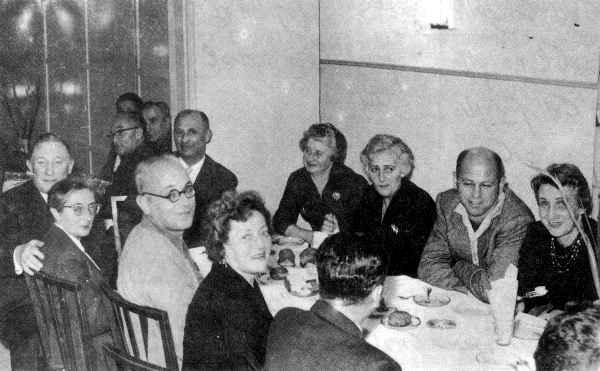
Seated, from right: Adalya Poltorek, Avraham Shafir (Yakov Shafir's son), Bronya Biberman, Y. Meyler (Akiva Zeyger's wife), Akiva Zeyger, A. Gokun, Ch. Kufman (Shikhman), Hadasa Rubin, Yisrael Otiker, Rachel Otiker and her husband |
[Page 37]
Cornbleet
|
Harry Cornbleet is seeking his relatives from Kremenets for the purpose of learning aspects of his background.
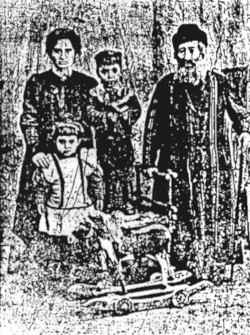
He is providing a picture of his great-grandfather Shlome Vinik, who was, people say, a cantor in Kremenets long ago. The woman in the picture is his second wife, Golda-Yente, with their two children, Duvid and Sosi. In Kremenets, Vinik was known as Shlomele the Cantor.
Anyone who knows anything about him can contact our organization in Israel or the landsmanshaft in New York. H. Cornbleet's address is:
Harry F. Cornbleet
12105 Saratoga Drive
Saratoga, California 95070
Translator's and Editor's Notes:
|
JewishGen, Inc. makes no representations regarding the accuracy of
the translation. The reader may wish to refer to the original material
for verification.
JewishGen is not responsible for inaccuracies or omissions in the original work and cannot rewrite or edit the text to correct inaccuracies and/or omissions.
Our mission is to produce a translation of the original work and we cannot verify the accuracy of statements or alter facts cited.
 Kremenets, Ukraine
 Yizkor Book Project
 JewishGen Home Page
Copyright © 1999-2024 by JewishGen, Inc.
Updated 25 Aug 2023 by JH