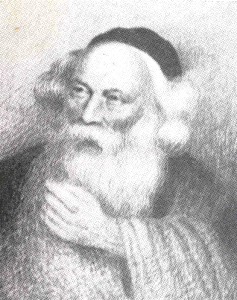
 |
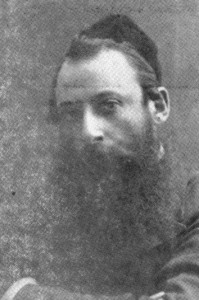
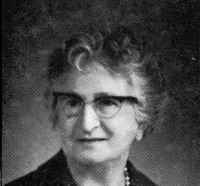
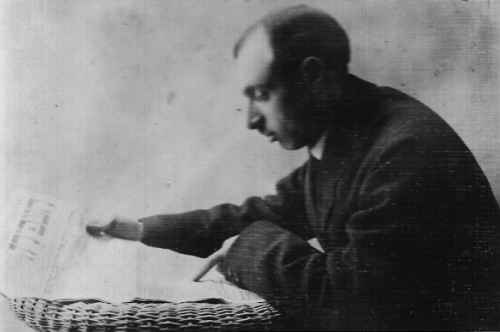
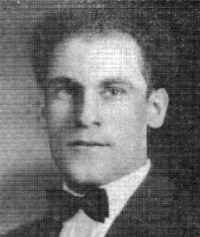
author of “Magen Abraham”
|
|
[Pages 60-63]
by Michael Rozenblum
Translated by Clarice Gostinsky Horelick
Edited by Ada Holtzman z”l
Many cities and shtetls in Poland became famous all over the entire Jewish world because of the greatness of their rabbis, scholars, writers, spiritual people, and political activists. Our Gombin once became famous all over the world because of its native son, the famous rabbi and interpreter of Bible laws pertaining to current issues, Rabbi Abraham Abele.
|
|
author of “Magen Abraham” |
Abraham Abele, the author of the famous interpretation of Shulchan Aruch, Orach Chaim, was known as “Magen Abraham”, the Shield of Abraham. His original name was Ner Israel, the candle of Israel, but because of certain reasons his son, R' Chaim Segal, with the agreement of the Council of Four Lands in Lublin, changed the name from “Ner Israel” to “Magen Abraham”.
The “Magen Abraham” always wrote his name: Abraham Abele son of the holy man, R' Chaim from Gombin. About his father R' Chaim we know very little. We do know however from the chronicles of his time that he died by Kiddush Hashem, for the Sanctification of the Holy Name, at the hands of Chmielnicki's Cossacks. His great son, Abraham Abele was then 9 years old (sic).The Magen Abraham was born in Gombin in the year 1635 and died in Kalish in 1683 (we write about him separately).
The later rabbis, a hundred years after the Magen Abraham were R' Alexander Yehuda Leib the author of the book “Midrash Ktuba”, on the tractate “Ktubut”, the set of “Ktubut” in big format, like a Sh“s (the six orders of the Mishna or Talmud) Gemara (“completion”, the second and supplementary part of the Talmud, providing a commentary on the first part i.e. the Mishna), 300 large pages of interpretation and elaboration of the Bible written by Rashi script.After him, but not for very long, the rabbi in Gombin was R' Israel Jehoszua Troonk, the very well known Gaon who was wooed from Gombin by the Jewish community in Kutno, who went under the name R' Jehoszele Kutner. He was the author of the rabbinical books, as Yeshuot Israel, (the Salvation of Israel) about Hoshen (the fourth part of Shulchan Aruch by Joseph Caro), “Yeshuat Malko” (the Salvation of His King) - questions and answers on the Arbel Shulchan Aruch. “Yavin Shmua” (the Rumor of Yavin), and other books. After R' Jehoszele Kutner, there served as rabbi for a long time, R' Simchale Gombiner, so they called him. He is the author of the book, “Ramzei Ash”, (the hints of the fire), a commentary of “Tanna (an authority quoted in the Mishna) Eliyahu”. He was a Kocker and a Gerer Hassid.After the R' Simcha Gombiner there was for a long time R' Natan Neta Natanowicz. He was known as a highly learned man and a Gerer Hassid. His grandchildren, the brothers Mazur, (children of his son Rabbi Meir Mazur, the rabbi of Nieszawa) became known as the Brothers Mazur who were wealthy and famous (“Gvirim”) in Warsaw. One of the brothers, Elijahu Mazur at the end of the 30s, before the war, was head of the Jewish community in Warsaw. Now he is in Israel, one of the biggest merchants in the diamond industry.
|
|
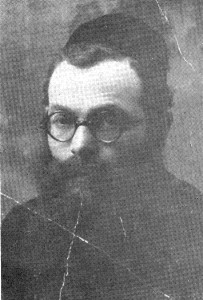
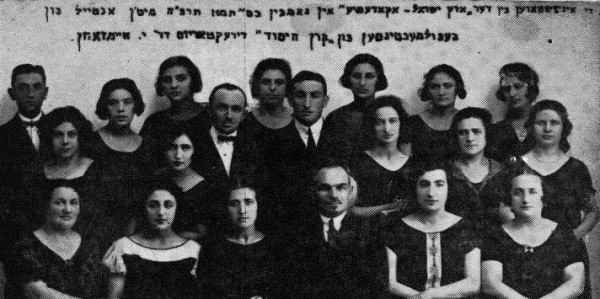
“EL ZET” |
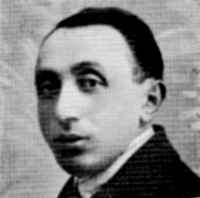
After the R' Natan Natanowicz served as a rabbi the famous R' Yehuda Leib Zlotnik, who was popular in Poland under the name “the Gombiner Rabbi Zlotnik.” He was an important public leader and a speaker. He was among the first founders of the Mizrachi organization and later of the “Histadrut Hazionit Haklalit”, the General Zionist Organization. He became famous under his pen name “Yehudah Elzet”. Under this name he published his book, “The Wonderful Treasure of the Yiddish Language”, also a large work -“Jewish Traditions”, and “Reshumot”, edited by A. Droianov, and individual books such as “the Beginning of the Hebrew Rhetorical Language” printed in Israel. R' Zlotnik was the Gombiner rabbi for about ten years until the year 1921, when he left Poland for Canada. In Canada, he was the Secretary General of the Zionist Organization. Later he was invited by the Jewish community in South Africa to serve as the head of the Jewish education and he acted much for Hebrew education in South Africa. From South Africa he immigrated to Israel and for many years was active in literature and published notable works in the periodical “Yeda Haam” ( Knowledge of the People). Also from time to time he wrote in the daily newspaper “Hatzofe” (“)The Spectator”).
The writer of these words remembers when he was a little boy, during the first years when the Rabbi Y. L. Zlotnik came to Gombin. The Hassidim were not at all pleased; in fact they worked hard he should not be elected; and when the Rabbi Zlotnik was elected with a large majority of votes, the Hassidim appealed to Gostynin (the jurisdiction to which Gombin belonged) with the complaint that the vote was not “kosher”. And the authorities' representative Naczalnik ordered new elections with stricter supervision from the government. In the second election the Rabbi won with an even larger majority. There passed a short time and the Rabbi received recognition also from the Hassidim. They saw his dedication to the Jewish community in general, and particularly to the Jewish community of Gombin.
|
|
After the time when Rabbi Y. L. Zlotnik left Poland, R' Natan (Nussen) Neta Nutkewicz from Rypin, served as the Rabbi of Gombin. After him came the Rabbi Unger, the son of the famous teacher, Uriah Unger of Wloclawek. He was the last rabbi up to the Holocaust. As it has been told, the Nazis tied the Rabbi to the tail of a galloping horse and that his how the Rabbi died. God will avenge his blood, together with that of all the Jewish victims.
Scholars and Hassidim in Gombin
Gombin was not as Hassidic as its neighboring towns of Zychlin, or Gostynin, where lived the Rabbi and Tsadik, the virtuous R' Yechiel Meir Lipszyc of blessed memory, known as the Gostyniner Tsadik. His influence was great also in Gombin. To him came not only Hassidim to hear Torah and Hassidism, but also ordinary people, even “Mitnagdim” opposers of the Hassidism and the Hassidim. And the Gostyniner Tsadik attended to all who had requests and those who were ill, advised them to say Tehilim, (The Psalms) and prayers in public and in private. The Gostyniner Tsadik was very popular in Gombin. Sholem Asch in his great work, “Jews of Tehilim”, the praying Jews, described the Gostyniner Tsadik R' Yechiel Meir. Sholem Asch himself was from the neighboring shtetl of Kutno. Sholem Asch in his famous book, “Dos Shtetl”, described Gombiner personalities like R' Jecheskel Gombiner, R' Shlomo Nagid, and others.Though there were few Chassidim in Gombin, there were however famous scholars and Bney Torah, learners of Torah, in the shtetl. Already a hundred years ago there was in Gombin the famous, “the little R' Abraham”. He was known in the Hassidic world in Kock and Gora Kalwaria (“Ger”). The well known Nagid in that time R' Fajwel Orbach was the father-in-law of R' Menachem Landau, brother of whom in Gombin they called R' Mendel Rabbi. R' Mendil Rabbi was the son of Rabbi Wolf Strikower. R' Wolf was the son of the Ciechanower Gaon and Tsadik R' Abraham Landau.R' Fajwel Orbach was in his time the “Gvir” wealthy philanthof the Hassidim in Kock and in Gora Kalwaria (“Gur”)..The Hassidim in Gombin, about 40 to 50 years ago, did not always have their own Hassidim shtibel, (small hassidic house of prayer). On shabbes, the Sabbath, they prayed in the townšs Beth Hamidrash, Torah school, after the prayers of the rich people, around ten in the morning. However, the Hassidim came into the Beth Hamidrash very early and studied while the rich people prayed. Frequently this brought out disagreements. The rich ones said that the Hassidim with their vocal studies disturbed their praying. When the arguments became stronger, the Hassidim rented a shtibel for themselves alone.From the various Hassidim, the Gerer Hassidim from Gora Kalwaria were the brightest scholars. After the Gerer Hassidim were the Alexan, Radzyminer, and others. Among the scholars and also the accredited teachers were: the town rabbi, R' Natan Neta z“l, R' Benjamin the teacher of religious subject, the great Gemarah scholar R' Jerachmiel Goldszmid, and his son R' Zalmen, R' Bunim Menasze Lubinski, R' Henich Rozenblum, R' Gedalia Noach, R' Lajbl Sztolcman, R' Herszl - the son-in-law of R' Yossel Chaiek. Of the respected wealthy Hassidim distinguished in town as learners of Torah and important merchants were represented by R' Chaim Luksenberg, R' I. Sikorka, R' Yossel Luksenberg, R' Lajzer Wigdorowicz and his son Jakob Wigdorowicz, R' Yossel Chaiek, his brother R' Mosze Mendel Chaiek, R' Lejzer Mosze Tiber, R' Jecheskel Rozenblum, R' Yossef Menche and his son Mosze Menche, R' Mendel Temerson, and son Abba, R' Abraham Elia Sochaczewski, R' Haim Josef Ejli, R' Israel Shochet (ritual slaughterer), R' Lajbisz Chazan (cantor) and a Shochet, R' Josef Dawid Klapman shochet who left and became shochet in Switzerland, R' Mordchai Jarlicht, Jakob Grinboim, R' Mendil Szczewinski, and others.There should be mentioned here Ezriel Yehudah Etinger the son of Moreh Horaa, the old teacher of religious subjects, M. Etinger. He was a Mitnaged, the opponent of the Hassidim. Even as an opponent he was a Ben Torah, a respected scholar of Torah, and maskil an educated person who practiced his religion.The writer of these words was born in Gombin and lived there in early childhood. He left Gombin and moved to Lodz with his family when he was 14 years old. All of the aforementioned upright honorable Jews he remembers with great honor.
by E. Finkenstein
Translated by Janie Respitz
Edited by Leon Zamosc
I would like to comment on some aspects of the Jewish religious life in Gombin.
My father Fishl Jonah Finkenstein donated a house for the establishment of an orthodox school. A large number of children studied there. I am sure that some of the Gombin youngsters who survived the catastrophe and are now themselves fathers of grown children certainly remember Fishl Jonah's heder (religious school).
The Jewish religious party “Agudah” also used the house for meetings and lectures. The work of “Agudah” was broad, covering many topics related to all aspects of religious life. Unfortunately, we do have documents about the activities of “Agudah”. They were consumed in the terrible fire of the Shoah.
I will recount from memory some names of religious Jews who were active between the two World Wars.
The chairman of “Agudah” was my father Fishl Jonah. He was elected to the city council as a representative of “Agudah”. My father also served as a director of the loan society Gemilat Hesed Kasse and was an active member of the Burial Society, the Psalms Society, and the Society to Visit the Sick.
Yitzhak Shekerke was also very involved in the work of all the societies. He was one of the most important Jews in Gombin and a great philanthropist.
Hersh Lajb Shekerke was one of the most active members of “Agudah”. He served as representative in the Gombin municipal council for a time.
Gedaliah Noach Shlang was another active religious volunteer. He was a learned Jew who devoted his life to community issues and the promotion of Jewish education for the younger generations.
Moishe Celemensky was a Jew with a caring heart who sacrificed everything for the community. He was an active and influential member of all the religious Jewish institutions.
I would also like to pay tribute to Chaim Lajb Borenstein, a pilar of Gombin's religious institutions. He was the heart and soul of “The Bread House”, which assisted the poor Jewish people of Gombin with life's basic necessities every Saturday and on the holidays. More than once, he covered the expenses out of his own pocket when there was not enough money.
As in all the other Jewish cities and towns, the religious institutions of Gombin played an important role in sustaining everyday life and preserving its Jewish character.
by Jacob Celemenski
Translated by Janie Respitz
Edited by Leon Zamosc
I arrived in Gombin at the age of thirteen. It was there that I spent my most beautiful, romantic years. My life took shape in the town, as I enhanced my learning and embraced socialist ideals. I still get strength from those sources, which allowed me to persevere and keep faith during the most tragic years of the Holocaust.
|
|
As I prepare to share a few memories of my years in Gombin, my eyes fill with tears. I see this beloved Jewish town through the distant fog of the tragedy, the cruel extermination that swept away almost everyone, including those who were dearest and closest to me. My father, sisters, brothers, together with their husbands, wives and children, along with the entire family, uncles, aunts, cousins, all died as martyrs.
During the First World War, when Poland was occupied by the Germans and the Jews of Warsaw suffered from hunger, disease and death, our home was also hit. Two of my youngest brothers died. My parents decided to leave Warsaw and move to Gombin, my mother's hometown. We were then a family of ten, my parents and eight children. For me, arriving in Gombin was an emotional experience. For the first time after the crowded, shabby streets of Warsaw, I breathed the fresh air of Gombin, full of the scent of wonderful pine forests. In the stream that meandered through the town, women would wash their laundry and dishes.
Jewish houses and shops were situated around the market place and on sandy roads, hunched wooden houses with moss on the roofs. Gombin was like an isolated island, far from the railroads. To get to the closest train station in Zychlin, you had to take a horse and wagon. To go to nearby towns like Plock, Wyszogrod, and Wloclawek, we used the Vistula river. Later on, there would be buses connecting Gombin with Warsaw.
Under the occupation, the agricultural production of Poland was exported to Germany, leaving the local population without grains and other essentials. In Gombin, as in most rural towns, people went hungry, particularly among the poor. Jewish workers had great difficulty to earn a living and, very often, children as young as ten had to help with daily work. It was at that time that the Polish Jews began to receive assistance from the American Jewish Joint Distribution Committee, popularly known as the “Joint”. The food and clothing distributed by the “Joint” helped ease the situation of the people.
Despite the crushing poverty, a diversified Jewish spiritual life flourished in Gombin. There were many social and cultural activities, and one could see the steady growth of political groups and parties reflecting different ideologies. Among all those movements, the “Bund” played a central role. Boys and girls enthusiastically embraced the appealing ideals of freedom and humanity. All kinds of topics were debated in our long walks through the fields and forests. We talked about justice and fairness, about the differences between rich and poor, and about Zionism, Bundism, and issues of war and peace. The Peretz Library, which had been illegal under the Czarist regime, came out to the open and was moved to the home of the Holtzmans, a beautiful location with a large reading room in the center of town. In time, the Peretz Library became one the most popular cultural institutions in Gombin. The members and activists came from all levels of society, from the poor houses of the artisans, market merchants and workers to the most established and wealthiest families. The library grew to five thousand books in Yiddish, Hebrew and Polish. It was the largest and richest library in Gombin and the surrounding towns. Among those who dedicated their time and energy to the library I recall Sarah Golda Frenkel (today in America); Liber Lizerstein (today in Brazil); Shloime Wolman, Moishe Orbach and Yechezkel Hodes (all three were murdered). The library offered evening lectures on social and literary themes, bringing distinguished speakers. Among them I remember Victor Shulman, Melech Ravitch, Yisroel Lichtenstein, Natan Shafran and Luria (who was from Gombin and would be later killed in Russia). There were also courses where people learned a variety of things, from Yiddish reading and writing to a course on Esperanto taught by Chaim Kerber, who lives today in Paris.
Like many other Jewish cities and towns, Gombin had an amateur theatre. One of the most active cultural leaders was comrade Chaim Luria. In addition to his extensive knowledge of Yiddish and general literature, he was an accomplished actor with a talent for directing. He organized a group that performed important plays such as Peretz Hirshbein's “Infamy”, August Strindberg's “Father”, Jacob Gordin's “God, Man and Devil”, Sholem Aleichem's The Lottery”, Abraham Goldfaden's “Shulamis”, as well as dramas by Mikhail Artsybashev, Stanislav Pshibishevsky, and many others. Every production of the Gombin amateur theatre was celebrated as a great event and was performed many times. In later years the director was Chaim Sender Zandman from Gostynin (today living in Israel). The proceeds from the performances were used to support cultural activities and buy food for the orphanage.
|
|
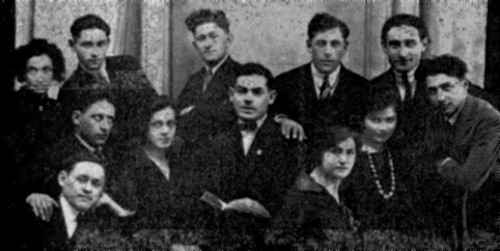
From right to left: Yechezkel Hodes, Blume Lizerstein, Shmuel Borenstein, Hanoch Goldshmidt, Sarah Golda Frenkel, Yitzhak Moishe Chaja, Shloime Adler. |
The choir, which was also an activity of the library, had a special place in the cultural life of Gombin. The choir master was Leizer Finkelstein, who already at eleven apprenticed with the town's cantor and displayed his great talent as a musician. He later learned to write music. The choir was one of the most successful cultural institutions in Gombin. Its repertoire included classical songs and Yiddish folk songs. When the choir performed, the hall was always full. Their popularity went well beyond Gombin. They were invited to perform in all the surrounding towns. Before the outbreak of the Second World War, the choir master Leizer Finkelstein was hired as a cantor by the large “German” synagogue of Częstochowa. He was murdered there during the Holocaust.
When Poland became independent a tailors' union was founded in Gombin, a branch of the Warsaw Textile Workers' Trade Union Central. Also belonging to this union were shoemakers, boot stitchers, bakers and servant girls. This was a period of actions and strikes for better working conditions, regular working hours, and more humane treatment by the bosses. In some cases, even the bosses' sons and daughters joined the union and the workers in the strikes against their parents. The union, which also organized reading and writing evening courses, had its own office with a paid secretary, comrade Moishe Orbach. The members of the fist board of directors were: Yechezkel Hodes, Simcha Chaja (today in America, Sidney Gayer), Meir Zelig Kerber, Litzek Maydat. Abraham Zhychlinski, Dvorah Lizerstein, Sh. Winter and Miriam Lichtenstein as representative of the youth.
|
|
On May 1st 1920, the Bund and the Polish Socialist Party organized a joint demonstration that marched from the marketplace through the streets of Gombin with red flags. This made a great impression in town. Later that year, when Bundists were being rounded up throughout Poland and sent to a camp near Krakow, Gombin's Bundist city councillor Melech Tadelis was arrested together with Simcha Chaja and the chairman of the union Yechezkel Hodes and his brother.
My father was a devout orthodox Jew and so was my entire Gombin family, my aunts, uncles and their children. However, my older brother Yosl was already a Bundist in Warsaw and an active member in the textile workers' union. He was the first one in our family to change religion for socialist ideals, while still wearing his long black coat, Jewish cap and boots. In Gombin he was active in the library and was a prompter in the theatre.
He began to bring books to the house and for the first time wore a “kurtz” – a suit with a short jacket. When my father saw this he angrily threw the suit out the window: “You will never wear this in my house!” But my brother knew that he would have to suffer for his convictions. He paved the way for all his sisters and brothers, all of whom eventually joined the Bund. I felt the need to read the Yiddish books and newspapers that he brought home. Even though I was still studying with my grandfather, I yearned for the library. I went there one evening when it was already dark. I stood confused. I saw people sitting around tables reading and discussing books. Here is where I first heard the names of Marx, Engels, Hirsh Lekert, Vladimir Medem. For the first time I heard that on the Sabbath people went to the forest for a “picnic”. I did not sleep that night. I knew that I had to discuss this with my brother, that he had to take me with him to the forest. The gathering in the forest intoxicated me. There were boys and girls from Gombin, from poor families, but they all beamed. I barely understood what they spoke about, but I was completely charmed by the atmosphere.
After that, I did not rest until I became a member of a Bund circle. That was the most beautiful day of my life. The best day of my youth. The year was 1919. I joined the circle named for Hirsh Lekert. The circles were like seminar classes, with groups at different levels.
|
|
In those years I worked as an apprentice with the master tailor Kukuridza, whose workshop was in his small home. He lived with a daughter, Bayle Ruchl, who had a child. Like all the other apprentices I had to help her with the housework. Summertime, I went with the whole family to an orchard, which master Kukuridza rented for the summer. I helped picking apples, pears and plums and then went with them to the market to sell the fruit picked. There was a goat in their house. My work included feeding the goat and holding the child. This was my start in learning how to be a tailor. In time, I joined the union.
The youth branch of the Bund was called “Tsukunft” (Future). For the members, it was more than a political organization. It encompassed every aspect of personal life, world outlook, personal honesty and morality. Often, the youth were so excited and uplifted by the socialist ideals that they drew in their parents to join the Bund. Many of those youngsters would come to play important roles in Gombin's communal life. The first members of the youth committee of the Bund were: Chane Tatarka, Rude Gostinsky, Yechezkel Hodes, Blume Lizerstein (today in Brazil) and Hindele Zajonc. All four died in the gassings at Chelmno.
My weekdays were very ordinary: filled with work and worries. But my holidays were the hours, evenings, and days when I went to the library for the meetings of the youth circle, when we went on our many walks in the forest, when we had a great time. Those days were filled with joy. We felt uplifted when the leaders of “Tsukunft” came from Warsaw to talk to us: Yoshke Lifshitz, Leon Oler, Pinhas Shwartz, Sholem Hertz and others.
It was delightful to have close and intimate friends. One of them was Abrumeleh Finkelstein, who later went to Germany and became a doctor. He was later killed in Treblinka. My second closest friend was Yankele Zhychlinski. He left for America. Today he is the chairman of the Gombin Society in New York. A third, David Melech Brzezinski, who is also in America. A fourth, Abraham Zhychlinski, now in Paris. I dedicated all my free time to the movement.
|
|
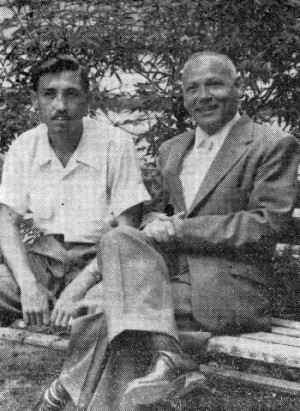
Abraham Finkelstein, Yankele Zhychlinski, Jacob Celemenski and Abraham Zhychlinski |
I will never forget the day I was chosen to bid farewell to our comrade Yitzhak Moishe Chaja who was leaving for America with his wife Bracha. It was my first public speech, and I said goodbye on behalf of the whole youth branch “Tsukunft”. Yitzhak Moishe Chaja was my first Bundist teacher in the “Hirsh Lekert” circle. He is still a devoted Bundist today in Chicago (where he is known as Morris Guyer). He was the first Bundist councilman in Gombin, loved by his friends and respected by his opponents. He was involved in all aspects of Gombin's communal life. He devoted special energy to the orphanage. His wife Bracha was very active in the cultural area and played a special role in organizing the drama circle. She took part in many performances.
I left my home in Gombin and returned to Warsaw in 1924. However, throughout my entire life I have carried with me the inspiration of the exciting days of my youth. These feelings gave me strength to endure the darkness of the Nazi occupation, which I described in my book “Mitn Farshnitenem Folk” (Elegy for my People).
I dedicate these recollections to the idealistic youth of Gombin, who passionately served socialist ideals and were so tragically exterminated. Also, to my father Moishe, my mother Shaine Bineh, my bothers, sisters and their children. And to my beloved Bronke, who fell as a pilot in the 1956 Sinai campaign in Israel.
by L. Wolman
Translated by Janie Respitz
Edited by Leon Zamosc
Meeting in Warsaw in 1926, the central committee of the Polish Bund launched an effort to promote the education of Jewish children in the values of the movement. That was the origin of the Socialist Children's Association (Sotsyalistishe Kinder Farband) or, for short, “SKIF”. A year later, the Gombin Bund, together with the local branch of the Bund's youth group “Tsukunft” (Future), founded the “SKIF” organization in Gombin. The members of the founding committee were Yosl Kohn, Moishe Frenkel, and Leybish Wolman. Their first task was to recruit Jewish children from the Povshechner school (the Polish public school) and among the boys and girls who for material reasons had to leave school and learn a trade.
I remember well the first meeting with the children. We explained the goals of the “SKIF” organization and our desire to offer a place where they would be able to grow, become more aware of what was happening in the world, and learn to face the important questions of life. The “SKIF” wanted to promote a sense of autonomy among the children and its activities included entertainment, singing and sports.
|
|
In the middle, the instructor Leybish Wolman |
The first meeting was very successful. The children were excited about the plans and almost all those who attended became members of the new organization.
The children spread the news about the Bund's new organization around Gombin. In a short time the membership grew. Very soon, the “SKIF” became the largest children's association in town.
We divided into groups and began cultural programs for the children. With the help of Freydl Finkelstein we started a mandolin orchestra. The director of the Gombin sports organization Abraham Frenkel began a physical education program. The children also enjoyed excursions to the forests and surrounding villages. The goal was to familiarize them with the beauty of nature and help them develop strong friendship bonds and a sense of family. For the children, every outing was a holiday. They waited impatiently all week for Saturday, when the field trips took place.
In those expeditions, we would play a variety of games. There was singing, dancing, and conversations on different topics. At the end of the day, we would sit around a fire and sing until late at night. We would then march back to town, still singing loudly.
|
|
In the middle, the instructor Abrumeleh Finkelstein |
In 1928, if my memory is correct, we organized the first “SKIF” summer camp under the leadership of comrade Bromberg from the Bund's Warsaw central committee. It was a great success, an immensely happy experience that made a big impression on everyone.
The summer camps were run like a children's republic. The boys and girls planned their own activities. As part of the program, we went to visit other children's groups in neighbouring towns like Gostinin and Plock. In 1937, the summer camp received important guests: Victor Alter, Sarah Shweber and Abraham Stoler.
It should be mentioned that one of the important components of the educational activity of the “SKIF” in Gombin was the “members' court”, where the children were encouraged to solve their own conflicts among themselves.
There were other children's groups and institutions in Gombin but, for us, “SKIF” will always shine in our memory with a special light.
by Rivka Frenkel Halpern
Translated by Janie Respitz
Edited by Leon Zamosc
|
|
| Rivka Frenkel Halpern, Israel |
Before the First World War, the Zionist movement and all other political organizations were illegal in Russia and Poland. The Zionist groups had to operate under the pretense that they were conducting social or philanthropic activities. After the occupation of Poland, however, Germany and Austria relaxed the restrictions on political activities. That created favorable conditions for a rapid expansion of the Zionist movement.
The 1917 “Balfour Declaration”, which announced the British Empire's disposition to allow the construction of a Jewish national homeland in Palestine, fired up the enthusiasm for the Zionist cause throughout Poland. In Gombin the activists of the movement significantly expanded their work. They distributed Shekels, collected donations for the National Fund, and launched a whole slew of new activities, including a Hebrew language kindergarten, Hebrew classes for adults, and a variety of lectures and cultural events focused on national and Zionist themes.
In 1920, news arrived from Palestine that Yosef Trumpeldor and his comrades had fallen in the defense of the settlement of Tel Chai. In Gombin and many other places in Poland, the news stirred a great deal of interest, particularly among youth groups that began preparations to move to the Land of Israel
I remember being at the Palestine office in Warsaw just before I left for the Land of Israel. When I told the officials that I was from Gombin, they honored me, saying that my town was known for its meritorious Zionist work. That reputation was certainly deserved. Gombin had a small group of devoted Zionist activists who fulfilled the movement's tasks with a great sense of responsibility. Thanks to their efforts, a large portion of the previously apathetic Jewish youth of Gombin were now committed to the fulfillment of Jewish national values.
|
|
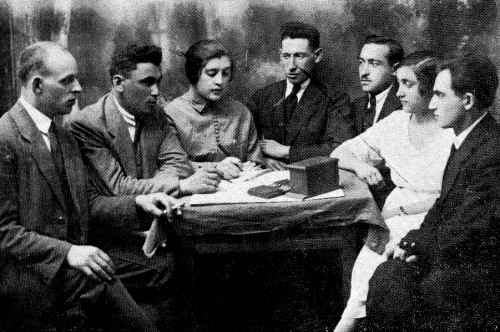
| Committee of “Keren Hayesod” (National Fund) |
I have fond memories of many of these Zionist activists. Most important among them was Rabbi Yehuda Leib Zlotnik, a blessed man whose spiritual personality influenced an entire generation of Gombin Jews. His arrival marked the beginning of a true national Jewish renaissance. The establishment of the kindergarten and the “House of Judah” school made possible the education of a generation of Zionist pioneers, many of whom are now living in kibbutzim and towns in Israel. Rabbi Zlotnik's sermons in the synagogue influenced all social classes, bringing them closer to Zionist belief and activities.
One of the most the most important persons at the helm of Zionist activity in Gombin was Abraham Zamosc, a man of blessed memory who was murdered in Treblinka. For many years he carried the entire burden of Zionist work in Gombin, neglecting his private interests. He was a bachelor without a personal family life. People jokingly said that Abraham Zamosc had married the Zionist cause.
|
|
| Abraham Zamosc, activist of the Zionist movement and director of the People's Bank |
It is also necessary to remember the valuable help of Rabbi Natan Nutkewicz, the brothers Melech and Avremele Tadelis, Abraham Prawda, Abraham Chaim Zychlinski, Moishe Glickzeliger, and my closest friends Rivka Leah Opatowski and Shaindl Zychlinski. There were many others whose names I do not remember. Many perished in the Konin forced labor camp. They had dedicated so much of their lives to the Zionist movement…
I would now like to mention my friends (may they live long lives) Yechiel Chajek, who lives in Israel, and Yitzchak Eiley who devotes a lot of time to communal and social work in Montreal and is active in all the Canadian campaigns for Israel. They contributed a lot of time and energy to the Zionist activities in Gombin. I would also like to fufill a personal obligation and mention the devoted and well-loved teacher Yakov Gazalka, who taught in the Hebrew school and gave courses for adults. Many of his students remember and greatly admire him. Gazalka, who moved to Israel in the 1930s, is known as Yakov Gurali and worked for many years at the Hebrew University in Jerusalem. He wrote three important novels, a trilogy about Jewish life in Poland, and made a huge contribution to the Jewish national renaissance in Gombin.
|
|
| Tarbut School kindergarten From the right: M. Glickzeliger, Rabbi N. Nutkevicz, A.L. Gips, M. Todelis |
Last but not least, I want to mention our dear friend Louis Philips (Pochekha) who currently lives in Detroit. He was active in the Zionist movement until the day he left Gombin. Today, Louis is active in all things related to Gombin and in the work to support Israel.
To conclude, I would like to emphasize that, thanks to the blessed work of all those who have been mentioned here, there are hundreds of Gombiners who survived and are now living in Israel.
Givataim, Israel, January 1968.
by Sidney Guyer (Simcha Chaja), Detroit
Translated by Janie Respitz
Edited by Leon Zamosc
|
|
| Sidney Guyer |
At the beginning of the 20th century a group of boys and girls who were active in the revolutionary movement laid the foundation for a Jewish library in Gombin. They knew well that, in those times, opening a library was a very important deed. They also knew that they would have to face material and political difficulties, but they deeply believed in their dream and made it happen.
They began to collect books, but they soon realized that this would not be enough. There were problems to solve. The biggest problem was: where do we keep the books? And how do we get money to buy new ones? Luckily, the sons and daughters of some well-to-do families liked the idea. They worked hard raising money at various events. Some went to collect bones from the butchers, then sold the bones and saved the money to buy books.
This continued for a few years. Another issue came up: where should we hide the books? Some parents did not allow their children to bring books to their homes because, in those days, many books were forbidden by the authorities or considered “non-Kosher” by the Jews. Therefore, it was necessary to permanently move the books from one place to another. This would change as a result of the First World War, when the Germans chased out the Russians. What had been previously forbidden was now permitted, and we eventually received permission to open a Jewish library in Gombin.
Now the question was: where would the library be located?
A shoemaker by the name of Hersh Mantchik lived on Kutno Street. He was called the “Kutner shoemaker”. There was also the tailors' workshop of Chaim Lurie, where Yosef Laski was a partner. They gave permission to open the library at their place. At that time, I was working as a tailor apprentice at Chaim Lurie's workshop.
|
|
| Moishe 0rbach “The Rabbi's grandson”, library and workers' union secretary |
I helped carrying boxes of books and building the shelves. Other helpers included Hanoch Goldshmidt, Yitzchak Moishe Chaya, Sh. Adler, Tadelis, Bracha Wolman, Sh. Sochazevski, and many others whose names I no longer remember.
The Jewish library was a great success. The number of readers quickly increased and very soon the space in the two workshops became too small for the library's activities. A larger, more appropriate place was needed. This dream was also realized when the library was moved to a large brick building on the main Market Square.
The new location was bright and nice. It was no longer just a lending library - there was also a reading room where everyone felt at home. There were pictures of Yiddish writers hanging on the walls, and the tables were always full of readers. The book collection continued to grow.
|
|
Standing at right: Choir master Leyzer Finkelstein |
In time, the library became the most important cultural institution of Gombin. It hosted a variety of community activities, lectures, meetings, and fundraising events. It was also the home of the drama circle and other cultural groups of the town.
I continued to help as an active member of the library until my departure for America.
by Simcha Chaya
Translated by Janie Respitz
Edited by Leon Zamosc
At the turn of the 20th century, Yiddish theatre was very popular in Polish cities and towns. In Gombin, a drama circle was founded by a group of talented people who were active at the library. Eventually, the Jewish drama circle of Gombin became the most popular amateur theatrical group in the region.
|
|
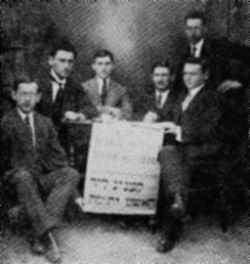
Seated from right: Yosl Szklower, Hershl Luschinski, director Chaim Lurie, Yitzchak Moishe Chaya-Guyer, Leybl Drachman Standing: Hanoch Goldshmidt |
At first, the group faced difficulties. The library hall, for example, was not large and comfortable enough for the growing audience. However, the dedication of the founders and participants allowed them to overcome the difficulties and, in time, the drama circle achieved important accomplishments.
The group's theatrical director was Chaim Lurie. He was very talented, always brilliant in the many roles that he played. He taught evening classes in Gombin, and he was always helping others to develop their acting skills.
|
|
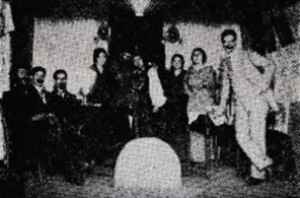
| The drama circle: director Chaim Lurie playing King Lear |
Hershl Tajfeld gave a lot of his time to the drama circle, together with Yitzkhak Moishe Chaya and his wife Bracha, who left for America in the 1920s. For many years, Hanoch Goldshmidt was responsible for the technical aspects of stage and sound. I learned a lot from him. Hershl Luschinski, a well-to-do Gombiner, provided financial help.
Naturally, not everything went smoothly. There were parents who did not like the idea of their children becoming actors. Chana Zychlinska had that problem with her father. She was very talented but her father was opposed from the beginning. He would storm in from behind the scenes and make a scandal. At first he succeeded, but in the end she came back and for many years brightened the amateur group with her talents. She later married Yosl Celemensky who was a prompter as well as a good performer in the drama circle.
Now our town had a group of youngsters who were attracted to the theatre and did not want to wait for the holidays to perform. They wanted to have a stable theatre that performed regularly.
|
|
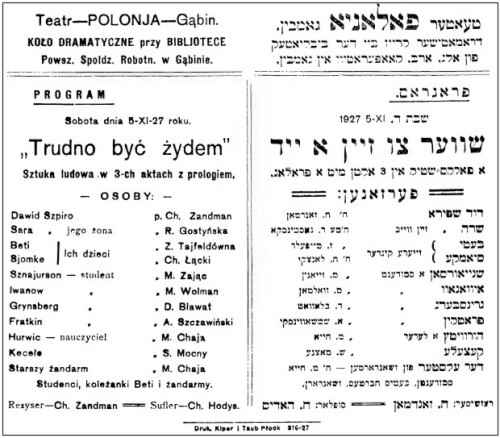
| Theatre POLONIA, Gombin Program in Yiddish and Polish, Saturday May 9, 1927: It's Hard to be a Jew |
The move from the library to a larger new location energized the drama circle. Our group was in contact with theater groups from other towns. We would visit them and they would come visit us. One of our most talented actors was Sh. Laski, a great character performer. Other very talented members were: Hershl Karo, Mendl Frenkel, and Lazar Finkelstein who had a beautiful voice. He later organized a choir within the drama circle. By occupation, he was a tailor, but his singing vocation prevailed and he eventually became a famous cantor in Poland and Germany.
|
|
First from right: Director P. Zandman Standing: Hanoch Goldshmidt |
Other active members of the drama circle were: Yakov Celemensky, Lipek Maydat, Moishe Wolman, Hinda Schwartz, Rude Gostynska, Chaya Wrubel, Chatzkel Hodys, Moishe Orbach, Zelda Tajfeld, Moishe Chaya… It is impossible for me to pay tribute to all those who helped with the plays, with the technical work, and with their support and encouragement. But one thing can be said: the Gombin drama circle was one of the most prized cultural gems of our town and it continued to be very active until the war. Eventually, however, the storm that hovered over Poland would not spare anything. The star of the drama circle, like every other light of Jewish existence in Gombin, would be ruthlessly extinguished by the Nazi murderers.
|
|
JewishGen, Inc. makes no representations regarding the accuracy of
the translation. The reader may wish to refer to the original material
for verification.
JewishGen is not responsible for inaccuracies or omissions in the original work and cannot rewrite or edit the text to correct inaccuracies and/or omissions.
Our mission is to produce a translation of the original work and we cannot verify the accuracy of statements or alter facts cited.
 Gabin, Poland
 Yizkor Book Project
 JewishGen Home Page
Copyright © 1999-2024 by JewishGen, Inc.
Updated 14 Oct 2020 by LA