![dab086.jpg [15 KB] - Rabbi Alter Mosze the Levite](images/dab086.jpg) |
may the memory of the righteous person be blessed
|
Born 1868 to his father Rabbi Israel Tuwje Gutman Cwi the Levite, Chair of the
Rabbinical College in Pacanów. Even in his youth he had the reputation
of being a genius. He was a son-in-law of Ber from Niemce (close to
Dąbrowa). Lived with and supported by his father-in-law. His father-in-law
gave him a house in Sosnowiec, from which he received rent payments.
|
|
| Rabbi Alter Mosze Aron the Levite,
may the memory of the righteous person be blessed |
After his father's death in Pacanów, he took his father's place in the Rabbinate, in 1906. In 1911 he came to Dąbrowa. At that time the battle heated up regarding breaking away from the Będzin community and becoming independent, which came to pass in a rough struggle on 23 June 1909. January 1911 the independent Dąbrowa community was established, and soon after that, Rabbi Mosze Aron the Levite was elected as the first Rabbi of Dąbrowa. Even earlier, three years before, he had bought a house in Będzin and lived there. From time to time he would come to Dąbrowa and attend to the religious needs of the Jews. His election as Rabbi was confirmed by the governor. The Rabbi of Będzin, Graubart, felt a little insulted by the Dąbrowa community, and he did whatever he could to hold off the appointment of a new Rabbi in Dąbrowa. Helping him was the Rabbi from Łódź, Rabbi Elijahu Chaim Majzel, and the Kromołów Rabbi, Reb Natan Nachum Rabinowicz. But the treatments did not bring about results. The votes for the new Rabbi of Dąbrowa were confirmed, and he began his term as Rabbi in Dąbrowa.
The Rabbinical Levite was a Radomsker Hasid, a great benefactor, a fanatic in
Jewish affairs. He was very involved in distributing free loans. He sold his
house in Sosnowiec and built one in Będzin on Kołł¹taja 42, a
new house. He did not allow any work on Sabbath; he paid his workers for
Sabbath, even though they did not work.
[Page 87]
In 1912 he published a book, Light of the Century, with speeches (in two
parts). The first volume has 128 pages and the second, 114 pages (published in
Piotrków).
He calls himself “Alter Mosze Aron the Levite,” son of Rabbi Israel Tuwje Gutman Cwi the Levite of Pacanów, son of the Hasid Joel Josef the Levite, who died 24 April 1903. In the flyleaf of the book he relates that he was once a Rabbinical judge in Będzin, out of honor, without salary, a member of the Rabbinical Assembly, of which Rabbi Engel was the head, and also honorary chairman. After that he took over his father's place in Pacanów for eight years, and afterwards he came to Dąbrowa. His book was published by the young Hasid Reb Pinchas Menachem Finkelsztajn, son of Eliezer Elimelech (born in Pyrzyce [?]) from Dąbrowa in 1912. In the book are endorsements by the Ostrów Rabbi, Rabbi Szalom Majer Jechiel Szapiro; Walędówer [?] Rabbi, Rabbi Szlomo Chanoch the Cohen Rabinowicz (Radomsker Rabbi) of Sosnowiec, Rabbi Motele, the Trisker Maggid's son. Rabbi Chaim Majer the Levite from Neustadt, witnesses in his introduction, that in addition to all the years that the author served as Rabbi in his father's place in Pacanów, he taught students; his single goal was to bolster the Jewish religion. Rabbi Chaim Majer, the Pińczówer Rabbi, serves as witness in his testimonial about the author's father, that he was a sagacious scholar, and well-versed; and also about the young years of the son, the author, that he heard wonders about him and that he was a great scholar who learned Torah easily. He himself spoke with one of his students, and he found him also to be a scholar of Torah, who knew clear and deep layers of the holy books, which he taught.
After the above-mentioned work, the Dąbrowa Rabbi challenged himself to
publish a large, holy book. That was Grains of the Earth, on the five books of
Moses, in five volumes. The first volume, on Genesis, had 288 pages; the
second, 296 pages (with testimonials from the Gerer Rabbi and the Radomsker
Rabbi from Sosnowiec, dated 1928). The second volume was easier to publish,
because a rich man in Dąbrowa, Reb Icchak Menachem son of Reb Chaim Mosze,
covered the publication expenses. The author mentions him in the second volume.
The third volume had 150 pages. The fourth, 160 pages (printed in 1931/1932).
The fifth volume came out in 1933 and has 198 pages.
|
|
| A group of young men in “Agudat Israel” |
The Rabbi was in charge of Dąbrowa for 24 years. He was very famous for his learning and clarity in all worldly matters. The Hasidim regarded him very highly; first of all, he was a Hasid, and second, he was a scholar and intelligent. He was sick in his last years. He used to go to Kraków to be healed by doctors and professors. The last time he traveled to Kraków with his family to see the doctor, his condition worsened overnight, and he died in his son-in-law's house, 3 December 1933, at the age of 62. He was brought back to Dąbrowa. His funeral was prepared the same day. In the communal building people sat and mourned, and the chairman Najfeld, in the name of the community, bemoaned the great loss of the Rabbi to the Dąbrowa community. The gathered stood and listened to his words, and afterwards they organized the funeral. A special committee was elected which informed all the Rabbis in Zagłębie and in the nearby towns and villages. The next day, noon, the Rabbis of the surrounding town started to gather. The Rabbis of Będzin, Strzemieszyce, Szerokie [?], Lublin, Czubin [?], Rabbi Dawidl Halbersztam and Rabbi Jehoszua Glikman (Sosnowiec), Rabbi Halbersztam (Old Sosnowiec), Rabbi Dan Lipszyc, Rabbi Chanoch Dawid Fridberg, the Radomsker Rabbi, all came. The Będzin Rabbi, the Trzebinier, Rabbi Dawidl Halbersztam, Rabbi Jehoszua Glikman, Rabbi Dan Lipszyc, Rabbi Chanoch Fridberg, and the deceased's son-in-law, Rabbi Blumenfeld of Königshütte [Królewska Huta / Cherzów], gave eulogies and took leave of the departed Rabbi. After the eulogies, the Hasidic custom of “hakofes” [circular procession with the Torah Scrolls] was observed, and the mourning procession proceeded towards the cemetery.
The funeral was drawn out because there was a question about who would replace
the Rabbi. The Rabbis who attended the funeral invited the communal
representatives in order to decide together about the Rabbinic question.
However, they did not come – with the complaint, that the Rabbinic
question in Dąbrowa needs to be decided according to common sense and not
by a law from the Rabbinate. In the end, the Rabbis ruled that the son-in-law,
Rabbi Reb Baruch Epsztajn, should become Rabbi in place of the deceased. All
the Rabbis, in their eulogies, indicated that Jewish Dąbrowa should carry
out their ruling, and they should agree, that the Rabbi's son-in-law, Reb
Baruch Epsztajn, should become Dąbrowa's Rabbi. The governing group of the
community voted for a stipend for the widow for her entire life, 3,000 zlotys a
year. Afterwards they granted another 300 złotys.
3. Rabbi Baruch Epsztajn of Dąbrowa
After the Levite's passing, the Jews of Dąbrowa wanted to nominate his son-in-law Rabbi Josef Blumenfeld to take his place. However, Rabbi Blumenfeld did not want it; he announced, in the presence of the deceased, that he would make aliyah to Palestine, and until then he was Rabbi in Królewska Huta. He authored a book, Pick-pocketing and Fear, with a declaration, “Also Josef,” (published in New York, 1958). The nomination of the old rabbi's son-in-law, Rabbi Baruch Epsztajn, was realized.
He was from the Ożarów-Opoler Rabbinical dynasty, grandson of the
great Lajb, who founded the dynasty in Ożarów. He was a son of
Jechiel the ritual slaughterer of Klimontów near Radom. Even in his
young years he was known as a genius. As a boy he was already communicating
with the well-known Rabbis of Pierworzyno [?] and Łokacz, from the leaders
of the young men of Agudat Israel.
[Page 89]
He was born in 1897. After his wedding he lived with his father-in-law, the
Rabbi of Dąbrowa, and after the father-in-law's passing he felt his place
as a teacher of instruction and a candidate for Rabbi. However, the Hasidim
from Radomsk and Ger blocked his way to becoming Rabbi and opposed him. He
received a majority of votes, but his opponents strove to negate them. After a
great deal of effort and difficulties, he was at last installed as Rabbi of
Dąbrowa. He did not enjoy his Rabbinic position, however, because his
opponents hindered him very often. He had five children.
With the outbreak of the war by the German-Nazis, he shared the same fate as
all the Jews in Dąbrowa. The Nazis murdered him and his family in 1942. He
has a brother in Israel who was earlier in Belgium – Jechezkiel the Levite
Epsztajn, and a brother's son, Mosze.
|
|
| “Szoszana Class”, Dabrowa 5695 (1935) |
by Efraim Lenczner
Translated by Dr. Hannah Berliner Fischthal
The synagogue in Reden was not distinguished for its external architectural
style. The inner furnishings were also far from luxurious for the holy books
within. One of the reasons for this was that this House of Study was not owned
by the Jewish community in Dabrowa and not supported by its budget, as was, for
example, the town synagogue. Instead it was located in the private home of Reb
Szymon Sliwka, of blessed memory (later it belonged to his widow Frymetl, of
blessed memory). The inhabitants of Reden should not be blamed for this. They
were active and dedicated participants in all social and political
institutions. They did not find it necessary to be concerned about making their
place of prayer outwardly presentable; it was a primitive house of study for
the masses, serving also as a gathering point for assorted politico-social and
philanthropic institutions.
As is known, the community leaders of Reden – headed by Reb Henoch Gerszon Szpilberg, of blessed memory – proclaimed the construction of a synagogue in Reden in the years 1910-12. For this purpose, they undertook a collection and created a fund under the name “A brick for a kopeck [Russian coin].” Coupon booklets were distributed among the businesses selling the “bricks.” Unfortunately, the plan never came to fruition because of the evil decree of the Czarist government against the Jews in Dabrowa, and later because of the First World War, in 1914. Savings lost their value; this was also the fate of other institutions, as, for example, the Loan and Savings fund, which ruined Reb Szlomo Halperin, may the Lord avenge his blood, Szternik, of blessed memory, Zilberszac, of blessed memory, and others.
With the end of the First World War and the establishment of the independent Polish republic, the concern of religious affairs was delegated to the authorized council of the Jewish community, which unfortunately had a limited budget, because the Miejska Synagogue was the official synagogue and was of course subsidized by the Jewish community council. (By the way it was also built by funds from two donors: the walls were from Berl Fuks, of blessed memory, and the roof from Reb Mosze Micenmacher, of blessed memory). The Jews in Reden made do with the existing House of Study. They made small improvements from time to time, and they also welcomed distinguished guests from Palestine, like Reb Lejb Yafeh and Uri Zatlawski and others.
This synagogue was a center for all Jews in Reden for prayer, for charitable
acts, and for all socio-political matters.
[Page 92]
by Cwi Rechnic
Translated by Avi (Abram) Stavsky
In Dąbrowa there were known the Krimilow Hasidism (Krimilower Hasidism) to which belonged my parents and myself. They were unified around their rabbi, Rabbi Natan-Nachum Rabinowicz, of blessed memory, whose seat was in Zawiercie. Our town had 3 “shtibelach”: Barden, in the house of the baker, Rabbi Zelig Miodownik; Balat-D¹browa, in the home of Rachel and Szlomo Rechnic; and the central [shtibel] in the house of Berl Kanarek.
A particular facet of this Hasidism was despite their religiosity and Hassidic life was that, along with their rabbi, they were Zionists and firm builders of the Land [Palestine]. My memory as a young member of the “Shomer Dati”, which never missed an opportunity to direct their prayers and efforts to the “Keren Kayemet Le-Israel,” was that no one ever refused [to help]. They even delayed their prayers [where necessary] for the benefit of “current affairs”. They were involved in Zionist Congresses and attended the speeches of Weizmann, Sokolow, Usyszkin and others.
The Shitbel, whose members came from all strata of the city, was a true brotherhood of members. It ran a benevolent society which more than once saved Jews from the shame of hunger. I particularly recall the situation wherein a Jew worked with a large family which could not afford to feed itself. He diligently enlisted the aid of citizens to come to their aid until they could get back on their feet. This was not an isolated incident. These simple and pure Jews were [true] Hasidism in body and spirit as well as Zionists with nationalist feeling. They felt the pains of all our “bnei Israel” brothers and were the hope of our homeland.
Unfortunately, they did not live to see the miracle of [the] renaissance of our people in Eretz-Israel, and were among the millions of our brethren who died “al kiddush Hashem” at the hands of the Nazi murderers, cursed be their memory.
May their memory be for a blessing.
[Page 93]
by Szmuel Ari Sapir
Translated by Jerrold Landau
It is worthwhile to recall and consider as examples several of the wonderful personalities of Dąbrowa Górnicza: for example Reb Reuven Lichtzier of blessed memory. He was a Jew who suffered. He had illness in his house, but he was nevertheless always imbued with joy. He fulfilled the commandment of welcoming guests in his house. He would say and fulfill, “Giving is taking.” I was told that he was wealthy during the time of the First World War, and he would distribute money from his private funds to many Jews, so that they would be able to celebrate the Passover holiday properly. They said of him that he was once going on a journey, and met a poor man who did not have shoes on his feet. He removed his boots and gave them to the poor person.
“Mendel Dąbrower” was one of the well-known Hasidim of Ger. He was literally like a Kocker Hassid. He negated this world. He was a genius and a giant in Torah. His wife concerned herself with livelihood. She sold all kinds of merchandise to the senior directors and officials. Rabbi Mendel traveled to the Gerrer Rebbe for Shavuot, and returned in the month of Cheshvan.[1] He remained at home for a brief time and returned to Ger. He was literally a special person. It was hard to get a word out of him. He remained without a livelihood after his wife died. His friends made sure to collect a sum of money, and decided to coronate him as the rabbi and teacher of righteousness in our city. They urged him, but under no circumstances did he want to accept the position. He distributed the money for other means.
I am obligated to mention my father-in-law Reb Shimon Lencner, peace be upon him. He was a pleasant man, who pursued peace, and fulfilled the adage “you shall conduct your business faithfully.” He also merited to fulfil the commandment of honoring his mother in an unparalleled manner, as if described in Tractate Kiddushin (32a): “They asked Rabbi Eleazar: to what extent is the honor of the father and the mother. He responded: even if they take your wallet and toss it into the sea before him, and he does not embarrass them.”
Finally, I will mention my friend Reb Berl Recht, may peace be upon him. He was a scholar and a great scribe, who conducted himself modestly. He was quiet, and benefited from the labor of his hands. He earned his livelihood from a chocolate factory, and he still had a great deal of time to study Torah. Anyone who needed to ask advice would go to Reb Berl Recht.
[Page 94]
by Berl Recht of blessed memory
(From stories of Hasidim)
Translated by Jerrold Landau
Bright rays of light burst through the windows, covered with thick snow, and spread dull light through the ice in front of the low house in which the Rebbe, Reb Moshe-Leib, lives. He was already walking back and forth in his narrow house. His face was bright with holy splendor, sublime glow, noble grace – these were all stretched over him. He would later awaken the morning…
The Rebbe's student, Tzvi-Hirsch of Zidachow stood in the room next to the Rebbe, all shrunken and bent. His bright eyes peered through the cracks of the door, as he watched carefully every light movement, every step of his Rebbe.
The Rebbe extended his hand to take the coat of hair from the nail. His student hid under one of the benches from fear, and watched the Rebbe leave.
The Rebbe left his home, and closed the door behind him. Then he [the student] carefully began to stick his head out of his hiding place. With light steps on his tiptoes, he followed after his Rebbe in the darkness of the night. The Rebbe crept along, with his feet sunk in the snow. A cold wind accompanied him and blew on the corners of his coat. The heart of the student was jolted, as he prayed silently: May it be His will that I not be caught…
In front of a small house, half immersed in snow, the Rebbe placed himself and listened intently to the sound of the tumult coming from there. He looked carefully through the windowpanes covered with blossoms and flowers that the fierce cold created for his enjoyment. A heavy sigh from the depths of the broken heart emanated from the Rebbe's body, the echo of which vexed his student, who turned himself to the side, all trembling and afraid.
The Rebbe turned his shoulder with wonderful agility, and turned again toward is home… Reb Tzvi Hirsch walked after him secretly, filled with wonderful longing.
The Rebbe stood in his house again, and quickly removed an old hat from his chest and put it on his head. He wore and old kapote, with a rope belt around his waist. He quickly went to the wood storage, and loaded twigs on one shoulder… He hung his woodcutter's axe on his other shoulder… He hurried again to his small house… With Rabbi Tzvi Hirsch behind him.
The sounds of sobbing emanated from the house, the wailing of children and the groans of adults mixed together into one dreadful lament.
Silence fell upon the house. The sudden knocking of the Rebbe on the door silenced them.
The Rebbe, laden with wood, stood in the pits and seemingly wondered: “Why this weeping?” he asked.
A voice full of anguish answered from under the blanket full of patches: Why this weeping – asks a Jew? Why not weep, merciful Jew. I have given birth, the house is so cold, and there is nothing with which to light the fire… How can I warm up…?
The children suffering from frost looked jealously at the Jews with the wood, and all together, as an organized choir, set their voices to weeping…
But – ! The Jew laden with wood silenced them – why do you cry? Here is wood… The children quieted, and an expression of silent gratitude was seen on their faces – They were prepared to fall upon the neck of the sudden redeemer and kiss him…
The master of the house, full of embarrassment, approached the Jew with the wood, and with lowered eyes whispered a secret into his ears: “I have no money with which to pay for the wood.”
The Jew answers him slowly, as he cast off the wood and held his axe. He cut twigs, made kindling, and ignited it… He placed a cup of hot water next to the bed of the woman who has given birth… “Take comfort,” he said, “do not be sad at all. When you have money you will pay me…”
The members of the household stood to give him their blessings. He took of his kapote and left the warm room quickly.
Again, Rebbe Moshe-Leib walked through the streets of Sasow and heads home, followed by his student Reb Tzvi-Hirsch.
The Rebbe very quickly removed his woodcutter's vessels. He put on white garments, sat down on the floor, and his eyes shed tears over the difficulties of the daughter of Zion.
And his student Rabb Tzvi Hirsch went about immersed in his thoughts, pondering: yes, yes, regarding him it says, “Your path is in the many waters, and your route is not known.” Indeed, indeed, we do not know it.
[Page 95]
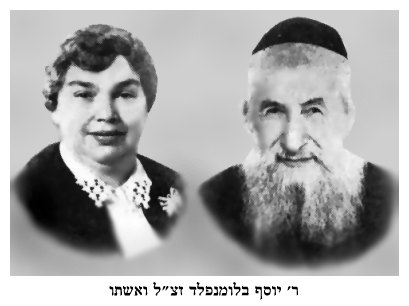
by Rabbi Szlomo Blumenfeld (his brother)
Translated by Jerrold Landau
|
|
Rabbi Yosef-Baruch Blumenfeld of holy blessed memory was born in the year 5650 (1890) to his father the rabbi and Gaon Rabbi Shmuel-Yaakov of holy blessed memory, who was the rabbi and head of the rabbinical court of Szydłów and later of Nowy Korczyn in the district of Kielce. On his father's side, he was the grandson of the Tzadik and splendid person of the generation Reb Mordechile, who was the rabbi and head of the rabbinical court in the city of Kielce and one of the great ones of the house of Kock and Pilow. From his mother's side, he was a descendent of holy Gaonim Rabbi Izele Charif of holy blessed memory, rabbi of the city of Opoczno, and Rabbi Yehuda Leibish, the head of the rabbinical court of Neustat near Warsaw. His grandfather, Rabbi Shaul the head of the rabbinical court was a rabbi in the city of Korow was the uncle of the Admor Rabbi Mendel of Kock. Ascending in holiness, his family tree reached up to Rabbi Shmuel Wahl, who was a king of Poland for one day. His ancestry goes up to Rabbi Heshel of Krakow. Rabbi Blumenfeld was always proud of his family tree, which he guarded carefully.
Rabbi Blumenfeld was educated and studied with his father, the rabbi and Gaon Rabbi Shmuel-Yaakov Blumenfeld of holy blessed memory. He was very diligent and constant in his learning. During his youth, his exemplary memory was recognized. When he reached the age of Bar Mitzvah, he knew several tractates of the Order of Kodshim by heart, including tractates Zebachim, Menachot, and Chullin with all their commentaries. He wrote many novellae on Torah. On account of his clear, straightforward intellect to understand matters properly, he became renown as a genius throughout all Poland, and his name went before him as one of the Torah giants.
He was ordained as a rabbi at the age of 17, with the degree of yoreh yoreh and yadin yadin.[2] He was ordained by the greats one of the generation in Poland – the Gaon Rabbi Yosef Angel of Krakow and the Gaon Rabbi Shmuel Angel of Radomyźl.
He got married at a very young age to the daughter of the rabbi and Gaon, the head of the rabbinical court and rabbi of the city of Dąbrowa Górnicza, Rabbi Alter Moshe-Aharon Lewi of holy blessed memory, the author of the books Tvuot Haratz and Ner Lameah. During his wedding, he delivered a three-hour sermon. His father-in-law stopped him in the middle, so the evil eye would not afflict him.
When he was young, about 20, he wrote many Torah novella, and the elderly Gaonim of that generation debated with him and wrote about him: “Rabbi Yosef is a Sinai and an uprooter of mountains”.[3] After he met the Gaon Rabbi Shimon Shkop, may the memory of the holy be blessed, and they were awake all night discussing Torah, Rabbi Shimon Shkop wrote of him: “I discussed words of Torah with him, especially the laws of the Land of Israel. I saw and recognized his traits of sharpness and breadth. He is an expert in Talmud and both the early and latter rabbinic decisors. He remembers everything by heart.” They used to say of Rabbi Blumenfeld that the angel of forgetfulness has no control over him, and everything that he learnt was on the tip of his tongue and etched in his memory as if he had learned it that day.
He was a man of the people and a man of friendship. He did not act haughtily
[Page 96]
and he did not demand his own welfare. He would be friendly with old and young, with Hasidim in the shtibel and with young lads in the Yeshiva. When he stood among the youths and delved into the intricacies of Torah with them, he appeared young like them in his sharpness, his learning, and the good spirit in which he shared his knowledge and novel ideas. If he went to the elder Hasidim, such as the Hasidim of Gur, Lubavitch, or Radomsk – with whom he worshipped in the latter times – he was like one of the group. He never wanted to sit at the head, and never thought that he was owed honor. He was a very discreet and modest man. He never wanted for people to stand up for him or give him honor, as would be fitting for a Torah Gaon such as him.
He was a true image of a Torah giant. He was a man of Poland, as if he symbolized the style of Poland. He was an expert representative of scholarship, with the primary sign being breadth of knowledge at a superior level, for Polish style [Torah] scholarship was based, first and foremost, on broad expertise and lightning speed. His grasp was extremely quick and sharp. He would delve into the depth of deep problems. Thanks to his sharp intellect and phenomenal memory, like a tarred pit that does not lose a drop.
He made aliya in 1935, despite the fact that he was a renowned rabbi in Poland in the city of Królewska Huta. After some time, when he was in Tel Aviv in the Land, they began to recognize his greatness in Torah, and he attained the lofty post as rabbi and head of the rabbinical court of Tel Aviv and Jaffa. He was attracted to the book Kaftor Vaperach of Rabbi Ishtori Haparchi, and wrote a commentary on it called Gan Yosef. Several of the greats of the generation wrote approbations to the book. The Gaon Rabbi B. Weidenfeld, may the holy be remembered for a blessing, of Trzebinia describes him as follows: The rabbi and Gaon great in Torah. These honorary descriptions were confirmed by all those who came into his presence and warmed themselves in his light. Even the Gaon Rabbi Moshe Avigdor Amiel, may the memory of the holy be blessed, the chief rabbi of Tel Aviv, praised him in public, as a great member of the army of Torah, as one of the great experts of our generation. Love for the Land of Israel enchanted Rabbi Blumenfeld. It was into this that he invested the aims of his commentaries, explanations, and notes, as he delved into the ancient books an archives to clarify that which was obscure.
We will cite his words in relations to the fifth edition of the aforementioned book: “This book, Kaftor Vaperach[4] for the nation of Israel, comes to inform the entire nation that the natural place for the chosen people is only the Land of Israel. From there, and as it says only from there, the flower of the sprout of Jesse will blossom, and this is a hint to the reading of the book Kaftor Vaperach.” Rabbi Blumenfeld continues, “And in my opinion, whosever seeks the real truth, will see in the State of Israel that portion of the holy Land of Israel, the natural place for the nation of Israel. For there is no doubt in the world, even after a portion of Israel was absent from the Land of Israel and lived in places where Israelites do not live, with all this what was in our hands remained with its prior holiness and heritage of our ancestors. All our thoughts must be to plant in our hearts that our only place, both physical and in the spirit, is the Land of Israel, and today, the State of Israel.”
From another place in the book: “In order to show all readers of this book the extent to which the souls of these true Gaonim pined to live in the holy land of the Land of Israel, the land upon which the eyes of G-d are always looking[5], especially now that we have merited the State of Israel that came to us from Heaven.” He told every Jewish person from the Diaspora: “Come, blessed be G-d upon us, to fulfil the settlement of the Land of Israel, for we have literally merited overt and covert miracles, as we have seen with our own eyes that the Arabs have fled on their own accord from the perspective of 'and you will flee, and there is no pursuer'[6] that was fulfilled with them. The entire settlement merited to see the foundation of our state, the living artery of the Nation of Israel in every place.”
“But the end result of the settlement of the Land of Israel depends upon us. We must work to settle it. Then will be certainly fulfilled with us, 'And you will give redemption to the Land in all the lands of your inheritance.'[7] The interpretation of the Chozeh of Lublin, may the memory of the holy be a blessing, when we take hold of the Holy Land, we also hasten the final redemption and the coming of our righteous Messiah on the soil of the Land of Israel in the State of Israel.” When he was in the United States, he preached this idea incessantly, and encouraged the community toward aliya to the Land.
The book Kaftor VaFerach is divided into two parts. The first part is composed of 15 chapters with the commentary Gan Yosef. The second part is composed of 35 chapters, with introductions to each chapter.
Rabbi Blumenfeld left behind many other works: a commentary of the book Mekach Umemkar [Buying and Selling] by Rabbi Hai Gaon, with glosses called Chok LeYisrael. He published many articles in Torah publications. In the Hebrew Encyclopedia (volume 19, page 203), his comprehensive article on Rabbi Yehuda HaLevi the author of the Kuzari is published. He also published many articles in the Sinai Torah monthly.
He died suddenly and painlessly at the age of 76. His energy did not weaken until his last day, and he was alert to everything that took place in the State of Israel.
[Page 97]
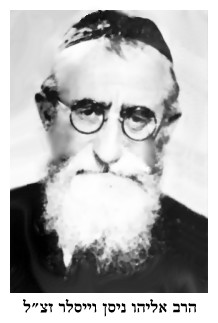
by Moshe Wajsler (his son)
|
|
Many strands tied him to Jewish Dąbrowa Górnicza. His mother, Gittel, was from Dąbrowa. Even after she married Avraham Wajsler of Będzin (who, after being released as a soldier from the Russian Army, built a large bakery in Granicza), she would frequently visit the homes of her parents and relatives in Dąbrowa. Her children would also visit the home of their grandparents in Dąbrowa either with her or themselves, for the distance between Granicza and Dąbrowa was not great. The father Avraham married off his daughter Devora to Yaakov-Leibish Stajnfeld, wo was the shochet and cantor in the city of Nikolaj in Upper Silesia. From there, they moved to the large German city of Nirenberg. The son Natan studied in several Yeshivos and became a scholar. He married Puria, the daughter of Reb Yisrael the rabbinical judge of Zawiercie, and continued to run his father's bakery.
The son Eliahu Nisan was one of the excellent lads of the district of Zagłębie, one of the first students of the Gaon of Koziegłowy, may the memory of the holy be blessed, and may G-d avenge his blood. He even studied with the renowned Rabbi Yosef Engel, wo lived in Będzin for many years, and who was forced to return to Galicia and settle in Krakow due to the Russian decree as he was an Austrian citizen.
Eliahu Nisan's diligence in the study of Torah stood out from all his other traits. He immersed himself in Torah with his full energy day and night. His gaze was inward, and his essence was modesty and discretion. He had a soft, somewhat deep but quiet voice. He walked on side paths, and minimized himself, as he he did not want to take up too much room in this world. He walked on the face of the earth with his head somewhere in the heavens, floating through the upper worlds.
His constant diligence in Torah bore fruit. From mouth to ear, they began to whisper about him that “he knows how to learn.” He quickly attained fame as a superb scholar, great in breadth and sharpness. He even gained a name in giving rabbinic decisions.
He married Chaya the daughter of Reb Szlomo the shochet Berkowicz from the town of Kamyk near Częstochowa. He continued living in his hometown of Granicza. He was an excellent prayer leader in the shtibel of the Radomsk Hasidim in Granicza. He had assistant singers: his brother Natan (perished in the Holocaust), his son Moshe Yosel, and the brothers Yosef of blessed memory and Naftali may he live (today in Tel Aviv). It was pleasant to listen to him sing the melodies on Sabbaths and festivals, and especially on the High Holy Days. As a veteran Radomsk Hasid, he loved to sing the melodies of the Tiferet Szlomo and the melodies of the hinouse of Radomsk.
[Page 98]
With the growth of the Jewish community of Dąbrowa, and especially the Reden quarter, the need arose to engage a rabbinical decisor who would respond to the many needs. The local Jews placed their eye upon Rabbi Eliahu Nisan as someone fit for this position. After a long deliberation, he acceded to them. He moved to Dąbrowa, and earned a lofty and honorable status. Everyone was careful about his honor, and listened to Torah and instruction from his mouth. He kept his distance from controversy. He was considered as one of the honorable and outstanding Hasidim of Radomsk, and worked a great deal for the benefit of the Keser Torah yeshivot, which were headed by the Radomsk Rabbi, Rabbi Szlomo-Chanoch Rabinowicz, who lived in Sosnowiec, and the son-in-law of the Kromołów Admor, may the memory of the holy be blessed, may G-d avenge his blood.
If there were those who considered Rabbi Eliahu Nisan to be of lowly spirit, they were found wrong: when they attempted to injure his Jewish pride, he knew how to ascend to a high level of sanctification of the Divine Name, and to demonstrate his strength of spirit. When the Nazis, may their names be blotted out, broke into his home in Częstochowa at the beginning of the war, like wild, bloodthirsty animals, armed from head to toe, in order to arrest the men of the house, Rabbi Wajsler already prepared his tallis, tefillin, and small siddur that he used for prayer. To their question about whether he owned weapons, Rabbi Wajsler took out his small siddur from his tallis bag and placed it before their wild eyes, while he answered, “This is our weapon.” They were momentarily astonished to hear this answer, and one of them even tried to hurt him, but his fellow prevented him. Furthermore, when they ordered his daughter to prepare for him provisions for a journey, he protested to them: “When you arrest a person, you are also required to concern yourselves with food for him.” Not only this, but when he was already together with his sons in the yards of their houses on their way to detention, and the terrifying cries of the family members could be heard clearly from the house, when one of them asked him whether there are other Jews in the second entrance to the house, he responded without hesitation: “I am not obligated to know what is taking place in the second entrance to the house.” The Nazi burst forth in fury, but did not dare touch him with his impure hands. In the meantime, the many Jews who were hiding in the second side of the house were saved, since due to their great anger from his unusual behavior, and their fear of this Jew, they forgot to approach there.
When he returned from his detention, and his full beard had been cut, and he saw the discomfort that this deed caused to his family, he explained to them that this was only the beginning, and that if these wicked people remain there, much worse things than cutting of beards would take place. Indeed, to our sorrow, these words came true. From here we can understand the strong reaction described above in the context of “Mordechai did not bend is knee and did not bow”,[8] which seemed strange at that time and which the events of the time justified.
When he made aliya to Israel, he settled in Shikun Pagi, Neve-Achiezer in Bnei Brak, and continued his deep diligence in the study of Torah. When he was hired as the kashruth supervisor in the restaurant tof the Lod airport, he waged a fierce battle to fulfil his duty, and did much more than what was expected of him in this area. With his traits and talents, he took first place in his love of his fellow Jew and love of the Land of Israel. When he heard anyone speaking ill of the Land, his face would contort with pain. In his final years, he spared no effort to come to the help of any Jew who suffered from physical or financial difficulties, despite the weakness of his body and his shaky health.
In his funeral in Bnei Brak, one could see the greatness of the appreciation of the masses to him. Large crowds participated in the funeral, including rabbis great in Torah, and friends and admirers from all over the country. Words of praise of his personality and charitable and benevolent deeds were in the mouths of everyone.
He left behind a wife and three sons who are scholars, two daughters, grandchildren, and great-grandchildren who continue to follow the path of their great father.
Translator's footnotes
[Page 99]
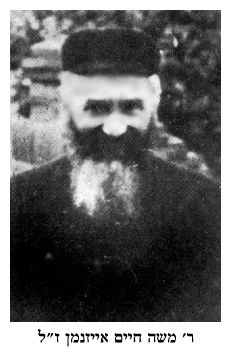
by Avraham Shachori
Translated by Jerrold Landau
The page is too short to describe this very active personality. The survivors that remain from the city know and remember he generous traits, and are certainly able to note bright periods in his life, filled with content and deeds.
He was an exemplary man. His chief concern was the needs of the community, which he served faithfully, without seeking reward. He often neglected is business and his family, so that he would be free to fulfil his many communal duties.
Reb Moshe Chaim Ajzenman corresponded with the greats of Polish Jewry, its scholars, Admors, and leaders. He frequented the home of the Admor of Ger. From his early youth, he basked in the shadow of tzadikim and rabbis, and cleaved to the dust of their feet. He drew influence from them. He found the paths to Torah and wisdom and their side.
It is therefore no wonder that, being full of Torah as a pomegranate, he aspired and found ways to impart it to the younger generation, so that a generation of those who will continue on can be raised, a generation of those who frequent the study halls, a generation of those who will delve into the complexities of Torah. Therefore, he was one of those who laid the foundation for the establishment of the Yesodei Hatorah and Beis Yaakov Orthodox school networks.
He had always been part of “Agudat Yisrael”. He did a great deal to glorify the power of Orthodox Jewry, and to ensure that its influence would penetrate all corners of Jewish life in his city and his entire area. He had a strong power of persistence, and he was zealous in all his opinions. He castigated and was tireless in his battle against all the secular streams in his community, which began to breach the walls of Jewish tradition.
When he was young, he was involved in business. He became a large-scale, important merchant, and earned an honorable, significant place among the economic circles. However, as has been stated, all this was secondary in his eyes, for his desires were directed toward the needs of the community. He was a parnas in the council of his community, Since he regarded this task as a sublime mission, he faithfully represented the community that had chosen him.
He had great personal charm. He was a harsh disputant with those who disagreed with his opinion and with the path of his party. Nevertheless, he knew how to differentiate between the unimportant and the important, and he knew how to relate in every matter based on the concepts of the Torah of Israel and the light of purity, beauty, and nobility that is hidden within the Jewish faith.
|
|
He was an eminent man, with his wonderful knowledge and talents. He was integrated in the “Agudat Yisrael” party and encouraged others to join it. As a live, energetic flame, he would go among those who shared his way of thinking, disseminating the light of Torah and faith in their midst.
Not only did he publish the fruits of his ideas and thoughts in Yiddish alone, but also in Hebrew (in Digleinu). He would also anthologize his writings, the fruits of is ideas and thoughts, without
[Page 100]
publishing them. His eyes were not raised to authority and leadership. He never turned his knowledge and expertise in Torah and the commandments as a means of earning a living.
Aside from his occupation in spiritual and communal affairs, which to him were like the heights of the world, he also worked in the economic arenas of life. He was among the founders of the cooperative movement of his party. When a branch of the commercial bank opened in the city, it was natural that he would be appointed as its director.
As a faithful spokesman of his organization and community, he participated in all the conventions and gatherings. He was a delegate to the chief convention [Knessia Gedola] of “Agudat Yisrael”. The splendor of is appearance and talents of understanding earned him an important and honorable place among the Gaonim of the Jewish people who took part in these conventions.
He was a man of many deeds. He was an expert in Talmud and the rabbinical decisors, and he disseminated Torah in public. He was splendid in his external appearance, with his straight stature and pleasant speech. He continued in the chain of commentators on Torah, delving int its depths and dredging up pearls of new commentaries. The Gaonim of the nation, rabbis, Admors, Yeshiva heads and scholars would frequent his home to confer with him.
His wife, Blima, may G-d avenge her blood, had a refined soul. His only daughter Sara was educated in the spirit of her ancestral tradition, and she in turn educated her young children in that spirit, imparting to them the traditions of the fathers and the faith of Israel. Tenderness and refinement encompassed the home, and the entire desire of the faithful wife and the daughter were to stand at the side of the eminent husband and father, who was occupying himself faithfully in communal affairs.
Thus was the man who was the glory of the community. When he saw expressions of deviation from religion and the eternal values of the nation, his soul would storm, and his heart would be agonized. He would complain and call out against the trend that was spreading to disassociate from the values of tradition and the ways of the Torah.
The wick of life of Reb Chaim Moshe Ajzenman, may G-d avenge his blood, was cut off while he was at the pinnacle of his communal work. His soul, and the souls of his wife, daughter, and grandchildren, ascended in holiness to the upper chambers. Their place of burial is unknown.
May their souls be bound in the bonds of eternal life.
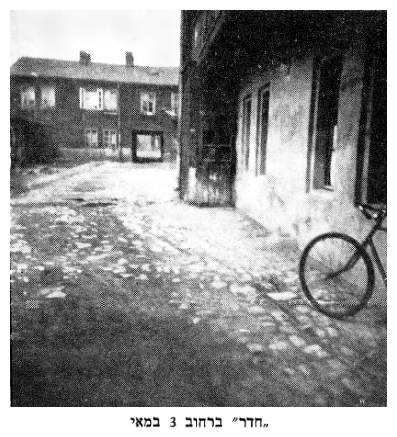
(Memories of the Cheder – religious elementary school)
by Pinchas Lustiger
Translated by Dr. David Dubin
They called him the “modern teacher”. He would always be scrubbed & immaculately clean, and his outer appearance was beautiful. When he walked in the street he garnered everyone's attention. They regarded him with awe and pointed their fingers: Motel-Melamed is walking! “Ahh, Motel-Melamed! He is the finest teacher in town. My son also learns from him” everyone would say proudly.
Motel would stride at his own pace with contentment and ease, and his steps were measured. He wore eyeglasses, and his dark beard was always combed and well-groomed. Graying hair added to attractiveness and an air of levelheadedness and grace. He wore a long black coat (“capote”) and carried an umbrella in his hand, wore shiny & sharp boots, and he walked proudly without facing right or left, but rather looking straight ahead. A sense of mystery whirled about this man, constitutionally quiet and introverted, constantly ruminating and conversing very little with other people. Nevertheless, everyone honored and exalted him, because Motel-Melamed was utterly dedicated to a vital mission: to spread Torah amongst his students.
Motel was different from all the teachers in town, both in appearance and in
his teaching method. I inquired and investigated his exact origins and place of
birth and where else his teaching methods are used, but no one knew the
answers. The method was his, and only his. To this day, when one of his
students is called to Maftir (for a section of Torah reading), and he recites
the blessings using the tune of Motel-Melamed, everyone's mouth utters:
“where is that from? What type of Hassid are you?” Indeed, he had
amazing tunes for Shir Hashirim (The Song of Songs), for Akdamut and for the
poetry within it that were specific to him and only him.
[Page 101]
The students, and especially the clowns among them, would regale with their
fanciful stories of how they would “take care” of their teachers: One
told of how he glued his teacher's beard to his desk as he nodded off, and when
he awoke he raised the desk with himself; a second related that he tied his
teacher's leg to his desk so that when he rose to discipline a student he
dragged the desk along with him; a third told how he fastened nails into the
chair, so that when the teacher sat he jumped up as if possessed.
Such talks were never told about Motel-Melamed, as he was always treated with manners and respectful awe. No student was ever disrespectful or would raise his voice to him. Motel knew to show a student such as this the strength of his arm, he never spared a wayward student the rod, and he multiplied the lashes in order to enforce the lesson.
I can pull from my memory images of the Cheder. As if from the darkness the cheder appears before my eyes in its glory & beauty, but also with its shortcomings. A large, dark room full of dust & grime, the majority filled with benches, crowded with children of all ages, jabbering in their high voices. Always chaos, noise and tumult. Though beyond the benches arose the pleasant voices of some students learning, most of the students stood in one corner of the room, conducting their business, engaged in games, gossiping about this and that.
How we envied – on our way to cheder – the gentile students, who were well-groomed, wearing lovely uniforms, and on their shoulders book bags full of textbooks and writing implements. And how beautiful were their school buildings! Housed in fine structures with high windows, letting in much light, and inside, everything clean and polished, the walls adorned with pictures and maps and large blackboards.
This was the teaching method in cheder: On Sunday we began learning the weekly Torah portion. The students sat crowded and cramped on the benches, at their head standing a small desk next to which sat Motel-Melamed. Motel would read a verse from the Bible, translating each word into Yiddish, and afterwards, everyone in the class: “and he said – hot gezogt”, “God – Got” “To Moses – tsu Moishe”, etc.
Wednesday would be testing day for the outstanding students; on that day the students would arrange themselves in a line around the desk, the first would recite the verse with its Yiddish translation followed by each student reciting the same verse. If a student failed – Motel would punish him to the utmost allowable, with the punishment commensurate with the severity of the error. Motel took account of small errors as well as severe ones, with small errors punishable by a “gemkele” (a blow on the chin), a gross error by twisting the ear and a severe error by a slap with a ruler.
A great and decisive issue among the students involved the problem of who would be first in line? If the first knew, the second would hear the answers from him, the third heard from the two before him, etc. If the first did not know, he would be punished, and the second would then have to review the verse, and if the second did not know, he would be punished and the third would be required to review the same verse. If the first did not know, it often led to all the students being punished, so usually an older, outstanding student who knew the Bible well would lead the line. Motel-Melamed never interfered and didn't determine the order of the line; this was an internal affair amongst the students.
When fateful Wednesday arrived, the students would arise early, rushing to cheder as the anxiety would roil their hearts, and loudly negotiate among them: who would go first, then second, etc.
One of the outstanding students was Jehoszua Majdman “Bobbe”. Why Jehoszua “Bobbe”? Because of his long, round nose with a central prominence. This Jehoszua Bobbe, he was the great hope of all the students: if he would stand first in line – all expected to escape harsh punishment, if he refused – a bitter day was expected – receiving the statutory beating.
Jehoszua well knew his position, thus he became haughty, lording it over the other students, teasing, annoying and vexing them. He was usually asked to be first in line, but he did not quickly agree, because despite being an excellent student he was destined to absorb several decent blows of the hand, and only after begging, pleading and cajoling, and after receiving many gifts did he agree.
When the time of the exam arrived Motel-Melamed sat by his desk in all his glory and gave three raps on the desk.
Trembling passed through the students, and they began to run about and spin around as if possessed. The top five approached the desk with knees trembling, shaking from anxiety, arranged themselves around the desk with Jehoszua Bobbe at their head. Jehoszua was a tall young man with a pale, freckly face, his eyes darting here and there uncomfortably and fearfully. He stood stooped, his head bent and his eyes fixed inside the Bible.
Silence pervaded the room, the slightest rustling wasn't heard, a feeling of
pressure reigned and everyone faced the elite quintet. These were the brave
ones marching first into the line of fire.
[Page 102]
Suddenly, a shaky and choked voice broke the silence: “These are the
generations of Noah…”, and afterwards the second and third down to
the end of the row.
The first verse went by quietly, but when he got to the second verse, Jehoszua failed; he began to mumble and to guess and finally didn't know. Motel raised the ruler, and Jehoszua raised his trembling arm near his chest, raising and lowering, raising and lowering, this time Motel-Melamed missed his mark, and the ruler shattered on the desk.
The students did not hide their joy, assuming that today there would be no punishing blows, but Motel-Melamed did not agree. He bent over, dug around, searched and found: from his boot he retrieved a shiny, new ruler and waved it in the air to the consternation and heartbreak of the students. Motel knew his ruler was defective, and he prepared a spare in reserve. “Cats such as you are,” he stormed, “what, did you think today would pass without discipline? That's why I planned a day ahead!” With that statement he took Jehoszua's hand in his fingertips, raised it slightly and applied the requisite blow. Jehoszua shook his hand as if to shake off the blow, blew into his hand to cool it slightly, rubbed his hand on his back and then took his aching hand in his other hand and continued. This time he completed the verse gracefully. Just a “gemkele” (a blow on the chin), and two ear twists.
When the blows came aplenty, Jehoszua would alternate offering his right and left hands. Sometimes he got confused, offered his right hand, remembered that he was mistaken, but before he could retract it a mighty blow would fall on his right hand.
After the examination the students would congregate in a corner of the room to lick their wounds. Those who had been hit would stretch out their hands to display them; they were red as fire. Everyone jostled to see Jehoszua's palms, felt his skin, tried to grasp it, but could not, because the skin on the palms of his hand was hard as the sole of a shoe from the blows.
Despite all this, none of the elite five ever thought to abdicate his place by the desk during the exam, for it brought them honor and increased their esteem. Only Jehoszua hinted that he would not stay at the head of the line, and this left a sad feeling in the students' hearts.
Then out fear was realized the next Wednesday, early morning as the students assembled to choose their places in line, Jehoszua announced sharply, “I won't be first anymore.” These bad tidings struck the students with shock, and when they recovered, they tried to speak to him entreatingly, smoothly, offering many gifts, but to no avail, as Jehoszua remained steadfast in his bitterness. “I will not be your perpetual sacrifice!” he announced emotionally. “Each of you should take turns at being first in line, then you will each feel the bitter taste. I renounce all your gifts, and even if you fill this room with gold, I will not go first this time!”
All the entreaties and answers were for naught, Jehoszua stating: “Justice! Where is the justice and integrity?! Will I always take your blows for you in return for a bowl of lentils? I demand justice!”
Even the harshest of the students could not withstand the bywords of justice and integrity. The concepts of justice and integrity were well inculcated into the students, as hadn't they always recited: “Justice, justice shalt thou pursue,” yet we could not arrive at consensus about who would head up the line, everyone being evasive, so it was decided to draw lots.
Let's go, take a handkerchief, tie a knot, and whoever loosened the knot would go first. The fateful knot was loosened by Jankele Grobajzen. The students greeted him with a joyful reception, grabbed his shoulders, raised him up and wished him success.
This would be Jankele Grobajzen's first time at the head of the examination line. Jankele Grobajzen was a boy of short stature, with a sweet face, and known as a good boy who did well, even excelled in his studies. He wore a cloak which buttoned up to his neck, his fringed garment covering his cloak, with the fringes hanging outside his trousers, overlapping his belt.
When the three raps announcing the examination were heard, confusion arose amongst the students, fear and terror overcame them, and with failing feet they approached the desk. This time the quintet arranged itself as follows: Jankele first, Pincus second, Jehoszua Bobbe third,etc. All the students felt and prayed in their hearts that Jankele would pass his first baptism by fire in peace.
And in fact, at first it went smoothly, Jankele recited verse after verse in his soft, mellow voice smoothly and confidently, translating correctly without a single error.
But suddenly an obstacle appeared, and the wagon stopped rolling as if stuck in mud. Jankele tried valiantly, groaned – and it was futile.
Motel-Melamed raised the ruler, aiming to land the blow, the room was ruled by
bitter, oppressive silence which weighs on the soul, only the sound of the
flies' buzzing was audible.
[Page 103]
I stole a moment when Motel was chasing away a fly from his face, I whispered
to Jankele, and it was as if the wagon got out of the mud and began to move.
The students took a deep breath as if a heavy weight had been lifted from their
hearts.
But Motel-Melamed was not oblivious to the goings-on, and two echoing claps of the hand broke the silence. “Cat that you are” he thundered at me, “when your turn comes 'tsum oys'zugen (to be tested)', you stand there like a stick, like a robot, not knowing what to say, but you know how to whisper?” Motel really went out of his mind, his anger not abating until he added a twist on the ear. Not just a twist, but a real twist that he turned the ear around three times forcefully, and as a finale he grabbed my chin and shoved it hard, he raised my head and didn't let go until he said in a melodious tune: “Thus will be done to the student who whispers to his fellow during a test!” and Motel-Melamed's rage abated only when he said that God does not forgive a sin like this.
I buried my eyes in the Bible out of shame, and my head was reeling. Suddenly the letters began to move, wiggle and dance a wild, demonic dance.
From that time onward, it was as if the heavenly spirit had abandoned Jankele, as he repeatedly made gross, severe mistakes, and the blows multiplied mercilessly and ceaselessly, Motel-Melamed seeming vicariously to want to force the Torah into our heads through the force of his arm.
Each time, poor Jankele offered his hand with resignation, not batting an eyelash, his expression not changing nor moving, only from his big, blue eyes his tears flowed in thousands of streams, pouring all along his rosy cheeks, dripping onto the Bible, wetting the holy letters.
Indeed, it was a “black day” for the students, remembered in infamy, all because of rebellious Jehoszua, but the evil did not pass over Jehoszua, who also absorbed his fair share of blows.
After the test, as was their wont, the students repaired to the corner of the room with bowed heads, ashamed of their failure, beaten and injured in mind and body, Everyone's attention was drawn this time to Jankele, all gathering around him, wanting to view the palm of his hand, to rub it and feel the skin. No one paid attention to Jehoszua or his palm.
Jehoszua stood alone. Perhaps he felt a pang of guilt over the suffering he inflicted on his friend, and perhaps he felt proud of having the strength to inflict such aggravation.
The students, whose only desire was to exact revenge on Jehoszua and to
irritate him, did all they could to instill jealousy in him. They lavished many
compliments on Jankele, flattered and praised him for his bravery, for his
strong and proud appearance – he didn't fear to put out his hand as did
Jehoszua – gave him sweets and many gifts, caressed and comforted him.
This was a small recompense for Jankele for all he withstood during the
examination, a small smile appeared on his noble face, and his moist eyes
gleamed and expressed great satisfaction.
A Winter Day in Cheder
In those times, the cheder day was traditionally a long one, the students
– who were free from their studies – played in the courtyard, but in
the winter they were imprisoned all day long in the cheder.
When evening approached, the students waited impatiently and longingly for the teacher to go to the afternoon and evening service, and when the awaited time arrived, there was no end to their happiness, as their souls were redeemed, and they ran wild and misbehaved to the point of insanity.
Occasionally the students would sit in a circle on the floor and tell scary stories. By the light of the kerosene lamp which threw a weak light, the students sat huddled and crowded and listened to exciting tales; about famous thieves who distributed their plunder among the poor, about valiant robbers, chased by the police in the streets of the city as they escaped over the rooftops and jumped from roof to roof, with the pursuers unable to catch them. They told about demons and spirits and in contrast, about God astride the lowest heaven and His head reaching the seventh heaven, all comprised of great flames, surrounded by flying angels, seraphs awaiting his decrees, millions of souls arriving unceasingly, with God sending some to paradise and some to hell. And hell is so terrifying, where the sinners are roasted and singed seven times a day. And they told a fearsome and bloodcurdling tale about a Jew who passed a synagogue at night, and the dead called him in to read the Torah, and the next day he was found dead of fright.
All these stories left an indelible impression on the students.
The time came to go home, the preparations began, first they prepared the lanterns; some lit their lanterns with kerosene, some with a candle, taking a potato, creating a hole and placing the candle inside.
When the lanterns were lit, they began to dress, putting warm coats over their
warm jackets, tying scarves that their good mothers knitted around their necks.
They were covered from the soles of their feet to their heads, they put
earmuffs on their ears and woolen knit gloves on their hands, their hats were
lowered until only a thin slit remained for the eyes, the children looking like
balls of wool. Before setting out everyone exhaled to test the cold. Indeed a
“cold worthy of dogs” reigned outside.
[Page 104]
Outside they were greeted by a snowstorm whistling from every direction,
snowflakes hitting their faces, a strong wing stifling their breathing, which
constantly forced them to turn around and stop walking.
Darkness covered the road. Deep darkness. Only a thick coat of snow stuck out of the dark, and the road was empty of people.
The students walked wrapped in their coats, wrapped and invisible, only the light of their lanterns was seen gleaming and moving in every direction like small stars. When the snow crunched under their boots, the students walked wracked with fear, every shadow appearing as a terrifying and fearsome demon, and every noise was suspected to be the sound of a giant.
The fear was greatest among those students who had to pass the synagogue. They were afraid they would be called there to read from the Torah. But against this they had a proven remedy: When they reached the synagogue they unfurled their ritual fringes, held them in their hands plodding along the distance crying before them: “”Hear O Israel, Hear O Israel!” And behold a miracle!: The incantation worked and never did a student, passing the synagogue at night, get called to read the Torah. Pronouncing the incantation “Hear O Israel” always saved them from all trouble, shielded and guarded against all from all danger and all evils, from the living and the dead.
That evening returned home with tidings for mother: Today I began to learn Gemara (Talmud). Immediately a shower of raisins and almonds rained on my head, a charm for luck and blessings for acquiring Torah and wisdom, and afterwards my mother lay her joyous hand upon my head, caressed me softly and said: “good, good, my son, be entrenched and engrossed in Torah and become wise!”
The high price I paid for Torah I hid from my mother, the tears had already dried long before, palms red as fire, with skin calloused hard as the sole of a shoe from the multitude of blows, and the burning ears I never revealed to mother.
And despite all that no one was dearer to me than Motel-Melamed! All these
blows left me with no scars, yet the Torah that he entrenched within me plowed
a deep furrow in my memory. “A Childhood lesson is not forgotten.”
Until this day I hum for my own enjoyment his amazing melodies.
[Page 105]
Kalman Barkai
Translated by Jerrold Landau
I recall only two details from the time of the First World War. When I was a young child, they woke us in the middle of the night so that we could prepare water and bread. Another time, I had to stand in line all night for bread. In the morning, some Polish lad came and said that I was not standing in line at all, and to my dismay, I did not obtain the bread.
|
|
Reb Motel would choose several students at the end of the week, I among them, and invite them to come on the Sabbath before the rabbi of our city to recite what we had learned through the week. The rabbi paid attention to us, and was full of astonishment at what he was hearing. He was very happy, and caressed every student on the cheek. The next day, he gave over full praise to Reb Motel over his students. Reb Motel was then in seventh heaven from great emotion.
Many students studied with Reb Motel. We sat on long benches, and he sat opposite us on a high place next to the table, and looked at us from afar. It was completely quiet in the cheder. We were not allowed to say anything more than was necessary for the study of Torah.
During Sabbath afternoons in the summer, we had to go to the cheder to study Pirkei Avot. So as to inspire our interest, Reb Motel would tell us stories on the great people of Torah, such as the Baal Shem Tov. He told us about the Land of Israel, “a land flowing with milk and honey.” He also said that the number of seeds in a pomegranate are exactly the number of the 613 commandments.
Reb Motel Wajnreich was an exemplary prayer leader, shofar blower, and Torah reader. I studied with him in cheder until I got older and began to search for a purpose in life. I studied sewing, which was considered a distinguished trade at that time.
Indeed, the childhood years of cheder study have passed and have been forgotten. However, I will never forget Reb Motel. I recall when
[Page 106]
I would meet him on the road on occasion, I would stand with bated breath out of great respect for him. I was deeply influenced by him, and to this day, I have not forgotten anything that I have learned with him. When I was already in the Land, news reached me that Reb Motel had been a teacher in the Mizrachi School, but one morning when he was walking to school, he fell to the ground in the middle of the street opposite the synagogue, and returned his pure soul to his Maker.
May his memory be blessed! We students will never forget him.
The Mikveh (Ritual Bath)
There were three mikvehs in Dąbrowa. One was on Majeska Street (later they called the street Szapena. The second was in Dambenik at Sziwek's, but that was outside the city. The third was in Reden. Most people went to Reb Zisha Luksenburg of blessed memory on Szapena Street. He was a tall Jew with strong muscles and a long beard. His wife was called Leicha by everyone. She was a healthy woman with energy. The couple lived at the edge of the city next to the fields for many years, and the mikveh was next to their house. Reb Zisha was not careful about ensuring that the mikveh waters were clean, and the sanitary conditions were dismal. He put chlorine into the water twice a year, in honor of Passover and Rosh Hashanah. This was all he did for cleanliness.
I recall that when I was a child, my father would take me to immerse in mikveh every Friday. This continued until I was 15, for I was not required to pay until then. When I got older, I already went myself and paid the entrance fee. Reb Zisha himself stood at the door and received the money from those who came. For the payment, everyone was allowed to also come there on the Sabbath morning. Reb Zushe would stand next to the entrance on the Sabbath as well, and he would remember exactly who had been there on Friday and paid the entrance fee. If he noticed someone whom he had not seen previously, he would not allow him to enter.
Jews from all strata of our city met at the mikveh. What did they not talk about there? They discussed politics, business matters, the synagogue, institutions, also about those wo evaded giving charity. In short – one found out about everything in the mikveh.
Reb Zishe also had his own house of worship, a sort of shtibel. He was also a prayer leader. People would come to him with questions of disputes, arbitration, and advice, since he was a wise Torah scholar. However, he did not like to get involved with issues of marriage matches or disputes between man and wife. To such he would always respond: “Certainly not.” Reb Zishe was also a charitable man, who loved to help his fellow with a benevolent loan.
Reb Zishe was not fluent in the Polish language. Thieves came to him one evening and demanded money. Reb Zishe did not think too much, and fled through the window shouting “gevald.” However, a thief also stood outside, and gave him a blow on the head with an iron rod. Reb Zishe did not pay attention to the blow. He ran ahead shouting, and his wife Leicha was also shouting behind him. The thieves became afraid and fled. Reb Zishe ran to the police on the Third of May Street. There, the captain and duty officer Bialer from old Dąbrowa met him and asked, “Mr. Luksenburg, what happened?” He raised his eyes and said in Polish: “They killed two Jews.” “Where? Asked the captain. Reb Zishe answered, “I am one and the second is about to arrive.” At that moment, his wife ran in. Reb Zishe pointed to her and said, “Here is the second Jew!” The captain had no choice but to bandage his wounds, and sent them both home accompanied by a policeman. The house was surrounded by curious people waiting to hear what had happened.
That is how they were both saved from certain death by the thieves, for they did not give over their money easily. Reb Zishe was not a coward. He was always a physically healthy man, with a strong spirit. He lived for many years. As I heard, when I was already in the Land, both died at a ripe old age, both close to 100.
[Page 107]
by Mordechai Gotlib
Translated by Dr. Hannah Berliner Fischthal
During a Shabbat walk on a side street in “Reden” in Dąbrowa, taken with my friends Mindsza Nusbaum and Dawid Każuch, of blessed memory, we overheard Gemara chants.
Do Jews who sit and learn in the middle of the day live in that house? “In this house is found,” said Dawid, of blessed memory, “the study house of our Jewish colony.” Corrections immediately followed. Actually, the study house was not built for the sake of study, but it was the remnant of an inheritance from the settlement there, which had its own minyan. Later it became a study house which is used up to the present day. I think of a synagogue as serving approximately 200 Jewish families, and I cannot believe my eyes. Is it possible that a community of Jews would not consider building a decent synagogue? It's simply shameful. “You came a little late,” the sexton of the study house explained. “Today there is, at least, a floor in the study house. There used to be times,” he said, “when the audience would be bathing in sand and dust during prayer; and it was also good…” – “In that case, you deserve congratulations for your efforts to insure that the enthusiasts would not jump up for 'kadosh' out of the mud… But tell me, please, why are the walls in the study house so black?” – “Our leaders,” explained the sexton, “are very nearsighted, and they probably don't see the black walls and the ripped ceiling… And furthermore, let's assume that they do see the blackness, so what should they do about it? You know that painting the study house would cost about 30 gulden?”
We did not answer the sexton on that argument. I remembered the words of the Będzin Rabbi Graubart, may his memory be blessed, when he once entered such a study house, and he screamed out:
“How full of awe is this place!”
[Page 108]
by Kalman Barkai
Translated by Avi (Abram) Stavsky
What happened was thus: A Dąbrowa Jew by the name of Awremele Berman, had
a marriageable daughter named Fajgl, who unfortunately lacked a dowry. Reb
Awremele was quite concerned and explored [many] ways to ensure a groom for his
daughter.
|
|
| One of the first graves in the new cemetery in Dąbrowa
(the headstone of Joszua Swiczarczyk z”l) |
After this disturbing problem had been settled, the Va'ad of the Kehila sought in earnest to erect a [Jewish] cemetery. They held an emergency meeting and invited prominent citizens, [political] party members and the rabbi at its head, and resolved to tackle the problem immediately. A Jewish public activist purchased a parcel of land in Dąbrowa's Old Quarter from a gentile under the pretext that he wanted to build a brick-making factory. [Were it not for this ruse], the non-Jew would never have sold the lot. To prevent the previous owner from wanting to cancel the deal and keep the land, it was sold again and re-sold once more finally to a fourth buyer, after which a fence was erected around the property. Once the land began to be used as a cemetery, the non-Jews shouted complaints at the original seller, who in turn said he had sold it with the provision it would be the site of a brick factory, and called for legal prosecution of the Jewish buyer. This was to no avail, as the law stipulated that if the [parcel of] land was now owned by a fourth owner, the original owner had no further legal claim [i.e., the land was no longer his]. Thus ended the problem of a Jewish cemetery in Dąbrowa.
Here I want to add several stories my father attributed to Awremele Berman, of
blessed memory. He was a wealthy Jew, the owner of a small house on Polno
Street, with a brush-making factory.
[Page 109]
He also had a large land parcel upon which rested the home of Reb Josele Fasko,
one of the principal builders of the main synagogue in town.
When Reb Awremele Berman lacked for funds, he sold space to Reb Josele with a stipulation in the contract that he allow a stand to be erected in the rear for the sale of brushes. They came to this agreement, however it transpired that Reb Josele Fasko began to dig foundations for a building. Reb Awremele decided to set up his stand and table for selling brushes right in the middle of the excavation work. Of course this led to confrontation, whereupon Reb Josele said this was NOT the area agreed upon for the brush sales. To which Reb Awremele replied, “since the precise area is not mentioned in our contract, I have the right to set up wherever I want.” The police intervened and halted all activity pending a judicial outcome. The [resulting] judgment ruled in favor of Reb Awremele and awarded him damages, following which the latter vanished from the scene. Reb Josele Fasko built a large house with a store in back and he had many Jewish neighbors.
I remember another story attributed to Reb Awremele Berman: he was a short man
with a small beard and in his speech affected a pronounced “resh” [r
sound]. He had been a member of the Dąbrowa Town Council even before there
was a Jewish Communal Center, inasmuch as he was one of the first Jews to live
in the city. Once they were all assembled at the home of Sziewicz, who was
called “Rebele”, for the purpose of deciding the outcome of something
important to the city. However the assembled spoke on different topics, each of
which was vital to that person alone, and the proceedings dragged on. Reb
Awremele became furious and went outside to the house of a neighbor called
Plachta, who was a wagoner. He took from him a handful of straw and returned
with it to the meeting. He then threw it on the table and said: “please
eat the straw, as you are not worth more than this!” All the assembled
[thus] got the hint, became insulted and immediately left the room without any
decision having been reached on an important issue.
[Page 110]
by Avraham-Abba Moszenberg (Haifa)
(In memory of my parents of blessed memory)
Translated by Jerrold Landau
My mother, Yehudit-Lea, was the daughter of Reb Avraham-Abba Liber of blessed memory, who died in Dąbrowa at the end of the First World War.
We were two children at home: my sister Ita (Jadza), three years younger than me, and I. In the summer of 1934, when my sister was five years old, she was overcome by strong pains in her abdomen during a children's game in the yard of our house. My mother hurried to the yard, took the girl by her hand, and brought her in the house. My sister could not lie in her bed due to the strong pains, and my parents took turns holding her.
The doctor hurried to our house, gave her some medicine, and did not determine the reason for the pains. During two days of indescribable pain of the girl, and after the visit of three local doctors, Dr. Lipsky, the surgeon of the local hospital, was summoned. He determined that the girl was suffering from appendicitis that should have been operated on at the beginning of the attack. The girl was brought to the hospital and operated on immediately.
After a 15-day hospital stay, the girl returned home in a worrisome situation. A male nurse came from the hospital for eight months to change the bandage of the wound, which did not heal due to an internal infection. There were no signs of improvement. She had strong pains with every light moment, and had to lie down motionless. The doctors did not know what to do to help. A known expert, Professor Wanikowski was summoned, I believe from Sosnowiec. After her examined the girl, he determined that if there is any small shadow of hope to save her life, she must be operated upon once again immediately.
When my mother heard the prognosis of the doctor, she said that she would not permit the girl to be operated upon without consulting with the Rebbe. The doctor was surprised at her words, and said that he was prepared to remain in our house for a response.
My mother immediately traveled to the Kromołów Rebbe, who lived in Zawiercie, Rabbi Nachum HaKohen Rabinowicz, may the memory of the holy be blessed. The Rebbe was updated on the girl's situation and forbade the operation. He added the name Chai to her name, and said that the girl would recover with the help of G-d.
When my mother returned, encouraged by the words of the renowned Rebbe, she told the doctor (who waited several hours in our house for the answer) that the Rebbe does not permit the operation, and that the girl will recover without an operation, with the help of G-d. The doctor was astonished and said that my parents are taking the life of the girl onto their own conscience. My mother answered calmly that she trusts G-d and the Rebbe's word.
To our great wonder, an improvement was noticed the next day already. It was not long before the girl could get out of her bed. She began to walk, and completely regained her strength and health.
This became a topic of conversation in our area, both among the doctors and among our Christian neighbors.
My parents and sister perished in the Holocaust. May G-d avenge their blood.
|
JewishGen, Inc. makes no representations regarding the accuracy of
the translation. The reader may wish to refer to the original material
for verification.
JewishGen is not responsible for inaccuracies or omissions in the original work and cannot rewrite or edit the text to correct inaccuracies and/or omissions.
Our mission is to produce a translation of the original work and we cannot verify the accuracy of statements or alter facts cited.
 Dabrowa Górnicza, Poland
 Yizkor Book Project
 JewishGen Home Page
Copyright © 1999-2024 by JewishGen, Inc.
Updated 20 May 2018 by OR
![dab087.jpg [39 KB] - A group of young men in Agudat Israel](images/dab087.jpg)
![dab089.jpg [35 KB] - "Szoszana Class", Dabrowa 5695 (1935)](images/dab089.jpg)
![dab108.jpg [40 KB] - One of the first graves in the new cemetery in Dąbrowa](images/dab108.jpg)