 |
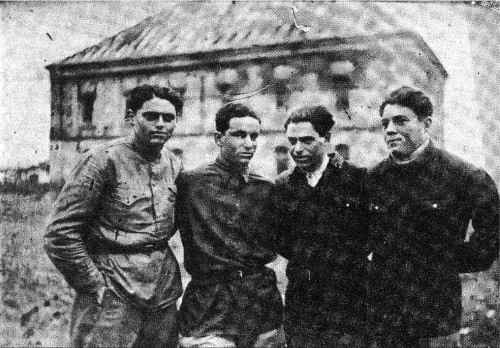
The photo was taken in 1945 by some young men who returned to town.
From left to right: Yonah Shkolnik - died in Israel; Yaakov Salomon; Moshe (son of Mechel Toker) Fundik - died in Czernowitz in 1962; Hirsh Tendrich (the “red”) in Czernowitz.
|
|
|
|
The photo was taken in 1945 by some young men who returned to town. From left to right: Yonah Shkolnik - died in Israel; Yaakov Salomon; Moshe (son of Mechel Toker) Fundik - died in Czernowitz in 1962; Hirsh Tendrich (the “red”) in Czernowitz. |
by Mordechai Reicher
Translated from Hebrew by Yariv Timna and Asher Szmulewicz
|
Up until today, it is hard for me to understand why they placed the main and the largest synagogue of our town in the most desolated place among the poor and wretched allies. How come it was decided that such a main building for all the town's residents would be placed in that corner? Perhaps in the old days was here the town center?
Big, was the house. High. Rising towards the sky, looking proudly over the lower buildings neighboring it: those walking below it looked like little creatures. Its architectural plans were like the “temples” of larger cities. |
[Page 354]
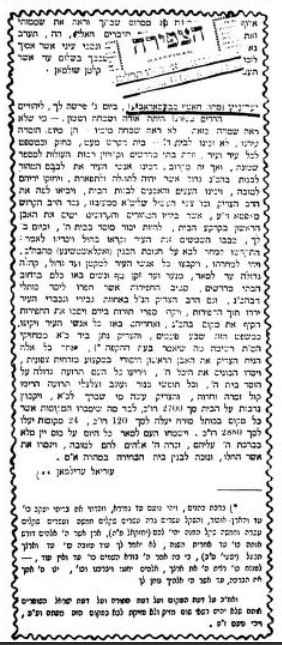
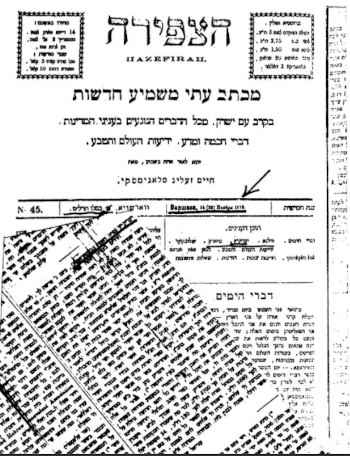
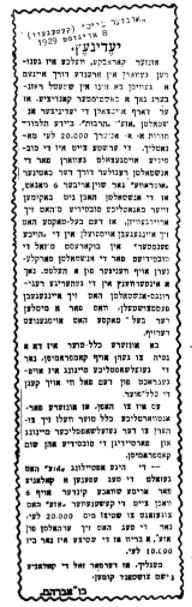
And so, it stood the high building proudly for many years. Stone walls were sturdy without plaster, and the torn big windows elongated and rounded up, it had vaulted dome ceilings embedded with colored glass that when the sunlight fell on it the lights were changing in colors inside the house and covered the people inside it. The building was erected in the early 1880s and the full details of the cornerstone laying were described in the newspaper “Hatzefirah” (Warsaw) on the 1st of Kislev 5639, November 14, 1878 (according to the old Russian calendar). We include here the article in facsimile.
|
|
| The newspaper “Hatzefirah” (Warsaw) dated Aleph Kislev 5639, November 14, 1878 |
| Yedinitz (Hotin District, Bessarabia)
On Tuesday, Parashat “Lech,” the Jews in our town were delighted. Whoever did not see such a joy has never seen joy in his life. Our town has never had a synagogue, all we had were “batei midrash,” eight in all. And now, our good city members opened their hearts to build a great synagogue for glory, brought wood and stones for it, and brought Rabbi Tzvi Heshil Shalit, a rabbi from Mezhbizh, the grandson of the holy Rabbi of Apta, who put the first cornerstone for the new house, and on the second “Lech,” the gabbaim (collectors) walked around town declaring to get ready for the house's inauguration! The next day all the town, men, women, and children gathered to see the digging of the first ditches for the house's walls. The Rabbi and the dignitaries, followed by the others, walked seven times around the pit of the house to be built. After that, the Tzadik put the first chiseled stone at the North-East corner, and the house was based. Everyone cheered, people played and sang music, 2,700 Rubles were collected from the people apart from the 24 seats on the eastern corner, which were sold for 120 Rubles each, amounting to a total of 2,880 Rubles. Everyone was pleased and drank wine all day, thanking God for his blessing.
Signed: Azriel Eidelman |
[Page 356]
It took years to construct this building, including long pauses in between. The scaffolding in and out of the building stood while the birds built their nests in the holes of the walls and ceiling, their tweeting mixing with the worshipers during morning prayers.
Even so, it did not disturb the house which was the center of the town's Jewish life. If there was a “call for an assembly” everybody knew, every man and woman, from old to young, that the meeting place was the Great Synagogue (“the shil”). Days of remembrance for the great men and educators, Remembrance Day of a national historic event, and all events, sad and happy ones, occurred in this place.
The “furniture” in this building, if we can call it furniture, was very simple. I have often asked myself, where did they find these long benches at the side of the walls and the simple “stands,” nobles, to feel sorry for, mostly broken, which had never seen a coat of color since their existence on earth?
The townspeople loved and respected the Great Synagogue. People liked to come in, to be together, imbued with a common feeling, and anxious about the event to happen when they gathered. Even for the regular day meetings, people looked forward to coming to the Great Synagogue.
20 Tamuz. Late afternoon hours. The shops closed earlier, the craftsmen left their work, and everybody flowed “zu der groyser shil” (to the Great Synagogue) to mark the beginning of the Yizkor of the leader of the nation. The house was full from corner to corner. People listened to speeches about Herzl's life and work achievements, and when the cantor Zalman Leib sang with a melancholic voice “the soul of our leader Doctor Binyamin Zeev Herzl who has gone to his supernal world,” everyone felt the hum of a soul hovering in the house, a sign of the sincere feelings of the people for the great leader and the common sensitivity that beats in their hearts.
Commemoration: 21st of Tamuz 5694 (1934). The news that “Bialik died” spread in town like an electrical shock. The same evening, without any prior notice, the shops closed, the workers stopped their work, adults, the youth, and school students flocked to the synagogue to come together to remember the great national poet whose poems were studied and were an integral part of their Jewish spiritual life.
The house was full from corner to corner. Late afternoon hours. Getting dark. Silence all around. The teachers Hillel Dobrow, Baruch Yaschikman, and the writer of these words, slowly climbing on the stairs before the Holy Ark mentioned the noble presence of the great poet (Chaim Nachman Bialik). They talked about his spiritual and rich legacy to our generation, and when parts of his songs “On the Slaughter,” “In the City of Slaughter,” and “My Late Mother” were read, many were weeping with tears.
We went out. The house emptied. Silver moon and starry night above. People went home carrying with them some of the poet's spirit, which gave them the strength to carry on with their life's hardships.
[Page 357]
As was told by Holocaust survivors visiting the town after the war, the Soviets got a hold of the synagogue, turning it into an agriculture machinery factory, the largest of its kind in Northern Bessarabia.
|
|
| The newspaper HaTzfira with an article from November 14 (26), 1878 about the construction of the Yedinitz synagogue. |
Translator's footnote:
from אי כסלו תרלייט/ November 14 (26), 1878
about the establishment of the Yedinitz synagogue
by Azriel Eidelman
Translated from the Yiddish by Asher Szmulewicz
Yedinitz (Hotin region, Bessarabia)
On Tuesday, Parashat Lech, there was a great joy for the Jews living in our shtetl. Those who did not see this rejoicing never saw a real joy, because since the establishment of the shtetl we did not have a synagogue, a small sanctuary, as in all other cities. There were eight houses of study and small prayer houses in town. Lately, the citizens prepared their hearts to build a great synagogue, a splendid and glorious one. They opened their hands to this good deed and prepared timber and stones to build the house. They brought from far away the righteous Rabbi Tzvi Heshel Shalit” a[1] from Mezbizh, the grandson of the holy Rabbi from Apt (may his memory protect us), to lay the first stone of the house with his safe and holy hands to be the foundation of G-d's house. Already on Monday, Torah portion Lech Lecha, the sextons walked in town and shouted: “Prepare yourself for tomorrow, come to the inauguration of the synagogue building.”
And so, the next day, all the people in town gathered, from children to adults, a large congregation from young to old people with women and children. Everybody came to the street of the houses of study around the pit that was dug to hold the foundations of the synagogue walls. The righteous above mentioned were in between the rich and important persons from town. They all went down to the pit; they took the Torah scrolls in their hands and surrounded the synagogue location with all the people in town, turning seven times around the place where the synagogue would be erected. The righteous gave a sheet of paper to all the Torah scroll bearers for them to say the according prayers while turning, then, the righteous laid the foundation stone on the northeastern corner.
[Page 360]
“And the builders laid the foundations of the House of G-d.”[2] The assembly celebrated the event. All the violin musicians and musicians of other instruments played joyfully holy songs. The Righteous blessed the assembly and collected donations for the amount of 2,700 rubles for the building of the house. This was in addition to the selling of the spots on the eastern wall that everybody was buying at the cost of 120 rubles each. The 24 spots would bring another 2,800 rubles. The people rejoiced the whole day with a glass of wine; May the Blessing of G-d be upon them. They thanked The Master of the Universe to allow them to finish what they started and soon to merit building the synagogue, amen
(May very fast the temple be built during our time, amen.)
Azriel Eidelman
Asher Goldenberg wrote interesting details about Azriel Eidelman, z”l, in his Hebrew article. Ten years after the publishing of the correspondence in “HaTzefira,” he emigrated to Israel. He was then 26 years old and was the first one from Yedinitz to go on the so-called “First Aliyah.” Two years later he came back to Yedinitz, but his parents and his sister later settled down in Israel.
Azriel leased and cultivated fields. As he used to sin a little bit with his pen in Hebrew or Yiddish, he used to visit Warsaw and was a frequent visitor at the home of the writer Yaacov Dinezon, a bachelor like him. He was also a friend of Yehuda Steinberg and carried his poems to Warsaw. Then he wandered around the world, visited Israel many times, and settled there in the 1930s. He passed away at an old age home in Tel Aviv, at almost 90 years old.
Translator's footnotes:
[Page 362]
Comment: We purposely used the word “Shil” and not “Shul” in the article because this is how the synagogue was called in the shtetl. All the other smaller synagogues were called “Kloyzen” (in the local dialect “kloz”). The word Beit-Midrash was seldom used. When people spoke about the “Shil,” it meant what other people called the great synagogue or the central synagogue. The average people did not say “Great Shil.” By the way, in the Yiddish literature or newspapers, a synagogue was often printed as “Shil,” with a yod, in order to differentiate from the word “Shul” with a melupem (diacritic of the letter “vav”) which represented the concept of school. A few used the word “Shule” when meaning school.[Page 363]
By Mordechai Reicher
Translated from the Hebrew by Ala Gamulka
| Every synagogue in town had its own particular congregation, the greater part of which belonged to a specific professional group and/or social class. For example, at the Sextons (Shamashim Kloiz) synagogue, the members were mostly butchers and leather merchants. At the Tailors (Schneider Kloiz) synagogue, the members were mainly tailors; at the Hosiatin synagogue, they were store owners, the rabbi, rabbinical court judge, and other scholars and intellectuals. At Shaarei Zion and Tarbut the members were progressives, followers of the Enlightenment and Zionists, and similarly for the rest. |
The Kinska synagogue was located between the market on top of the hill, and beyond it was the tall Christian Church on the west and the Tailors Street to the north. It was an old building, built with mud bricks and straw. Its floor was wooden and had many depressions and cracks because of old age. On the walls and the ceiling, there were paintings of flowers, fruits, birds, and other fowl, the names of the 12 signs of the zodiac and the ten tribes. An artist drew them. Electric lamps hung from the ceiling and spread light in the middle of the building, especially on Shabbat and holidays.
A few stone steps led to an entrance hall in the building. Its walls were made of wood and had cracks and depressions in them. There was no ceiling, and it was an ideal location for birds' nests. The birds flew at leisure and visited the inside of the synagogue, and nothing stopped them.
The praying members came mainly from the low middle class. The minority were grocers and small businesspeople. All were honored with seats on the eastern wall, and each had his own specific place and lectern. The majority were craftsmen, tailors, carpenters, etc. They sat on long benches, with designated seats and compartments for storing their prayer articles.
On weekdays, ten to twenty men came for morning, afternoon, and evening prayers. On Shabbat, the synagogue was fuller. Noah Sandlar was the main gabbai. He was a tall Jew, nice looking, with a long red beard. He was a shoemaker, and he had a shoemaking workshop, one of the best in town. He, himself, did not work. Is this how his surname came to be? It is difficult to know. He was not a scholar, but he was intelligent and was known to be adept at handling matters with the authorities.
Suddenly appeared Shalom Parikmacher (Barber). He was the owner of a barbershop.
[Page 364]
Our theater actors obtained beards and wigs for plays from him. He was said not to be an opponent of liquor. He was rumored to have been involved in unsavory deals, and that is why he was close to the authorities. This Shalom was tall, skinny, and had a pronounced Adam's Apple in his long neck. When he spoke or prayed, his voice could be heard from one end of the synagogue to the other. He was comfortable in the synagogue and walked around like an owner. He fulfilled many tasks during prayer sessions. For many years, he used to stand near the open ark on the eve of Simchat Torah and assign honors during the Hakafot. In addition, he always ascended the tiny Bima on Rosh Hashanah and Yom Kippur in the center of the building, rapped on the table, and called out in a loud voice:
“Ladies,” adding names of the specific prayers such as “Le'El Orech Din” or “Nesane Tokef”
Immediately, the participants were fearful, and the women immediately began to cry…
The synagogue was fortunate to have an excellent cantor, one of the best in town. He was Levi Valevitch. Levi had a pleasant and sweet voice, full of emotion. On the High Holidays, when he chanted Hineni or “Do not forsake us in our old age” or Yizkor, many congregants had tears in their eyes.
These plain Jews were good people. They were dedicated and true to their congregation, to its problems, its poverty, and its needs. They were also loyal to the redemption of Eretz Israel and were always prepared to help. No wonder then, that on the eve of Yom Kippur, there were various “bowls” placed on long tables. There were collections for charity, for poor brides, the Talmud Torah school, the Jewish National Fund, Tarbut, etc. The congregants put their contributions into boxes and bowls. Some gave more than others according to their means. No one refused to give.
They loved to listen to the speeches of the emissaries of the Jewish National Fund, Keren Hayesod, or other organizations tied to Eretz Israel.
I recall that in those days, I was mostly away from home. It was well-known that I was knowledgeable about and connected to matters pertaining to Eretz Israel. When I came home during the holidays, I went to synagogue with my late father. I was always asked to relate news of Eretz Israel. I could never refuse.
It was during the 1929 clashes, and in the Diaspora, there was a special fundraising event for the Jewish National Fund under the name “The Galilee.”
[Page 365]
I came to the synagogue, and I was asked to speak. I went up on the tiny Bima. The prayers stopped. It was complete silence. I told them about the clashes, the victims in Jaffa, the settlements in distress, the redemption of the Galilee, and the founding of (Kibbutz) Hanita. I told them that among the founders of Hanita there were five members from our town. They were Yitzhak, son of Moshe Shteinburtz, the appointed rabbi, and Pinchas, Buma, and Rachel, children of Kalman Meidelman. One could feel the awe that enveloped the listeners, and one could feel their heartbeats.
Unfortunately, these good Jews did not feel that the Holocaust was approaching and that a terrible fate awaited them.
[Page 366]
May these lines serve as memorial candles to this poor congregation on their day of remembrance.
Where did the name Kinska originate?
It was said that once, in the place where the synagogue was located, there stood a horse stable that belonged to a wealthy man. The Jews bought the stable, razed it, and built a synagogue in its place. The word “Kini” in Ukrainian means horses, and that is why the synagogue was given the name Kinska, the synagogue of the horses, i.e., in the place where once there were horses.
[Page 365]
by Moshe Furman
Translated from the Yiddish by Ala Gamulka
| As far as I know, the first small synagogue in Yedinitz was the Old Synagogue. I heard it was founded after the 1850s, or even earlier. |
The praying members belonged to all layers of society. The elder Gabbai in the synagogue, that I remember, was Alter Tchernolipker, z”l. He was strict, but a respectable man and a good person. He used to share the places and distribute the Torah honors and the Hakafot on Simchat Torah. He always recognized the importance and the standing of the people involved. No one remembers any dispute in the synagogue. The first cantor that I remember was named Shmuel-Yosef. He was a tenor. His son, Avraham Tzurlik, helped him on Yom Kippur during the Musaf.
The Great Synagogue was erected at the end of the 1870s. It was followed by the Stepaner synagogue, the Hosiatiner Synagogue, the Zalman's Synagogue, and the Tchortkover Synagogue. In 1906, the Zionists founded their Shaarei Zion synagogue together with a Talmud Torah.
After the death of Gabbai Alter, my grandfather, Mordechai-Nissan, z”l, became the Gabbai.
[Page 366]
He was followed by Avraham Harlap, z”l, and Zvi Grobman, z”l. In the last years before the war, the Gabbai was Yitzhak, son of Reuven-Yosef Schwartz.
After Shmuel-Yosef, the cantor in the synagogue was Moshe Oziser. His unique occupation was making honey. Other cantors in the synagogue were Baruch Saltzman and Moshe-Ber Hahamovitch. The latter's rendition of “Ledavid Mizmor” always drew the crowd.
The synagogue was financed by “bowl” donations on the eve of Yom Kippur. The Gabbai and some leaders stood by the bowl on that evening. At the end of Yom Kippur, they divided the money among the morning and afternoon cantors. They did not forget the Shofar blower and the sexton. The Shofar blower, all his life, was Yonah, the ritual slaughterer, z”l. The Torah reader, all his life, was Shmulikel Dayan. His son, Baruchel Dayan, assisted him in the readings. The Shofar blower then was Meir-Ber, son of Baruch-Zalman. The sexton was also Nahum-Zalman. He was followed by his son- Shmuel-Leib, z”l.
The Russians came into town in 1940 and changed the synagogue into a meat warehouse. They did the same with all our other synagogues, including the Great Synagogue as they usually did everywhere.
Holon
by Moshe Furman
Translated from the Yiddish by Ala Gamulka
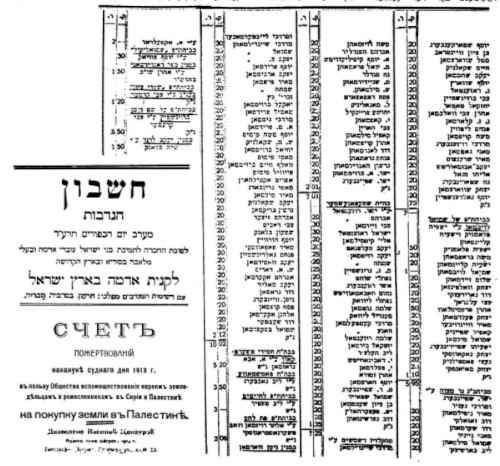
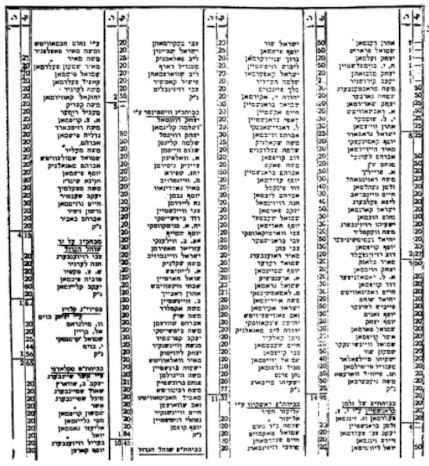
We bring to you here a copy of a special document about the Jewish community of Yedinitz. The document was found in the bequest of Baruch Blank, z”l. (He made Aliyah in 1931 and died in Tel Aviv in 1945). It was given to us by Dr. Elimelech Blank, son of Baruch Blank. The name of the document is: “Donations made on the eve of Yom Kippur 1913 for the purchase of lands in Eretz Israel.” The document had been published in a brochure of a Zionist Center (probably Jewish National Fund) in Odessa. These donations were collected in the “bowls” placed in various synagogues on the eve of Yom Kippur in all the settlements of southern Tsarist Russia: Kherson, Bessarabia, and Tovaria. The document contains the names of most of the donors according to the synagogues where the “bowls” had been placed.
Afterward, we were left with a list of close to 360 heads of families who attended synagogues in Yedinitz. The list contains names of well-known members of the Jewish community and its leaders. Unfortunately, those who gave the report cut the list by listing “Small donations” and “Various donations” without including the names.
In total, 131.51 rubles were donated then in Yedinitz. (At that time, Baruch Blank oversaw the Jewish National Fund). The amount collected was quite respectable. It was larger than the one collected in larger towns.
[Page 369]
An interesting fact: in Shaarei Zion, the donations were also collected in the women's section; in the Yaakov Lerner Minyan, near one of the bowls, Sarah (wife of Baruch Blank) sat, probably in the women's section.
Many names were misspelled, e.g., A.L. Yamelnitser (Yogolnitser, teacher, and poet), Varman (Weisman), Veisminer synagogue (Hosiatiner), etc.
The synagogues in the accounting can be found in the list of synagogues in Yedinitz (in Yiddish).
| Yaakov Lerner Synagogue
Collected by Baruch Blank |
||||
| Rubles | Kopecs | |||
| Yaakov Lerner | 1 | |||
| Baruch Lerner | 1 | |||
| Leibush Lerner | 1 | |||
| Avraham Lerner | 1 | |||
| Baruch Blank | 1 | |||
| Nuta Morgenstern | 1 | |||
| I.Sh. Rozentalier | 50 | |||
| Leib Fichman | 50 | |||
| Zeev Soninshtein | 25 | |||
| A. Tsonastrovsky | 50 | |||
| Alter Roitman | 25 | |||
| Small donations | 25 | |||
| Total | 8 | 25 | ||
| Old Synagogue
Collected by A. Levitas |
||||
| Rubles | Kopecs | |||
| Meir Boim | 50 | |||
| Zvi Zilberman | 50 | |||
| Zvi Fichman | 20 | |||
| Avraham Levits | 23 | |||
| Israel Fichman | 20 | |||
| Avraham Levitis | 20 | |||
| Yechiel Kleinman | 20 | |||
| Pinchas Foks | 20 | |||
| Yosef Finebaum | 20 | |||
| Yaakov Rabin | 20 | |||
| Meir Finebaum | 20 | |||
| Meir Helfand | 20 | |||
| A. Gandilman | 20 | |||
| Small donations | 2 | 27 | ||
| Total | 5 | 50 | ||
| Collected by Pinchas Heilperin | ||||
| Rubles | Kopecs | |||
| Pinchas Halperin | 20 | |||
| Shlomo Halperin | 20 | |||
| A. Halperin | 20 | |||
| Shabtai Rotman | 20 | |||
| Aharon Vineshenker | 20 | |||
| Yosef Ginsberg | 20 | |||
| Nuta Shor | 20 | |||
| Lippe Shor | 20 | |||
| Betzalel Grinshpan | 20 | |||
| Israel Elkir | 20 | |||
| Yosef Fishman | 20 | |||
| Yaakov Roizinblat | 20 | |||
| Pinchas Roizinblat | 20 | |||
| Dov Berl Rabin | 20 | |||
| Yosef Shpeyer | 20 | |||
| Berel Rabinovitch | 20 | |||
| Shlomo Vetmir | 20 | |||
| Motel Kertzman | 20 | |||
| Yosef Rabinovitch | 20 | |||
| Zeev Kalibalsky | 20 | |||
| Total | 4 | 0 | ||
| In Shaarei Zion Synagogue
Collected by Ben Zion Veiman |
||||
| Rubles | Kopecs | |||
| Ben Zion Veiman | 50 | |||
| Aharon Denman | 50 | |||
| Shmuel Pradis | 50 | |||
| Yitzhak Zelman | 20 | |||
| Kh. I. Boimelshteyn | 50 | |||
| Yitzhak Melvzon | 20 | |||
| Yaakov Kirshner | 20 | |||
| Moshe Trachtenberg | 30 | |||
| Simcha Garber | 20 | |||
| Yitzhak Shadirman | 20 | |||
| A. Rabinovitch | 20 | |||
| I.L. Shuster | 30 | |||
| Aharon Weitzman | 30 | |||
| Israel Grabard | 25 | |||
| Yosef Kamenetzky | 20 | |||
| Meir Heidelman | 30 | |||
| Avraham Lerner | 20 | |||
| Pinchas Shatz | 20 | |||
| A. Freilich | 50 | |||
| Moshe Rosenthal | 30 | |||
| Zalman Gelman | 40 | |||
| Haim Weintraub | 30 | |||
| Lipa Felberg | 40 | |||
| Israel Kargman | 50 | |||
| Nahum Hochman | 30 | |||
| Yeshayahu Rosenberg | 30 | |||
| Moshe Weksler | 20 | |||
| Yechiel Nemitshinitser | 50 | |||
| Yosef Koifman | 30 | |||
| Dov Rosenfeld | 20 | |||
| Meir Blank | 20 | |||
| Yitzhak Hoichman | 20 | |||
| A.L. Yamelnitser | 20 | |||
| David Koifman | 30 | |||
| Haim Rabinovitch | 30 | |||
| Yechiel Shochat | 20 | |||
| Feibish Lerner | 50 | |||
| Yosef Zanis | 30 | |||
| Yosef Yitzhak | 20 | |||
| Shmuel Forman | 30 | |||
| Asher Koifman | 25 | |||
| Shmuel Vineshenker | 20 | |||
| Shimon Shor | 50 | |||
| Yeshayahu Meilfaler | 40 | |||
| Sendel Teitelman | 20 | |||
| Tn. Feivel Vareta | 50 | |||
| Moshe Gicherman | 50 | |||
| Small donation | 25 | |||
| Total | 14 | 95 | ||
| In the synagogue of Zalman Bronstein
Collected by I.Ts. Feldman and V. Zingman |
||||
| Rubles | Kopecs | |||
| Zalman Bronstein | 20 | |||
| Yaakov Zvi Feldman | 20 | |||
| Veide Zingman | 20 | |||
| Yoel Liverman | 20 | |||
| Israel Shor | 20 | |||
| Yosef Fishman | 25 | |||
| Baruch Schneiderman | 20 | |||
| Leibush Rothstein | 20 | |||
| Israel Kuperman | 20 | |||
| Shlomo Heller | 20 | |||
| Melech Finebaum | 20 | |||
| Yehuda L. Akerman | 20 | |||
| Shmuel Bronstein | 30 | |||
| Haim Ekshteyn | 20 | |||
| Moti Bronstein | 20 | |||
| L. Randishansky | 20 | |||
| Avraham Roitman | 30 | |||
| Moshe Shkolnik | 25 | |||
| Shlomo Feldboim | 20 | |||
| Dov Koifman | 20 | |||
| Moshe Foks | 20 | |||
| Avraham Bronstein | 50 | |||
| Yosef Edelman | 20 | |||
| David Finkel | 20 | |||
| Avraham Libman | 20 | |||
| Hune Rosenthal | 20 | |||
| Yaakov Forman | 20 | |||
| Shmuel Schechter | 20 | |||
| Yosef Harriman | 20 | |||
| Zvi Vartikovsky | 20 | |||
| Zvi Branishter | 20 | |||
| Zvi Cohen | 20 | |||
| Meir Rosenberg | 20 | |||
| Shmuel Reder | 20 | |||
| Yosef Shteinman | 20 | |||
| A. Arenvitsik | 20 | |||
| Shmuel Groman | 20 | |||
| M. Lamatchinsky | 20 | |||
| Moshe Eidelman | 20 | |||
| Israel Akerman | 20 | |||
| Zeev Povitchevitch\ | 20 | |||
| Yehoshua Pinkovsky | 20 | |||
| Yehuda Leib Sagalnik | 20 | |||
| Nissan Kolker | 20 | |||
| Haim Schechtman | 20 | |||
| Zvi Koifman | 20 | |||
| Shmuel Weismann | 20 | |||
| Michel Glezman | 20 | |||
| Natan Parnas | 20 | |||
| Yeshayahu Teiberg | 20 | |||
| Small donations | 1 | |||
| Total | 11 | 37 | ||
| In the Roshkov synagogue Collected by Eliezer Hasid |
||||
| Rubles | Kopecs | |||
| Eliezer Hasid | 20 | |||
| Shlomo, son of Nahum | 20 | |||
| Shmuel Buxbaum | 20 | |||
| Haim Feldman | 20 | |||
| Mordechai Rosenberg | 20 | |||
| Zvi Bekerman | 20 | |||
| Israel Shteinin | 20 | |||
| Leib Palavnik | 25 | |||
| Mendel Dorf | 20 | |||
| Leib Schwartzman | 20 | |||
| Feivel Katshir | 20 | |||
| Zvi Rosenblit | 20 | |||
| Small donations | 2 | 55 | ||
| Total | 5 | 0 | ||
| In the Veisminer synagogue
Collected by Yitzhak Rosenthal and Shlomo Kligman |
||||
| Rubles | Kopecs | |||
| Yitzhak Rosenthal | 50 | |||
| Shlomo Kligman | 50 | |||
| Shalom Weisman | 20 | |||
| A. Wolfensohn | 20 | |||
| Tsalik Nimirman | 20 | |||
| Yehuda Shapiro | 20 | |||
| M. Weintraub | 20 | |||
| Meir Goldinov | 20 | |||
| Yosef Gechman | 20 | |||
| Noah Leiderman | 20 | |||
| Zvi Weinstein | 20 | |||
| David Bimsheisky | 20 | |||
| Yeh. A. Snitkovsky | 20 | |||
| Yosef Shteif | 20 | |||
| At. B. Vilenky | 20 | |||
| Azriel Hapirman | 20 | |||
| Israel Weintraub | 20 | |||
| Moshe Shkolnik | 20 | |||
| A. Leivitch | 20 | |||
| Shoel Harmein | 20 | |||
| Shabtai Veinevitch | 20 | |||
| Aharon Rabeich | 20 | |||
| B. Weinstein | 20 | |||
| Moshe Axelrod | 20 | |||
| Moshe Shits | 20 | |||
| Avraham Schwartzman | 20 | |||
| Moshe Bitsheisky | 20 | |||
| Yaakov Kuperschmid | 20 | |||
| Moshe Vineshenker | 20 | |||
| Yitzhak Livisuk | 20 | |||
| Meir Volevitch | 20 | |||
| Yeshaya Bernstein | 70 | |||
| Moshe Heindelman | 20 | |||
| Pinhas Bronstein | 21 | |||
| Moshe Rabinovitch | 20 | |||
| Machel Havisovitch | 20 | |||
| Zeev Schwartzman | 20 | |||
| Haim Vineshenker | 20 | |||
| Naftali Rotershteyn | 20 | |||
| Small donations | 1 | 84 | ||
| Total | 10 | 45 | ||
| In the Great Synagogue
Collected by Nahum Hahamovitch and Moshe Meir Sakalenir? |
||||
| Rubles | Kopecs | |||
| Moshe Meir Sakalenir | 25 | |||
| Meir Shimon Feldman | 30 | |||
| Shmuel Fishman | 20 | |||
| Koppel Feldman | 20 | |||
| Moshe Lerner | 20 | |||
| Yekhezkel Kovirman | 20 | |||
| Moshe Kerik | 20 | |||
| Machel Ritter | 20 | |||
| A.Ts. Koifman | 20 | |||
| Moshe Roitbard | 20 | |||
| Gedaliah Fishman | 20 | |||
| Avraham Fishman | 20 | |||
| Moshe Melir | 20 | |||
| Shmuel Shmulevitch | 20 | |||
| Avraham Sagalnik | 20 | |||
| Yosef Fishman | 20 | |||
| Hanina Shindir | 20 | |||
| Moshe Stelmich | 20 | |||
| Yaakov Schechter | 20 | |||
| Haim Grossman | 30 | |||
| Gershon Vitsir | 20 | |||
| Avraham Babir | 20 | |||
| Small Donations | 20 | |||
| Total | 4 | 85 | ||
| Synagogue near the Great Synagogue | ||||
| Rubles | Kopecs | |||
| Zvi Rosenberg | 20 | |||
| Hannah (Hune) Lerner | 20 | |||
| Sh. Ts. Sapir | 20 | |||
| Tuvia Fichman | 20 | |||
| Yaakov Kleinman | 60 | |||
| Small Donations | 20 | |||
| Total | 1 | 60 | ||
| In Sidig shul
Collected by Yitzhak Boim |
||||
| Rubles | Kopecs | |||
| V. Milgram | 20 | |||
| Al. Brein | 20 | |||
| Shmuel Kramansky | 25 | |||
| I. Boim | 44 | |||
| Small Donations | 1 | 56 | ||
| Total | 2 | 65 | ||
| In the Skladny (market) synagogue
Collected by Asher Sheinberg |
||||
| Rubles | Kopecs | |||
| Yaakov B. Schwartz | 20 | |||
| Shaul Steinberg | 20 | |||
| Michel Steinberg | 20 | |||
| Asher Steinberg | 20 | |||
| Shimshon Koifman | 20 | |||
| Zusi Gleizman | 20 | |||
| Eliezer Gatman | 20 | |||
| Yoel Gatman | 20 | |||
| Berel Rosenberg | 20 | |||
| Yosef Karen | 20 | |||
| Yosef Shtarkenberg | 20 | |||
| Ben Zion Weintraub | 20 | |||
| Motel Schwartzman | 20 | |||
| Haim Shkolnik | 20 | |||
| Yaakov Schechtman | 20 | |||
| Yosef Schwartz | 20 | |||
| N. Rosenthal | 20 | |||
| Zvi Bronstein | 20 | |||
| Yekhezkel Tatar | 20 | |||
| Aharon Zvi Valchman | 20 | |||
| N.Z. Klarman | 20 | |||
| Pinhas Litwin | 20 | |||
| Moshe Koifman | 20 | |||
| Mordechai Rosenberg | 20 | |||
| Mani Gapman | 20 | |||
| Meir Shrentsus | 25 | |||
| Yaakov Abramovitch | 20 | |||
| Eliyahu Segal | 20 | |||
| Noah Shternberg | 20 | |||
| Yitzhak Schwartzman | 20 | |||
| Yosef Goldenshteyn | 20 | |||
| Small donations | 75 | |||
| Total | 7 | 00 | ||
| In the House of Prayer of Shmuel Loibman
Collected by Yeshaya Plotnick and Yeshaya Kleinman |
||||
| Rubles | Kopecs | |||
| Yeshaya Plotnick | 50 | |||
| Moshe Brafman | 20 | |||
| Yeshaya Kleinman | 20 | |||
| Shmuel Loibman | 1 | 0 | ||
| Shalom Zaidman | 20 | |||
| Yitzhak Wolfensohn | 20 | |||
| David Goridetsky | 20 | |||
| Zvi Elbrach | 20 | |||
| Aharon Promislow | 50 | |||
| Yitzhak Feldman | 20 | |||
| Meir Winerober | 20 | |||
| Koppel Shteinik | 20 | |||
| Shmuel Millman | 25 | |||
| Yeshayahu Shternberg | 20 | |||
| Yitzhak Nokovsky | 20 | |||
| Getsi Postilnik | 20 | |||
| Yitzhak Mayansky | 20 | |||
| Small Donations | 1 | 10 | ||
| Total | 5 | 95 | ||
| From Ner Mitzvah synagogue
Collected by Isr. Steinberg and Mordechai Genir |
||||
| Rubles | Kopecs | |||
| Meir Gitelman | 20 | |||
| Dov Vovolki | 20 | |||
| David Sherman | 20 | |||
| Mani Genir | 20 | |||
| Shmuel Millman | 20 | |||
| Leib Barshefsky | 20 | |||
| Moshe Roitman | 20 | |||
| Avraham Handler | 20 | |||
| A. Yosef Kisilevitch | 20 | |||
| M. Yoel Frohman | 20 | |||
| Noah Sandlar | 20 | |||
| M. Schneiderman | 20 | |||
| Sh. Millman | 20 | |||
| Pessach Rapaport | 20 | |||
| L. Magalnik | 20 | |||
| Yehoshua Frenkel | 20 | |||
| I. Kofman | 20 | |||
| Zvi Harin | 20 | |||
| Koppel Millman | 20 | |||
| Aharon Koifman | 20 | |||
| David Landman | 20 | |||
| Pinchas Grossman | 20 | |||
| Gershon Handelman | 20 | |||
| Isr. A. Broitman | 20 | |||
| Isr. Steinberg | 20 | |||
| Small Donations | 2 | 01 | ||
| Total | 7 | 01 | ||
| The Stepanester synagogue
Collected by Isr. Rosenthal |
||||
| Rubles | Kopecs | |||
| Avraham Rosenthal | 20 | |||
| Zvi Zaidman | 30 | |||
| Israel Rosenthal | 30 | |||
| Eliyahu Castleman | 20 | |||
| Yaakov Helfant | 20 | |||
| Yaakov Roitman | 25 | |||
| Simcha Roitman | 20 | |||
| M.V. Grinstein | 25 | |||
| Naftali Shochat | 20 | |||
| Asher Rosenberg | 20 | |||
| Nahum Chachamovitch | 20 | |||
| Naftali Livak | 20 | |||
| Shlomo Gutman | 20 | |||
| Mendel Livak | 20 | |||
| Mordechai Castleman | 20 | |||
| Hune Castleman | 20 | |||
| Shlomo Rosenthal | 20 | |||
| Yekhezkel Birman | 20 | |||
| Leib Heltser | 20 | |||
| I. Rabinovitch | 20 | |||
| I. Feldman | 20 | |||
| Aharon Zamora | 20 | |||
| Yosef Hertzman | 20 | |||
| M.D. Steinberg | 20 | |||
| Shmuel Shpeyer | 20 | |||
| Ben Zion Schechtman | 20 | |||
| Isr. Feferholtz | 20 | |||
| David Gershinzon | 20 | |||
| Small Donations | 1 | 35 | ||
| Total | 7 | 25 | ||
| From the Sextons synagogue Collected by Mordechai Sheindelman and Mordechai Leichtermacher |
||||
| Rubles | Kopecs | |||
| Mordechai Sheindelman | 30 | |||
| Shmuel Sheindelman | 20 | |||
| Yaakov Ts. Sheindelman | 20 | |||
| Yosef Friedman | 20 | |||
| Yaakov Arbitman | 20 | |||
| Meir Fishman | 20 | |||
| Simcha Fishman | 20 | |||
| Zacharia Katz | 20 | |||
| Yankel Broitman | 20 | |||
| Michel Friedman | 20 | |||
| Mordechai Gitman | 20 | |||
| A.M. Friedman | 20 | |||
| Yosef Moshe Simis | 20 | |||
| Sh.M. Shkolnik | 20 | |||
| Yechiel Broitman | 20 | |||
| Moti Simis | 20 | |||
| Wolf Haim Broitman | 20 | |||
| Feivel Simis | 20 | |||
| Efraim Akselhorn | 20 | |||
| Moti Grinberg | 20 | |||
| Meir Millman | 20 | |||
| Yaakov Shkolnik | 20 | |||
| Gershon Brickman | 20 | |||
| Avraham Zitser | 20 | |||
| Zvi Dobis | 20 | |||
| Shimon Blank | 20 | |||
| Yosef Horovitz | 20 | |||
| Meir Popovsky | 20 | |||
| Pinhas Goldenshteyn | 20 | |||
| Yaakov Wasserman | 20 | |||
| Sh.A. Doris | 20 | |||
| Avraham Akerman | 20 | |||
| Yaakov Malir | 20 | |||
| David Grauman | 20 | |||
| Nissan Weinberg | 20 | |||
| Pessach Kofman | 20 | |||
| Elchanan Akerman | 20 | |||
| David Schechter | 20 | |||
| Shmuel Bekerman | 20 | |||
| Small donations | 2 | 12 | ||
| Total | 10 | 02 | ||
| From the Tchortkover Hassidim synagogue
Collected by A. Abba Grauman |
||||
| Rubles | Kopecs | |||
| Various donations | 5 | 20 | ||
| From the Patishtove synagogue
Collected by Leib Gochberg |
||||
| Rubles | Kopecs | |||
| Various donations | 3 | 50 | ||
| From the Tailors synagogue
Collected by Leib Sapir |
||||
| Rubles | Kopecs | |||
| Various donations | 3 | 00 | ||
| From Pat Lechem House of Prayer
Collected by Alter Roizman and Zeev Tchernostravsky |
||||
| Rubles | Kopecs | |||
| Various donations | 2 | 06 | ||
| From the Nissan Varman Minyan
Collected by A. Axelrod |
||||
| Rubles | Kopecs | |||
| Various donations | 2 | 00 | ||
| In Shmuelikel’s House of Prayer
Collected by Yosef Zweik |
||||
| Rubles | Kopecs | |||
| Various donations | 30 | |||
| In the minyan of Dondivshony village
Collected by Aharon the ritual Slaughterer |
||||
| Rubles | Kopecs | |||
| Various donations | 1 | 50 | ||
| From Shaarei Zion House of Prayer (Zvi Kremer) | ||||
| Rubles | Kopecs | |||
| Small Donations | 1 | 20 | ||
| From the Nissan Bronstein House of Worship
Collected by Zvi Kremer |
||||
| Rubles | Kopecs | |||
| Small donations | 5 | 50 | ||
| From the Yaakov Lerner Minyan
Collected by Shaya Blank |
||||
| Rubles | Kopecs | |||
| Various donations | 1 | 50 | ||
We are presenting here a photocopy of a unique document of information about the Jews of Yedinitz in 1913.
[Translation above]
|
|
List of donors from Kherson, Bessarabia, Tovaria |
by Moshe Furman
Translated from the Yiddish by Ala Gamulka
| Yeshayahu Vinitsky, in his survey Cantorial Art in Bessarabia (in the book “The Jews of Bessarabia” from the series “Encyclopedia of the Diaspora,” Jerusalem, 1971), presents an entire group of cantors born in Yedinitz or those who served there and who became famous out of town. |
*Yosef Shternberg (Yossele from Karpatch), born in Karpatch in 1884. He was a student of Piny Minkovsky, from Odessa, and was a cantor in Yedinitz for a long time. He has been in America since 1923. The writer Moshe Altman (from Lipcany) describes him in his novel.
* Nissan Weisman He was the son of Yosef-Zeev Weisman (nicknamed the old whistler) from Hotin. Father and son were wealthy on their own, and music was their hobby. They did not earn their living from it. Nissan Weisman used his house for cantorial concerts, which were well known.
* Avraham-Leib Weisman He was also a ritual slaughterer. He was famous as a prayer leader in Yedinitz at the beginning of the previous century.
* Yaakov-Yosef Gershteyn (1874-1942). He was the son of Yonah Shoichet (ritual slaughterer) from Yedinitz. After Yonah's death, he moved to Yedinitz. He was a cantor and a ritual slaughterer there and was murdered in Transnistria.
* Baruch-Zeev Zaltsman (1866-1939). He was nicknamed Baruch, belonging to Velvel Getzel.
[Page 372]
Born in Yedinitz, he was a famous leader of the Musaf prayers in the Old Synagogue, where Yonah Shoichet did the morning prayers. He died in Yedinitz.
* Reuven Weisman (1877-1917). He was a grandson of the ritual slaughterer Avraham-Leib Weisman. He was the cantor at the Stepanester Synagogue and died during the plague of 1917 (probably the “cufflinks”).
* Dov Einis, nicknamed Berele, the ritual slaughterer. His father was well known as a cantor in Kamenetz-Podolsk. He was also a ritual slaughterer in Yedinitz.
* Efraim, son of Dov He was nicknamed “Froike the pleasant singer.” In Yedinitz he was a poet, a concert singer, and a teacher of singing. His family immigrated to America, and Froike became a well-known cantor there.
* Shlomo Akerman He was born in 1902 in Yedinitz and became an outstanding cantor at the age of 13. He immigrated to America as a young boy and there he studied music and cantorial chanting. He became a famous cantor.
This is an opportunity to mention a young man from our town, Naftali (Tuli) Lenkovsky. He made Aliyah from Russia in 1971. Tuli survived Transnistria and studied music in the Red Army. He then studied in the Moscow Yeshiva. He became a well-known cantor. He led services in Leningrad and spent some years in Georgia. He came to Israel from there. Recently, he was hired for two years as the cantor in the American city of Columbus, Ohio.
[Page 373]
by Yosef Magen-Shitz
Translated from Yiddish by Ala Gamulka
According to town lore, the first synagogue in Yedinitz was the Old Synagogue (see the article by M. Furman). The most important synagogue was “The Shul” or “The Great Synagogue,” as it was so called in Hebrew, our sacred language. It was founded in 1878 (see the article by M. Reicher and the report by Azriel Eidelman in “Hatsfira”).
According to the report by Azriel Eidelman in “Hatsfira” (1878), there were at that time eight houses of worship. He refers to them as Houses of Learning and synagogues, which add up to eight.
A second testimonial about the synagogues of Yedinitz is given to us by a document from 1913,[a] which was found in the private archive of the veteran businessman from Yedinitz, Baruch Blank, z”l. (He made Aliyah in 1932 and died in Tel Aviv in 1945). It was given to us by his son, Dr. Elimelech Blank. It was the “Report on Contributions from Yom Kippur Eve 1913… for purchasing land in Eretz Israel.” This report was published by the Odessa Zionist Center. It contains the lists of the donors from every town, by synagogue. Bowls were placed for the purpose of collecting funds for the purchase of land in Eretz Israel. We received a list of all the synagogues in Yedinitz in 1913. There were 20 in all.
[Page 374]
Missing from the list is the Vayaner Synagogue.
Haim Horovitz indicates that the Vayaner Synagogue was founded after 1913 by Jews who had formerly prayed in the Old Synagogue. This is also shown in the “List of Pledges.” There were two collection bowls in the Old Synagogue.
It is recalled that eventually there was also a Minyan in the Tarbut Library. It was only used on Shabbat and Holy days.
Original footnote:
by Mordechai Reicher
Translated from the Hebrew by Naomi Gal
|
|
When R' Shmuel, nicknamed R' Shmilkel, passed away and his son R' Brouchel inherited his place, the village leaders debated: should they let R' Brouchel despite his young age continue his late father's legacy and serve as a Rabbi and Dayan, or, since the village grew bigger and more prominent with time and there were more multifaceted problems, maybe it would be better to bring to the village a new Rabbi and Dayan who would be more suitable to its new size.
The argument between both sides, to bring or not to bring a new rabbi to the village, was not an easy nor comfortable one and became sometimes quite volatile. Finally, those who wanted a new Rabbi won and by the majority vote for becoming one of the messengers from the village as representatives to travel to Falesti, Bessarabia, to invite the Rabbi Gaon Yechiel Michel Burstein and his wife to his new nomination in Yedinitz in the summer of 1920, was Avraham Weissman.
Haim Horovitz tells this interesting detail, heard from people who knew about the discussion between the two opposing sides, for and against a new Rabbi, that one of the fierce opponents to the new Rabbi was R' Yaakov Kozlover (Darf). R' Yaakov was a respectful, patriarchal-looking Jew, with a long white beard, always dressed to the nines, befitting to a yeshiva scholar. And indeed, he was educated and brilliant; he was also strict hence he did not hesitate to disqualify the skills of the new intended Rabbi.
While the argument lasted, the village was chaotic. Friends turned to be a nemesis. Neighbors who were living amicably all their lives quarreled. In the synagogues, they argued for and against until midnight. The artisans and the butchers shook their fists and announced that they would boycott the new rabbi and would not acknowledge him.
[Page 376]
When the rabbi finally arrived, he went on his first Saturday to pray in the synagogue of the Husiatyn Hassidic Dynasty and, of course, all the village's “who and who” were among the congregating. R' Yaakov Darf was present, too. The rabbi climbed the podium and preached about current affairs. R' Yaakov listened carefully, all stressed out, and when the speech was over, he got up and said only one word: “AHHH!” and left the synagogue. This one and only syllable coming from R' Yaakov's mouth was enough to disqualify the new rabbi. And although the rabbi got his tenure, people still spoke about this syllable for many years. Despite his serving as the rabbi, Yaakov Darf never accepted him and stayed loyal to R' Brouchel, who inherited the qualities and qualifications of his righteous father.
The legacy of R' Shmulikel the Dayan was divided between the two: R' Yechiel Michel would serve as a rabbi and the presiding chief dayan for the Yedinitz community and its surroundings, while R' Brouchel the Dayan would inherit his father's officiation.
The pedigree of the new rabbi was quite impressive. He was a descendant of a rabbinical family as was his wife, who granted more respect and security to his elevated position.
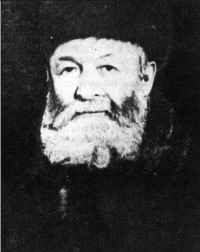
Rabbi Burstein was born in 1872. On his father's side, he was the grandson of the late righteous Gaon Rabbi Yosef, and on his mother's side, he was the grandson of the late Gaon Leibush from Stanislav, the uncle of Meir Margaliot, who wrote “Meir Netivim.”
[Page 377]
He got his teaching certificate from Rabbi Alter from Old Constantin and many other distinguished rabbis. In 1895, he was nominated as the Rabbi of Falesti. His wife was the granddaughter of the late Rabbi Dov Ber, the Maggid from Mezeritch, and the family of Rabbi Nahum from Chernobyl.[a]
The rabbi's appearance was impressive, befitted to a man carrying the Torah crown. He was wise, had good common sense, was upright, and good-looking. He showed a lot of wisdom in arbitration and money matters and hence, was very popular amid his community and in the near and far surroundings.
His house on the village main street, the Post Street, was wide open to whoever needed God's word or the rabbi's help. Non-Jews would seek his advice, too, since he was known as a wise and personable man.
He set his place in the synagogue, not a simple feat for a rabbi, among the Husiatyn and Chortkov, where he belonged, as well.
He was best at teaching and was an expert on divorce Halachic law. To this fact, the Gaon from Brejin testified in his book “Questions and Answers.” Rabbi Burstein himself left a book titled “The Shiloh Water” about divorce Halacha.
He excelled also in speaking. He had a witty and captivating scholarly language. No wonder that when it was announced that the rabbi was going to give a speech about actual events at the synagogue, something he did not do often, many flocked to hear his words, and between them, were many not synagogue regulars including some who were even non-religious.
Rabbi Michel Burstein had an only son, Rabbi Dov, a brilliant Torah scholar who was the Chief Rabbi of Boto?ani in Romania. He used to often visit his parents and his visits became a special event among the village inhabitants, especially amid the Torah scholars and the learned.
|
|
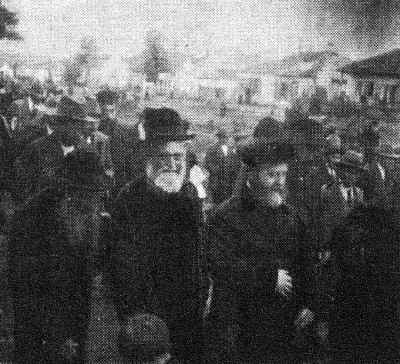
| Rabbi Michel Burstein z”l, at the head of the delegation, welcoming the rebbe on his visit to Yedinitz. This was apparently the Vizhnitz rebbe, who would stay in the home of R. Akiva Fradess. |
[Page 378]
About these visits, Rabbi Dov Burstein wrote himself:
“I used to visit my father's home once a year. Sometimes I visited it twice a year, be it during Holydays or for family affairs. My father's home was an open one for many who addressed him in different matters. I used to accompany him often to the synagogue where he prayed, amid Torah learners and scholars. I had a feeling, that I am at a place where many Yeshiva students, Hassidic Jews, book lovers, and public activists, which did their job wholeheartedly. He used to pray in two synagogues: in the Husiatyn and the Chortkov, but the one he preferred for some reason was the Husiatyn one, hence, I got to know some of the people praying there, and I remember our meetings to this day despite the dozens of years that had passed.[b]
Rabbi Michel's wife was devoted to public affairs and was very active in the “Dressing the Naked” establishment that provided clothes to the village poor.
The son was famous as a Torah expert and was also immersed in modern science. He published several important papers about wisdom and morals while he was still in Romania when there were discussions about the Jewish ways of slaughter and the attempts to negate them. He wrote a book in Romanian about kosher slaughter. In the publication “The Arbiters Treasure” published in America, he wrote articles about fingerprints that help to release Agunah, articles that were novelties in the world of Torah and science. Nowadays, he still publishes articles in religious newspapers in Israel and America.
Rabbi Dov Burstein Jr. served twenty-nine years as the Rabbi and Dayan in Boto?ani and since 1950 he lives in Israel. For the last fourteen years, he serves as the regional Rabbi and Dayan in the Chief Rabbinate in Tel Aviv.[c]
Rabbi Michel Burstein, the father, was doomed to pass the forty-first years of the Regime change in Yedinitz. As was told, he died in 1940, and according to the same source, many attended his funeral. (See next page) [Page 379]
|
|
Original footnotes:
[Page 380]
by Ephraim Schwartzman
Translated from Hebrew by Naomi Gal
The rabbinical judge Rabbi Shmuel, z”l, inherited his chair from his father, the Dayan R' Moshe Baer. R' Shmuel died when he was 70 years old and left an honorary legacy. His nickname was “Shmulikel the Dayan.”
I can still recall the funeral of R' Shmuel, the Dayan. As a sign of mourning, all work stopped in town; the shops were closed and the young students were released from school classes so that they could take part in the funeral.
My father, the late Rabbi Yaakov, and the judge's grandchildren had already detailed his story and his outstanding qualities. Here is what was said about the judge's attitude toward arbitrary fees. The debating sides paid as much as they could, but he never allowed one side to pay more than the other.
He was poor himself and broke all his life. Still, from his meager income, he would donate, especially on Shabbat eve and on Holydays, to the village needy. When he heard impoverished parents could not pay the salaries of a Melamed, and that their children may, God Forbid, be deprived of Torah, R' Shmulikel summoned all the town wealthy citizens to his house and forced them to establish a “Talmud Torah” and to sustain it with donations. And indeed, the rich inhabitants accepted his demand. And it happened often that he paid from his skimpy pocket the Talmud Torah teachers' salaries when they complained that they were not paid for many months.
Although he lived a dire life, he never complained to anyone. His youngest son, R' Brouchel, received his rabbinical ordination in one of Poland's Yeshivas. When he inherited his father's rabbinical judge chair, he followed his righteous father's footsteps. He perished in the Holocaust, z”l.
Jerusalem
|
|
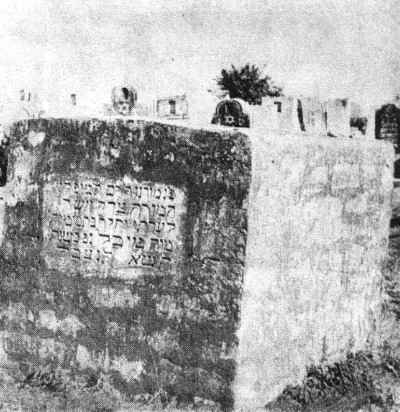
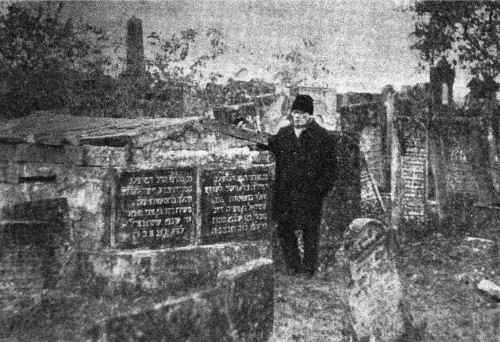
On right: R' Shmuel, son of R. Moshe-Dov Chachamovitz, z”l (died on February 5, 1920) On left: R' Moshe-Dov, son of R. Zvi, z”l (died on January 16, 1871). The gravestone was discovered and repaired by R. Yeshayahu Elkis (in the photo) |
by Yosef Magen-Shitz and Mordechai Reicher
Translated from the Yiddish by Ala Gamulka
The community was established according to Romanian laws, as they pertained to various religions. The proposal for the formation of the community according to the law was to care for the religious belonging of the “citizens of Mosaic persuasion.” It was meant to support religious personnel, the Jewish religion, and social philanthropic institutions.
Before the foundation of the community, the organized Jewish society comprised separate institutions and groups. This is how it was during Tsarist Russia. They were the remnants of a previous autonomy. Let us list them:
[Page 382]
Every funeral was involved with a barter for payment between the Chevra Kadisha and the relatives of the deceased. It sometimes led to the indignity of a corpse.
A large part of the income of the Chevra Kadisha was spent on food in honor of its members and the sextons, for Mitzvah dinners on the Yahrzeit of various Chasidic rabbis and “good Jews,” and on celebrations on all kinds of holidays. This was a tradition of many generations, and no one would dare criticize the custom.
Regretfully, there are no people left who can describe the context of the “Taxes” or the Chevra Kadisha. The survivors do remember names of those who were involved with the Meat Tax: Meir Boim, Itzik Rabin, Yankel Dorf, Shmuel Vineshenker, and others. Also mentioned here are Hersh Finegold and Yosef Fishman as leaseholders. Also, Alte Hannah (Keiles') Rosenberg, who sold vouchers for the slaughter of chickens. These are all fragmented memories.
[Page 383]
The police commissioners and mayors were replaced by the Romanians with a municipal organization in the form of communes and town halls. There were times when there were separate town halls for the town of Yedinitz and the village of Yedinitz. At that time, there was a Jewish mayor. When there was only one town hall for both sections the mayor was a Christian and the vice-mayor was a Jew. They were both nominated by the party which then ruled the country. Haim Horovitz gives a list, shown in the book of police commissioners, mayors, and vice-mayors since 1886.
The process of organizing official and recognized Jewish communities was quite slow in Bessarabia. In Yedinitz the community was first organized in 1935-36. It immediately took under its wing the Meat Tax section, but the Chevra Kadisha distanced itself from it. The community looked after education, the Talmud Torah school, the Jewish hospital, the Old Age Home, medical help, the bathhouse, and Mikveh. It also looked after religious needs, supported the rabbi, the Dayan, and other religious personnel. It managed the baking of Matzos (it was a source of income), etc. The community also represented the Jews in front of the authorities.
The first committee of the community management was elected through the representatives from the synagogues.
The “committee” or “management” of the community comprised the following people: Lipa Felberg (Chairman), Yosef Shpeyer, Motel Boimelshteyn, Itzik-Hersh Tchak, Avraham Axelrod, Zeide Zingman, and Yeshaya Lamatchinsky. They are all deceased by now. Haim Horovitz remembers (in his great work, which is included in the book) the important activity of the committee. The Romanian regime of Cuza-Goga had decided to revise the citizenship of all Jews. There are no records left of the operation of the community, its budget, income, and expenses.
[Page 384]
The community was dissolved during the first Soviet occupation of Yedinitz in 1940.
The details of Jewish life in Yedinitz under the Soviets are given in a conversation with newcomers from there and published in our book.
|
|
|||
Taken from “Unser Zeit” (Kishinev) |
||||
|
|
JewishGen, Inc. makes no representations regarding the accuracy of
the translation. The reader may wish to refer to the original material
for verification.
JewishGen is not responsible for inaccuracies or omissions in the original work and cannot rewrite or edit the text to correct inaccuracies and/or omissions.
Our mission is to produce a translation of the original work and we cannot verify the accuracy of statements or alter facts cited.
 Edineţ, Moldova
 Yizkor Book Project
 JewishGen Home Page
Copyright © 1999-2024 by JewishGen, Inc.
Updated 7 Aug 2022 by LA