|
|
|
[Page 293]
Moshe Bachrach
Translated by Gloria Berkenstat Freund
We in New York knew G'dlake Seid as a quiet man who was not active in communal affairs. He was a capable businessman and a sociable man, but he could not utter a word at a meeting. It seems that the shocking news of the death of all of Goniadz gave him a push to throw himself into the aid work on behalf of the individual Goniadzers who survived. Evidently as he needed a great deal of help to be able to organize an aid committee.
At the Goniadzer Ladies Auxiliary (New York Ladies Union), which excelled with aid for Goniadz in its time of need, Seid easily agreed that they [the Ladies Auxiliary] should incorporate as an organization in the
[Page 294]
|
|
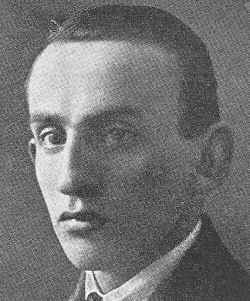
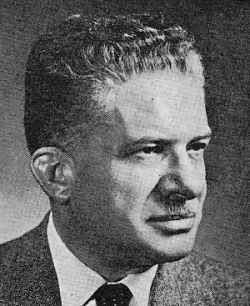
| Gedaliah Seid |
planned committee and when he turned to me for “technical” help
[Pages 295-296]
|
|
|
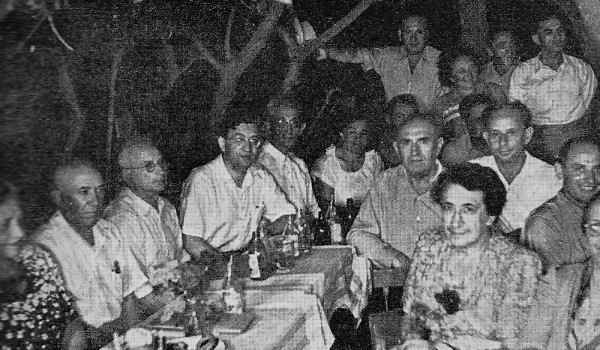
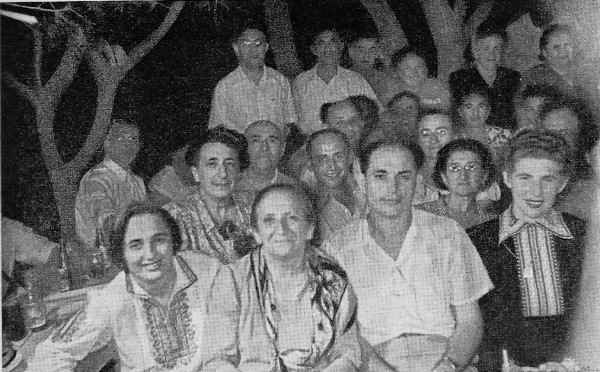
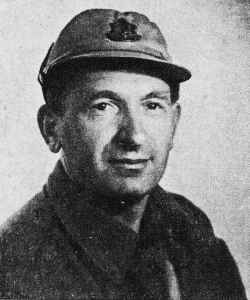
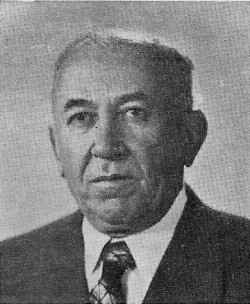
| The two pictures were taken during the visit of Gedaliah Seid (of blessed memory) and his wife in Israel, 1951 |
I promised to place myself in the service of the task without delay, on the condition that this not be bound with too many “parliamentary” idle words. I meant by this that the aid committee should be declared as a fact and to then draw people to something that exists and is already functioning. (Here it is necessary to
[Page 297]
mention that the Goniadz-Trestiner Landsmanschaft could not as an association join an aid committee only for Goniadzer. Therefore, they [the new committee] had to think of Goniadzer Jewry - wherever they would be located.)
Seid truly from the start was afraid of “public meetings” that could yet ask, “who authorized you” to organize a Goniadzer aid committee? But the circumstances demanded bold activity; we began to do the work ourselves. And as usual - people did not
[Page 298]
frown when someone else freed them from heavy work. And right from the start, the work was varied and difficult, although the call was admirable. Seid received courage; the thought was constantly in terms of doing and not of meetings.
“There are those whose who acquire the World to Come in numerous years, and there are those who acquire the World to Come in an instant.”[1] It happens that a person repays himself - and the community - with one sacred work for an entire life of daily work. G'dlake Seid achieved this in full measure through his great accomplishment with the aid committee.
[Pages 301-304]
by Dovid Bachrach, Petach Tikvah
Translated by Gloria Berkenstat Freund
(A garland of memories to the memory of my childhood friend, who fell among the heroes of Tel-Hai,[1] 11 of Adar, 5680 [1 March 1920].)
I remember Moshe-Kalman, his father, the turner. Sick, always coughed and wiped his face with a red handkerchief. He was an Ein Yakov[2] Jew, one of Nisen the tailor's students. He coughed out his soul and his son, Yakov, was left as an orphan[3] at a very young age. He became the provider of food for his family - a mother and two sisters.
We studied together in Motye's kheder [religious primary school]. He had a beautiful voice and he was one of the best choir boys with the khazan [cantor], Reb. Nakhum, of blessed memory. He was the long-standing solo singer and he would “turn” his melodies with a fine sense of music. His resounding voice would be heard during the study of Gemara [Talmud] and younger children would pay him a kopike for going over a section of Gemara with them.
Once Idel Meir, the watchmaker's son, brought a chess set to kheder. The kheder students were very happy playing and decided to make their own chess set. Who would make it? Yakov Tuker, naturally. Kopikes were collected for Yakov, who little by little turned all of the pieces on his lathe. This would be done in the evening by the glow of a small lamp. The cold in the room was unbearable. The windowpanes were covered with frost. The poor turner's wife did not have the money to heat [the room]. But Yakov turned the chess set with his own hands and everyone was proud of their friend, the “artist.”
Gonaidz started a new occupation, matzo baking, between Purim and Passover and it was called podriad [enterprise].
[Page 302]
I remember three such “enterprises”: at [the house of] Gershon the orphan, the Sotnik's relative; at [the house of] Gershon the cabinetmaker near the beis-medrash [house of prayer]; and in Josl Sayke's house where Yoske's [wife or daughter] Nekhame's old bakery was located. The bakery was run by Majczuk's [wife or daughter] Mirke Feywl and Mashe [wife or daughter of] Shimon Yankl… Mirke stood at the market the entire summer with a trough of fruit. In winter she would sell lampshades. And there was no income from this - and the “enterprise” came after Purim. Yakov Tuker was employed there [the matzo bakery] as a matzo roller. His work hours were from six in the morning until late in the evening. And he never could be absent. I was then studying in the kheder of Uncle Shlomo Moshe, Shimeon's son, who lived in Saike's house. I would drop in to see Yakov rolling and, at the same time, learn the trade. - Yakov was interested in teaching it to me so that he could catch his breath for several minutes… I would work in fear that my father would learn that I had slipped out from kheder and also that the supervisors - the rabbi and Gershon Borukh - would catch me. But I learned on the condition that my work would be added to Yakov's account.
Our friend, Yankl Szmerke's son, died in the spring of 1920. The khevre kadishe [burial society] approved that we, his friends, would carry the mite [board on which the deceased is placed or carried] to the cemetery. On the way back, Sender Miltshon told us that the turner's wife received a letter from the Zionist Organization that her son Yakov fell in the fight
[Page 303]
in Eretz-Yisroel along with Josef Trumpeldor and six other comrades defending the solitary settlement of Tel-Hai in the Upper Galilee.
Dear, dear Yakov! You fell a hero, defending the Jewish land and Jewish honor!
In your merit and in the merit of your fallen comrades, who defended a solitary Jewish settlement, the entire Upper Galilee was saved and remained in Jewish hands.
Your death is a worthy one and full of consolation[4] like the death of our millions of brothers,
[Page 304]
sisters, who were tortured in the concentration camps and gas chambers. Your comrade, Trumpeldor's last words, “Never mind; it is good to die for our country,” was also said in your name. You were the first to fall in Tel-Hai, running to block the gate against the wild Arab bands. You were a model of self sacrifice and heroism and we will always remember your name with reverence.
And Goniadzers are proud: the fine choir boy, the chess turner-artist, the matzo roller grew into a great Jewish hero of the entire people and land of Israel.
[Pages 303-306]
by Yisroel David Yardeni (Yarushevski)
Translated by Selwyn Rose
From the depths of my memories a ghostly figure rises up before me; standing before me is a young boy – seven or eight years old, red–cheeked, a crumpled hat stuck on his head, his head slightly bowed with a faint smile on his face. I take one or two steps forward and I am in his house – one long, broad room. A beam was place across the ceiling rafters to which was tied a length of rope and below, just above the floor a second beam. Between the two beams were two logs of wood into which were stuck sharp iron teasers. In the center of the room a wooden tree–stump with an axe or two stuck in it – this was his father's workshop for manufacturing spindles. Among the tangle of wood–shavings and wheels his father worked, making spindles in time for the beginning of the weaving season of autumn.
The house was full of adults and children and Yaakov, the youngest. His father, Avraham Kalman was a sick man with a serious lung complaint spending many weeks in bed during the winter. Yaakov began working at a young age and even during the few months of the year when he learned in the “Heder”, I would see him standing next to his father in the afternoon, winding the thread onto spindles.
[Page 304]
As an adult he became the provider for the family and when his mother became a “milkmaid”, I often saw him carrying two full milk urns. I knew that he regularly rose up early in the morning with his mother to walk four or five kilometers at milking–time to the Christian farmer to buy milk from him and then sell it to householders at their door.
Once he came to me with a proposition: he would always assist me on condition that I taught him some Torah, some Rashi and a little Hebrew. From then on he would come to my paint–shop and help me with my work and afterwards I would teach him; we were happy to see how he advanced in his studies.
I recall the long passageway along which he had to walk in order to get to David Shmerl, “the tutor”. On the left was a bakery – the bakery of “Pascha and her Daughters” and the tempting aroma of fresh bread that awoke the appetite. His compliments and praise for Pascha and her daughters saved him on more than once from hunger.
– “Give me some fresh bread for a kopek”
– Pascha weighed some bread – and gave it to him.
– …and for a kopek! Says Yaakov, a little shame–faced and feeling qualms of conscience.
And the following morning he waited at the open door of the bakery and not Pascha but Bilka was standing
[Page 305]
there at the counter and from her, too, he bought a kopek's worth of bread.
Yaakov's father died when Yaakov was fifteen years old and before he was fully competent at making a complete spindle in all its aspects and so one day he traveled to the nearest town – Korycin to finish learning the trade.
From then on I hardly saw him because he came back only very rarely to see his mother and his home and when he was due to join the army he went to America. Once, when I was sitting in the railroad station in Lod, waiting for my train to Jerusalem, here striding towards me was a soldier. He fell on my shoulders.
Yaakov!
He had come from America with the Hebrew Brigade.
[Page 306]
He spoke to me about the possibilities of finding work in his trade in Jerusalem. He was not going to leave Palestine. What had moved him so? I remembered: His father had a brother in Jerusalem. Twice he had visited the town as a doctor. On one of the evenings, I had gone to Tucker's house and saw there an old man with bushy eyebrows shielding his eyes, his white beard sticking out from his face like lowered spears. He was talking about the Western Wall with the children sitting round the table listening. Yaakov's mouth was agape and his eyes fixed immovably on the old man's face, the peak of his cap to one side.
Yaakov fell heroically in defense of Tel–Hai 11th Adar 1920.
Indeed – he never left Palestine.
[Pages 305-306]
by A. Ben-Meir
Translated from Yiddish to English by Gloria Berkenstat Freund
A beautiful, bright soul.
Who does not remember him? A grandson of the old rabbi, a genteel, sensitive one, rich spiritually.
His rabbinical pedigree did not create any luxury for him - not in his orphaned childhood years and not in his youth, when, during the World War [One] years, he lived as a refugee in Bialystok and later - as a teacher at the Hebrew public school in Goniadz, where he occupied a respected place and was beloved by everyone.
His delicate body could not long endure and during the difficult war years he became ill with tuberculosis.
His devoted sisters applied every means to save him, sent him to sanatoria in Germany and to Switzerland and then, in 1921, brought him to America. He was in treatment for several years at the best
[Page 306]
|
|
| Yonatan Neiman |
sanatoria, first the Arbeter-Ring sanatoria around New York, later in Denver, Colorado and in California, hovering between “better” and “worse”.
Yonatan knew that his days were numbered and he accepted his fate
[Pages 307-308]
(Sonnet)
by H. Leivik
Translated from Yiddish to English by Gloria Berkenstat Freund
| The days and years pass, pass, Natan Neiman. And I stand again at your burial garden bed. The blue Rocky Mountains in their timelessness - - They do not speak today - they are all still. Are they happy that I have come? - - I take a handful of your grains of sand and I spread them apart - - The silence immediately becomes bright, delighted As if it has heard a reawakened voice. Through a ballad I made your death known, And through it people grew to love you And yet I do not avoid asking you now: forgive me For leaving you at the end of the world in Colorado. Forgive me, too, that I wake you unexpectedly from your rest, And take my 14 lines with approval. H. Leyvik[1] Denver, May 5, 1948 |
[Page 307]
with resignation. He died in full consciousness on the 25th of March, 1933 (27 Adar, 5693) in the Denver sanatorium.
The famous poet, H. Leyvik [Halpern Leyvik], long may he live, who in 1932 started a friendship with Yonatan, was with him during the agony of his death and took part in his funeral and burial. He then created the unique “Ballad of the Denver Sanatorium” - a pearl of Yiddish poetry that has been published many times and also translated into Hebrew by A. Shlonsky.
Leyvik visited Yonatan's grave in 1948 and immortalized him impressively in a sonnet entitled, On the Grave of Natan Noyman [Yonatan Neiman].
Yonatan left a diary - a small notebook where he recorded his great experiences: family memories from his childhood, impressions of friends, copies of touching, content-rich letters to his devoted sisters, opinions about Yiddish and Hebraic works and writers,
[Page 308]
moods from his sick bed and also several original lyrical poems and free translations.
From his diary, written in a fine, restrained style with a deep feeling and clear understanding, radiates the bright personality of a young, smart man who loved life and who approached his end stoically calm, without complaints to God and to the world.
“I did not go to visit your brother out of pity,” - the poet, H. Leyvik, said at the time to Yonatan's sisters - “I came to him to learn how a person can be purified through suffering.”
We bow our heads to his spiritual strength. Neiman's purified soul was united in a great and elevated work of a world famous Yiddish poet. With the deepest recognition, and with the friendly consent of the author, we include the fine, touching sonnet in our Yizkor Book.
[Page 309]
(Poem)
by Yonatan Neiman
Translated from Yiddish to English by Gloria Berkenstat Freund
| As at night, the stars fall Become still and quickly lost Thus fall my sparks By now for years and years.
Letters and moans, quiet tears,
My windows are open (Written in the dark after a hemorrhage) |
[Page 309]
(Excerpt from Yonatan Neiman's notebook)
by Yonatan Neiman
Translated from Yiddish to English by Gloria Berkenstat Freund
What a bright personality he was! I remove the negative side - his intolerance to Jewish apikorsim [literally, heretics] - he was entirely fair. Christians are what they are, but… Jews, sons of the covenant, to whom God revealed himself, and they would sin? - this cannot be tolerated…
A Din Torah [law suit before a rabbinical court] before my grandfather: A Jew sold his “holiness” to another one for two gildn. He arrived home and his wife shouted that she would rather have the holiness… However, the customer would not take back the money. They came to the rabbi. My grandfather ruled that the customer is not really a customer and scolded both Jews, “One does not trade in Godly things!”
My grandfather's sense of humor: With honey cake and whisky in the house of a rich man of the shtetl; the rich man says to my grandfather: “Rabbi, I am still a godl [prominent man].” - My grandfather answers: “In Lithuania a groshn [small coin or penny] is called a godl.”
…Welwl and Zalman play chess, my grandfather sits and studies. Suddenly he raises his head, looks at the chess board and shows one of them a move. The brother protests: “Father, why, why?” My grandfather answers: “Never mind, never mind, we need to help someone who is weak…”
When I came to Motya the Melamed [teacher in a religious school] in kheder [religious primary school], Motya said to me this: “Your grandfather, of blessed memory, warned me: ‘Motya, do you hear me, we do not hit children in my home.’”
In his boyish years my grandfather was a great brat. He liked to ride on a he-goat. Therefore, he did not grieve when my brother, Khone, often did not want to go to kheder.
My mother adored my grandfather. When she was a small girl she wanted to learn to read and write Russian. A small book cost 15 kopikes; my grandmother was stubborn: it is not needed. My grandfather finally asked my grandmother to give the 15 kopikes. He told my mother that in his young years one “learned to write Russian” on the floor with chalk. And when the floor was covered with writing, it would be wiped with a wet rag and he would again write.
My grandfather was very well respected by the Christian gentlemen. They trusted me because they knew that I was a grandson of the old rabbi. Apparently they believed that a grandson of such a rabbi must be an honest young man…
[Pages 311-312]
by Avraham Yaffe, (Tel–Aviv)
Translated by Selwyn Rose
|
|
| Yehoshua Supraski |
He was born in Goniadz the son of Eliyahu Supraski. He received a traditional “Heder” education, became enamored of the “Ha–haskela” [Enlightenment] movement and began to learn Hebrew and Russian. He was self–educated and a voracious reader both of literature and the Russian and Hebrew Press of those days. From his intense studying began to feel pain in his chest. The town's doctor, Dr. Kanpinski, advised him to exercise by walking and running in the fields around the town during the winter when the fields were covered in snow.
Supraski belonged to the younger generation of the town – the first among the adherents of the Haskala and Zionists, like: Ze'ev Kaminski, an active Zionist and orator at meetings, or Shimon Louis, scholar and academic, organizer of Zionist and Haskala propaganda in the Beit Ha–Midrash where spent many hours studying, teaching and commenting on the Torah and Midrash.
Later, he made his way to the Russian town of Kursk where he quickly became a central figure in Zionist activity. His aptness and suitability for the position found expression in his being elected as a delegate to the Basel Congress and also to the All–Russian Zionist meeting in Minsk. In the Memorial Book for Dr. Yehiel Czelnov there is a photograph of the Minsk meeting in which he appears as the delegate from Kursk together with Yaakov Rudenski, the delegate from Goniadz. After his marriage to one of his acquaintances from among the girls of Kursk, he rarely came to Goniadz, visiting only occasionally. He became an active citizen in the Jewish community of Kursk devoting himself to the Zionist cause. With the Russian revolution, at the time of Kerensky, he was very active with speeches in public and local political institutions. In recognition of his personality and public activities for the good of the town, he was delegated as a representative by the temporary authorities for the entire Kursk area, With the outbreak of the Bolshevik Revolution, He left Kursk and moved to Berlin with the rest of the Russian refugees who found asylum in Germany in general and Berlin in particular. There he remained for a short time and then moved to his final place of refuge, for the rest of his life, his personal and national refuge – the land for which his soul yearned – the Land of Israel.
He remained idealistic and multi–active all his days in Palestine. He succeeded in his commercial ventures and also consolidated his social standing. He acquired properties both for himself and also for his acquaintances in Goniadz as settlements for them. Later he opened a successful credit bank that achieved a respectable standing in the banking community. His public works brought him further recognition and he was elected vice–chairman of the Tel Aviv–Jaffa community. In multi–national meetings dealing with Zionist interests he was one of the leading speakers. He rose to the top of General Zionist party and was one the founding activists of “Ha–Boker” [“The Morning”] journal. He achieved his highest post when elected to the board of the Sochnut management.
Yehoshua Supraski was the bridge who, from his modest “nest” in Goniadz, rose to the heights of public works in Palestine. He took part in the temporary government meetings of David Ben Gurion at the time of the Declaration of Independence in 1948. A few weeks after that he died at the age of sixty–eight – years full of splendid activity for the good of the people and the country.
May his memory be blessed forever.
[Pages 313-315]
by Avrom Yaffe
Translated from Yiddish to English by Dr. Isaac Fine
His first education was in the traditional religious elementary school of his Jewish town. However, he did not continue his studies in the House Of Study, as did the children of other merchants in town. At the beginning of the twentieth century, some young Goniondz men journeyed to known centers of Torah learning, such as yeshivas and torah centers in other cities. Dovid Rudski was among those who pursued secular culture. He went to Lodz, where the German language prevailed. There he succeeded in acquiring a smattering of German language and culture. Since he did not receive economic support from home at that time, he was forced to return to Goniondz.
When he came home he suffered from pulmonary problems. His family very actively sought a cure for him, and a cure was found. He continued to improve his competence in the German language and later in French as well. He wanted to travel to France and study there. Meanwhile, the time came for him to present himself to the Russian Army for induction. His parents were suppliers to the Osowiec fortress. He had learned how to make a certain kind of hatband worn by the army in summer from a Goniondz hat maker.
He was recruited into the army and sent to Moscow, where Russian physicians conducted pulmonary exams for recruits. After a time, he was given a medical certificate stating that he was cured from pulmonary disease and fit for military duty. After being declared fit for duty, he went to Paris with neither parental approval nor their assurance that they would provide him with economic support. He hoped to achieve economic independence by his own efforts. He did indeed succeed in achieving this goal by means of the hat maker trade he had learned. Later, however, he did receive financial support from his family in Goniondz.
At first he concentrated on philosophic studies and passed the baccalaureate exam. Dovid at that time transferred to the Faculty of Medicine. He completed his medical studies shortly before the outbreak of World War One, and was granted the title of Doctor of Medicine. In Goniondz, Dovid had been very involved with a group of friends who were immersed in Zionism and secular culture. He very much enjoyed their discussions. Dovid also participated in the foundation of the Goniondz Zionist Library, later called “The Dawn”, after the Dawn group of young Zionists in town. In Paris he participated in Zionist meetings with Dr. Max Nordau. The Paris Zionists recognized this very competent Jew from Russia. They fully accepted him into their group.
When World War One broke out, he volunteered for service as a military physician with the French Army, with the approval of the Russian Embassy. France, England and Russia were at that time allies against the German Empire. He fulfilled this role with distinction. In a weekly edition of the Russian periodical Rivya Vidanosti Ogonoyed, his photo appeared with the inscription “A son of our land, doctor of medicine, now on the French front in charge of a medical detachment.” He was once wounded on the front line. After his recovery, he again returned to the front to assist in providing medical care for the wounded both in hospitals and in the field.
At the time of his return to active duty, the typhus epidemic was spreading among the troops like wildfire. Dovid's devotion to curing the ill moved him to labor tirelessly day and night. He finally succumbed to the disease and perished. In his life and in his death, he distinguished himself by his dedication to duty. May his memory be for a blessing.
[Pages 313-316]
by Avraham Yaffe, (Tel–Aviv)
Translated by Selwyn Rose
Yehoshua Rosenbloom was born in the late 80's of the nineteenth century. During his childhood he grew up in the home of his mother and step–father, Eliyahu, Asher Bikowski. His mother had two other older boys from her first marriage. Yehoshua – the youngest – differed from them: he was talented and very studious, continuing to be so for the whole of his short life. After completing his studies at the “Heder” under Yudel the teacher, he went to the Yeshiva at Lomza.
[Page 314]
After about a year returned to Goniadz as a senior graduate. A year later he joined the yeshiva in Novogrudok. There he underwent a spiritual transformation: Enlightenment. He became one of the major workers in Zionist activities in the Yeshiva. When a Zionist Congress took place in the Yeshiva of Lida, from its foundation under the management of the leader of “Mizrachi” [Religious Zionist Movement] Rabbi Y. Y. Reines z”l., the young Yehoshua was present. Yehoshua, with a very ebullient and vibrant personality,
[Page 315]
was very excited with the congress and when he returned to Novogrudok from there, he leapt enthusiastically from the train to join the few colleagues who had come to greet him, falling heavily on the platform and breaking a leg. He lay many weeks until his leg healed but even so not completely.
When he returned home, exhausted and ill, his mother devoted herself to caring for his health. And indeed after a few months he was well enough to return his “evil ways” – his ambition for a general education and knowledge. His main ambition now was to be examined in Russian and four years' gymnasium. When he came to visit me at the synagogue he told me what he had read in “Moreh Nevuchei Ha–Z'maneh” [Guide to the Perplexed of the Time] by Nachman Krochmal, “Paradoxes” by Max Nordau, which we read to each other our own writings – poems – originals and translations.
[Page 316]
Yehoshua was also a very talented speaker and with great courage was not deterred from approaching the somewhat older “Young Zionists” in Goniadz and was active in the Zionist meeting and in the Zionist Library Council. However, on his return from Germany it was discovered that he was suffering from well–established tuberculosis. In the last year of his life he managed to publish a Yiddish poem in the “Der Shtral” periodical. From time to time he would come to the library and talk to those gathered there on culture and Zionism.
In the last few months of his life his illness intensified and confined him to his bed from which he did not rise again. For a few weeks he lingered on in pain with a high temperature and breathing difficulties and died at the age of twenty–five.
“His life's song was cut short in the midst thereof”
[Pages 315-318]
by Moishe Bachrach
Translated by Marvin Galper
Leibel was born and raised in the town of Grajewo. He acquired distinguished competence in Hebrew language and grammar, the Bible, and the Talmud through a program of personal self-directed studies. He studied Hebrew language and grammar in the seclusion of his attic. He also acquired knowledge of Russian and Polish as well as calligraphic script. When his time arrived for active duty with the Russian Army, he was assigned to serve as a regimental headquarters scribe. This duty spared him from many strenuous military drills and maneuvers. When the time came for him to stand watch with his rifle on his shoulder, he would memorize the 618 commandments from the book “Commandments Of The Lord”, whether by day or by night, in intense heat or in bitter cold. He observed these commandments throughout his life, but the law of the rifle, never. This is the sort of soldier Leibel Bachrach was in the town of Saratow on the Volga River in the late eighteen hundreds of the nineteenth century.
He was an iron merchant in Goniondz. Leibel was always immersed in his studies at home during his leisure time. His wife Shayne Belke facilitated his freedom for solitary studies to a considerable extent. He often studied late through half the night while very quietly humming a Gemora tune, so as to not awaken the family from sleep. If any of us awakened during the night we would witness a remarkable sight. The house would be enveloped in darkness and sleep, except for father immersed in his Talmudic studies, with a small kerosene lamp by his side. The sweet melody which accompanied his studies was wonderful to hear.
He never relied on the classroom teachers of his children or their private tutors. He often had talks with teachers and tutors about the most effective methods for bible instruction and childhood education in general, as well as education of his own children in particular. His first step was to teach his children Hebrew with the proper intonation, so their teachers could then continue on in the same fashion using the appropriate word stresses. With his talent as an educator, he allowed his children to pray according to the Ashkenazi tradition. Goniadz was very immersed in traditional Judaism. He, however, was a Chassid, and prayed in the Sephardic fashion of the Chassidim.
Leibel Bachrach was the first in Goniondz to advocate the principle of equal education for boys and girls. His vision embraced not only German, Polish and Russian, which were then in fashion, but also the Hebrew language, the Prophets, a special book of bible commentaries, and the Introduction To The Talmud as well. He was a gifted educator and completely lacking in self-consciousness in his approach to teaching. He could explain the first problems encountered in Talmudic study with such clarity that even a child could comprehend. All his students found it a pleasure to learn from him.
When the First World War broke out in 1914, the German Army bombarded the Russian fortress of Osowiec. While this bombing created devastation among the homes of Goniadz, Leibel Bachrach remained immersed in Talmudic studies in the tiny apartment of Yehuda the cap maker, surrounded by a group of refugees from Grajewo. The assembled group seemed oblivious to the surrounding bombardment.
Leibel Bachrach was also a prolific writer in both Hebrew and Yiddish. He was interested in both secular and spiritual matters. He communicated with both merchants and yeshiva directors. When he sensed that a merchant in Warsaw or Brisk, for example, was an educated man, he would add on a few sentences on biblical matters or other Jewish topics to the end of each business letter.
He was a long time subscriber to Yiddish and Hebrew periodicals such as “The Time”, “The Friend”, “The Life” or “The Moment.” Russian newspapers from St. Petersburg also arrived at our home on a regular basis. The Russian newspapers were intended only for us children to learn Russian, and certainly not for absorption of the Russian spirit. Leibel Bachrach established a well-balanced Jewish education for his sons and daughters. In November 1917, when the news of the Balfour Declaration reached Goniondz, he advised the town youth, including his daughter Chaske who now lives in Israel, “Children, learn a trade and be in the land of Israel.”
Arye Leib Bachrach died in Goniondz in 1919. His bones remained in Goniondz and it seems that not a trace of his grave remains. But his name lives as a perpetual memory, engraved on the tombstone of his wife Shayne Belke in a Tel Aviv cemetery.
[Pages 319-324]
by Kalman Bachrach
Translated by Gloria Berkenstat Freund
He was called Leibl Mushke's [Mushke's son] or Leibl[1] Pekarski. To me he was Chaim Aryeh. This is because we studied together in the same class in the Goniadzer Hebrew School. There, everything was in Hebrew, our names, too.
I remember the name in Hebrew because this was characteristic of our acquaintance, our comradeship and, perhaps, for our entire life. Both of our ideologies and strivings were the same through all the years, built on Hebrew and Zionism, although we were almost always physically apart since our parting in Goniadz, he in the distant city in Canada and I in New York, thousands of miles apart each from the other. We were together only one more year and worked in the same school in Montreal, Canada.
Our friendship was deep and strong. True, we did not correspond because Chaim Aryeh was not a letter writer, but we were bound together emotionally and we could never forget one another. When he suddenly left us, a wound remained in my heart.
When I begin to think of our young period, the word “zealot” comes immediately to my mind. Chaim Aryeh was a modern, zealous man, that means not for studying Gemara [Torah commentaries] like a [poet Chaim Nahman] Bialik's zealot, but for modern subjects: Hebrew language, literature and several sciences, all subjects that we studied together. His zeal was natural and elemental. He had the strength of pulling along everyone around him like the force
[Page 320]
|
|
| Chaim Aryeh Pekarski |
of a terrible rainstorm. When we prepared ourselves for examinations, he could study 18 hours a day. Sleeping or playing, all of the things that play a great role in a young person's life, did not exist for him. He had one purpose - to study. And he studied with persistence and a strong will that broke through all difficulties.
Chaim Aryeh loved to talk of that period: incidentally, he possessed the ability to tell stories. Everyone already knew the story of the string when I returned to Montreal and I met Chaim Aryeh there.
The story is from the last days of our Gordz exams from the Gordz school. Chaim Aryeh was then constantly studying and repeating, truly as it is written: “While you sit in your home, while you walk on the way, when you retire and when you arise,” before eating, in the middle of eating, during the day, at night - without measure and boundary. I do not know how many hours a night he slept then; I was afraid that he even studied
[Page 321]
in his sleep. And also I with him - as much as possible, as much as I could help him. When he arose early, I had to arise early, earlier than anyone in the house. How does one arise earlier than everyone? I did not have an alarm clock and he did not want to bang on the shutters because this would wake up other people in the house. It was decided to bore a small hole under the window, draw through a string and to bind the string to my hand. And so it was. Chaim Aryeh came in the morning, pulled the string and woke me from sleep.
The same story was repeated in Montreal, but a little more intensively. There, I have to confess, I could no longer keep up with him. His zeal and determination were even stronger than before, at a time when the differences in our character traits were more distinct and stronger. I let myself be influenced by the environment and went along slowly. He stormed with his entire strength and wanted to take in everything around him. His energy had no boundary. Perhaps this actually was his misfortune, his energy burned out too quickly.
We were then newly arrived in America and learned to read, write and speak English. The goal was to prepare ourselves for university. Chaim Aryeh threw himself into English with fervor. English, as is known, is not a phonetic language and “speln,” that is, the laying out of the words, is an entire education. Chaim Aryeh developed his own theory about how to learn “speln.” He wrote each word 10, 20, 50 times; it depended on the difficulty of the word. And as he began to write, there was not enough paper. He wrote on everything, the calendar, on the walls, both sides of envelopes, all paper
[Page 322]
bags and all sorts of wrapping paper. There truly remained no paper in the house on which there was no writing.
I was told that he acted the same way later when he was in the Canadian Far West. He reached the goal that he had set for himself. He graduated from the university there, became a lawyer and one of the most important Jewish leaders in Western Canada. There he also married and built a family.
Chaim Aryeh was an immigrant who was newly arrived in a country where he was strange and where the language and the customs were strange. He had to make his way in the country with his own 10 fingers, adapt himself to new circumstances and establish himself. This was not easy. First, he needed to support himself and at the same time study. Secondly, he needed to begin his career as a lawyer when he already had a family with children. He achieved both, thanks to his stubbornness and enormous driving force.
Earlier he had maintained himself and supported his family as a Hebrew teacher. As such, he did a great deal in the area. He founded a day school in Edmonton, one of the first in the country, which made a great name for itself in the history of education in Canada. He was a very capable teacher and administrator. It is a shame he did not remain in the profession.
And as a lawyer he achieved great esteem in the province in which he lived. There he became the greatest in his field among Jews and non-Jews. At his death, he was mourned by all of his colleagues and the flag over the courthouse hung at half-staff for his funeral as an expression of sorrow.
[Page 323]
Our sages have said that a man does not leave the world with half of what he wanted to achieve. This was particularly true about Chaim Aryeh. He achieved wealth and fame; he created a beautiful family. He was a leader in Canadian Jewish life. But he did not achieve one thing, settling in Eretz-Yisroel.
There is no doubt at all that this was one of the main goals of his life. He wanted to transplant his family to our homeland as we once dreamed in our youth. He hoped to raise his children in the land of which we dreamed, in our revived language. This he did not achieve. He tried. He especially traveled to Eretz-Yisroel in the 1930's,
[Page 324]
knocked on the doors of the Mandate Government and tried to find a new soil and foundation for his family. However, he returned in a grave mood. I saw him then for the last time. Traveling through New York he stayed with us in our house and spent several days with us.
Yes, if he had been 15 years younger, he certainly would have achieved it with his stubbornness and diligence. But a man is only young once. Even he did not have enough energy for a second time.
Chaim Aryeh, my friend, you went through Goniadz, the small shtetele, to Edmonton, the capital city of the province of Alberta, like a storm. Your tempest lived its life somewhere in the distant emptiness of Canada and disappeared. Chaim Aryeh, the friend of my youth, your illustrious memory will always live in my heart.
[Pages 324-326]
by Dr Josef Karmin
Translated by Selwyn Rose
In memory of my father, Rabbi Yehoshua z”l
Few were the years that I can recall visiting my father's house because already as a child I was moved from one Torah location to another at my father's behest and the store of memories of that dearest of men is sparse indeed although I know, and am witness to the deep love he had for me, his eldest son. I recall many walks had with my father on Shabbat afternoons outside the town as far as the Sabbath limits allowed. I wondered what it was that brought my father to take these strolls. His love for me? His wish to give me pleasure and to chat with me in Nature's bosom? That was more than fifty years ago in a small forgotten little town in hostile Christian surroundings!
He had his own way of educating his children:
[Page 324]
Intense love, understanding and consideration, and thus he was with thousands of his pupils, educating and guiding them from their earliest childhood and continuing to maintain contact with them throughout their lives until they immigrated to Palestine. He had the pleasure of seeing hundreds of his protégées immigrate until in his latter days he, too immigrated.
My father didn't want to make of the Torah a pick–axe for digging: he distanced himself from the Rabbinical authorities and sought for himself many ways of sustaining himself: he opened a shop; he indulged in various business ventures such as the manufacture of shoe polish, inks, and many other ideas. Only when all hope failed he became a teacher – and with remarkable success, for he loved the task and made many improvements.
[Page 325]
He was one of the first to create a “studio” that became known, in time, as the “Heder Metukan” [“Improved Heder”]. Apart from the “regular” subjects of the “Heder”, the “Heder Metukan” taught Hebrew and Hebrew grammar and arithmetic, festival tractates, plays in Hebrew and introductions to National Zionism. The Heder was spotlessly clean, thanks to my mother who saw it as Holy work. The government inspectors always left in stunned silence at the order and capabilities of my father.
My father was active in all the town's various institutions: Hostel for the homeless, Talmud Torah, Accommodation for the traveler and all the rest of the town's institutions. He was the first among the leaders in matters concerning Zionism in town and when Zionist workers organizations began to appear, it was he who found them and brought them to town; he it was who organized and paid for the room, organized the library, gave lectures and established dialogues and conversations. In spite of being an orthodox Jew with a pure spirit, he refrained from joining the “Mizrachi” movement and remained close to those movements. His hand was in everything “and everyman's hand was against him”[1] there were even threats against him…he knew no fear to the end of his life. In Palestine as well, he would walk alone at night even when there was shooting in his neighborhood. While still in the Diaspora he was not deterred by anyone among the powerful non–Jews whom he faced as an equal. He was an intelligent Jew and as such he was called in Polish “Storozom” [“genius”] a man of endless information. Many came to him for advice and counseling on an infinity of topics and he always knew to give the correct advice. Because of this he won many, many friends. It seemed to me that the whole population of the town was his friend,
My father loved books and he had an extensive library in which were to be seen side–by–side, not only the “six orders of the Mishna”, the Haggada and all the regular religious works but also all the books on “Enlightenment” from those days: Mapu, J. L. Gordon, Smolenskin and others. He was extremely knowledgeable as a scholar of Hebrew grammar, of the Tanach and its interpretations and even the Talmud itself had felt his touch. On more than one occasion he had been invited to take part in discussions, clarifications and debates together with the leading rabbis of the area. He was a subscriber to the Hebrew papers of the day –“Ha–Tzfira” and “Ha–Melitz” and also “Olam Katan”, a children's Hebrew journal of the day for us and for his pupils. And with what great interest and warmth and deep penetration he would read all these children's stories. He was a faithful colleague of Avraham Mordecai Fiorka, one of the Enlightenment era's most conspicuous writers who wrote also for children. He loved children, understood their outlook and their souls.
All of us – all his children, he taught foreign languages and tried, as hard as he could to provide us with a broad education and found us, undeterred, revolutionary students, many of them in hiding in the town from the authorities chasing them, trying to find whatever work they could giving private lessons. Still as a child I recall him teaching me Russian (which he himself commanded), German and French and other secular subjects, and thus he was towards my sisters as well.
He was totally confident of himself with complete faith in his methods and when the “Herzliah” gymnasium opened in Jaffa he didn't hesitate for one moment before sending our mother there with all the “baggage” (six children). I remember all of us sleeping on the floor in one room in Neve Tzedek – and caught a fever. Our mother took us all home. A year later my father sent me back again alone, when I was only twelve–years old, to the same gymnasium “Herzlia”. He accompanied me as far as the ship in Odessa. He saw me aboard and parted from me. It is easy to imagine how much courage and faith that took to do so. I recall when I reached thirteen he sent me a gold watch that I sold and bought a pistol. I can still remember my father's moralistic comments to me after someone had informed him of what I had done. He wrote: ”You can't be a writer and a fencer[2]” and so on. And thus, always, he guided me from a distance with a smile and so much love even if, sometimes, he disagreed with my choices in life that very often were strange to him.
Already as a child I wanted to be a writer or a compiler of books and I remember “A Nature book teaching the Children of Israel to Grow Wheat” with the help of articles printed in Russian of popular science magazines of the time – and sent it to “Toshiya”, a publisher of Hebrew books at the period. I didn't have any money and sent the manuscript without postage stamps. “Toshiya” declined to pay the postage and it was returned to me. Of course this became known to my father and he paid for the double fee. He delayed the manuscript for a couple of days and looked over the material and afterwards returned it to me with a smile saying not a word. That was my father in everything he did.
Often when he returned from meetings of one sort or another, he would bring one or two guests from among visitors to town on public business, or even drunks and paupers whom he had found on the way home. He would wake our mother up and she would prepare food and beds for them.
And mother, like every wife, wanted our father to sit at home with her and the children and refrain from public affairs and would try to let him know by subtle clues or a word here and there; more than that she didn't dare to his face. She respected him enormously and there was always peace and goodwill; however, none of this came to his attention and he maintained his actions. My mother grumbled a little but continued to be the dutiful wife and mother to her husband and children until her dying breath.
[Pages 327-330]
Avraham Yaffe. Tel-Aviv
Translated by Selwyn Rose
Our father, Rabbi Mordecai Yaffe (z”l), came from a long dynasty of rabbis, descendants of the Gaon, Rabbi Mordecai Yaffe “The Lavush” (z”l). My brother, Yitzhak was born in Kovrin (Grodno Province), in 5640. When he was about ten years old he already knew by heart several portions of the Tractate Berachot from the Talmud. When our father passed away in only the 33rd year of his life, Yitzhak was eleven. In the town of Goniadz, where our father had moved to be the town Rabbi in the last years of his life, the spirit of the Enlightenment movement had begun to infiltrate and my brother, wearing the long caftan of the orthodox Haredi movement, began to visit the school that had opened in the town. He diligently pursued his studies both at school and in the Beit Hamidrash. During the daytime at school and at night until well after midnight he was intensely involved with his studies. He was tireless in his studies of Hebrew grammar, Russian and other subjects.
With the first awakening of the work of cultural Zionism in town my brother became involved deeply in that also and took part in the establishment of the town's reading-room and library and other branches of Zionist activities of the period.
While still young he already began to work as a teacher, in the beginning privately, and afterwards, in the “Heder-Metukan”. He became teacher and mentor to his younger brothers and acted as father to them.
When “Pedagogical Courses” opened in Grodno in 1907, he was immediately accepted and shone in his speciality of the Tanach and grammar, as well as in his studies of geography and history. When I was in the final year of my studies of these courses the seniors were still talking of the diligence and learning of my brother
[Page 328]
whose statements and comments were quoted as the words of a professional authority. When he completed his studies he was appointed teacher at the modern Talmud-Torah in Kovno which was supported by the “Dissemination of Enlightenment” movement in St. Petersburg. His work at the Talmud-Torah reflected his devotion and capabilities as a teacher and instructor, which in his eyes he saw as Holy work. To a great extent that was the fruit of the efforts and influence of the excellent course instructor A. Kohnstamm (z”l) who was the director of the Grodno courses.
My brother would get up very early before going to school to prepare his daily lessons. As a student at the Talmud Torah he intended to set a good example from the beginning. At the same time he completed his nature studies and created a small garden at his lodgings and planted and grew various plants tending them until the garden became an example of excellence. Tenants saw him day after day, sleeves rolled-up, carrying buckets of water from the well to water his garden. In Grodno, he married a woman, the daughter of the loyal teacher and writer, Menahem Mordecai Silman (z”l). She too excelled in her studies and was gifted as a teacher.
The quality of his work in Kovno was recognised by the members of the “Disseminators of Enlightenment”, Kohnstamm, Pialkov and others, but the young couple intended to immigrate to Palestine, the land of their desires, and of the people to whom they belonged, and to which they wanted dedicate their talents.
They were aided in achieving this. Dr. Nissan Turov who was head of the Teachers' center in Jaffa in those days had contacted the course management in Grodno and requested a good
[Page 329]
manager for the school in the settlement of Rehovot and the management thought of Yitzhak Yaffe and suggested the name to Dr Turov. My brother accepted the offer with joy and pleasure and at the end of 1912 they immigrated to Palestine.
There he found happiness. He was director of the school in Rehovot for eleven years and devoted all his energies strengthening the school, and raising its standard to that of the Settlement's school par excellence.
His knowledge and love of nature aided him greatly.
However, while living in Rehovot he became ill with rheumatism and moved to Jerusalem to teach there at the school for boys under the directorship of Joseph Meyouhas, and lived in Beit Ha-Kerem where he built himself a house. Here also his dedication and love of his life's work of teaching added to his reputation.
[Page 330]
Here, in Beit Ha-Kerem, he brought to fruition the results of his knowledge and research of the geography of Palestine.
After a hard day's work of teaching in school, he would sit until late hours, reading books, both in Hebrew and foreign languages, examining and investigating, evaluating and digging deeper into earlier obscurity until he had raised his investigation to a level surprising many.
“If a man that dieth in a tent”... in the tent of his work of teaching and investigation. The weakness of his heart did its work; from day to day he grew weaker and on the 17th of Av, 5688, my brother passed away.
What matters if we conquer the world? Both life and death are a puzzle for the world; the soul that mourns refuses to be consoled. The loss was great for the family and also for education and investigation of the country.
[Pages 329-331]
Translated by Gloria Berkenstat Freund
Nakhum, the son of Eliezer and Rywka Zakimowicz, and brother of Moshe, Shaul and Mashe Gitl, was born in Goniadz on the 4th of September 1911. He studied in a kheder [religious elementary school] until he was seven years old. From age seven on, he attended the Goniadz Hebrew Tarbut School [Zionist, Hebrew language school]. At age 12, he became a member of Hahalutz HaTzair [the Young Pioneers]. From then on, he was active in the youth movement. At age 16 he went to Hakhsharah [preparation for emigration to Eretz-Yisroel] by himself and he worked in various locations as he prepared to become a halutz [pioneer who emigrated to Eretz-Yisroel]. He already showed his writing abilities then.
He emigrated to Eretz-Yisroel in 1929 and settled in the Kibbutz Ayelet ha-Shahar in the Galilee. He was drawn to the Galilee while still at home. There he met his friend, Genya, and he brought his parents and sister there. In 1935, his first son, Nemrod, was born.
He did every kind of work in the Kibbutz, simple fieldwork as well as with the tractor.
[Page 330]
|
|
| Nakhum Zakai |
He was connected with Haganah [the defense - underground military organization from 1920-1948] throughout the years and always was ready to defend the country, particularly during the time of Arab unrest. During the Second World War he demanded that he be permitted to join the “brigade” (in which his two brothers
[Page 331]
served). However, this was not permitted because he was needed in the country.
In 1943 the British secret police carried out a search in Nakhum's house and decided to arrest him. However, his comrades and the local members of Palmach [strike force - elite Haganah fighters] hid him and sent him away from the kibbutz. He spent over a year in another kibbutz under another name and in constant fear.
In the war for liberation, he fought in the Galilee against the Syrians (a downed Syrian airplane still lies as a memorial where it fell in the middle of Ayelet ha-Shahar). He was courageous during the worst times and also encouraged his comrades in arms. Shortly after this, he enlisted in the Tazhal (Tzva Hahagana LeYisroel [the Israel Defense Forces] - the official army of the land of Israel). He was a sergeant at first, then a lieutenant. In that capacity, he welcomed the young people from the eastern nations and helped them to adjust to their new circumstances. After the war, he was involved with educating the young people at the kibbutz.
At that time, he also took upon himself the literary task of writing the kibbutz journal. At the same time, he became the official Galilee correspondent for Al HaMishmar [On Guard] (daily newspaper of Mapam [United Workers Party]). The kibbutz erected a hut for him deep in the field where he did his literary work undisturbed.
In November 1951 he went through the course to become a full lieutenant in the army. He graduated with distinction for “endurance.” He became the military chief of the entire region when he returned to the kibbutz.
In 1952, on Israel's Day of Independence, he fell in a tragic manner in an accident during his division's maneuvers.
[Page 332]
Nahum Zakai (Zakimovitch)
Translated by Selwyn Rose
Blessed be thou to me for a possession for eternity
A safe haven you were for me when I arrived from the Land of Nod. In your breast I absorbed for the first time, the scent of the fields and the taste of the land of our forefathers. Walking in the wake of the horses behind the plowshare, my blood was rejuvenated: Earth. Mother-earth! Solid earth lies beneath my feet. A foundation; mountains, endless forests surround me. Every day I hew hidden treasures from the Galilee scenery. I felt empowered in its presence by its strength and its magnificence – I drank it all in thirstily but my thirst was not quenched.
With you I learned a new prayer, the summer prayer for dew. And the curse of Genesis “with the sweat of thy brow thou shalt eat bread” – you became for me a blessing. How did I love in the Canaanite nights to roam with the breeze, open-chest and wild hair, among the fields of wheat and orchards and to split the silence of the night with song.
From the book “Scrolls of Fire”: The chronicles and writings of those who fell in the War of Liberation.
[Pages 332-334]
Translated by Selwyn Rose
26.3.43.
To a Friend
– – – Outside it is raining ceaselessly. The floodgates of heaven have opened and it seems as if the sun was stolen this winter; and the mud – Oh, my, the mud! – was an inseparable part of our lives. It also snowed, soft snow–flakes like feathers, and how happily the little children welcomed Nature's gift. Eyes sparkled and legs danced: “How it caresses, tickles; cold, hot, burning”… and even I, myself: I need only close my eyes for an instant and I will see pure, shining–white snowy fields, like the bright, pure innocence of our childhood… the snow melts and with it – all the imagined fantasies of that childhood. Blood–stained snow, the blood of magnificent European Jewry, trampled on and pillaged to the clarion–sound of the jack–boots of wild animals; and the
[Page 333]
whispered secret prayers of the compassionate. The snow melted and left behind grey mud…
Dear friend! Absorb deep within yourself all the bitterness, all the anger at the blood of babes and sucklings, the innocent, splendid Jewish blood spilt on the roadsides in broad day–light under the eyes of righteous bystanders, … Contain your anger and wait for the grace and compassion of heaven. The words of the anonymous messenger who only recently visited us, and only a short while ago broke out of the ghetto walls, still ring in my ears: A people slaughtered will remember the millions trampled under the jack–booted heel of defiled legs and the hundreds of thousands shamefully exterminated. A people slaughtered like sheep and no strength to resist – and the argument continues…European Jewry destroyed and none to save it…and Yehezkiel, Eliyahu, Ze'ev,
[Page 334]
Prisoners of Zion – in round figures: 8, 6, 5, 18 years of building and effort. They are our guilty ones!… You are not alone! As you are, so are all of us. It is the law of life – to forge ahead and arrive at the end without retreating. A people condemned to the fire will not be consumed by the fire. No edict and no law, dry and modish – will stand in our way. Our justification we will ask from no one. One fate for all of us. Our hearts are with you, friends, and we will continue on our way, the road of pioneering soldiers in the Homeland. We will not rest until we see you all again among us at home. We know that “the entire world is a gallows for me”. We will not deceive ourselves for one moment but with determined stubbornness and increased courage we will continue. “Seven times we fall and yet rise again[1].” The guilty ones know who they are – and their helpers. “Zion, Will you not enquire after your prisoners”?
(From “Scrolls of Fire….Part B”).
|
|
JewishGen, Inc. makes no representations regarding the accuracy of
the translation. The reader may wish to refer to the original material
for verification.
JewishGen is not responsible for inaccuracies or omissions in the original work and cannot rewrite or edit the text to correct inaccuracies and/or omissions.
Our mission is to produce a translation of the original work and we cannot verify the accuracy of statements or alter facts cited.
 Goniadz, Poland
 Yizkor Book Project
 JewishGen Home Page
Copyright © 1999-2024 by JewishGen, Inc.
Updated 15 Feb 2022 by LA