 |
|
|
[Page 264]
By an Unknown Rabbi
(submitted by Engineer Davidovicz)
Translated by Allen Flusberg
Only a bridge over the little river separates one town from the other. But in fact it is a single community with one rabbi—in spite of the fact that each town has its own synagogue and beis medrash[2] and also a separate cemetery. For in times past these were two separate towns, with separate communities, located on either side of a border. Today, however, it is a single community.
The Jewish community of Golub is very old, with an ancient walled synagogue, an old beis medrash, and an old cemetery. In this cemetery a local rabbi who was a great prodigy and a student of Rabbi Akiva Eiger[3] lies buried. In the beis medrash there was a trove of valuable rare religious books.
The Jewish community in Dobrzyn is also old, but not as old as that of Golub. The synagogue, which is constructed of wood, is about one hundred years old. The cemetery, however, is older than the synagogue. There Rabbi Toib, a student of the old Alexander[4] Rebbe[5], Rabbi Yechiel[6], had been laid to rest.
Rabbi Toib was supposed to be Rabbi Yechiel's successor, as had been requested by the older, highly regarded Hassidim. But Rabbi Toib categorically refused the position; he himself began traveling to see[7] Rabbi Yechiel's son, Rabbi Yisroel Yitzchok (the author of the book “Yismach Yisroel”).
There were 15 Torah scrolls in the synagogue and 5 in the Beis Medrash. In the Beis Medrash there were also several sacred silver vessels.
In January, 1939 Dobrzyn became famous throughout all of Poland with the terrible pogrom incitement that the local Endekes[8] carried out against the Jews. It resulted in a boycott and in picketing, and it ended with an actual pogrom, during which many Jews were wounded and very seriously stabbed; 70 windows were shattered in Jewish dwellings, and merchandise was robbed and destroyed.
The local priest, Barszewski, stood at the head of the pogrom incitement. He was a well-known anti-Semite and enemy of the Jews. He was the author of the well-known inciting work “Shadow”, which was circumspectly polemicized in his newspaper. These events in Dobrzyn were echoed by an interpellation by Rabbi Rubenstein[9] in the Polish Sejm[10].
Immediately after the outbreak of the war, in September 1939, hordes of German soldiers descended on the town. Right after their arrival they began to seize Jews for various types of labor, at the same time beating them cruelly. One day later a series of beard shearings began. Nearly all the Jewish men were left with no beards, and during the beard shearings the beatings and torment were repeated.
Four days later they sealed all the Jewish houses and businesses. Additionally they began to inventory Jewish homes and simultaneously confiscate their property—all their meager belongings and merchandise.
Not far from Dobrzyn there was an estate, called Szitna, which belonged to a Hassidic Jew named R.[11] Yitzchok Yaakov Szmiga, a rare, generous person, a philanthropist and a prominent social leader. In spite of the fact that a terrible anti-Semitic incitement had gone on for an entire year in Dobrzyn and in the surrounding area, Szmiga had not been affected by it. With a generous hand he had distributed various products, as well as cash, to needy Jewish families. But at the same time he had provided for the peasant farmers and farmhands; for this reason he was well liked by them, as well. The landowners also liked him very much.
During the massive bombardment, hundreds of Jews and Christians fled to Szitna. Szmiga allowed them access to the manor, which had dozens of rooms; he himself spent each night in the barn. He opened the granaries that were full of food, and from them he distributed flour, kasha and potatoes to the people; the cows were milked and the milk was distributed; the refugees also ate the many geese, chickens and turkeys that were on the estate. He did not hold anything back, but in spite of everything a bitter fate awaited him. One fine day several SS members came in and took him away. He disappeared forever without a trace, and no one even found out how and where he had met his death.
Another sorrowful event took place on the first day of Rosh Hashana 5700[12]: two huge trucks filled with a large number of police drove onto the main street of the town, and went after the synagogue and the Ger[13] shtiebel[14], taking out 230 Jews who were wrapped in their taleisim[15] and dressed for the holiday in their silk kapotes[16]. Among them were elderly men, in their eighties, as well as some children ten to twelve years old. They loaded them into the trucks and took them away in an unknown direction; and to this very day no one even knows what became of their bones.
This transport contained the finest and most prominent personalities of the town: party leaders and socially active people, community representatives, municipal councilmen, etc.
Here we provide a partial list of the most prominent of those who were seized: (1) Avrohom Gurfinkiel; (2) Yechiel Zissholtz, a community representative and municipal councilman; (3) Oizer Kohn, 64 years old; (4) Yosef Binyomin Gąsior, 60 years old; (5) the chazzan[17] Zylberberg; (6) the shochet[18] Mendel Gurfinkel; (7) Itzik Shamash; (8) Cudkiewicz; (9) Flusberg[19], 59 years old, an ill, broken-down man; (10) Yisroel Muller; (11) Frenkiel; (12) Dentist Blauzeg; (13) Moishe Pozmanter; (14) Dzialdow; (15) Mordechai Salomon, chairman of all the social institutions in the town; (16) both sons of Chayim Yanuar; (17) Sztetyn; (18) Eliezer Zaklikowski; (19) Kalman Arfa, administrator and leader of the Poalei-Tzion[20]; and many others.[21] [22],
The same fate awaited the Golub pharmacist, Riesenfeld, a distinguished person who was a great philanthropist, a great contributor to Zionist funds, and who was beloved by the people of Dobrzyn-Golub. He was arrested by a Gestapo officer and was taken away accompanied by him; and to this day no one knows where he took him.
Later they emptied the synagogue and the beis medrash of their benches, tables and Aron Koidesh[23], converting both of these sacred places into a stable. The local Poles gathered around for this particular “Culture Action” and took away much of the furniture that had been left outside.
It is worth noting how the Dobrzyn anti-Semitic priest Barszewski behaved in this case. When he became aware that the Poles were dragging away the furniture that the Germans had brought out of the synagogue and beis medrash, he quickly came running. He demanded of the Poles gathered there not to dare touch those objects that had been held sacred by the Jews; and, for those who had already taken some of these things, to immediately bring them back.
They demolished the synagogue in Golub, as well, replacing it by a stable.
On the 6th of November 1939, thirty-five of the most distinguished families in Dobrzyn, consisting of approximately 100 people, received an urgent request to appear at City Hall. There they handed them written instructions that they were permitted to take along in the transport; the transport consisted of several vehicles that were already waiting for them at City Hall. The men, women, children and elderly were separated from each other, and they were placed separately in three vehicles. They were driven away in an unknown direction, and to this very day no one knows what became of them.
Among the 35 families were: (1) Shlomo Yosef Lipski; (2) Yisroel Muller, a family of 11 people (not the same Muller who was on the previous list); (3) Lemel Lewin; (4) Mendel Sapersztajn; (5) a woman and child named Dzialdow (see Footnotes 21, 22).
On Thursday, November 9th, early in the morning, the head of the Jewish council was called in to appear before the Chief of Police, who told him the following: Since all the Jews are being evicted from the town today, he has a proposition with respect to this expulsion. If the Jews will deliver a total of 40,000 zlotys during the next three hours, they will be permitted to take small essential items with them.
A terrible panic ensued, and the Jews began to collect money from every direction. But in spite of the best of intentions it was not by any means possible to collect this much cash. Altogether 20,000 zlotys were collected; the remaining 20,000 zlotys were brought in the form of various valuables, including a basket full of gold and silver objects.
As requested, the Jews gathered at City Hall at the appointed time, each of them carrying a bundle on his shoulders and waiting for the police's order. In the meantime some of the policemen went after the unfortunate people gathered there, beginning to cruelly beat them left and right, not even discriminating with respect to gender or age. They did not let anyone get away, and everyone was badly beaten. Then the Jews were told to leave the town in the direction of the “General Government”[24] but not in the direction of the Reich—for obvious reasons.
As we now know, the sacred buildings, such as the synagogue and the beis medrash, were later set ablaze; and the Torah scrolls were damaged and torn up. The cemetery was plowed up and turned into a park. The Golub synagogue and beis medrash also suffered the same fate. There, too, the cemetery was plowed up.
This is how the Jewish community in these two most beloved towns, Dobrzyn and Golub, ended its physical existence, concluding a living history that had endured for hundreds of years.
*The author is an unknown rabbi; [article] submitted by Engineer Davidovicz.
|
|
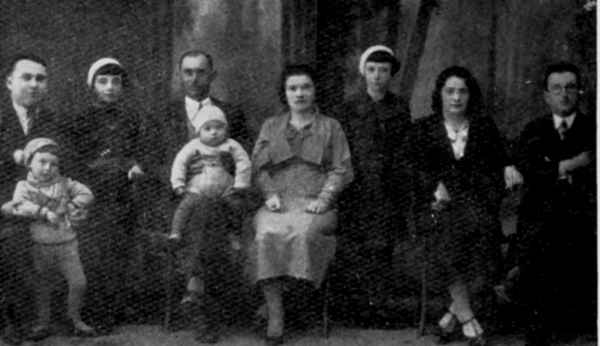
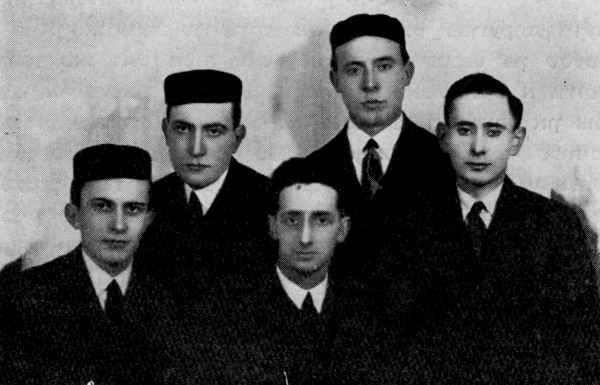
| Mendel Kohn's children (wearing caps) with their friends[25] |
|
|
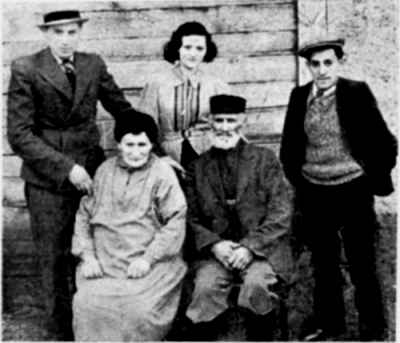
| No caption[26] |
Translator's Footnotes
By Shlomo Aleksander
Translated by Allen Flusberg
Perhaps I am not able to convey with my humble pen the depth of the heartache I feel as I look back at the enormous destruction of our beloved town Dobrzyn. During its hundreds of years of existence a great deal of history had transpired there; and all at once the accursed German murderers arrived and wiped out Jewish Dobrzyn, leaving behind not a trace of its rich past.
Dobrzyn was renowned for its good people: when it unfortunately happened that a Dobrzyn Jew lost his money in business, or a wagon-driver lost his horse and was left without any livelihood—then the dedicated volunteers would immediately take up a collection to put that Jew back on his feet. And all of this was done covertly, “matan besayser”[2]. If a Jewish young man did not wish to serve in the Russian army then he would come to Dobrzyn, where the benevolent Jews—a people excelling in compassion[3]—would ensure that he crossed the border to Golub. And from there the Jews of Golub would transport him further, whether or not he had the financial means. I recall once going into the Beis Medresh[4], where I found that there were more than ten Jews who needed to cross the border. The issue was not only bringing them across, but also giving them the capability to continue their journey beyond Golub. Those who were engaged in the needs of the community turned to the wealthy people of the town, and by the time I returned to the Beis Medresh the next day not a single one of those ten Jews was still there—that is, they were all already on the other side of the border.
The list of prominent philanthropists of the town was a long one. Everyone considered it an obligation to do favors for others, and it was not merely for esteem. People would spend their valuable time helping those who were suffering. Whether it was late at night, in rain or in snow, they would hurry to fulfill the sacred duty of “ozoiv taazoiv imoi”[5].
The aid institutions that existed in this small town were very active. I will mention only a few of them: the “gmilas chasodim[6] fund”, “hachnosas orchim”[7], “hachnosas kalla”[8], “bikur choilim”[9], etc. Noble Jewish housewives donated their most precious time to ensure that these institutions could carry out their normal activities. There were pious women who by Thursday would already be making certain that needy families did not lack anything on the Sabbath, Heaven forbid. And who in fact can enumerate all the good deeds that the people of the town accomplished?
Dobrzyn also had its political parties, comparable to those of all the large cities of Poland. Foremost was the Zionist organization, which led a great deal of activity for the Land of Israel. Everything was present in this very town, but unfortunately this is all history now. Together with the annihilation of six million Jews, our precious beloved town was destroyed, as well; even the Jewish cemetery, where our dear parents had found their eternal rest, was destroyed—as was also the Beis Medresh with our beautiful synagogue, where for generations Jews had presented their supplications before the Master of the Universe. May the curse of “ I will surely blot out the memory of Amalek”[10] accompany our enemies for generations to come.
Our only comfort has been the building up of our beloved Land of Israel, which feels like home to every Jew throughout the world. Today every Jew takes pride in the State of Israel, knowing that it elevates the dignity of each and every one of us. No sacrifice is too great for the sake of our state, which has made it possible for millions of Jews to build their home and presence here.
Let this Yizkor Book serve as an everlasting monument to our fallen parents, sisters and brothers who gave their lives as martyrs—may God avenge their blood.
|
|
| Mr. Chayim Kaczor and His Family[11] |
Translator's Footnotes
by Mich'le Plotniarz-Shlesinger, Chicago
Translated by Allen Flusberg
It was a lovely, gentle town, with warm and cordial people living in it. In my youth I left to immigrate to America, but I never forgot it. A mystical force had bound me to it and to its inhabitants. Many times my rest would be disturbed when my thoughts turned to the fate of those dozens of families, blessed with many children, as I wondered whether they could satisfy their daily needs. Were they healthy? I can still see their pained faces and sorrowful eyes as they accompanied me when I departed. And to this very day their warm wishes ring in my ears.
With a heavy heart I left them, wondering whether I would ever see them again, whether I would someday return on a visit in the dark nights, slogging through the deep mud to see their sad faces, with not even a feigned smile, always fearful for the morrow. How difficult my first years away were as I adjusted to the reality that we had become separated by a vast ocean, and that we could be together only in our thoughts. We shed many a tear in those days, a generation back, when we arrived in the Golden Land to seek a way to support ourselves under difficult circumstances, while at the same time we carried with us plans to organize help for the needy of the town. At first it was very hard for us to do so, but we did not shirk our duty to those we held dear.
When I visited Israel I attended a meeting at which I spoke of some of my memories from those days. I was pleased to be able to share these memories with my friends in Israel, memories of an era that had passed. Those generations who knew of the greatness of the town in that era could relate anecdotes exemplifying the kindheartedness of individuals there to one another.
Now it has all been destroyed: the town is no more; for us it no longer exists. But the spark of its rich history will remain in the hearts of our fellow townsmen wherever they are, and, with the appearance of this Memorial Book, it will also be passed on to future generations.
Translator's Footnote
By Michl'e Plotniarz-Shlesinger
Translated by Allen Flusberg
I can still see Jews, residents of the Shul Gessl[2], walking to prayer services in the morning, some to the synagogue and some to the beis medresh[3]. I can still see children with chickens under their arms, hurrying to the slaughterhouse. I see Jews on Friday afternoon, going to the mikve[4]; and hundreds of children scurrying along during the morning so as not to be late for cheider[5]. Most of these cheiders were concentrated along the Shul Gessl. It was almost impossible to avoid the Shul Gessl, the throbbing hub of life in the town, with its synagogue and the beis medresh; shtiebls[6] and cheiders; slaughterhouse and butcher shops; and [places to] heat vessels red hot[7]. In addition those who wished to go down to the Dreventz River, whether to wade or bathe, would access it by walking along the Shul Gessl.
Now for the panoramic view: the gessl ended at a tall mountain, on the top of which stood a dilapidated house. For dozens of years the shoemaker Moishe Reuven Krajanek, a long-bearded, lanky man, lived and worked there. He was the first to arrive at the synagogue for morning prayers, but he was also the first to leave, even before the prayer service ended. He would say that his stomach was growling, that he was hungry. His four sons were also shoemakers, but in later years they sought various opportunities to free themselves from their calling. Overall, this was a quiet, respectable family.
The majority of the residents of the Shul Gessl were members of the working class, but several wealthy families, whose homes and shops had been passed down as an inheritance, lived there as well. At the beginning of the twentieth century the bookstore of Mr. Efraim Eliezer Granat (Rimon) was also located on the Shul Gessl.
During the summer months, every passerby's shoes would be covered by dust from the unpaved gessl, while during the winter months their shoes would be covered with mud instead. The city council—which was dominated by Poles even though most of the population was Jewish—never found it necessary to pave the Shul Gessl with paving stones. But the total destruction has solved all these problems …Dobrzyn is no more; the Shul Gessl no longer exists.
Translator's Footnotes
By Tuvya Tinski
Translated by Allen Flusberg
Just like all the other towns of Poland, our town had a synagogue, as well. Ours was known throughout the surrounding towns for its artistic paintings. Landscapes of the holy places in Jerusalem, such as the Western Wall, Rachel's Tomb, the Tower of David, and Absalom's Pillar adorned the walls and ceilings. Whoever saw them for the first time would be quite enthralled. The town also contained a Beis Medresh[2] and many shtiebls[3], such as the Ger[4], Alexander[5], Otwock[6], and others. When I was already a grown young man, I preferred to attend prayer services in the synagogue, even though I favored Hassidism. I would also enjoy going to the synagogue when I was a little boy. On Sabbaths and holidays I would bring my mother's siddur[7] to synagogue for her.[8] It was a thick siddur, heavy and large, and I could barely carry it. The siddur contained all the prayers with a Yiddish translation, as well as parables and techines[9] in Yiddish for the Blessing of a New Month[10] and for Yizkor[11]. Many of the women used to listen to my mother praying out loud, and then repeat her words verbatim. Probably a good number of them didn't even know the [Yiddish] alphabet and were pleased to have my mother lead them in prayer. Many times, when I went inside the women's section of the synagogue to carry my mother's siddur home, I would listen to the women crying while my mother was saying the prayers from her Yom Kippur[12] machzer[13]. For my mother this was both a mitzvah[14] and a pleasurable act that she continued to observe for many long years.
When I turned nine and began studying gemoro[15] with Mr. Nissan Melamed, he gave me warning that from now on I was no longer to carry my mother's siddur home on the Sabbath.[16] Of course I complied with my teacher's demand, thereby bidding adieu to the women's section of the synagogue.
Later I began to sing in the choir led by Cantor Degola, who had influenced my father to let me participate in it. At that point I became a more frequent visitor to the synagogue—but now, of course, in the men's section. Here I also had the opportunity to get to know all the functionaries of the synagogue: the shamash[17], the gabais[18], and the vested prayer leaders. These functionaries held sway not only over the large synagogue itself, but also over the small shtiebls that were located alongside its entrance. The town's skilled workers attended services in them; and in one of them members of the chevra kadisha[19] attended weekday services. We young men, a group called “Loimdei Torah”[20], also took over one of these shtiebls; in it the Mieszaniec Rabbi, who in those days pretended he was the official rabbi of Dobrzyn, used to give lectures.
One shtiebl was taken over by the members of the organization Bikkur Choilim[21] and Hachnosas Kalla[22]. They had their own Torah reader, Moishe Leib Gutglass. Each shtiebl held approximately four minyans[23], and so on Sabbaths and holidays all these little synagogues were full of men attending the prayer service.
On a slope leading down from the synagogue was the Dreventz[24], a small river with a powerful current. There the pupils who attended the various cheders[25] located nearby would bathe in the summer. On Rosh Hashana[26] crowds would throng both banks of the river: the German Jews from Golub[27] on one side, and the Dobrzyn Jews on the opposite bank, both at tashlich[28].
To the right of the synagogue stood the tall “Rokers” Mount with its white sand. This sand was used by the housewives as scouring material, and also to sprinkle onto freshly washed wooden floors.
There were beautiful, plastered stones about 20 meters in front of the synagogue, and the entryway was lined on both sides with iron chains. The windows of the synagogue cellar were visible from the courtyard of the synagogue; people were afraid to look down through them because of legends about demons and swooping evil spirits. And for this very reason the bier that was used to carry dead bodies to the cemetery was kept there.
Within the synagogue, everyone instinctively raised his eyes towards the tall aron koidesh[29] with its beautiful poroiches[30], and also towards the multicolored stained glass windows. The glass tower at the very midpoint of the ceiling was particularly impressive, and everyone was always stealing glances at the beautiful artwork just below it. Even the bima[31] for the reading of the Torah was unusual for its esthetic beauty; it was quite different from bimas in the synagogues of other small Polish towns.
On Sabbaths and holidays the prayers were led by the cantor, accompanied by a choir.
Every prayer of the Yomim Noiroim[32] affected the congregation in its own unique way. They would be gripped by fear when the cantor and choir sang the verses of “Unesaneh Toikef”[33]: “And as a great trumpet sounds, a small, silent voice is heard; the angels scurry, seized by fear.”[34] The motif of the singing was one the elements used to arouse emotion. The prayer “Man is derived from dust, and his end is dust”[35] gave us pause for thought and soul-searching; at that moment one could hear a quiet, deep wail, as tears appeared on many a face.
Years of joy and sorrow accompanied the synagogue during its many years of existence, until the Destruction.
May these lines of mine serve as a reminder of that lovely, architectural building, the Dobrzyn synagogue, which was destroyed by the Nazi murderers.
|
|
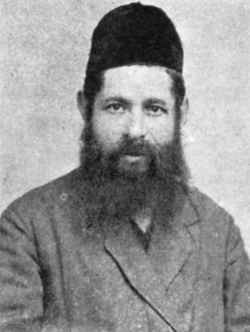
| Mr. Yaakov Tinski, of blessed memory[36] |
|
|
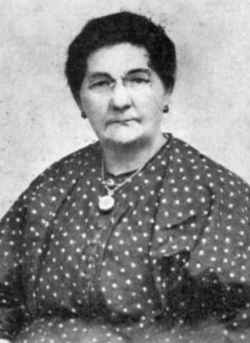
| Wife of Mr. Yaakov Tinski[37] |
|
|
| Yosef Alterowicz and his wife Tserl[38] |
Translator's Footnotes
by Avraham Dor (Dobroszklanka)
Translated by Allen Flusberg
To the ruins of my birthplace Dobrzyn, which once was, but no longer exists, I dedicate the following memoir…
At first glance the town of Dobrzyn is no different from the many other provincial towns of Poland: a town square surrounded by streets and alleyways, densely built up, filled with large and small houses, some standing sturdily, and others on the verge of collapse. The Dreventz[3] River, flowing along the town's edge, constitutes a natural boundary between Germany and Russia. Pedestrians and wagons cross over the bridge spanning the river.
At the entrance to the town, coming along the road from Rypin, one can look up to see the historical Crusader castle that is located on the mountaintop. In it there is a museum that contains a collection of ancient objects having significant archeological value.
Villages, some tiny, lie scattered all around the town. They are populated by Polish farmers, who constitute the agricultural hinterland of the town, i.e. those who provide it with a livelihood.
With the exception of the road to Rypin, all the roads leading from the tiny villages into the town are unpaved. For this reason they are difficult to navigate during autumn because of the deep mud that the frequent rainfall brings. And in the town itself there are some small streets that are nearly impassable because of the deep mud. Many a time passersby would leave behind their galoshes, which they had been unable to extricate.
On the cold winter days, when snow fell and covered the streets with a thick layer that reached up to the windowsills, the residents would emerge to shovel the snow away from around the houses. Afterwards they would dig out a path to the shops, incidentally clearing the sidewalks of snow.
The winter season is hard on the ordinary people, who have to use their limited resources to stockpile food and fuel throughout the rest of the year. And when winter finally does end, the town comes back to life, awakening as if from a deep sleep, and begins to resume its normal routine.
For the young people, summer starts with Majówka[4], that is, May 1st, when they go on outings to the nearby forests. They gather strawberries, eating as many as they can and bringing home whatever is left. These outings are repeated several times during the summer.
Most of the young men of the town were unemployed. There were two reasons for it: First, there were no opportunities for work in the town. And second, even if there had been such opportunities, would it have been appropriate for a balabatish[5] Jewish boy to labor? In any event, this was the psychology of the parents in our small town 50 years ago.
And so it was a common occurrence in the small towns in general, and in Dobrzyn in particular, for families blessed with many children—some of whom were already grown up—that the adult children were living off their fathers. The father was the one and only source of livelihood for his entire family. Often he was just an ill and broken man, barely able to keep struggling, who was nevertheless carrying the burden of a household of more than ten people.
In our town there were “pious women,” or—as they would be referred to nowadays—community volunteers, who helped the needy. Some were doing it for the sake of fulfilling a mitzva[6], while others were simply motivated by compassion. In both cases the main goal was the same, helping those in dire need.
The needy of the town fell into two categories: those who were known as poor people and took charity; and those who were still very far from even asking for charity. The second category included respectable families, craftsmen, small-time peddlers and businessmen who had become impoverished, either because of the boycott or as a result of the generally difficult economic situation. These were taken care of by a specific group of women who approached them in a tactful, honorable manner.
There were no professional beggars in the town. Even the well-known pair—Leibye and Shimye—who for many years would go from house to house on Fridays to collect alms, were greeted by most of the families in the town with smiling faces and sincere warmth. During the period of the Czar, a normal donation was a single groshen; and no sooner than someone handed them a kopeke would Leibye say, “What, are you trying to make fun of me?” For years on end they made their traditional Friday rounds of nearly all the houses of the town.
Typically, special market days—fairs— took place four or five times a year. At these times all the farmers of the region would stream into the town square with their goods. A day earlier the town would already be full of commotion, with everyone getting ready for the coming day. The used-clothing dealers would set up their stalls at the edge of the sidewalk, taking up a large fraction of the Lange Gass[7]. Here they would sell pants, coats and suits. The shoemakers also would lay their goods out for sale in the town square on this day on special tables that had been prepared a day in advance.
Thousands of farmers descended on the town on this day, some to sell and others to buy merchandise. They would fill the inns and bars; beer and vodka would flow like water. As evening fell and they began to leave town, many of them could be found lying drunk along the sides of the streets and on the sidewalks. Sometimes they had drunk away the entire sales price of a horse or a cow.
For the children these market days were especially joyous, since they could observe this great commotion that they would otherwise seldom see, and particularly since they would also get some “fair money”.
And indeed on various other occasions and holidays the children were given many opportunities to play and have a good time. On Purim[8], for example, they would all be disguised in masks—“Larves”[9] as they were known in Dobrzyn—which could be purchased only at Yehoshua Meir Waldenberg's store. On Lag BoOimer[10] they would march around in the nearby forests, carrying bows made of branches, pulled taut with some string and supplied with a few wooden arrows. They would return home joyfully towards evening.
It was particularly interesting to see a wedding procession moving through the streets of the town as the bride and groom were led to the huppa[11] that was usually set up in the synagogue courtyard. Those accompanying them would be carrying lit candles, the children would be singing, and the adults would be dancing. As the saying went, when Dobrzyn makes a wedding all of the townspeople are mechutonim[12].
There was a long list of special town customs, specific to periods of joy and of grief, but with the passage of time many of them fell into disuse. There were those who saw this as progress, but traditions should, to some extent, be preserved.
Of course, with the destruction of Polish Jewry, the way of life of the small-town Jews disappeared, together with their customs and long traditions.
May these lines, dedicated to the town of Dobrzyn, remain as a memorial for future generations.
|
|
| Henya Drogen, one of the first female socialists in Dobrzyn[13] |
Translator's Footnotes
|
|
JewishGen, Inc. makes no representations regarding the accuracy of
the translation. The reader may wish to refer to the original material
for verification.
JewishGen is not responsible for inaccuracies or omissions in the original work and cannot rewrite or edit the text to correct inaccuracies and/or omissions.
Our mission is to produce a translation of the original work and we cannot verify the accuracy of statements or alter facts cited.
 Golub-Dobrzyń, Poland
 Yizkor Book Project
 JewishGen Home Page
Copyright © 1999-2024 by JewishGen, Inc.
Updated 3 Oct 2017 by LA