|
|
||||||||||
|
|
||||||||||
 |
||||||||||
|
Early History of the Rabbinical Weil Family(Clarifying Some Historical Errors)by Werner L. Frank
NOTE: To access footnotes, click on numbers within parentheses, eg. (F1). Bibliographic references are contained within square brackets and are listed at the end of this article. IntroductionThe most startling and exciting result of my genealogical investigations was the discovery of a family link to the well-known and highly respected rabbinical family Weil. For the past six hundred years, this Weil dynasty has been the source of a countless line of rabbis and Jewish community leaders, having spread their influence and purview throughout southern Germany, as well as to more distant pockets such as Prague in Czechoslovakia, Lissa, Krakow, Brisk, and Lublin in Poland and Ludmir in Ukraine. There may also be a connection between this family and the many Weil/Weill/Weyl folks that settled in Alsace and elsewhere. I was introduced to the Weil family by cousin David Blum (F1) who had determined our descent from Rosa Weil (1748-1821) of Kippenheim, married in 1766 to Maier Auerbach (1746-1834) of Nordstetten. From this point, in the eighteenth century, I was immediately catapulted back four hundred more years to the recorded origin of the Weil lineage in the fourteenth century. Going back that far boggles the mind, realizing that I had traced at least one of my family branches to the time before the discovery of the Americas, to a period when Europe was engaged in the Hundred Years’ War, and to the era in Asia when the Ming Dynasty ruled China. But, even more surprises were awaiting discovery. The Weil
family claimed descent from that major thirteenth century Gaon
(illustrious), Rabbi Meir ben Baruch of Rothenburg (1215-1298),
called the Mahara"m (F2).
This relationship would extend my family purview several hundred
years earlier, bringing my analysis to the epoch of the Second
Crusades and the time of Moses Maimonides (1135-1204).
The Origin of the Weil FamilyThe patriarch of the Weil family is Rabbi Jakob ben Yehuda Weil, the Mahari"v (F3), who was born in the period 1380-1390 in Weil-der-Stadt, a small town located near Stuttgart in what is now Württemberg. Jakob Weil was a student of the renowned and honored Rabbi Jakob Halevi Möllin (the Mahari"l) of Mainz and Worms. Jakob Weil was ordained by the Mahari"l and installed at Nürnberg as rabbi in 1407, where he married a woman, name unknown. Berthold Rosenthal acknowledged that the Mahari"l’s brightest student was Jakob Weil, whose descendants counted amongst the oldest Jewish families that had settled in southern Germany [17, p.43]. Mollin Jakob Weil served as rabbi in Nürnberg, Augsburg, Bamberg and Erfurt, the latter location from 1444 until his death in around 1456 (see Encyclopedia Judaica). He made his historical mark by assembling the important codification of the laws of ritual slaughtering and examination, resulting in a scholarly treatise, Shechitot v’Bedikot. Rabbi Weil was also responsible for compiling the prayers and practices of the Jews living along the Rhine River. He was a prolific participant in responsa, the questions and answers (She-elot u Teshuvot) that were exchanged between scholars on halachic (talmudic legal) matters. In this regard Rabbi Jakob Weil was one of the key contributors among the early achronim, the second group of rabbinical authorities engaged in the pursuit of rationalizing the issues of Jewish law (F4). The writings of Rabbi Jakob Weil have been repeatedly published over the years beginning in Venice in 1549 (F5). An example of a contemporary anthology containing a number of his works is the 1959 published comprehensive volume, She-elot u Teshuvot, v’Halachot Shechitah v’Bedikah, v’Chidushe Dinin [26]. The thoughts and views of Rabbi Jakob Weil have been captured in the Yeshiva University Ph.D. dissertation of Rabbi Bernard Rosensweig, leading to the publication of his scholarly book, Ashkenazic Jewry in Transition [16]. In this work the author has described the life style, the views, and the practices of fifteenth century Ashkenazic Jewry (F6) as reflected in almost 200 responsa of Rabbi Weil (F7). Furthermore, he has also deduced from these responsa particulars relating to the life events of Rabbi Weil himself. It appears from this analysis that others, and more older sources on the life of Rabbi Jakob Weil, had also relied on these responsa for their various conclusions regarding aspects of his family and his career. A completely different approach in looking at the life of Rabbi Jakob Weil was taken by one of his prominent descendants, the historian and novelist Thelma Stern-Täubler. A prolific author, Stern wrote a fictional account of the fourteenth century life of the family of Eleasar from Weil-der-Stadt [21 (English), 22 (German)], reflecting her view of the life and times that must have surrounded her ancestors during the time of the Black Plague and beyond. [Stern-Taubler] The origin of the Weil family is not clear. A 1957 assessment of the early Weil history is contained in the Ernest B. Weill book, Weil-de Veil, A Genealogy, 1360-1956 [25] (F8). Reference is made in this book to a 1936 document advancing the notion that Jakob’s father, Yehuda (born around 1360), may have come from Spain to Germany [4]. There is even an attempt to tie the Weil name to a sefardic location, Valls near Tarragona. Despite these suggestions, I believe that the family took its surname from Rabbi Jakob’s birthplace, Weil-der-Stadt. Ernest Weill also reveals another belief that is a matter of controversy. He identifies the unnamed wife of Rabbi Jakob Weil as a descendant of the great scholar, Rabbi Meir of Rothenburg (the Mahara"m" m) of the thirteenth century. This position is supported by descendant Asher Weill in [14, p.176] as well as by Raymond M. Jung in his letter to Maajan [Leserbriefe, page 929 of Heft 40] (F9).
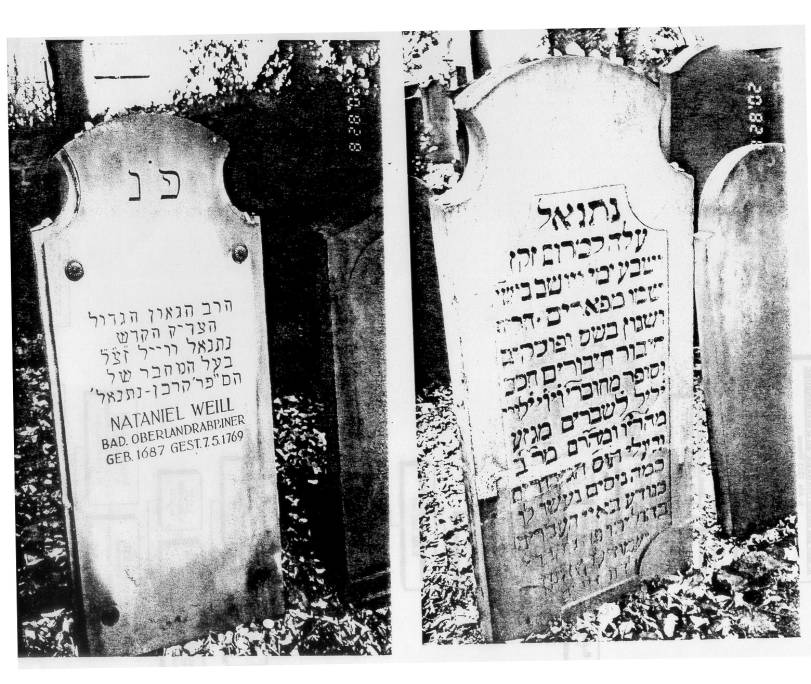
In contrast, a family connection to R. Meir is also mentioned in the 1898 work of Dr. Leopold Löwenstein [13]. In reference to Rabbi Jakob Weil, it is stated that "zu seinen Ahnen gehörte der berühmte R. Meir von Rothenburg." This comment implies that Rabbi Jacob Weil was in the direct line of descent from R. Meir which contradicts the just mentioned role played by his wife. To further the argument, Löwenstein then points out that the tombstone of descendant seventeenth century Rabbi Nathanel Weil contains the inscription, "Descendant of the Mahari"v, the Mahara"m and the great Tosaphists" (figure 1).Clearly, Nathanel Weil is entitled to this identification with Rabbi Meir since the inscription is true regardless of whether the line of ascent goes through Rabbi Jakob’s side or through the side of his wife (F10). Other prominent sources such as Güdemann [9], Rosensweig [16], and Shapiro [18] (F11) repeat the conclusion reached by Löwenstein, all relying on the specific responsa #15 attributed to Rabbi Juda Minz (F12). The relevant portion of this responsa is translated as follows: [Gudemann] "I heard that the Marari"v (z"l) followed the thinking of the Mahara"m because he had a family connection with him." There are two operative Hebrew words in this sentence, mityaches and krovo. It seems to me that my translation of "family connection" is as valid, if not more so, than the presumption made by others that the meaning suggests direct descent. In any event, the statement by Rabbi Minz ("I heard…") is rather weak, certainly not convincingly stated at such a great distance from the stomping grounds of the Weils. Bottom line, the comment could equally support a family connection to the Mahara"m, either through Jakob Weil or through his wife. To further my position that the ascent to the Mahara"m is through the wife, I note that the naming tradition among the Weils does not reflect the given names that are known with respect to the family of Rabbi Meir of Rothenburg. According to Zimmels [28], the Mahara"m’s brother is Abraham, he has two uncle rabbis, Josef and Nathan, and his father is named Baruch. None of these names appear in the line of descent of Rabbi Jakob Weil. On the other hand, we observe that one of the sons of Rabbi Jakob Weil is called Meir or Mahara"m, a naming convention that probably is due to the son’s maternal connection to Rabbi Meir of Rothenburg. The Mahara"m name is rather distinctive and was the topic of a paper authored by Rabbi and genealogist, Bernhard Brilling [3]. Rabbi Brilling asserts that this name, also in such forms as Maram, Marum, Marim and Maron, is a clear sign of descend from Rabbi Meir of Rothenburg. He specifically notes the traditional belief that the first bearer of this name was the son of Rabbi Jakob Weil. Subsequently, the name appears frequently among the descendants of the Weils, as well as in other families.
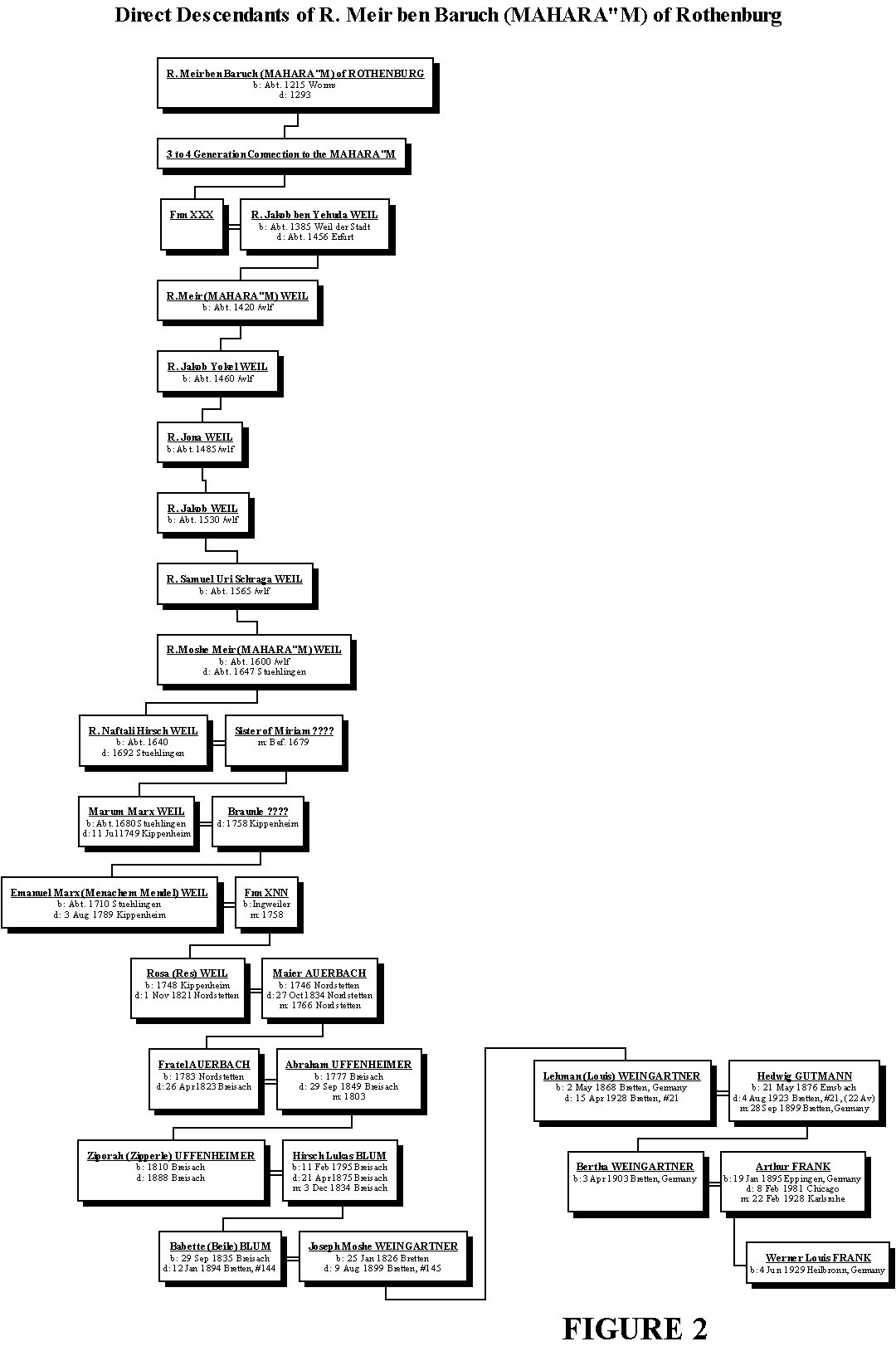
Based on this analysis, we have a direct descendant chart of nineteen-plus generations, from Rabbi Meir of Rothenburg to this author as shown in Figure 2. Since there is a spread of around 170 years between the births of Rabbi Meir and Rabbi Jakob, it is likely that there are at least 3 or 4 missing generations encapsulated in the box marked "Connection to the Mahara"m." Furthermore, in Mishpachot Atikot b’Yisrael [18], the father of Rabbi Meir is identified as Rabbi Baruch ben Meir, adding thereby another two generations. This would make the span of the descendant chart from myself to Rabbi Meir, the grandfather of the Mahara"m, to be at least 23 generations, bridging a period of over eight hundred years.
|
||||||||||


|
Figure 3 (click on the image for a larger view) |
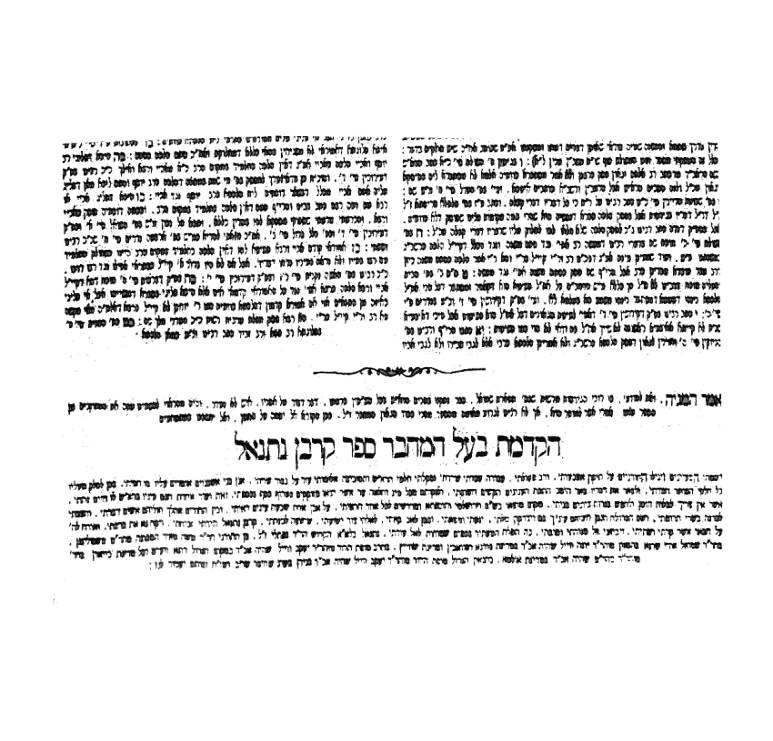
There is yet another unique source for genealogical information. Rabbis and Jewish scholars observed a tradition of making personal introductions (hakdamot) and soliciting approbations (haskamot) as forewords to their published sacred writings. These prefaces are devices having a twofold purpose: (1) to give credence to the authority of the author by virtue of praise and endorsement of his work by third parties and (2) to give honor, praise and admiration to the author’s forebears, thereby claiming yichus (pedigree) on his own behalf. The preambles often include the family lineage of the author and so it becomes important to genealogists. An example of such a presentation relating to my own research can be found in any current publication of the Talmud Babli (figure 3). In the volume, Shabbat, heading off the portion Korban (F14), authored by Rabbi Nathanel Weil (1687-1769), is the following recital contained in the Hakdama (F15):
Nathanel;
son of my esteemed father and holy Rabbi Naftali (z"l);
son of the Torah scholar Rabbi Moses Meir, known as the Mahara"m from Stühlingen;
son of the honored Rabbi Samuel Uri Shraga;
son of the Gaon and our teacher and rabbi, Jona Weil, AB"D (F16) in the lands of Burgau, Schwaben and Switzerland;
son of the wonder of his age, our teacher Rabbi Jakob Weil, who was the AB"D in the great place of Donauwürth and all the lands of Bayern;
son of our teacher and rabbi, Mahara"m, AB"D in the lands of Ulm;
son of our teacher and rabbi, Mahara"m, AB"D in the lands of Ulm;
son of the greatest Gaon, wonder of his age, our teacher and rabbi, Rabbi Jakob Weil, AB"D of Nürnberg, compiler of Shechitot v’Bedikot and She-elot u Teshuvot.
This lineage forms the basis on which Dr. Leopold Löwenstein compiled the 1898 comprehensive history of the Weil family [13] adding thereto an abundance of collateral information known to him at that time. Therein also lies one of a number of disputed aspects of this family history.
Löwenstein acknowledges in his work that there was a controversy with respect to the Weil lineage. He cites the opinion of Rabbi Tiah Weil, son of Rabbi Nathanel, that there was a gap in the line-up of his family’s pedigree (F17). Rabbi Tiah believed that there was a missing generation of a Rabbi Jakob Weil who should be rightfully placed as the son of Rabbi Jonah Weil and as the father of Rabbi Samuel Uri Shraga Weil. I am of the strong opinion that this is the case.

Footnotes
1. David Blum of Jackson Heights, New York. (return)
2. Rabbi Meir ben Baruch of Rothenburg was a Tosaphist (codifier and commentator on the Talmud), as well as a liturgical poet. He is more popularly called the Mahara"m, a title of honor derived from the lead letters MHRM of the Hebrew, Morenu Harav Rabi Meir (Our teacher, the rabbi, Rabbi Meir). He has also been bestowed the title of Me'or haGolah (Light of the Exile), along with Rash"i and Rabbenu Gershom. R. Meir was born in Worms around 1215, ultimately ending his life in prison at Ensisheim, Alsace beginning in 1286, remaining there until his death in 1293. Fourteen years later his body was ransomed and reburied in Worms. (return)
3. Morenu Harav Rabi Weil (Our teacher, the rabbi, Rabbi Weil). (return)
4. The achronim (the later ones) are distinguished from the earlier scholars who were called the rishonim (the first ones). The Encyclopedia Judaica quotes prominent Rabbi Salomon Luria, stating that "Weil was the chief of the achronim and his successors relied upon his rulings." (On the other hand, Raphael Halperin [10] categorizes Rabbi Jakob Weil among the last of the rishonim.) (return)
5. I actually thumbed through an original copy of this publication at the Dorot Jewish Division of the New York Public Library. According to the identification stamp contained on the inside front cover of this rare book, the most recent owner was Rabbi Dr. Adolph D. Jellinek, Prediger (preacher) of Vienna. (return)
6. Here we use the term Ashkenaz to refer to the area of Jewish settlement in western Europe, specifically on the banks of the Rhine river. While the term now refers to Jews from all of Europe, in contradistinction to the Sefardim, in the middle ages the word distinguished the German Jews (including the area of Alsace) from those Jews living in Poland and other points of Eastern Europe. (return)
7. This approach for studying a man and his period through the analysis of responsa was exemplified by Rabbi Rosensweig’s teacher, Dr. Irving A. Agus, author of Rabbi Meir of Rothenburg [1]. Agus enumerates 788 responsa in question and answer format, preceded by a thorough life story of Rabbi Meir of Rothenburg and his times. (return)
8. There are actually three main sources upon which Ernest Weill builds his genealogy. One is the classical work of Dr. Leopold Löwenstein [13]. A second is a study by Berthold Rosenthal, commissioned by Alfred Sonder and published in 1935, Ahnentafel der Kinder des Nathan Weill [20]. The third source is the Dutch language genealogy, Het Geslacht de Weille, (Weil, Weill, De Veille, De Veil) [4]. In April, 2000 I became aware of further research by Gerhard Sonder, son of Alfred Sonder. Gerhard Sonder undertook translating his father’s 1935 book to English. In this process he updated the genealogical data, made some corrections to the original work, and added some of his own comments and observations to enhance the text for his own descendants. My research has been enhanced through private communications with Gerhard Sonder. (return)
9. It should be pointed out that none of these three cited sources produced any kind of evidence to support their positions. (return)
10. According to Löwenstein [13, p.5], Rabbi Nathanel can also claim descent from the Tosaphists through his mother, Miriam. (return)
11. Jacob Shapiro in Mishpachot Atikot b’Yisrael [18] goes even further. On pages 70, 86, and 159 he identifies Yehuda, father of Rabbi Jakob Weil as neched (grandson) of the Mahara"m of Rothenburg, albeit there are three to four generations separating these two individuals. The only likely explanation for this illogical situation is to adopt the less frequent usage of the word neched to mean progeny, descendant or offspring. (return)
12. Rabbi Juda Minz was a rabbi in Padua, Italy where he died in 1508 at around one hundred years of age. The Hebrew is: Shamati sh’Mahari"v z"l halach acher da-at Mahara"m l’fi sh’haya mityaches acharov sh’haya krovo. Rabbi Juda Minz was a cousin of Rabbi Moshe Minz (1415-1485) who was a student of Rabbi Jakob Weil. This may have been the conduit and source for the speculation contained in the responsa regarding R. Meir of Rothenburg. (return)
13. The availability of female names and their progeny is unusual in Jewish genealogy since most early sources only trace the male lines. Thus, to identify a female ancestor often requires the discovery of her husband’s family, from which vantage point one may be able to backtrack a connection to the distaff’s family. (return)
14. The Korban Nathanel (Offering of Nathanel) is a supercommentary on the Talmudic explanation of the Ro"sh, Rabbi Osher ben Jechiel (1250-1328). Rabbi Nathanel Weil may have been drawn to interpreting the writings of the Ro"sh since the latter was a student of the Mahara"m of Rothenburg, the presumed ancestor of the Weil family. (return)
15. Gerhard Sonder had commented that the Weil rabbinic line was actually broken in the fifth generation. He indicates that Samuel Uri Shraga, Moses Meir and Naftali may have only had the honorific title of Chaver and rabbi. This could well be true since one notes that the praise bestowed on these three ancestors in the Hakdamah of Figure 6.3 is devoid of an official rabbinical position as was the case for their forebears. (return)
16. AB"D is the abbreviation for Av Beit Din, the Head of the Rabbinical Court. As will be seen later, there is a question regarding the accuracy of placing R. Jona Weil at this point in the chronology, as well as the location of his rabbinical jurisdiction. (return)
17. See Löwenstein [13, p. 5 and Beilage 1, p. 40-44]. (return)