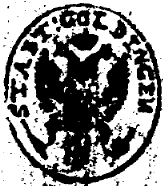
The records shown here are among the earliest of
the Courland archival records microfilmed in 1940 and now held by the
Herder Institute
at the University of Marburg, Germany. The copies used here were made from a set
held by the Family History Library of the Mormon church, and are used with the permission of the Herder Institute.
The list here is an Oklad (tax) list for Goldingen (Kuldiga) dating back to 1799. A scanned sample page in handwritten Gothic script is included, as well as a transcribed version of most of the data in the complete files. On the sample page, the pair of columns containing 5's and 10's is not transcribed; these columns represent the amount of tax paid (5 rubles and 10 kopeks). This Goldingen list differs from the Hasenpoth Oklad 1833-4 in several respects, including:
All family members are included -- males and females, adults and children, servants, etc.
Only first names are provided. This reflects the fact that Jews within the Russian Empire were known only by their first name and patronymic until the early 19th century. In 1804, it was decreed that they adopt hereditary names to alleviate the difficulties that the state was having in keeping track of this quite nomadic (see below) population, especially for the purpose of collecting taxes. The history is described in Alexander Beider's A Dictionary of Russian Surnames from the Russian Empire. Subsequent sets of records from the Herder microfilms show that compliance with the decree was far from complete well into the 1810s.
Given the absence of surnames, the lists are organized numerically. Two sets of numbers are shown, which are closely correlated but not identical. One number identifies family groups, and the other heads of households (HH); in some cases there was more than one HH in a given extended family.
One column on the list shows the place of residence of the family in 1797, i.e., two years earlier. There appears to be a remarkable degree of mobility, although it is possible that the place of residence is actually the place of formal registration, which may reflect a pre-1797 reality. A column has been added in the transcription showing, where known, the modern location of the prior place of residence. Some of these places are well-known towns, such as Tukkums, Frauenburg (Saldus), Hasenpoth (Aizpute) and Sassmaken (Valdemarpils), but many are estates or much smaller towns. In those cases the approximate location is indicated via the administrative structure.
The absence of surnames obviously limits the genealogical utility of these lists when they are seen in isolation. However, the inclusion of full families can allow lists such as these to be related to later lists that include surnames. In this way family histories can be traced back to before the adoption of surnames, with the information on places of prior residence then becoming potentially useful. In the sense that we are identified by our surnames, it is lists like these that allow us to get down to our true "roots", as they allow us to bridge the period during which surnames were adopted, and often to determine the origins of our surnames.